Joban Vampires

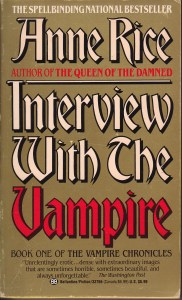
Interview VampireThe first vampire novel I ever read, I remember correctly, was one of the Dark Shadows series written by Marilyn Ross. I don’t recall which one, since I had to buy my books from Goodwill or some such vender utilized by the poor. Now, I’m really a squeamish guy and the sight of blood bothers me. Barnabas Collins, however, was a compelling character—deeply conflicted and a reluctant vampire. The combination of his sadness and the setting in coastal Maine kept me looking for Dark Shadows books every time we went shopping. It surprised me, given all that, that I had such difficulty getting into Anne Rice’s Interview with the Vampire. I started reading it years ago (it was also a second-hand copy, and, interestingly, the color scheme of the cover nearly matched Dark Shadows novels) and some eighty pages in put it down only to forget about it. Starting from the beginning a few weeks ago, I gave it another try. Although Louis is a conflicted vampire, the pace is languid and it was almost as if the self-pity was overdone. I was determined this time, however, to see it through.

One of the recurring themes of the book, and I presume the Vampire Chronicles series, is that vampires are not evil because of the Devil. In fact, there is nothing Satanic about them. Blame tends to fall on God for their state. The more I thought about it, the more the theodicy of the vampire began to resemble that of Job. Like Job, death for a vampire takes a long time. There is much suffering along the way. Louis can love, in a measure, and can loath himself. He never really understands what it is to be a vampire. The other undead he meets help to define him, but he can’t get too close. His life is a kind of Hell without Satan.

Rice’s vampires don’t fear crucifixes or shun churches. In fact, Louis takes a priest as one of his victims, sacramentally near an altar in a church. Religious imagery and discussion abound in the book. It truly is a vampire theodicy. Perhaps, for its day, it was the next step in vampire evolution. Bram Stoker, while the most famous contributor to the modern vampire myth, didn’t corner the market on defining the undead. When Louis meets vampires of the old world, they are mindless, plodding killing machines that even other vampires avoid. Rice’s vampires feel, think, and yes, theologize. I feel strangely satisfied now that I’ve finally finished the Interview. It was a vampire at my bedside for so long that it feels like an accomplishment to have finally laid it to rest.


Buying Intangibles

Perhaps it seems that I’m writing quite a bit about music these days. Being a theoretical and practical failure in the practice of music, it may seem presumptuous. If I’m honest, I’d admit that visiting the site of Woodstock was kind of a religious experience for me. That experience and the fact that popular musicians from my younger days have been in the news of late compel me to analyze a bit. My wife shared a blog post on John Pavlovitz’s website entitled “Bono Called Out Christian Musicians For a Lack of Honesty. He Didn’t Go Far Enough.” The screed is both about the Christian music industry and about current trends in evangelistic super-churches that share in the glitz and glam and leave you wondering what Jesus would do. The message of early Christianity and the sixties was similar: social justice, peace, non-judgmental attitudes, care for others, love all. Don’t worry about the bottom line.

Many churches, it has become clear in this age of nones, are struggling to compete in the spiritual marketplace. Since every institution must have “product”—not books, music, reverence, or worship, but “product”—money must change hands. If you have any doubts look at what the mega-church pastors are driving. Christian bands seem not to have a social conscience so much as a desire to feel good. It’s a thriving industry, for sure. Music that makes you feel safe is delivering false promises, though. The deity thundering on that mountain might ask you to sacrifice your own son, and there could be a good, solid backbeat to that. What is the role of religion in an entrepreneurial society? It used to be that you couldn’t buy what they were giving away. Everything now has a sale tag on it.

Back in college we used to argue about whether U2 was a “Christian band” or not. Clearly they recorded on a secular label. Amy Grant, the darling of 1980s believers, matured and seemed to fall from grace. Larry Norman, never part of the establishment, died too young. Music and religion both stand, in fact, out of the reach of sticky capitalist fingers. Anything that you have to pay for is more a cheap imitation. YouTube has made all of recorded history available for all. Even mainstream churches are experimenting with tablet hymnals and virtual communion. Grace mediated through a touch screen. Debit cards accepted. The only thing that seems to be missing is that human touch. That down in the mud reality of it all. Music that had a message and that message wasn’t about supporting convention. “Upon this rock,” you can almost here the man say, “I will build my church.”

IMG_2833


Things Remembered

IMG_2839 copy

Freedom. Independence Day is our celebration of liberty. Yesterday I happened to find myself at Bethel Woods, the out-of-the-way location in New York where Woodstock was held. Probably no one in 1969 realized just how formative Woodstock and its message of peace, love, and music would become for American culture. Those of us who came of age in the ‘70s learned about it as recent history (I was only seven at the time and, I’m sure, would’ve found the whole thing somewhat unChristian had I been here then). Much has changed in the intervening years. Not many peaceful events get so much airtime any more. Upwards of 400,000, basically unpoliced, youth, gathered in Bethel, New York, for three days of music, chaos, and peace. The Vietnam War was still draining our nation of its youth and murdering its idealism. Fear of the other, racial inequality, and male superiority were part of the context that led to the need for Woodstock. Freedom was free.

Often on this blog I reflect on the sacredness of place. Events that take place in a location leave their impression on the land. Bethel Woods Center for the Arts, the current administrators of the property, have left the field largely intact. As my wife and I stood at the top of the hill and tried to imagine almost half-a-million people here, it was strangely quiet. The nearby museum had plenty of music playing, but standing where it actually happened, there were only ghosts of an event studied in school and which, even today, kids can generally identify. I couldn’t have named every act that played the concert and, although the music was clearly important, it was the gathering that is most remembered. Self-governing youth getting along in an area so remote that still today you have to drive a couple miles to find even basic necessities, sent a powerful message. It was an event that, I fear, can never be replicated. The snake has spoken.

Nearing fifty years later, we’ve become so paranoid that anyone who looks Middle Eastern is under suspicion. Guns, which children of the sixties shunned, have proliferated and may now be carried, wild-west style, in many states. A fear-mongering candidate bellows fascism before the Grand Old Party. Remember, Nixon was president during Woodstock. I may have lived hundreds of miles from here, occupying myself with the matters that seven-year-olds find so pressing. But Woodstock happened. By the time I got to Woodstock, everybody else had gone. I see others milling about the museum, slightly older than me. Perhaps some of them were here for the event itself. We all seem to be searching for something here. The festival had its problems, for sure, but with a sincere belief in freedom, it makes the pre-seventies United States feel like a strangely foreign county. How do we get back to the garden?


Summer of Frankenstein

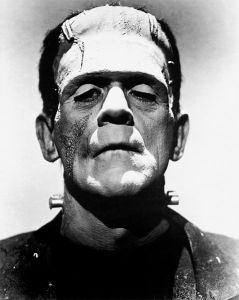
Two centuries can make an enormous difference. Just two-hundred years ago Napoleon’s defeat at Waterloo was merely one year in the past. North America and parts of Europe were experiencing “the year without a summer.” Perhaps due to that cool and rainy summer, when Mary Godwin and Percy Bysshe Shelley called on their friend Lord Byron, their thoughts turned to ghosts. According to the legend, together with Byron’s personal physician John Polidori, the friends spent a night writing scary stories. Polidori, although not widely remembered today, invented the vampire that would, in Bram Stoker’s hands, become the aristocratic Dracula, and eventually, with Anne Rice’s influence, Lestat, Louis, and Armand. Mary Godwin, soon to be Shelley, gave birth to perhaps the most successful of new monsters ever created—that of Victor Frankenstein’s construction. Many have claimed the monster’s pedigree to have been that of the golem, but Shelley’s creativity went beyond this forebear into the sympathetic misfit who, like all of us, never asked to be born. The two centuries since that summer have been haunted.

477px-Frankenstein's_monster_(Boris_Karloff)

Quite apart from the monster tale, Frankenstein is also about building that which we, in our hubris, can’t understand. Progress without forethought, as Epimetheus could never learn, housed immediate and very real dangers. The two centuries since Frankenstein have proven Mary Shelley a prophet. An early supporter of women’s equality, she profited from her novel, but never managed to thrive. Just six years later her famous future husband would die tragically in the Romantic genre of a shipwreck. Even with important friends, Mary found it difficult to capitalize on her success. The monster was real enough.

We’ve become accustomed to making things we can’t control. When’s the last time you were able to fix a car broken down by the road, apart from the occasional flat tire? Can you really stop your job from becoming completely different from what you signed up to do? What about when that bully wanders from the playground into the political field? Once you’ve figured out how to split an atom, you never forget. It may have been Napoleon still recently in the news, or the fact that 1816 failed to warm up like it was expected after the solstice. Perhaps it was the fact that Mary Godwin was a liberated woman in a world still utterly determined by men. We can’t know her intimate and ultimate reasons for creating a monster, but we do know that once the monster is unleashed we can never bind it again.


Popular Eternity

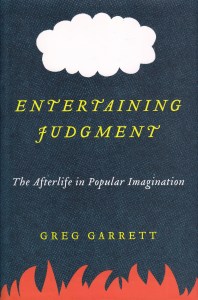
EntertainingJudgmentPopular culture, it seems to me, mediates reality. The media of various descriptions teach us what to think, and even if there is a religiously “orthodox” answer to questions, we will weigh it in the scales against what larger society says. This becomes clear in Greg Garrett’s Entertaining Judgment: The Afterlife in Popular Imagination. Garrett, a scholar of religion and popular culture, turns his attention to death in this book. More precisely, what happens after death. The usual suspects of ghosts, vampires, and zombies are here, but also the realms of Heaven, Hell, and for the Catholics in the house, Purgatory. All of these are seen through the various lenses of movies, television, song, comic books, regular books, and games. It’s fair to say that we’re a culture obsessed with death. But then again, what culture isn’t? It may be just that it comes across more charming when there’s a buck to be made at it.

What I found interesting is that although the Bible has little to say about Heaven or Hell (and nothing at all about Purgatory), each of these realms has developed a canonical script. Hell is hot and fiery, Heaven is cool and cloudy. Purgatory is gloomy, but beyond that comes in mild, medium, and hot varieties. We know these things from various teachings of our respective religions. In popular media, however, the script has been changing. We now have mild unpleasantness passing for Hell, if it lasts forever. Nobody needs to get burned. Heaven, meanwhile, can be just okay. It’s certainly better than the other place. Or the other two. We’ve overused our superlatives and have been left feeling like we’re on antidepressants.

Polls continue to tell us that many, if not most, Americans believe in literal Heavens and Hells. A point Garrett raises, however, is they may not mean by that what their clergy assert to be the case. Since near death experiences are controversial, nobody can say that they’ve actually been to either place, or the third. The exception to this rule is those who work in fiction—in whatever form. Since we can see their visions of the afterlife so clearly they have become the arbiters of eternity, with or without any religious training. In this day of marketplace religion and nones, Heaven and Hell seem to have become secular. The church may have introduced the ideas (actually, they seem to go back to the Zoroastrians, but I’m thinking of American culture) but the media have taken them over. We may be secular, but we still die. Entertaining Judgment might give you an idea of what to expect, depending on whose vision you buy.


Dinosaurs, Old and New

T._rex_old_posture

Tyrannosaurus rex, aside from being a photogenic movie star, was one of the top predators of its day. Ironically, in the Jurassic Park original trilogy (which would have been, more appropriately Triassic Park) tyrannosaurus rex becomes the ultimate protagonist, while unfeelingly killing to meet its own instincts. Since saying “tyrannosaurus rex” wears you out, we’ve become accustomed to calling the great carnivore t-rex. Everyone knows t-rex when they see it. Its a sign of danger, aggression, and unthinking acquisition. In one of nature’s great ironies, however, t-rex had tiny arms, nearly vestigial. What it wanted it had to get with its mouth. To live like that you have to grow pretty big, so big that nobody else can really challenge you. Punching is out of the question.

I’m often struck as how appropriate dinosaur evolution is to the human situation. Dinos (because “dinosaurs” is also too long) grew to be the top life-forms of their day. (We like to think of being the top. The perspective from down here in mammal land, in those days, was pretty different.) If you’re big enough, who’s going to stop you from taking what you want? Endless rows of teeth and a constant hunger can do wonders for evolutionary development. But then, extinction. Recent analyses have shown that it wasn’t as simple as an asteroid strike. It seems that many features of nature conspired against the dinosaurs, including the tyrant lizard king. T-rex had evolved into the monster featured in many pre-teen nightmares, only to be replaced by birds and mammals. Maybe it grew too big to be supported by the planet that allowed it to crawl out of the slime eons before.

In a recent photo of a Trump rally, one of the signs of a supporter had flopped over leaving just the word “rump” visible. I had to ponder this. T-rump. “Dinosaur” is a word used today to mean something that has outlived its time. Ideas, as well as such practices as, say, claiming that one race is superior to others, have rightfully gone extinct. There are those who say that t-rex was less a fierce carnivore than a scavenger. A vulture rather than an eagle. They claim that such a large snout and such small arms better suit one who picks at that which is already dead instead of working hard to bring down the more challenging beasts, often with horns. I’ve always thought dinosaurs were very appropriate metaphors for the human situation. Even Jurassic Park was superseded by Jurassic World, after all.


Stations, Everyone

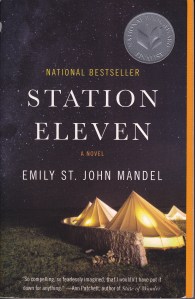
Station11There has been a movement, of late, among some sci-fi authors, to envision a more optimistic future. I have always been a fan of dystopias, myself. Perhaps it’s the working-class mentality backed up by being raised in poverty speaking, but sometimes I feel that collapse is more fair than progress. What passes for progress, anyway. Maybe I’m thinking this way because I just finished Emily St. John Mandel’s Station Eleven. This book has been on my radar for some time since it is one of the more hopeful dystopias out there. The story of a group among the very few who survive banding into a traveling troop of musicians and thespians is about the most hopeful outcome I can imagine. Not a day passes when I don’t feel the effacement of humanity that has been slowly taking place since I first became aware of the world. Sure, I do appreciate the strides made in medicine. Of this internet, which is the only place anyone ever really sees me, I’m less sanguine. It has its benefits, but even Mandel mentions the cell-phone zombies that are all too real and as omnipresent as an omnipotent deity used to be.

Station Eleven has, as many dystopias do, a religious sect that emerges after society collapses. This element of bleak futures is actually very accurate, I anticipate. We’re constantly being told by the “intellectuals” of the public variety that religion is for weak-minded dreamers with milquetoast aspirations for fantasy. The fact is the vast majority of people in the world are religious. The numbers are nowhere even near close. If a pandemic were to wipe out all but one percent (and hopefully it wouldn’t be the one percenters that survive) those who remain would, without doubt, turn to religion. People are easily led in this area of life. Mandel gives us The Prophet. His vision of the world is not helpful, but he has no trouble gathering a following. He’s also somewhat messianic: child of a single parent, raised in Israel, he comes to bring a sword to a nation already prostrate in the dust. This is powerful stuff.

Societies that try to rebuild themselves after traumas quite often rely on religion. This is hardly surprising as civilization itself began as religions coalesced into temples and their priesthoods. What is surprising is that so many intelligent people today can’t see just how important religion is to our species. As I suggested before, part of this is that religion defies simple definition. It’s easy to belittle “magical” thinking when it’s assumed religion has to do only with the supernatural. Religion, however, reaches into whatever we believe. Some ideas in modern cosmology, derived from physicists and their mathematics, can look sort of religious when viewed from a certain angle. As those who write dystopias know, religion is complex. It may lead to massive destruction. Chances are, however, that if there are any human beings left to crawl out of whatever pit we dig, they will do so with religious ideas in their heads. As usual, the writers have foreseen it.


:-D

Screen Shot 2016-06-12 at 8.33.16 AM

Technology runs amok. I confess to being born before earthlings landed on the moon. I remember a world where Purelle boogers simply did not exist. A time when to read the Bible meant opening that black leather with gilt edges that suggested some unknown bovine had paid the ultimate price to wrap those red-lettered words. Then came the LOL Cats Bible. The Lego Bible. Now the Emoji Bible. Emojis are made possible by the demand of cell phone users to express that which otherwise requires considerable wordsmithing. They’re popular. So much so that Oxford Dictionaries’ word of the year is the unpronounceable 😂. I’m not even sure if you’ll see it on your screen. If not, imagine a yellow circle laughing until it cries. Or crying until it laughs. There’s some ambiguity there. In any case, bibleemoji.com offers to translate your favorite Bible verses into emojis.

A naughty little boy, I suspects, lurks inside many of us of my particular gender. So I opened a new tab and went to biblegateway.com. There I looked up Ezekiel 23.20, in the King James, of course, and copied and pasted it. The results were somewhat 😒. “4 she doted upon their paramours, whose flesh is as the flesh of asses, & whose issue is like the issue of 🐴s.” I don’t know about you, but I see several missed opportunities there. A picture, they say, is worth a thousand 📚. Is there an emoji for “words”? Can there be? I’m trying hard to keep within my word quota here, so please bear with me.

I’m hoping against hope that unicode has kept up with my puerile fascination with rebus writing. It seems likely that all writing began that way. Draw a picture of what you mean and, with a little luck, others will understand. The capital A, for example, represents the head of an ox. It’s easier to see if you flip it upside-down. Better yet, just write it this way: 🐮. The ancient Egyptians, one gets the impression, would’ve been proud. After all, we call their labor-intensive communication system hieroglyphics, or “sacred writing.” It was inevitable that what some consider holy writ would eventually come down to the lowest common denominator. Still, I’m somewhat disappointed. When I dragged my mind to more lofty verses all I found were simple textual changes to my requests. Perhaps it’s for the best. When I tried “Jesus wept” I got “jesus wept” rather than the expected 😭. 😦


Man’s Best Fiend

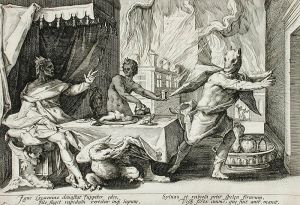
While reading the Hull Daily Mail (don’t ask), I came across an article entitled “Rock legend Alice Cooper ask questions about the Beast of Barmston Drain.” Apart from that lovable Britishism of making groups into grammatical plurals, this brief article gave me much to wonder about. After all, Paul Simon’s most recent album features a song entitled “The Werewolf,” (about which I recently wrote) and here is another rock performer from my youth raising the question about a similar beastie. According to the piece by Amy Nicholson, the Beast of Barmston Drain is a new urban legend about a creature half-man and half-dog. No doubt, werewolf reported sightings have been in the ascendent over the past few years, but how such an insignificant beast drew the attention of Alice remains unknown.

800px-Lycaon_Transformed_into_a_Wolf_LACMA_M.71.76.9

Many who know me—and those are few—are shocked to learn that I grew up listening to Alice Cooper. A fundie kid listening religiously to the father of shock rock? Songs about monsters, spiders, female maturation, and necrophilia? Perhaps it was because Welcome to My Nightmare just summed my childhood up rather nicely. Whatever the reason, to this day Alice Cooper is the only big name rock act I’ve even seen in concert. And that was only about six years ago, when I was still teaching at Rutgers. I had trouble hearing student’s questions in class on the next Monday night. Alice and werewolves in the same headline feels so much like yesteryear that it makes me want to believe in shapeshifters all over again. No wonder Hull is set to be the City of Culture. (Hey, Glasgow had it’s turn, so fair’s fair.)

To me, werewolves reveal much about a culture that strives to be far too civilized. We suppress our inner animal to become tie-wearing, wine-swilling sophisticates only to wonder where the wonder’s gone. And we start seeing werewolves lurking in culverts and drainage ditches. At least people are getting out at night. I’ve followed American tales of the dogman for years now, reading all of Linda Godfrey’s books on the subject. Even if it doesn’t exist, we stand to learn much of the creature that just won’t go away. Of all the transformations people talk about, that to the wolf is the most compelling, and among the most ancient. It may only be a dogman that people are seeing at the moment, but given some time it will evolve back into the wolf from which the story had its very beginnings. The answers, as always, probably lie in our childhood.


Holy Castle

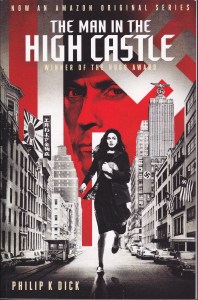
ManHighCastleReading about Philip K. Dick prompted me to read one of his novels. But which one? Some Amazon pick-up lockers on the way to work are painted with a mural of The Man in the High Castle. I haven’t seen the series, but there was the paperback, facing out, at the local independent. It’s been a while since I’ve read Dick, so I have to find my legs for his style. I’m surprised at just how much religious language he uses. Our cultural biases tend to insist that intelligent people aren’t hoodwinked by religion, but it does, nevertheless, appear. The premise of Dick’s novel is based largely on I Ching, the “Book of Changes.” Indeed, the conclusion of the novel relies heavily upon it. Along the way, however, Dick shows his sacred mettle when it comes to Judaism and Christianity as well. His prose is sprinkled with biblical quotes.

More than just a surface awareness, The Man in the High Castle offers some deep reflection for the reader. Mr. Baynes, seated on the rocket to San Francisco, ponders the Nazis who’ve won the Second World War. Reflecting on their hubris he considers how they’ve come to think of themselves as divine. “Man has not eaten God; God has eaten man.” This gave me cause for pause. Apart from Dick’s narrative, the idea of divine anthropophagy is in keeping with much human experience. We often consider ourselves masters of our own fates. Many, however, find themselves dangling like a spider from a web over the fire. Not that of Edwards’ Hell, but simply that of human circumstance. The Nazis didn’t win the battle, but listening to today’s political rhetoric, they may have won the war.

Nobusuke Tagomi explains to Baynes how I Ching, a 5000-year-old book, is alive. “As is the Christian Bible; many books are actually alive.” Far from poking fun, Dick suggests there may be something to all this mumbo-jumbo after all. We are conditioned to mock, dismiss, and ignore religion in this world where rationality leads to presidential races such as this one we’re currently suffering. Follow the trail back, I suggest. Look for clues. Philip K. Dick isn’t the only secular writer who knew more than the average person about what fascism looks like, and about the role of religion in its downfall. The novel may not be easy to read. It demands much of those who approach it. Nevertheless, it preserves the truth that many books, indeed, are alive.


Mythisotry

Positivism takes no captives. I’m not talking about the philosophical system—not necessarily—but about the phenomenon of assuming absolutes are available for human consumption. Some physicists, for example, assume that because our five senses can detect reality only the perceptions of those senses can be considered real. Material. Nothing more. Nothing less. A similar view plagues those who believe history is the telling of “what actually happened.” No historical event has ever been fully explained. All stories are told from a perspective. This is particularly dangerous when religions get involved. Many mistake historical veracity for “truth.” If it didn’t occur just as “the Bible says” then we should throw out the whole shebang. No point in believing in half truths. This is a myth.

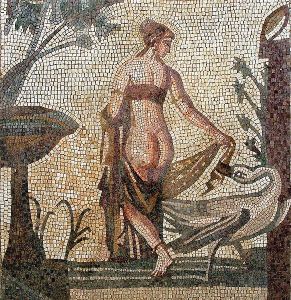
This point was reinforced when a friend send me an article about the production of “The Hollow Crown” on the BBC. Apparently a local politician tweeted that having a Nigerian of Jewish descent (Sophie Okonedo) play Margaret of Anjou, a French queen, didn’t match history. As proof he provided a downy white Medieval illustration of the queen. In a rare moment of academic cool, an historian quickly pointed out that the illustration came from a manuscript that claimed Margaret descended, Leda-like, from a swan. Her whiteness, thus, belonged to her avian DNA. As the story makes clear, history is the modern mythology. We assume we know what happened, but we will only ever have part of the picture.

582px-Leda_mosaic_crop

Prejudice seldom worries about historical accuracy, unless, of course, it helps to uphold the bias. I used to caution my students about taking history as a statement of fact. Certainly there are events with factual elements, but when everything is interconnected we can never untangle precisely what happened. When we “believe” history, we are choosing to accept a certain viewpoint of things. One person’s manifest destiny is another person’s genocide. Peculiar institutions are very peculiar indeed. History, as we’ve come to know, reflects the point of view of the historian. It must be read and evaluated as the opinion of the writer and not as the absolute truth. For me, I rather like the idea that some people are descended from birds. It certainly helps to make more sense of what I see in the behavior of those who claim to be making history today.


The Werewolf in Summer

464px-Werwolf

It must be incredibly difficult to write a truly scary song. I don’t mean the kind of scare that most heavy metal can innately deliver, but I mean the kind of thrill that a classic horror movie gives. I’m constantly looking for the movie that can recreate the chills without getting blood all over the carpet. Music, however, soothes the savage beast. I remember when Michael Jackson’s Thriller came out. Now, nothing about Jackson’s musical style shows any hint of being scary. It’s too upbeat. In the end the ghost will be a mere reflection in the mirror, and the zombies will fade with the sunrise. I had some people tell me back then that it gave them the chills just listening to it. Amateurs. A couple weeks back I wrote a post on Radiohead’s “Burn the Witch.” It’s kind of scary, but it doesn’t keep me up at night. I haven’t heard Paul Simon’s new album Stranger to Stranger, but when I learned from NPR that it has a track called “The Werewolf,” I knew I’d eventually add it to my growing stack of MP3s.

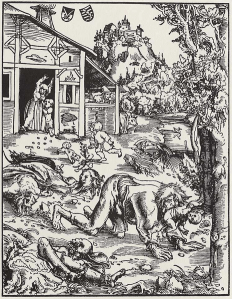
Like Thriller, the musical style of the song isn’t inherently scary. The organ in the final minute is pretty effective, though. What’s scary about “The Werewolf”? The lyrics. Simon is, to this child of the sixties, the foremost lyricist of his genre. Rich, complex, nuanced, his words tell a story and that story is scary. While I prefer my werewolves with different baggage, it’s pretty clear that like most shapeshifters the werewolf stands for hunger. There’s violent rage, of course, but like the wendigo, hunger drives those who can’t fulfill their desires in human shape. The Howling, for example, shows how lust can make a werewolf. There is a lust more dangerous than that of the flesh, and that is the greed that leads to societies with one-percenters who just can’t stop eating.

When we see Trump-clones who pay no taxes at all, due to the good that being uber-rich offers the economy, we should listen for howling in the night. Too many an April has rolled around where those of us called “middle class” stare in wonder at just how large a cut our government takes. The werewolves don’t wait for October to come around. No, those who are hungry eat all the time. I don’t find Simon’s music to be particularly scary. The tempo is upbeat and his voice just can’t feel threatening. Still, I’m shivering after listening to “The Werewolf” even though the shortest night of the year is fast approaching on padded paws.


The Found World

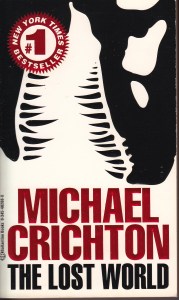
LostWorldChallenges will make you do funny things. One enjoyable dare has been Modern Mrs. Darcy’s Reading Challenge. With a modest twelve books in twelve months goal, the specific target is to read the types of books laid out. Into one of those categories, for me, fell Michael Crichton’s The Lost World. It’s sad that I feel I need so many disclaimers—I never really outgrew my love of dinosaurs—such escapist literature is indeed a guilty pleasure. Crichton could write a quick read, not bothering to pause for literary hindrances, and this novel fits the bill. It always surprises me when at the end of a traumatic story where friends die (this time ripped apart by reptilian carnivores) that the protagonists escape and never mention the dead. They joke, explain holes in the story, and generally look forward to a better, raptor-free future. There is, however, some food for thought here, among the lucre-grubbing sequel to Jurassic Park.

The first religious element that caught my attention was resurrection. Ian Malcolm rather convincingly died in Jurassic Park (and even an unconvincing death works for most people). In The Lost World he’s suddenly back again, with a barely disguised deus ex machina, and is as diffident as ever. The other former protagonists know better than to return to an island full of dinosaurs. Resurrection is a time-honored literary trope. So much so that it’s sometimes difficult to believe that death is in any way permanent. Well, come to think about it, the dinosaurs too are resurrected. Do reptiles have souls? Crichton’s dinosaurs seem to.

Then, just over halfway through the story, I was stunned. The chapter, or section, called “Gambler’s Ruin” explains how science and religion (or the humanities in general) are really the same. I couldn’t believe that a bestselling novel actually took the point of view that scientific objectivity is just as fraught as post-modern literary theory. There is no way to observe without influencing. When a conscious presence enters the equation, the facts have to counterbalance in return. Many, of course, would disagree in principle. Still, this unexpected bit of profundity stopped me in mid-chomp. Materialism, beguiling as it may be, doesn’t explain Heisenberg or Schrödinger. It takes a resurrected mathematician to do it. No wonder chaos abounds in this world where dinosaurs still rule the earth.


Omen, O Man!

Omen_ver4

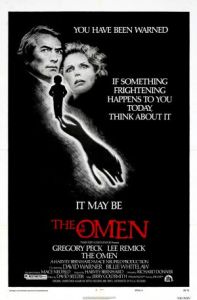
Of the unholy trinity of late-60s to mid-70s horror movies Rosemary’s Baby (1968), The Exorcist (1973) and The Omen (1976), the last always seemed the least effective to me. Having recently read about the Devil in American popular culture, and having a rainy Friday evening alone, I decided to give it a try again. Based as heavily on Hal Lindsey as it is, once one outgrows dispensationalism it is hard to be frightened by the idea of biblical end times. Everything from making up verses in “Revelations” to utterly bogus Holy Land geography (Megiddo is north of Jerusalem, not south—did the writers not even own a map?) contributes to a set of untenable tenets, even among the bibliterati. The film relies mostly on shocks and startles to earn its horror stripes, and after you’ve seen the movie once, these lose their power in subsequent viewings. Nevertheless, on this rainy May night, so close to June 6, I noticed new ways in which the movie undermines its own message.

The premise, of course, is that Damien, the son of the Devil (who apparently has a thing for bestiality), is plotting to take over the world through the means of politics. Having been watching the events of the past few months I have to wonder how the Devil could improve on progress through such channels. But I digress. His step-father Robert Thorn, US ambassador to London, discovers his “son”‘s identity and tries to kill him. With a strong anti-Catholic bias (the Antichrist is born in Rome, the seat of the church, and is protected by Roman clergy) the film nevertheless spawns sympathy for the Devil. As a child, Harvey Stephens hardly appears diabolical. Maybe it’s just because my brothers and I also spilled goldfish from their bowl once, but it seems to me he acts just like most little boys do. Who really wants to go to church at that age? As the movie approaches its climax, he’s represented as the biblical good-guy.

Thorn has to confirm Damien’s satanic identity. Like Delilah, he creeps up on the sleeping boy and cuts his hair. Convinced by a man who introduces himself “I am Bugenhagen” that he has to stab the boy, Thorn in a white car outraces police (so there might be a bit of prophecy here after all) to sacrifice the child on the altar. The movie casts Damien as both Samson and Isaac within a few short minutes. Apart from the film’s use of violence against women’s bodies (Thorn won’t allow an abortion, Kathy seems to have a penchant from falling from high places in slow motion, Baylock gets a fork in the neck) it actually seems ambivalent about the evil of the boy. An unfortunate birthmark does not a devil make. We’ve made it through the change of the millennium and many other hazards, yet dispensationalism is still with us, as is its anticlimactic Antichrist, Damien. He’s less scary than the real politics of an entirely secular age.


High Castle Blade Runner

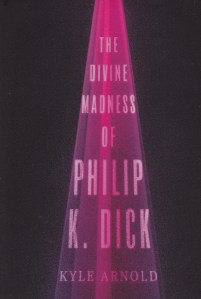
DivineMadnessGrowing up evangelical, one of the popular topics of conversation was crypto-christians. (My spellcheck insists that this is a lowercase expression.) Crypto-christians are people, generally famous people, who might be secretly “Christian.” You see, despite stereotypes most evangelicals really do want people to go to heaven. In fact, they tend to be obsessed with it. And besides, it can’t hurt to have a celeb backing your claims. One name that never came up in my circles was Philip K. Dick. I grew up reading science fiction. My reading patterns (which haven’t changed much) involved reading what I could find among used books at Goodwill. We were poor, and besides, there were no bookstores in our town. Like many people, I’m sure, I learned of Dick by watching Blade Runner. I occasionally heard others discussing the movie, but I hadn’t seen it myself and thus continued blithely unaware until I began teaching. I then read how Blade Runner is a possible Christian analogy, and curious, I read Do Androids Dream of Electric Sheep?

Since then Dick, who never made it big in his lifetime, has become a staple of the sci-fi diet. In The Divine Madness of Philip K. Dick Kyle Arnold explores the now famous 2-3-74 episode. Dick, in addition to being over-medicated, had mystical experiences. The “big one” took place beginning on the date implied in its title. This vision, while not orthodox by any standard, is clearly religious. Critics tend to think that Dick may have either faked it or that he underwent some kind of schizophrenic episode. Arnold, a clinical psychologist, has the chops to demonstrate that these latter explanations are off base. Dick had a legitimate visionary experience—something even neuroscientists can’t access because the experience is subjective and personal. It had a large impact on his life, but it did not make him mentally ill.

Arnold is not, as far as I can tell, a crypto-christian hunter. He is a psychologist attempting to understand a most complex and tormented writer of superior science fiction. What becomes clear, however, is that Dick was well-informed about Christianity. He imagined himself a secretive first-century Christian in an oppressive Roman Empire. This aspect of his life tends not to emerge in pop culture discussions—how Christian can you be and still be cool? Certainly Dick was not a conventional believer, but religious imagery and even actions became some of the most important moments of his life, according to his own recollections. Philip K. Dick was clearly a haunted man. And one of the specters haunting him was an often undiagnosed religion.