As (Not) Seen on TV

Screen Shot 2016-04-04 at 4.16.28 AM

Last night, I fear, I did not see “The Story of God with Morgan Freeman.” Our “double play” service already rivals the cost effectiveness of a ballpark lunch, and a triple play is out of reach for as little time as we have for television. This may be one case, however, where I’d be inclined to sacrifice some Sunday evening sleep to watch. I’ve seen numerous episodes of Through the Wormhole. I’ve noticed that over time the topics have grown more and more metaphysical. Yes, there is an uneasy after-shave burn to Occam’s razor. We’ve been told for so long that reductionistic materialism can account for everything, even these unorthodox thoughts in my head of an early Monday morning, and that religion is what’s left over after cleansing a dirty pig. Yet still, yet still…

A few years back, when I was still active in FIRST Robotics, I noticed a few things. Many of the mentors to the teams were not opposed to religion. Far from it. Not only that, but the national (now international) finals of the competition were met with religious fervor. Then, my last year as a mentor it was announced that “God himself” (aka Morgan Freeman, a reference, of course, to Bruce Almighty) would be present for the event. Science and religion are met together; technology and spirit have kissed each other. Perhaps this one size fits all universe is a bit premature?

“The Story of God” will spend six weeks on the National Geographic Channel exploring the origins of religious belief. People who haven’t learned that this is all nonsense will watch and wonder. Universities will, however, continue to close departments where such things are explored. Just because something is interesting doesn’t mean it’s profitable. One must think of such things when one has a business to run. I’m no prophet, but I do have to wonder if this might not be a sign. Maybe Occam’s razor-burn is chaffing a bit more than we thought underneath this white collar. Maybe it’s time to let the beard grow a little and see what the face really looks like. Maybe it’s time to watch TV.
Heroic Gestures

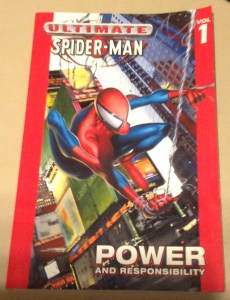
It seems like superheroes have been around forever. They are really, however, the product of comic books from the 1930s on. Adapting well to the big screen, a generation of kids is growing up that may have had their first taste of caped crusaders on the silver screen. I haven’t seen Batman V Superman, only the latest of a long string of the recent procession of such movies. Even so, the character of Superman—among the first superheroes—is less than a century old. Since the meme was conceived, however, it has mushroomed out into all kinds of outsiders offering deliverance. Superheroes are clearly about salvation. Even the anti-heroes. Otherwise they’re a hard lot to classify. Some have super powers. Others have only a lot of money and highly honed physical abilities. Or exceptional intelligence. The one thing they all offer is some kind of salvation. You might have to look for it, but it’s there.

Comic books in general, and superheroes in particular, have recently gained academic credibility. The ivory tower is often a location from which to look down on popular culture—the unwashed crowd—and seek more rarified topics of investigation. Superheroes, however, have proven resilient enough to this academic kryptonite to garner some attention. Comic books can be works of art. More than that, if a meme won’t let go, well, that itch should be telling us something. Sociologically, in a world of near constant uncertainty (who’d have guessed Trump would ever be where he is today?) superheroes seem to offer a stability that daily life lacks. Call it escapism, but what is salvation if not a form of escape? Let somebody else don the cowl and take care of the dangers we never even knew existed.

IMG_0037

Like many kids, I grew up making my own comic books. I invented a couple of superheroes that never found any adoring audiences, but the process taught me something. Looking back at those times in my life, they were periods of extreme crisis. My own superheroes were coping mechanisms. We couldn’t afford a lot of comic books, but once I started working, during junior high school, I started buying Doc Savage novels and consuming them like popcorn. I was trying to get through difficult times. I’ve seen editorials suggesting that the era of superhero movies is dwindling. I doubt that it is. They may eventually fade from the silver screen, but they will still lurk in the graphic novels and recesses of the internet. We need our heroes. We need deliverance.


Golem

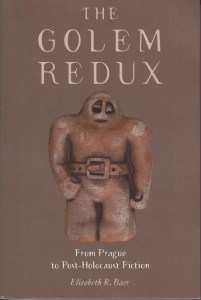
GolemReduxI read a lot of books. About a hundred a year. At the end of the year I go over them all again and many of them, I see, failed to make a deep impression. Some, I know, before I close the back cover, will stay with me. Maybe even haunt me. I count Elizabeth R. Baer’s The Golum Redux: From Prague to Post-Holocaust Fiction among those that will linger long. My regular readers will know of my predilection for monsters, so a golem book will hardly be a surprise. I realized, however, upon completing my academic paper on Sleepy Hollow, that my reading on the golem was rather slim. I’m no longer sure that it’s even a monster. As a goy who’s spent a good deal of his life among the Hebrew Scriptures, there’s a natural resonance, it seems, with those oppressed for being who they are. Golems are created in times of crisis but have unexpected, or at least unwanted, repercussions. Baer offers a thoughtful, intertextual study of the golem, largely through the lens of Jewish fiction.

Having dealt with the Bible as portrayed in Sleepy Hollow, I treated the episode where its significance truly unfolds (“The Golem”) as the entryway into the culmination of the first season. Now it appears likely that season three will be the erasure of the aleph, it seems appropriate to give golems their due. The story begins with the oppression of the Jews in early modern Prague. Rabbi Loew makes a golem from mud to protect the beleaguered community. This soulless, selfless protector becomes an archetype for various superheroes and literary characters ably summarized by Baer. The book put me in mind of my only visit to Prague, too brief and too ill-informed to truly appreciate what I was seeing. To see you have to learn to read.

While some writers have fun with the golem, others understand it in more serious tones. Those who can’t forget the Holocaust see things in a way that others cannot. Not that only Jews can summon a golem, but its origins and reuse have a special place in a community that longs for a protector. I’m reminded of the book of Job, and there’s a good reason for that. While reading The Golem Redux on my commute, I came home to find a copy of Pete Hamill’s Snow in August on my wife’s stack of books to read. As it is one of the titles studied by Baer, I felt an odd synchronicity at play. The book had been recommended by one of the booksellers at our local indie shop just a few weekends back. Tied in with all the other golem-based thoughts in my head recently, I’m inclined to think that this was no mere coincidence.


Cthulhu’s Tea Party

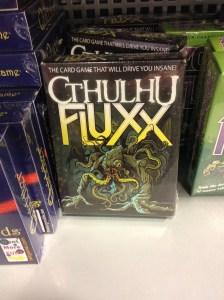
It was in the eldritch-sounding Oshkosh that I first came across H. P. Lovecraft. The web was still somewhat of a novelty then, and I’d run across a Dagon symbol that I couldn’t identify. My researches led me to the old gods of Lovecraft’s atheistic imagination. Even non-believers are haunted, it seems, by deities. Dagon, about whom I’d published an academic paper, always seemed to be a divinity to whom very few paid attention. Little did I know that in popular culture this god, along with others made up by Lovecraft, were slowly gathering an immense following. Now, about a decade later, Cthulhu is everywhere. I was reminded of this when I came across a website advertising Cthulhu tea cups. As you drink your tea, Cthulhu emerges. These novelty items, along with many, many others, are easily found. Cthulhu is running for president. The creature that Lovecraft described with such terror is now available in a cute, stuffed plush. Board and card games come in Cthulhu varieties.

IMG_1551

What I find so interesting about this is that the following of Cthulhu has taken on religious dimensions. Not that writers haven’t invented religions before—L. Ron Hubbard came up with Scientology after a career of science fiction writing, and Jediism is considered a religion by some—but Cthulhu represents the darker aspects of religious thought. As Lovecraft described him, he is a horror. Not the kind of thing you’d want to discover peering out of your teacup. I wonder if this is precisely why the fictional god has become so incredibly popular. In a time when some real presidential candidates are really scary, suggesting that an evil deity take on the job may only be natural. Cthulhu is, after all, really more an alien than a god, but to puny humans the point is moot.

Mainstream religion is not about to disappear any time soon. There is, believe it or not, a strong resistance to the materialistic reductionism that presses in on us from all sides. People are not becoming less religious—they’re becoming differently religious. The old sacred texts are being replaced by the fictional Necronomicon. Ethereal beings that have always been there are bowing before ancient aliens who aren’t really eternal or omnipotent, but who feel more real in our culture of might makes right. Whether a religion is factual or fictional has come to matter less than the feeling that there is something, anything, larger than humanity that demonstrates the vanity of our striving after material gain. That actually sounds quite biblical. Anything believed with adequate passion stands a chance, it seems, of becoming a religion.


Underground Easter

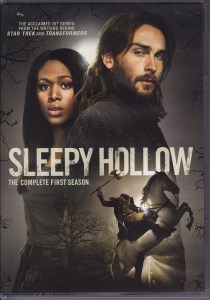
SleepyHollow

Recently I had the opportunity to write a post for the OUP Blog on the topic of Sleepy Hollow. I’m not exactly obsessed with the program, but it fascinates me that a television show that is so religiously based was such a hit for a couple of seasons. Religiously based, that is, in a thoroughly secular way. That may sound like a contradiction, but that is precisely part of the charm. We are constantly being informed that religion is on its way out, but we keep coming back to it in other guises. Sometimes disguises. Since today is recognized as Easter among many western Christian groups, I thought it’d be appropriate to consider resurrection. We know that resurrection is an idea that pre-dates Christianity and that it is one of the most basic religious hopes people share, in some form or other. It is also one of the central themes of Sleepy Hollow.

The premise of the series is that Ichabod Crane has been resurrected two centuries after his death. Alive in Sleepy Hollow, he and Abbie Mills fight off a variety of weekly frightening monsters, the primary one being the Headless Horseman. But the Headless Horseman is also a resurrected character. Ironically, he is Death, and even Death comes back from beyond. As particularly the first season goes on, we find other characters dead and risen. George Washington comes back from the dead to give instructions for coming out of Purgatory. The second horseman of the apocalypse, War, is a character brought back from the dead. In the second season, Thomas Jefferson, in a kind of futuristic sense, is brought back from the dead as a kind of living hologram. Where, o Death, is thy sting?

Sleepy Hollow is a secular program. There is no overt religious message. To tell a compelling story, however, the writers keep coming back to the Bible and other sacred texts, and supernatural themes. In researching the program I learned that other networks (who has time to keep track of them all?) also have supernatural features and that competition is fierce. Meanwhile we’re being told that religion is all but stomped out under the weight of rationalism. My observation is that it may be dressed up as something different. It may even be in disguise. Religion, however, is experiencing its own resurrection in popular culture and the idea of Easter has yet to be considered obsolete.


Not Camelot

In the English imagination the Arthurian legend is deeply connected with the Christian myth of Britain’s founding. This may not be on the surface, of course, but the places associated with King Arthur (as well as the tales themselves, such as the Holy Grail) overlap with sacred locations. I was reminded of this by a recent Guardian article about Tintagel Castle. Back in the day when my wife and I visited Tintagel with friends, I was still shooting film. Slides, no less. Some wonderful images came out, the way that only Ektachrome delivers, but I haven’t been able to convert them to digital. I guess you’ll have to take my word for it. Tintagel is in the news because English Heritage, the owner of the property, is developing it to make it a larger tourist draw. According to Geoffrey of Monmouth King Arthur was conceived at Tintagel. Not in the castle—now in ruins—that was built centuries later, but on the island that is accessed by footbridge over a dramatic cove on the Atlantic Ocean. It’s enough to make you drop your pastie.

Our own little Merlin

Our own little Merlin

Locals, according to The Guardian, protest the dressing up of the historic site. A bas relief of Merlin has been carved into the living rock, and this is hoped to draw the Glastonbury crowd to the southeast. Glastonbury, upon our visit, was already the home of New Age vendors. It too has connections with Arthur. The staff of Joseph of Arimathea can be seen, still growing after all these centuries. The Holy Grail—likely from Celtic mythology of the cauldron—is also associated with Glastonbury. Oh yes, and also King Arthur’s grave. Even apart from Monty Python, the legendary king has captured the imagination of thousands across the centuries. There’s something about Arthur.

The historicity of the king, however, is vigorously debated. The same is true of many religious founders. Those around whom legends grow become more and more inaccessible with the passing of the years. England was Christianized in the seventh century as part of a political expansion. If Arthur ever lived, it was after that period, perhaps in the days before Beowulf. We just don’t know. It is clear, however, that his legend is intertwined with that of those early Christian days. There never was a Holy Grail—of that we can be fairly certain. In the service of myth-making, it is nevertheless indispensable. Staring out over the Ektachrome sea at the ruins of the island castle of Tintagel, it is only too easy to believe. If only I had the pictures to prove it.


Modern Vampires

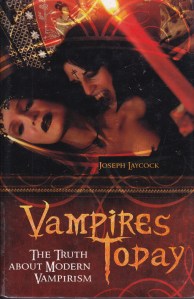
VampiresTodaySometimes I feel guilty. A grown man reading about vampires? Then I think of such puerile things as television and the stock market over which other adults waste their time and my pituitary gland releases endorphins and I carry on. I must say, however, after reading Joseph Laycock’s Vampires Today: The Truth about Modern Vampirism, that I’m not a vampire. Nor have I ever wanted to be. I am fascinated by the idea, however. The more I read—as is the case with most good academic books—the more I questioned definitions. Laycock does a good deal of that questioning himself in this book, and I came away wondering what indeed defines a vampire? As a child it seemed pretty clear. The vampire was a blood-sucker who came out at night. Fangs, a thirst for blood, and a faded aristocracy seemed to be the essential characteristics. But I was only a child.

Before you get the wrong idea about Laycock’s book, I need to say that his is a serious study of modern day vampires. Yes, they exist. No, they’re not easy to define. As an academically trained scholar of religion, Laycock is keenly aware that self-definition is crucial to categorization. Religious believers self-identify. We have no way of categorizing an adult (and some would say no way at all of children) without their own affirmation of what they believe. Vampires Today, however, raises the pointy question of whether those who self-identify as vampires constitute a religion. Or if vampire communities may be considered religious groups. In case you’re confused: many people identify themselves as vampires—sanguinarian and/or psychic. They believe they require the life energy of others to live and prevent illness. They sometimes drink blood—with permission—or siphon the life force of other people. Like all adults, they should be treated as self-identified. Probably not, as Laycock carefully spells out, a religion.

As in his other books, Laycock takes seriously groups that would, based on numbers alone, be considered fringe. Nevertheless, these groups are a part—sometimes an influential part—of larger society. We live in a world where we’re authoritatively told there is nothing but matter and energy, and as biological beings our purpose is reproductive success and then death. Is it any wonder that vampires and others are seeking something more? I’m no vampire. I read the occasional, thoroughly pulp, Dark Shadows novel to recapture a little of that after-school wonder I felt watching the waves pounding on the Maine cliffs while Barnabas Collins lurked inside. And he bore a strange truth that was perhaps instilled in those young years. Age is only partially a biological matter. Defining it any other way is, I have to believe, immature. So I read about vampires and wonder.


But Loses (His) Soul

Although a couple steps from the real thing, a book review can be an art form of its own.  A short piece in a recent Wired magazine focused on an ironic bestseller that I keep seeing on the standard lists: The Life-Changing Magic of Tidying Up, by Marie Kondo.  Apart from something we’ve probably all heard from our moms, I wonder why so many people buy a book telling them to get rid of things.  Clive Thompson notes in his review (“Clutter Clash: How Tidying up Can Hamper Creativity”) that one of Kondo’s pieces of advice is that books should be on the list of things to discard.  Disagreeing in principle with this assessment, it is an even larger argument that I would like to challenge: “studies” apparently show (I’m not sure which studies) that clutter can be “soul crushing.”  Given that we have no empirical way to assess souls, I’m uncertain how to measure the number of angels crushed under my stacks of books.  Who has the right to assign clutter to the ranks of venial sins—or mortal, for that matter?
 
The book’s subtitle, The Japanese Art of Decluttering and Organizing, may provide some vague spirituality to the topic, and I agree that entropy can get the upper hand from time to time, but soul-crushing?  Some of us keep books and papers precisely because of their value in lifting the non-verifiable soul.  In fact, I was just reading (ahem) about how religions (the traditional home of wisdom about souls) revolve around their books.  Perhaps we should leave at least a showy Bible for the coffee table to display along with our copy of Feng Shui for Dummies.  My soul feels lighter already!

IMG_2727
 
When did advice for improving our souls shift from those who spend their ruminative lives asking the weighty questions to those who suggest picking up after yourself might just work as well as a life of self-denial and putting others first?  And why would you buy a book that recommends you don’t keep books?  My existential crisis deepens, and I haven’t even read it.  I can’t shake the feeling that  I spent thousands of dollars over multiple years getting an education in what turned out to be merely housekeeping.  I marvel at the clutter-free environment as much as the next person.  That’s one of the reasons I love art museums so much.  Yes, my soul does get a boost there.  If I go to the gift shop on the way out, however, I’ll likely want a book to help recapture those sublime moments.  Then I will go home, where my clutter awaits, and will truly feel peace in a place where books abide in profusion.


St. Pat Tricks

What does it say about a saint when the celebration of his day is excessive drinking? Virtue and vice, while not nearly as Manichean as sometimes made out to be, nevertheless conflict in such a setting. Like many American mutts, I have some Irish heritage. I wear green on St. Patrick’s Day, as it’s the done thing. I avoid any celebrations, however. When my job calls for travel to college campuses, I know to avoid the time around St. Patrick’s. Indeed, I’ve taught on campuses where Spring Break was always scheduled around St. Pat’s so as to minimize property damage on campus. Send them off to Florida, where they can be some other electorate’s problem.

IMG_2681

This is an interesting dichotomy. We live in a fairly permissive culture, at least when it comes to things like sex and violence. We nevertheless have built a Prohibition-Era-like mystique around alcohol consumption that makes our college-aged kids a little too curious. Binge drinking and its predictable aftermath have become far too common. Put them together with an Irish saint and all bets are off.

Historically, the Irish have been maligned in what is an acceptable way. Few complain when a nationality is non-ethnic on the surface but non-welcome nevertheless. The Irish have been historically oppressed, but today we forget all that. We hold parades with bagpipes to bolster solidarity, but only if the taps are freely flowing. Drinking with holidays is nothing new. Even Judaism has its Purim and other religions may, from time to time, relax strict rules on the evils of alcohol. But what does it say about a saint that there is apparently no other way to celebrate his day? Wearing green, yes, but that may be entirely accidental. It is, after all, a Dionysian rite of spring, our apparel matching the verdure we soon anticipate as winter wends its weary way out. Even so, I’m glad not to have to be on the streets of a major city when the parade marches by. Even with my Irish ancestry, I prefer to celebrate in my own quiet way, just by wearing green.


Lovecraft Legacy

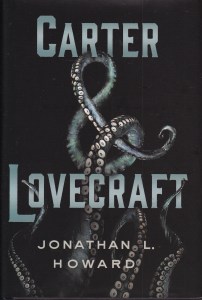
CarterLovecraftHistory can be a funny thing. Take the way it treats some people. H. P. Lovecraft wasn’t famous in his lifetime. In fact, his isn’t exactly a household name even now. His creation Cthulhu lurks grandly in the internet, and even Lovecraft himself is finding mention in some literature courses, despite his lack of literary finesse. Yet, fiction is being written about him. I just finished Jonathan L. Howard’s new novel, Carter and Lovecraft. While H. P. doesn’t appear as an acting character in the novel, he is related to one of the protagonists in a way that is essential to the story’s plot. I won’t give away any spoilers here, but the novel takes over where Lovecraft, the non-fictional character, left off.

Lovecraft, famously, was an atheist. Nevertheless he spun a mythic world of Old Gods that has become canonical in its own right. His stories veritably teem with religious themes as well as monsters. In fact, in Howard’s treatment of the mythos, the religious elements still show up. As I’ve noted before, one need not be a theist to be a capable theologian. Fiction like that of Lovecraft, or that of Howard, inherently holds a kind of numinous quality. In fact, fiction frequently does. In reading, we allow ourselves to be drawn into another world. What could be more religious than that? The beliefs of the writer, it seems, may not ultimately matter.

At one point, at least, in Carter and Lovecraft the sentiment becomes explicit. One of the characters contemplates starting his own religion, only to realize that he’d have to write a holy book. That, he decides, would be a lot of work. As one who dabbles in various forms of literary art, I can take his point. There is something wondrously exhausting about giving birth to words. And those words make worlds. When you stop to think about it, that’s kind of a religious thing to do. I’d recommend Carter and Lovecraft to H. P. L. fans. It’s not a Cthulhu-fest, but it is an enjoyable, compelling tale that raises questions which, if not handled carefully, will quickly turn theological.


Mere Monsters

While my colleagues and I wait to hear if our monster session will be approved, my thoughts naturally turn to the taxonomy of monsters. One of the perennial problems in the study of monsters is that definitions vary widely. We might all agree that a werewolf is a monster, but what of Cthulhu? Or of a horribly deformed, but completely natural animal? What about demons? Should we all agree that we know what a monster is, how do we divide them into categories for easy study? One way of doing this might be to rely on binaries. For example: natural monsters versus unnatural monsters, living monsters versus undead monsters, monsters from earth versus monsters not from earth, monsters created by humans versus naturally occurring monsters, fictional monsters versus monsters reported in nature. It soon becomes obvious that monsters are a widely divergent group of creatures.

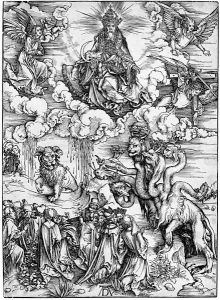
Monsters have won an enduring place in popular culture. I think of The X-Files. Apart from the “mythology” of the series, many episodes featured a weekly scary monster. The same is true of Sleepy Hollow, now in its third season. Monster movies, although perhaps taking a back seat to super heroes of late, are regulars on the silver screen. We just can’t seem to live without our monsters. I’ve mentioned in my many posts about monsters that the connection with religion is so obvious that it hardly requires apology. But a deeper question has occurred to me. It has to do with the nature of religion (itself not well defined).

439px-Durer,_apocalisse,_12_il_mostro_marino_e_la_bestia

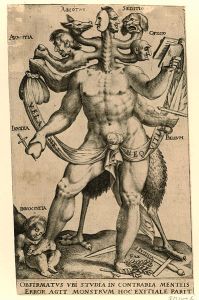
Religions exist to deliver people from the trials they face. Offering Nirvana to break the endless cycles of reincarnation, or Heaven when we die after one go-round, religions claim to give us something of an assurance that things will work out. (Mostly.) In the light of this, why does religion give us monsters as well? Surely they are more than mere metaphors for the misfortunes of daily life. There has to be something more to it. What that more is, I’m not certain. I’m not even sure of how to approach the question. Monsters will, for me and many other Monster Boomers, remain a guilty pleasure that we are pleased to be able to address as adults. I am becoming more and more convinced that the more we learn about them, the more we learn about religion itself. And perhaps also about those who give shape to religious thought.


Holy Haunted Book

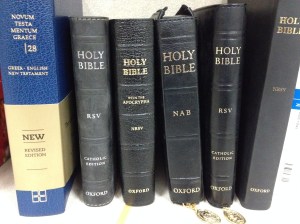
Religion is one of those words that defies easy definition. As I’ve suggested before, you know it when you see it, but trying to pin the idea down is a different matter. Consequently, religion is closely related to a number of other areas of interest: philosophy, ethics, monsters, and the paranormal, to name a few. I was interested, therefore to see a blog post recently concerning a “haunted Bible.” Call me naive, but the thought had never occurred to me before: could a holy book be haunted? Churches are notorious for housing ghosts, of course. As someone who’s spent overnight retreats in churches I can vouch for the fact that a sanctuary after dark is a naturally eerie place. I’ve never seen a ghost in a church, however, and I’m not entirely convinced they exist, and if they do, what they might be. In any case, a haunted Bible is a different story.

David Weatherly is a fairly well-known paranormal writer. My web search brought up his blog where he explains that the haunted Bible was for sale on eBay with an asking price of $180,000. The owner, who remains anonymous, claimed to take no responsibility for any damage the supernatural scripture might cause. Instead of thinking that we have here a genuine haunted leather scripture, I know it can be nothing other than a genuine hoax (not on Weatherly’s part). Realtors know well that a haunting can, in today’s climate, counterintuitively drive the price of a house up. With people hungry for some element of the supernatural in their lives, and ghost hunters of all sorts on their televisions, they are willing to shell out a few more dollars to have a spirit around. And since ghosts can’t sign contracts, there’s no guarantee that they’ll be there once you move in. The supernatural can, it turns out, be the perfect scam.

If items can be haunted, I suppose a Bible might as well. When an owner, however, turns down an offer of 50,000 pounds that odor you’re smelling is that of a rat. I love old books. I have a few around that have more than a century’s weight on them. Looking at used bookstores longingly, I see first editions of Poe or Shakespeare that sell for far less than the asking price of the most printed book in the western world. Bibles, if you know where to look, can be had for free. I’ve got at least a dozen of them myself. Nothing makes fakery quite so clear as greed. No wonder the haunted Bible was such a disconnect. There’s nothing paranormal about love of money. That’s all too normal for anyone who tries to sell a Bible for implied spirituality.

IMG_1235


Soul Library

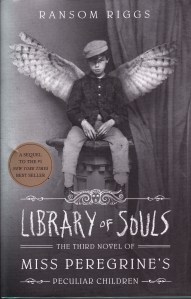
LibrarySoulsThere’s a kind of trinitarian logic to the trilogy format. Long before Hegel’s model of thesis, antithesis, and synthesis, people have grouped things into threes. And there is a hook that film-makers have used to ensure that viewers will come back for the third installment: the cliffhanger. The second episode leaves everything unresolved and you’ll be sure to see the third. Think of the original Star Wars trilogy, or Back to the Future, or even Pirates of the Caribbean. In each case the first film could stand alone, but the second insisted on a third. This is a little trickier with books since, as we all know, publishing is a slow business and writing takes time. I saw Miss Peregrine’s Home for Peculiar Children, by Ransom Riggs, in 2011. I knew I would read it since the cover alone was so intriguing. Young adult literature, it turns out, has come a long way since I was able to classify myself that way. Then Hollow City came out. It ended as a cliff hanger (remember the formula), back in 2014. Just over a year and a half later, The Library of Souls was released.

Having just finished the trilogy, reading each as it came out, I would say that, like most trilogies, the first installment was the best. Freshest, a new idea, where characters exist with whom the reader participates by in filling in the blanks, a series grows more complex as it expands. Some elements that weren’t there at the beginning have to be read back into the previous installments. In my case, I’ve read so many books in the interim that some of the details have grown hazy due to the simple passage of time. Still, Riggs is to be highly commended for bringing souls back into discourse among the young. Too long we’ve been sold the story that we have no souls.

I’m not going to go into any great detail here since those who want to learn how Riggs handles the tale will read his books, but I will say that a stubborn materialism has settled over intellectual culture. Some neuroscientists have naively said, “we’ve looked for it and can’t find it, therefore it must not exist.” And since most of us don’t have access to their kinds of equipment or training, we’re told to acquiesce. Give up your souls—buy into materialism. Buy stuff. That’s what we’re all about. It is a relief, in the midst of all of this, to have a popular writer suggesting, through fiction, that it is souls that make us who we are. The books aren’t preachy. Indeed, it would be difficult to say they are religious in any conventional sense. They are, however, soulful. And for that I am very glad to have read them, even as a middle-aged adult.


Religious Laughter

Reader’s Digest famously runs a feature, “Laughter: the Best Medicine.” I’m not a Reader’s Digest reader, and I’ve generally only seen it on coffee tables and bathroom cabinets of friends. Still, that’s the feature to which I always find myself turning. The jokes, this being Reader’s Digest, are always inoffensive. Safe subjects that are nevertheless funny. Usually. As adults we come to know that the taboo subjects of childhood are often the funniest. Off-color jokes about sex or religion, sometimes both together, elicit the most boisterous laughs. We don’t use them, however, because someone will surely be offended.

A recent article in The Guardian by Gary Sinyor raises the question of religious humor. Sinyor, who is Jewish, wrote a comedy play called “NotMoses.” As he farmed the idea and advertising around to advisors and friends, he was warned how he might be putting his life on the line for his humor. Reflecting on this, he comes to the conclusion—spot on, in my opinion—that the religions that don’t laugh at themselves are somehow insecure. His parade example is Scientology, as humorless a religion as exists. As he points out, although widely banned, many Christians found Monty Python’s Life of Brian very funny indeed. Of course, some branches of Christianity weren’t, and still aren’t, laughing.

Photo credit: Richard from Canton, Wikipedia Commons

Photo credit: Richard from Canton, Wikipedia Commons

The world can be a humorless place. There is so much to worry about: the ill treatment of women, starvation, horrific diseases, Donald Trump. What right have we to laugh? I once had a close friend with cancer. Most would agree that this is no laughing matter. During treatment this friend lost all her hair and at one point another friend encouraged her to laugh about it if she could. “If there’s nothing you can do about it, you might as well laugh,” was the advice. In poor taste? Perhaps. Nevertheless, there was some truth to it. My friend recovered. The disease is not something she cares to talk about. Nevertheless, humor helped her get through it. The most serious things, in other words, sometimes cause us to laugh. Religious comedy, after all, is not laughing at religion, but at how seriously we take religion. There is a difference. And laughter can, even if I got it from Reader’s Digest, be very good medicine indeed.


Religious Monsters

Some colleagues and I are working to meet a deadline. I suppose I use the word “colleague” rather grandly, since they both have teaching positions, nevertheless, we have a common goal. We are fascinated by monsters and we’d like to see the American Academy of Religion dedicate a small section of its large annual meeting to them. We’d do all the work. At first glance, this might seem an odd topic for the serious study of religion. The fact is, however, that monsters are a part of human experience—at least in our imagination—and the conceptual space overlaps considerably with religion. Many monsters have their origins in religious thought. Some theorists go further than that and suggest the very concept of “monsters” comes to us, courtesy of religious beliefs. We can see it time and again in popular culture; the movie or television show, or novel that features monsters ventures into the territory of religion.

The reason for suggesting that this relationship be formalized is the fact that, although this connection exists, it has not be given adequate study. Monsters are the denizens of childhood imagination. When we grow up we leave our monsters behind. But not really. We just stop talking about them. With our mouths. The film industry knows that a horror film will generally draw in the lucre. Halloween has become a major commercial holiday. Stephen King is a household name. I’m not sure why all of this is so, but I think it might have something to do with repression. When we grow up we are taught there’s no such thing as monsters. Those who refuse to relinquish those beliefs are ridiculed. We have more important things to do. Things like making money. Deep down, however, we may still believe.

The fantastic and belief are intimate companions. In fact, belief is at the root of much of our experience. That’s not to say there are really monsters in the night, but at some level we believe there are. And we also believe that infinite deities control this infinite universe that may be only one of many multiverses. It just seems likely. Evidence may point in the other direction. Empirical proof is lacking. And yet, we believe. I’ve discovered a number of colleagues over the years who share this academic fascination with monsters and religion. I don’t know if we’ll be approved by the powers that be, but at least we will have begun to raise the question. What lurks behind it is a matter of belief.

397px-Arminianism_as_five-headed_monster