Thor’s Return

Once as I sat in the office of an Ivy League professor of Greek religion, I asked about the myths of the Classical gods. The professor (who knew that I had taught religion as well, but at more like a Noxious Weed League school) appeared genuinely insulted and told me in no uncertain terms that scholars of religion didn’t take that nonsense seriously. The study of “myths” was left to Classicists, not actual scholars of religion. Is it any wonder, then, that we don’t really have a grasp on what the average person believes? Being a blue-collar scholar, I always took seriously what students told me about their beliefs. It wasn’t really a great surprise, then, when my wife pointed me to a story in The Guardian about a temple to the Nordic gods being built in Iceland. According to the story, the modern adherents of Ásatrúarfélagið (thank you unicode) don’t really believe in a literal Odin or Thor or Frigg, but see them as metaphors to help them face the way life is. A millennium after becoming Christian, some Icelanders are apparently getting back to their roots.

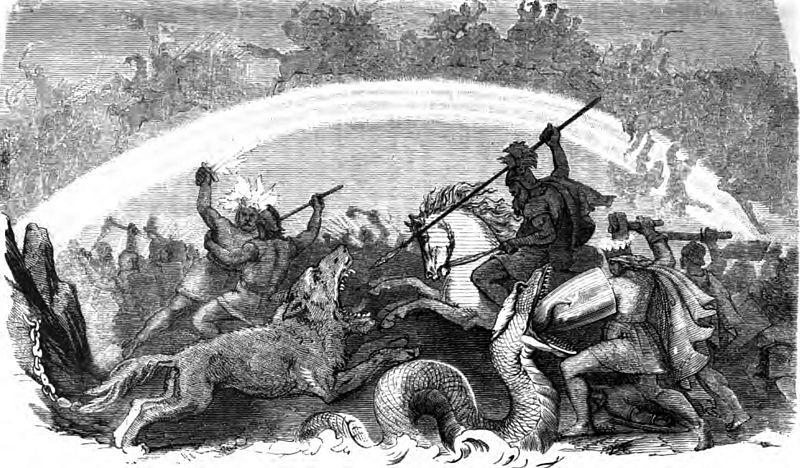
There has always been, to me, a fascination with the Nordic gods. These rough-and-tumble deities inhabited the harsh and snowy regions where daily life was often a struggle to survive against the elements. Frost giants were enemies and nobody really emerges as the winner after Ragnarok. In the Bible Yahweh does sometimes come out swinging, but for the most part he seems a deity content to sit on his throne and issue commands. The Scandinavian gods were characters of action. In some sense they seemed to struggle just like the rest of us do. They are, of course, more powerful and as the movie makes clear, Thor has a charisma that more self-righteous deities appear to lack. Lest anyone be ready to run to their priest at this point, please be aware that this too is a metaphor.

On the other side of the equation there are sure to be critics who argue that building a temple to fake gods in this day and age is obviously a waste of human talent and resources. Such are people with no imagination. Religious belief, metaphor or not, has been part of the human psyche from the very beginning. Elsewhere I have suggested that animals show the same behaviors as what we Homo sapiens would declare rudimentary religion. Rationalism has not provided a reasonable alternative to religious expression. Even a Stoic knows to appreciate art, although beauty provides no essential element to simple survival. Simply put, humans enjoy the finer things of life. Perhaps unappreciated since long sublimated, among those finer things are the old Nordic gods. And their return is a kind of resurrection.
The Battle of the Doomed Gods
The Battle of the Doomed Gods

Dr._Strangelove_poster

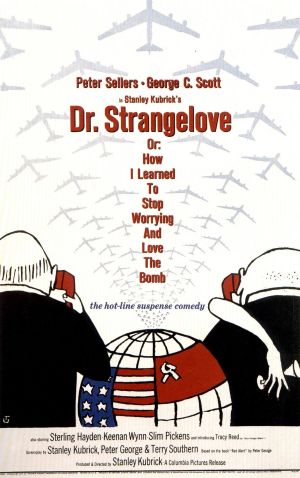
In honor of the fifty-year anniversary of the release of Dr. Strangelove this past week, my wife and I sat down to rewatch the movie this weekend. Psychologically, as Kubrick found out, dark humor was the only way to deal with the sense of doom that pervaded the world into which those of my generation were born. Nuclear weapons had been developed and the Cold War was in full swing. Somehow, even in small-town America, I didn’t find Communism to seem so awful. After all, I grew up reading the Bible and it sounded quite a bit—at least in theory—like the arrangement the apostles had made in the book of Acts. The idea of private property, the very spine and muscular system of capitalism, was considered a sure way to lead to God’s kingdom not being established on earth. Nevertheless, that is the way, as the phrase goes, that the money went. And Communism threatened the right of one percent to horde all the money, so we were ready to annihilate all human life for it. Talk about taking your marbles and going home! No child should grow up knowing the meaning of the phrase “mutually assured destruction.”

Dr. Strangelove has held up well for the half-century since its release. Despite the thawing of the Cold War, the big chill isn’t over yet. And humor still seems the only way to keep sanity and deal with the state of the world. There are still many General Turgidsons out there (some of whom have held very high government offices, and this is no joke). There are at least, as far as we know, fewer General Rippers. So we hope. As the bomber crew nears its target, Major Kong goes over the contents of the government issued survival kit, among which is a comically small Russian Phrase Book and Bible combined. Kubrick, a master of satire, has the godlessness of Communism thrown time and again across the lips of the hawks. It is better to kill everyone than to allow the godless to rule. Even the Bible, however, shares space with the Russian phrasebook, making us wonder whether it is a tool of conversion or an admission of inevitability. Still the bomber, piloted by a Texan, flies on.

Perhaps the biggest moral dilemma we face is our ability to destroy hope. Capitalism promises opportunity to all. Like many who grew up poor, however, I have found lies hidden in plain sight. It is not easy to move ahead if you choose to mire yourself in debt to get an education. In fact, if you lose a job in higher education you can easily find yourself adrift for a decade or more, not earning any retirement money and being frequenly sought out by your local universities as an adjunct instructor. In fact, at many points your career might look like the end of the world. So it is that I take great comfort in settling down to watch Dr. Strangelove again. At least it is an honest movie, and that hasn’t changed in the past half-century. And I think I may have been wrong about how few General Rippers there really are.


Good, Evil, and Normal

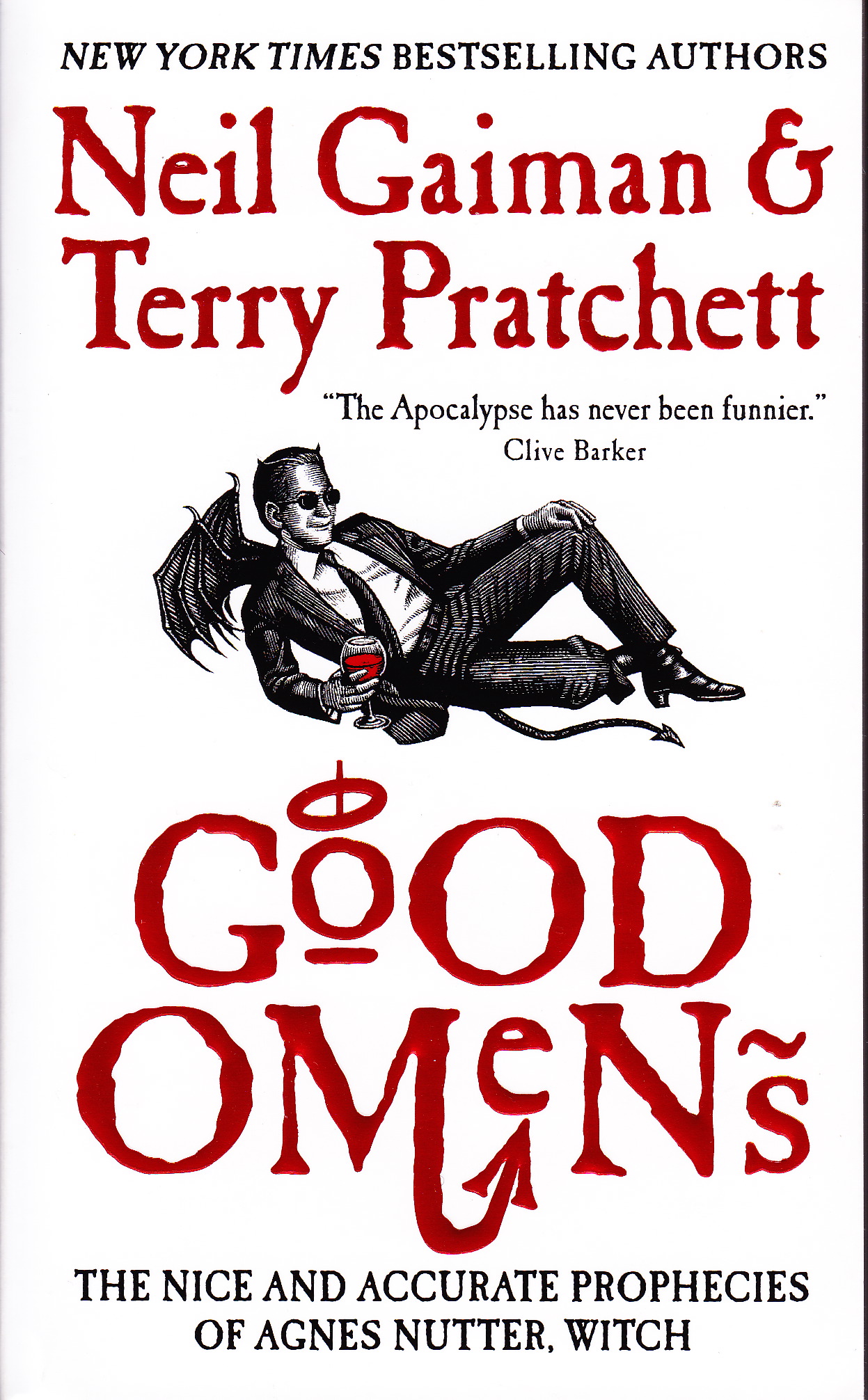
GoodOmensTo date I’ve read a fair number of Neil Gaiman novels. One of my students started me out on American Gods and I pursued his others on my own after that. I was a little unsure about Good Omens, however. I guess I’ve always been dubious about the quality of co-written books. Terry Pratchett, an accomplished novelist in his own right, paired up with Gaiman on this one, and it took the wisdom of another student, albeit recently graduated, to assure me that it was worth the effort. Given that it’s about the apocalypse, or perhaps an apocalypse that doesn’t quite take off, there seemed to be no reason not to give it a try. It is, at the end of the day, a charming book with colorful characters and an Antichrist who gets switched at birth and grows up in a normal household and herein lies the tale.

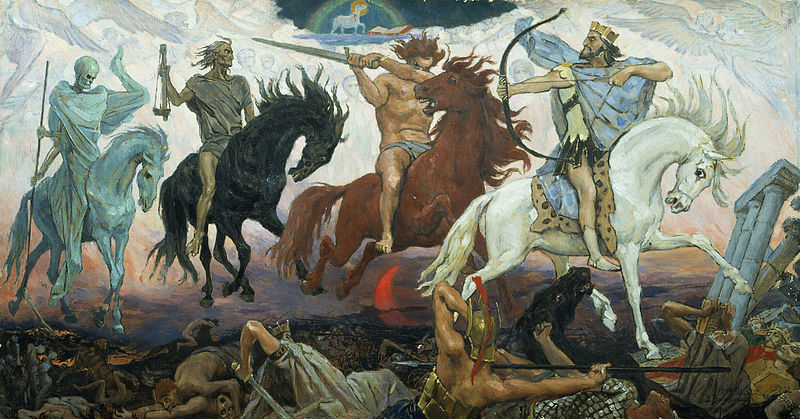
One of the most common religious themes in novels is the end of the world. The four horsemen of the apocalypse are one of the most striking literary tropes of the first century, if not of all time. The real question about the end of the world, it turns out, is—why can’t it be funny? For those who’ve pondered that, Good Omens is the book for you. It actually does help, however, if you’ve read the Bible. It adds to the cumulative effect. Subtitled The Nice and Accurate Prophecies of Agnes Nutter Witch, the book revolves around the certainty of the written word. Prophecy, however, just as in the book, only achieves verisimilitude in retrospect. The prophets didn’t always get it right, even in the Bible. Human choice often causes a breakdown in divine plans. In Good Omens, you’re pretty sure from the beginning that the world won’t end, but you’re not quite sure how it won’t end. The unfolding of the story eventually addresses how a prophecy can fail.

Free will, those who specialize in theology and philosophy will say, is among the more difficult of phenomena to pin down. Some predestinarians would say it’s all an illusion. We are programmed to do what we do. Ironically, some reductionistic materialists would say the same thing. Each of us, however, trudging through out days of toil and play, feels like we’re making our own decisions. True enough, sometimes circumstances decide for us, but if we were given the choice of good or evil, wouldn’t we approach it the way we approach just about everything else? Along the way, the demon Crowley asks a pointed, poignant question: why would God make people inquisitive and then forbid them some obvious, desirable fruit? Isn’t the conclusion foregone? Any writer today would know the outcome before the first sentence was finished. And so, free will is off and running. I hope that the fact that the world doesn’t end won’t be a spoiler for anyone, because I also hope that others will read Good Omens and learn a great deal about how demons can be good, angels can be naughty, and people will always just be people.


What If?

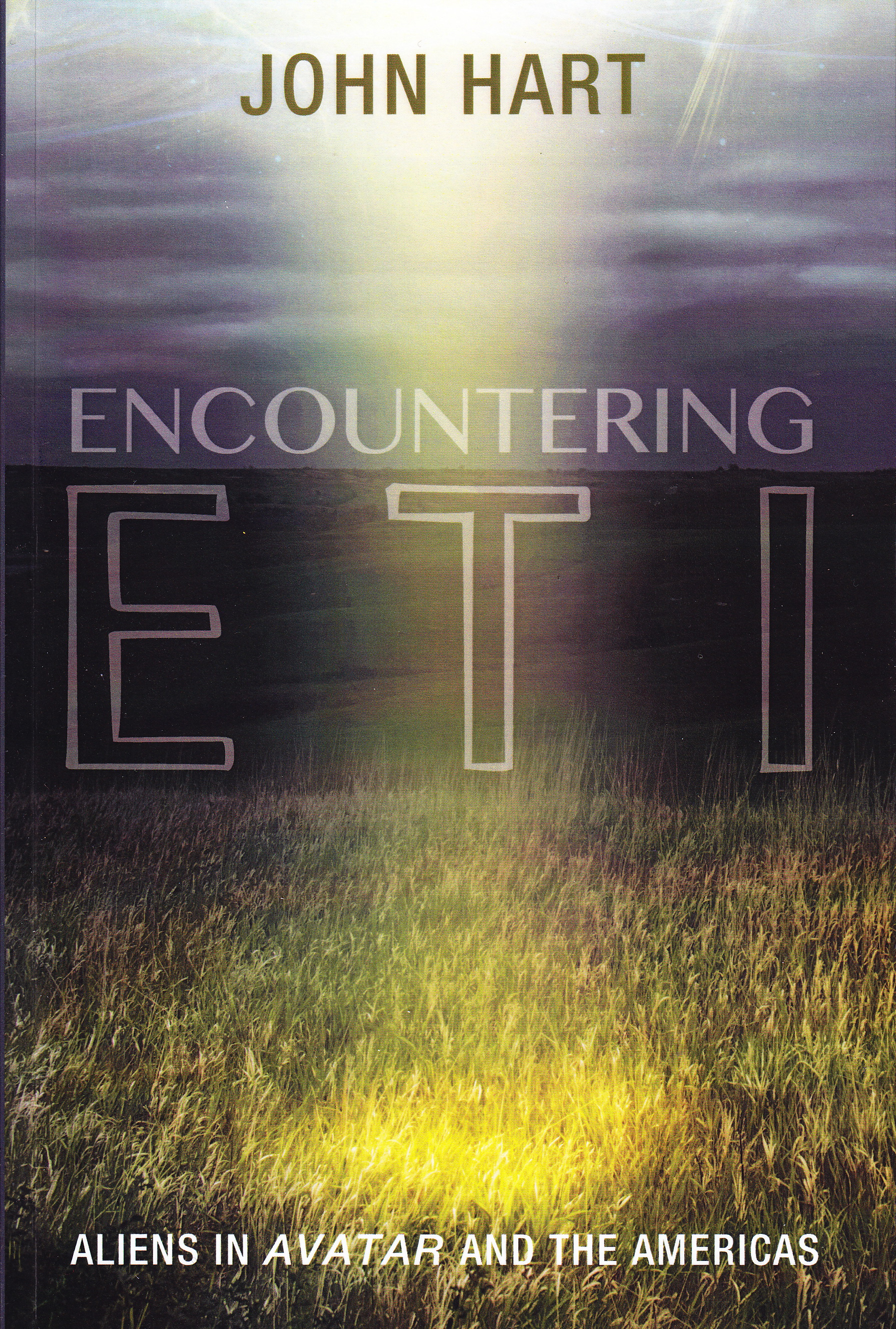
EncounteringETIA game that parenting books used to recommend was called “What if?”. It was an imagination game played by parents with their children to teach them about “stranger danger” in a way that wasn’t too scary. We naturally, it seems, fear the other. “What if?” kept coming to me as I read John Hart’s book Encountering ETI. ETI is a bit more precise than the more familiar ET, whom everyone knows, is an extra-terrestrial. The I stands for intelligence. What happens, in order words, when we meet extra-terrestrial intelligence? I very much admire academics such as Hart who are willing to ask what is such a necessary question. The point of the book is much more an ethical than a speculative one since human history has pretty much documented what happens when the Discovery Doctrine is applied. Natives (or TI, terrestrial intelligence, if you will) at the hands of newcomers with the Discovery Doctrine, are soon wiped out. History has repeated the story far too many times. Scientists such as Stephen Hawking even apply that to us, saying that if ETI arrives we will be exterminated. Hart takes a much more balanced look at the question.

Part of the problem is that we, as a society, have been taught to laugh at those who’ve seen UFOs. UFO stands for Unidentified Flying Object, and many people can’t identify what they see in the sky. But we all really know what I’m talking about. Those who’ve seen what may be non-terrestrial flying machines are automatically classed with the mentally unstable and ridiculed into silence. Thus it has been since the 1950s, despite foreign (!) governments and their militaries admitting that yes, we see things and we don’t know what they are. France, Argentina, and Russia, for example, have opened the files to some extent. The point that Hart makes is well taken—if we ridicule so automatically, will we be prepared when they arrive? Shouldn’t we be thinking about this now that scientists are discovering there are likely billions of planets in the Goldilocks Zone (capable of supporting life)? Ah, but it is so hard to let go of racial superiority! Homo sapiens sapiens are pretty impressed with themselves. As if nothing better could be conceived. Perhaps this is original sin.

Hart, whose book is subtitled Aliens in Avatar and the Americas, takes the possibility of visitation at face value. I’m sure it has impacted his career somewhat. The wise choice, it seems to me, is to take seriously what is almost a dead certainty—we are not the only life in the universe. Ironically, the idea that we are is largely based on the Bible. Genesis makes a pretty clear statement that we are God’s best idea. We’ve largely dropped God from the picture, so we, as humans, now occupy the top rung. And when we find humans different from ourselves we ask how we might exploit them to our advantage. (Here’s where Avatar comes in.) Hart’s book, as readable as it is affordable, is one that any thinker should take seriously. It is a book of ethics, writ large. Universal ethics, one might say. The aliens may not land in our lifetime, but chances are pretty good that they’re out there somewhere. It might be best to take some time to clean up the house before guests arrive.


Seeing I

One of my few Twitter followers (stawiggins) suggested that I watch Dr. Ken Hayworth on YouTube. Specifically, Part 3: If we can build a brain, what is the future of I?, hosted by Galactic Public Archives. It is well worth 9 minutes of your time. Trying to figure out consciousness has been a major preoccupation of mine for some years. I don’t have the tools of neuroscience, but I do have over half a century of coming to know this “I” that constantly seems to wake up in this same body and experience all its woes and occasional joys. Hayworth suggests that the self is a model projected by our brains to help us make decisions and to plan for the future. In a fascinating thought experiment, he notes that if a duplicate self were made, we (or I) should not object to being executed since there is an exact copy now. Hayworth notes, however, that any individual will object because we are “designed” to think this way about ourselves. Designed, I wonder, by whom? I suspect Hayworth means evolution designed us that way, but evolution is non-teleological, and, I suspect, not really reificatory. Evolution is merely a process.

Perhaps the horns here are only those of a semantic dilemma, but I feel not. Hayworth goes on to discuss how instinct works to continue this illusion of self. I’ve never found instinct a very believable concept. We use it when we want to deny consciousness to animals and very young children. Since they can’t have a concept of “I” they have to have “instinct” to preserve themselves. Logically, to me, this seems to be fudging. What is instinct? Is it really any different than admitting at some micro-level, animals have consciousness? To me it seems that consciousness is one of those “turtles all the way down” kinds of propositions. To be alive is to be conscious at some level. Be careful how far down you dig here.

DSCN2021

Hayworth then goes on to what sounds like an almost biblical conclusion. Ethics insists that humans are part of a whole. (A very diseased whole, as the imbalance in society forces us to conclude, but a whole nevertheless.) To kill one is to violate the consciousness of the whole. This concept seems sound, and I would suggest that it might benefit from expansion. Why stop at the human level? We are animals. Animals are conscious. Here we are back at the turtles again. Perhaps we have expended too much energy trying to parse self from soul from mind from consciousness. Perhaps we are all part of a large collective consciousness. If so, we got some very sick units near the top. Any organic being that insists only one percent needs to be kept in perpetual plutocratic indigence while billions of others wonder how long they will survive at this payscale in this economy, or, more realistically, act as slaves to that one percent, is a sick beast indeed. If consciousness is collective, we could all use a massive shrink.


Soulful Phantoms

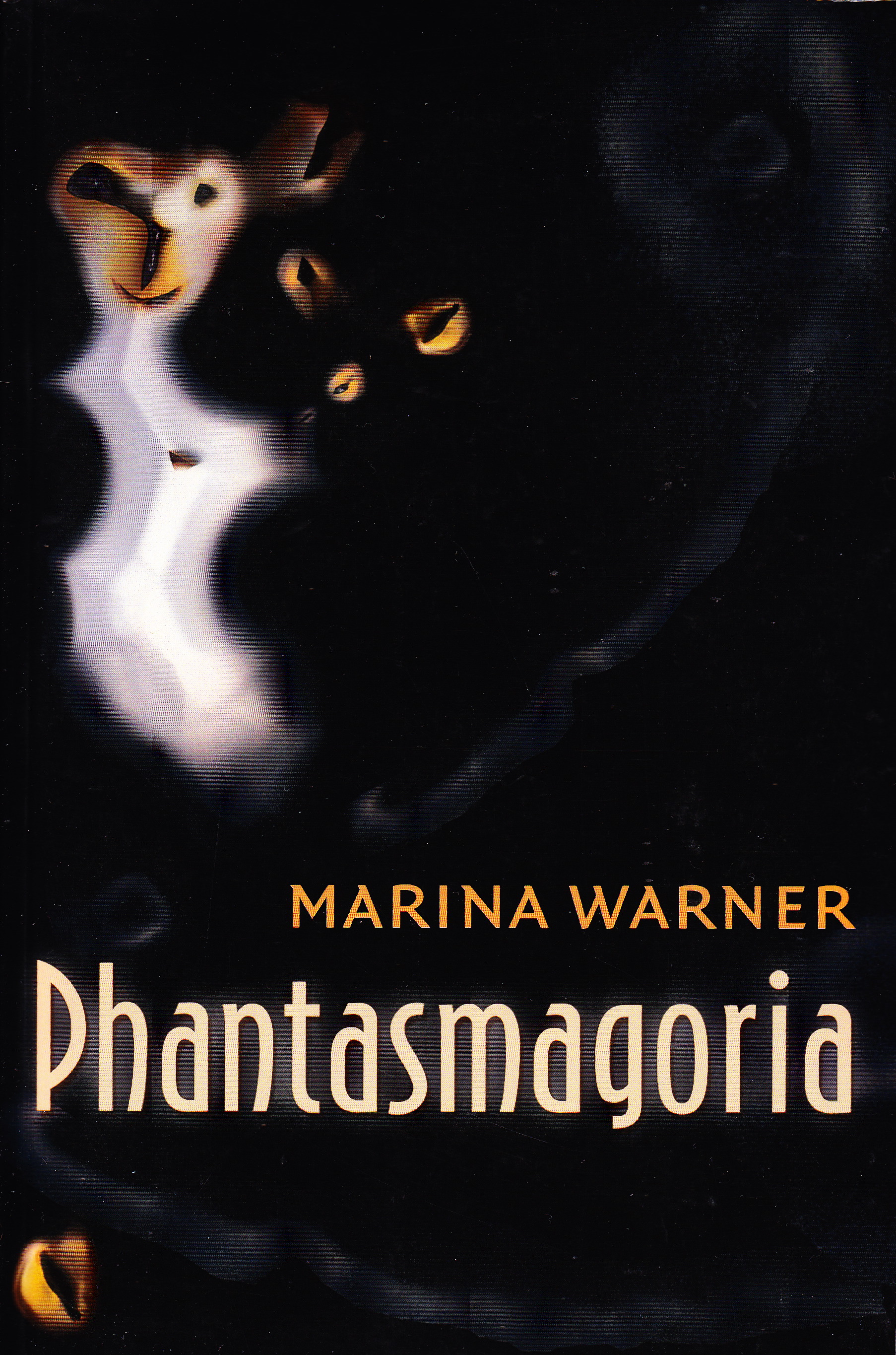
PhantasmagoriaPhantasmagoria is a most appropriate title for the book by Marina Warner that bears that single-word name. The back cover bears none of those helpful tags that give the reader a handle by which to categorize the book. The subtitle helps somewhat: Spirit Visions, Metaphors, and Media into the Twenty-first Century. The book is about ensoulment. The popular rage among many academics is the exploration of embodiment—the times and trials and wisdom of having a physical body. (We all know it, but it is the scholar’s job to think about it.) Warner asks what soul stuff is and pursues this through many media: wax, air, clouds, light, shadow, mirror, ghost, ether, ectoplasm, and film. She’s not suggesting that souls are made of these things, but rather that people have used these media to explore what a soul might be. Apart from being a fine historical resource on these different avenues of exploration, individual chapters in the book focus on various artists, psychologists, parapsychologists, writers, and Scriptures. This makes for a fascinating, if challenging, exploration to undergo.

One of the topics that emerges in the discussion is how soul distinguishes itself from other unquantifiable aspects of being human: what is mind, for example. We can’t really define soul, but it is frequently differentiated from mind or personality, neither of which is particularly well understood. In an era when we’ve not so much ceased to ask these questions as sublimated them into various fictional realms, a book like Phantasmagoria is especially important. The reaction against materialistic reductionism is strong, if not empirically provable. We still flock to theaters to watch zombies on the screen, precisely because we too have become soulless. Romanticism had a place for Gothic sensibilities as well.

Along the way Warner makes a particularly apt observation that politics and entertainment have become difficult to distinguish. Thinking over the number of entertainers who’ve become policy makers, this is a particularly disturbing thought. We trust the media and it gives us entertainment. Most college professors make so little money as to be jokes when it comes to running a political campaign. Where your treasure is, as the saying goes. Media, in all the forms explored, has failed to capture the soul. The chapter on Revelation (the book) is truly spectacular, coming, as it does, in the section on film. It is the embracing of the chimera of the end of the world pieced together from various myths and nightmares that our political leaders find, in many cases, far too compelling. Someone like Warner might be a much better leader to trust, even if she is a scholar.


Divergency

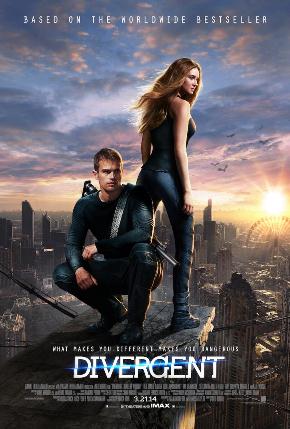
DivergentSelf-denial, no matter what its motivation, is a religious ideal. In its more extreme forms it becomes martyrdom, but most religions agree on the value of taking less for yourself so that others might have more. This has been running through my head since seeing the movie Divergent. I read and posted on the book some time ago, but having recently seen the movie—a fairly faithful adaptation to the novel—I was forcefully reminded that this is a dystopian parable. In the future, society is divided into different factions, based on a person’s predisposition. This is done to keep the peace, and the factions seem to get along until suspicion grows about the group called Abnegation. The Abnegation faction is moved by pity and compassion for others. They are the consummate self-deniers, not thinking of themselves to the point of limiting time they can spend looking in a mirror. Others are the focus. Naturally, those who see the utter selflessness of others wonder what they’re really up to. Suspicion grows that this group is after wealth, in the form of food, secretly stockpiling it for themselves. Nobody would give up for themselves so that others can have more.

As I watched the movie I thought about religious groups that preach self-denial. Granted, I’m only one person, but growing up that was the message I continually heard loud and clear in the teachings of Jesus, according to the Gospels. Deny yourself so that others might have more. The deeper I became involved with the church, however, the rarer I found such behavior. By the time I reached college, I still hadn’t figured out that religion had become an industry, like any other. A service industry, to be sure, but it still had CEOs and treasurers and, increasingly, political power. The political seduction of religion already had a history by the time I became aware of it, but I still believed that self-denial was at the core of true religion. Perhaps the factions I heard whispering around me were right. Perhaps there was something more driving all this.

In Divergent, the belief in selflessness leads to self-sacrifice. In many feel-good movies, this leads to an expected resurrection. Here the future is bleak, and the dead remain dead. There is a kind of resurrection as the Dauntless faction comes out of its stupor, but the movie leaves the viewer wondering if there is a future after all. Is there a place in the world for those who legitimately want everyone to share? I think that every time I find myself driving. Behind the wheel, selfish maneuvers that lead to little, if any, ultimate gain seem to be deeply embedded in those who want to get there first. Abnegation, it seems, is a danger on the road. Driving, it seems to me, is a real test of someone’s religious convictions. Perhaps it is that one has to realize that the vehicle in front of you contains another human soul. Or perhaps it is that the fragmentation of society has already gone too far and those who don’t take for themselves are not emulated, but consumed.


The Last Word

The end of the world, it seems, never goes out of fashion. My wife shared a story on the BBC about CNN (such self-referential media hype may be a sign that society is collapsing already) having a video ready to release for the apocalypse. In a bit of end-of-time sangfroid, it is rumored, CNN’s Ted Turner ordered a last-second video to be made so that loyal CNN viewers would be ushered out with his version of the last word. The media, of course, is a powerful segment of society. Occasionally schools and businesses are shut down due to their meteorological predictions. The media tells us who the experts are, and why we should listen to them. The media provides us with some of the only fact-checked material from far-flung ends of the globe—or even outer space—to which we, the people, would not normally have access. The media, in other words, determines reality.

800px-Apocalypse_vasnetsov

Meanwhile I wonder, as I often do, what gives those who own media corporations the right to determine reality for the rest of us. For example, if the rumor of Turner’s video is true, what would give the rich and powerful the right to determine what flashes before our eyes as the world winks out of existence? The apocalypse, after all, is a religious concept. Although largely developed from biblical scripts, other religions do occasionally have their end-of-the-world myths, just like most religions have beginning-of-the-world myths. If you have billions of dollars, does that mean you have the right to determine end-times viewing? When money determines the truth, the world has already ended.

Nevertheless, the idea lives on. We are constantly reminded that one or another religious sect has declared that the end is nigh. We’ve heard it so often that we’ve ceased to pay attention. In a world where the media has largely dismissed the rest of the Bible (except when blockbuster movies come out featuring a biblical story) why does Revelation still hold such currency? After all, the apocalypse takes its very name from the final book of the Christian Bible, and without Revelation we might be none-the-wiser about the looming end of all things. Revelation was very much a product of its time. Despite the progress of science and technology that gave us the media corporations we blandly recognize today, we still harbor doubts deep down about the longevity of it all. Even those who write the news look to other media giants to get some hints of the truth. Ironically, they don’t seem to want to ask scholars about it. After all, sensationalism is news. At the end of the world, we really don’t care what scholars have to say, as long as we’re entertained.


Worn Out Religion

Truth claims are integral to religions. No one would join a religion not declaring itself to be true. Some months ago, I posted about the store True Religion that had recently opened at our local mall. I’ve always found such branding odd—surely the store wasn’t proselytizing those who had religious commitments to buy its jeans. Or perhaps it was trying to lure in the increasing generation of nones. I have seldom felt any kinds of truth claims applied to my apparel. I buy clothes at reasonable prices and wear them until they are no longer fit to be seen in public. Even then I continue to wear them at home until they simply grow too holey to be of utility. I seldom have clothes left in good enough shape to donate, and I’m only fashion-conscious in terms of a decade or two between stints of buying what’s on the bargain rack. Religions, of course, sometimes do dictate what it is appropriate to wear. Leviticus famously declares that fabrics of mixed fibers are an infraction. Perhaps True Religion carries only single fiber-fabrics? I guess I’ll never know.

IMG_1868_2

Since our local mall has mostly clothing stores (few whimsical shops appear any more), I seldom go. There is an Apple store, and since our family has used exclusively Apple products since the 1980s, we do have to stop in from time to time. On my most recent trip, I noticed that True Religion, right across the corridor from Apple, had gone. “There’s no more true religion,” my daughter quipped. I couldn’t help but think about the implications of all this. Surely this was not the first religion to die. Disused churches have been converted into businesses for years, and some religions die out entirely rather than just fade away like an old pair of jeans. What is the message, however, when a claim of truth is made, only to be closed down by the exigencies of finance alone? Something disingenuous is going on here.

Religions not only make truth claims. They also convey a sense of promise. If you believe, you receive something in return. But what does it mean to believe? Driving home we passed the Elks Lodge. Once, when my daughter received a certificate of merit from the Elks, we were invited to an award ceremony there. The president of the lodge, doing a bit of proselytizing, mentioned that very little was required to join the Elks. “You do have to believe in God,” she said. How do you measure such a belief? Did she mean to say “you have to say that you believe in God”? The Elks are, after all, not a religion, but a community organization. Although True Religion is gone, the Elks, with their minimal commitment to faith, are still around. My clothes are perhaps a bit too worn to join the Elks, but what else is there to do when there is no more true religion?


Monster Map

Monster QuestMonsters are becoming more mainstream. Or at least it seems that the ridicule factor, with which I had to deal as a child, has moderated a bit. A friend recently sent me a link to Hog Island Press’s Monsters in America map. No doubt, skeptical persons will dismiss such whimsical charts as a load of hooey, but people continue to see unusual things. Although we don’t subscribe to any television service, it has become clear that ghosts and Bigfoot have become pretty standard fare for reality shows. Lake monsters still make appearances from time to time, and since we aren’t always watching the waters, nobody’s terribly surprised. And who knows what’s flying below the radar at night? People have believed in monsters from the very earliest of times. We, however, live in an age when belief can’t exist without proof, and our world of the plausible has shrunk because of it.

Another problem here is the definition of “monster.” The traditional monster was pure fiction—werewolves, vampires, and zombies simply don’t exist. We tell scary stories about them because it’s fun to be afraid when we know there’s really no such thing. American monsters, on the other hand, are based on eyewitness reports, reliable or not. I grew up literally on the edge of the woods in a rural town and never saw anything cryptozoological in nature. At the same time I learned that it’s difficult to see everything in the woods. I would’ve never guessed, for instance, that the number of deer and bear that were shot each season were only a small representative of their populations. The woods, it seemed, should’ve been much more crowded.

Those who’ve spent time in the woods know that nature doesn’t reveal everything easily. Looking at the Hog Island Press chart, I notice some new creatures (to me) and some surprising omissions. Wisconsin and Michigan, both heavily wooded and (I speak from experience here) areas of strangeness, seem devoid of the creatures so commonly reported. Linda Godfrey has written extensively about the dog-men (or werewolves) not uncommonly reported in both states. I suppose that in making such a map there is an embarrassment of riches. People see things all the time, and urbanites have a difficult time identifying species the naturalist finds, well, natural. One need not be credulous to enjoy the monsters of the natural world. It is fun, in any case, to consider the possibilities, now that monsters have gone mainstream.


Commandments by Committee

Something about the holiday season seems to bring out atheistic activism, or at least media interest in atheism. Now that we’re safely in 2015, I suspect things will quiet down a bit until the next major religious holiday comes along. Ironically, since I was a child I’ve heard about how secular Christmas, in particular, has become. Reactions to this have led to “Christmas wars” that give the lie to sleeping in heavenly peace. In any case, back in December CNN ran a story on the atheist ten commandments. This was just before the holidays, but just after the release of Exodus: Gods and Kings, so it was a story sure to capture human interest. The atheist commandments were chosen by a committee, and, of course, have no binding value. Many of them are more precepts than commandments since, it seems, you need a deity to command all of humanity. Nevertheless, the number 7 commandment has a very biblical sound: “Treat others as you would want them to treat you, and can reasonably expect them to want to be treated.”

More interesting than the list, in my way of thinking, is the form of delivery. The ten commandment format is an obviously religious one. Atheists have long tried to make the case that non-belief is not the same as immorality, and there can be little doubt that this is correct. One need not believe in order to be a good person. Yet, the force of the symbolic ten commandments comes from a divine mandate. Committees, as efficient as they may be, don’t have the same kind of authority. You can hear it now—“Why should I listen to you? Who are you to tell me what to do?” With God there is always the threat of eternal damnation or the sending of plagues. Commandments by committee appeal to reason.

The ten commandments—here I mean the traditional ones—haven’t fared especially well among the faithful. Survey after survey shows many people don’t know all ten well enough to cite them. Some, such as the one against coveting, are hard to demonstrate or prove one way or the other. Honoring parents, in some extreme cases, seems sinful in itself. What doesn’t count as a graven image? So my question is, who has the authority in a post-Christian world to give commandments? The religious certainly won’t take advice from atheists, and religious leaders disagree among themselves about what the deity demands. No committee, it seems, can capture the true essence of divine demands. Perhaps it is a matter of boiling the ten down to one (similar to number 7 cited above) and getting our leaders to truly believe this before imposing it on all.

480px-Rembrandt_-_Moses_with_the_Ten_Commandments_-_Google_Art_Project


Biggest Buy

It isn’t really that much of a specialty item. You see, we live in an older apartment and three-pronged outlets were mostly reserved for kitchens the last time the place received any kind of upgrade. I’m not sure which century that was, but here in the twenty-first, we have lots of electrical toys, and of course, they come with grounding plugs. We needed an outlet for a device, but the nearest plug was yards away. Well, it seems that extension cords are now fire hazards, so you need to use a power-strip. Your typical power strip, as I came to learn, has a six-foot cord. (Although I said “yards,” I meant more than a couple.) So I drove to Best Buy. I can’t remember the last time I was in one. These “buy it large,” “consume excessively” kinds of stores aren’t really my style. I never believed the consumer myth, but I figured these large appliances must require surge protectors or power strips, right? And surely not all houses have conveniently located plugs.

Photo credit: Myke 2020, Wikipedia Commons

Photo credit: Myke 2020, Wikipedia Commons

I am neither a large man nor a fetching woman, but it became clear that I was practically invisible in the store. Trying to get the attention of anyone on the blue-shirted staff was impossible. Even walking right up to someone with purpose wasn’t enough. I did notice, however, that the blue shirts were fairly adept at helping the female clientele. Eventually I found the surge protectors, etc., in their aisle—up to eight feet in length. I tried for another 20 minutes to find help, but the kind of help I need, apparently, doesn’t come in bulk. Maybe on a couch. I went home and within minutes found what I needed on Amazon. I would have it in two days.

Bulk buying, in my humble opinion, is an ethical issue. I’ve stopped going to Home Depot, and even Staples and Barnes and Noble are final resorts. What I’m looking for can’t be found in such places. Besides, nobody wants to stop and direct a bearded, perpetually confused-looking guy. We live in a culture where worth is measured in comestibles and durable goods purchased in bulk. Those with the most buying power are the gods. I can’t even drive by Costco without a substantial delay on a Saturday morning. I don’t need very much to get by. Still, come to think of it, I could use a power source that is conveniently located. And perhaps, some day, a culture more interested in quality than quantity.


Like a Virgin

Having more than two days in a row when I could be both home and awake, led to some premature spring cleaning over the last few days. One of the artifacts discovered among the piles of “deal with it later” things was a booklet that was likely an impulse buy—a stocking stuffer or perhaps a whimsical birthday giftie. In our house it could have only been directed at me since it was a little book about Virgo. I have never, even in my most experimental modes, considered astrology to be anything but pure fantasy. I do, however, realize that it is just as old as astronomy, and ancient peoples firmly believed that the sky had unseen influences on everyone. Still, the calendar dates during which you are born can’t provide personality traits any more accurate than gross generalizations. Two of my brothers and I are Virgos, and we are very different personalities, despite having grown up together.

Still, curiosity compelled me to take a few minutes to look at the guide by Teresa Celsi and Michael Yawney. It begins with a brief introduction to astrology, and as I thought about it, I realized that there are indeed people who take it seriously. Long ago I recognized that the criticism “ridiculous” (apart from being offensive) is never an adequate antidote to religious belief. Many elements in conventional Christianity, and other mainstream religions, fall into the similarly implausible realm. There is a kind of science to astrology—labeling and categorization, observation and recording. I still don’t believe it, but I can see how it might appeal. And I thought I could recognize myself in the Virgo the booklet described. Yes, some of that was definitely me. Then I got to the bit about a Virgo’s house being neat and tidy, and how people appreciate it. We live in a small apartment and visitors (who are few) are more inclined to make sure their immunizations are updated after leaving, rather than praising our housekeeping skills. Fact is, clutter doesn’t bother me that much.

Virgo2

The majority of the little novelty book was about relationships, of course. I still remember the days when “what’s your sign” was considered an acceptable pick-up line, at least if movies are to be believed. I couldn’t remember my wife’s sign, and was surprised to read, when I found it, that we might encounter some conflict, should we decide on a permanent relationship. We’ve been married for 26 years with barely a raised voice in all that time. Maybe it’s because I’m a Virgo. Or maybe it is because we are more the agents of our own destiny than the stars. Nevertheless, it would be a comfort if we could pick up a chart and know what our lives might be like. It’s easy to see why astrology has taken on the quality of a religion for many. Please excuse me but, according to my nature, it is about time to get back to my cleaning.


Land’s End

Although not due for release for another two years, the internet is already buzzing about Pirates of the Caribbean 5. Thing is, once a studio finds a successful formula, they’re reluctant to let it go. Nevertheless, with a couple days off for New Year’s, and all the family here, we decided on a marathon of the four movies available for home viewing. I used to use a clip from the second movie (Dead Man’s Chest) in my classes to demonstrate how the Bible is portrayed in popular culture. In the scene where Pintel and Ragetti are rowing toward the beached Black Pearl, Ragetti is leafing through a Bible, although he can’t read. He says, in his defense, “It’s the Bible. You get credit for trying.” Indeed, the Bible appears disguised as the huge codex of the pirate code (a kind of over-compensatory pentateuch), and, as I noted before, the book that saves the mermaid’s life in On Stranger Tides. In fact, for those willing to look behind the scenes, the Bible shows up repeatedly in the series.

Even as a landlocked child maritime themes and concepts were compelling to me. I yearned for the ocean without ever seeing it. Long I stared at the cover of Rachel Carson’s The Sea Around Us in wonder. When I finally had the opportunity to strike out on my own, it was to Boston I headed, with its rich New England tradition of the sea. I have tried, ever since, to return there. Theologians, although I don’t count myself among their number, have often found a religious resonance with the sea. The Pirates of the Caribbean movies, based as they have been on a Disney ride, nevertheless manage to tap into the romance of the ocean. Not compellingly written, apart from the fun antics of Captain Jack Sparrow, they don’t present an entirely coherent story line, but they do put the viewer, vicariously, at least, on the ocean. And they have been among the most successful film series ever released. Many, I suspect, are drawn by the lure of the open ocean.

Rewatching the films also reminded me of Cthulhu’s influence on the character of Davy Jones. The origins of the euphemism “Davy Jones’ locker” are uncertain, although some trace it back to Jonah. Nevertheless, it stands for the place of death on the sea floor—the very place where Cthulhu lies dead but dreaming according to his creator H. P. Lovecraft. No doubt, Lovecraft’s description of Cthulhu played into the depiction of the character of Davy Jones as presented by Disney. At the end of At World’s End, Jones falls dead, once again, into the maelstrom that will take him back, dreaming, to the ocean floor. In so doing he participates in the endless give and take of the sea. I suspect a couple years hence will find me in a theater to watch what seems a somewhat tired trope, but it will be more the sea than the sparrow that will draw me in.

Photo credit: Anthony92931, Wikipedia Commons

Photo credit: Anthony92931, Wikipedia Commons


2015

New Year’s Day seemed to me, as a child, an odd choice for a holiday. We’d just had Christmas a week before. Of course, at the time I did not realize that the date of New Year’s was a symbolic one for the Christian calendar, and the celebration seemed no more significant than getting to stay up until midnight. The systematic changing of the years felt just like the regular progression of numbers, and what was there to celebrate about that? Of course, time cures even itself, and I came to see New Year’s as a time of new beginnings. Resolutions never sat well with me, since improvements, I’ve always believed, should be implemented as soon as the problem is noticed. Waiting until the dead of winter hardly seemed like an inspiration to get things done. Unless the resolution was to get more sleep. Still, we can all use new beginnings.

Photo credit: chensiyuan, Wikipedia Commons

Photo credit: chensiyuan, Wikipedia Commons

New Year’s, however, has taken on a more somber tone of late. As an adult, I often brood over the past year, and it seems that just when hope may be on the horizon, we find new ways to make the situation worse. Much of it comes down to politicians and the economy, two things that no resolutions ever seem to fix. Although I didn’t see the point of it all as a child, I did look to the future with optimism. It has gotten so bad now that science fiction writers have to make a case for trying to have a positive outlook. Dystopias are popular, I believe, because they are believable. Given the performance of politicians and church leaders (with the obvious and large exception of Pope Francis) we’ve seen little to suggest that our institutions have the will or the means to improve our lot. Even the Pope has made enemies by being a nice guy.

Already we’ve begun to hear that some apocalyptic groups have targeted 2015 as the year the world will end. We’re just getting over 2012. I think what is most disturbing is the sameness of it all. Another year means the continuation of a job that keeps food on the table, at least it is to be hoped. Beyond that, we will have more antics to watch that, were they not so fraught with consequences, might be thought funny. I haven’t lost my capacity to dream. Those who think me a pessimist don’t know me very well. Dreams are, however, futures that we have to take into our own hands. We can’t spend 2015 waiting for politicians and corporations to suddenly change for the better. In what sense is “business as usual” ever new?