The Wars of the Worlds

Just as it is appropriate for news sources to carry religious stories without ridicule in weekend editions, October is the month when strange things might be reported with a degree of seriousness. I have often noted in the past that “paranormal” (think X-Files) phenomena are closely related to religion. Since our ruling paradigm is one of belittling the intellects of those willing to consider evidence beyond the accepted, news stories featuring the unexplained do so with a generous helping of scorn. I was amazed, then, when my wife sent me a story on the BBC News Magazine from the World Service Sport section. (Which is near enough to paranormal, as sports fail to interest me in the least bit.) A story by Richard Padula is entitled “The day UFOs stopped play.” Near this date in 1954 in Florence, Italy, a soccer game stopped as UFOs appeared above the stadium. Former World Cup players stared upward instead of at the ball. The event was documented and never explained. I kept waiting for the jowl-waggling punchline. It never came. Here was a news story from a reputable source taking something strange at face value.

Paranormal activities and religious experiences are in the same category when it comes to a materialistic universe. They can’t exist and so the superior mind must laugh them off, stating they are an illusion, hallucination, or hoax. They still happen, nonetheless. Some world governments are beginning to announce to their citizens that they recognize unexplained arial phenomena exist and—truly astounding for government rulers—they have no explanation. Something weird is going on. It was on Halloween Eve in 1938 that Grover’s Mill, New Jersey, was invaded, according to an Orson Welles radio play. Since the inexplicable panic that came following that broadcast, extraterrestrial visitors have been laughed off the serious news page into the comic section. News stories have never taken it seriously since.
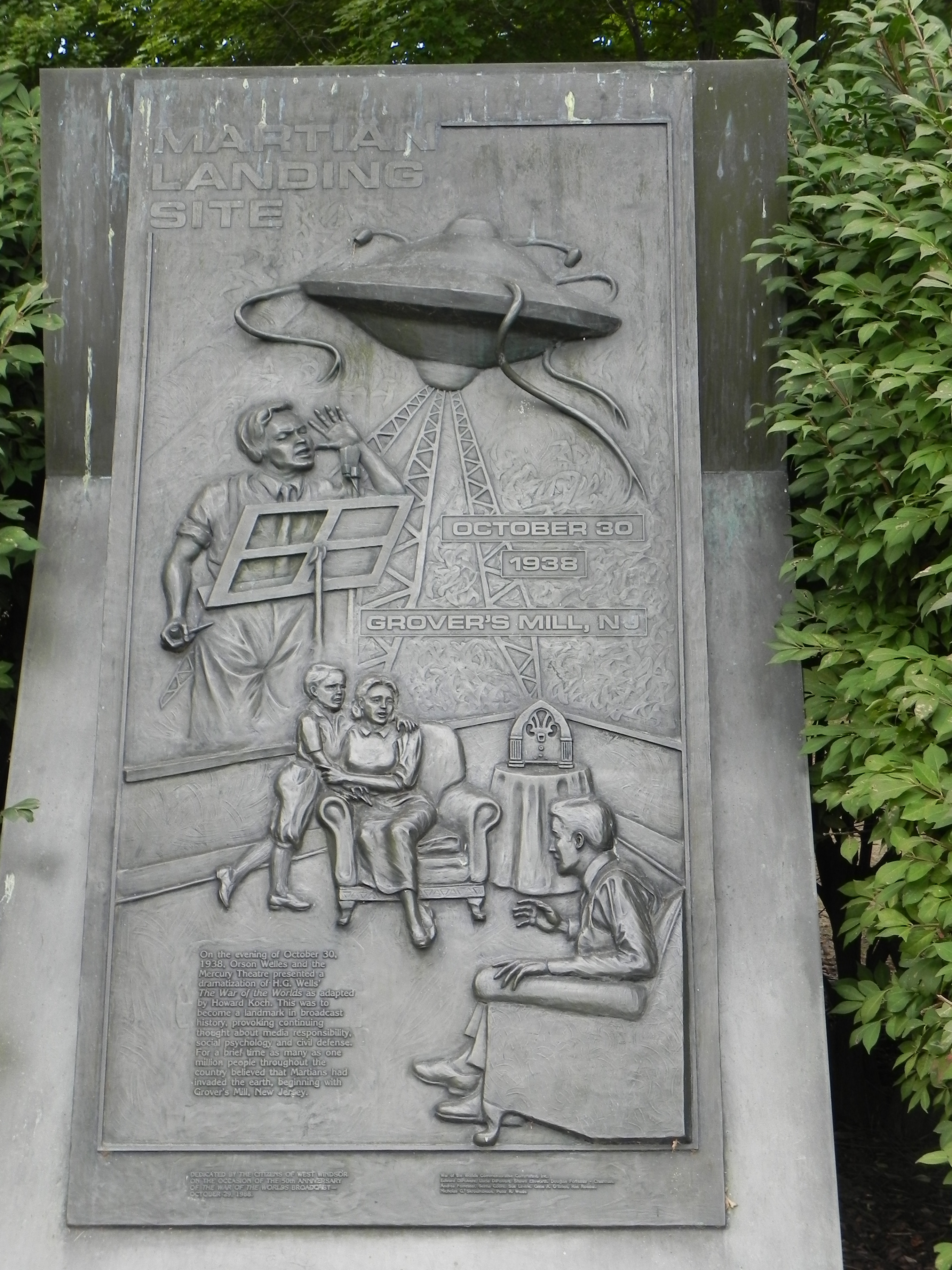
DSCN4237

A sports writer, casting about for an interesting story, might well focus on an event of such Fortean dimensions. Some highly respected people present at that game were interviewed with utter seriousness and traces of physical evidence were even gathered. A substance whimsically called “angel hair” was found all over the city, and despite the chemical signature, was declared to be the webs of a massive spider invasion (who needs aliens to be scared?) by many scientists who didn’t witness it. Laugh and the world laughs with you. The BBC doesn’t seem to be laughing in this story. Tomorrow is Halloween, when many improbable things seem possible, if only for a short time. Weather balloons, swamp gas, and Venus notwithstanding, sometimes people of normal intellect turn their eyes to the sky and wonder.

Non-Fiction Steampunk

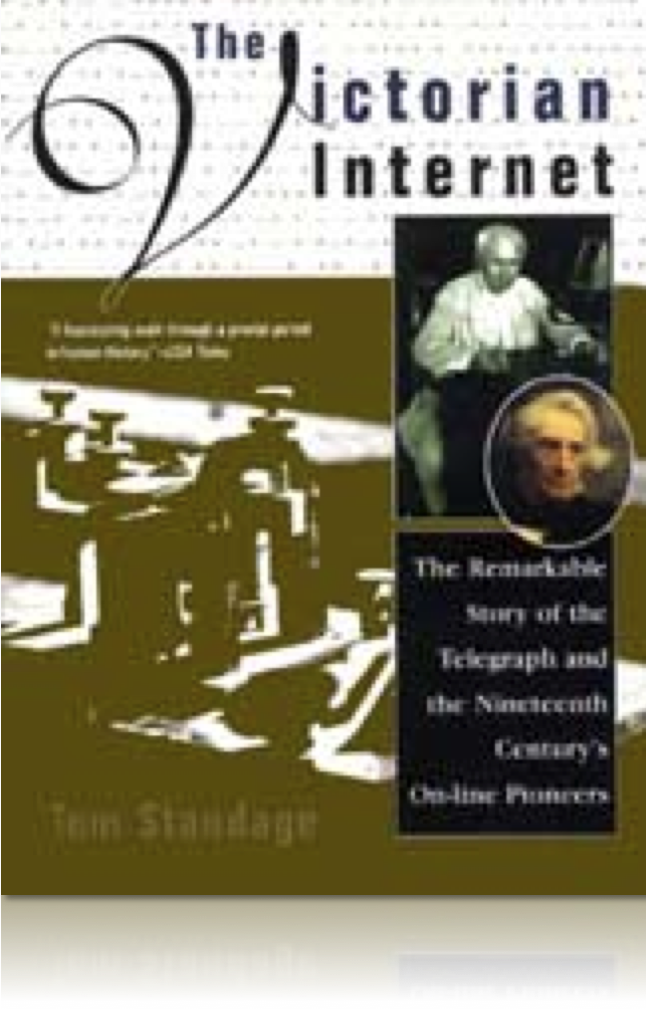
TheVictorianInternetThe histories of Tom Standage approach familiar things from unfamiliar angles. Being interested in Steampunk, and a daily user of the internet who has trouble recalling what life was like before then, I found The Victorian Internet fascinating. Subtitled The Remarkable Story of the Telegraph and the Nineteenth Century’s On-line Pioneers, the story of the wiring of the world did resonate in any almost eerie way to the early days of the world-wide web. Despite my disclaimer, I do recall those days clearly when the only way someone could get in touch with you immediately was the telephone, and you had to be at home for it to work. Prior to the telegraph, news traveled even slower and you could go months without hearing from those closest to you, if they happened to be away. Samuel F. B. Morse knew that first-hand, as Standage tells it. His wife died while he was out of town, and although he rushed back right away upon hearing, she had been buried before he reached her. Such was life when news arrived only by letter. Morse was among those who invented the telegraph, a device that made the world realize that yes, it was possible to send information to distant places almost instantly. It soon become a wired world.

Standage is also more circumspect than some writers who declare, with breathless awe, that some new device will cure the world’s ills. Showing how the telegraph generated much the same hyperbole as the internet (that peace would reign now that people could communicate instantly, that technology had brought a miraculous rapprochement, etc.) he notes that people remained people. Wars continued—intensified, in fact, into World War One where technology was devoted to destruction. People had always been able to kill each other. Now they could do it faster, and in more hideous ways. Still, there’s no denying that once the idea of instant communication caught on that we would continue to develop it rapidly. You never need be away from a network that covers much of the developed world and you can talk on your phone from deep under the Hudson River to the top of the Empire State Building. You can order a pizza from anywhere.

Ironically, Morse dedicated part of his earnings to endow a lectureship concerning how science related to the Bible. It was clear that technology had achieved the impossible (okay, well, the improbable) and yet, Victorian society still relied on the truths contained in Scripture. The telegraph, which began with the words, “What hath God wrought,” ended with the attempt to figure out how the Bible fit into all this. Just because humans had crossed the great barriers of oceans with electric cables didn’t mean the Almighty was out of a job. Even today God can be found on the internet. Along with many other choices of distraction and business. God is not so much dead as commodified. The difference between Morse’s day and ours was that then they knew that the Bible impacted daily life. It continues to do so today, but we’ve become too sophisticated to give it much of a nod. We might be well served, however, to look back once in a while as well as to look forward. We might be surprised at how little things have changed.


Devil’s Food

One figure among the standard repertoire of Halloween characters has never appeared on my list of favorite monsters. I suppose it may be because as a child I fervently believed there was a devil that he never made my A-list. Satan was real, according to my church, in some almost biological, corporeal form. Even as a youngster I knew vampires, werewolves, Frankenstein’s monster, and the rest, really didn’t exist (even after I hid under my covers all night once, after putting my head down on a bat that had flown into my bedroom). The devil was, however, biblical. And I never felt tempted to dress up with red horns and pointy tail, carrying a plastic pitchfork. Halloween was always among my favorite holidays, but it was for pretend monsters and ghosts (which might perhaps be real, but which were not diabolical, according to my childhood economy of the spiritual world). The consequences of devil imitation seemed eternal, and even today, in the rational light of the twenty-first century, I can still be given pause even though I know the concept is a Zoroastrian one that morphed into early Christianity’s need for a kind of anti-Christ.

IMG_0276 copy

There are many who still believe in a real devil. Some branches of Christianity (and Islam) teach that a literal devil lurks about in our world. In western culture he is a figure instantly recognizable, although there are differences of opinion in his anti-iconography. Last weekend I visited a fine little restaurant in a New Jersey town that has a reputation for being haunted (the town, not the restaurant). It was a seat-yourself day and the table my wife and I ended up selecting had shellacked cards on top as part of the decoration. There in front of me was the devil. I pondered this. The cards, all captioned in Spanish, had mundane subjects: an umbrella, a musician, plants, a spider (okay, so that last one’s a little scary too), but only one supernatural figure. Perhaps the entire deck, had I seen it, might have had more. No doubt, for a world that postulates a good God, a devil covers, well, a host of evils.

The word “devil” is somewhat loosely applied these days. New Jersey has its own cryptid called the Jersey Devil, which has led to iconic names for sports teams and perhaps a public official or two. But even in the aftermath of 9/11 there were those who seriously postulated seeing the face of the devil in the tumbling debris of the twin towers. For a character of the religious imagination, the devil has managed to impress deeply on the human psyche. I know in my rational mind that I should simply dismiss all of this and get on with the business of enjoying the monsters that will show up at my door later this week. Nevertheless, when the waiter comes out with our food, I look down at the table and decide to pass on the hot sauce for today, just in case.


The Fate of Goddesses

The goddesses Asherah and Astarte are sometimes confused, even by experts. Astarte, also known as Ashtart, Ashtarte, Athtart, and Astaroth, among other names, is the lesser attested of the two among the Ugaritic texts. Indeed, to read some accounts of the latter goddess, she becomes dangerously close to being labelled generic, the sort of all-purpose female deity embodying love and war, and sometimes horses. In the Bible Astarte lived on to become the bad-girl of Canaanite goddesses. Her corrupting ways were a conscious danger to the orthodox (as much as that is read back into the texts). She became, over time, literally demonized. It seems that originally she, like most goddesses, had a soft spot for humans. Since she wasn’t the one true (male) God, however, she had to be made evil. It is an unfortunate pattern as old as monotheism. One of my original interests in studying Asherah (not Astarte) was precisely that—the obviously benevolent divine female seems to have been chucked wholesale when the divine masculine walked into the room. Why? Well, many explanations and excuses have been given, but whatever the ultimate cause, Astarte lingered on.

IMG_1620

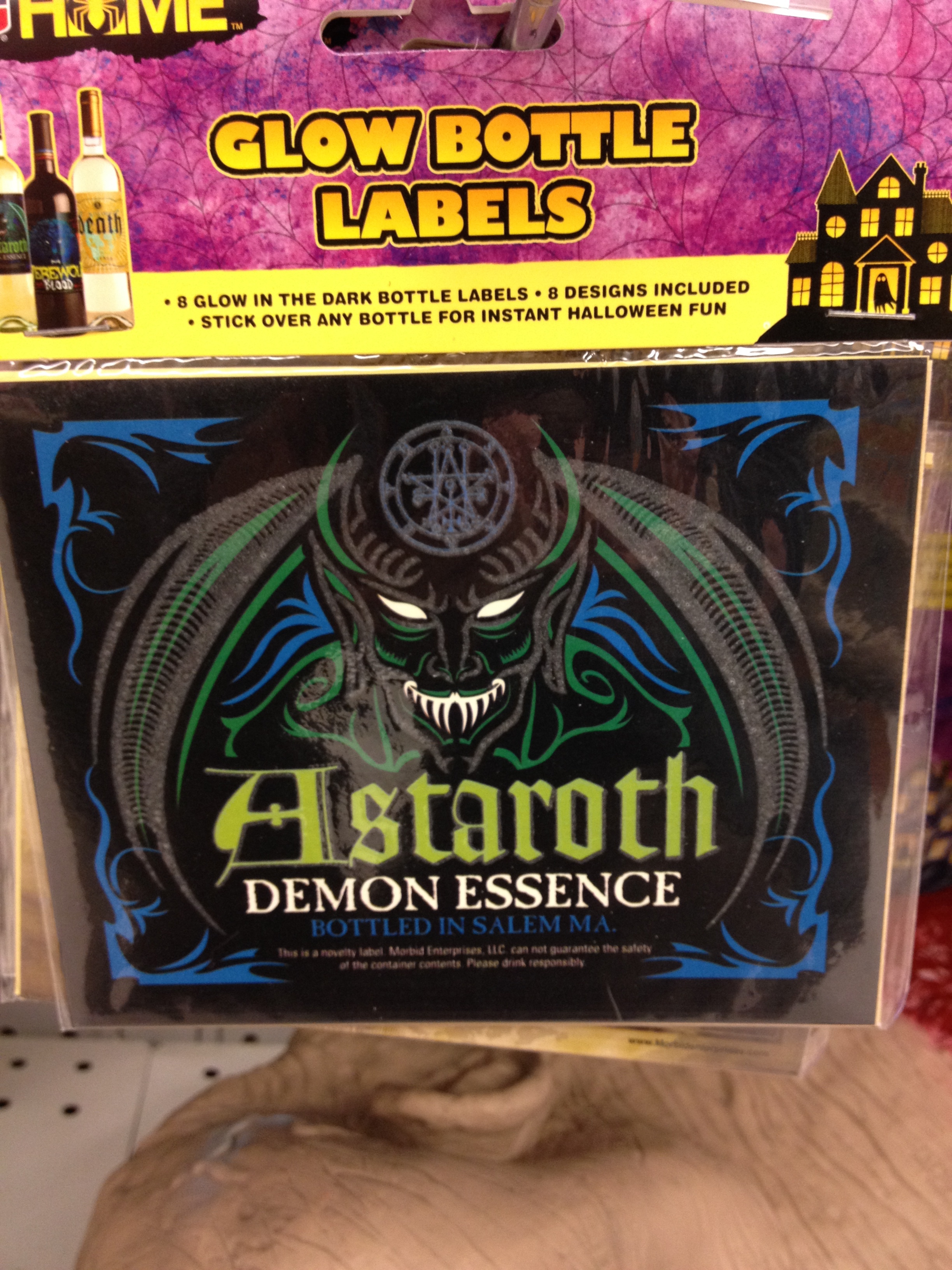
In a local pharmacy the other day, I was looking over the Halloween tchotchkes. Amid the usual assortment of pumpkins, skeletons, and ghosts, I found bottle labels reading “Ashtaroth Demon Essence.” Although I’ve spent a good deal of my life cloistered in academia, I was not surprised by this. I know that in popular culture the goddesses of antiquity live on as supernatural powers, sometimes good, sometimes evil. Astarte, once depicted as the friend to at least some of the humans devoted to her, is now commonly a demonic force. The image on the bottle label, however, was most unflattering. I know, this is just kid’s stuff. Still, as I stood there among last-minute costume seekers and distracted parents, I knew that I was witnessing the influence of ancient religions in an unexpected way. Did any of the goddesses survive as a force for good? How could they when the only god was male?

We know very little about ancient Astarte beyond the fact that she took away some of the luster of the omnipotent (as now conceived) deity of the Bible. A jealous God, as Holy Writ readily admits, visiting iniquity down to the third and fourth generation. (That might explain a lot.) Prior to monotheism benevolence and malevolence could arise from goddesses as well as gods. Compassion, it was believed, was largely a feminine trait. Monotheism decided for the jealous male instead. We won’t find a bottle label for the Almighty, although the accouterment of the arch-enemy are everywhere evident this time of year. And speaking of the diabolical, the Ashtaroth Demon Essence, I noted, was available at a steep discount.


North Tarrytown

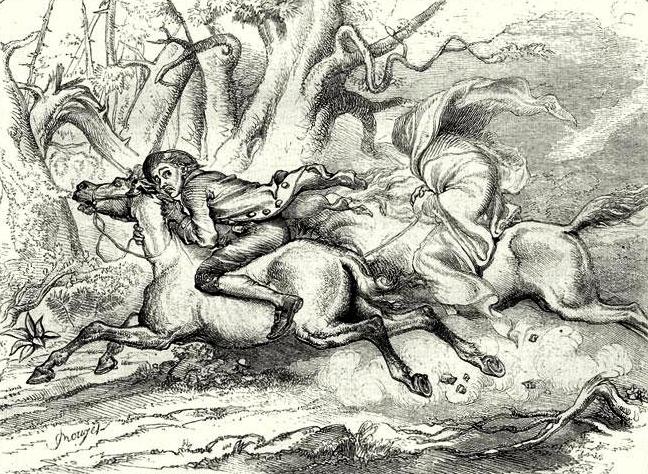
Ichabod Crane has undergone many incarnations since Washington Irving conjured him. Not very sympathetically described in the original “Legend of Sleepy Hollow,” he was gangly and somewhat clumsy and full of self-importance. The story of which he is forever a part, however, has become iconic of American myth-making. A deep symbolism runs through the story of the headless horseman, and for those who’ve actually been to Tarrytown, the modern incarnation of Sleepy Hollow, there may be a disconnect between the urbanity of a town so near to New York City and a rustic school teacher in a rural setting. Still, there seems to be quite a bit of buzz about the current television series “Sleepy Hollow” that I decided to see for myself what was happening. The conceit of Ichabod Crane reawakening, in a kind of Rip Van Winkle twist, in the present day is engaging. He is now a professor at Oxford University turned patriot to the American cause, which brings him to the point of actually beheading the horseman in the first place. But this literate, witty, and moody retelling involves more than Irving. The Bible is pretty much central to the series, at least as far as I’ve seen.

The headless horseman is none other than Death, the final of the four horsemen of the apocalypse, according to holy writ. Although the characters all refer to the Apocalypse as “Revelations,” something that causes premature baldness in biblical scholars, the program places the town of Sleepy Hollow at the crux of the oncoming end of the world, with the other three horsemen to be summoned along the way (Pestilence or Conquest, War, and Famine, for those who are keeping score). Also, witches, hearkening back to Salem, have a prominent place in the narrative, and the forces of rational law seem to be at their collective wits’ end to make any sense of religion breaking into a secular world. Without the Bible’s final book, Sleepy Hollow would have no legs (as well as no head).

Ichabods_chase_crop

In Tim Burton’s Sleepy Hollow, Ichabod Crane came through as a detective plotting science against superstition. At the end, however, even the most rational had to admit there was more going on than the science of the day could explain. That is part of the appeal of the Sleepy Hollow legend. No matter how strong the light we shed on them may be, our psyches reach out for the immaterial, the ghostly, the supernatural. We like to believe in sacred books and spells to protect from evil. Even the Twilight Zone episode “The Jungle” plays on how in even the most advanced cultures we still build skyscrapers with no thirteenth floor, as if our towers represent an unknown hubris for which we may be held accountable. Irrational? Perhaps. But Sleepy Hollow is not so somnolent these days when the Bible once again takes center stage and hoofbeats are heard once again in the night.


Empire State

Hegemony is a funny word. In studies of antiquity it is commonly found since it denotes the “Leadership or dominance, especially by one country or social group over others,” according to the Oxford English Dictionary. Today it has a vaguely imperialist taint, although it doesn’t necessarily require that one nation actually pillage another’s wealth or resources. The idea that people are, and should be, free is pretty much assumed in developed nations. Or so at least our rhetoric dictates. The word hegemony came to mind, however, as I saw an interview with a corporate leader. He was discussing how his company had budgeted for technology development on an increasing scale, to catch up with current developments, and then leveled the tech expenses off after that so that the business could move into its prime objectives. The reality was vastly different, however. Each year’s budget saw increasing technology costs and it shows no signs of slowing down. Every industry, it seems, will have to keep devoting larger and larger shares of its budget to technology. Hegemony.

It’s not that any one company is solely responsible for our obeisance to technology, so this hegemony has no head. It is the idea of progress gone wild. Last year as I set out for the American Academy of Religion and Society of Biblical Literature annual meeting, a notice popped up on my laptop that a software upgrade was available. Since I file that I required was no longer accessible unless I updated, I clicked through all the agreements and provisos that I can’t understand and began the upgrade. Download and installation time measured in hours rather than minutes and I soon had to interrupt the process to get to the conference. This had consequences that nearly led me to becoming utterly lost in a part of Baltimore I’d been warned to avoid. The gods of technology demand their due. Now, less than a year later, I can’t access certain files unless I upgrade again.

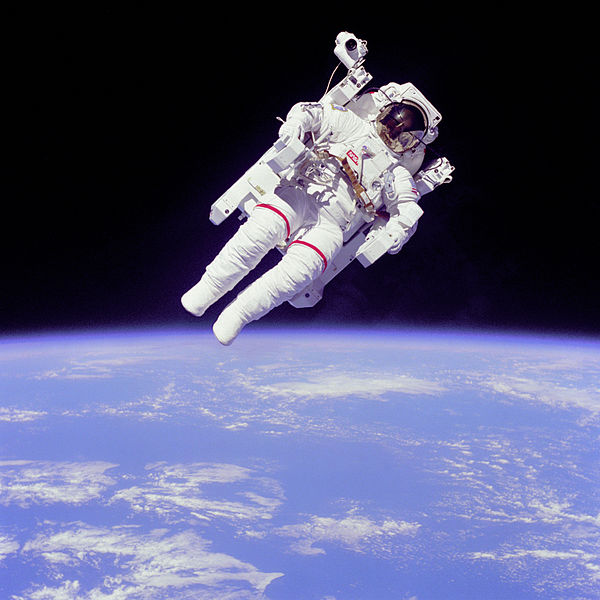
Don’t get me wrong—I’m not a complete Luddite. I enjoy the instant gratification of finding information in seconds through a web search, but I’m not always sure that I can believe what I read. Technology means photos can be manipulated, sounds can be fabricated, facts can be created, all with no basis in reality. I used to have students ask me if such-and-such a fact they’d read online was true. Facts, it appears, are now negotiable. Nobody’s really in charge, it seems. Instead we are lead by the vague idea of progress, a new god with technology as its prophet. Even now I know people who think they never use computers but they drive without realizing their car is full of them, and turn on the television not realizing that the tech is no longer chip-free. Meanwhile those in the technology industry seem to have plenty of extra cash around, while those of us in the humanities ponder whether the ancient hegemonies have really changed at all. Let me look that up on the internet, once this upgrade is through.

600px-Astronaut-EVA


Monsters of Science

ScienceOfMonstersMaybe it’s the ebola in the air, or perhaps the gas from all the midterm elections verbiage, but I’ve been on a monster run this October. I just finished Matt Kaplan’s The Science of Monsters: The Origins of the Creatures We Love to Fear. It is a charmingly written book, at parts approaching the finesse of Mary Roach. Beginning with the ancient Greeks (and sometimes stepping back into the world of the Bible or the Mesopotamians) Kaplan examines the major categories of monsters and tries to offer scientific explanations for why people came up with them. It is a keen conceit and it is deftly handled. Noting that animals sometimes got jumbled in the fossilization process, he offers explanations for creatures such as the Chimera, Griffon, and perhaps even the Sphinx. Some of the unlikely episodes are quite fun to visualize as well, as when a snake slithers over a tar pit where a goat got stuck and was eaten by a lion that also got stuck. Beast after hideous beast he brings down to analytical size, sometimes convincing even this old monster lover.

One of the problems, however, is that science often doesn’t comprehend the symbolic nature of mythical thought. Quite apart from sheer creativity—and it does exist!—some of the material in Kaplan’s analysis would have benefited from having a mythographer’s look. For example, demons do not suddenly appear as monsters in the Middle Ages. Kaplan knows this, but that’s where he starts. The ancient Mesopotamians knew of them very, perhaps, too, well. And Lilith isn’t even mentioned when discussing succubi. Still, there’s a great deal of interesting conjecture here, and some scientifically, if not mythographically, viable suggestions on whence vampires and werewolves. As expected, modern sightings of cryptids are simply swept off the table, but I almost shouted aloud when I read that he gave credence to Wade Davis’s work on Haitian zombies.

The larger question here is one of approach. Do monsters lend themselves to scientific explanations at all? The case that elephant/mammoth skulls might suggest a cyclops seems reasonable enough, and the occasional dinosaur bone that represented a giant in ancient times is entirely possible. (Who can tell one femur from another anyway?) But the monster is primarily a creature inhabiting the shadowy realms of religion and psychology. Our fears are seldom directed toward science, although, now that I’ve read his chapter on “The Created” I’m not so sure. Constructing backward toward the unknown is always a dicey proposition, as those of us who’ve studied history of religions know. We may be able to find the genesis of modern monsters, but, admittedly, the fun for most of our scary friends is that they are mysterious. Impervious, as it were, even to science.


Gothic American

AmericanGothAmerican Gothic, the painting by Grant Wood, caused me trouble at Routledge. An author wanted to use the image on the cover of his book (we eventually managed it) but the choice was contested at every step. Along the way editors, editorial assistants, and marketers all told me what the painting represented and how it was inappropriate. I’ve learned, however, a few things from the post-modernist movement: nobody can say what an artwork means definitively. So when I read American Gothic: New Interventions in a National Narrative by Robert K. Martin and Eric Savoy, I was ready for a combination of po-mo and the macabre. Like post-modernism, Gothic is a difficult term to define. Indeed, the first set of essays in this collection struggle with definitions. Being literary criticism, the book points out that the novel and Gothic more or less developed together. When people read to be entertained, as early as the eighteenth century, they wanted to read Gothic tales.

Being a life-long fan of Poe, I was pleased to see that he made a good showing in the pieces contained in the book. What makes it appropriate to this blog—other than it being October, a comment that requires no explanation in the northern hemisphere—is a notion I found early in the book. People read horror literature for healing. Anthropologically, the wounded healer is a well-recognized figure. In a world where we expect opposites to go together health comes from disease and healing from being wounded. The gothic is a wounding of the mind to lend it healing. To be sure, many of us who read gothic literature do not relish scenes of violence or hurt. We do, however, find a kind of therapy within such darkness. In the darkness light is best appreciated. Who uses a flashlight outdoors on a sunny day?

As with most books from multiple authors, there’s some unevenness to the contributions here, yet more often than not, I found deep insight throughout its pages. Religion makes occasional appearances. Indeed, the figures of the monk and the debased church are stock images for early gothic literature. The sacred, if we’re honest, is a bit creepy. Having spent many nights in churches on retreats or for hospitality when youth groups couldn’t afford a hotel, I know that fewer places are scarier at night than an unlit, empty sanctuary. The gothic, following culture, has tended to move away from monasteries and churches into the more scientific spaces of the twenty-first century. Nevertheless, ravens and haunted houses still evoke the age-old fears of a coming period of darkness, the Halloween of the soul. And for those who want to know how a post-modern crowd scans the darkness, this book will not disappoint.


Autumn Music

It is an experience as old as humanity itself. At least humanity that started to realize that age, as remote as it may seem, will always eventually catch up with you. This past weekend was Family Weekend at my daughter’s college. Since her school does things up right, there were a variety of events on offer, one of which was an a cappella group concert. A cappella has come a long way since my college days, with students able to use their voices to sound like a band, professionally mixed, and full of energy. Somehow, I don’t recall that much energy from when I was a student. In any case, the inevitable group doing “oldies” took the stage an opened with a song from 1987. Wait. What? Since when was a song of which I remember the first release an oldie? The kids did a great cover, and I suspect in their minds it was really an old song. I was only 25 when it was given to the world. Can I really be an oldie? Outside the leaves on the trees were brilliant, as if on cue for the tuition payers to have their heartstrings wrung. Trees become their most alluring as they are about to die.

Songs, however, have a way of becoming part of you. Back when we were young(er) and idealistic, my wife had thought to study music therapy. Nashotah House, however, decided to change the career trajectories of an entire family in the name of orthodoxy. One of the things she learned in her classwork, prior to being sent back to the work-a-day world, was that patients suffering from dementia can often sing a song from their youth, even if they can’t speak a word. Music gets into our brains in a way that language learning doesn’t, and when we hear that song we are, to borrow a phrase from Bob Dylan (which another of the groups sang), forever young. It is a beautiful wish, endlessly covered and recovered. Watching those kids on stage, I recalled being on the cusp of adulthood myself. Everything seemed possible then. Then a world that others constructed imposed its constraints on me. My hair began to grow gray even as the leaves lit up yellow and scarlet and fire orange.

DSCN4928

Religion is the business of those who are old. Even as a religion major in college I was classed among those old before my time. We think of the hereafter on our deathbeds, not when we’re twenty. For those who teach their children to ponder eternity at a young age, however, that portal is never far from view. My fellow students were looking ahead to careers in all kinds of fields that would make their fortunes and reputations. My modest attempt to bring a younger generation to a more mature outlook faltered at the hands of Fundamentalists, and it was music that helped me through that terrible shock. Little do we think that that song we like so much is marking us indelibly as a child of our age. Time will not relent. We will be the ones, like the trees, showing our signs of age as our children show us where the future lies. And the attitude of that song from 1987 will be, for any who truly listen, forever young.


The Joy of Tech

In the age of Steampunk, New Jersey is among the world capitals. Indeed, today is the second day that the International Steampunk City will be inhabited in Speedwell, home of the telegraph. For yours truly, Steampunk is an escape. Alternate realities often look better than the pedestrian one we’ve inherited, so we like to look at the world through steamy lenses and imagine how it might have turned out differently. New Jersey, in the spring, also hosts the Steampunk World’s Fair. Perhaps we have more pressures to escape here in the Garden State. Imagination is certainly in no short supply. I attended the International Steampunk City last year and decided that I’d like to be a part of it. Knowing a thing or two about ancient technology, I thought I might share a bit with the Steampunk crowd. What is Steampunk without tech? Some ancient technology, although not very well known, is perhaps of even greater influence than we might imagine.

One of the connections that is easily misplaced in this era of purely scientific advance, is that technology was devised in the service of religion. At least in the early days. The greatest architectural achievements came under the aegis of temple building. Domes, arches, and eventually flying buttresses that could hold tons of stone high over your head—these were to please the gods. We can’t imagine Stonehenge as anything other than a capitalist venture these days, a way of drawing in the money. Of course, ancient builders knew of the financial benefits as well; temples were often the equivalent of ancient banks. Still, beneath all the pride of accomplishment there was the belief that the gods were somehow pleased with our innovation. Perhaps we’ve just done away with the convenient myth. Steampunk often has a religious underpinning. Many of the stories I’ve read touch on our ancient mythologies. Only, in fantasy, there are different possible permutations.

We sometimes think that technology is a modern phenomenon. Actually, it is quite ancient, as far as human culture goes. The first “computer” was invented around about the first century. Since it didn’t have an obvious benefit to the control of the masses, however, no technological revolution took place. The steam engine was, in nascent stages, invented also in ancient times. Until we learned, however, that it could be enslaved to make certain industrialists rich, we had no need for it beyond a diverting toy. Technology does not take hold without a deeper purpose. Every now and again I get a little paranoid knowing that I carry a telephone that knows my exact location at all times. As if I were important enough for anyone to care. Then the feeling passes and I open my iBooks app and turn to my latest Steampunk novel. I am a slave. I wonder what innovations there will be at International Steampunk City this year that might change the world. Only the imagination will limit the possibilities.

DSCN4341


De Profundis

IMG_1591In a grocery store last week a friend pointed out how many magazines had pictures of Robin Williams on the cover. Although his suicide two months ago was tragic, I wonder about the message we send to young people (and maybe some older ones as well) about this fixation. As we probe, attempting to understand the sad clown (and they generally all are), are we inadvertently telling our kids that suicide will make you an icon? We often hear accusations that extremist Muslims “brainwash” their youth into thinking that a righteous suicide will lead to glory. Perhaps the glory we perceive is somewhat different here in the post-Christian west than it is in the post-Christian east, yet I wonder what the essential difference really is. Why can’t we see that the cult of celebrity seldom ends well? The worship of the successful does not really grant them eternal life, as much as we may think otherwise.

Call me a curmudgeon—I probably deserve that—but when I overhear office mates in their cubicles or young people on campuses talking about stars I feel not a little like Rip van Winkle. Most of the names I do not recognize, and even showing me a picture doesn’t really help. Of course, I enjoy movies as much as the next dinosaur, but apart from the bargain bin and the occasional indulgence in Amazon Prime I really can’t much afford them anymore. I walk into a bookstore (where they can still be found) and the authors I want to read are not on the shelves. They are gone and all but forgotten. Many of them having left profound ideas in their wake. I guess I could pick up a magazine. Robin Williams looks happy on the cover.

I used to watch some late-night television before my job required waking between three and four a.m. One of the things I quickly noticed is that those stars our society worships had little of substance to say. That’s not to say all actors and media darlings are shallow, but I often wondered why their interviews always seemed to come down to the lowest common denominators. Have we lost our interest in probing beneath the surface? Isn’t there some profundity left to explore? Don’t get me wrong—I find Robin Williams’s death a tragedy. He may have been a deep and philosophical man. Who really knew him? Nevertheless, I wonder if perhaps, if we challenged ourselves a bit more, we might just consider the messages that our media broadcast. After all, they have to turn a profit. Do we really mean what our magazine covers seem to imply?


Monster Mash

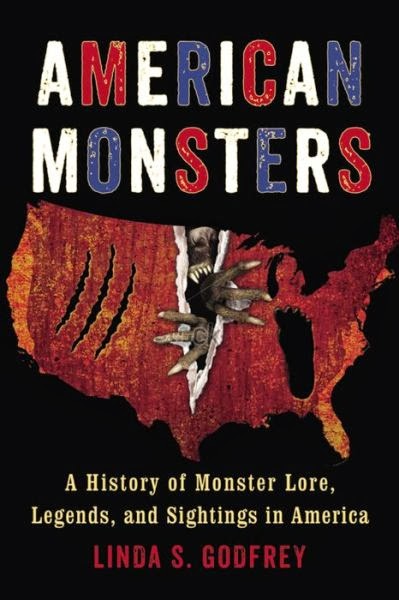
American MonstersIn one of those ironies of personal history, I never met Linda Godfrey although we lived not far from one another and shared a great many common interests. I’m not sure she would return the sentiment, but while I lived at Nashotah House many odd things happened. Academics can be pretty deep in denial about what they experience, and although I never saw any man-wolves, as I stood outside one night to photograph a comet I felt terribly exposed and in not a little danger. This was on a rural seminary campus. Nashotah was still wooded then, before evangelical shaving of the landscape, and certainly among the most gothic of seminaries I’ve ever seen. Meanwhile Linda Godfrey was researching, just a few miles down the road, weird animal sightings on Bray Road. I began a correspondence with her after we left Wisconsin and I have read all of her books. Local history has always fascinated me, and although I was an accidental Wisconsonite, I nevertheless enjoyed learning about the strangeness of the state I formerly called home.

Godfrey’s latest book, American Monsters: A History of Monster Lore, Legends, and Sightings in America, throws a wider net. We are all in here with the monsters. Blending, as the subtitle suggests, lore and legends with eyewitness accounts, American Monsters can leave the reader a little disoriented, in a good way. We’ve been taught to discount anything that doesn’t match the everyday—what boss wants a worker with a higher vision?—and pretend that such things don’t exist. Weird creatures don’t donate their bodies to science readily, and we are left wondering if something is really peering at us from these October woods. Inside you’ll find stories of flying, swimming, and running monsters. We are safe nowhere. Either from the scientifically undocumented or from those that are purely imaginary. I stand outside in the dark in a smallish town waiting for a bus. What was that sound behind me?

Monsters are only now beginning to gain academic respectability. When I was in graduate school the topic felt so puerile that no respectable Ph.D. candidate would dare suggest such a dissertation to a button-down committee. Now they are beginning to roll off the presses. As part of the religious imagination, monsters are not so easily dismissed. We can assign them to the dark caverns of fantasy and under-stimulated imagination, but they will burst out in their own time and, like gods, demand our devotion. I have no idea whether these cryptids creep, flap, or swish around in our world. People see them all the same. And believing may be seeing. I’m glad for Godfrey’s success at pointing out that our rational world is full of monsters. Hers is a perfect book for days of effacing light and lengthening shadows, all across the country.


Theatrical Desert

LawrenceOfArabia

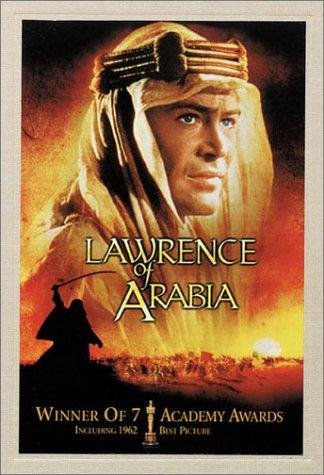
While the appellation T. E. Lawrence may leave many scratching their heads, “Lawrence of Arabia” will still garner nods of recognition. Of course, having a major movie made after you is a pretty good way to retain currency. Being a student of the history of religions, focusing on those of ancient West Asia, I read about Lawrence as I was doing background reading on what would eventually become known as the Middle East—another contrived name. Lawrence, who apparently disliked being called, “of Arabia,” along with Gertrude Bell, played a formative role in what would become a theater of European entanglements that continue to cause trouble to this day. The First World War gave opportunity for colonial interests to play out in the tribal polities that had worked in that part of the world for centuries. The fact that many of these countries are oil rich didn’t hurt.

Yesterday, starting very early, my wife and I settled in to watch the movie Lawrence of Arabia. Since it was released the year that I was born I might be forgiven for missing the first run in theaters, but I really hadn’t had the opportunity to see it before. Sure, you can pick up the DVD in many bargain bins at video stores—now also becoming rare—but a day with four free hours to watch a movie is also an endangered species. What struck me the most about the movie, after the commitment it takes to spend so long watching it, is that the few women who appear in it have no lines. Or lives. No woman speaks for this entire film. Although the portrayal of the Arabs is positive, the utter invisibility of half of all people on the planet is somewhat bewildering. Although not shown in the movie, Lawrence was known to be able to pass himself off as a woman, it is said. Yet the real women are missing, as if their stake in the world following the war just didn’t matter.

It may have been intended as a man-cave of a film—fighting scenes (although mild by present-day standards), things blowing up, and an awful lot of masculine bravado make up much of it. Still, men are not known for sitting patiently while minutes and minutes of visually lush desert scenery and blur shots of the sun take up so much of their weekend time. Yes, women did not fight in the field during the war, but they were an important part of the story. Gertrude Bell, as I mentioned, was a key figure in the drawing up of the boundaries of the Arab world. The movie isn’t about her, nevertheless the women show up in numbers only twice, once to wave goodbye the to army off to take Aqaba and then as nurses to help the overflowing hospital in Damascus. In neither scene do they talk. Perhaps it is intentional, but such a tactic made the desert seem very barren indeed. War has victims of all genders.


Dirty Words

I don’t have any bumper-stickers on my car. As clever as I may think any particular one to be, driving down the highway is not the place that I want other drivers to get ticked off at me. A more judicious use of turn-signals would be my preference over mass-produced witticisms. I suspect that most readers know of my liberal leanings. Some have even bothered to inform me that they no longer read my musings precisely because of this. On the information superhighway, unlike the real highway, you can just click off and not be annoyed anymore. My bumper, therefore, will stay clean. While in a parking lot recently I saw a bumper-sticker reading “Not A Liberal.” I had to ponder this a bit.

IMG_1589

I grew up conservative, although, as working-class folk, we didn’t label ourselves with that word at home. I wouldn’t have even known what it meant. Liberal, in its basic form, has to do with generosity and being respectful of others. The media has built it up into a kind of evil juggernaut that intends to take over the safe, unchanging world of religion and politics. I wonder how liberal became a dirty word. Who, among your friends, would want to remain so if you disrespect their views and refuse to show generosity? I get the sense that even conservatives are liberal with their friends. When I walk past the homeless sleeping on a subway vent to keep warm, I wonder if conservatives ever read the parable of the good Samaritan. What bumper-stickers would the homeless wear?

A polarized society had better prepare for the big chill. In my admittedly limited experience, people come in a continuum of positions, not just one extreme or the other. It makes better news, however, when we divide into camps, the more clearly to spar with one another. What separates us is more important than what brings us together. Yes, I grew up conservative. I continued, however, to grow up. I suspect in some things I am still conservative, while in many I am liberal. I’m not sure what I’d put on my bumper-sticker. What do I want people to know about me while I’m driving? I think it might be better to suggest “I Respect You,” than an implied “I don’t like your views.” Then again, since it happens so often, I now look for a Jesus fish automatically when I’m cut off in traffic. Be careful of what you put on your bumper, because dirty words are in the eyes of the reader.


Knockin’ Where?

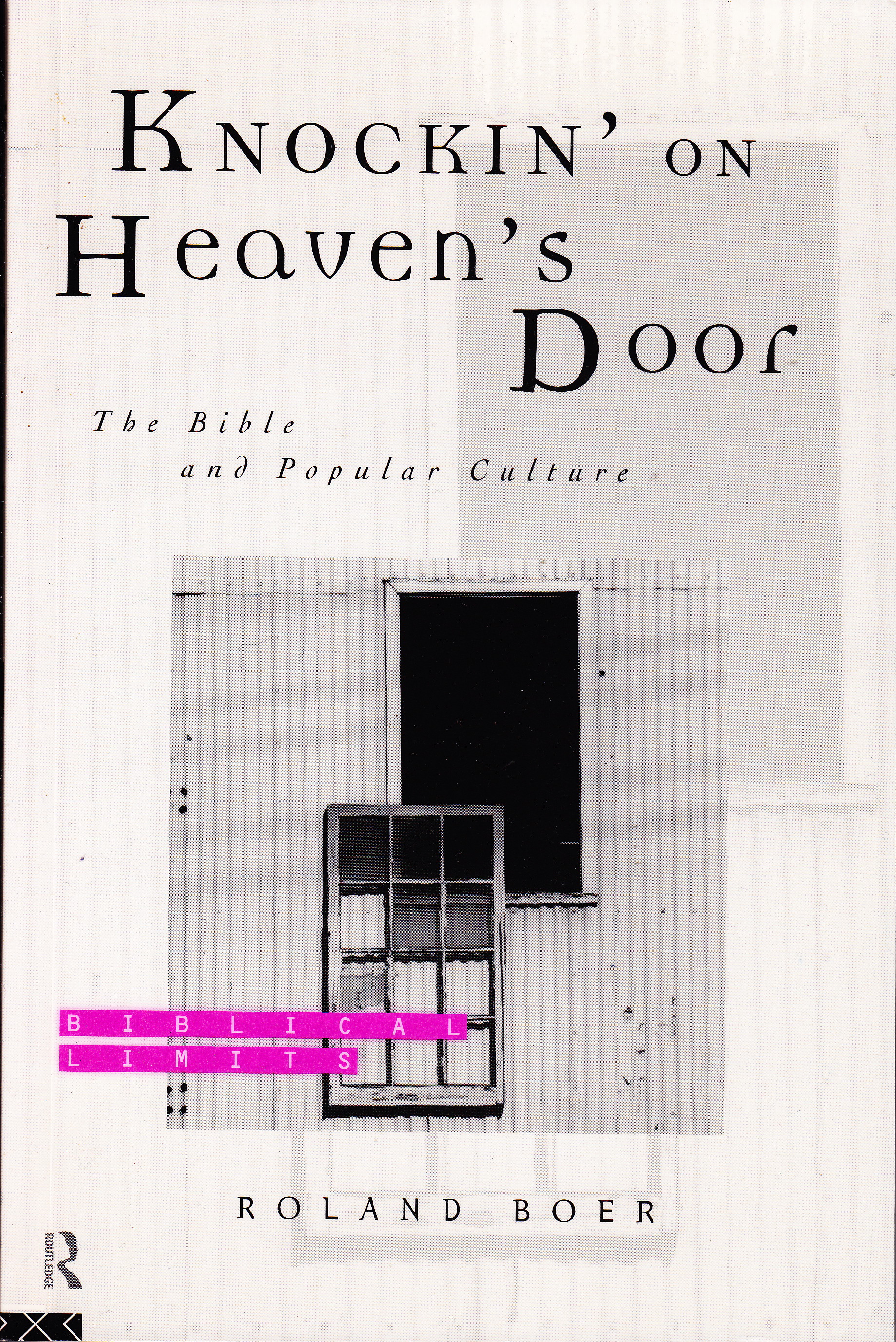
KnockinOnHeavensDoorFor a while, when I was with Routledge, I tried to kick-start the old series Biblical Limits. I didn’t initiate the series, but it had been cutting edge at the time, and one thing biblical scholars seldom get to claim is that particular adjectival phrase. Alas, my enthusiasm wasn’t contagious and the series never moved ahead. Recently I decided to read Roland Boer’s Knockin’ on Heaven’s Door: The Bible and Popular Culture. Little did I realize that it would be a book that would make such a literal fit for the symbolic nature of my blog title. This is a book that my internet savvy would declare NSFW: not safe for work. Boer explores the sex and violence that are really rather pronounced in the biblical text, but which are often sublimated into object lessons for the faithful. We hear that such books as Song of Songs are allegories since they can’t possibly be about real people really attracted to each other. Would God sanction such things, well, after Genesis 1, I mean?

Post-modern readings of the Bible like to place the obvious before the reader. There is, no doubt, some over-reading going on here, but there is plentiful insight as well. A number of places I stopped and thought, I could use that, were I still teaching. Popular culture isn’t just movies and video games. There is a very human element to culture. Indeed, culture would not exist without such a thing as human interest. Boer explores everything from David’s carnal interests to Alfred Hitchcock’s morbid ones. McDonalds to Ezekiel in Guns-n-Roses. This is not the usual finding Christology in E.T. This is more like the bad boy’s Bible.

If the Bible cannot be made applicable to a constantly changing culture, then it becomes irrelevant. Many object to Boer’s bold treatment, but I believe that unless we can move beyond our concerns with J, E, D, P, R, Q, and double, or triple-redactions, we’re going to lose readers from page one. Knockin’ on Heaven’s Door is a page-turner. You can sit on the bus and have people think you’re reading about the Bible when in reality, a chapter on pornography may have you blushing madly. It brings to mind Odysseus in Polyphemus’s cave. But then, blind giants may be the most dangerous of all.