Lola Lolita

LolitaAs a father, Vladimir Nabokov’s Lolita is difficult to read. With Banned Book Week upon us, however, and with my wife suggesting I read Reading Lolita in Tehran, I figured I’d better read Lolita in New Jersey first. It’s not the kind of book you want to be seen reading on the bus. As is well known, the novel is written from the sympathetic point of view of a pedophile. It is distinctly creepy and yet also strangely sincere. Effacing the distinctions between love and lust and healthy and ill psyches, the story draws you into the life of a single-minded Humbert Humbert and his twelve-year-old obsession. I had been prepared for the end of the story, having seen Stanley Kubrick’s cinematic version some years ago, still, this tale distresses. Banned books take us to places we’d rather not be, and cause us to linger there. This is part of their secret appeal. These authors are honest enough to make us question assumptions. You have floated out of sight of land.

Lolita, through euphony, if not something more, reminds me of “Lola.” The Kink’s hit. I first heard “Lola” while I was in seminary, although it had been released a decade and a half earlier (I tend to run a little behind the times). When I listen to songs I pay attention to the lyrics, and I was disturbed to find that “Lola” was a catchy tune with a (to me, at the time) disturbing message. I confessed to a friend that I liked the song, but wasn’t sure that I should. We ban songs just as we ban books, because they bring us to a place where we question what we thought we knew. In my case, it often doesn’t take much. My friend Dave gave sage advice not to overthink the whole thing. If you like a song, you like a song. Let the music play on.

“You say you’re afraid for children,” Ellen Hopkins’s second stanza of “Manifesto” begins. (I confess to following a different scansion of the poem, call it poetic license.) I believe, however, our fear is for ourselves. We know that we could have a monster lurking inside. Lolita does not encourage pedophilia. Like many social crimes, pedophilia is the manifestation of an illness that some people, like sociopaths, unfortunately suffer. The lack of empathy for others is a frightening thing indeed. It makes for some of the scariest movies, and headlines, that I have ever seen. We do ourselves no favors, however, by pretending it doesn’t exist. I know little of the life of Nabokov, but I know that he died in Montreux. I know that he could afford to live there at least in part because of the royalties from Lolita, a novel whose manuscript he had once attempted to burn. And I know that in Montreux “some stupid with a flare gun,” well, you know the rest.
Bargain Basement

Signs, in my experience at least, lend themselves to being over-read. How often a heedless moment suggests something more than was intended—signs try to say too much in too few words. Indeed, poets rather than marketers ought to be sought. I found myself in Barnes and Noble recently, since Borders is gone. In all fairness, I attended two independent bookstores as penance afterward. Nevertheless, in the corporate atmosphere of the last major brick-and-mortar chain, I saw a sign. Several, actually. One of the most obvious is how many tchotchkes the store had, as opposed to wall-to-wall books. Barnes and Nobel has never been particularly imaginative in its selection of floor stock, but now it is a great place to buy toys, electronics, and coffee. Maybe pick up a book as an afterthought on your way out.

IMG_1550

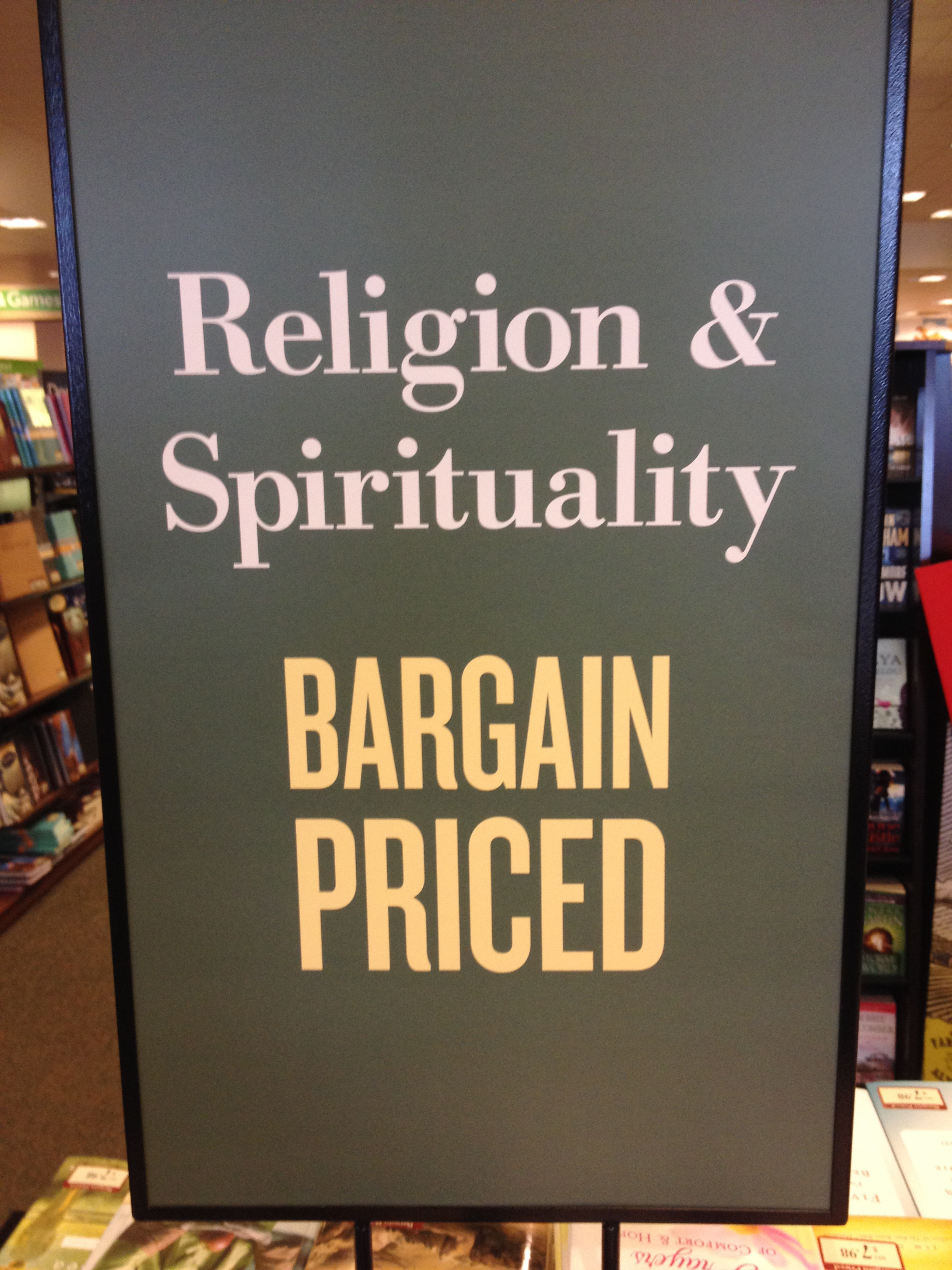
The front space just inside the door of a bookstore is prime real estate. Publishers have to pay extra to have their books displayed immediately inside the doors—something they reserve for sure-fire rapid sellers. The average customer will walk in, down the center aisle and there they will find promoted (and demoted) items, laid out on their own tables. So it was that I saw a sign reading “Religion & Spirituality Bargain Priced.” In fact, they’re free. Not the books, but religion and spirituality. Even in this secular world, people are not shy about buying books in these categories. Step into the religion aisle sometime. You may be surprised how much you find there. In fact, those who track the industry often include Christian books as a third major category besides fiction and non. We trust those who know enough to write books about such matters. The Bible, despite its detractors, is a bestseller by any measure.

Do we, however, value religion and spirituality? So often religion is portrayed as the root of all extremism while spirituality is relegated to the weak-minded. The science section generally takes up only half the shelf space of religion. People want to know what it’s all about. The rates are anything but bargain priced. Some religion may indeed be simple, but most religions are unexpectedly complex. Those who engage them seriously know there is more to life than just fact and fiction. There are middle grounds and outer limits. There are places that have yet to be discovered, let alone explored. We are in the infancy of intellectual awakening. Of course that shows in how quickly we’ve abandoned our bookstores and gone off after less weighty things. If you have a moment, though, on your way to the coffee bar, you might pick up some religion cheap, and who knows where it might lead?


Fighting with Monsters

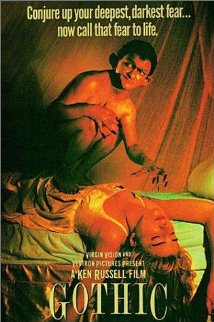
GothicThe Lady and Her Monsters reminded me of Gothic. A friend of mine in seminary showed me this “shocking” movie by Ken Russell just after it was released on VHS (I always was fond of ancient history). To my young eyes this was a challenging film, but it rated higher in moodiness than scariness. Roseanne Montillo’s book brought the movie to mind because, it turns out, several of the incidents in the movie were based on fact. Perhaps I need to take a step back because Gothic never made it big, and many may not realize that the movie is about the legendary night Mary Godwin (soon to be Shelley) came up with the idea for Frankenstein. In an early nineteenth-century walk of fame, Percy Shelley, Mary Godwin, Lord Byron, and John Polidori decided to write scary stories, as a kind of contest. Only two ever made it to print, Polidori’s The Vampyre, which inspired Bram Stoker’s Dracula many decades later, and Mary Shelley’s Frankenstein. The movie, with Ken Russell’s famous flamboyance, traced an unlikely story of the friends conjuring a ghost and then banishing it once again before the stormy night is over.

Ken Russell had the reputation for being obsessed with the church and sexuality. These interests are certainly well represented in Gothic, where Percy Shelley, famously an atheist and believer in the supernatural, struggles to make sense of it all. Polidori, Byron’s personal physician, is presented as a Catholic who admits, when each has to confess his or her deepest fears, that God terrifies him. The friends (perhaps in an unwitting prelude to a television series by that name) explore sexuality and the supernatural through the long night. Waking nightmares meet them at every turn. They even have a skull of “the black monk,” a character attested in all sincerity, at one time, at the most gothic seminary in the Wisconsin woods.

“He who fights with monsters,” Friedrich Nietzsche opined, “might take care lest he thereby become a monster. And if you gaze long enough into an abyss, the abyss gazes also into you.” That which we worship is that which we fear. Certainly the Christianity of the Middle Ages had as much of Hell as of Heaven in it. Bursting out into the light of rationalism, it seems, did not banish the darkness after all. We still have many questions left unanswered, and many intelligent people have begun to question whether any one paradigm fits all of the evidence. I suspect not. Human experience goes in multiple directions at once. We have ladies, we have monsters, we have scientists, we have God. And on rainy nights we have movies that make us see that we have combined them all into a tale often repeated but never fully understood.


Dark and Stormy Night

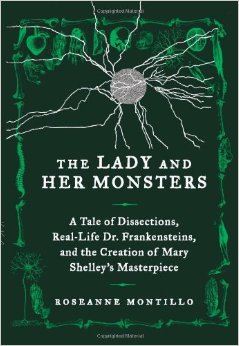
LadyAndHerMonstersI miss my monsters, especially when I stay away too long. I had eyeballed Roseanne Montillo’s The Lady and Her Monsters: A Tale of Dissections, Real-Life Dr. Frankensteins, and the Creation of Mary Shelley’s Masterpiece nearly a year ago in a busy Port Authority bookshop, and wanted to curl up with it right away. Well, work and the world intervened, but finally I found time for the beast. Although a member of the monster kid generation, as a child I never felt much kinship with Frankenstein’s creation. I think it is because there was so much human intention involved in his origins. Almost ungodly. Too godly. Vampires and werewolves, and even mummies, seemed to have come up on the wrong side of a curse and couldn’t be blamed for being what they were. Frankenstein’s monster had a willful, if neglectful, creator. A human being, and fully so. There was, it seemed, some kind of blasphemy at work here.

Montillo’s book, however, gives me pause to rethink this. I had never realized, foe example, that Shelley’s book unfolds over nine months, and that Mary Godwin Shelley had suffered as her own fate unfolded—or unraveled—after Percy Shelley’s death. Nor had I stopped to consider that in the lifetime of these young lovers scientists and poets were overlapping careers with philosophy holding them together. I also hadn’t realized that Percy Shelley also shared his beau’s enchantment with the fantastic. But Montillo gives us so much more, wandering through the seedy world of body-snatchers and scientists who experimented on the dead, often with an eye toward a secular resurrection.

Frankenstein’s monster has, of course, become an instantly recognizable fixture in our society. Indeed, it is almost the definition of monstrosity: the ultimate mischwesen while being technically only one species. A creature that crosses boundaries and is both dead and alive, a miracle and a curse, innocent and evil. Morillo places this creature in the context of a world where galvanism was thought to bring life and medical schools scrambled to find corpses to dissect and on which to experiment. A world where the Shelleys would visit Lord Byron and Polidori, literally on a stormy night, and give the world both Frankenstein and the prototype of Dracula. Where the three men of that night all died prematurely and tragically, survived by a struggling Mary who lived only to fifty-three and who gave the world one of its most memorable nightmares. Horror fiction was, and is, considered lowbrow entertainment, but there is something profound here. And we are richer, if more unsettled, for having it.


Dystopian Paradise

Dystopias resonate with me. As I ponder why, two factors seem to rise to the surface: dystopias are inevitably populist in orientation, and I was raised religious. Each of these factors requires some explanation, but so does the choice of addressing dystopian topics on a cheerful September day. In an article by Debbie Siegelbaum in the BBC News Magazine, Project Hieroglyph is featured. Project Hieroglyph, which involves some people I know, is an attempt to write a more optimistic future back into science fiction. To understand my reservations, I have to confess to having grown up as a nerdy science fiction reader. The stories from the 1950s and ’60s to which I had access (growing up poor, and buying books at Goodwill and second-hand shops) tended to be optimistic—people colonizing other planets, creating great labor-saving inventions, traveling time itself. In the meanwhile I slept in torn sheets in a ratty room and had to work to buy my own school clothes, inevitably cheap. For a few years our house didn’t even have a bathtub or shower. It wasn’t an easy existence, and I found solace in religion and science fiction, both of which promised a better future.

Today, forward-looking literature tends to be pretty bleak. With reason. Optimistic futures are the luxury of the elite. The average working person labors under a constant threat of unemployment and no jobs to replace the one you have. Hey, some of the people I see begging in Midtown are not dressed in the rags of the classic ne’er-do-well. Their signs asking for help are articulate and neatly written. The elite may look to a brighter future, but from street-level things appear a bit more challenging. There’s no question that politicians long ago lost touch with the commoner. They have no idea what life is like for most of us. Same is true of most university folk (cited in the article); unless they’ve been cast out, I suspect, they can conjure a pretty rosy future. With tenure.

That’s the populist angle. Now for the religious. The basic idea of Project Hieroglyph is as old as Buddhism, or perhaps even older than that. Salvation. Religions promulgate the idea that people require salvation. Otherwise it’s pretty difficult to get people up on a Sunday morning and convince them to drop their money in the plate. Look, however, at what has been happening to mainstream churches. So technocrats and other elites think technology, rather than the gods, will save us. Those devices of optimistic 1950’s and ’60’s sci fi have turned on us, and we have become slaves to our own technology. Gee, it’s awfully gloomy in here! Perhaps we need a brighter vision of the future where technology makes things better. It sounds like a return to the stories I read as a child. Still, I can’t help noticing all the closed churches I see, and how much the penmanship of the indigent has improved with the passing of time. If only I could decipher hieroglyphs my future might look shinier too.

Is this paradise or what?

Is this paradise or what?


Disco Duck

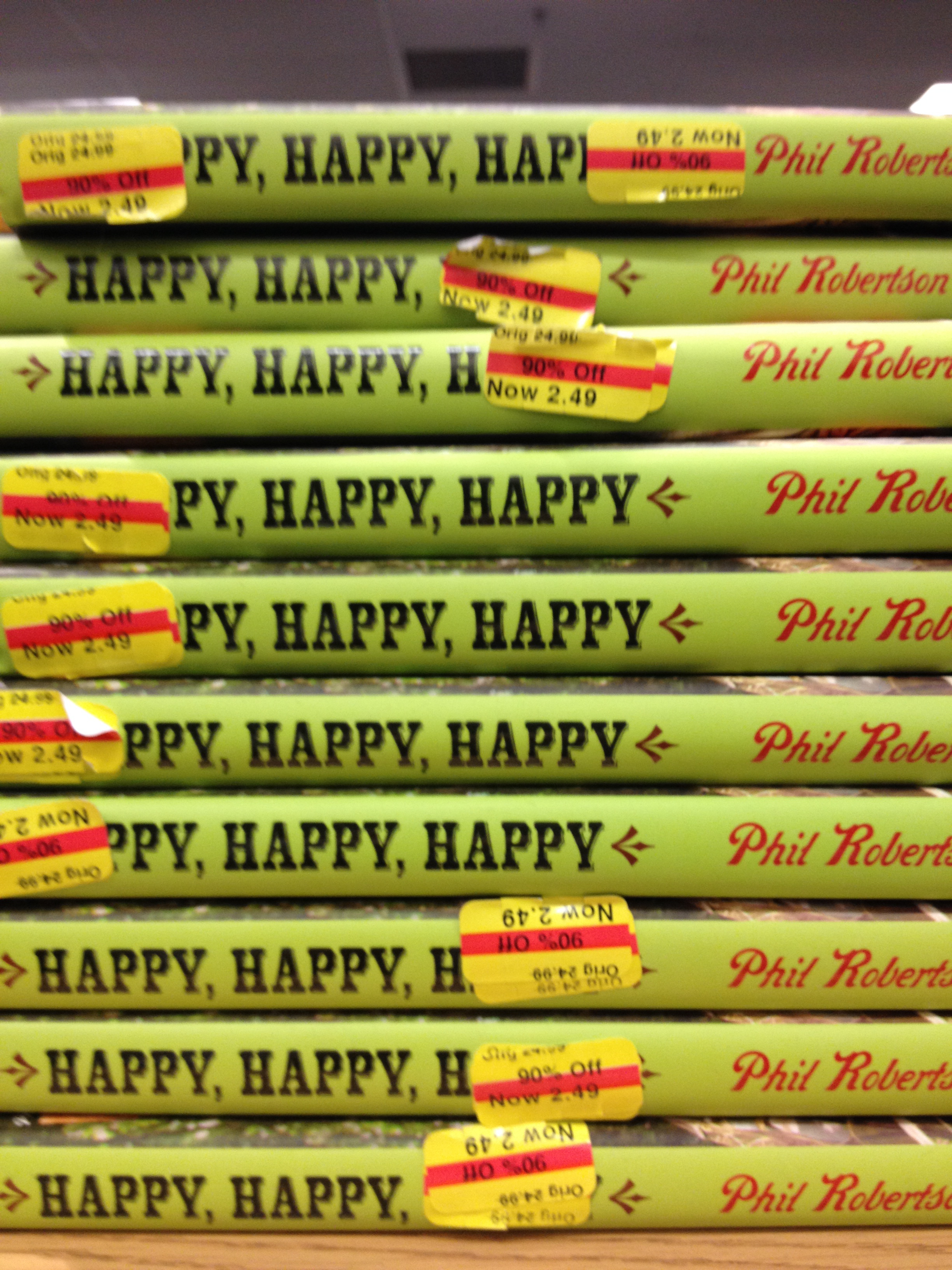
From the Roman Empire, Holy or otherwise, to the British Empire upon which the sun once never set, human endeavors are inevitably temporary. We like to think we’re making lasting contributions. Not so long ago Phil Robertson could make claims on vast amounts of media attention for his homiletical, gun-toting brand of family values. Despite not being a television watcher, even I was drawn into the drama as Happy! Happy! Happy! became a bestseller. Perhaps because my pursuit of religion has never earned me three such exclamation points, I read the book to find the secret of success. It is a combination of unquestioning belief and a willingness to blow the heads off of ducks in flight. Not that I would know about such things. The Dynasty made its way into Time magazine and other media outlets as the most interesting thing reality television, which is anything but, could throw at us.

Then Phil made a statement that set many viewers off. Mistaking intolerance for true religion—rather a constant in the algebra of faith—Robertson expressed his views on homosexuality and the ratings began to slip. Last year as I walked into a department store, I found Duck Dynasty bobble-head dolls and even fake Dynasty beards for those with no gumption to grow their own. Golf balls and beer glasses and all sorts of merchandise. Yes, you could partake of the good life without even cocking or pumping your shotgun. Other members of the family wrote books. (I have friends who produce quality literature who can’t find publishers.) We love the self-made genius of a simple guy and his make-believe world. Happy. Happy. Happy.

IMG_1503

It has been some time since I’ve seen Duck Dynasty mentioned in the media. I wandered into the same department store this year to find stacks of Dynasty merchandise drastically reduced. You could buy Phil Robertson’s memoirs for even less than Amazon prices. In bulk, if you desired. My historically inclined mind turned to the great empires of antiquity. Did Alexander, I wonder, really know what he wanted? What about when you finally reach the ocean? What is off on the other side? Once you’re out of sight of land, you’ve lost your control back home. Next thing you know, Diadochi have fractured everything. The gods of empire, it seems, don’t have it all together after all. Happy? Happy? Happy?


Retro Progress

LittleOrleyIn these days of high technology, remembering childhood might be seen as cowardly nostalgia. When driving my daughter back to college, however, sometimes I need a little nostalgia. So it was that we passed a pleasant couple of hours listening to Little Orley stories told by Uncle Lumpy. Having read ancient history for years, I don’t mind saying that I was a devoted fan of Captain Kangaroo as a child, and Mr. Green Jeans was one of the reasons. Before the Captain, Green Jeans (Hugh Brannum) had recorded a set of radio stories about Little Orley, beginning in 1946. (Lest readers get too driven by nostalgia, I wasn’t around for the original broadcasts.) In the small town of Franklin, Pennsylvania, across the state from where Brannum died, our library had a record of some of the episodes from his radio show. As a child I listened to these tales so much that I still have parts of them memorized to the word. The web brought Little Orley back to me, and now anyone can purchase the tales that I had gone for decades without hearing. Driving through eastern Pennsylvania on an emotionally laden journey, Uncle Lumpy seemed the perfect fare.

A few facets of the program struck me anew. Little Orley stories, for those unfortunate enough never to have heard them, are tall tales about a farm boy that involve all manner of hypostatized natural phenomena. Animals, plants, the moon, clouds, and even pancakes talk and act like humans. Or gods. Orley encounters these all with no hint of surprise, and yet goes to church on Sunday and Wednesday night for prayer meeting. The God in these stories is anything but a jealous deity, sharing the stage with a king of the oceans, lakes and seas that can transform a person to a fish, or with mysterious voices that can make a boy a worm and a worm a boy. Leprechauns gambol through the woods, and snowmen amble about trying to help with farm chores. Stories like these in the Bible are now considered factual, right Balaam? In the 1940s they were standard fantasy for children.

Now we’ve come to an era of biblical literalism that fears and despises challenges to the single God of sacred writ. In Little Orley, however, a message of tolerance (with some notably politically incorrect caricatures) predominates. Orley is time and again in situations where those who are different should be, and inevitably are, treated as equals. Even God gets some help from talking bats who ring the bell to bring the faithful to church when the sexton breaks the bell-rope. Change, I know, is inevitable. As these miles disappear behind me, I can feel it keeping pace, eventually to eclipse me. Progress is good, but sometimes the way ahead is best found by looking back in wonder.


Watchers and (Un)holy Ones

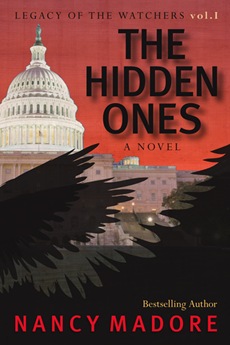
HiddenOnes Angels, demons, djinn, watchers, giants, and a healthy dose of fantasy pervade Nancy Madore’s novel, The Hidden Ones. In this present world where, I’m told, the supernatural is irrelevant, it is pleasant to come across a work of fiction that delves so deeply into the pagan roots of Judaism, Christianity, and Islam. Monotheism does have its own skeletons in its capacious closets. Madore is a novelist who insists on prying open those doors long shut, and spinning a tale that involves first responders, shady military officers, and a band of rather hapless archaeologists. And Lilith. Throughout the story Madore comes up with clever etiologies for stories that will appear in canonical form much later, and at one point I couldn’t help wondering if the screen writers of Noah had read her book. Well, actually, The Hidden Ones is the first of a trilogy, Legacy of the Watchers. I’m sure the next two books will contain many surprises as well.

The Hidden Ones put me in mind of Michael Heiser’s novel, The Facade. Both take on the mythology of the Nephilim, the fallen ones about which the Bible tells us enough only to leave us hungry. The early chapters of Genesis are like that. There’s so much going on that those of us reading it many centuries after it was written are left wondering what the full story was. The writers of the Bible had no compunction to disbelieve in monsters and beings beyond the human ken. Nor does the Bible attempt to systematize them in any sustained way. These creatures just are. As the old saying goes, however, fiction has to make sense—those who write with gods and angels have to make them fit into a system.

No doubt, the uncanny occasionally intrudes upon our rational world. The Hidden Ones presents one such intrusion that, ironically, takes some of the fact of the Bible while leaving the theology suspect. We know that even before the Hebrew Bible was complete ancient scribes were attempting similar things. The book Jubilees, for example, tries to fill in some of the unanswered questions of Genesis, including the watchers and details of the flood. Jubilees, however, never made it into the Bible thus depriving canonical status to the backstory that demonstrates how religion often chooses for ambiguity, leaving it to theologians to bring it all into a system. And novelists. And among those novels that tread where even J, E, P, and D quail, is The Hidden Ones.


A Run-By Fruiting

Photo credit: Eva Rinaldi, Wikimedia Common

Photo credit: Eva Rinaldi, Wikimedia Common

I’ve never been enticed by the cult of celebrity. Becoming famous is frequently a matter of being in the right place at the right time to get noticed. Interviews with stars inevitably come across as lacking in substance. Some of the funniest people I’ve known have worked in camera shops, administrative offices, and IT departments. Still, the suicide of Robin Williams a week ago has impacted a wide swath of the nation. We hate to see a funny man die. It is such a truism as to be trite that those who are clowns often host inner demons. Laughter, Reader’s Digest proclaims monthly, is the best medicine. Who better to heal than those who know what it’s like to have been wounded? Yet we want the funny to keep on making us laugh until we move on to the next diversion.

For this past week I’ve been pondering how one man’s tragic death has jolted a nation into a reflective moment of silence. I can’t say I was Robin Williams’ biggest fan, but I’d seen a number of his movies, and I was devoted to Mork and Mindy growing up (aliens have a way of getting prime-time exposure that has never really been explained). I thought he was good at what he did. He was famous and had money, but it wasn’t enough to buy off the demons. Suicides hit me hard since I’ve known a few and have struggled with depression myself. There are times, truth be told, when no direction is up. It is at those times, however, that others tend to ignore you, lest you bring them down. People like to laugh.

There is something profoundly religious about the idea of a wounded healer. Anthropologists as well as theologians have noticed it. They need have only looked as far as the Bible to find examples. Yet the Christian tradition treats suicide as a great sin against God and the plan is that we all live to die either at the hands of nature or of someone else, so the guilt doesn’t cling to us. Death always leads to a remorse that entails such guilt. And yet it is inevitable. As a nation we are used to seeing comedians overdose or live reckless lives that end tragically. Deliberate action, however, feels the most horrendous of all. We’ll ask “why?” for a while, and we’ll make tributes and tearful speeches. And meanwhile some of the funniest people we can claim will be sweeping our floors or asking “would you like fries with that?”


Write the Truth

XalliopePublication is a tricky business. Just ask my friend, K. Marvin Bruce. Marvin and I have known each other for years as he’s been trying to break into fiction publishing. I don’t envy him. His novel, Passion of the Titans, was under contract with an indie publisher who eventually reneged on their agreement. What can you do? As a supporter of publishers you don’t want to sue, so the novel is floating around again, looking for a home. Meanwhile, I was flattered to receive in my mailbox a copy of Calliope magazine. Calliope is published by the Writer’s Special Interest Group of American Mensa, Ltd. Marvin’s story, “Initiating an Apocalypse,” won third place in their fiction open. Not only am I pleased for my friend, but I was glad to see his story was about gods. Zoroastrianism doesn’t get much attention these days, but Marvin’s tale is about a hapless professor who wants to start an apocalypse by using Zoroastrian deities. I won’t give any spoilers since I’m sure few people have read the story.

His tale has me thinking of gods in fiction. I suppose mainstream literary fiction avoids deities, but fantasy, science fiction, and horror all make good use of them from time to time. Neil Gaiman’s American Gods made quite a splash, and although Marvin has no hope of becoming a widely recognized name, his novel also features gods. It is a literary incarnation. We like to see gods in some ways limited to human circumstances. Omnipotence rarely makes for a good plot. In many respects the Bible attests to this. If God is omnipotent (which is not a claim the Bible actually makes) why can’t the world be a happier place? Indeed, the solution most fondly groped by theologians is either free will or a version of the Zoroastrian solution: a god who is evil. Enter the Devil.

The Devil is also undergoing a kind of literary renaissance. We find a plethora of books and movies starring the prince of darkness. Despite the panegyrics of rationalism delivered by angry atheists, nothing salves the human soul like a good supernatural entity. Fiction writers have long recognized that. Gaiman was not the first to make the gods do his bidding in literature. There is a likelihood that even Homer knew the appeal. Many people can accept that gods might exist, and they certainly don’t object to stories in which they cavort. Fiction, as literary analysts know, teaches us about reality. The characters may not be literally true, but the fact is that in our minds there is still plenty of room for gods. And, if you one of the rare ones to read Marvin’s story, you’ll see that, true to human experience, deities don’t act as we expect them to. Savvy publishers, it seems to me, would do well to recognize the appeal of the gods.


Infernal Religions

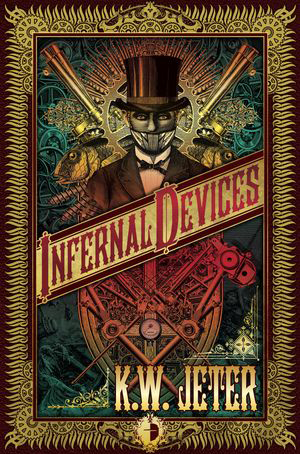
infernalDevicesThe first steampunk novel I read, although some would dispute the classification, was Neal Stephenson’s The Diamond Age. To be sure, I’d noticed other Victorian-style science fiction, but the idea of prescient technology settled into my head to nest for a while. I read a few other exemplars of the genre, finding each interesting in its own right. Having just finished K. W. Jeter’s Infernal Devices, however, I get a sense that I’ve neared the fount. Jeter is generally credited with coming up with the neologism “steampunk,” and this novel, while not his first, is fascinating for the heavy religious symbolism that is used throughout. In our secular, post-Christian age, we tend to forget that in the nineteenth century (actual, if not alternate reality) religion still played a tremendous role in people’s lives and outlooks. Infernal Devices uses that outlook quite effectively. The remnants of Cromwell’s puritan cause appear as the Godly Army, set against science and technology in a society still imbued with religious belief. When a flying machine appears overhead, the Scots suppose it is the beast of Revelation harbinger of the world’s end.

Like most steampunk offerings, Jeter offers us plenty of mechanical wonders. The hapless Mr. Dower, our protagonist and narrator, is the son of a mechanical genius, now deceased. The story involves Dower trying to unravel the many strands his father wove in a lifetime of invention and innovation. The one device that stood out to me, however, was the automaton priest and choir of Saint Mary Alderhythe, Bankside. Dower’s father had invented a robotic priest to go through the mechanical motions of an Anglican mass. Having sat through hundreds of such masses, I could see the point he was making. There are variables, but the overall draw of ritual is, well, its ritualism. The sameness that assures an assuaged deity and a safe congregation. The Godly Army, however, is more revisionist in intention.

Jeter, I’m sure, did not intend for the novel to be read for religious truths. It is rollicking and fun, with characters that you can’t believe but you want to. The driving force, however, behind much of the story is the religious bias of elements of London society. Dower, blamed for vices he doesn’t really have, is chased from his home by the Lady’s Union for the Suppression of Carnal Vice. The Godly Army, however, steals the show. Perhaps the most profound observation comes from Scape, who quips “That’s what you get.. when you give people Bibles and guns,” about the Godly Army. “It just messes up their brains.” At this point I began to wonder whether the story were really fiction after all. In this case the truth indeed perhaps lies in steampunk’s alternate history.


Romney Wordsworth

TheTwilightZoneLogo

The Twilight Zone, one of my favorite fallbacks when I’m alone, doesn’t shy away from religion. I remember watching some of these moody tales in my childhood, already in reruns by the time I was old enough to appreciate them, and occasionally having my young mind shaken as a result. The frisson of having reality not being as it appeared kept me wanting to see more of Rod Serling’s universe, evaluating, re-evaluating, speculating. Often heavy with psychological realism, despite the obviously outlandish premises, these half-hour plays in black-and-white still have a strange power to alter a mood. I recently viewed the episode “The Obsolete Man,” which closed season two. Having been declared obsolete myself, more than once, I found this story particularly chilling. A totalitarian state declares what worthwhile occupations might be, and Romney Wordsworth, as a librarian, doesn’t hold one of them. With shades of both Orwell and Bradbury, Wordsworth is sentenced to death.

In startlingly strong language, Serling has Wordsworth declare that, despite the decision of the state, there is a God. He wants his death televised, to which the Chancellor is happy to acquiesce. Locking the Chancellor into his room where, Wordsworth reveals, a bomb is about to go off, he tests the steel of the state by accepting his fate. Wordsworth spends his last hour reading the Bible. The Chancellor sweats and chain smokes himself frantic, finally calling out, “In the name of God let me go!” Wordsworth, of course, does. Rod Serling was not known as a particularly religious man. Many of his characters are hard-bitten, tough-talking caricatures whose bravado masks a profound uncertainty about life. The writing may not be stellar, but the ideas are beyond the stars. Religion is very human.

Many of these Twilight Zone episodes I have never seen. Still, they do reveal a world of imagination that had a tremendous impact on Cold War America. Bomb shelters, revolutionaries, and invaders haunt the minds of not just those born in the fifties, but of every generation since. The state that protects us is the very one that breaks open our luggage to look at our unmentionables when we want to fly. To keep us safe from ourselves. A decade before Serling’s series, George Orwell was looking a quarter century ahead, calculating the trajectory. The good guys, it turns out, have the wherewithal to decide who is obsolete and what is subversive. And if you don’t see things their way, they’ll start talking impeachment or perhaps worse. Your next stop, the Twilight Zone.


Cowboys and Demons

Cowboys_&_Aliens

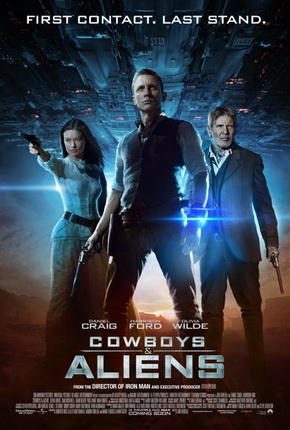
Cowboys & Aliens finally came down into my price range. For movies I’d have to view alone, I generally wait until they appear for free on some online movie service or for less then ten dollars at Target. I’ve been waiting for this one since 2011, but my patience paid off. Inspired, so the rumor goes, by the Roswell incident, the film follows the adventures of some old western stereotypes as they encounter the superior power of aliens. The aliens, it seems, are just as materialistic as humans, coming to the old west in an extraterrestrial gold rush. They abduct humans to learn their weaknesses (which really seems superfluous given the technological imbalance between the species) and anger a number of ornery hombres in the process. Then we have an old-fashioned shootout with ray guns versus bows, arrows, and bullets. Human devotion, however, defeats the evolved armor and flying machines of the—well, what are they exactly?

The cowboys scratch their heads, not quite having the consarned concept to categorize these flying machines and their occupants. The local preacher, who is a pretty handy shot, tries to help the confused cowboys, who settle on the term “demons” to describe the extraterrestrials. We forget that in the early part of the last century other galaxies had not yet been discovered, and although we knew of other planets, there was assuredly no way to get there from here. Ugly things that come from the sky are demons. This doesn’t lead to a whole load of speculation—nobody suggests praying to take care of the menace, although the Native Americans resort to a religious ritual to unlock the mystery of where the demonic hoard is hiding. Through her resurrection we discover that Alice is a good alien, planted in the town to stop the invaders from doing to the earth what they did to her planet. And winning the heart of Jake Lonergan (whose very name suggests lone gunman to insiders) along the way.

Since the movie is three years old, I won’t worry about spoilers—if you’re inspired to watch for the first time, however, you might want to do so before finishing this. When Alice figures out how to stop the alien mining operation for good, Jake is left, for the second time, with his woman being killed by demons. Woodrow Dolarhyde, realizing that the outlaw Jake isn’t such a bad guy after all, seeks to console him at his loss. At the end of the movie, in a camera angle that goes from Woodrow to Jake, the focus falls on the cross atop the local mission as Woody says, “She’s in a better place.” All aliens go to heaven. Literally. With echoes of the X-Files, Cowboys & Aliens is sufficient for a dark night where demons and angels are a little too close to tell apart.


The Good, Bad, and Human

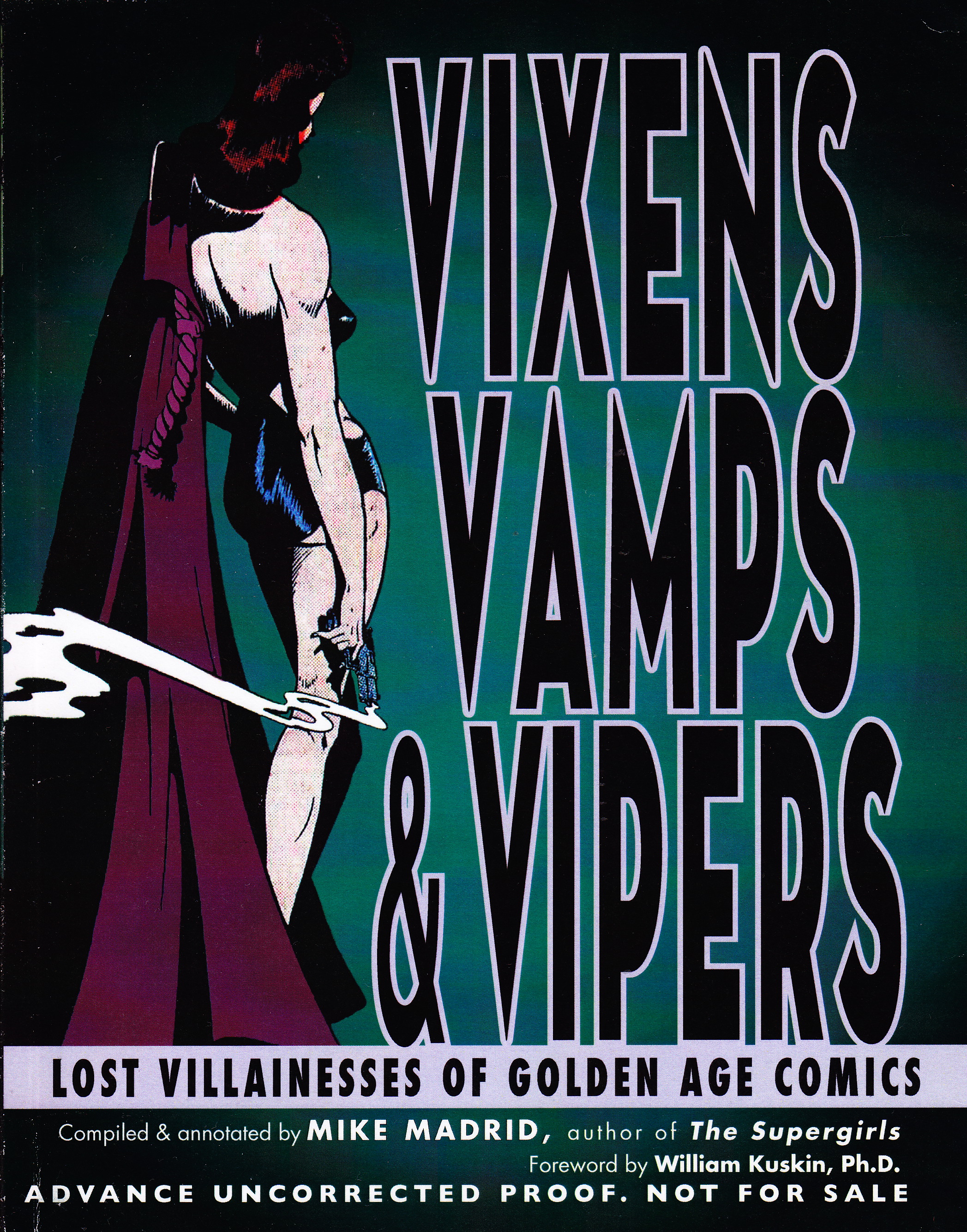
VixensVampsVipwesMike Madrid may know more about women in comics than anyone else alive. I’ve commented about his Supergirls and Divas, Dames and Daredevils, and he’s now followed up his previous successes with Vixens, Vamps and Vipers: Lost Villainesses of Golden Age Comics, due out in October. Despite the lament of many a parent that comic books are a waste of time, Madrid demonstrates through a close reading, that some of the most basic issues of society are featured in graphic format. Psychologists have long known that people are visually oriented. We have to learn to read, but we’re born with the knowledge of how to look. Comics, therefore, appeal to the young reader, illustrating the action with exaggerated pictures to underscore the tale. Although the early heroes were generally male, Madrid showed in his previous two books that girls and women were also superheroes, but, as in real life, competing in a world constructed by men for men.

Vixens, Vamps and Vipers flips the coin to see the role played by villains less known than Catwoman (whom he discusses), and torn between the human impulses to succeed and to be good. In fact, the first few pages of the book offer a profound consideration of the terms “good” and “evil” as they apply to the comic book (i.e., the real) world. As Madrid points out: if there were no villains, we would have no need of such colorful heroes. At the same time, evolution has embedded a desire to protect females in the minds of most males—Poe knew that the death of a beautiful woman was the among the most moving of literary images. Still, as Vixens, Vamps and Vipers points out, some of the villains here considered are beautiful and the allure demonstrates that something much more complex is going on beneath the surface. Despite the image of the hero, all people, male and female, constantly struggle with the impulses to do good and evil.

One of the complexities that religions attempt to codify is human nature: are we born good or evil? Are we totally depraved or inclined to strive for divinity? Any honest assessment of humanity, it seems to me, must take into account that we constantly struggle. Total depravity is totally disproved by the many good impulses shown by those of religions outside Calvinism and Christianity, let alone the tendency of humanists and atheists to help others. In fact, in many circumstances good and evil are intricately intertwined. Madrid explores this conundrum with women put in difficult, if fictional, scenarios who must decide which impulse to follow. He’s honest about this. Some will become superheroes despite the hurdles the male champions put in their way, while others will follow the trail that leads to his latest exploration of humanity through illustrated story. Look for Vixens, Vamps and Vipers and enjoy, if secretly, learning something profound about human nature.


New Gods

The new gods are the old gods, apparently. Increasingly I feel myself to be in the old category, but I do glance at Wired once in a while in a vain attempt to recapture my decidedly low-tech youth. I was halfway through July’s edition when I saw “Worship More Gods!” near the top of the page. Of course, gods aren’t what they used to be. The short column, Angry Nerd, was on about all the movies out there featuring Greek gods. Classic gods. Although they’ve been around for a couple of millennia or more, they had apparently fallen into the obsolescence pile for a number of centuries, staring around 1700 years ago. When I was in fifth grade I first heard about these gods (okay, I had watched that ridiculous cartoon Hercules—pre-Disney—as a child, but does that really count?). Mrs. McAlevy (and I sure hope I spelled that right!) felt that kids in my redneck little town needed to know about the gods and heroes. It was some of the most fun I ever had in school. I took a reprise class in college, just for good measure. After all, Clash of the Titans had just shown that gold can rain down like that in Danaë’s secret chamber, if you hit that sweet spot. Myth movies have flourished ever since.

Gods

Can we ever have enough of the old gods? There are lessons to be learned there still. It is safe to say that one of those lessons is that we should not act as the gods do. Almost always they do not stand as moral exemplars. Lest we feel too superior on that point, it is worth pointing out that the God of the Bible sometimes pulls some tricks that we would consider a little less than moral, right, Abraham? The role of the gods is to tell us what to do, not to show us. Impossibly high moral standards, after all, are difficult even for the mighty ones to keep. With great power and little accountability, well, we don’t need to have gods to show us what happens.

I’m not intending to put words in the mouth of the Angry Nerd. The point of the article seems to be that we should share the wealth. There are plenty of other cultures out there with very colorful gods (sometimes literally colorful). In the cultures I’ve studied those gods pretty much fall into the same category as my step-father’s mantra “do as I say and not as I do.” Rank hath its privileges. There’s no doubt that the gods provide some good moral guidance—even the deities of the Canaanites seem to have had pretty clean expectations for humankind. But when it comes to behavior, well, let’s just say they don’t behave like a bunch of nerds. These are the frat boys of the universe. We obey because we know it’s dangerous to do otherwise. So in this day of religious sensibility, perhaps having a few more gods wouldn’t hurt. As long as we keep in mind that every deity has his or her limitations.