No, Uh

Noah2014Poster

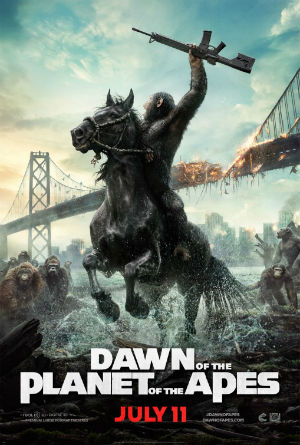
“Give me any two pages of the Bible and I’ll give you a picture.” The words belong to Cecil B. DeMille, according to Stephen Whitty’s weekend write-up about Bible movies in the New Jersey Star-Ledger. The story was inspired by a trio of big-budget Bible films—Son of God, Noah, and Exodus—set to be released this year. While Mel Gibson put me off of Jesus movies, perhaps forever, I’ve been planning to see Noah ever since my wife first pointed the poster out to me in a local theater lobby last month. The flood story has always spoken to me, lasting well beyond the nursery years with all the fluffy animals aboard the ark. One of the points that Whitty is making, however, is that Hollywood knows something the New Atheists do not—there’s big money in religion. People will pay to see it on the big screen. The Bible still speaks to a secular nation.

Noah’s story has been dramatized many times over in the entertainment media. It is often a theme in popular fiction, although well hidden, and reemerges in the occasional search for the lost ark documentaries or Veggie Tales shorts. There’s something timeless about the world-wide flood. For me it seems to go back to the thrill of the impossible. Those first eleven chapters of Genesis teem with the surreal world of lifespans centuries long, primordial gardens full of good food, gods intermarrying with humans, and waters that cover any number of sins. There’s a robust, adventurous air to such stories—they push on the boundaries of human experience and burst beyond them. It doesn’t matter whether Noah’s ark is round, boxy, or extraterrestrial—the flood’s the thing. It appeals to imagination like less mundane disasters simply can’t.

I don’t go to the movies to learn about the Bible. I can do that right at home with a single outlay for a relatively cheap book that can be read over and over again. No, it is these early days of the Bible that give rise to the prepositional phrase “of biblical proportions,” that the movies show so well. I’m not sure that I’ll be able to make the transition from Batman to Moses when Exodus comes out later this year, but next month I do plan to let the waters of the largest event in earth’s fictive history wash over me with all its CGI glory. Seeing is not always believing, but the flood is one of the most powerful stories ever told. Who can resist the calling of deep unto deep? Be warned, the entire theater will be in the splash zone.


Holy Hollow

HollowCityEveryone wants to belong, to fit in. Growing up, I seldom felt I managed it. When you’re very young you don’t know enough to notice that you are more melancholy than other kids, or that you can’t afford the nice things they can. As you reach your teenage years, however, and you know that you come from the kinds of families that other parents warn their kids about (fairly poor, very religious, and just a bit peculiar). No wonder I find Ransom Riggs’ books so engaging. Yes, they’re written for young adults, but just about anything that Quirk Press publishes is worth the read. As an adult, if I’m honest with myself, I’m still waiting to feel like I fit in. The kids in Hollow City, the peculiars, know that they can never fit in. They have special, impossible talents that make them the targets of monsters called hollowgasts, or hollows, who try to gobble down as many as possible. Monsters, outsiders, and very human relationships—it’s a winning combination.

Quite apart from the spellbinding pace Riggs spins out (he’s a master of building tension), there are some quasi-religious elements in the books as well. I read Miss Peregrine’s Home for Peculiar Children a couple years back, and Hollow City develops the mythology a bit more. The real enemies are the wights—mean-spirited malcontents who rule the monsters. They learn that they can become demigods if they extract what makes a peculiar peculiar. That’s a religious concept: the essence that materialists tell us isn’t really there at all that makes us what we are. The children are self-sacrificial toward their mistresses, birdlike and godlike at the same time.

Peculiars have two souls, although most of us don’t know what to do with even one. The soul has, of course, come under great suspicion over the last century or so. There seems to be something that makes us what we are, and it isn’t just cells and DNA. Some call it consciousness, others personality. There are those with élan and others with spirit. We can’t call it “soul” because that smacks of superstition and yesteryear. So we read of children with two souls and none to spare. Even Philip Pullman had souls for his children in His Dark Materials. The soul, in both these book series, leaves a person completely dehumanized when it is excised. Of course, materialism will do that for free. Yes, I know it’s fiction—young adult fiction at that—but my money’s on Ransom here. Let’s hear it for those who have a surfeit of souls!


A Toy Story

As a life-long pacifist, it might seem strange that I find myself waxing sentimental over a military-themed toy. You see, I just found out that G. I. Joe is turning fifty. For those of us who grew up in the 1960s, G. I. Joe was the acceptable “boy doll” (now, technically, “action figure”) that all the guys had. Some of us had several. We didn’t have much money, but Christmas always gave an opportunity to accessorize Joe with either the latest developments (life-like hair in a buzz cut, pull-string vocalizations, “kung-fu grip”) or the many vehicles that could be purchased separately. As the Vietnam War wore on, Joe turned his interests to science and humanitarian causes, but boys like to anthropomorphize as much as girls do, and Joe continued to get himself into many bizarre adventures. At least in our apartment he was known for fighting dinosaurs, robots, medieval knights, and even General George Custer. Joe was a fighting kind of guy. He had guns and gear and shoes that were almost impossible to remove when you wanted to change uniforms (only when Mom was out of the room). So G. I. Joe has been around for half a century now. I can’t remember childhood without him.

G. I. Joe often had near fatal encounters in our home. One of them, the talking one with life-like hair, suffered a severe war wound that left his bottom half completely dissociated from his top. I don’t think we kept the lower abdomen and legs—there was something slightly unnerving about plastic buttocks—but I did keep his top half, the talking bit. It shocked me when my Mom asked if she could take him to church. We were a “Bible believing” family since it was the days before people much talked about Fundamentalists. My mother was a Sunday School teacher. (Thus my early amazement at the magic of flannelgraphs, still primarily used for religious teaching.) We didn’t believe in evolution, and we certainly thought war was a bad thing. I did wonder, though, why Mom wanted to take a toy to church, particularly a dismembered, violent one.

Being the son of the teacher did have some perks. I knew enough to read my Bible and learn the lessons, but we were not given sneak previews for Sunday School. Seeing the trailer might make actually attending superfluous. So when Joe went to church I learned why: people are not animals. The pull-string voice box, although the sounds emerged from holes in his perforated chest, was proof. People talk, animals don’t. We didn’t evolve after all. The other kids were seemingly impressed by my evangelistic Joe. Who would’ve thought that “G. I. Joe, U.S. Army, reporting for duty” could have ever converted a lost soul? On Ebay, I see, some of these vintage talkers can fetch up to $600. Mine, I’m sure, ended up in a landfill somewhere in rural Pennsylvania where, I have no doubts, he is still preaching to the other toys about the dangers of evolution.

The ultimate adventure...

The ultimate adventure…


Mad Charles

Moving to New Jersey was made easier by Weird N.J. I found out about the magazine while still domiciled in Wisconsin when the series of books produced a Weird Wisconsin edition. I read it cover-to-cover and learned about the magazine. When weirdness would have it that we’d be moving to that self-same New Jersey, I began reading the magazine religiously. Lately, however, it has become more mainstream and less weird, but still, it is a great source of local information. We landed in Somerville because of its educational reputation and closeness to Piscataway, where I worked. I’ve always had a thing about being able to pronounce the name of the town in which I live (and I’ve even resided in Oconomowoc), so Piscataway was out. In any case, Somerville High School has an engineering program and the expected robotics team that goes along with such pedagogy. When my daughter joined the team, the whole family was drawn into four years of endless fundraising and promotion for an underfinanced club. So it was weird when I saw a story called “Rock em’ [sic] Sock ‘em Robot: Somerville N.J. vs. Mad Charles, the World’s First Singer Songwriter Karate Robot” in the latest Weird N.J. In my four years in the club, I’d never heard of Mad Charles.

Robots and religion are topics I’ve often related on this blog, so I read with amazement that about two decades before FIRST Robotics ever got its start, there was a somewhat famous robot in Somerville. Eugene Viscione was the inventor of Mad Charles, a robot that was built to help improve karate moves. The robot, as often happens in small towns, went on to other things, such as cutting records that, according to the article by J. A. Goins, are quite rare. In the 1970’s, however, Mad Charles was a local sensation, now all but forgotten some four decades later. There were even Mad Charles tee-shirts available. While we sat dreaming up new ways to get money out of the locals, and even set up a booth for the Somerville street fair not far from where Mad Charles at one time could have been found, nobody mentioned the karate robot. I doubt anyone had heard of it.

History is a fickle friend. Of course, being from a small town myself, I know it is very hard to get noticed, and even harder to be remembered. So those sleepy, pre-dawn weekend bus rides to robotics competitions, it was sometimes easy to consider how one gets overlooked. This past November, many hardly noticed as NBC didn’t make a big deal of it, FIRST robots opened the Macy’s Thanksgiving Day Parade. Somerville’s latest robot was not among the horde (we have always had a problem keeping enough charged batteries on hand), but as the robots rolled through Herald Square, I was thinking of Mad Charles and a legacy that has been forgotten. Come to think of it, I guess that is weird after all.

A Somerville robot (center)

A Somerville robot (center)


Faithful Places

PlacesOfFaith Is there any more American a diversion than the road trip? Those of us who live on large land masses with relative ease of travel sometimes like to go for, well, the fun of going. If you’re a sociologist, however, you might find funding for a road trip if you can put a thesis behind it. Christopher P. Scheitle and Roger Finke made such a trip and entitled the results Places of Faith: A Road Trip Across America’s Religious Landscape. This isn’t really an academic book, but it does contain some interesting information about faith communities that might otherwise remain off the radar (with the exception of mega-churches, one of which they visit in Houston). Religion, it becomes clear, is still a large part of life for many Americans, and not just small-town rubes like yours truly. Thriving faith communities are found in New York, San Francisco, Houston, Detroit, and Salt Lake City. Scheitle and Finke don’t neglect the smaller venues either, stopping at rural sites in Nebraska and Pennsylvania. Perhaps the biggest take-away from their book is that religion is diverse and deeply embedded in the United States.

While many claim that atheism is humanity’s next big step forward, it has to be admitted that freedom of religion (without which atheism might be problematic) has gone far. Although Places of Faith sticks pretty close to Christianity, Islam, Buddhism, and Judaism, there can be no question that many, many other religions constitute a nation where “mainstream” is not as normative as it may seem. As also became clear from the descriptions and photos the authors provide, religions are fond of splintering. Faith can be made of brittle stuff. As I’ve argued before, we are really each our own entity of personal religion. We share some traits with the larger group, but unless we’re an identical twin, likely nobody thinks quite the same way we do. Religious leaders know this well—uniformity is often a thinly veiled illusion.

Having studied religion for most of my life, I can’t say that there was too much new to me in this little book. It provides a tolerant, and colorful tour through some religions that will be less familiar to those who don’t consider just how broad the landscape is. You won’t become an expert in Mormonism or the Amish, but you might learn a thing or two about both. The authors encourage something that many religion majors know by rote: you learn a lot by exploring your local religious landscape. As a college student I tried not only Presbyterianism and Pentecostalism, but also the Jehovah’s Witnesses and the occasional foray into that mysterious realm of Episcopalianism. There was more diversity, even in that small town of Grove City, than I had the ability to explore on my own. This much was certain, however, people find meaning and comfort in their beliefs. To deny them that is to deny them what makes religious freedom the wonder that it is.


Asp and Receive

Among the X-Files episodes that bothered me the most was “Signs and Wonders,” where Mulder and Scully visit the snake-handlers. The human fear of snakes is so deep that it reaches back beyond our split from chimpanzees—our curious cousins who also fear serpents. The reality show Snake Salvation, which I’ve only seen once, has lost its star due to, you guessed it, snake-bite. I don’t rejoice in the death of Rev. Jamie Coots; it is tragic when a person with such faith falls victim to it. Nobody castigated Steve Irwin for swimming with rays, however. It comes with the job. Snake-handling tends to be an off-shoot of an extreme literalism. Many of the rest of the Christian mainstream are content to know that the snake-handling passage (note the singular) in Mark is a disputed section of the Gospel. It is likely not original and carries weight only for those who accept the King James without question. It doesn’t command the handling of snakes; it is merely a suggestion.

774px-Snakehandling

According to the story on USA Today, Rev. Coots refused medical treatment after his bite and soon died. Snake bites are not as fatal as they once were—with proper treatment they are often survivable. The faith, however, that declares asps risk-free comes with a caveat that doesn’t allow for medical intervention. If it’s your time, it’s your time. If it weren’t for reality television, probably none of us would even know. Snake-handlers do get bitten from time to time, just as surely as Baptists dry out once they get out of the water. It is the way of nature. Religion tends to view itself as capable of overcoming nature in various ways, and that seems to draw in the reality TV crews.

Not only Jamie Coots, but the famed evangelical Duck Dynasty took a hit recently. That’s because the stars are only people. When we put them on the magic box we either worship them or wait for them to fall. Authentic faith, I firmly believe, does not come through television. Shortly after the invention of the tube, evangelists found their way onto the airwaves. But reality television is necessarily about the slightly off-kilter, those who aren’t like the cookie-cutter executives in Manhattan or Los Angeles. Chances are they’ll be from the south and people will watch with incredulity. Isn’t that what belief is all about? Faith is a wonderful thing when it works. Like most non-empirical phenomena, however, it doesn’t always work like view on demand. Snakes evolved to bite, and people evolved to believe.


Room for One More

Room_237_(2012_film)

Conspiracy theories have a definite attraction. In a world where governments are more known for keeping secrets than for carrying out the will of the people, they are often easy enough to believe. Elected officials are, of course, human. Humans have recourse to prevarication from time to time, but we do expect that a corporation that takes its secular tithe from our income should be honest about its doings. So it is that I find Room 237 endlessly fascinating. Room 237 is a documentary about Stanley Kubrick’s The Shining. Winter is also an appropriate season to watch The Shining, so I took the ersatz experience of Room 237. This documentary, besides featuring some interesting conspiracies, also shows how religions may come to be.

Stanley Kubrick, as common knowledge goes, was a genius. In a day when movies are often pure escapism, much of it brainless, it might be surprising to consider a film-maker a literal genius, but anyone who’s watched one of Kubrick’s mature films is left in no doubt. The Shining, although based on the Stephen King novel, takes the story in very different directions, and there is much more going on in the film than first meets the eye. Room 237 interviews true Shining affectionados who find the “real” story line to be the genocide of Native Americans, the holocaust, a retelling of the minotaur myth, the faking of the filming of the moon landing, and a variety of other perceptions beyond the norm. Kubrick, known for the care he took in arranging every shot, clearly put subtexts into this film. What really caught my attention, however, was when one of the commentators said that he had his first real religious experience while watching 2001: A Space Odyssey.

2001 has always been one of my favorite movies. Simple and sometimes psychedelic, even with the novelization it is almost impossible to understand. With that haunting monolith, so like an outgrown iPhone, I found myself as a child believing in the evolution Kubrick suggested as a higher power led from ape to space in the instant of a bone toss. The majesty of that film that never lets humanity claim any true superiority still has the power to conjure nightmares that The Shining can’t. With the grand soundtrack of the opening of Also Sprach Zarathustra (himself the founder of a religion), I can understand how this might be a numinous experience. Movies function as modern myths, and, I contend, that is one reason that religious themes emerge so readily in great films. In Room 237 none of those interviewed considered any religious elements for The Shining, but no doubt, if an ape can walk on the moon, they’re there.


Past Imperfect

WiredPastReligion is inextricably tied to the past. So when I noticed an article in Wired entitled “The End of Then: Past? Present? Online, It All Runs Together,” by Paul Ford, I determined to read it once I could figure out whence that musky aroma arose. Maybe it is just my imagination, but the order of the major advertisements in Wired seems like a pre-packaged sexual scenario. Near the beginning of the magazine is an aromatic ad for Chanel for men. A few pages on is a more than full-page ad for Viagra. A few pages on is a short piece on Trojan lubricants, followed coyly by that rare cigarette ad. (I’m probably reading too much into this, but I’m a creature of the past.) Where was I? Oh yes, the End of Then. Ford’s point in the article is that the internet has made access to the past incredibly facile. Anyone with a portal into the web can find scads of information about the past, making past and present indistinguishable in a sense. My thoughts turn to the future.

The future seems to be the true unknown country. Not long ago I saw a story on the internet about how scientists conclude time travel to be impossible because we have not found messages from the future on the web. But we have found the past. Or have we? Ford mentions our fascination with Babylonian tablets, and suggests future historians will be equally intrigued by our continuous electronic chatter. But I turn back to that clay tablet. Those tablets, many of which were already in the deep past well before the Bible was scrawled, preserved what was important for a pre-industrial society: receipts, court records, and myths—the stories of the gods. And their command to build a round ark, at least according to Irving Finkel, whose book seems not to be available in the United States. Those myths, adapted to biblical proportions, have long been in the public domain, and yet, are they really in any sense present? Try giving students a quiz and find out.

We have a past that will always remain inaccessible. The present, for better or worse, is all we’ll ever have. Religion, however, is tied to the past. True claims are based on historical events, some less believable than others, that are permanently out of reach. We can watch how religions play out in the present and decide later. In the future. But the past haunts us forever. I, for one, had thought that cigarettes were on their way to extinction. But I need to put this edition of Wired down because that cologne ad is making me dizzy. And it leaves me wondering about future prospects and what religion has to do with any of it.


Porcine Prognostication

Punxsutawney Phil phled his shadow this morning, leaving many despairing another six weeks of winter, which meteorology seems to dictate anyway. I used to tell my students that Phil is a most peculiar prophet, in that he is, presumably, neither Christian nor Jew, but rather of the rodent religion (whatever that may be). People pretend the little guy has powers beyond those of the average mammal when it comes to predicting vast, chaotic systems. If a groundhog flaps his eyelids in Pennsylvania, prepare for plows and shovels and more thermal underwear. Playing into this annual phenomenon is the provocative persistence of the idea that prophecy is prediction. As much as scholars attempt to expunge the idea that foretelling wasn’t what prophets were ever really about, the populace likely wouldn’t have paid them any attention, had the possibility not presented itself that these preachers knew something the rest of people didn’t.

Prophecy is a strange phenomenon. We claim that we would like to know the future, but I’m not sure that we really would. Knowing that we’ve set ourselves on many tracks that inevitably lead to tears, do we really want to know? After taking my daughter back to college, we sat in a fast-food place to grab a bite on the way home. It had been snowing again, as it will do in the winter, and the television in the corner was blaring on about another apocalyptic band of snow. A bearded and burly Pennsylvanian at the next table turned to me, attracted, I supposed by my own facial hair, and said, “What about this global warming?” I nodded politely, not being very burly myself, but I thought of the fact that global warming does mean more severe winters in some places and warmer conditions in others. It is marked, scientists predict, by erratic weather, not a constant sauna in those regions accustomed to snow.

Although a Pennsylvanian by birth, I have noticed that my ancestral New Jersey does not receive much snow. Until this year. We’ve had the white stuff on the ground for over two weeks in a row. Yes, it snows in winter, but not usually here. I shiver and think of global warming. It is a chilling thought. Punxsutawney Phil may live far enough inland not to have to worry about learning to swim, but the same can’t be said of the inhabitants of most of the major cities of this country. We know it is coming, but we turn a blind eye. Progress in the name of unbridled big business interests brighten a future otherwise a bit more gloomy than we might prefer. Phil ducks back into his burrow and the rest of us clutch our coats a little tighter around us. Prophecy is a mixed blessing indeed. We already know the outcome before the groundhog awakes.

An agnostic groundhog ponders the inevitable (photo credit: I. EIC)

An agnostic groundhog ponders the inevitable (photo credit: I. EIC)


NC-17

HolySh*tHoly Shit (in the philosophical mention sense, not the use sense), by Melissa Mohr, is a book I had intended to write. I’m glad Dr. Mohr beat me to it, however, since her treatment would be difficult to top. Few ideas are so arresting as the forbidden topics, and Mohr shows us that swearing occupies a compartment of the brain separate from regular speech, and it may even have therapeutic qualities. A Brief History of Swearing, to use the less offensive subtitle, is not an easy book to read in public. Since most of my reading time is spent in densely packed transit vehicles or waiting areas, I always wonder who might be reading over my shoulder. As a short guy that’s always an issue. Nevertheless, Mohr’s book is fun and informative, and I suspect I will read it again for all the information packed into it.

You see, Mohr uses both words of the title in a literal sense. Beginning with the Romans, but then stepping back to the Bible, clearly swearing has religious origins. While the Bible doesn’t prohibit coarse language in any direct sense, it does believe in oaths. Swearing oaths was serious business, and that seriousness led directly to the concept of swearing. Combine that with the idea of cursing (which the ancients also believed effective—ask Saint Peter) and you get the spectrum covered by the concept of “bad words.” (At least up until modern times.) Although I’ve studied religion my whole life, I was surprised how much I had to learn about the more earthy aspects of spoken sacred language.

As Mohr amply demonstrates, what counts as swearing changes with time. Giving the case of the Lindisfarne Gospels, she illustrates how a glossing priest causally dropped the equivalent of a medieval f-bomb right there on the pages of the holy Gospel. It wasn’t considered swearing at that historical moment in time (and besides, a fair amount of it goes on in the Bible). How far we’ve come. I recall one of my Nashotah House students telling me how he had to take a rather freely expressive classmate aside and tell him he was pretty sure that the f-word was an inappropriate adjective to use when referring to the Trinity. But now I see the wisdom of the ages at play. People use their most powerful words for what moves them most deeply. I doubt Mohr had quite that in mind, but if you read her delightful study you can find out what I may be full of after all.


A Girl Named Cthulhu

It was only a 25-word blurb in last week’s Time magazine. A Canadian couple decided to let the internet community name their daughter. As of the time of writing the third most popular suggestion was Cthulhu. WWLD? The internet has brought Lovecraft’s sleeping deity to life. Ironically this evil, belligerent, and fearsome god tends to have more fans than some of the more loving, cuddling varieties of deity around which western culture arose. Children are a parent’s ultimate investment (or should be) and the name we bestow will influence their view of life. I still recall the scandal of when I first showed my Mom a baseball card where the player was named Jesus (Spanish pronunciation, please!). I innocently asked if that was allowed since we’d been taught that although other biblical figures were fair game, the name of God was a retired number. There was only one Jesus, and this baseball card a monument to sinful arrogance.

Cthulhu

Of course, we lacked the biblical training to know that Jesus is only the Greek form of Joshua, a name of fair game to any young lad. Naming after a deity was otherwise verboten. Of course, that has all changed now. Names are up for grabs, and it is getting harder to find unique ones. H. P. Lovecraft, who died in relative obscurity, could find publication only in pulp fiction magazines—the lowbrow literature of his day. The divine fruit of his fertile imagination has now taken on the dimensions of true divinity. How many potential names are out there on the internet? Lovecraft alone gave us many gods. All the Dianas, Thors, Carmans and Dylans out there are in good company. Why not name a child after a god?

Names do effect a child’s view of life. Growing up in a biblically literate family, I often thought of the Stephen of the New Testament. The first Christian martyr, he died with a vision of heaven in his eyes, earning the meaning of his name, “crowned.” I aspired to live a selfless life, in as far as such a thing was possible in the twentieth century. It was my name—it was my destiny. There are no other “Steves” in my family, and when I was old enough to comprehend that many children bear family names, I asked my Mom whence mine had come. It turns out that I was named not after a family member or even a saint, but after a cartoon character. Touché, Cthulhu! Long may those of us with unorthodox namesakes stick together. The world is our myth.


Sidekick

I have moved from the territory of Sharon to that of Laura. New York City is a conglomeration of smaller neighborhoods, and even Midtown Manhattan hosts hundreds of smaller sub-divisions. Although I’ve never intentionally consulted a psychic, I do tend to notice them. Once while on a visit to Galena, Illinois during the summer, we stumbled on a psychic booth where the proprietor was giving free readings. With some trepidation, we let her give our daughter a reading, just for fun. I don’t recall what she said, or even what her name might have been. There’s just enough fear of the unknown left in me to compel me ever want to visit a psychic, even if it is for entertainment purposes only. Clearly, however, there is a market. Where the market makes a hole someone will fill it. So I pondered Laura the psychic.

IMG_1178

The other day I passed her sign. Like most psychic ads I see, Laura’s sign makes use of religious symbols; the cross, bird, crescent and star, all thrown together amid an interfaith openness from which most religions might learn a lesson. Are psychics religious? I suppose that’s a personal question. The phenomenon of psi, if it does exist, and if it does involve spooky influence at a distance, tends to be classed with the supernatural. A few brave universities have from time to time explored the phenomenon, whether or not commercial psychics have it, scientifically. They set up controlled experiments and have even obtained statistically significant results. I’m more inclined to doubt statistics than the outcomes. Statistics are the tools of markets, and markets, well, make me shiver.

IMG_1183

Then I passed another sign. This one, just a block or two from Laura, seemed to suggest that witchcraft might unleash my potential and power. That sounds like a good thing. But then I noticed the FOX logo at the bottom. Another quality program, it seems, has fallen to the spell of witchcraft. It did confirm, however, that it is all about money. One size does not fit all. Religion adapts to fit a free market economy. Totalitarian states either attempt to disband religion completely and/or build up a national mythology that supplements traditional teachings. It doesn’t take a psychic to see that coming. As long as there’s money to be made, who’s complaining?


The Devil Made

Some things you just don’t mess with. Just in case. For a variety of reasons, not least of which is lack of biblical support, many Christians no longer believe in Satan, or “the Devil.” As I written before, the Hebrew Bible has no such diabolical character and he seems to have been devised from an old Zoroastrian dualistic belief system when he finally does appear. In other words, Satan is not among the core beliefs of the Judeo-Christian tradition. Nevertheless, according to an Associated Press story the Satanic Temple is petitioning to have a statue of Satan placed on the capitol grounds in Oklahoma City. The action was prompted by the placing of a Ten Commandments monument in this public space, and, invoking the freedom of religion clause, the Satanic Temple has decided to play tit for tat. Either religion is free, or it’s not.

Backer_Judgment_(detail)Although the Satanic Temple claims to be sincere in its beliefs, the group’s website indicates that it understands religious belief in a metaphorical way, and that it wishes to parse superstition from religion. This envisions revising Satan as an “icon for the selfless revolt against tyranny,” according to the AP story. The commissioned monument includes a Baphomet-style Satan (goat head and beard, wings and pentagram—you get the picture), that features—sure to raise the ire of Oklahomo sapiens—children gathered around the dark lord. It will double as a seat where individuals may sit on Satan’s lap, although I’m not sure what they might be asking for. Various representatives of the Sooner State say they’re all for religious freedom, but Satan just has no place in the conservative breadbasket of the nation.

Provocation occurs on both sides in this trial of wills. Justice can be realized without Moses’ top ten on every courthouse lawn. The Code of Hammurabi demonstrates that. People are capable of enacting justice without God, or the Devil, telling them to do it. The triumphalism of religion is the heart of the issue. In a world daily aware of those outside the neighborhood, finding that other religions exist and thrive is an affront to the “one true faith,” whatever it may be. It may be that Jews, Christians, and Muslims have no problems with the ten commandments. Other religions might. Leading with having “no other gods before me” starts the conversation off on an awkward tone. The solution may be as simple as amending the commandments to add just one more. If we can see our way to doing that I have one that I’d like to propose: “thou shalt not let thy religion cause childish behavior.”


Flash Freeze

Frozen_(2013_film)_poster

One industry has, in this era of leisure, proven itself powerfully recession-proof. Entertainment, conceived broadly enough to include the sellers of strong drink, always seems to do well when the bread-and-butter parts of the economy tank. Among the entertainment giants is Disney, making it an easy target for curmudgeons like yours truly. Every once in a while, however, the cynicism has to melt. Frozen induced one of those experiences. I left the theater feeling that this may have been the best Disney movie of all time. You see, I grew up largely without Disney. We didn’t vacation in fantasy-lands like Disney World (when we could afford to vacation at all), and watching a movie was a rare treat. We did see some of the old style animations that came to our small town, such as Bambi and Dumbo, and we did watch the television program, I want to say on Sunday night. My real experience of Disney, however, came with parenthood where VHS and then CD then online versions of the movies made them accessible any time, in nearly any place. In the past decade or so, I’ve noticed, Disney has been putting considerable money behind the crafting of story, something many movie moguls fail to attempt. Frozen, however, stunned me.

The visual beauty of the Scandinavian world is no doubt part of it. I don’t often mention C. S. Lewis on this blog—he has been so thoroughly appropriated by the evangelical crowd that it is often difficult to admit how influential his work was to my college-age self. Lewis was unashamed of his Christianity, but in his fiction it isn’t always in your face. When I read Surprised by Joy, his autobiography, a scene—just a sentence really—lodged in my head. Joy, he noted, could be brought on by visions of the grandeur of the frozen far north. Lewis noted that not everyone has that perception, but I certainly share it with him. Elsa’s icy world impales with its beauty. Although I’m sensitive to cold, a deep desire stirred in the construction of that isolated ice castle. Elsa could, as an appropriately messianic figure, walk on water and ascend to heaven.

Of course, as I’ve observed before, the central trope of cinema is resurrection. Anna takes on the self-sacrificial role for her sister, marking Disney’s move away from the magic of the heterosexual kiss as the cure to all female ills. No, here are women who thrive not only without, but in spite of strong male characters. This is a world where not one, but two female protagonists are needed to carry the plot to fulfillment. Self-sacrifice, in fantasy worlds, often leads to resurrection. With Anna’s act of love for her sister, the cinematic world has reached an important pinnacle in its lesson to children: love comes in many forms, and if it is really love it is never bad. Elsa ends up satisfied without a king to guide her, a woman who reigns as she is, not as society says she should be. If only the ice of our patriarchal world could be melted so easily.


Shipwrecked

Childhood dies in pieces. There is nothing a young boy desires more than a father to show him how to negotiate life. As Mick Jagger eloquently declared, however, many of us know “you can’t always get what you want.” I did not get to know my father growing up, and so I did what any American did in the 1960s—I looked to television for solutions. Children can be terribly naive, but I had a shortlist of ideal candidates in my head. The one who unwittingly set the direction for my life was shipwrecked on a not-so-grim deserted island. Everyone loved Gilligan because he made them laugh, but the Professor, he seemed the ideal father: rational, mostly kind, and generally unflappable. My earliest career ambition, before I decided that janitor was my true calling, was to be a scientist. This was largely because of the Professor. Religion eventually interfered in my plans, but even as I attended seminary, and then graduate school, the Professor never left me. He had been a kind of father figure to me. I’m sure going to miss Russell Johnson.

TheIsland

I still feel a stab of delight when, watching old Twilight Zone episodes, “the Professor” appears. When I see Johnson in It Came From Outer Space and This Island Earth, it’s a particular island I’m thinking about. An island where, if religion came up, it was treated lightheartedly but even science, for all its clear thinking, never managed to help get the castaways rescued. This island represented my childhood. Innocent, sincere, and strangely funny. Little did I realize at the time that the science Roy Hinkley advocated would become such a fierce enemy to the religious milieu from whose baptismal waters I’d never fully emerge. It sure would’ve helped to have had a father to sort all this out.

Back before Borders (a kind of ersatz father) closed,Tina Louise came to our local to promote her new children’s book. I couldn’t believe I was standing twenty feet from a childhood icon—a movie star, nonetheless. How shocked I was to see her in The Stepford Wives where she talked about sex—that was always in the deep, deep background on the island. Pagan gods exerted real power on Gilligan’s island. As I grew up, religion held me in its powerful grip. With the Professor and the Bible in my head, I went off to become logical, intellectual, cynical. I taught Bible, students called me professor. Then my career was shipwrecked. Is it any wonder that I had that nightmare about being lost at Nashotah House again last night? Sometimes a boy just needs a father to show him the way. Thank you, Professor, for stepping in. You influenced one life in a way that I’m sure you never expected.