Ouch! Ouch!

The cold and flu season seems to have had an extended life this year, what with snow still falling in April and yet another week of cooler weather in the forecast. Although there’s no cure for the common cold, we do have the ability to prevent many maladies with a vaccine. Under eight years of Republican governance, New Jersey had become quite friendly to those who don’t want their kids vaccinated, despite being the most densely populated state in the union. The reason many objectors give? “It’s against my religion.” There was a massive outcry recently when a bill was approved that requires religious objectors to state what their religion is and what exact tenet of that religion vaccination actually violates. The statements of those opposed show that religion was largely being used as an excuse by those who didn’t want their children inoculated. Confirmation class has a purpose after all.

Social responsibility, of course, reaches beyond the home. In fact, it begins as soon as we open the door. Add to that the fact that most people can’t describe the basic beliefs of their own religion accurately and you have a real case for contagion. When you sign up to join a religion—what a capitalistic idea!—you generally go through training classes to let you know what you’re publicly proclaiming you believe. Given that religion deals with everlasting consequences, you might think most people would pay close attention, embedding the facts deeply. That, however, often isn’t the case. Beliefs are handed down like family heirlooms, or are gleaned from watching television (usually Fox). One’s religion is useful for making excuses, but people hate to be challenged on this point.

In the right’s continuing war on social responsibility, they’ve been pumping the media full of anti-vaccine fear. Vaccines, they’ll aver, use human embryos. Any other other form of conspiracy theory can be used to turn hoi polloi against them. Our society was built into what it is by as many people as possible agreeing that when it comes to the good of all, individual prejudices sometimes have to be overlooked. It’s natural enough for parents to be concerned for the wellbeing of their children. It’s sadly ironic when their “religion” tells them that the most basic protections are somehow evil. Who can help but to think of Abraham holding the knife above a bound Isaac on the altar? That is, if they happen to be of a certain religion, and if they paid attention during their version of confirmation class.
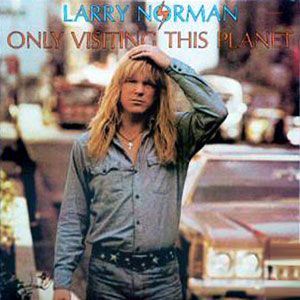

Situation Norman

It was in a locker room. I couldn’t believe I was here. First of all, at Gordon College—that bastion of conservative Christianity. Second of all, in the same room as him. A friend had offered to drive me up here from Boston, where we were both in seminary. I was a little saddened to see less than 200 chairs set up on the gym floor, carefully arranged on a tarp so as not to mar the shining wood beneath. Larry Norman came onto stage to great applause, and was remarkably intimate with his fans. He’d been a big name in the 1970s, almost single-handedly starting the Christian rock genre. After the concert was over, my friend said “Do you want to meet him?” Here he was, in the locker room, taking the time to speak with fans, individually. He refused to sign autographs, preferring to give the glory to the Lord. But he listened, he responded, and, it was clear, he loved.

While the sections of the brain that process religion and music may not be the same, we know that our gray matter is intricately interconnected. Analysts have noted that the most famous religious leaders of modern times have quite often been deeply affected by music. Religious services without some form of music are in the minority for a reason. And it really doesn’t matter what style said music takes, it moves people. Instead of apologizing for my own musical tastes, I’ll simply note that I was exposed to Larry Norman at a young age. Although his religious perspective and mine had parted ways before I had the chance to meet him, I’ve never disparaged his music. It is authentic, innovative, and above all, sincere.

Gregory Alan Thornbury has just published a biography of Larry Norman. I will surely read it. Although Christian rock has grown insipid and cloying since it began, it is still a remarkably lucrative business. Evangelicals will pay good money to get those rock rhythms with unthreatening words and praise of Jesus thrown in. Norman’s songs, however, were complex and nuanced. Equal parts love and social justice, they might not even mention Jesus. Or when they did, they might suggest he was a UFO. Unconventional. Blasphemous to some. As the ‘70s faded into the ‘80s, Larry Norman was considered old news. He had, however, started something that was bringing other people lots of money. And he looked me directly in the eyes late one night in the locker room of a conservative Christian college, and told me to keep on believing. Obscurity, he showed by his life, is no measure of a person’s actual importance. And music and religion can never be separated.


Private Browsing

Montclair, New Jersey, is a diverting place. At least it is for me. I used to teach—strictly as an adjunct of course—at Montclair State University. And like many other diverting towns, Montclair has multiple bookstores. On the occasions my wife has to spend a Saturday working in Montclair I often accompany her. If the weather is decent I can walk to both bookstores and have a leisurely browse. Since anything leisurely is rare these days, I eagerly anticipate such trips. Typically I’ll sit in my wife’s work place counting off the minutes until I can leave to get to the Montclair Book Center just as it opens. Used bookstores are a bit like archaeology—you never know what you’ll find, and some of the treasures may be unique. I often have the store mostly to myself, for private browsing.

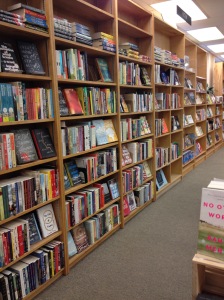
This time, however, I had another task to accomplish first, before I could go to the first bookstore. By the time I arrived, it had been open for over an hour and there were, surprisingly, plenty of people there. We’re accustomed to hearing that people no longer care for books. While it’s true they won’t bring in the numbers of, say, those wanting the latest video game, it’s also true that on a pleasant Saturday morning an independent bookstore can be a crowded place. It warmed my heart to see so many readers out. And they weren’t all old like me. Younger people talking about the merits of this or that author, browsing in the sections I frequently haunt. Although I found none of the books on my list, I still had that blessed feeling you have when you discover you’re not really alone.

The other store, Watchung Booksellers, is a couple miles to the north, at least by the walking route I use. A small indie, it typically has what modern-day people might be expected to be interested in. I arrived to find it crowded as well. I’ve been there a number of times in the past and usually there are two or three others browsing. This time it was actually a little difficult to get around the small space. Seeing children there made me especially glad. A crowded bookstore is a sign of hope. As we struggle against the forces of ignorance and hatred that seem to have gripped the privileged classes, Saturdays at bookstores doing brisk business are an indication that the future may correct such ill-informed sentiments. Bookstores are termometers of national health, and seeing them busy made my Saturday. It’s worth getting up early just to spend such a day in Montclair.


Exorcising Theology

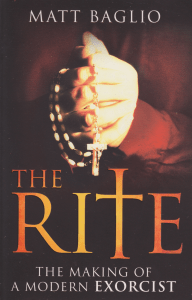
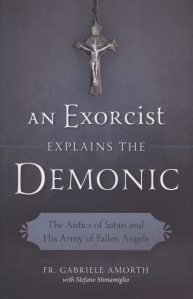
Among those curious about exorcism, the name Fr. Gabriele Amorth requires no introduction. As “the Vatican’s chief exorcist” (a claim the book makes), Fr. Amorth was known for conducting many deliverances and for teaching a new generation of exorcists. Looking for an entryway into his perspective, I read An Exorcist Explains the Demonic: The Antics of Satan and His Army of Fallen Angels. That a priest in Rome should be conservative was no surprise. What was truly astounding about this account was how unquestioningly the exorcist accepted nearly everything to do with Roman Catholicism. His reading of the Bible is quite literal. His understanding of the Virgin Mary as the Mother of God offers no nuance. Demons are fallen angels and, somewhat surprisingly, he uses “Devil” and “demon” interchangeably. For a hierarchy so thoroughly parsed, this was a bit unexpected. Encountering these explanations, much of what I’d recently read in Matt Baglio’s The Rite made sense. Baglio’s protagonist studied in Rome when Fr. Amorth was still active.

Much of the book felt like a lecture from the 1950s. Sex, drugs, and rock-n-roll can all lead to demonic possession. And it turns out to be quite pervasive. Many people, saints and sinners alike, are possessed and don’t even know it. This is truly, according to the priest, a “world with devils filled.” The book begins with a Catholic, if literal, interpretation of Jesus’ role in the salvation of humankind (although the masculine pronoun is preferred throughout). Not only that, there’s no question that women can or should be exorcists. This is something that priests alone can handle. And he even goes far as to point to Eve (who literally existed, one gets the impression) as an example of how women are more easily tempted than men. Reading this brief tractate was like stepping back into a world that even antedates that of the Republican Party. Not decrying science, however, Fr. Amorth suggests medical explanations can account for some of what sufferers deem as possession. Those who think they are in trouble with demons should first go to a psychiatrist. If the problem can’t be solved, it’s time to call in the men in black.

Another area of concern is his outlook on other religions. African and East and South Asian belief systems are coded as possibly satanic. This universe is a strictly Catholic one. Having noted that, a strong undercurrent of love pervades the book. It’s clear that Fr. Amorth was a priest motivated by care for others. His theology may have been hopelessly medieval, but his heart was in the right place. And, if the accounts are to be believed, he was quite good at expelling literal demons. Some of the metaphorical ones, however, seem to have remained firmly in place.


Dreaming Reality

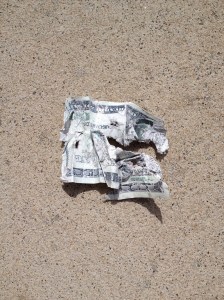
It was like that dream—you know, the one where you find a penny on the sidewalk, stoop down to pick it up, and discover that there are hundreds more of them. Maybe that’s the kind of thing those born in humble circumstances dream of, but we all recognize the draw of a windfall. People are pretty tight with their money in Manhattan, but it was early in the morning, still dark, and rainy when I saw it. A hundred dollar bill on the ground. Then I noticed more—a while bunch of them. When I reached down to pick one up, it came apart in my hand. Of course, it was a novelty replica of an actual piece of currency. When I walk through the garment district I often find great swatches of scrap cloth that have spilled out of designers’ trash bags. I’m tempted, I’ll confess, to pick them up and save them for future use. Nevertheless, this hundred dollar bill wasn’t what it appeared to be. Many things aren’t.

Religions around the world are predicated on the fact that what seems to be real isn’t. Even long before The Matrix came along. The idea that what occurs in our heads—or to use more conventional religious language, our hearts or souls—is truly real automatically takes us a step away from material reality. It’s not to say that this soggy, pulpy piece of paper in my hand has no existence, but it simply isn’t what it pretends to be. On mornings when the fates are all synched just so, I’ll look out the window of the bus from the helix and see Manhattan laid out in front of me like a picture postcard. “It’s not real,” I whisper to myself. Unlike the tourist in awe during a first visit to the city, I actually mean it. This concrete, glass, and steel world is not real. I’d feel a bit exposed suggesting such a thing on this blog had I not the biggest names in world religions behind me. One thing that they all seem to agree upon is that reality isn’t just what we experience in this corporeal vehicle that we currently call home.

Religion has been called the opium of the people. Marx wasn’t the first to suggest that the more needy among us were the driving force behind belief. Nevertheless, belief is present in all forms of thinking from extreme rationalism to naive acceptance of what your parents told you. The thing about religion is that it conscientiously advocates belief. It admits up front that it holds certain things to be true. One of those beliefs happens to be that things are not what they appear to be. Here in Manhattan we’re all so busy rushing around that who has the time to stop and think like that? I frequently walk past Holy Innocents church on my way to work. I may function, in this world, as an editor of biblical studies, but as I pass that edifice to a faith to which I don’t even belong, I feel the draw. Inside those doors—and I know this is true because I can sometimes hear the bells—a different reality awaits. Out here there may be hundreds of dollars scattered on the ground. When you look closer, however, you discover that they’re not what they appear to be.


Academia Dot

The marketplace for ideas is just that. A place of commodity and exchange. We pay our professors good money (and our administrators even better) so that we can be given “goods.” The same is true of the publishing industry. Those of us who write books primarily (I think) think we are expressing ideas we have that we suppose are worthy of discussion. The book comes out. We await reviews. Citations. Exchange of ideas. Oh yes, and royalties. Only the naive think academic publishing will lead to much of the latter in the greater scheme of things. And so many of us turn to for-profit sites like Academia.edu to pedal our wares for free. After all, Academia is offering us a free service, isn’t it? (At least if you can ignore the constant sell-ups to find out who’s been reading your stuff.) But Academia isn’t non-profit. There’s money to be made here among gullible academics.

Oh, I have a page on Academia just like everybody else. Several of my papers, long out of the payout stage for their journals or parent books, are there for free. Academia frequently asks me if I’m sure I don’t want to upgrade—increase my visibility. Make them a bit of lucre on the side. So the other day I was flattered when I received an email about my dissertation from another vendor. I didn’t recognize the sender, but the content of the email made it clear they didn’t recognize me either. It was an offer to publish my original research done at the University of Edinburgh. Problem is, it’s already been published. Twice. Both editions beyond the purchasing power of mere mortals, but still, it’s out there. Academics, I expect, are some of the favorite targets of the entrepreneurial. We, after all, don’t speak that language. We trade in the currency of ideas. We’re easy marks.

I think Academia.edu is a great idea. Often it’s possible for those of us who are unaffiliated to find papers that journals insist on selling for fifteen bucks a pop—considering I can buy an entire book for that much, no thank you—for free. There may be hidden costs involved, but some days I do miss Robin Hood. No matter how many years I’ve been an editor, I can’t stop thinking like an academic. It comes with the territory. You can’t simply forget all that graduate school taught you. One thing most academics haven’t learned, however, is how to interpret the web. Long before our government allowed the freedom of the web to end, not all sites were free.


Mediated Reality

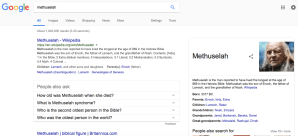
According to the Good Book, Methuselah lived nearly a millennium. For all that, the information on him in Genesis occurs in a mere five verses, in a span of seven. We learn when he married, whom he sired, and how long he lived. Not much information of the last antediluvian, especially considering how much time he had. When I searched for him on the web the other day, the information box that showed up on Google had, at the very top, a picture of Anthony Hopkins. I immediately recognized his makeup from Noah, a movie that I just can’t make myself love. The fault for having no other image may be the failure of human imagination—where do we find an image of a thousand-year old?

The internet mediates our reality. One of the points of both my books now in the works is that modern understanding of the Bible is largely media based. Few people have the time or inclination to read such a big book. (Given the continued evangelical support of Trump, it’s pretty clear that most of them haven’t read it either.) We want other people to do the heavy lifting and give us a summary in neat little boxes at the top of the screen. There’s far too many things to do in this tangled web to be spending months reading a ponderous, outdated tome, even if it does have plenty of sex and violence. Even if it influences the lives of each and every person living in America every single day. We’d rather have someone else—preferably not some egghead with a Ph.D.—give us the executive summary.

Once I did the math. If you add up the dates in what I used to call “Genesis years,” the year Methuselah died was the year of the flood. The Bible doesn’t say that old Methuselah drowned when the windows of heaven were opened, but it’s a reasonable conjecture. Nature abhors, it seems, a human being living so long. Our bodies just aren’t built for it. Some trees, on the other hand, have been alive for thousands of years. Botanists call them “Methuselah trees” (I told you the Good Book influences everything!). The pity is we know so very little about this ancient human being from days of yore. Was he a good man? He seems to have been washed out in the sluice gates of what became one great universal sewer at the time. Although we know little, his life would make quite an epic movie, I think. We already have an actor lined up, for Google tells me so.


Updates

So, I’m getting ready to update this website. I’ll give you a warning before things change. Another update, however, is in order. I’ve been promising that I’d let you know when my forthcoming book with McFarland received its final title. Well, drum roll please! The final title is actually the first title I proposed—Holy Horror: The Bible and Fear in Movies. And it has an ISBN: 978-1-4766-7466-7. And a cover design too, but I can’t share that just yet. It is appropriately lurid, matching the subject. But in all seriousness, the book makes a case for the fact that many people understand their religion via popular media. Being a bad boy, I look at it through horror movies.

The title Holy Horror was a play on Douglas Cowan’s excellent book, Sacred Terror. I recall reading that book, starting the night I bought it as SBL, curled up in the swank conference hotel bed, turning pages until I couldn’t hold my eyes open any longer. It had honestly never occurred to me that religion scholars could get away with writing about horror movies. Cowan had the natural advantage of being a Canadian, something I’ve always longed to be. He also has a secure university post. I was, at the time, just a guy trying to feel secure in what seemed like (and turned out in reality to be) a threatening seminary position that was shortly to end.

It may be difficult to understand how horror can be consoling. It can. I’m a squeamish guy. I don’t like blood and gore. I hate being startled. Nevertheless, I took comfort in this genre as my career was falling apart. Holy Horror was a cathartic book for me to write. There’s more than a little metaphor in it. One thing that will become clear to readers is that the Bible is no stranger to horror movies. Ironically, many of them are strangely conservative—Carol J. Clover’s classic Men, Women, and Chainsaws (which I’ve reviewed on this blog) made that point clearly. Horror often has the same message as your typical Disney film, although it’s presently slightly differently. How so? Well, I can’t say very much here or you’ll have no reason to read my book. McFarland does a great job with publishing this kind of title. You won’t find it in Barnes and Noble, and not likely in your local indie either, but it’ll be available on Amazon and these days that’s enough. And before long these pages will change to reflect its coming.


Scientists, Unplugged

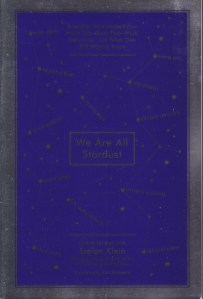
Feeling inferior is common among religionists. When cultures list their brightest and best, scientists often top the list and those who specialize in religion are nowhere to be found. This situation gives the lie to the fact that many scientists think about, and are influenced by, religion. That became clear to me in reading Stefan Klein’s We Are All Stardust. Not Klein’s best-known book, this is a collection of interviews with well-known scientists, unplugged. There are many big names in here, such as Richard Dawkins and Jane Goodall, as well as some less familiar on a household level. Klein, himself a Ph.D.-holder in physics, asks them somewhat unconventional questions, with the goal of bringing a more human face to scientists.

When asked directly, scientists admit to thinking quite a bit about religion. Of those interviewed, several are hostile to it while others accept some tenets of one faith system or another. Most of them indicate that either religion or morality plays an important role in society, if not in science itself. The sad part is almost none of them seem to realize that the study of religion can be (and among the university-trained, generally is) scientific. In academia, religious studies is often vaguely tossed in with the humanities, while others would suggest it fits under social sciences—as a sub-discipline of anthropology, for example. Few understand the field, in part because many specialists enter it for initially religious reasons, somehow tainting it.

While I enjoyed the book quite a lot—it was a quick read with plenty of profound ideas—it also had a disturbing undercurrent. The explanation that many of the interviewees gave for why they went into science was “curiosity.” The implication was that those who can’t stop asking questions, and have intelligence, go into science. Again, this feature is true of most academic fields, if they’re understood. Greatly tempted to go into science myself, I simply didn’t have the mathematical faculties to do it. While I took advanced math in high school I wouldn’t have gotten through without my younger brother explaining everything to me. My real concerns lay along the line of ultimates. Learning about Hell at a young age, it made the most sense to me—very curious and scientifically inclined—to avoid going there. To do so, the proper target of my science should be religion. While many scientists in We Are All Stardust are friendly to philosophy, religion is considered a far less worthy subject by not a few. True, religion often behaves badly in public. It doesn’t bring the money into universities that megachurches reap. But unplugged even scientists still think about it.


Re-reading the Rite

I’ve written on The Rite before. My current book project, however, led me to reread this account after watching the movie based on it a couple of times. The film dramatizes, of course, the somewhat understated demonic activity in the book. The protagonist loses about 30 years in age and isn’t yet a priest. As is usual, the book is better than the movie. Matt Baglio’s story follows Fr. Gary Thomas from parish ministry in California to his discovery of possession and appointment as an exorcist. As part of the Vatican initiative to have an exorcist appointed in every diocese, Fr. Thomas was sent to Rome to take a course on exorcism. His experience was all academic until he began to attend actual exorcisms with an unconventional Capuchin monk. Very little described in the book is difficult to believe.

This time around the curses nabbed my attention. Among exorcists of the Roman Catholic stripe, there is a strong belief in the reality of curses. Not only the reality of curses, but the belief that curses can lead to demonic possession. Knowing that Catholicism has struggled with accusations of being unsophisticated and behind the times, the fact that this isn’t more widely known is pretty self-explanatory. Growing up Protestant, I was always taught that curses are make-believe. They don’t really have any influence on a person’s life. The world of demons, however, is a supernatural one and the concept of curses still holds sway in this universe, as the book shows.

Another arcane aspect that resurfaced when I reread this book is just how elaborate the Catholic backstory is. Many Catholics, it’s clear, distance themselves from such topics as the Devil and demons, but there’s no escaping the Virgin Mary and the drama of Jesus versus the powers of evil, as well as the intercession of saints. The problem is that many of the players are personified in the Bible. It’s pretty hard to say the Good Book got it wrong. That worldview lends itself to belief in supernatural impingement on this sphere. Not that that’s a bad thing. Many people, however, would rather believe in a materialist world with physical cause and effect being the main operating paradigm. Demons complicate all that. But then, so does the idea of Mary being a perpetual virgin, and even the patrilineal heritage of Jesus himself. The Rite brings to the light something many would perhaps prefer to be kept under a bushel. Strange things do happen in this world, and they do tend to respond to the backstory that’s been told. That makes such books difficult to classify, even with the backstory.


Canadian Care

Amazon, probably not purely out of kindness, gives some customers access to the most read stories in the Washington Post. Apart from talking to my wife, this is about the only way I learn about what’s happening in the world (mine is a small world after all). I have no idea what Amazon’s metrics are for determining which stories to share, but I was amazed at one focusing on doctors in Canada. The story also appeared in Newsweek and other media sources. Unlike many medical professionals, these Canadian physicians are petitioning the government for lower salaries. They say they already have enough money and other healthcare workers aren’t being paid adequately. Why not share when you have extra? I’ve always thought Canada was far ahead of its southern neighbor in the ethics department, and this about clinches it.

Don’t get me wrong—I’m grateful for doctors. (You should see how much money I give them!) Nobody wants to go through life with this or that hurting or aching all the time. Most of the doctors I’ve met have been kind and descent people. Seldom as strapped for cash as I am, but then my doctorate is in a more intellectual field; serves me right. What really becomes a star in my personal firmament is that somewhere in this world enamored of capitalism, a privileged class has said, “this isn’t right.” Economists have been warning us for years that unbridled capitalism isn’t sustainable, but that falls on deaf ears in this country. Maybe our political leaders should see an otolaryngologist? Maybe they’ve got some wax build-up in there.

Doctors work hard. They have long hours and have to put up with smelly and messy situations. There’s a reason we have to pay so much to compel them to look where the rest of us are told to avert our eyes. At the same time, every other major developed nation in the world has some form of socialized medicine—it is a basic human right. Everywhere but here. If you drive through New Jersey you can’t help but be taken by the palatial campuses of the pharmaceutical companies that call this state home. There’s gold in them thar hills. As I gaze at them from the highway, my thoughts are driving across the border to a land that’s both affluent and caring. When’s the last time we heard an American entrepreneur say, “I’ve got enough—give the rest to someone else”? When too much is never enough, that’s something it’s going to take a Canadian doctor to treat, I fear.


Woodland Creatures

Maybe I watch too many zombie movies, but the story of zombie raccoons was just too good to pass up. A story by Marwa Eltagouri in the Washington Post described a spate of recent “zombie raccoon” incidents in eastern Ohio, not far from where I grew up. While the likely explanation is distemper, one of the behaviors of these raccoons stands out—they walk on two feet. Since I also enjoy the occasional non-fiction book by Linda Godfrey—who’s made a name writing about anomalous animals in North America, particularly bipedal dogs, or wolves—I found this aspect of the raccoons particularly interesting. That’s the thing, you see. Bipedalism suggests other human-like traits. Think great apes. Or penguins. (Although birds are generally bipedal, they tend to be squat and more horizontally inclined than vertical. The penguin not only dresses for our most formal occasions, but waddles around like many of us do after having been a bit too generous at the dinner table.) But bipedal raccoons—now that’s scary.

As a species Homo sapiens seem to have a need to believe themselves unique. Over the centuries any number of traits have been claimed as unique to us. Bipedalism, the ability to speak, being relatively naked so that we have to wear clothing, being able text with our opposable thumbs—we’re not like other animals. We’re special. So when animals that normally go on all fours walk on two legs we instantly think they’re trying to be like us. They want to have all the rights and privileges of our species so they can elect alt-right leaders and destroy everything they’ve built. Uppity critters! We have trouble reconciling ourselves with our animal origins.

Other animals, it seems, are beginning to note the advantages of walking on their hind legs. I’ve watched enough zombie movies to know that it’s the intention that’s the real problem. They want to be like us. Notice the accounts of bipedal animals—witnesses say there’s something in their eyes. Global domination. Yes, they’ve been watching us and now they want the same things we want. They want to take over the world. I know enough about World War Z to know that you can’t save everyone. Hard choices will have to be made. And maybe I’ve watched too many movies, but I’ve noticed the bipeds are from red states: the dog-men of Michigan and Wisconsin, the raccoon-men of Ohio. If we can’t save everyone, we need to make wise choices. Why not let them have Washington, DC? They certainly can’t be any worse than what we’ve got there right now.


Knowing It All

Reading about the Trump administration underscores once again the traditional American contradiction of, love of, but mostly hatred toward, experts. When you’re lying on that operating table, you stake your life that an expert is going to perform the surgery. When you buy that airline ticket, you’re banking that the pilot will be an expert. If you’re electing the most powerful individual in the world, you’ll excoriate experts and defer to the guy with the weird hair that says whatever he pleases and has never been a public servant a day in his life. This observation isn’t original with me, of course. I’m only an editor. Nevertheless, the same dilemma comes down to my little world of academic publishing as well. Most academics don’t understand this business—I was an academic at one time and I certainly didn’t—and yet don’t like to bow to the expertise of those who do.

Please don’t misunderstand. I’m making no grand claims to understanding this industry into which I unwittingly stumbled. I have been involved in it for over a decade now and I’m still learning. One of the things I’m learning is that many academics don’t trust experts. In part it’s academic culture. A doctoral program, if it’s a good one, will make you question everything. Sometimes even experts forget when to engage the brakes. When dealing with the experts at a publishing company, many academics doubt the expertise of those who do this day in and day out for a living. Books, however, have measurable sales records. There’s hard data for analysis. Not that it’s foolproof (but what is?), such metrics are time-tested and based on reasonable data sets. Often that’s not enough to convince an expert that other experts know more than they’re revealing. A personal philosophy, but one which I pursue with appropriate skepticism, is that other people should be left to do their jobs. As I frequently note, those who talk to the bus driver, freely giving advice, often make the situation worse for everyone.

The case of religion, however, is a special can of worms. There are no experts in this field, even among those of us who are experts. Had I realized this when I was younger, I’m not sure it would’ve made much of a difference in what I ended up doing with my life. You see, religion is all about ultimates. The big questions. The sine qua non of every single thing. When I read about things like politics, or entrepreneurship, I think to myself, “That’s all fine and good, but at the end of the day, is it what really matters?” If life is a search for meaning, why not grab it by both hands and try to become an expert at it? Some would say that’s the job of the philosopher, but let’s face it, religionists and philosophers deal in the same currency. One is more abstract than the other, to be sure. Still, don’t take my word for it. Please consult an expert.


Upstate Goddesses

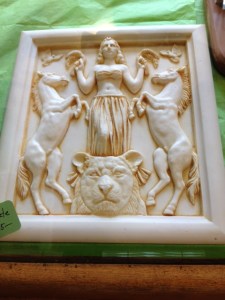
Goddesses give you connections. Here in Ithaca, all kinds of specialty shops abound. University towns are like that. This one had lots of goddesses. Ever since writing my dissertation on Asherah I’ve been interested in female divinities. Part of the reason for this is that I fail to understand how many men don’t see the power of women in their lives and insist that men should rule. Goddesses remind us that women have as much to contribute as do men, and they should be honored and respected just the same. Deities, after all, are projections of humanity. In any case, I found myself in a shop with many goddesses. The proprietor noticed my interest and struck up a conversation. This was ironic because where I live no one asks about my academic background; I have to travel to find interested takers, I guess.

She told me of an upcoming conference that would like to hear my thoughts on the topic of Asherah. Since my book on the goddess has been plagued with high prices, it remains hidden down three or four pages on Amazon, while lower priced dissertations easily float above it. My conversation with this stranger brought out that I had planned to write on other goddesses. A friend had done his dissertation on Anat, so I began working on book on Shapshu, the Ugaritic goddess associated with the sun. Some cultures made the sun male, the people of Ugarit, however, knew the true nature of brightness. I was going to make an academic career of goddesses.

Every great once in a while an academic will ask me about Asherah. Chances are their book or article will fail to cite my work, but they do seem to know to make queries. In my hopes to get a job beyond Nashotah House I followed the advice of colleagues to write a biblical book before finishing another book on “pagan” deities. In the career vicissitudes that followed, goddesses had to fall by the wayside. Although there can be money in deities, as this shop in which I stood proved, they aren’t really a marketable commodity in the realm of making an academic living. Now that I’ve found my way back to writing books again, perhaps I’ll return to my goddesses. That brief encounter in an Ithaca store resurrected some of the fascination of learning about the inner lives of divine women. The need to remind the world, it appears, has only become greater since I first wrote about Asherah decades ago.


Ithaca Musings

Ithaca may be the ultimate hippie town. Open and accepting of diversity, it’s a place where anyone can speak out against what’s going on in the government and not worry about finding any objectors. Yesterday when I was in Buffalo Street Books, customers openly vented their frustrations with the way Washington’s handling things, and others joined in. There’s a sense of righteous anger here that hasn’t been fashionable since the days of the biblical prophets. You have heard it was said Watergate was a bad thing, but verily I say unto thee something much worse than Watergate is here. And although winter is still holding on in upstate New York, nobody doubts global warming is real.

From my first visit here, I knew that I wanted to live in Ithaca, but it is one of those places you can’t afford to live. Amazing how the liberal cities are the places people want to reside. Places where you can’t just turn off the realities of a diverse world just because some things make you uncomfortable. Places where if you notice that other people are different you are reminded that you, in their eyes, are the different one. There is no static, monochrome, cookie-cutter American. Why is this an idea so hard to sell? Capitalism leads to and fuels the desire to own. And owning leads to the desire to own more. I’ve often noticed this since being out of higher education—even within your own company others want what you have. The basic civility of the socialist is missing. That’s where the “me first” attitude leads.

In upstate New York, as in many parts of the nation, the very names remind us that others “owned” the land before Europeans arrived. Native American concepts of ownership were so different from the capitalist ones that forcefully landed on these shores that those views were forced, under firearms and steel, to assimilate to the foreigners’ ways. Capitalism takes no prisoners. Turnabout, they used to say, is fair play. We no longer feel that way as a nation. The interlopers have taken over. We’ve made the country in our own image. And it certainly isn’t any more noble for it. Being in a place like Ithaca always makes my spirits ebullient. The very concept of ownership is an odd one, I realize. Mere mortals can never really own anything. We can pretend to, or perhaps we can take a more enlightened view. We are all borrowing things here. And I would love to borrow a piece of real estate here in Ithaca.