Zounds Like

Liberation from the confines of academia allows for the occasional indulgence in taboo subjects. I can’t remember when I first heard of stigmata. I didn’t grow up Catholic, and, like many Protestants, distrusted much of what came from Rome. Still, I was interested in the supernatural. When I learned that people in this modern day and age sometimes developed unexplained wounds corresponding to crucifixion, I was intrigued. Ted Harrison’s book, Stigmata: A Medieval Mystery in a Modern Age, is the first I’ve actually read on the subject. It has some fascinating observations to share. It was some time after seminary that I learned that Francis of Assisi (aka St. Francis) was the first stigmatic. I had admired Francis for turning down wealth to assist the poor and commune with nature—what’s not to like?—but I didn’t realize that he had initiated this rare, but real phenomenon.

Harrison considers the question of why it was only in the 13th century that the stigmata began to occur. They have occurred ever since, in very small numbers, primarily in Italy and primarily among women. But why then? He points out that the church, shortly before this time, began to emphasize the physical suffering of Jesus on the cross. We’re probably all familiar with some of the gruesome images that emerged from the church and its artists at that time. As such images proliferated, people were given a visual focus that directed their devotions. Every great once in a while, this led to stigmata. Why women? As Harrison points out, men with intense spiritual needs could become priests. Women could not. The church would not forbid personal devotion, and if such devotion led to stigmata, well, a person arguably had a direct line to the divine. That was something normally preserved for priests through the Eucharist.

Stigmata have to be understood in the context of mysticism. The more recent cases studied by Harrison include some non-Catholics and some other unexpected candidates for what is, after all, a very intense spiritual experience. What emerges is a thoughtful, one might dare say contemplative, approach to the issue. Some stigmata have been self-inflicted. Some have not. Medical personnel have witnessed and examined these improbable wounds and have not explained them away. Once, during a faculty meeting at the New College of Edinburgh University (I was post-graduate student representative) one faculty member groused after one of my advisors had presented a challenging idea: “you’ve dropped us in a mythological world. I want to get us out.” There it is in a nutshell. Some people can live in a world where stigmata occur. Others have to explain it away. The difference is all in the matter of perspective.


Power in the Blood

Converts, they say, are often the worst. It matters less what the conversion is to or from, since the zeal of the newly enlightened is impossible to match. The textbook example with religion, especially in America, is Evangelicalism. Those who’ve “found Jesus” are eager and too willing to tell others about it. You don’t often hear, however, of those who grew up Evangelical, but then had second thoughts. Often they disappear quietly. Evangelicalism is a potent force in American life. Intellectuals, embarrassed by it, tend to pretend it doesn’t exist. Or it’s on its way out. No need to approach, with nervous laughter, those who actually believe this stuff. Evangelicals, however, can get presidents elected and their zeal can take away any number of freedoms deemed “godless” by those who may have no more education than the local bartender. Matthew Avery Sutton’s American Apocalypse: A History of Modern Evangelicalism is masterful. Although not comprehensive (the movement is too large for that) this book does not shy from the unifying fact behind radical evangelicalism—the belief that the end is nigh.

Oh, I know. Those of us who are educated have no need to take such nonsense seriously, right? Sutton may change your mind on that. When you realize just how close to disaster after disaster this thinking has led (and continues to lead, under the current administration) us, you might want to take the Fundamentalists a bit more seriously. They constitute the largest religious bloc in the nation. One of the baffling things about them is their protean nature. What’s the difference between an Evangelical and a Fundamentalist? And what’s with the obvious differences between a Timothy LaHaye and a Billy Graham? And where do these people get all their money? (Fundamentalists have always been close to nearly endless, well, funding.) Republican presidents from far before Nixon realized that big business and conservative theology, although strange bedfellows, are remarkably compatible. (Each thinks the other side doesn’t realize it’s being used.)

American Apocalypse is an important book. Written before perhaps the strangest turn in US history last November, it might have helped to show that Trump was a serious threat from the beginning. If only the educated took it seriously. Evangelical antipathy to women’s rights, civil rights for minorities, and socialized medicine run very deep. It’s the Old Boys’ Club with a vengeance. Recent events have shown yet again how important it is to understand these ways of thinking. And those of us with insider knowledge have never been welcome in the academy. That’s okay, though. If I go back to my roots I’ll realize the world’s about to end any day now. Those who’re smart might think about taking equestrian training because I’m sure there will be white horses involved. If only I could get myself converted back.


Surface Tension

Montclair, New Jersey, is distinguished by having two bookstores. On Saturdays when my wife has to work there, I sometimes come along. Apart from the pleasant company, it isn’t every day that one can visit two bookstores. By supporting such shops, I am protesting the ignorance rampant in this nation. One, the Montclair Book Center, specializes in used books. Not always competitively priced, I nevertheless seldom leave empty-handed. It’s a healthy walk from there to Watchung Booksellers, a compact indie up by the train station. For a small store they always have an intriguing selection and I’ve never seen it empty on a Saturday. As I was walking the distance between the two, I noticed that Montclair’s downtown (and I’m not picking on Montclair, which I love) focuses on appearances. This is true of almost all shopping malls as well. Salons, clothing stores, eating places, tattoo parlors, health clubs. Places you go to help hone your image. Where are the stores catering to the mind?

Don’t get me wrong, I also have a body. I like to keep healthy too. I jog when I can, and I’m a vegetarian of nearly twenty years. Yes, there are the necessary places like drug stores and specialty shops where you can get your vacuum cleaner repaired, but few places to go explicitly to encourage mental growth. Hot, I stopped into a coffee shop for a bottle of juice. Patrons were busy at their phones and laptops. I recalled how there was a time when intellectuals hung out and conversed in coffee shops, exchanging ideas over mugs long grown cold. Even those sitting outside on the sociable, colorful chairs were busy texting, Instagramming, or tweeting away their weekends. I closed my book and walked on. I felt a vague but pressing need for intellectual engagement. I headed to the second bookstore.

On the way home one of those industrial-sized lawn-care vendors cut us off on the highway. Lawn-care is big business around here. It’s all about appearances. What has happened to the life of the mind? Allow me my curmudgeonly years—I recall walking downtown as a child and seeing the office supply store with actual paper, smoke-shops with their abundant magazines and wire spinner racks full of questionable paperbacks, and even the Christian bookstore with its tracts and Bibles. I didn’t have the benefit of living in a university town, but people I saw were talking to one another. Exchanging ideas with someone actually present. Self-consciously I look down. I’ve had these cargo pants for many years. This shirt I’m wearing I purchased in Wisconsin in another decade. Even these shoes haven’t been replaced after all these miles. This hat on my head is almost older than my college-graduate child. I can’t be bothered with my appearance right now, though, because there’s another bookstore just ahead.


Eclipse 2017

It’s the day after the eclipse. Perhaps it’s because of the internet, but the excitement about this somewhat common event reached a fever pitch. Maybe it was because we all wanted something other than Donald Trump to talk about. Maybe it was because we hoped that the eclipse might have brought about some profound change. In the days before science was a thing, eclipses were divine events. The sky doesn’t darken at noon. It is an uncanny, an eerie thing. The last eclipse—alas, only partial—that I experienced was at Nashotah House. My wife was still a student in Illinois at the time, and without her to remind me, I went about my classes as usual. When I stepped outside the eclipse was already in progress. Nashotah’s quite rural, but the birds and insects were silent. The light was weird. The shadows of the leaves were scooped crescents on the ground. I could understand why pre-scientific people trembled.

These days we know there’s nothing more to life than scientific formulas and a bit of sloppy chemistry. So why do we bother getting bothered about eclipses? The fact is they remain religious in our minds. This is nature acting in a way not normal. Apocalypses generally include the sky growing dark. One of the plagues of Egypt was darkness. In the ancient mind the sun did not so much cause light (the moon could give light too) but it lived in the realm of light. If something blocked the sun that was one thing. If something invaded the realm of light, that was another. An eclipse was such an invasion. Even as monotheism began to take hold, people thought of the sun as a deity. It, after all, directs our lives.

In New York City I wasn’t sure what to expect. I went to street level with a couple of colleagues about 10 minutes before maximum coverage (about 71%) began. Knots of people stood on the corners on the eastern side of Madison Avenue—those who build skyscrapers don’t think of eclipse viewing on the streets below. What struck me most, however, was a kind of peace and awe. Strangers sharing various viewing devices with each other and looking up expectantly. Clouds had begun to move in, and I found myself talking to complete strangers, sharing out the eclipse-viewing glasses my wife had given me. We were participating in a moment of transcendence. Such moments are rare today. No, an eclipse is more than simply the moon moving in front of the sun. It is a human event as well. And one which, in the absence of the sun, brings out the best in us.


Celestial Happenings

Science fiction used to be the mainstay of my reading. Unlike a true fan, I was never exclusively devoted to it—my tastes are far too eclectic to be contained by any genre. Nevertheless, at a used book sale, on a whim, I picked up Frederik Pohl’s The Day the Martians Came. It had a cool looking spaceship on the cover, and I recognized his name from my childhood reading. I prepared myself for an adventure. Instead I found a disillusioned tale of humans and their foibles, many of them religious. Many tales, in fact. Indeed, I wasn’t surprised to find out that this was originally a set of discrete short stories later laced together into a novel. The point, it seems, would be appropriate to Qohelet. Human beings run around doing their pointless things and failing to communicate with one another. That much was true to life.

The Martians, who are more evolved and intelligent than humans, but who appear to be mere docile animals, are discovered near Christmas. Much is made of the fact that humans still celebrate Christmas on Mars. And, if you can cut through all of the snark, there’s also a message that we like to live out our prejudices whenever possible. So the humans, excited about Martians being transported back to earth, try to take advantage of each other any way they can. Some of the most complex of the stories involve religious leaders who dismiss science and assert mystical knowledge of these extraterrestrials. These leaders, of course, are only after the money of the gullible. They’re playing the popularity circuit, or running cults, and the clueless are drawn to them. And so the book isn’t really about Martians at all, but about human folly. Mainly religion.

Science fiction means different things to different people. In a used bookstore I noticed Neil Gaiman under science fiction. As much as I enjoy his work, I’d classify it as general literature instead. Genres are there to help us find related material. The name Frederik Pohl and the word “Martians” in the title suggest science fiction, but the book itself doesn’t really meet the criteria. At least for me. Perhaps it’s because we’ve landed rovers on Mars and are now talking about a human expedition. Mars has become somewhat less exotic. Religion, meanwhile, continues to churn and muddy the waters. Not always as cynical as the leaders seem to be in this book, nevertheless they are part of the discussion since once we get off this planet we’re going to have foreign deities with which to deal. Whether we respond with snark or science fiction is entirely up to us.


Miracle on 34th Street

It smelled like Christmas. I was out of the office for a rare lunchtime errand, and I had just turned the corner from Madison Avenue onto 34th Street. It hit me like childhood—the scent of pine. I couldn’t believe it as I looked ahead. Wreaths lay piled up on the sidewalk. At least a dozen newly harvested trees were leaning on a makeshift frame along the street. Long disused store windows from B. Altman’s were fully decorated with Christmas scenes. Five minutes later, after my errand, I walked through the scene again. Tourists were snapping photos to paste on Instagram, Snapchat, or Facebook. Clearly the people responsible were getting ready for the holidays extremely early even for money-grubbing New York. Of course, it was all a set for a television shooting. Working in Manhattan is like being on a movie set most of the time.

It isn’t at all unusual to walk through the line of trucks and trailers parked along one of New York’s lesser used cross streets on my way to work. I see set artists working to make a store front look as if a fire had recently broken out there. Famous people lurk inside their trailers until handlers can get them out and away from hoi polloi. We’re all actors here. This isn’t an authentic existence. As I walk through today’s Christmas set, I step past the homeless with their grocery carts full of their worldly possessions. They’re the only ones on this street who aren’t actors.

I’ve been working in Manhattan for six years now. The dizzying extremes of wealth and poverty juxtaposed hard up against one another is disorienting. We would rather live in a fantasy world than help those who are suffering in real time. Yes, there are people who dwell in hells of their own making. I’m not naive. I also know that we create hells for those we don’t like. Those who “underperform” or who don’t value mammon as much as a red-blooded American should. We cast out those who have mental problems and politely ignore them as they rage on the street corner. We do, after all, have to get to work. New York is an experiment in which the virtues and vices of humanity are concentrated and magnified. We then project it onto the silver screen for all to see and covet. But just off the set there are hurting people. They won’t appear on the camera, but they’ll be there after the crew is gone. If we wanted to, amid all these trees and wreaths, we could find a way to help them. We could make this world a better, more authentic place. It’s my Christmas wish that we will.


Creative Religion

If you ignore common sense and read this blog, you know that I try to be creative in my approach to the world. It’s bold, in my way of thinking, to claim the mantle of creativity since there are so many people out there that the world has already decided are creative enough, thank you. Who has time to visit all the world’s museums, read all the world’s novels, or watch all the world’s films? Why contribute to the clutter? The answer—in as far as there is an answer—is that creativity is a way of being. My wife sent me a piece by Maria Popova from Brain Pickings. It is about the creative life. I’m reluctant to claim the title for myself, but the essay does match the description of what I’d like life to be.

Writing about religion daily requires a certain amount of creativity. If you think about it, it does make sense. Religion deals with intangibles. “Things not seen.” It also delves into that deep place called meaning and wrestles with issues we all have to face in our lives. It’s really a shame when religion becomes ossified into a system with no creativity or humor. One might make the case that it ceases to be religion then. The other day I was recalling just how powerful a high mass can be. Even now, if the mood is right, the memory of my first experience of it can bring tears to my eyes. It is a pageant of mystery and power. And creativity. The colors, the sounds, the scent of incense, the pressure of the kneeler on your knees, the sharp bite of flame tokay. It may not be the worship the way the disciples did it, but it sure has a creative genius.

When, however, worship became a daily requirement—when the majesty became mandatory—something was lost. Creativity means being willing to try something different. As much as we creative types cherish our friends, we need time alone with our Muses. And when we come back together with those friends, it is all the more pleasant for having been away. Creative people do not control their creativity. It clearly works the other way around. We can’t stop being creative, even if—and I can’t imagine why—we’d ever want not to be. Religion, on the other hand, tends to get stuck in some awkward places. If only it could be brought together with an open creativity without becoming trite it might find a place in a world too busy to take time simply to be.


Fall of the Titanosaurs

If I had it all to do over again, I might well have gone into paleontology. Like most kids, I grew up fascinated with dinosaurs. Then “real life” got in the way and you need to get a job since you can’t spend your time playing with your cheap plastic toys and dreaming Triassic dreams. There’s no future in the past. So I decided to study dead languages instead. Still, the recent discovery of Patagotitan mayorum is exciting. Titanosaurs—the really big dinosaurs—were not even known when I was a child. What we used to call “brontosaurus” was about as big as they got, but we did know that diplodocus was out there somewhere, even a bit longer. We didn’t have to worry about ark space in those days because we knew that extinction happens.

The current evangelical flavor of the day takes a hard line on evolution. Since it absolutely can’t happen and since there’s no denying dinosaurs, they must’ve crowded onto old Noah’s floating hotel along with everybody else. The problem is we keep discovering more and more large dinosaurs. Patagotitan was 122 feet long, without skin. It weighed more than ten elephants, making me wonder about water displacement ratios. Depending on your definition of that fuzzy measure of the cubit, the ark was only 450 feet long. And Patagotitan is only one of the titanosaurs that dwarf the already huge apatosaurus (the correct form of brontosaurus) and brachiosaurus. Even if they hibernated the sheer mass of reptilian tonnage wouldn’t leave much room for the latter ascendant mammals. That is, if mammals had come later and ascended.

Noah, despite being a traveler, never made it to Patagonia. In fact, the ark pretty much stayed still during the flood, coming to rest in Turkey after having been constructed somewhere just east of Eden. And since the Bible doesn’t mention continental drift we can’t even rely on Pangea to have gotten all the beasties to ark central on time. I’m guessing that Patagotitan was probably a slow walker. Since the continents were just like they are today, it must’ve been a fair swimmer as well. And it didn’t mind quarters just a touch claustrophobic for such a massive monster. What with all the home improvement shows these days, Noah might have considered an addition to the ark. But the Bible says God gave him the plan and one thing we know about the Almighty is that what he says he means literally. Dinosaurs or no.


The Way

Part of the problem is that I’ve never been fortunate enough to learn Chinese. You see, scholars of religion are often insistent on reading scriptures in their original languages. It has been a long time since I’ve picked up the Daodejing, one of the formative scriptures of Daoism, and I was struck by a number of things. First (and I have the confirmation of Sinologists on this), the Daodejing is difficult to understand. This isn’t just a translation issue. Nor is it an issue of Chinese thinking. All world scriptures are difficult to understand. One of the major problems with the Bible is that it has been translated into English for so long that many assume the language concerns are negligible. They’re not. The Bible has many obscure parts. Also it’s worth noting that the Daodejing has been translated nearly as much as, if not more than, the Bible. It is a very influential text, in part, I’m sure, because it’s not easy to understand.

Paradox isn’t within the comfort zone of many western religions. We like our belief structure to be (mostly) rational and believable. In fact, to start an argument just point out the fact that the Bible has contradictions. (It does, for the record.) The point being that a westerner will want to believe it is consistent and coherent throughout. If they can’t have that in English then they’ll say it’s inerrant in the original languages (it’s not). Religions shouldn’t make your brain hurt. Paradoxes, however, require deep thought. They can’t be read quickly to be stored away as factual information. They do, however, constitute a large part of life. Look at Washington and meditate. Daoism, the religion that generally follows the teachings of Lao Tzu (the putative author of the Daodejing), finds truth in contemplating opposites which are both simultaneously true. And not true. Interestingly, many of the sayings in the Daodejing are similar to ideas attributed to Jesus in the New Testament.

Dao is often translated “way.” One of the striking things about Edmund Ryden’s translation is his choice to use the feminine pronoun for “the way.” This is motivated, as I read it, out of concern to do justice to the presentation of the dao in the Daodejing itself. While the dao is not god, nor personal, it is powerful. The recognition of feminine power is clear in many aspects of the Daodejing. That’s not to say that the culture wasn’t patriarchal, but merely that it recognized balance—the famous yin and yang—as being inherent in the way the universe works. If such an idea could truly take hold the world might be a better place even today.


Thy Fandom Come

It’s not hard to feel that you’re from another planet. If you were born in the sixties and had kind of a rough transition to this whole internet thing, you know what I mean. Still, I want to be part of it—it’s kind of like New York City, only bigger. And faster. The commute doesn’t take nearly as long, now that dial-up’s a thing of the past. So I bought someone who was into fandom Sam Muggs’ The Fangirl’s Guide to the Galaxy: A Handbook for Geek Girls. This particular fandom, well, fan, gave me the book to read. I’m a feminist, so I don’t have any issues with reading a book intended for girls. What became clear to me, however, is that I don’t understand the internet nearly as well as I thought I did, and that girls find they’re oppressed there too. What is it with men and control?

It is an ethical issue. I don’t blame people in the past for not thinking like we do, but today there’s no excuse whatsoever for considering somebody a lesser person because of their gender. Women and girls have just as much right to “guy things” like geekdom as do males of the species. Fandom is all about fun. Enjoying the fantasy of living, for a little while, in other worlds. From the way many men treat women it’s no wonder that they feel that need just as much as my own self-identified gender. Religion, unfortunately, bears much of the blame for this. In the largest religious bodies in the world women are still excluded from leadership roles. Religion is kind of like fandom in that way, I suppose. It can be all about exclusion. We exclude others to make ourselves feel special. Why not celebrate difference and find a place for everyone?

It’s difficult to read The Fangirl’s Guide as a man simply because you’re constantly reminded (and not intentionally, because it’s written for girls) at how inhospitable men have made much of the world for their female earthling compatriots. I was reminded at several points in this book of how films like Wonder Woman and the recent Ghostbusters stand out in their sympathetic portrayal of women heroes. And equally how men find reasons to criticize them. Then I consider the White House and shudder. When a nation elects an open and avowed patriarchalist as president we all could use a fantasy world in which to hide. This little book didn’t make me into a fangirl, but I do hope it makes me a better man.


Implied of Course

The American terrorist attack in Charlottesville over the weekend should have us all frightened. Despite declarations of “it couldn’t happen here,” fascism is an adaptive disease that finds its way to new hosts quite readily. The atmosphere coming out of Washington only promotes contagion. Trump’s response—bad behavior all around, no one party to blame—left the supreme white commander open to criticism. The appropriately named “White” House spokespersons responded with an implied “Of course that includes white supremacists,” according to the Washington Post report. That’s an awful lot of weight for an adverb to bear. The past six months have given many of us reason to doubt it’s true at all. “Of course” 45 loves all Americans. Or at least their cash.

Of course, I could be making a lot out of an implied deflection. A national leader should not hesitate to point the blame squarely at any supremacist group. Listen closely: no group is superior to another. Anyone’s background, examined closely enough, is likely to turn up a character or two who would be suspect. Trump’s election gave a new boldness to fascist groups—this is the way America’s going, isn’t it? Republican leaders, full of squees and shivers, refuse to say anything negative about a man whose thumbs can’t even reach the humility emoji. Hate crimes are wrong. They used to be illegal. What has happened to leadership? It’s more than just the CFO, wait, I mean Commander in Chief, who’s implicated here. It’s an entire political party that won’t stand up against injustice. What ever happened to “truth, justice, and the American way,” Clark? There’s never a phone booth nearby when you need one.

Back when I worked at Nashotah House, we had a conflicted environment. One of my colleagues told me something that has stayed with me ever since: “silence implies consent.” If you don’t condemn evil, you are complicit with it. We all need to stand up and say racism isn’t just an opinion—it is evil. Human rights are more than just civil rights. All people have the right to be treated fairly. Someone who hates others enough to climb into a car, start the ignition, and accelerate toward a group of pedestrians is guilty of premeditation. A president who won’t say as much is tacitly saying it might just be okay. Of course, it might just be that he’s too self-absorbed to get the thumbs going on the words we’ll never read: “I’m sorry.” Of course I’d be glad to be proven wrong.


Prophecy of Hezekiah

Maybe my recollection of the Gospel’s a bit hazy. I seem to remember one of the main characters of the New Testament saying something about doing unto others as you would have them do unto you. And turning the other cheek. I may be recalling incorrectly, since Robert Jeffress, one of Trump’s “evangelical advisors” (and since when do Presidents need evangelical advisors?) has said the Bible gives you permission to take out your enemies. Granted, it takes a twisted exegesis of Romans, and twisted exegesis works best in twisted minds, but this runs full frontal in the gospel ideal of love just two books earlier in the Good Book. Forcing the Bible to say what you want it to say is a tactic as old as preaching itself, but still, those of us with training in Scripture shudder.

Pulling verses out of context like the Bible’s a magic book is called “prooftexting.” Not related to the current plague of texting, prooftexting means you can make the Bible say whatever you want it to. The classic example is that the Bible says “there is no God.” Check it out. I’ll even give you the reference: Psalm 14:1. What’s that? I’ve left out the most important part? “The fool says in his heart, ‘there is no God.’”? You see what I mean. The danger here is that a feeble-minded, biblically illiterate world leader could easily be swayed. Nukes, after all, are great for your ego. Who wouldn’t want the Bible to say that it’s fine to take out all your enemies, and horde all the money you possibly can (not it’s not the root of all evil—Paul is dead, after all.) Except Paul wrote Romans. How are we ever to decide?

The Washington Post story by Sarah Pulliam Bailey may not suggest that we should pay attention to Bible scholars—hey let’s not get too radical here!—but the world would be a very different place if we did. The Bible is a complex and difficult holy book. (As most holy books are.) The idea used to be that you had to spend a lifetime in a monastery, or at least a few years in a seminary, to say something intelligent about it. And that training wasn’t reinforcement of literalism. But we live in a brave new world. A world that re-envisions Jesus as the loving God with his finger firmly on the button. And sycophant preachers saying, “Go ahead, make my day.” It’s all there in the book of Hezekiah.


Bible Hobby

Hobby Lobby needs a hobby. Besides the Bible, I mean. The amorphous media has been buzzing about the new Bible Museum set to open in Washington DC soon. The Lobbyists seem to think the Bible will save America. Not the Bible exactly, but their narrow, constricted, and uncritical view of the Bible. Seems a lot to expect from a museum. Museums, the Green family apparently hasn’t considered, are monuments to the past. When I last saw the politically incorrect Elgin Marbles I didn’t feel inspired to run out and build a parthenon. Instead, I simply wondered about the past and how it must’ve been cool back then. I didn’t want to live there though.

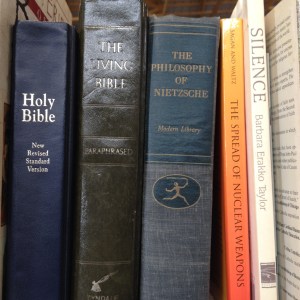
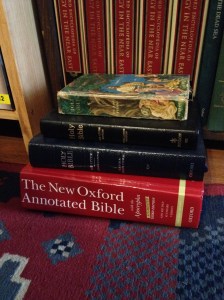
I’m sure there are great plans for the Good Book in the Bible Mausoleum. Looking at displays of the same text over and over can surely get a little dull, if we’re being honest with ourselves. I like Bibles as much as the next guy. Actually, I probably like them more than the next guy, but that’s beside the point. I don’t need to go to a museum to see them. There are Bibles all around my office, a mere arm’s length away. Here at home I can take in many of them at a glance—there are Bibles on three sides of me even as I write this from my favorite chair. Saving a nation that’s had the Bible from the very beginning sounds just a touch ambitious to me. But then, I’m no billionaire with nothing better to do with my money. There’s probably a tax write-off in there somewhere.

The thing about the Bible is, once you learn about it you can’t unlearn what becomes clear along the way. Cover your eyes or ears if you will, but we know the Bible had a long and complex history before becoming “the Bible.” It doesn’t have much of a plot without Revelation tacked onto the end—and seriously, that was one of the reasons it made it into Holy Writ to begin with! The circumstances that led to the Bible were often quite profane, in fact. It was the recognition of it as a sacred book that was a religious activity. The next step was to spread it as far as possible. That’s pretty much been done. The end result? The election of Donald Trump. If that’s salvation we’re all screwed. At least when we’re all standing in the bread line we’ll have a museum to visit while we wait. And it will be an encomium to something that was great once upon a time.


An Odyssey

Once again in Ithaca, I find myself thinking of the classics. Although it’s difficult to believe these days, even rural Americans used to value a classic education. Take upstate New York. Not only is there an Ithaca, but also a Rome, Syracuse, and Homer, among other locations. This speaks of a time when the non-urbanites wanted to be considered sophisticated rather than gun-toting, bigoted rubes who actively hate higher education and all that it stands for. My maternal line of ancestors came from this region, and although they were simple farmers, they still named my grandfather Homer. And his sister was Helen. They knew the Bible, yes, but they may also have know the Iliad.

In a recent, flattering online game, Oxford Dictionaries offered a quiz to help you identify which classical hero you were. This is flattering because most of us aren’t heroes, but instead work-a-day types just trying to survive in a Republican world. I had to confess being pleased to find the result suggested I identified with Odysseus. Odysseus was king of Ithaca, you see, and considered one of the heroes more inclined to use his brain than his brawn (although he could use that too, if push came to shove). Perhaps it felt right to me since my own life feels like an odyssey. And my grandfather was Homer. I was first exposed to classical mythology in fifth grade, and I have loved it ever since. Besides, I’m more of an upstate mentality than a downtown one. The thing about an odyssey is that you’re not always in control of where you end up.

Sitting here in Ithaca I wonder how Americans came to despise the notion of classical education. The standard of living is higher in college towns like this. People treat each other well and there’s a strong sense of community spirit. On the way here yesterday we had to drive through rural New Jersey. We stopped in the decidedly non-classically named Buttzville for gas. The car in front of us had “Blue Lives Matter” and pro-Trump bumper stickers all over it. Yet the guy who limped out and made his way into the vehicle looked like he had probably benefitted from government largesse over the years. Proud of a president who brags about not reading. Who wants to bomb a country he can’t find on a map just because it’s different. I think to myself, I’m glad I’m on my odyssey to Ithaca.


Movie Meaning

Theology has never been my thing. Now, those who don’t parse things too finely may find that an odd statement. “This blog almost always addresses religion,” they may say, “how can you say theology’s not your thing?” Perhaps for the layperson “theology” means anything having to do with religion. In the biz it has a more specific meaning. Theology is tied to a faith system. It tries to explain, rationally, what that belief system entails. Religious studies is more about studying what religion is and how it works. It was this fine distinction that put me off from reading Screening the Afterlife: Theology, Eschatology and Film. Christopher Deacy treats the subject theologically and, depending on the theologian, that can mean a lot of effort for little result. I was, however, pleased about a number of things in Deacy’s book. He doesn’t shy away from horror, for one. And he takes cinema seriously.

The idea behind the book is straightforward—theology and movies should be in dialogue about the afterlife. At a number of points Deacy makes it clear that films reach a wider audience than theology books. Again, those of us in the biz know that to be very true. If people watch movies they begin to accept what those movies tell them as true. For those of one of the established faith systems, if things haven’t altered all the much since I was young, discussing the religious meaning of a secular film is always interesting. (Some of my friends drew the line, however, when I found Elijah parallels in a film where a bread machine went out of control, but that’s a story for another time.) People take movies seriously. During economically depressed times, movies thrive. We need to pay attention to them.

The problem with theology is, no matter how open it may be, there’s always some element of rightness involved—this perspective is right and that one wrong. It can hardly be any other way. To open the door too widely is to invite yourself to exit. Deacy selects films he finds theologically meaningful when addressing (mostly) Christian views of the afterlife. I’m guessing—and it’s only a guess—that many people get their information from popular media and theologians are completely off the screen. That doesn’t mean theology has no place, but it does mean that its place is in the hands of other scholars rather than those who just want to sit around and talk about the film they saw last night. Both may be profound, but one is more clearly enjoyable than the other.