The New Neighbors

Apartment dwellers often ponder new neighbors. If anything gives the lie to being in control of your own destiny, renting your domicile does. Still using the old, aristocratic terms landlord or landlady, we know that we are under someone else’s authority. “As long as you’re under my roof,” my bully of a step-father liked to huff, “you’ll obey my rules.” When you rent, you can’t choose your neighbors. Those who own the property have final say. If they play the stereo too loud (“game” is probably the modern equivalent, but I was born before Pong even came alone) and won’t listen to your plea for a more monastic setting, you throw yourself on the mercy of your lord or lady. We got new neighbors this week. Not just us, but the whole galaxy. Seven new earth-like planets—surely ruled by Trump-like dictators—have been discovered. Let’s hope they’re early to bed, early to rise types.

During the Bush administration I often fantasized about the aliens landing on the White House lawn. I thought, with a president so obviously lacking intelligence, what would our new neighbors think of us? Would they complain to the landlord? You’d think that after that long trip across cold, vast interstellar space they’d maybe have the right to expect to find the brightest and the best in charge, right? Mission accomplished. The sign says so right there. Or to put it in a modern key, “Earth first, Earth first.” If they’ve got their intergalactic television on, I hope it’s switched to a different channel.

15207890820_d855b341e3_z

Contact, the novel by Carl Sagan, suggested the first contact from the aliens would be of Adolf Hitler. Among the first poisoned radiation this planet flung off into space was the fascist propaganda of 1930s Germany. Earthlings, not yet tempered by the Trump brand, were shocked. Surely this is a sign of hostility! Unless, of course, you control both the legislative and executive branches. Then you can just decide not to show up at the town hall and tell everyone you’ve got more important things to do. So, what will our new neighbors think? Do they just want the bodies of their compatriots from Roswell back, or is it a more serious discussion to be held behind closed doors? After all, African slaves were merely chattels in a negotiation between a more powerful culture and unhuman indigenous dullards with nothing better to do. On the spaceship back to their extraterrestrial slave mines, I do hope they have the common decency to keep the music down to a reasonable level.


Dreaming Reality

The problem with monsters is that they’re not easily reduced to a lowest common denominator. This becomes clear in an article about the under explored (from a western perspective) monsters of Australia. Christine Judith Nicholls, in “‘Dreamings’ and place – Aboriginal monsters and their meanings” (sent by a friend), describes many of the scary creatures of the outback. The article title references Dreamtime, a kind of aboriginal journey that ties into indigenous Australian religion. The division between imagination and reality isn’t as wide as we’re sometimes taught. (More on this is a moment.) Nicholls’ article demonstrates that many of these monsters impress on children the dangers of wandering away from parents. Indeed, that is clearly part of the socializing function of monsters. The question, however, is whether that’s all there is to monsters or not. (Nicholls doesn’t use reductionistic language—she does note this is a psychological explanation.)

In an unrelated article in The Guardian, by Richard Lea—“Fictional characters make ‘experiential crossings’ into real life, study finds”—researchers suggest that fictional characters seem to appear in “real life” from time to time. All those who read fiction know this phenomenon to a degree. Just because someone is completely made up doesn’t mean that s/he doesn’t exist. Since our minds are the ultimate arbiters of reality, fictional characters and monsters may indeed be “real.” This isn’t to suggest that physical, flesh-and-blood imaginary beasts lurk in the dark, but it isn’t to suggest that they don’t either. Reality is something we haven’t quite figured out yet. The more we think about it, the more it appears that both hemispheres of our brains contribute to it.

monster

When the morning newspaper raises alarm after alarm about the frightening tactics of the Trump administration the temptation is to give up to despair. That’s not necessary, actually. Reality requires our consent. Imagination can be a powerful antidote to the poison spewed by politicians. What fictional character—or monster—might step into a situation such as this to make it right? If the power of millions of smart minds were concentrated on such a being, would it not become real? Friends have suggested over the past four months that the arts—creativity—are going to be especially important in the coming years. If we are to survive evil we’ll have to use our imaginations. That’s something that the aboriginal peoples can teach us, if only we’re willing to believe.


Devil of a Time

thedevilOne might be excused for thinking so much about the Devil these days. Displays of lies and evil intentions are on pretty obvious display at the highest levels. Indeed, the current political situation has me reassessing my skepticism about the Antichrist. One of the truly well thought out books on the subject is Jeffrey Burton Russell’s classic, The Devil: Perceptions of Evil from Antiquity to Primitive Christianity. The first in a series of books Russell wrote on the topic, The Devil opens with evil. Noting that the Devil defies easy definition, Russell begins rather disturbingly with literary descriptions of acts that can only be described as evil. This allows him to point out that real life events often surpass those that authors can get us to read, intimating that something is seriously wrong with the world.

Having noted that, the emergence of the Devil is not an easy one to trace. Evil has been recognized in many cultures and it has been explained in many ways. Some have personified it, but even that took a long and circuitous route to the dark lord we know today. Bits of Greek philosophy and Zoroastrian cosmology combine with an emerging monotheism among the Israelites and their kin until eventually we have an embodiment of evil appearing. Even so, the Bible has no clear image of who “the Devil” is. This took further developments beyond the New Testament and the image that eventually won out, so to speak, borrowed heavily from classical mythology. Eventually Old Scratch emerges in a recognizable form.

Belief in the Devil still runs high in American culture. I suspect it will run even more so in months to come. At the end of Russell’s well researched study, the Devil comes down to the blatant disregard for the suffering of others. One might think of the mocking of the disabled or the favoring of the wealthy over the poor. Evil may be known by many names but it is easily recognized by those not caught up in its worship. This became clear in the biblical quotations sprinkled throughout the book. “Woe unto them that call evil good, and good evil,” for example. Or “when an ungodly man curses Satan, he curses his own soul.” Mirrors may serve multiple purposes. The vain look into them and see only beauty. Those who believe in the Devil can’t help but know who it is that stares back.


Bigger Bibles

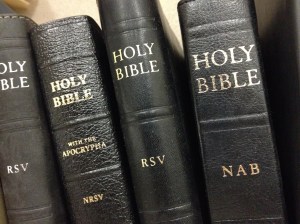
The Book of Jubilees. 1 Enoch. It’s been years since I’ve read these “apocryphal” books. I’m thinking about them today because of the concept of canon. If you’re like me—and I sincerely hope you’re not—you never heard the word “canon” until you reached college. If I’m honest with myself I’ll admit that I thought the professor was saying “cannon.” A single-n canon is a “rule,” or in this case a collection of texts. There were lots of texts in antiquity. Not many people could read, but that didn’t mean that those who could stopped writing (those who have ears to hear, pay heed). The image of the Bible with which I was raised—and mine said “Holy Bible” right on the front, so I knew it had to be right—was a collection of 66 books; 39 in the Old Testament and 27 in the New. Before I reached college I heard that Catholics had some extra books in their Bible. (Surely they must be about image worship and praying to Mary!) Then I discovered “the Apocrypha.”

The number of apocryphal books is not fixed. When I became an Episcopalian I learned to call them Deutero-canonical books instead of Apocrypha. I still couldn’t figure out the number because two of them (Daniel and Esther) are already in Protestant Bibles, but are expanded somewhat in Catholic Bibles. Do they count or not? Then there were others like Judith, Tobit, and 1 and 2 Maccabees. Interesting books, but it was hard to see what they added to the already pretty long Scripture I grew up with. I became accustomed to considering these “extra” books part of the canon. The Bible was bigger than I thought. Then I heard someone say that Jubilees was in the Ethiopic Orthodox canon. Indeed, eastern Orthodox Church canons differ from Roman Catholic Bibles. The Ethiopic Church (called Tewahedo by the locals) has millions of members. It is an ancient faith. It has a really, really big canon. You can’t learn much about it, however, at least not easily.

Because it is almost completely confined to Ethiopia, not much western scholarly attention has been lavished on Tewahedo. Sure, you can pay university press prices for a monograph or two to find technical reports, but few have bothered to ponder what all this means for the Bible. That’s why I’m thinking about Jubilees and 1 Enoch. These books are part of a Christian Bible but not the Christian Bible. There are many sacred texts in the world. Those of Hinduism and Buddhism put our somewhat tiny Judeo-Christian Bible in a different light as a small contender in a huge arena. There are scriptures from all over the world. And the response in our “globalized” university system is to cut religion departments. There’s still a lot to learn. I taught Bible classes for nearly twenty years and fell behind a bit in the larger world. It’s been far too long since I’ve read Jubilees and 1 Enoch.

img_1354


Lunar New Years

Celebrating the New Year in the middle of winter is a strange idea, at first glance. As I have discussed before, January 1 is “Circumcision-style New Year,” based on the projected date of Jesus’ circumcision after the church had settled on December 25 as his birthday. In actuality, a winter New Year date is due to its proximity to the winter solstice, and the other popular contenders for the honor of the head of the year, historically, have been the spring and autumnal equinoxes. The matter gets more complicated when a culture has a lunar calendar since the sun and moon don’t see eye-to-eye when it comes to their timing. That accounts, obviously, for a shortened February, but also for why a full moon doesn’t occur on the same day of each month. Now, I know little of Chinese culture, but I do know that Chinese New Year fell on January 28 this year, initiating the year of the rooster. Considering what had happened only eight days prior, this feels incredibly apt to me.

800px-hahn_im_huhnerhof_flamisch_17jh

Cultural diversity is a wonderful thing, and this nation is rich in it. You can, to pick a trite example, sample cuisines from around the world in a moderately sized town. Here in New Jersey getting onto a public transit bus will almost guarantee that you’ll hear at least one non-English conversation going on. Nevertheless I do have to confess that I don’t know what the year of the rooster represents in a Chinese context. As concepts cross borders they take on new associations and those who assign those new associations don’t represent those from the original land. So let it be here. Not knowing what the rooster symbolizes in China, I turn to its American expression—the cock. This is its year. The newspaper headlines read like a fortune cookie, in this distorted view of things.

To shift this metaphor to yet another cultural context—originally Jewish, but now appropriated by Christians around the world—think of Passover. For Jesus a night of betrayal. Peter, arguably Jesus’ best friend, denied three times in one night that he even knew his BFF. Cursing and swearing, according to the Gospels, he said, “I don’t know that man.” The cock crowed. It was around the spring equinox. A new year had begun. Within 24 hours, according to the story, Jesus was dead. We have much to learn from other cultures. The concepts change, however, when they’re stopped at the border.


Ash Monday

I was traveling abroad with a friend. We’d just arrived back in the United States and were making our way through customs. Since he was from another country we were separated. The border agent told me I couldn’t come back into the country unless I demonstrated that I was a racist. Only racists were permitted. He began to pressure me, even offering to help. Should I comply? I awoke in a panic. As someone who suffered frequent childhood nightmares, this was something new. In the past it was merely a monster chasing me, or my alcoholic father. Now I’m having nightmares about the government of my own country. And here it is, Presidents’ Day. Like U2’s early “New Year’s Day” or Bruce Springsteen’s “Independence Day,” there’s a decidedly poignant tone to this holiday. Looking towards DC I see nothing to celebrate. I see a government putting the mock in democracy.

This Presidents’ Day, I have a modest suggestion. It could fix democracy. When an election (I’m thinking Brexit as well as 11/9) squeaks out a victory because people don’t vote or don’t understand the issues, a true democracy would then hold a follow-up, “what I really want” vote. If we insist on keeping such arcane tools as the Electoral College in place, this is the only way for democracy to actually work. It wouldn’t be necessary in the case of a candidate winning both the electoral and popular vote. When that happens it’s pretty clear someone won. When the two are divided, however, that’s also a clear signal. Only unthinking automatons would declare that a landslide defeat is actually a win, based purely on political casuistry. Is there an ethicist in the house?

dscn6820

This Presidents’ Day feels more like Ash Wednesday to me. Ash Wednesday is for public mourning. It is a realization and confession that we have sinned. We wear ashes to make it conspicuous. This year no ashes are required. Perhaps we should wear black bands on our arms. I would, only arm bands seem to have a way of becoming bright red and appropriating ancient religious symbols. We have sinned, and we have sinned boldly. The miasma of Foggy Bottom is as clear a condemnation as is devoutly to be wished. When I start waking up in a panic, in a body-sock of sweat, my childhood monsters have become real. It’s Presidents’ Day 2017.


Alma Mater Matter

I was a teen-age religion major. Okay, that’s a bit dramatic, but I did start college at 19 and, being a first generation matriculant, had no idea about majors. No idea about colleges either. The school you choose stays with you for your life—especially if you decide to go into academia. A couple of recent events brought this home to me again. Grove City College is stridently conservative. Since I was raised Republican, it felt like a good fit at the time. It was cheap and close to home, and since my parental contribution was a total sum of zero, both of these factors counted heavily. Overlooked by many a hiring committee, it was also academically rigorous at the time. For better or worse, it’s now on my permanent record. Enough ancient history.

Recently a colleague asked me about an author, noting his undergraduate degree was from a school not unlike Grove City. I saw myself from the outside (yet again). Conservatism can be a lifestyle choice. My fellow religion-major grovers mostly went on to Gordon-Conwell Theological Seminary or other bastions of further conservative thought. Their minds were already made up. In their early twenties, no less. I headed to Boston University, at the time the most liberal of the United Methodist seminaries, by reputation. But still my record says “Grove City.” My academic writings should leave no doubt as to my scholarly outlook (most of these papers are available on Academia.edu), but there is always a shadow of suspicion over a former grover. You can’t change your alma mater, no matter what the next decision you make says about you.

Then I came across a recent writing sample from one of my Grove City professors who’s still on the faculty. This piece showed that as this faculty member was in the early eighties, so he is still today. Biblical literalism all the way down. With over three-and-a-half decades to read, that’s incredible to me. I guess I just don’t share the kind of arrogance that declares you got it right the first time and that everything you read confirms a literal Adam and Eve. And a snake and a tree. What am I to think when I see a conservative undergraduate school on someone’s academic record? I would hope that I would know to look at the next step to see what that reveals. I am a grover, but a bad grover, I guess. You have to know how to read a permanent record.

Photo credit: The enlightenment at English Wikipedia

Photo credit: The enlightenment at English Wikipedia


Ode to Zibaldone

Scribbling. All it takes is a margin of an agenda paper or the back of an envelope. I don’t remember when I started doing it—I’ve been writing my own blend of fiction, facts, and philosophy since I was in elementary school—but I would find a relatively clean piece of paper, fold it up, and put it in my pocket. I’ve carried a pen around with me for decades. Why? You never know when an idea might strike. There’s nothing like the discovery of a new idea. Lifelong learning is like that. So it was when I was reading Lemony Snicket’s Series of Unfortunate Events to my daughter that I learned about commonplace books. A commonplace book is a notebook where you jot all kinds of things down and you know where they are, unlike that piece of paper in my pocket that long ago started to rip apart at the folds, the ink becoming illegible as the paper grew softer and more pliable. A commonplace book seemed like a great idea.

This all came back to me when a friend send me a story on zibaldones. I’d never read the word before. A zibaldone, according to the story by Cara Giaimo on Atlas Obscura, is an Italian commonplace book. They used to be part of every thinking person’s accoutrements. A blank book where you could write down anything of importance. Giaimo suggests that the internet has taken the place of the zibaldone—blogs, Facebook, Twitter, Pinterest—we’re spoiled for choice where to put our thoughts. I still carry a commonplace book, however. Too many, in fact. Next to my writing chair rests a stack of notebooks. There’s one for each non-fiction book I’ve written, whether published or not. There are several filled with fiction. Some with poetry. My most recent zibaldones are Moleskines, which I purchased—as many as I could afford—when Borders sadly went out of business. Ideas. They just keep coming.

Some of my notebooks.

Some of my notebooks.

Perhaps the greatest benefit of the zibaldone is that, if one survives, an historian gets a glimpse at what someone who was not famous saw. Observations about the world scribbled down. The most proficient of scribblers organized their commonplace books in advance. As for me, I still scribble things on scraps of paper. I carry a notebook and pen at all times, but sometimes an idea is so slippery I don’t have time to pull a formal zibaldone from my pocket. I tape scrapes of paper into my notebooks. Right next to new words I’ve learned. Somewhere among today’s scribbles you’ll find the word zibaldone along with the hope that some day some of this might be significant.


Where Arthur?

Arthur Rackham - "How at the Castle of Corbin a Maiden Bare in the Sangreal and Foretold the Achievements of Galahad," Wikimedia Commons

Arthur Rackham – “How at the Castle of Corbin a Maiden Bare in the Sangreal and Foretold the Achievements of Galahad,” Wikimedia Commons

We’re all grail hunters. It doesn’t matter what religion, if any, you claim. We want to find that grail. If I was as rich as Donald Trump I wouldn’t bother with the presidency. I’d spend all day on Atlas Obscura. A friend recently sent me one of their stories, “6 Stops on the Hunt for the Holy Grail” by Meg Neal. As the story points out, the grail may not be real, but many places claim it. We want it not because it’s real, but because it’s magical. Midas’ touch without the consequences. Blessings in this life and bliss hereafter. You can have it all.

Nobody knows where the legend of the holy grail begins. One thing’s for certain: it’s not the Bible. The Gospels merely state that at the “last supper” (not a biblical phrase) Jesus took the cup. That definite article implies a certain cup, not just any cup. While speculation has it that this meal was a Passover seder we can’t be sure even of that. If it were that wouldn’t tell us much about this cup in any case. Since the tale is especially prevalent in Celtic lore (many grail sites are in regions loaded with Gaelic influence) some have suggested that the story comes not from ancient Palestine, but from Hibernian traditions of the caldron. This would send seekers back to the mythology of Bran and his life-giving cauldron. In other words, it would share some roots with a modern kind of grail—that of Harry Potter fame. Bran, I once argued in an academic paper, has echoes of some ancient eastern tales. Scholars, of course, are not convinced.

The grail doesn’t come into prominence until the Arthurian legend. Arthur seems to have been an historical person, but facts about him are as rare as they are about Jesus. How he came to be associated with the grail is anybody’s guess. Both Arthur and the grail share a place in Celtic legend and it is perhaps here that the two were brought together. A more crass form of the cauldron is the pot of gold associated with leprechauns—those Gaelic sprites. The grail represents our wishes fulfilled. It’s seldom the spiritual journey that’s sometimes portrayed. The grail represents power. If Indiana Jones has taught us anything it’s that where there’s power, there’s also abuse of power. Then again, we don’t need fiction to know the truth of that.


Know Your Monsters

at-stakeEdward J. Ingebretsen is one of the most intelligent analysts of monsters about. That may seem like a small order, but it’s not—many people write about monsters, and Ingebretsen is one to whom attention is owed. At Stake: Monsters and the Rhetoric of Fear in Popular Culture is not an easy book to read. Narratively sophisticated, it takes on some issues we’d rather not have addressed. One of the great myths about monsters is that they’re all for fun. The current understanding of monsters gives the lie to that worn adage. Monsters tell us something extremely troubling about ourselves and we don’t like to have someone pointing it out. When hearing that some of the monsters considered are Jeffrey Dahmer and Susan Smith, the prospective reader might wrongly assume why. The monster may not be whom one expects. Indeed, Bill Clinton makes his way into the discussion, as do Andrew Cunanan, O. J. Simpson, and Matthew Shepard. Be not quick to judge, however; you must pay attention.

As most writers on monsters recognize, religion often fuels them. Without belief monsters have no power to scare. We’ve probably all seen horror films that underscore this point. If a creature is unbelievable it loses its ability to be frightening. The movie invariably ends up in the B category and is appropriated for laughs or for an example of how not to make a film. Ingebretsen knows that to understand monsters we must understand ourselves. We too often allow unspoken prejudices (which are sometimes nevertheless shouted aloud) to inform our opinions of what is deviant or evil. Just look to Washington and see if you can disagree. The more we tease these monsters apart, the less they conform to expectations.

As implicated by his title, a great deal is at stake in coming to grips with monsters. They aren’t just for childhood Saturday afternoons anymore. It may be that they are one of the healthiest means for dealing with the steady stream of fear flowing from the District of Columbia. Without our metaphors, we are lost. Those set on destroying monsters have no concept of just how terribly helpful they are. You can’t be sure who the beast is, they are so very protean. They will, however, get you through some dark nights. Not without scars, but wiser, if a touch more melancholy, in dawn’s cold light. Take monsters seriously. It’s the only way to survive them.


Made of Clay

golemInvestigating a new field, at least on an academic level, involves a little disorientation. Part of this derives from the fact that academics didn’t use to write about monsters. Another part of it, however, is that those who do such writing have been doing so while my attention was elsewhere. It’s not easy to learn dead languages reasonably well. I didn’t pay much mind to the golem, being as it is, a “modern” monster. Probably responding to early modern pogroms, the golem was considered a defender of persecuted Jews. He was, however, a mindless defender. Made of animated clay, the golem was brought to life by magic and could only be killed in the same kind. Maya Barzilai has written a masterful account of how this monster relates to war. Golem: Modern Wars and Their Monsters explores how modern golem stories (and there are many) tend to relate to situations of conflict.

I had read about the golem before, and had trouble locating many academic resources on the creature. Barzilai demonstrates how much there is to ponder. It seemed, prior to reading her book, that the golem was mostly obscure, but it turns out that many writers, artists, and filmmakers have appropriated the clay giant over the years. Those who trace the history of comic books suggest that Superman was originally a kind of golem figure. I hadn’t realized that the golem had his own short-lived comic book series. When a people are persecuted repeatedly, having a secret weapon may not seem a bad thing. But the golem is difficult to control. It rampages. It can kill the innocent. Barzilai raises the question of whether a people with an unstoppable weapon are ever justified in using violence.

That question hangs pregnantly over the present day. The rich white men that run this country feel that they’ve been oppressed. Not willing to admit that it’s morally reprehensible to treat women as objects (they’re “hosts,” we’re told), blacks as inferiors, or hispanics as illegal, they bluster away about family values that aren’t consistent with anything other than threatening those who are “different” into submission. And yes, the Jews are among those these white men scorn. I wonder where the golems have gone. It could be that, like those of us self-identified as pacifists, that those who know how to make golems simply can’t justify violence. Barzilai didn’t intend for this in her book, I’m sure. Still, each new era brings new perspectives to these monsters made of clay.


Come Forth

the_lazarus_effect_2015_film_posterHorror movies provide a strange consolation at times such as this. When evil has overtaken democracy, it’s almost like strategy, watching how fictional characters deal with things that are wrong, things that are too close to real life. The Lazarus Effect has been on my watch list since the last sane presidential administration, but need finally dictated that I watch it. The premise is clear from the title—Lazarus is universally known as the dead man who came back to life. A group of medical researchers at a university in California find a way, through direct stimulation of the brain, to bring dead animals back to life. The idea is that they will give surgeons more time to resuscitate critical patients if they can get the formula right so that it works on people. An evil corporation steals their discovery and they have just a few hours to replicate the experiment to prove they are the ones who perfected it. Predictably one of them (Zoe) dies and her fiancé brings her back to life. Mayhem ensues.

Those who’ve seen Pet Sematary will find many similar ideas covered here. Those who come back from the dead are somehow distorted versions of their former selves. Those who do the resurrecting end up dead at the hands of the modern-day Lazaruses. There’s not much unexpected here except that Zoe, a Catholic, ends up in Hell. There’s quite a bit of talk about religion versus science—what really happens when you die. Zoe, despite being a practicing Catholic, has never been forgiven for her childhood sin of setting a fire that killed some neighbors in the apartment building. Religion and horror sharing the screen is something fairly common, but it is seldom as forthright as it is here.

Resurrection—necessarily a religious concept—is a frightening prospect. Horror films have shown many times that this is a miracle that just shouldn’t happen. At least not on this plane. (Those who’ve watched Re-animator know how bad the consequences could be.) Scientists, generally unbelievers in the cinematic world, just can’t accept either an afterlife or death. Using technology to challenge a godless fate, they inevitably end up losing. So it is in The Lazarus Effect. Some biblical scholars have suggested John’s rendition of the story is a kind of biblical horror tale. I mean, Lazarus had been dead four days in the warm climes of the Holy Land. His resurrection seems to have ended up well, however. Then again, there is an inherent difference between science and religion. Neither one, however, is now really in charge.


Animal Ways

nightofanimalsNoah’s Ark has a way of showing up in many literary forms. Familiar to many from Genesis, it actually predates the Good Book by hundreds of years. On the backside, it keeps recurring in literature as diverse as Neal Stephenson’s Snow Crash, Jonathan Carroll’s The Ghost in Love, and Margaret Atwood’s MaddAddam trilogy. It also shows up in Bill Broun’s debut novel Night of the Animals. Set in a future that’s becoming present faster than Broun likely anticipated, the story revolves around an addict who hears animal voices. The story stubbornly refuses to let you get any grip on a slippery reality, so the reader’s left guessing even at the end. In the 2050s Britain is under a fascist regime that seeks to keep the wealthy happy and everyone else servile. (Keep reminding yourself this was written before 11/9.)

Cuthbert, the protagonist, believes the animals—most of which are extinct in the wild—are calling him to release them from the London zoo. As an addict his perception of reality is constantly in question. His sense of mission, however, is not. One of the stranger elements in the tale (and that’s saying something!) is the revival of Heaven’s Gate. This cult, instead of wiping itself out, has gone international. The approach of a comet sets the Neuters (as they’re called) on a mission to wipe out earth’s remaining animals. Many of them are in the London zoo, which brings Heaven’s Gate into direct conflict with Cuthbert, who is busy trying to release as many talking animals as possible. London literally becomes a zoo and Heaven’s Gate openly attempts a coup.

All of this sounds wild and fantasy-prone, but like 1984, fiction sometimes peers deeper into reality than science. Is it science fiction? It’s set in the future, but it’s difficult to say. What has all this to do with Noah’s Ark? The novel itself draws the parallel—the zoo that preserves the last of their kind is, by default, an ark. The Ark. Floating on a world-ocean of irrational turmoil where might (read wealth) makes right after all. Religious imagery interlards the story. Cuthbert becomes St. Cuthbert. His possible granddaughter (the reader is never sure) manifests as the Christ of the Otters. There’s even a kind of Second Coming. This is a novel that feels like altered reality. That illusion is given the lie when you close the book and turn on the news.


Hidden History

the_official_poster_for_the_film_hidden_figures_2016

History involves perspective. We sometimes forget that. I was alive when human beings first reached the moon, so maybe I’m a bit blasé about what a great technological accomplishment that was. Down here on earth we were still having trouble with the human rights thing—still are, incredibly. Working in my own silo I hadn’t heard of Hidden Figures and wouldn’t have gone to see it if my wife hadn’t suggested it. It’s hard to be reminded of the world into which I was born and how terribly backward it was. For all my conservative upbringing we were never racists. Of the two African American guys I remember attending my elementary school, I was proud to call both of them friends. I could see no reason not to think of them as friends. We lived in the same town and had the same basic needs. I had no idea the struggles they really faced.

Although offering social commentary, gently coating it with humor, Hidden Figures follows the story of three mathematicians who made America’s participation in the space race possible. Moreover, they were all women. African American women. Brilliant, but unequal under the law. I was glad for the darkened theater as I couldn’t keep my eyes dry thinking of the terrible backward step we’ve taken since November. This nation has never been fair to African Americans and police statistics bear that out. Given equal opportunity, I can’t help but think of what me might accomplish. How this nation could support a bigot for the highest office in the land I can’t compute. It sets the clock back before I was born. We wouldn’t be where we are not without shining examples of humanity like Barack Obama.

We are fighting for the future. Over the past few weeks every few days I’ve been attending marches, rallies, and political meetings. I’ve been signing petitions until my clicking finger is numb. I wish there were more that I could do. The blatant racist, sexist maneuvers by Mitch McConnell should stand out as a mark of shame on all who claim the name American. Silencing Elizabeth Warren from reading a letter by Coretta Scott King regarding Jeff Sessions. When our children’s children look back on this age they will rightly wonder how people who’ve been privileged all their lives could turn their backs on progress in the name of racial insecurity. And how Mr. McConnell could’ve had the appallingly bad taste to do so during Black History Month. History involves perspective.


Theoretically Speaking

lit-theory-vsiI’ve been brushing up on my literary theory. All writing tends to get classified as fact or fiction, and we don’t stop to think, generally, about what “literature” is. Those of us who write fiction and non know that a well-placed hyperbole might throw us from one camp into the other. Such is the power of rhetoric. So it was that I found myself reading Jonathan Culler’s Literary Theory: A Very Short Introduction. Witty and insightful, Culler acknowledges the elephant in the room for many of us—theory, in a literary context, is often impenetrable. I’ve often wondered what one had to do to be considered a theorist, and this little book actually addresses that. Nobody has time to read all the theorists, though, and come up with their own creative things to say. Chose your poison.

The Bible, of course, is literature. That’s one reason I was reading Culler. I found one of his assertions immediately applicable: people in nineteenth-century England saw literature as a unifying principle. The British Empire encompassed the world, and to make diverse peoples a part of it, literature might be used, they thought, to do the trick. Culler suggests that it might have been a substitute for religion, which, he notes, was no longer holding society together. This gave me pause. Religion—at least official religion—began as social glue. The earliest recorded religions were state sponsored and served to cast the monarch in the role of the special appointee of the gods. There’s no arguing with that, right? Elaborate, expensive temples were erected. Financed by tax-payers’ dollars. This worked fine since priests declared the rule of the king as sanctioned by the gods. Nations warring against each other were thought of as rival gods fighting.

When science began to take the universe literally, religion lost its stickiness. How do you hold a society together when the gods no longer exist? You see, scientists didn’t think out the whole picture in advance. Scientists, like most academics, work in silos (that’s a metaphor). The discovery of a scientific truth can dissolve a social epoxy quite efficiently. Recognizing the slippage in the British Empire, theorists (I suppose that’s who noted such things) considered literature the great uniting force of a diverse people. We’re kind of facing that same dilemma today as literature is becoming, for many, as irrelevant as religion was a century-and-a-half ago. At the same time, people don’t understand science well enough to assess it for themselves. What are we supposed to do? Is there a theorist in the house?