Freedom Trail

The machine gun on the bow of the National Guard boat would’ve impressed me as a boy. Now it kind of scares me. The helicopters overhead pass frequently. Police on jet skis chase girls in a canoe away from the shore of the Charles as if they were piloting a landing craft on D-Day. A whole blessed platoon of chartreuse-garbed police on bicycles pedal by, some clearly out of shape, creating a presence. It has been a quarter century since I’ve been in Boston to celebrate our freedom. I wonder where it’s gone. To get onto the Esplanade you have to be brushed with a metal detector. Although the web site said backpacks would be searched, the guy at the gate claims it said they were not allowed at all. “You can empty it out”, he said, “and put the contents in a plastic bag,” but the empty cloth must stay here under a tree like a naughty dog. “Happy Independence Day,” he says. I wonder if he’s aware of the irony.

Big Brother

Big Brother

We have become the most skittish home of the brave I know. We are being watched, we are told, for our own good. The watcher is not some enemy nation, but our own “leaders.” Lead us not, I pray, into temptation. I wonder when we considered chasing girls in a canoe away from the shore a matter of national security. In 1985 I called Boston home. When my wife and I came to the Fireworks Concert as a young engaged couple, we lazily wandered down to the Esplanade, plopped on a free bit of grass and saw maybe an officer or two the entire day. Now everyone on this grassy strip is treated as if they’re on a grassy knoll. Armed police on boats cruise the shore to make sure we’re minding our manners. After dark that helicopter spotlight can’t help but to make you feel guilty of something. There’s a hurricane coming, and three tons of fireworks are sitting anxiously on the barges in the river. The concert begins, but soon so does lightning. They skip right to the fireworks, forget the 1812 Overture. I wonder about my evil backpack under the tree.

The woman behind me is talking to her companion about how illogical the backpack rule is. “If the bag is empty, why can’t you take it in?” she asks. I’m not one to talk to strangers, but I have to turn around to agree. We exchange horror stories about being screened at the airport. Doesn’t anybody see how offended our revolutionary forebears would’ve been by such a military presence in peacetime? What if some crazed national decided to do something insane? Would that wicked machine gun hit me and my family, right on the waterfront, while trying to get the perpetrator? Are we collateral damage on the trail to freedom? Or is freedom even in the picture any more? We can’t let the terrorists win. Every time we face a backpack full of homemade explosives with hundreds and hundreds of chunky guys on bicycles and hovering our heads with deadly force, I can’t help but think it’s no contest. There’s a hurricane coming. They rush through the fireworks and I join the other owners of dispossessed backpacks looking for my luggage. Then the fattest raindrops I have even felt begin to fall.
Call it Civilization

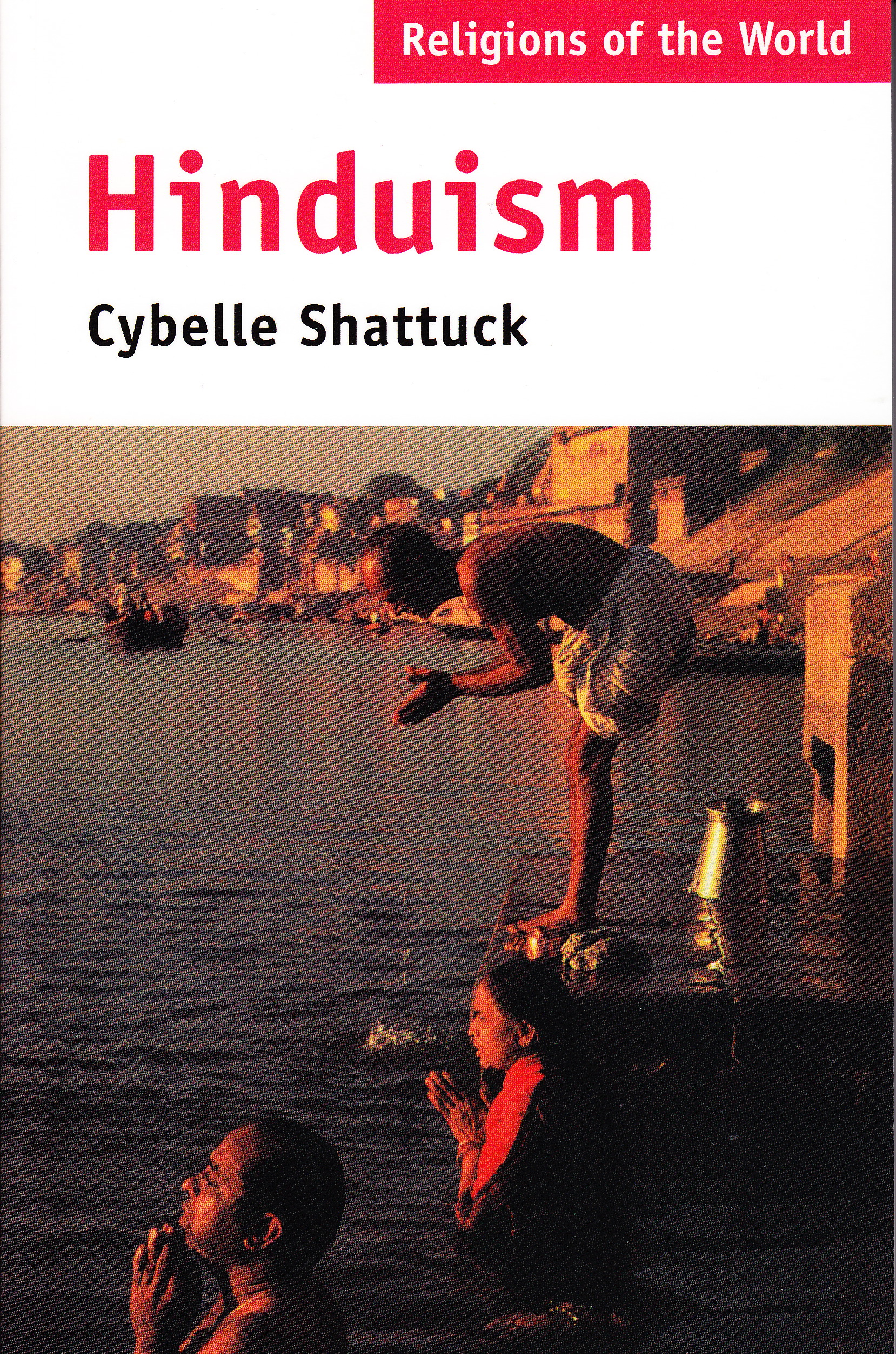
HinduismWhile brushing up on Hinduism by reading the book of that title by Cybelle Shattuck, it once again occurred to me how the concept of religion distorts itself. Prior to the Roman Period, the concept of religion really had no name. In fact, religions were sets of folk beliefs held in common by people of a single culture. These beliefs had many functions: keeping social order, establishing common practice, undergirding a kind of optimism in the face of inevitable death. Since long-distance communication was rare and unreliable, communities separated by more than a few miles soon developed details that fit their own situation and would hardly apply universally. Until they were written down, anyway. In Hinduism—which is in no sense a unified religion—even the “sacred writings” were not held to be authoritative for all people across all places and times. That concept would emerge with Christianity, a religion that would define the term and try to make it stable.

Hinduism is the oldest continually practiced “religion” in the world, as far as we can tell. The religions of the Mesopotamians and Egyptians eventually died out (although they have been revived by some in recent times) but the folk belief—or better, folk practice, of ancient India has continued relatively uninterrupted while new religions from Israel and Arabia changed the rules of the game. Monotheisms quickly demand heresies. A single God would not tell people different truths. Something upon which Shiite and Sunni, Catholic and Protestant, Pharisee and Sadducee all agree. One Lord, one faith, one baptism. By fire.

Meanwhile, even with Muslim and Christian missionaries afoot, Hinduism continued its accustomed continuity. To be a Hindu doesn’t mean worshipping the same god with the same ritual as everybody else. It is a way of living intended to keep dharma and avoid bad karma. And even as trendy westerners stretch themselves into impossible yoga postures, they are participating, at some level, in ancient practices that we call the religion of Hinduism. Shattuck’s brief introduction is a nice little primer that explains this time-honored folk tradition in a way even a believer in religion can understand. There are, it turns out, more things in this philosophy than our universe has ever dreamt of. Or perhaps the one dreaming is really Vishnu after all.


It’s My Body

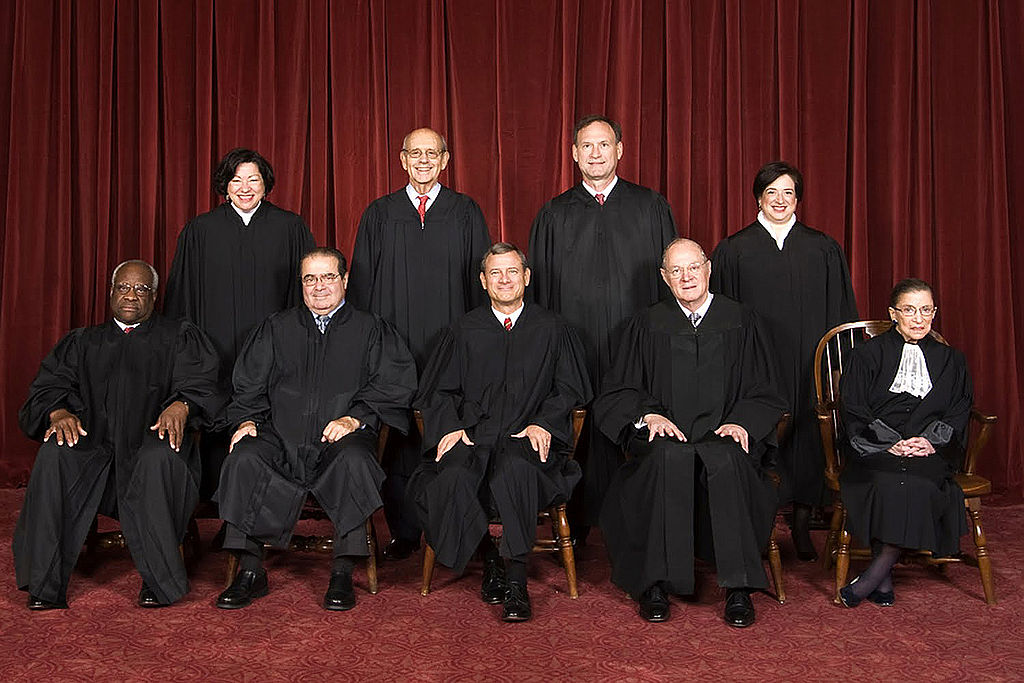
Those who believe mythology is dead have to look no further than the Supreme Court. Amid pictures of women protesting religious freedom to be told what to do with their bodies, the Court decided that employers may withhold rights to birth control under the rubric of religious belief. The ones who raise the issue, however, biologically never carried a baby to term. One gender making decisions for the other. We all know that the official stance of Roman Catholicism, closely followed by radical Evangelicalism, is that God intended sex only for procreation. Those women who find themselves on the receiving end of unwanted conception are helpless in the eyes of the law, depending on who their employer is. Blind justice indeed. Obamacare is intended to help level the playing field. Too few people have any real control over what medical treatment they can afford. I know more than one fixed-income person who suffers chronic pains due to lack of adequate treatment. I also know people who have used the system for plastic surgery before a trip to the beach. It seems that your employer now has the right to decide—but only if you’re a woman, and only if it involves what might be euphemistically called your “private parts”—what care you deserve.

Legislating morality, we religion majors debated even when I was back in college, cannot be effectively executed. If you presume there is a God, then enforced obedience is no obedience at all. Even conservative undergraduates could see that. Now our “Supreme” Court, with its male majority, has followed the lead of closely held corporations (doublespeak for certain patriarchal, Evangelically based companies) and declared that half the humans in America don’t deserve the same health care as the other half. The reason? Closely held companies don’t want women to have access to birth control. Our courts strike a blow against freedom and justice for private religious interests.

Within days of one Christian denomination declaring that gay marriage will be—should be— sanctioned, our own judiciary sides with the right of upper management in private corporations to discriminate based on gender. At least the owners of Hobby Lobby and Conestoga can sleep better at night knowing that they’ve prevented women from having their basic rights upheld. And metaphorically crawling into bed with closely held corporations are a male majority of supreme court justices who believe one man’s religion (yes, man’s) has the right to overturn the freedom of his employees. With the blessings of a male God. A situation like this prevailed, it seems to me, until 1863, also with the backing of scripture. Only in those days the argument was, I believe, that God is clearly Caucasian.

Looks balanced...

Looks balanced…


Tongues of Fire

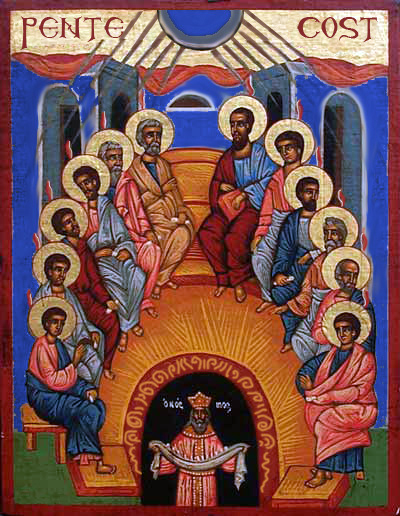
“Do you want to see?” she asked me, fraught with all the emotions of a teen far from home. I’ve often questioned the wisdom of church groups sending large numbers of high school students to retreats or conferences where shear ratios of chaperones to teens guarantees intrigue. She was an attractive girl, and despite my commitments to asexuality early in life, I found her plea compelling. We weren’t supposed to meet after hours without the adults around. I was insanely curious, however. “A few of us will be gathering behind the gym,” she said. I demurred, afraid to break the rules. “Do you want to see now?” she insistently asked. We were in a room largely empty, as the adults were headed toward the food, the way adults always seem to do. I agreed. Nervously she closed her eyes in prayer. When she opened them, they were glassy and far away. A stream of nonsense words effortlessly bubbled from her mouth. This went on for what seemed like minutes, although I knew it was only seconds stolen from a scheduled curriculum. She closed her eyes, and coming back to herself, looked exhausted. “What did you say?” I asked, breathless. “I don’t know,” she admitted.

This was my first experience of glossolalia, or speaking in tongues. I was at the United Methodist Youth Annual Conference, and I’d just met the girl who’d revealed so much. Methodists, as a rule, aren’t much into glossolalia, but the Pentecostal movement has Methodist roots, and teens are the great experimenters of the human race. I can’t recall how I met her, or even her name. I felt an incredible attraction to a girl who could let herself be so possessed, however; so vulnerable to an Almighty deity. I decided not to go to the after dark gathering. Instead I sought out a minister I trusted. He explained that such signs, if truly divine, are only done in the presence of an interpreter. She was misguided. Yet I couldn’t get those glassy eyes out of my mind. Where had she been in those fleeting seconds when her mouth spoke a language she didn’t know?

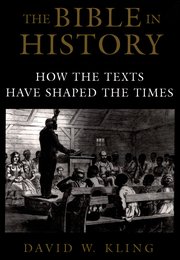
While reading David Kling’s The Bible in History’s chapter on Pentecostalism, this all came back to me with incredible force. A few years later I attended a Pentecostal service with one of my college roommates who belonged to that tradition. Being in a room full of true believers speaking in tongues at the same time unnerved me. I never went back. Psychologists and neurologists have explanations for how glossolalia occurs. The standard evangelical explanation is quite different. For one young lady whose name I can’t recall, it was a sign she wanted desperately to share. A personal assurance that John Wesley himself encouraged his followers to seek. Not that Wesley ever suggested speaking in tongues. That only began in 1901, after a hiatus of nearly two millennia. To a teenage spiritual seeker in the presence of a young lady, away from home, it was a mystical experience indeed. The assurance, however, would have to wait.

Image credit: Phiddipus

Image credit: Phiddipus


Kingdom Come

Bible in HistoryPopular media tells us the Bible is irrelevant. As someone who has struggled for years to find a non-sacerdotal job in that area of specialization, it’s not difficult to believe popular media is right. Despite all the rationales on all the religion department websites out there, there is little that you can do with your degree. It was refreshing, therefore, to read The Bible in History: How the Texts Have Shaped the Times, by David W. Kling. While not exactly what I expected it to be, Kling’s book did explore several specific pericopes (pericopae sounds too pretentious) with an eye toward showing how a single verse from the Bible could change western history. The examples go from the early monastic movement up to debates about women’s ordination that are, unbelievably, still on-going. The social movements he traces demonstrate that the Bible has been, and continues to be, more than just a book.

At several points through this volume I stopped to consider the implications. From an outsider’s point of view many of these debates must seem almost infantile. They would have no teeth at all if not for the belief that the salvation of humanity rode on their correct interpretation. Often—too often—the results were the torture and oppression of others, for the sake of the Gospel. If we’ve got this right, then we need to prove it through might. A mighty fortress is our God. So the Psalms seem to say.

Few people stop to consider just how deeply engrained in our culture the Bible is. The idea, on the surface, is almost like a fairy tale: once upon a time, God said… And yet, some of the most intelligent people the world has known have staked their very reputations on this claim. As a postscript to Kling, we can still see the Bible’s influence on politics—and therefore society—over a decade later. We still debate whether homosexuals can legally love one another. The biblical basis of this debate is thin, but it is a bulwark even today. We argue about stem cells, and although from the biblical worldview such things are mythical; yet that same Bible gives people the material with which to argue, eh, Jeremiah? And where is that female president we should’ve elected long ago? Any ideas, Paul? No matter how we may discount it, the Bible is, and will continue to be, a most influential book. Too bad we as a society don’t care to learn about it from specialists. Not when it’s so irrelevant.


War in Heaven

Van_Helsing_poster

Van Helsing, about which I’ve posted before, is not a great film, but it is perhaps the closest that modern cinema has to offer for my childhood Saturday afternoon viewing. Vampires, werewolves, and Frankenstein’s monster all appear together in a ménage à trois that Universal would’ve been proud to own in the 1960s. With lines cribbed from some of the Universal originals, plus some less believable chatter from Steven Sommers, the campy film is unrelentingly in dialogue with religion and its monsters. Indeed, the plot revolves around the church’s plan to save humanity from monsters by the employment of the eponymous van Helsing. I’ve probably seen the movie half a dozen times, and I’m a bit embarrassed to admit the this is the first time I’ve stopped to wonder at why, unlike Bram Stoker’s van Helsing, the one in the movie is named “Gabriel.”

It should’ve been obvious at the first viewing, but this time I was watching the movie with the intention of parsing its theology. In medieval Roman Catholic angelology, there are seven archangels. Two of them (or three, depending on whose Bible you are reading) are named in Holy Writ. Gabriel is, of course, one of them. The movie also shifts Dracula from being son of a Wallachian nobleman to being the “son of the Devil” (clearly by adoption). The Devil’s gift of resurrection (with which the movie is rife) comes with the vampiristic curse. And the climax of the film has the leader of God’s army (“the left hand of God”), Gabriel, battling the son of Satan. This is none other than the war in Heaven of which the Bible speaks. The leader of the archangelic army is actually Michael, but having “Mike van Helsing” as your lead just doesn’t carry the gravitas of Gabriel.

The movie opens with Dracula claiming that science has triumphed over God, and yet the mythology of monsters prevails. Frankenstein’s creation is morally pure, being a loving child of science, and the church declares him anathema. Throughout the movie all the monsters claim to want is to live, to survive. In fact, they are already resurrected. The werewolves get the dog’s share of the theology, however. They are infected or cursed rather than reborn. The war in Heaven has come to earth as angels and demons battle for supremacy. In the end, it is the human family chosen by God that goes extinct. I’m not sure all the theology adds up at the end of the film, but again, that is the very nature of mythology. And a film that can bring back a careless Saturday afternoon really doesn’t need to make sense at all.


Born Identity

Richard Dawkins, most famously in The God Delusion, made the claim that children are born without religion. Faith is something we’re taught in the growing up process, and we generally learn it from our parents or guardians. A recent piece in The Guardian (the newspaper, not ersatz parent) by Andrew Brown, stakes a bold, and surely correct, counterclaim: children are not born atheists. This isn’t just wishful thinking. As Brown points out, study after study has shown that people, especially children, are prone to belief. Where Dawkins does have a claim to verisimilitude, however, is that religious branding is not a product of nature. We have to learn what flavor of religion tastes good. As Brown points out in his opinion piece, we also have to learn to be the nationality that everything from our passports to our job applications requires of us. I can’t decide to be Scottish or Canadian. I’ve tried both, and here I am, an American mutt, just as I was assigned at birth.

What should  I believe?

What should I believe?

Like nationality, religion is frequently a matter of where you are born. Take a look at a world map of religions and see. India is the most statistically likely country to be born Hindu. It can happen elsewhere, but it would be unlikely where no Indians live. Life sometimes offers the opportunity to change belief, generally through education or through proselytization, but it is fairly uncommon. Most people don’t think too deeply about their religion. You accept what your parents tell you about what’s poisonous and what’s not, and how to drive a car. Would they steer you wrong on religion? Not willfully, surely.

The tabula rasa myth has been one of the most difficult to eradicate. We’re born with all kinds of things going on inside already. Specific religious belief is not one of them, but the tendency to believe is. We believe because it is human nature to do so. We can learn not to believe, and we can even become wealthy by sharing that outlook vociferously. You can also get a good deal of money by being religious and selling alternatives to science. The Institute for Creation Research is well funded, from what I hear. The one place where there is no money, and where you’re not likely to be noticed, is in the middle. Some of us are born as middle children. We had no choice in the situation, and no matter what we decide to believe, we’re no less Episcopalian than we are atheist, or vice versa.


June Bugs

On my way to work yesterday, I came upon an overturned June bug clawing at the air, trying to regain its feet.  I’m always in a hurry getting to or from work, but I decided to stop, offering the insect a leaf to grip, and turning it back over.  I knew, as I spied birds flying overhead, that its chances weren’t good.  In the course of nature, insects are radically overproduced because so many get eaten.  In my apartment they can even be a source of sudden terror when they find their way inside.  I knew the June bug was probably nearing the end of its short time on the earth, but as I held out that leaf to it, I knew that in the act of struggling we were one.  That sounds terribly Buddhist of me, I know.  Insects and humans share, on the most basic level, the desire to survive.  Who likes to feel vulnerable—soft, unprotected underbelly exposed to the air?  Defenseless and helpless?  Certainly not this poor beetle.

Photo credit: Patrick Coin, Wikimedia Commons

Photo credit: Patrick Coin, Wikimedia Commons

Stepping off the bus in New York City, I began my daily power walk to work.  The bus had arrived a few minutes late, and my anxiety level about clocking in works as if it’s on steroids.  I have to buzz past the interesting things happening in the city, the people who merit a second look, the architecture that has an unexpected amount of detail, only to be lost in the overwhelming number of buildings.  Big buildings as numerous as bugs on a summer morning.  Then I saw a box pulled up on a low sill outside some swank bank.  I often need boxes at work, and I can’t help stopping to appreciate how this unbroken expanse of paperboard would be useful.  Then I noticed the feet sticking out the end.  There was life in this box, not so different from the beetle I’d stopped to help an hour and a half ago, in its exoskeleton, grasping for some kind of salvation.

I arrived at work agitated. I had been able to help the beetle, but what could I do for the sleeping human being in his box? I had no money in my pocket, and even a twenty would stay the exposed, raw human on the city street for no more than a few hours. To care for a person takes commitment, long-term willingness to make sure that those who fall on their backs are set again on their feet, given the resources, the opportunities they need to get along in a world where those circling above are far more dangerous than the birds in my neighborhood. I looked at my calendar. June is nearly over. The June bugs will soon disappear. And yet I couldn’t erase the image from my mind. How much relief seemed to show on that inexpressive June bug face when it could finally crawl away from the center of the sidewalk. Something was terribly wrong here. And a man was sleeping in a box just two blocks away. In the act of struggling we are one.


Trans-Human

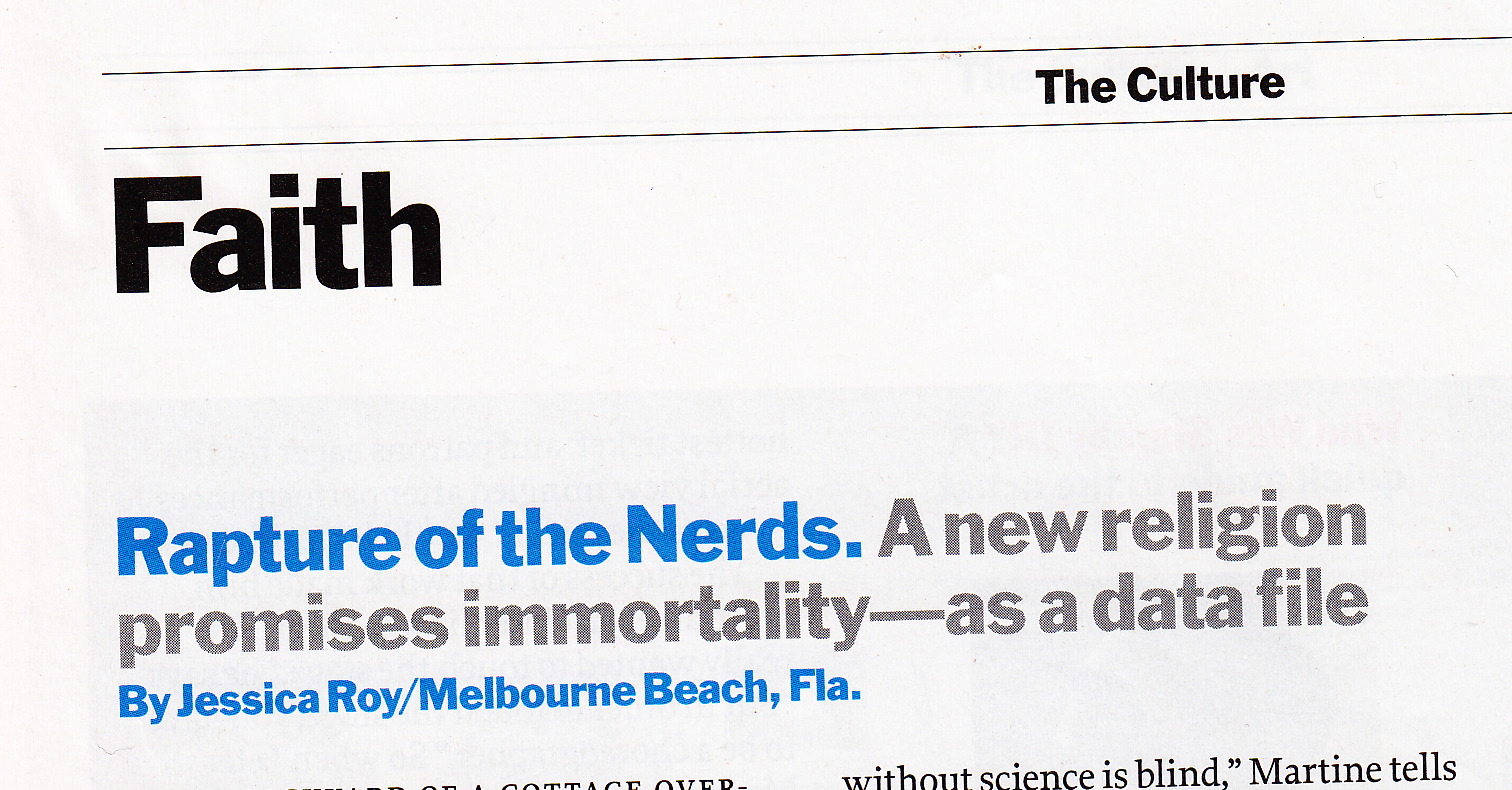
“Rapture of the Nerds,” an article in this week’s Time magazine by Jessica Roy, has me scratching my head. Or it would if I had a head. That is, if I were an uploaded consciousness in a machine. A transhuman. The idea that consciousness is transferable to hardware has been gaining momentum over the last several years during which humans have evolved into illogical machines. Roy’s article about Terasem, which is being called a new religion, explores what the leaders of the movement teach about human consciousness. You write down your thoughts in most intimate detail, download, and viola, send them out to the cosmos. Your soul has been saved. If only we knew what a soul was. Transhumanism has been promising an attenuated kind of immortality for its adherents, but as I sit down to write out my thoughts, I’m aware that there’s always a lot more going on in my brain than the simple ideas I can scrawl down before they evaporate. There’s quick wisps of thoughts about my loved ones, my schedule (what do I have to do today?), what I ate for supper last night, how I feel—all of this while I’m putatively thinking about writing a blog post. Schizophrenia of the soul?

Faith

So much of thought is having a biological body. From early days I have been aware that this body will die. I was taught that the soul would live on, but this thing I call consciousness seems pretty closely tied with this thing I call life. And once the biological input ends, that part will be over. I think. In other words, my thoughts are tied to my biological existence. How can I even begin to write a minute fraction of them down accurately? I used to toy with an idea called meta-thinking. It was something I came up with as a plot element in a science fiction story. The idea was that those who can think two thoughts at once would eventually take over from those of us with lesser mentalities. Those who have two minds in one brain are, it seems, a step closer to the divine.

I use technology on a daily basis, but I am a disingenuous advocate. Some of the most transcendent moments I’ve experienced have been outdoors with technology left behind, under a sunny sky with an ocean breeze blowing in my face and those I love walking beside me. I think I’ve already broadcast that out into the universe by simply being a part of it. I don’t need circuits and motherboards to make me more of what I am. Technology is the follower. It is consciousness that will always remain in the lead. And we still really don’t even have an idea of what consciousness actually is. It’s certainly not this computer that’s sitting on my lap. And I do have to wonder, once my consciousness becomes a robot, what it will do with this strange, primate urge I have, when I’m puzzled, to scratch my head.


Mores the Merrier

The Presbyterian Church (USA) and I go back a long way now. Not that I’ve ever been a member, but one of their institutions gladly accepted four years of my tuition money and tolerated my presence on campus during that same time. I arrived at college a fundamentalist, but, as a religion major who thought through what was presented in class, I soon discovered that literalism was as wrong as sin. This past week the Presbyterian Church (USA) voted to allow gay marriages. Talking to someone I still know in my native, conservative western Pennsylvania, I learned that disgruntled heterosexuals I’ve known since I was a child are now denomination shopping because of the change. Ironically, this includes divorced individuals and others who can’t seem to get the hang of this heterosexual relationship thing. Marriage may not work for straights, but we sure don’t want the gays to have a chance at it.

Gay marriage, of course, is only the tip of the iceberg upon which modern Christianity is bearing down. And not just Christianity. Any ancient religion that finds itself surviving in a world that has completely changed since its founding has trouble remaining relevant. This issues of peasants in Palestine under imperial Roman rule are very different from a high-tech, service-industry, desk-job society. One could argue that people never change, but I suspect that society gives the lie to that. Some issues are perennial—we still haven’t figured out how to make sure the poor have enough. We will walk out of church, however, when we see affluent people of the same gender walking down the aisle together. With priorities arranged this way, is it any wonder that the mainline churches have difficulties retaining members? For some, the church has become a place to feel comfortable with their prejudices rather than to try to figure out what a first-century religion means in a twenty-first-century world.

I applaud the Presbyterian Church (USA) for its decision. It will certainly cost the denomination numbers. It is, however, a move to try to introduce justice back onto the agenda. One does wonder whether it was predestined. Far be it from me to speak for a first-century carpenter, but I suspect that a church founder who stressed repeatedly that love, not judgment, was the way to become one of his followers might be a bit sad at the political turn this has all taken. We know, from all that biology tells us, that sex has far more importance to humans than reproduction. It has a pair-bonding social function without which many couples would split up. This seems true regardless of the gender combination involved. Why not acknowledge this fact as truth and get on with the important business of negotiating the twenty-first century? Of course, we will have to find some other way to justify our prejudices.

IMG_1087


Elmer Gantry

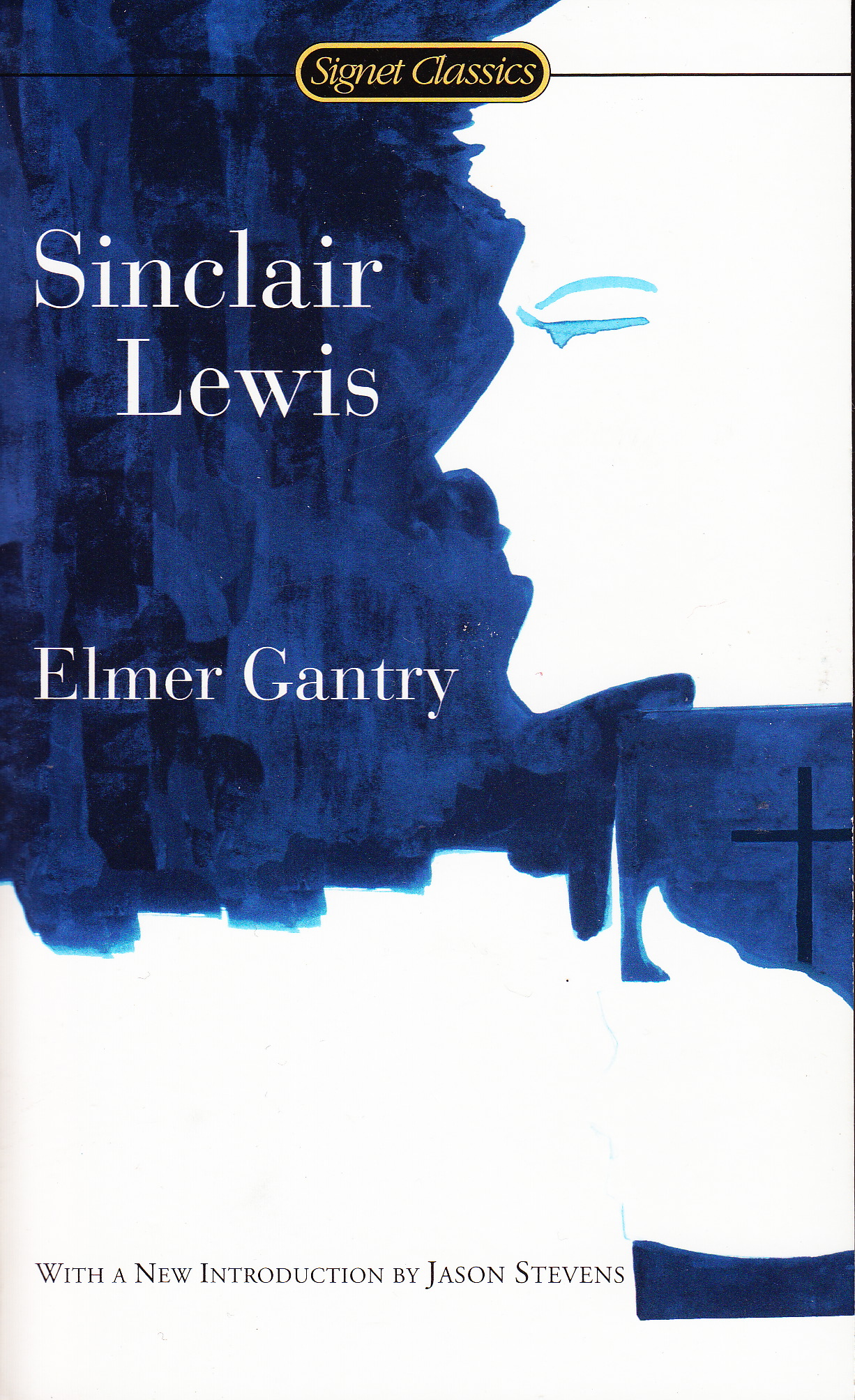
ElmerGantryIn recent years a renewed interest has arisen concerning how powerful entities are perceived by others. Academics are asking how the United States is seen by other nations. Corporations are trying to improve their public images because, well, let’s face it, it effects the bottom line. The same thing applies, but with a difficult kind of finessing, to churches. Part of the difficulty is that churches declare that they have the truth. Backing down from this in the face of public opinion more or less scuttles any claims being made. Thus I’d been curious about Elmer Gantry for some time. Sinclair Lewis’s novel of the self-absorbed, arrogant clergyman who believes in no god other than his own desires, is considered a modern classic. Written during the height of the follies of the Scopes Monkey Trial and Prohibition, as the Fundamentalist movement was just getting started, Lewis used dark satire to try to put the self-righteous in their place. I’d known the name Elmer Gantry from many other media references, so I figured it was time to see who he was.

Going into the novel I had few preconceived notions. Gantry, I knew, would be a hypocrite from the start, but beyond that, cultural references don’t give many hints. Although Lewis’s well-known wit shines through from time to time, on a whole the novel is a distressing read. I suppose it’s the mark of a great writer that you can despise a character so, but really, Elmer is led on his path, indeed, encouraged, by those who know him and whose only zeal is conversion for conversion’s sake. A womanizing, athletic, hard-drinking student, Gantry is where many young men want to be. The campus ministries, however, keep after him until he realizes what all clergy know at some level—there is power in being able to manipulate people by religion. As portrayed by Lewis, Gantry does try, once or twice, really to believe. His cynical and selfish nature, however, are too difficult for him to overcome and he therefore employs them in all his relationships as he climbs the corporate, ecclesiastical ladder.

There is really no triumphalism here, with the society discovering and ousting the charlatan. Indeed, as the book ends, the Reverend Doctor Elmer Gantry dodges a serious threat to his career only to be appointed to one of the most influential churches in New York, poised to go on to even greater things. Trying to find the blame in the novel, however, is not a simple task. Gantry is all too easily led. He follows his base desires deftly and confidently. He knows a mark when he sees one. Throughout his ministerial life, however, he is encouraged and prodded onward to success. Most ministers, in my experience, are burdened with conscience. I’m sure a few slip through with their own agendas, but the working clergy are nothing like the protagonist to this tale. Lewis focuses on the worst offenders. Those who are in it for the power, should they read Elmer Gantry, would find a model who is, like many in the era of early psychology and sociology, too easily excused because of circumstance. More than that, however, they might learn how they look to a larger society for which the church has become a mere historical curiosity. Elmer Gantry is by no means the worst type of figure we can imagine in a secular society.


What You Pay for

Over four to one. It’s a sad statistic. A friend sent me a story in Slate exposing, once again, the (some would say) criminal inequality of university administration to the “talent.” Turning our eyes to Canada, the piece by Rebecca Schuman narrates how when administrator Indira Samarasekera of the University of Alberta announced that she was leaving, her position was applied for by four faculty members of Dalhousie University as a group. Intended as a pointed joke, the faculty members, led by Kathleen Cawsey, noted that if all four were hired the salary of Samarasekera would cover all of their salaries with a substantial raise. Universities continue to insist that administrators should pull down corporate salaries for what, to the eyes of everyone else, is a job with no point. Long before even a Dean had been born, faculty taught because that’s what they do. As perennial overachievers they require very little managing to do their jobs. The more corporate universities have become the more pronounced faculty abuses of they system have grown. Coincidence?

In my current ancillary job to the calling of my life (the classroom), I spend a lot of time on college, university, and seminary websites. One of the interesting dynamics I’ve noticed over the last few years is that when you want to find faculty (the only ones likely to write a truly academic book) you have to wade past tabs announcing trustees, administrators, and other dead weight. Almost as if institutions of higher education find the subject experts to be an embarrassing afterthought. When we send our children off to take the SATs and have them sign up for honors courses and college-placement classes in high school, we’re probably not thinking about what trustees they will be emulating or administrators they will be ignoring. There was a time when people associated universities with the faculty talent they could draw. And the subsequent benefit to paying students.

How the times have changed...

How the times have changed…

Samarasekera’s $400,000 salary will be, undoubtedly, claimed by another faceless administrator. Universities across the United States and Canada will help to recoup their costs by hiring more adjunct faculty and slashing permanent positions. And parents will weep all the way to the bank’s loan officer. Our children are being taught “business ethics” in real time. Tuition will go endlessly up to make sure we can afford the best paid deans of this or that, and the most comfortably paid coaches whether or not their teams win or lose, because, we all know in advance who the losers are. One thing is for certain, they will not be the administrators or coaches. They will, however, be the ones paying to sit in the classroom.


The Truth about Elves

We are nothing if not certain. We know that there are no such things as intelligent non-human entities anywhere in the natural realm. We may reluctantly nod toward some animal intelligence, but that’s as far as the head inclines. Humans are the acknowledged and absolute top of the chain of command. Until you try to build a road in Iceland.

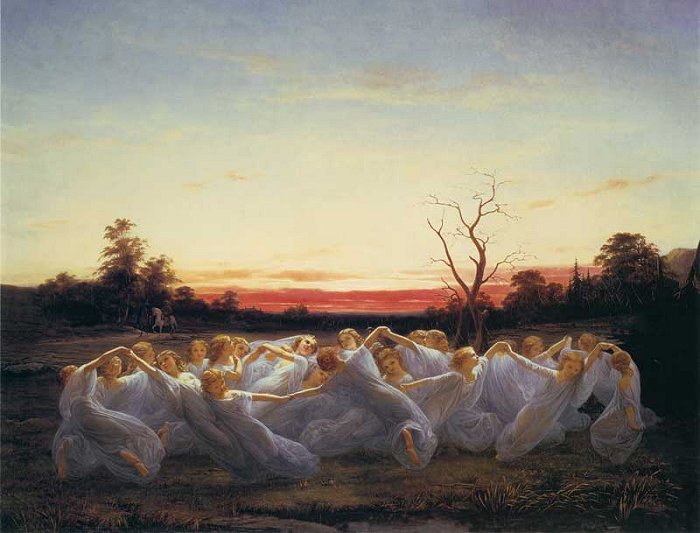
The story of how the road crews were called to a halt because of fear of infringing on elf territory hit the internet months ago. An article in the BBC News recently revised the scene. Emma Jane Kirby traveled to Iceland to see just how seriously this was being taken. I, for one, am glad that mythology survives on the surface in at least a few small places in the world. According to Kirby, surveys suggest about half of all rational adults in Iceland at least hold open the possibility that Huldufolk exist. The Huldufolk, or “hidden folk” are not diminutive, but human-sized and invisible. Who’s to say that invisible people don’t exist? Show me.

Ängsälvor_-_Nils_Blommér_1850

Rationalists are quick to jump out with the accusation that witch trials and other superstition will soon follow should we allow that perhaps the angelic, demonic, or folkloristic beings exist. Of course, it was the rational authorities of the day—often the church—that made those trials possible. Without religion, though, we never would have had science. I don’t think the invisible beings had anything to do with it. Human, all too human, hatred was the real culprit. Fear can lead even the most well-adjusted to the precipice on a dark and stormy night (with apologies to Edward Bulwer-Lytton). People are inclined to mythology to give meaning to a world that, no matter whether scientifically described or not, must make sense to us. Sometimes the elves seem to be the most likely explanation.

The only thing really lost by catering to the belief in elves is money. It might take a little more time and a bit more effort, and empty the coffers just a bit more, but in the end both elves and humans are happier. This worldview has a sense of wonder that a money-padded saunter through Manhattan simply lacks. When faced with the choice between mean money or disgruntled elves, I know the path I would rather take.


Psalm 151b

sinead-oconnor-take-me-to-churchI can’t claim to know much about Sinéad O’Connor. When she did her Saturday Night Live act a few years back, I remember the outrage among several Nashotah House students muttering unholy threats. Not that they were Catholic, having *ahem* celibacy issues, but they objected to a picture of Pope John Paul II, known colloquially as “J2P2,” being torn up. This symbolic gesture lost her, on campus anyway, about a dozen fans. I had nearly forgotten the Irish bardess when my wife sent me an NPR story on her recent song, “Take Me to Church.” I was immediately struck by the lyrics that, to this old Psalter reader, sounded very much like a Psalm. The lyrics, while some will certainly disagree, resonant very strongly with the self-confession that permeates the hymnal of ancient Israel. Not that O’Connor has suddenly become a proper Catholic, but she has entered the band of David.

Many popular artists over the years, I would contend, have struck that familiar chord. Anyone who reads the Psalms at face value will find it hard to miss the angst of the writer who tries to do right only to find that s/he needs someone to “take them to church.” Music is the confessional of the soul. Psalms can be a most secular book. The way some biblical scholars like to explain it is that the Torah and the prophets are God speaking to (read “commanding”) people, and Psalms are the opportunity of people to speak their mind to the divine. This might explain the otherwise inexcusable anger that pours out in invective which, if we’re honest, we’ll have to admit to having felt from time to time.

The line we draw sharply between sacred and secular is attenuated in the Psalms. In fact, it is in any honest religion. When religions present themselves as strictly lived as if people could be truly righteous while others should be excluded, trouble is on the horizon. Pictures get torn up, and the “faithful” grow angry. I know few who would argue that humans are perfect just the way we are, yet, for the most part, we try to do what is right. The standards any religion proffers are too high, and we are bound to fail. Perhaps the saving grace, if I may borrow a bit of religious language, is that even the secular can write effective psalms along the way.


The Call of Madness

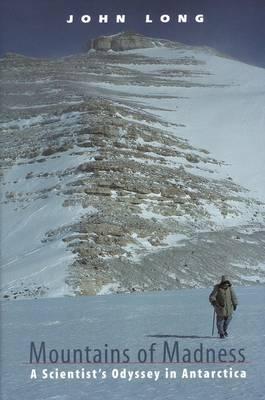
mountainsofmadnessPicture this: the wind is howling outside your tent, violently snapping the fabric. The temperature outside is well below freezing, and you are camping at the base of a mountain nobody has ever explored. You are hundreds of miles from any possible help, in the midst of Antarctica. What do you do? Read H. P. Lovecraft’s “At the Mountains of Madness.” At least that was the decision John Long made on his journey to collect fossil fish in the most inhospitable continent on the planet. Mountains of Madness: A Scientist’s Odyssey in Antarctica is one of those rare books where a rational, educated man of empirical approaches allows the creative, emotional aspect of life speak. I picked the book up at a library sale, based solely on the title. I recognized the Lovecraft in it, and wondered whether it was accidental or not. Besides, reading about polar regions has always fascinated me. Indeed, according to the records of those who’ve trespassed into those regions, madness is not a rare consequence.

Long’s book is not religious, but it is filled with wonder. The mechanistic science that’s often fed to the public is frequently technical and lacks those mysteries we’ve evolved to love. Nowhere in this book is the compelling aspect more relevant than in Long’s accounts of Christmas. The population of Antarctica—a select group by anyone’s standards—is mostly scientists and technicians. Deep field expeditions, it stands to reason, take place in December, which is the summer of Antarctica. In the case of those in the field, they are far removed from their home base, and even the earliest explorers noted in their diaries that Christmas was celebrated, in however minuscule a manner rations and perilous conditions allow. Nobody bulking here that it’s all just a myth.

Lovecraft’s story places explorers far from help in the mountains of Antarctica where they discover they’re not alone. The story inspired such movies as The Thing from Another World, and therefore John Carpenter’s The Thing. Lovecraft, like Long, was a disciple of science and yet, even in his atheistic world deities break in. It’s like Lewis’s Narnia where endless winter with no Christmas is unbearable. Long makes it clear in his account that Antarctica changes a person. Transcendence, those of us who linger over religions know, can express itself in many different ways. For some it is the grandeur of barrenness and inhospitable weather of an unfeeling environment where both macro and micro-predators have trouble surviving and penguins gather to struggle through weather humans can barely tolerate. For others it is camping below the very mountains of madness. Without some wonder, we just don’t survive.