Veni Creator Spiritus

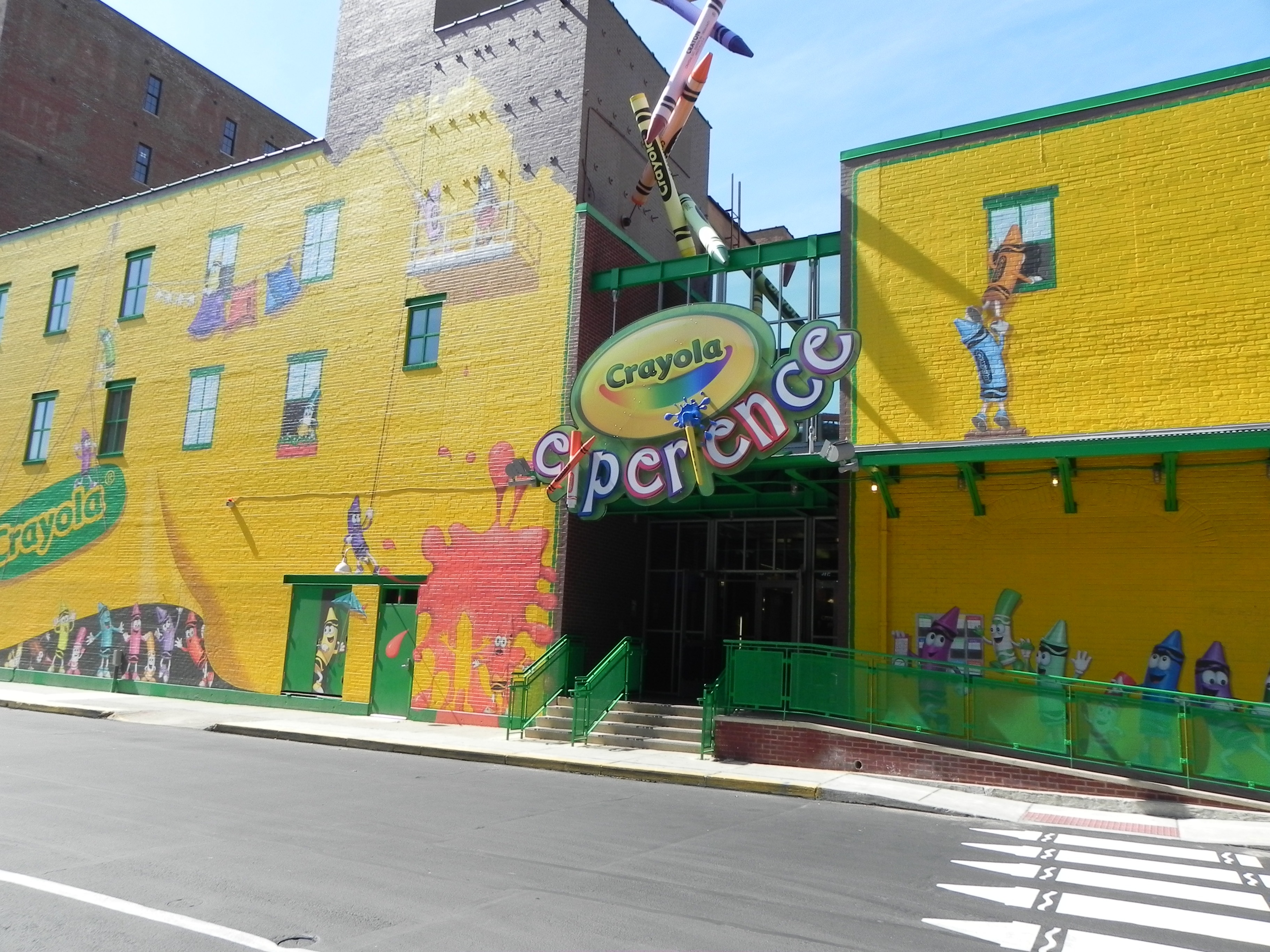
Over 100 billion have been made. Not McDonald’s hamburgers, this time, but Crayola crayons. For many of us, Crayola is one of the distinct scents of childhood, and the vibrant colors Binney and Smith offered were inexpensive keys to creative expression. After a visit to the Crayola Experience in Easton, Pennsylvania over the weekend, I began to wonder how society might have changed due to the introduction of the inexpensive crayon. Reading about childhood in the Victorian era often feels like a Dickensian bleak view of want and wasting. Children learned their lessons in school, when they went to school, in black and white. The world of color was visible to them, but not ready to hand for representation. Maybe I’m under the spell of that Crayola smell again, but I wonder how giving a child a box of color changed the way the world was perceived.

DSCN4604

The Crayola Experience, like the showcase of Hershey, Pennsylvania, is not a factory tour. You’re not shown the inside of the place of business, but rather the public facing side of capitalism: the part that makes you want to buy. Even after the kids are grown. Nevertheless, the experience is one of wonder and imagination for young and old alike. Art is a deeply personal form of expression. Even as I sat at a low, brightly primary-colored table, shading away on my picture, I didn’t want anyone else to see it. This was my own self-expression. On the wall were quotes from children who were not quite so damaged as me, declaring why they decided to color the cow purple or the horse green.
DSCN4607

To participate in some of the activities you need to cash in a token; admission gives you three and more are available for purchase. The motto on the tokens is “In creativity we trust.” It is a motto that I can live with, for it seems that creativity is the realm of the divine. Otherwise, I find it difficult to fathom why a few hours amid such a juvenile pastime could be so utterly satisfying. It’s as if the rainbow, a religious symbol of my childhood, had been fractured out into countless variations and captured in wax for the expression of my soul. Breathing deeply of that paraffin recipe, I think how only the other major aroma of childhood—that of Play-Doh—can take me back to fantasies of innocent hours where the world demands nothing of you beyond being who you are. How quickly that grace period ends. And yet, for a few dollars we can go back for an hour or two, and remember what it was like to create entire worlds.

International Panic Day

Holidays have diverse origins. Some appear to have been made up in a fit of madness, bearing no particular relevance to anything. When I saw a publisher offering an “International Panic Day” sale, however, I supposed it was a joke. A quick web search indicated otherwise. June 18, for reasons nobody can really identify, is International Panic Day. I’m reminded of the Simpsons episode where Marge, liberated from her phobia of being mugged, runs past grandpa calling, “I’m not afraid!” to which he replies, “Then you’re not paying attention.” Fear and panic, while not the same thing, live in the same neighborhood. Many analysts point to fear as the primal emotion behind religion. We may never be able to prove that with any certainty, but I can’t think that panic has a religious origin. Many panics have emerged from religious fervor, but the panic itself seems not to have conceived religion.

Run_on_the_Seamen's_Savings'_Bank_during_the_Panic_of_1857

According to Holiday Insights (dot com, of course) no information can be found on the origins of the holiday, which makes it sound like a perfect internet invention. It is a day to feel unsettled. For some of us, that seems like most days. Again citing the wisdom of cartoons, Charlie Brown notes in the 1965 Christmas special, “I know nobody likes me. Why do we have to have a holiday season to emphasize it?” Holidays can be like that sometimes. But a panic day? I have an amateur theory that International Panic Day derives from Panic Day (about which Holiday Insights also has no information), which falls on March 9.

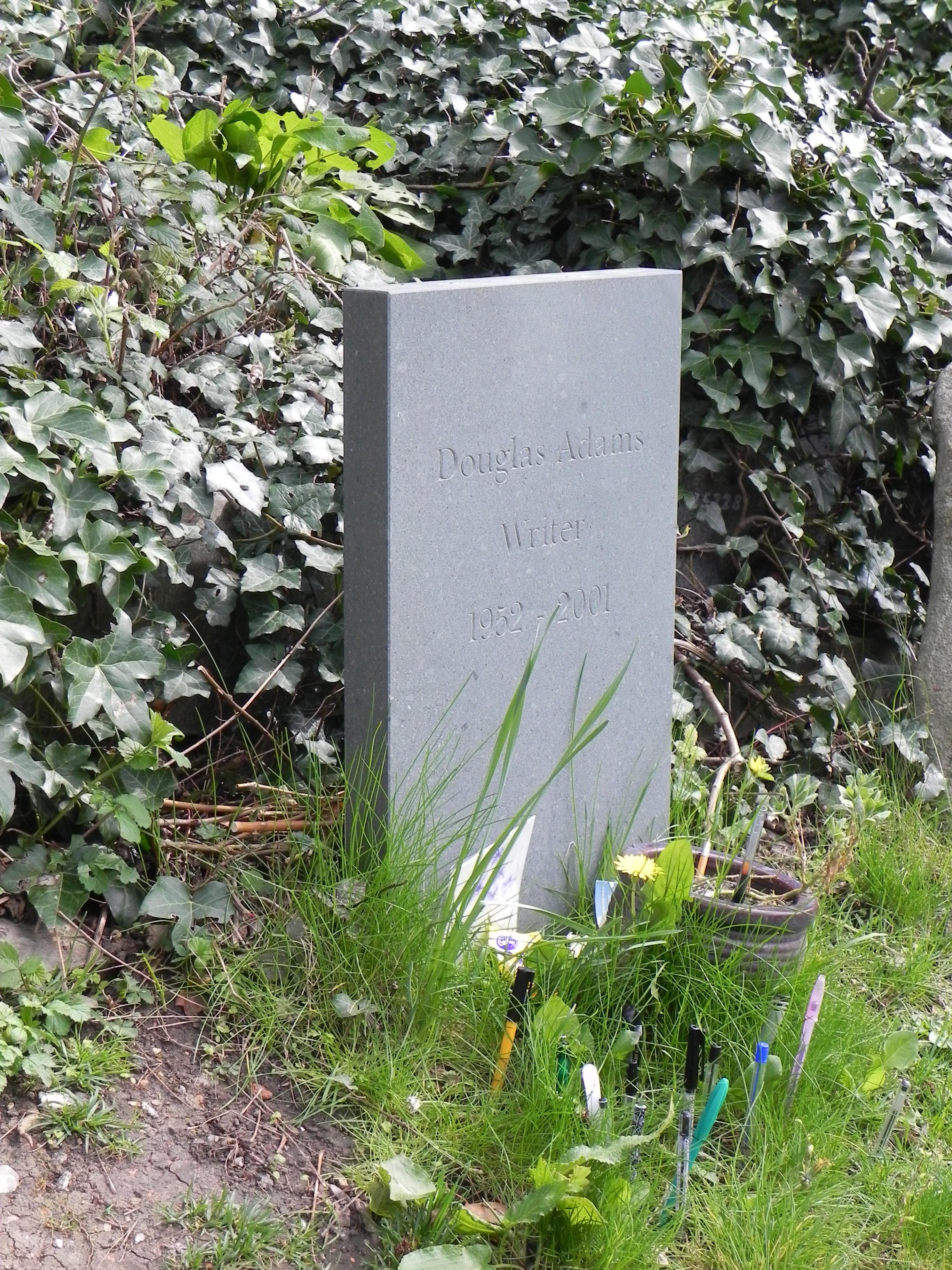
Some online sources have noted that the choice of June 18 is a strange one for International Panic Day because the next day is already (and has been since 1979) World Sauntering Day. This holiday is believed to have begun at the Grand Hotel on Mackinac Island in Michigan. Apparently W.T. Rabe, the holiday’s creator, was reacting to how popular jogging had become and wanted people to slow down for a day. International Panic Day would seem to suggest that running is the best option. Without a goal, of course, other than just to get away. Maybe there is a connection with religion after all. Having long been a fan of Douglas Adams, however, I am a devotee of his contra-mantra: don’t panic.

DSCN1993


Medjugorje Matrix

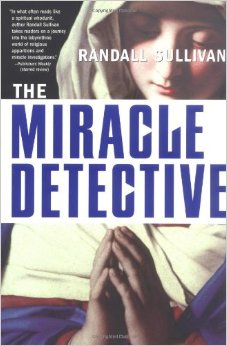
Miracle Detective“Expect a miracle,” Oral Roberts used to sign off, “and a miracle is yours today.” Physicists tend to be a bit more hard-nosed about the issue. In a mechanistic universe miracles are disallowed. How can you predict the outcome of any experiment or scenario when the whim of the divine could change the results? Nevertheless, most churches at least hold out the possibility of the rare miracle either set in centuries far past, or even occurring today. Randall Sullivan’s The Miracle Detective is, therefore, an almost unbelievable book. A reporter for Rolling Stone, Sullivan began investigating Marian apparitions. Although in the popular mindset, even among skeptics, such things are seen as promotions by the church to shore up the faithful, as Sullivan points out, the Catholic church is extremely cagey regarding miracles. It might be easier to convince a physicist than it is the Vatican, that a miracle is occurring.

Spending part of the tragic war in Bosnia-Herzegovina, Sullivan interviewed most of the six children who claimed to have visions of Mary at Medjugorje. While he remained skeptical of what he found, it is at times a decided head-rush to read his book. We tend to dismiss non-academic reporting of events by hoi polloi as unsophisticated, or superstitious. The events at Medjugorje, however, have been thoroughly tested by physicians and communist-appointed scientists and have left them scratching their heads. In some cases, getting them to convert to Catholicism. Rome, however, did not give its seal of approval to what was happening there. Sullivan, not religious himself, but open-minded, found the investigation compelling, if not life-changing. In this lengthy account, the reader is drawn into a rational world where something mysterious is clearly happening. A world that both the church and the academy deny might exist. And yet, something incredible stands on record nevertheless.

Lourdes, Fatima, and numerous lesser-known locations boast erstwhile visions of Mary that include miracles in their wake. Although the events in Medjugorje were unfolding the year I started college, majoring in religion, I had never heard of them until I read The Miracle Detective. As Sullivan notes, at times it seems better not to know about such events because they disturb a comfortable worldview where intrusions from the outside just don’t happen. Life, however, includes many incidents which we simply take off the table because they don’t fit into our scientific paradigm. The implications are just too discomfiting. Climbing off the bus after having read several chapters of the book was like stepping back into a world somehow so effaced that I felt there must be something on the other side. Many of those experiencing these miracles were barely Catholic, or were not religious at all. And yet something happened to them, causing them to wonder. And that wonder is catching for those who read the strangely compelling account of an open-minded, if accidental, miracle detective.


Inspired. Absolute. Final.

IMG_1394Recently I spent some time in my native Pennsylvania. Doing so sometimes makes me believe in a bizarre kind of predestination. I never had any truck with theological fore-ordainment; I’d rather just give up and get it all over with now. Nevertheless, the Bible was very present in the Pennsylvania of my youth and logic dictates that if something is, a priori, more important than everything else, only a fool wouldn’t pay attention. When we’d be driving along a country road and a prominent outcropping of rock was spray painted with “Jesus Saves,” I’d feel a quiet reassurance that my choices had been sound. I started reading the Bible as a child, toughing it through Leviticus and Chronicles, with true Protestant fervor. The Bible, I believed, could never let you down.

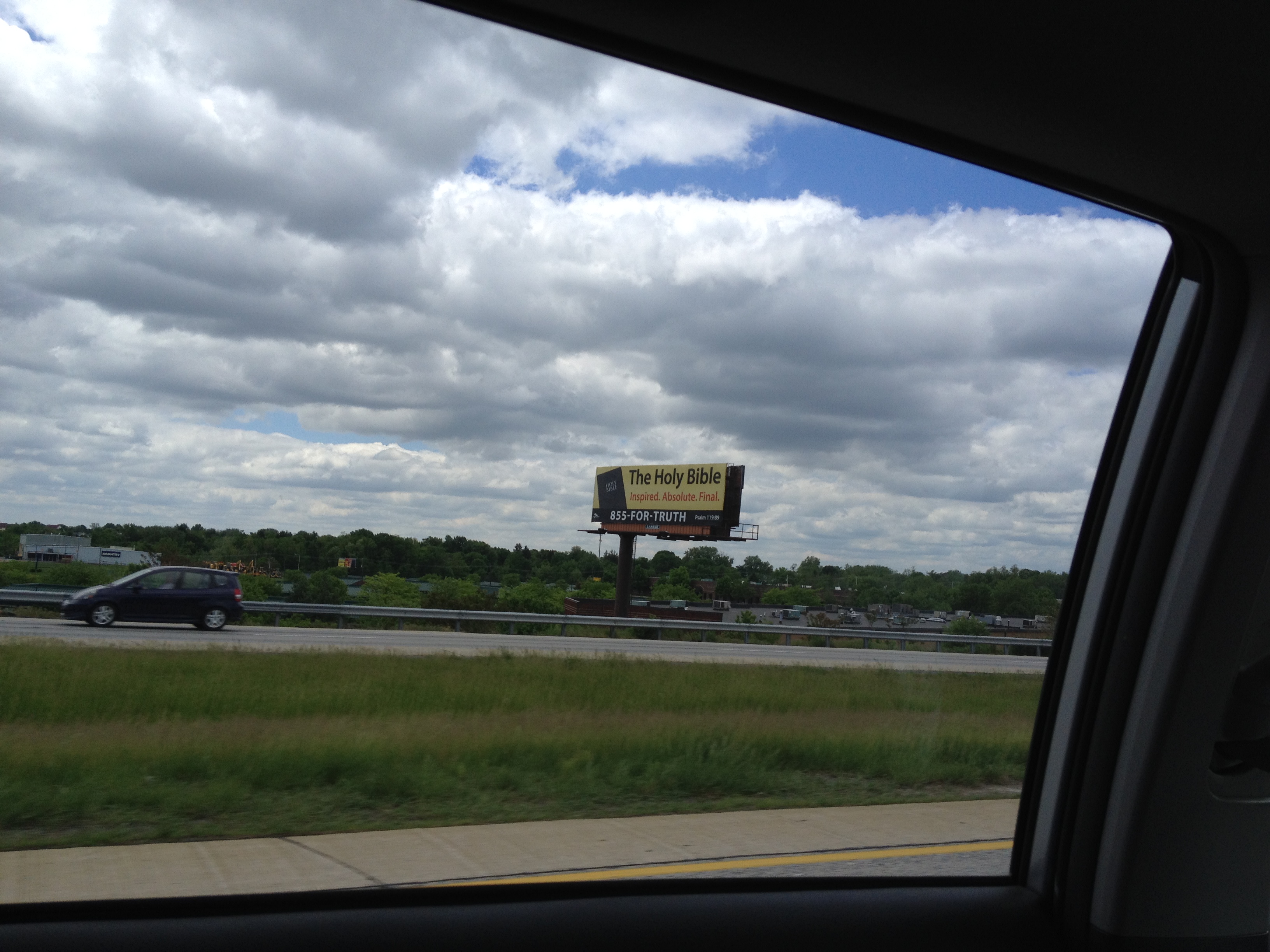
On my recent drive down memory lane, I passed a road sign advertising the sacred scriptures. It read “The Holy Bible. Inspired. Absolute. Final.” There was a number to call, ending with the words “for truth” in place of digits. Operator. Information. Get me Jesus on the line. (With apologies to Sister Wynona Carr.) The odd thing is that I always assumed this was normal. Ticking off the miles on Interstate 80, I used to see how many “Jesus Saves” graffiti I could find on overpass pylons. Even in Manhattan I still find the same phrase scrawled in the cement of a grimy sidewalk, and I always look for it when I walk that way. It was all so matter-of-fact that there seemed to be no reason to question any of it. The same held true for most of the faculty at Grove City College. No questions asked. Just read the highway signs.

Ambiguity toward the Gospel truth seemed wrongheaded and foolhardy. It is, however, difficult to take the Bible seriously without at last beginning to ask questions. Even the Bible has a backstory. Be careful how far back you turn the pages. There was a prequel to Genesis, for those who dare to look, just as their is a sequel to Revelation. Inspired—no doubt. Absolute—perhaps. Final—I doubt it. The last word comes only when all has been said and done, and given the signs I see along the road, it looks like this journey is only just getting started.


Private Religion

Some things are best left private. I don’t know what possessed me to request a car maintenance visit first thing in the morning on a Saturday. I mean, the dealership is a 45-minute drive, and there are few places less inspiring than an automotive waiting room. The coffee is weak and tepid. Usually the television’s blaring some nonsense, and even before eight on a Saturday morning there are plenty of other people around. But there’s free wifi. Well, not exactly free when I get a glimpse at the bill. So I think perhaps I can write a blog post while I’m waiting. How do you write about religion with people watching? It’s the bashful bladder of the soul. Back in my Nashotah House days, when I was required to preach, I couldn’t write a sermon with wife or daughter in the room. I couldn’t practice it in front of family. For some things, you just need to be alone.

So, as I’m trying to write this innocuous little homily, someone pulls up next to me on the single table in the waiting room. It’s like standing at a row of exposed urinals. Trying not to be obvious, I turn my screen a little more in my direction, and less in his. Still, there are people sitting behind me and who says that the sense of being stared at is a myth? Although communal worship is often a public event, at least in a crowd of like-minded believers, the experience of the divine, however defined, is deeply personal. It seems that there’s only one soul per customer. We don’t know what a soul is, but it shouldn’t feel lonely, because we don’t know what consciousness is either. Still, trying to perform here is trickier than I’d imagined. I might just have to finish this at home.

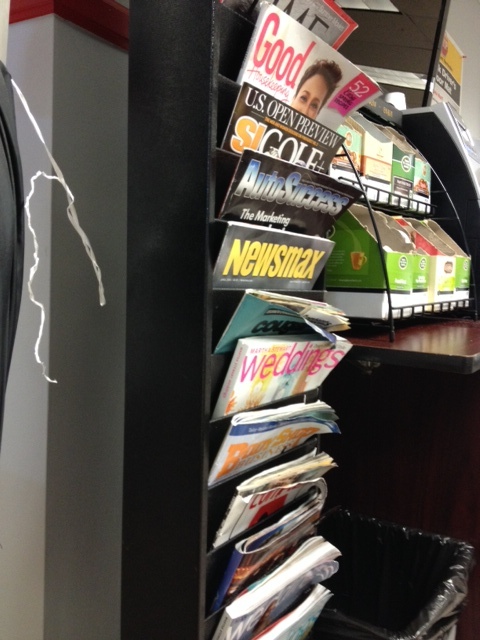
photo-19 copyIt used to be a truism that two topics are not for public discussion: religion and politics. Such fightin’ words only lead to tears and wars. The magazine rack next to me is insipid with Sports Illustrated, Bowhunting, and AutoSuccess for the guys, Real Weddings, Good Housekeeping, and Martha Stewart Weddings for the ladies. The only book I brought has an overtly religious title. What was I thinking? Next time maybe I’ll bring Zen and the Art of Motorcycle Maintenance. I climb into the newly serviced car to drive home. Are those docile bubble lights on the car behind me? I’m still being watched. All the way I never even touch 55, because driving is one of those situations where non posse non peccare truly does apply. When the cruiser finally turns off, I read New Jersey State Park Police on the side of the car. Some thoughts, like religion, are best left private.


Global Warning

“Sticks and stones,” the childhood wisdom goes, “may break my bones, but words will never harm me.” We were taught that little mantra as a response to being teased by bullies. But words can and do hurt. They can even be lethal. Although I’ve come to realize that specific words are inherently neither good nor bad, I’m still a little shy around some of them. The website known, euphemistically, as “IFL Science!” contains an f-bomb that sometimes makes me wary—what’s wrong with just regularly loving science? In any case, perhaps this adverbial use of the most versatile swear word is intended to make the website a bit of racy fun. The posts are often very good. So it was that I recently read a story about “Friends of Science.” This group, it seems, is paying good money to convince the scientifically illiterate that global warming is natural, caused by the sun and not emissions, and so we should just chill. IFL Science! points out that the group, however, receives money from petroleum companies. Sticks and stones.

450x436_q75

On my way to work this week, I noticed how many of the ads in ebullient, affluent Midtown Manhattan reflect dark shows and movies. It’s summertime, when we expect bright colors and sunny weather. Has it, perhaps, been too sunny? The best selling non-fiction book over the past few weeks has been on economic inequality and how it will lead to a good, old-fashioned primate crash. Going ape-crap on the bullies. Our species doesn’t tolerate radical unfairness for long. Those who suck money from under the ground may not fracking care about the rest of us, but they sure pull in the big money. Big enough to buy the truth. Our emissions, they seem to say, don’t stink. And that weird weather you’ve been noticing for the past decade or so? That’s normal. Words will never harm me.

Global warming is a reality.

Oligarchy comes in many forms, the most insidious of which is the benign overlord. The implied subtext is “if I am smart enough to make all this money, I must surely be smart enough to decide what’s best for everyone.” Call it the gold standard of hypocrisy. In an increasingly secular society where the rewards of heaven devolve to what we can grab on earth, this might even be called a kind of theology. We all know that public policy and federal laws can be purchased, if we call it lobbying. Or election fund donations. The truth it seems, is up for sale. Call it Friends of Science—the name says it all. And if we’re tempted to add our own epithets, it might pay to ask what harm can words really do?


Missing Apocalypses

Sharknados aside, we seem to be in a lull of apocalypses at the moment. In the run-up to the change of the millennium and 2012, we perhaps had our fill of dire predictions of the end of all things. Funny how the fears seem to run so high when the Grand Old Party is telling us what to believe. When we settle down and try to wrestle with real-world issues with real-world ideals, the need for watching it all burn seems to settle down in the back seat and let the adults drive for a while.

IMG_1309

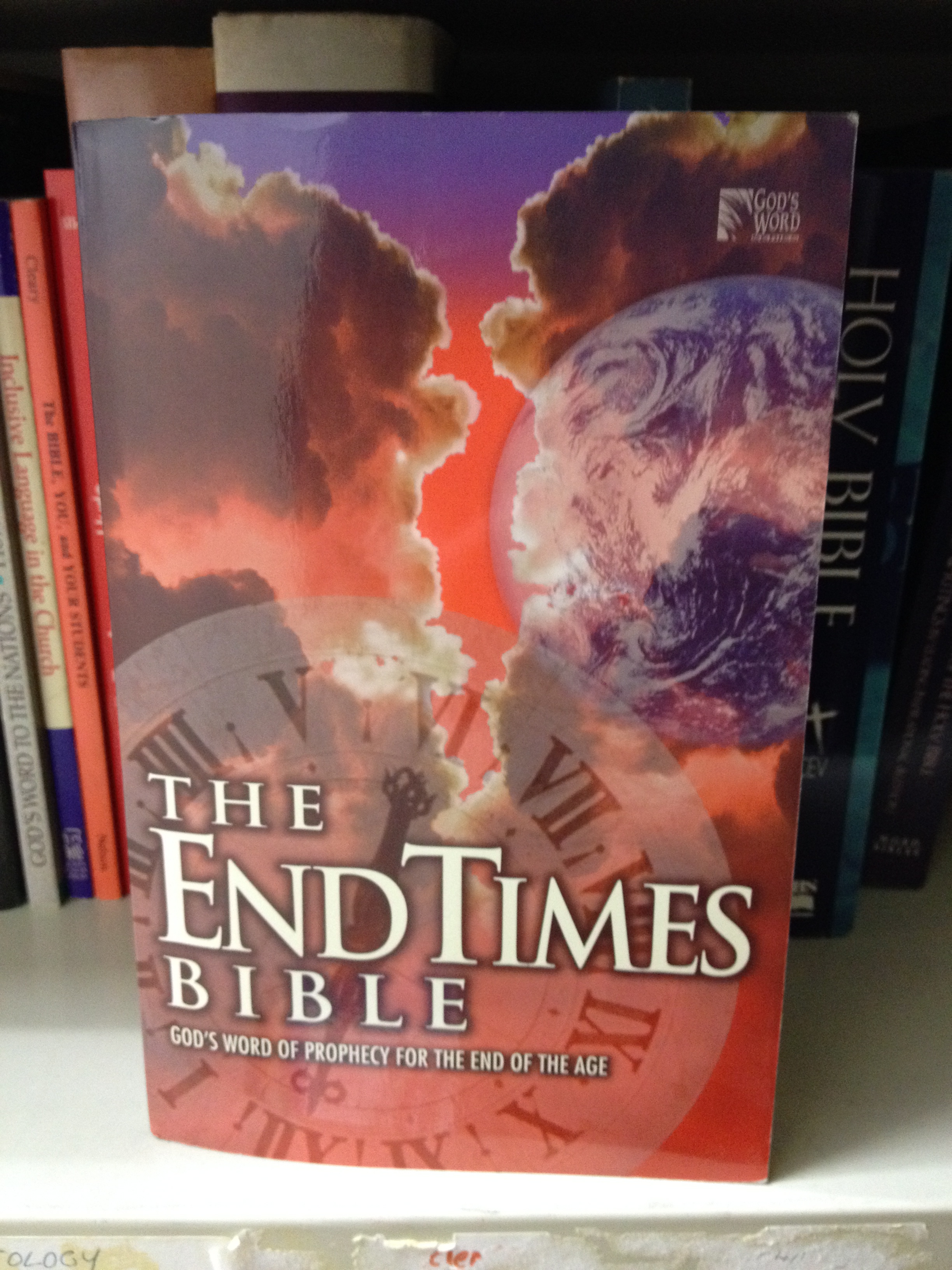
I recently came across The End Times Bible (now out of print). Published in 1999, this Bible had a not-so-subtle message that the end of all things was nigh. As it had been before, and, knowing human nature, will be many more times again. I imagine myself, in a Left Behind fantasy, watching a neophyte trying to make it in the post-apocalyptic world with a Bible. References to the end times are rare in Holy Writ, and dreadfully obscure. Reading Tim LaHaye or Hal Lindsey you might think the Bible has step-by-step directions for negotiating the wrath that is to come. As if the Bible were a recipe book and you wanted chocolate-chip cookies. Ironically the world is full—over-full in point of fact—of people with advanced degrees in Bible who’ve spent years and years of their lives learning to uncover the minutest hints that the Bible gives. Most of these folks are unemployed and wouldn’t mind sharing a bit of that simplistic apocalyptic pie baked up by the premillennialists. And yet, the world goes on.

Even as I was researching The End Times Bible, however, I began seeing references to the next apocalypse. Some are hopefully suggesting 2019, since, apparently, God likes round numbers. The reprieve we’ve been feeling, I have no doubts, is only temporary. In the course of human events we will have alarmists elected to high offices and once again panic will begin to build. The Maya let us down, and Howard Camping up and died. No worries—there are other arcane civilizations and the world knows no shortage of prophets in button-down shirts. Still, I’ve kind of enjoyed this little vacation without having to hush the irrational fears that God’s non-biological clock is inexorably ticking.

The biblical world is a simple one, in its own way. Created in six days just a few thousand years ago, it topples off its pillars and ends in a fiery demise in some millennial scenario, if only it can keep its own story straight. And like any good story, children will come back to it time and again.


Programming God

Robots have been part of my world far longer than I ever recognized. Still, growing up in a small town in the 1960s, their impact was fairly minimal—they may have had a part in the manufacture of the car we drove, and perhaps helped prepare some of the products we bought—but those robots were far away. Far more present were those on television who, for the most part, were funny and helpful. This month’s Wired magazine runs a story entitled “Trusting Our Robots,” by Emily Anthes. The point of her short article is that people feel more comfortable with robots that are programmed to appear uncertain. We don’t trust robots to drive our cars, as she points out, but we give them more, old-fashioned primate sympathy when we make them look like they’re having a hard time. Just a couple weeks back Time magazine had a blurb on how we’re now at the point of programming drones to kill without human input. Add a dose of uncertainty and we get a glimpse of what it must be like to be gods.

Underneath our exteriors, we all know that robots do what they are programmed to do. In many respects—physically, especially—they are superior to us. Nevertheless, human knowledge is not perfect. We, too, are prone to uncertainty. Our robots aren’t better than we are, only more efficient. Doubt is a human quality. Perhaps our most endearing. As Ms. Anthes notes, “even when confronted with evidence of our own inferiority, we resist a robot’s help.” We have evolved over millions of years to interact with other creatures. Those non-biological entities we’ve created and endowed with artificial intelligence (sound familiar?) somehow can’t equal the right we’ve earned from struggling against, and along with, nature for these many eons. Would God really trust us with the keys to the universe?

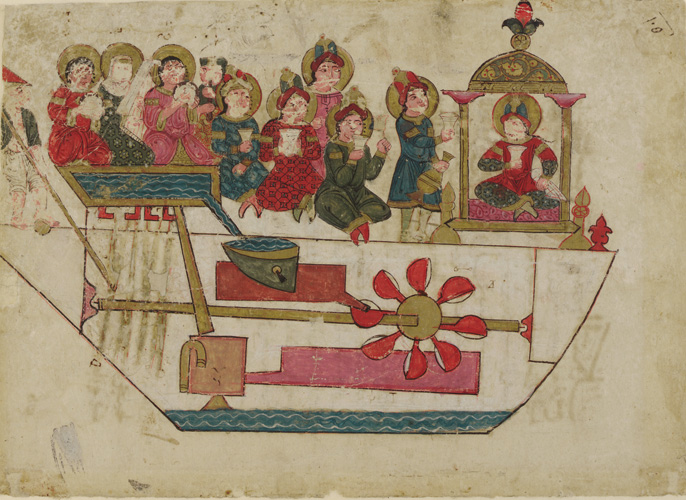
An early plan for a robot.

An early plan for a robot.

Robots, we are told, are our inevitable future. Some visionaries look forward to uploading human consciousness (even though we have no idea what it is) into a machine and, with replaceable parts, living forever. Before the dead and resurrected Jesus, according to the gospel of John, stood Thomas—the man some traditions said was Jesus’ very twin—and yet he doubted. As much as we claim otherwise, we adore Thomas for it. Evolving even in a world full of religion—itself a product of our evolution—we are so unsure. Our robots, however, programmed by us, have no doubts. Even when they act confused, it’s only because we tell them too. Our minds, as Wired tells us, resist letting robots drive the car for us. We let them pull the trigger, however, and pray our programmers got it right.


St. Ghost

HauntedSouthernTierSince they combine two of my soft spots—local history and ghost stories—books telling the tales of home-town specters are compelling in a homespun way. On a visit to Binghamton, New York, I picked up Haunted Southern Tier by Elizabeth Tucker at the local bookstore (I have a hard time passing up an independent bookstore anywhere). Those of us at least a little familiar with upstate New York know that the southern tier is not strictly defined, but it is a recognizable section of the Empire State that runs just north of the Keystone. I was drawn to the book by Elizabeth Tucker’s name; she is the author of Haunted Halls, a book I reviewed earlier on this blog, about college campus ghosts. These local travel guides tend to focus on the weird and whimsical, and aren’t meant to be taken too seriously. Nevertheless, the connection between ghosts and religion is tangible in just about any part of the world, no matter what one believes.

This fun read brings a number of explicit religious points to the surface. One involves the strange phenomenon of haunted churches. Given that many varieties of Christianity offer Heaven as a reward immediately following death, having a ghost hanging around a church seems strangely disingenuous. Perhaps that’s why few churches admit to such things. Another interesting tie-in to religion comes in Tucker’s section on roadside ghosts. Stories of spectral hitchhikers are quite ancient, but I had never considered them biblical. Tucker mentions one such instance in the Book of Acts, and upon reflection I realized that she may be onto something. The account of Philip converting the Ethiopian eunuch is one of the odder tales of the early Christian movement. Philip explains Isaiah’s prophecies to the chariot-riding dignitary who gives him a lift, and baptizes the visiting Ethiopian before mysteriously disappearing. Could this be the prototype for the vanishing hitchhiker folklore theme?

Perhaps the most serious of the religious connections in the book, however, has to do with St. Bonaventure University. For those familiar with Thomas Merton’s life story, St. Bonaventure will not be unexpected. Merton taught at the school as he was struggling with his identity that led him to become one of the most renowned Trappist monks in the world—one who spoke approvingly of Buddhism, to boot. Merton is not said to haunt the university, but his presence there at one time has endowed this Catholic school with a sense of spiritual gravitas. The ghosts come from elsewhere.

Books on ghosts are a guilty pleasure with a serious undertone. End of life issues, once we move beyond the medical, are the unquestioned provenance of religion. Whether or not there are any ghosts out there, religion will claim the final word on afterlife. And only those who experience it will ever really know.


Real Reading Rainbow

Libraries rule. According to recent studies libraries rate higher than religious institutions, according to public surveys, in their usefulness to society. From the lost library of Alexandria of yore to the local Carnegie, libraries have been the repositories of information almost from the beginning of civilization itself. Last week the American Library Association, according to an article forwarded to me by my wife, and the Banned Books Week planning committee, announced a theme for this year’s recognition of the books various groups (many of them religious) tell us we shouldn’t read. Banned Book Week, of course, falls in September. It might seem strange that planning has to go into this, but the banning of books has never ceased and the list grows year by year. I recently mentioned John Green, one of the authors who frequently appears on banned lists for children. In an age when encouragement to read should be running high, we hide behind platitudes to keep our eyes toward a predetermined prize. Among the reasons frequently given for banning a book: its religious outlook. I.e., the “wrong” one.

IMG_0324

I often wonder why we think sheltering children who are old enough to read from the collective knowledge of the human race does them any favors. Our culture so successfully removes us from nature that we don’t experience the “facts of life” that our ancestors no doubt noticed early and often. Violence, sex, drugs, and death, however, haven’t become any less common. They are only hidden until their knowledge hits with often catastrophic force, leading to neuroses about how unsafe our world really is. A function of story, if neurologists are to be believed, is to help us navigate the many trials we’ll encounter by seeing how others have done it before. I don’t doubt that there is age-appropriate material for children, but they understand a lot more than adults like to think they do. In my teaching days I was always amazed at how much undergraduates knew that I was only beginning to discover as a professor. Books seem a good way to introduce knowledge appropriately.

The internet, of course, gives access to unvetted knowledge to anyone with access to a computer or phone. Published books, it used to be, had the added value of passing through editorial hands on their way to public presentation. A funny thing happened on the way to the library. We’ve democratized the writing of books through self-publishing, but we’ve not yet ceased to ban them. Perhaps the real way to protect our children is to listen to them. We seem to think telling is better than hearing, although the flow of knowledge can go both ways. Instead of banning books for our young we might all benefit from opening of our own minds.


Clockwork Universe

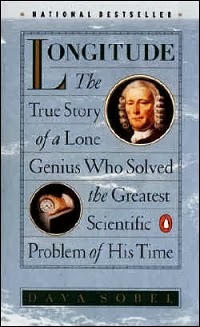
longitudeIn a clockwork universe, time is an essential interpretive factor. Those of us constantly crushed for time hardly realize just how recent of an invention it is. Time has, of course, been around forever. Human interaction with it, in the daily sense of what defines work and what defines leisure, dates only to modernity. Train schedules, in the Victorian Era, led to the need for standardized time across large land masses such as North America. Prior to that, with an uncanny precision to those of us who infrequently take the time even to look at the sky, clocks across the nation were set at noon by observing the sun at its zenith. Even though the concept of longitude existed, its measurement at sea was maddeningly difficult. The Phoenicians, the ancient mariners who circumnavigated Africa, did so by staying in sight of land as much as possible. The open ocean gives few clues as to those imaginary lines we assign to keep our location certain.

Dava Sobel’s Longitude: The True Story of a Lone Genius Who Solved the Greatest Scientific Problem of His Time, is, despite the lengthy title, a brief book laying out the story of John Harrison. Harrison, a clock-maker whose precision clocks made the calculation of longitude a much more precise science, was in a race for a royal grant to reward the discoverer of a method for giving precision to ships at sea. Harrison represented those who believed accurate clocks could solve the problem, while others argued that mapping the heavens would give sailors the best chance. Often we forget that loss of life greater than that on the Titanic could occur when ships ran aground, due to lack of knowledge concerning their longitude. Navigating the seas before GPS and before accurate watches, was often a matter of informed guessing with very high stakes. Harrison never did get to claim fully what he’d earned and we’ve all but forgotten how difficult finding the correct time was when our computers remind us, to the second, of precisely when we are.

Prior to science, the keeping of time was a religious function. Sacred calendars marked holidays—often with the ulterior motive of keeping farmers on track for when planting time for various crops, and their harvests, should commence. Telling the change of seasons by when to add or discard a layer of clothing seems eminently practical, but it doesn’t help an agricultural society to plan ahead adequately. The gods would give the time, and all they would require was a cut of the profits. It was, all things considered, a reasonable trade-off. And now holidays have mostly slipped their religious moorings to become times when we simply don’t have to go to work. Speaking of which—look at the time…


Jonahado

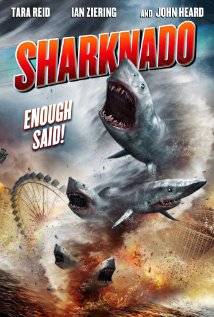
SharknadoSome movies are so bad that they become classics. Some are just plain bad. The jury in my head is still out on Sharknado. The story, obviously tongue-in-cheek, is so far-fetched as to be pretentious, and anyone who knows something about either sharks or tornadoes, or both, will likely find credibility waning from the first scene. For those sensible among my readers, who’ve not seen the movie, the title gives it all away. A global-warming-induced hurricane hurries toward Santa Monica with its forever young sun-worshippers. The hurricane floods the California coast, bringing sharks to the city streets. As our protagonists drive around somewhat pointlessly, the sharks attack their car, eventually eating everyone who’s not family. At one point the family tries to buy rations at a liquor store, only to have the news announce that this is the apocalypse. The store owner scowls that it’s the government, not God, that’s bringing this upon them. Then the waterspouts appear, morphing into tornadoes carrying sharks, still hungrily chomping at everything as they fly through the air.

Ironically a biblical theme comes about with the swallowing of Nova. As she falls from a helicopter (don’t ask), a great white shark snaps her up in mid-air, and since she’s about the only character you can care about, the movie seems to have reached its nadir. As the tornadoes dissipate and the sharks coming raining down, the eponymously named Fin is swallowed whole by a huge great white, while still holding his chainsaw. We already know that this latter-day Jonah will make his way back out, and we are supposed to be surprised that this is the very same shark that holds the reborn Nova, who admits her real name is Jenny Lynn. Like Neo in The Matrix, she is the convert to a new faith, this time in the family of Fin, whose only fault, it seems, is that he cares too much for others.

While a made-for-television B movie (although C or D might be more appropriate), Sharknado demonstrates the popular conception of the apocalypse. Not that it will involve flying sharks and destructive wind-storms, but that the end of the world is somehow inevitable. We have convinced ourselves that its a matter of when, not if, the world will meet its demise. Global warming, clearly our fault, is blamed by the movie (as is the government), but the story is that the flimsy culture we’ve constructed is subject to utter ruin by a hurricane and maritime predators. Or I could be reading far too much into this. Religious tropes may be picked and chosen at will. And when things really go wrong, like accidentally switching on Sharknado, we have a ready arsenal of religious ideas at hand to blame. And the apocalypse may be the least of our worries.


The Fault in Whose Stars?

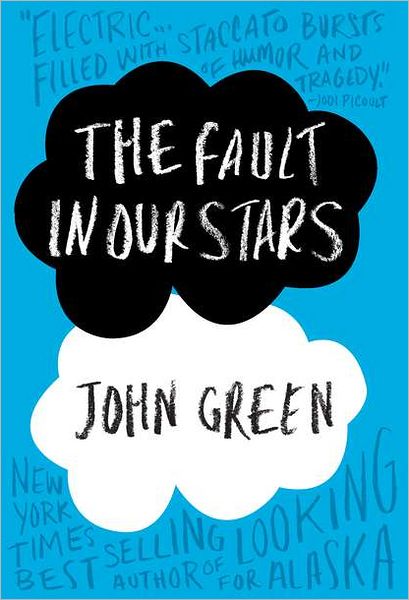
The_Fault_in_Our_StarsTheodicy. I’m no theologian, but the problem of suffering erects a wall ever higher between wanting to believe and actual experience. Many great thinkers have laid down their faith because of this insuperable hurdle. The movie version of John Green’s The Fault in Our Stars opened last night, but I didn’t see it. It was difficult enough to make it through the book. I have to admit feeling a bit wimpy about finding a young adult novel emotionally challenging, but it just is. As I mentioned a few days ago, Veronica Roth’s Divergent trilogy has been topping charts lately, but so has John Green’s novel of childhood cancer. Theodicy is deeply inscribed in this sad tale of loss and love. From a purely biological perspective, the death of the young is explicable, but that seems to be the easy way out.

I’ve been toying with The Fault in Our Stars since January. Picking it up long enough to read a few pages, then growing frightened and putting it aside for a few weeks. The story begins in “the literal heart of Jesus” in a church for a cancer support group where Hazel meets Gus, and, as young people do, falls in love. Green is clear on one point from the beginning: no novel where the protagonists are victims of cancer can ever have a happy ending. We just have to watch and wait for the inevitable. The children return time and again to the “literal heart of Jesus” but no healing comes. They face loss and every page you turn brings more imponderable questions. Yes, this is fiction, but we live in a world where childhood cancer exists. And childhood starvation. And childhood victims of abuse and violence. And still we try to find a way to fit it into a broken-down theology and wonder why we don’t smile more often.

I don’t shy away from provocative fiction. I read scary stories with all sorts of monsters. Finding ourselves, however, in a world where neither rationalism nor theology really makes all the sense they should, sometimes the scariest stories are the truest to life. John Green’s fiction, it comes as no surprise, is frequently banned. Reading it as an adult one finds parts predictable and parts handled too gently, but with enough realism thrown in to want to see it through to the end. Banning books, however, is merely an attempt to shield children from that which they need to see. We do no favors, hiding the truth from those best equipped by nature to accept it. The real question is whether theodicy itself can survive. Perhaps, like the characters in the novel, it will come to its own quiet termination with no real answers to offer.


Map and Territory

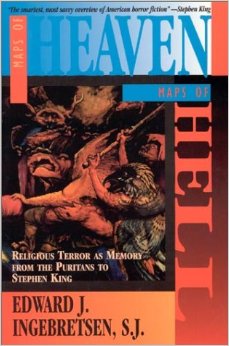
MapsHeavenMapsHellAt first glance the Puritan divines of early New England should seem to be as far from horror films, on the cultural divide, as phenomena can be. After all, academics long ago declared “genre fiction,” and particularly Gothic and horror fiction, to be lowbrow at best, and generally of no cultural worth. The amazing success of scary movies only underscores this point. Edward J. Ingebretsen (S.J.), however, begs to differ. His wonderfully insightful book, Maps of Heaven, Maps of Hell: Religious Terror as Memory from the Puritans to Stephen King, is a surprising study of how religion and terror share much that is essentially human. On this blog I have, from time to time, claimed that religion and horror are close cousins. In fact, they may be siblings. Since studies of Cotton Mather and Jonathan Edwards are often produced by Reformed, or at least Protestant, theologians, it may be that a Catholic thinker will catch aspects often overlooked. The Puritans, with their Calvinistic underpinning, had a worldview that holds much in common with standard horror fare. Ingebretsen suggests that to map Heaven, you must also map Hell.

The map conceit works well as the reader navigates through unconventional ways of thinking. The fears of the Puritans included the fear of God, and those who read or watch horror have noticed that nothing scares like the divine. It may not be on the surface, however. Even those not accustomed to deep digging can, upon a few moments’ reflection, see that the Gothic writers of the American canon have drawn repeated from this well. Many literary experts (well, some) celebrate H. P. Lovecraft’s atheistic rationalism, but enjoy his tales of the old gods nevertheless. His modern heir, Stephen King, is quite open about the potential fear of religion. He even blurbed the back cover of the book.

As society grows continually more secular, the religious impulse will not disappear. Sublimation, the process of changing states, may hide what is happening from the casual eye. A close look shows, however, that the same fears Mather and Edwards unleashed on witch-addled, spider-fearing New Englanders, have come back to us in pulp and celluloid. Religion has its earliest roots in a kind of holy fear, it seems. The innovative human mind, however, with its drive to rationalize, devised mythologies that make fears seem plausible. Those mythologies are relatively easy to believe. Everybody likes a good story. Stories, with all their twists and turns, can leave you lost in the woods. It’s good to have a map. I would suggest Maps of Heaven, Maps of Hell. You may still be scared, but you may feel more sophisticated for it.


Uisge Beatha

Water is essential for life. Life as we know it, in any case. It is no surprise, then, that many religions incorporate water into their rituals. Last week I posted about the biblical stories of Jonah and Noah, both of which involve acts that were later interpreted by Christians as baptism. Muslims use ritual ablutions as part of their worship tradition. Water is life, after all.

IMG_1392

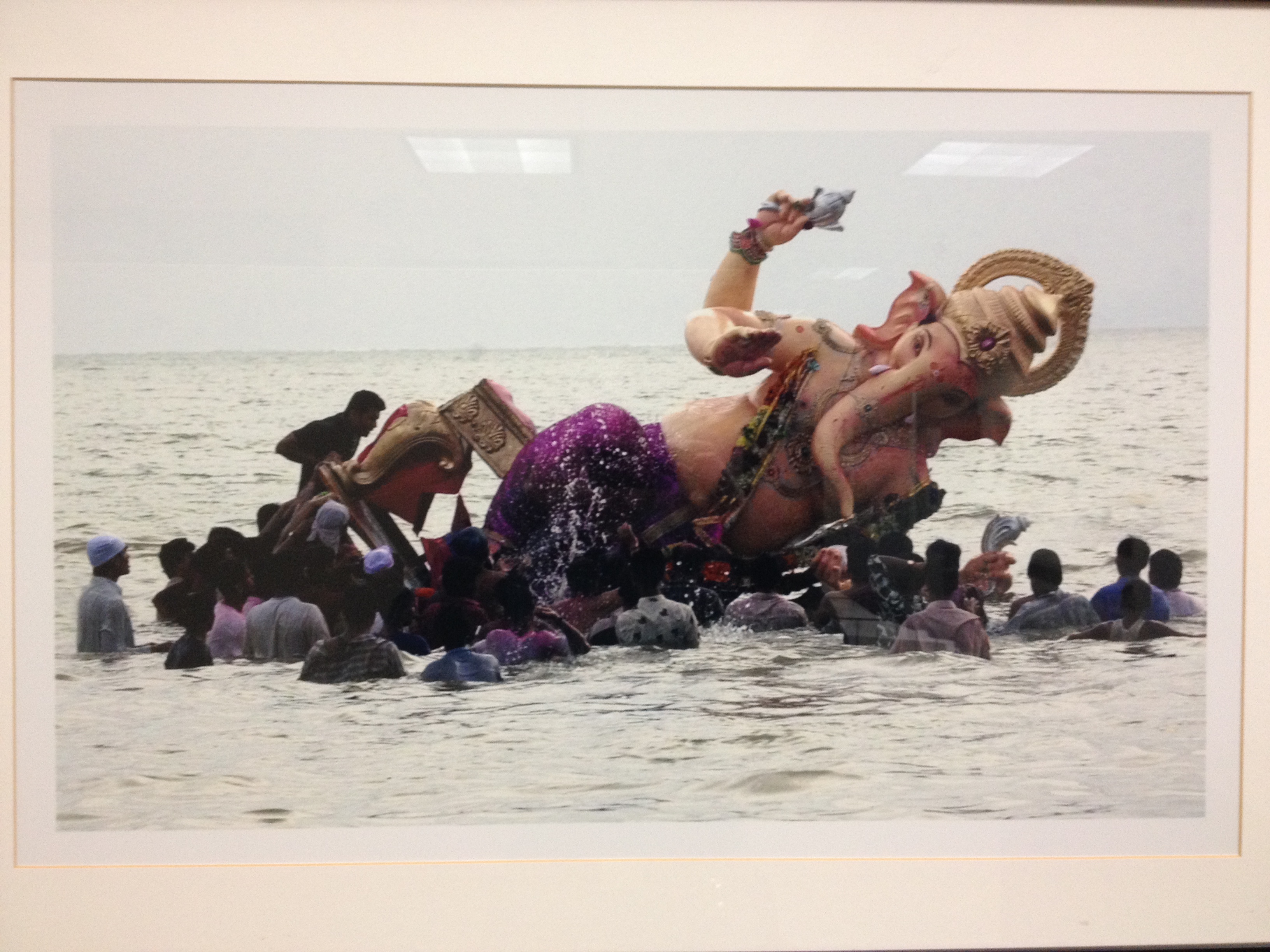
While wandering the halls at work, I notice the various artwork on the walls. One large, framed image has frequently caught my attention: several men are shown carrying a statue of Genesha, the Hindu elephant-headed god, through the water. Coming at this from a Christian background, I wondered what was going on since it looks like baptism. Hinduism, I know, is not a unified religion, but rather a conglomeration of many folk traditions from ancient India—one of the two seats of ancient religiosity. The stories of ancient India are colorful and diverse, and a bit of research suggests that this particular photo is likely the festival Ganesha Chaturthi, commemorating the story of how Ganesha came to have an elephant’s head. Crafted from inert matter by his mother Parvati, Ganesha was posted to watch the door while his mother bathed. Parvati’s consort Shiva returned and not knowing who the boy was, the lad’s refusal to allow anyone to enter led to a war. Eventually the Ganesha was beheaded and to appease his consort, Shiva supplied him with the head of a dead elephant and the boy resurrected. The immersion of Ganesha statues, or Visarjan, takes place as part of the Ganesha Chaturthi, during August or September.

I admit I’m not an expert on Hinduism, so some of the details may be a little off here. What strikes me, however, is the similarity between this story and that of Jesus. Like Ganesha, Jesus was associated with a modest mother, slain, and resurrected. He, too, is associated with ritual baptism. Growing up, we were taught of the many unique aspects of Christianity. We had, we were led to believe, the only resurrecting deity in the world. Our God alone could bring back from the dead, and the way in was through immersion in water. While learning about Ugaritic religion I read of Baal’s death and resurrection. Although stories of baptism haven’t survived, he also battled the sea and came out victorious. Some ideas, it seems, are particularly fit for religious reflection. The details may be unique, but the archetypes are very similar. Religions may be many things, but in the end, unique is a word that must be applied with the greatest of care. In the meanwhile, the next time I read of walking on the water, I will recall that even Asherah was know as “she who treads upon the sea.”