The Cow Jumped

While digging through the attic for some reference material for a colleague this weekend, I came upon a box of Bibles. I actually have many Bibles around the place—often within an arm’s reach—despite the ease of internet biblical access. One thing of which I own few are leather-bound Bibles. Trying to be as vegetarian as I can, I have avoided leather in my apparel as much as possible (sometimes the alternatives are even more expensive), and apart from a rare, old book, I prefer cloth to leather, and, generally, paperback to cloth. Still, working in the Bible industry, I know that among the best selling Bibles are the leather variety—those that involve the ultimate sacrifice, although not of the human kind. Leather as a book-binding material is an early development. Leather is durable, and strong, even if a little kinky. Before synthetics, it was used to protect tomes that had been written by hand, representing hundreds, or thousands, of human-hours of work. You wanted it to last. So kill the fatted calf.

I was amazed, therefore, to discover that most leather Bibles are bound with pigskin. That’s right, the material tossed around the grid-iron Sunday afternoons from September through February is kin to the very binding on your standard Bible. Pig leather (never called that) is cheap and durable and is the routine binding for leather Bibles. You want a kosher holy book, you’ll need to buy calf-skin (one thinks of a savior dying at only 33), and it will cost you. Pigs, generally eaten by Christians, are unclean to Jews and Muslims, and books bound in pig cannot be touched by the most religious of the monotheistic sibling faiths. To me, I just see dead animals all around in any case, and wish we might find some way to protect our pages with something else.

Photo credit: Ben Salter, Wikimedia Commons

Photo credit: Ben Salter, Wikimedia Commons

A larger issue (isn’t there always a larger issue?) is a porcine one. Pigs, we are told, are very similar to humans. We use their organs to transplant for our own, and some scientists think they may have played a role in human evolution (although this is not the conventional view). Although I can’t claim Babe led me to vegetarianism, it certainly didn’t hurt. For that matter, neither did Charlotte’s Web. Still, the idea of swearing atop a deceased pig to tell the truth, or watching a televangelist beat a dead pig, definitely has some theological implications. So as I sit here staring into a Hammermill box full of Bibles, I wonder about the hidden costs. Not just to calves and pigs, but to the species who claim that this box of books contains a truth deeper than the many other tomes all around me. And I wonder just how naive I may have been on the finer points of the religion based on these books as well.

Fire Bearer

Prometheusposterfixed

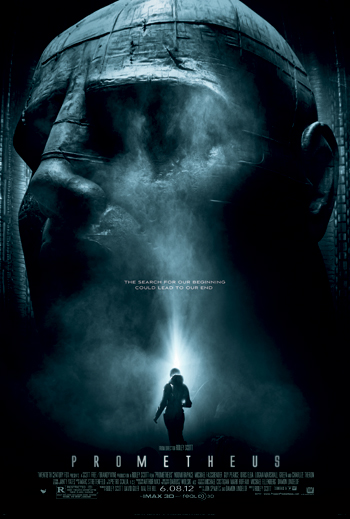
Part prequel and part religious odyssey, Prometheus both treads familiar ground and explores new territory. In keeping with my invariable sense of timing (I saw none of the Alien trilogy in theaters), I waited until well after the fact to see the movie. I had heard Prometheus called a prequel, but even if I hadn’t some of the Ridley Scottish touches might’ve given it away: a large ship bound for a distant planet, evidence of unexpected inhabitants—yes, they knew about the “engineers” (we could call them “watchers”) but not the proto-Aliens they were breeding. We even have the android that understands science’s need to be greater than that of human need. Déjà vu. Still, there’s something very different here—direct discussion of religion and how faith plays into the work of scientists. Elizabeth Shaw, the sole survivor, wears a cross as she tries to work out what her father’s teaching about religion might mean. The cross isn’t hidden in the background—it is brought out into the open and discussed.

If you haven’t seen the movie, the premise is that ancient artifacts (including the ubiquitous Sumerian, Egyptian, and Mayan templates) added to a new discovery in Scotland, demonstrate that a race of giants have been inviting us to their planet for thousands of years. In fact, they had engineered us. (Ironically, the biologist who espouses Darwin is among the first to die.) Peter Wayland, industrialist billionaire who doesn’t want to die, funds a trip to meet these engineers. The engineers, save one, died long ago. Apparently of some plague (cue the aliens!) that were created to destroy humans. They were about ready to send the nasty beasties to earth when they were overcome, with only a single survivor. No coincidence that this planet was reached on Christmas day. It becomes clear to Dr. Shaw that these engineers were intent on destroying the human race they created. And still, she slips her cross back on before facing the engineers of life and death. This was Noah without all the water (and much better writers).

Of course we think we know the rest of the story. Sigourney Weaver bravely led us through three alien attacks before sacrificing herself in a New Testament kind of ending. But what about Elizabeth Shaw? She who bore and aborted the mother of aliens in a very maculate conception? She is off to a prequel’s prequel to find out why these engineers wanted to destroy us. Rumor tells of Prometheus 2, and I wonder if we will get to meet our maker’s makers. Although Scott is an atheist, he brings us Moses later this year, and has already given us Mary and Jesus wrapped up into one with Ripley and her spiritual mother, a sci-fi St Anne, in Elizabeth Shaw. After all Elizabeth was cousin to Mary, and now that the question of faith has been openly discussed, it will have to be more fully addressed. Among the unanswered questions is whether I be able to make it to the theater on time to see this one, or will two years vanish before I find the time to address the eternal questions that Ridley Scott always seems to pose.


Take Twice Daily

Once in a way, when I feel a dusty archaism settling over me, and I realize my eyes don’t focus as well as they once did and that sedentary life in front of a computer screen is slowly killing me, I betake myself to a book sale. In this particular part of the country the big sales are in the spring. I’m told that the book business is dying, but if I can get out of a book sale with no bruises or scary brushes with over-eager buyers, I count myself lucky. I confess, I’m a bookaholic. I spend too many hours a week on public transit, and I consider it a moral obligation to read in public. Even in a city the size of New York, I’ve had people on the bus plop down next to me and say, “You’re that guy who reads.” Public displays of literacy. While some of the books I read are common enough, others are difficult to find in even university libraries. I know that’s an excuse, but my vice is buying books.

I once read a children’s story about a house actually constructed of books. I want that house. Although new books aren’t cheap, there are ways of making them fit into a modest budget. And although you really can’t build with them, they insulate the soul. Reading is more than fundamental—it is the very essence of learning. When I glance at Publisher’s Weekly and read that print sales aren’t what they used to be, I am buoyed by seeing the strong market in young adult literature. We have at least raised a generation that likes a good story. The earliest literature was religious, and many religions developed around written words. It’s a mistake to take religion for gullible belief. If there weren’t power in these words, why would anyone believe?

photo 2

Local book sales can be huge events. Each year Bryn Mawr and Wellesley have a combined book sale in Princeton. If you get there after opening, there will be no place to park. The libraries of Hunterdon County in New Jersey hold a sale that, until this year, required off-site parking and a full three days of hiring a shuttle bus service to get hundreds of buyers back to their cars. And these venues are packed. People do buy books. And many of them are half my age. It is a seed of hope. Some people are surely looking for a quick read, maybe to take on vacation, but you can also see the seasoned, selective literati carefully examining the offers, backs bent, brows furrowed. For twenty dollars you can even get in early, before the goods have been picked over. The man checking me out said the sale gets bigger every year. Looking out over the sea of cars, I feel strangely ebullient, as if I’m atop Nebo looking over the promised land. Although it’s quite a drive, I’m already home.


Lord Have Mercer

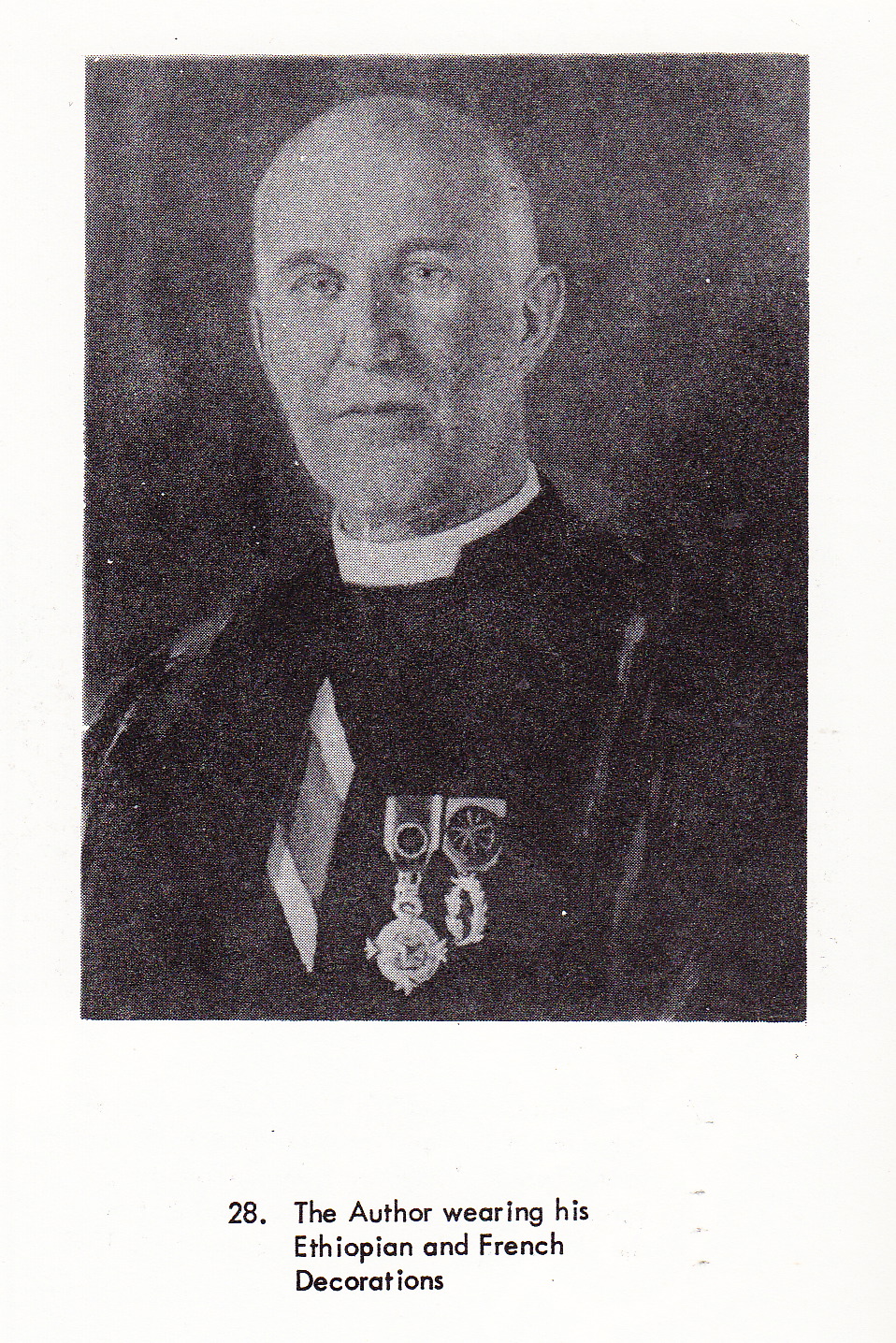
Samuel Alfred Browne Mercer was an Assyriologist who failed to establish an academic legacy.  I quickly learned, when consulting his The Tell El-Amarna Tablets that his work was considered inferior, and that it would not have been published, had it not been for his wealthy wife.  Not a very ringing endorsement for a guy who wrote a grammar of Assyrian.  It was a little odd, then, in the library at Nashotah House when Mr. Tolan was clearing out shelf space, that he asked me if I would like a copy of Mercer’s autobiography.  The library had two and, well, needed more shelf space.  I thanked him for the slim volume and took it home to read.  The little book is self-published, and it had been typed with a sans serif font, something rare for a published volume in those days.  It had been annotated by hand, I presume by the author.  And it told a most interesting story.
 
Mercer, I was to learn, had been a student at Nashotah House.  Now, in my days at the seminary the internet had not yet made it that far into the backwoods of Wisconsin.  We eventually did get a dial-up connection and we thought we were so twenty-first century.  In any case, Nashotah House, when it finally established a website, did nothing so vainglorious as to list noted alumni or faculty.  The only two I ever heard praised were Gustaf Unonius and Michael Ramsey, the former for being the first graduate, and the latter as an adjunct instructor (and, incidentally, the Archbishop of Canterbury).  Samuel A. B. Mercer, as he styled himself, would not likely have raised even a unibrow.  He had written a couple of books on a learned topic, but had failed to impress.  Reading his life story was somewhat intimate, however.  He tells of riding on the top of a train in Russia to get from city to city with little money, and of visiting Ethiopia where, it seems, he was convinced the Ark of the Covenant might just be.  Had I not studied Akkadian and read about Assyriology, I might not have ever come across his name.  We were, however, touching at an odd juncture.
 
Not even rating a Wikipedia article, Mercer disappears into obscurity after his informal accounting of his life.  He apparently had a wealthy wife (home life is not the focus of his brief story), and a lasting desire to spend time in Kush.  Although it has been years since I’ve read his story, I recall that he did have a life of adventure and a little intrigue.  Maybe we were spiritual kin after all, for we each tried and failed to make an impression on an ivory tower world where those who tarry too long at Nashotah are deemed among the least important of academics.  After all, even the relatively comprehensive list of institutions of higher education on the University of Texas website (and Texas and Nashotah have a lasting connection) fails to mention the seminary.  Its little library, nevertheless, does hold evidence of a lost life-story or two.

SABMercer


Science Fiction Double Feature

Two news stories last week—one from the Associated Press and one from the Chronicle of Higher Education—hit upon a common theme: scientific illiteracy. Both articles presented scientists who felt that if they could just reach the (mostly) American public with easily digested facts, then belief in the Big Bang, evolution, and global warming would suddenly make sense to everyone. It may not be my place to say, as I’m not a scientist, but I believe they’re wrong. Don’t misunderstand. I do believe in the Big Bang, evolution, and global warming. In fact, I spent part of last week flagellating myself (metaphorically) for not posting something appropriate on Earth Day. I worry a lot about global warming and what we do to our only planet. What I mean is, these scientists don’t understand religion. People don’t willfully reject the facts. That takes religion.

One of the reasons that I continue my daily efforts on this blog is that our educated elite constantly refuse to acknowledge the blue whale in the room. People are naturally religious. Some grow out of it, some are educated out of it. For most, however, the price to do so is far too high. Science offers little to take the place of faith. For all of its innuendo, the Big Bang tends to leave most of us cold. I don’t support religions spreading ignorance, but even the Bible recognized that it is useless to say to a poor person, “stay warm and well fed” if you don’t offer a blanket and some food as well. It’s chilly in an infinite, yet expanding universe. Why don’t scientist understand that if you give a jacket, maybe people might actually warm up and listen?

hs-2010-13-a-large_web

Religion, however we define it, is a coping mechanism. Even many atheist biologists admit that it has an evolutionary utility, embarrassing as that may be. Evolutionary scientists also tell us that we don’t evolve according to plan. Nature (de-personified, of course) opportunistically uses what’s at hand to help creatures survive. Instead of trying to understand religion, many in the hard sciences think that speaking loudly in single-syllable words will convince those who’ve found meaning in evolution’s solution of religion that somehow evolution was wrong. The worst thing we can do is to waste more money trying to understand religion! I hear it’s very cold in outer space. Still, things seem to be warming up down here. For those who can’t evolve gills, it’s time to learn to swim.


Education for Hire

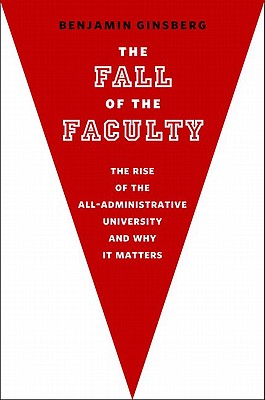
FallOfTheFacultyCapitalism takes no survivors. Ironically, the very concept of capitalism was the result of deep, intellectual reflection. Not that trade hadn’t existed before then, but the arguments that an economy could be based on these principles took an academic setting to become established facts. Universities have been the bastions of new ideas for centuries now. In the United States, however, they are being eroded into corporate playgrounds. Benjamin Ginsberg’s The Fall of the Faculty: The Rise of the All-Administrative University and Why It Matters, will, unfortunately, probably be read only by those who actually care about higher education—faculty and a few curious parents who wonder why they’re paying so much. This is a very important book, and Ginsberg addresses a theme that has been repeatedly expressed on this blog: higher education is in severe crisis because it is treated as a business, not as an educational enterprise. Unlike most situations in life where ambiguity reigns, there’s no question, in this case, whence the blame lies. Ginsberg places the finger firmly where it belongs: professional administrators do not understand, or really even care for, higher education. If you’re curious why you’re paying top dollar for your child’s education, and yet they’re being taught by adjuncts, look no further. Ginsberg has your answers.

Administration, while somewhat necessary, has become an end in itself. A self-perpetuating lackey of capitalistic double-speak. I’ve worked in corporate America enough to know that recognizing a person’s true strengths (what we used to call gifts) is not where managers excel. The bottom line is all they can see. Ginsberg’s is an angry book. And this anger is full of justification. Higher education has become just another garden-variety business, for profit at the heart of it, because faculty have let it slip away. I have been formally associated with eight institutions of higher education, and I’ve seen this pattern operate over and over and over again. Despite the fact that universities thrived in the centuries before professional administrators began treating them as “businesses,” even my alma mater, where Adam Smith himself once taught, could not help hiring a public relations firm to try to bolster the image of an institution which could claim David Hume, Walter Scott, Charles Darwin, and Alexander Graham Bell, among many others.

How the mighty have fallen. Ginsberg does offer some solutions, but is skeptical that many schools can be saved. The fact is, the highest growth rate in the higher education “industry” has been administrators. As faculty jobs are cut and diced ever finer, administrative posts increase at triple-digit rates, and their standards are those of businesses, not educators. Hindsight, of course, comes with greater acuity than foresight, but now that faculty realize they’ve been outmaneuvered, there is little hope of turning the ship in time. Nine-tenths of this iceberg lies hidden beneath the sea, and everyone presumed this ship was unsinkable anyway. Universities were devised by theologians, not entrepreneurs. Like ants crowding around cookie crumbs, business interests have been drawn to the great, untaxable bastions of what used to be called higher education. Factories come in many shapes and sizes. One of the most deceptive is that which bears the once honest nameplate of university.


Irrational Reform State

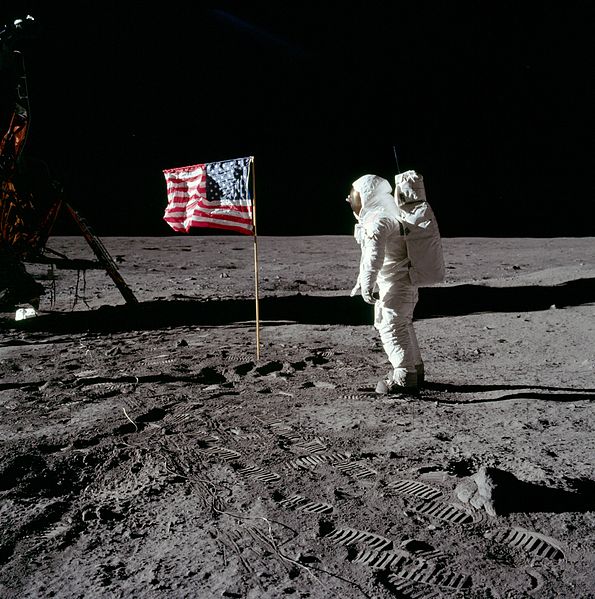
Since 1954, after the cut-off date for new religions (see yesterday’s post), American children have been making a pledge to an inanimate object with the words, “under God.” Despite the fact that all parents know that children take liberties, the reality is that conformity is deeply embedded in young people. Totalitarian states everywhere have recognized that indoctrinated children are difficult to deprogram. In the chilly heart of the great panic known as the Cold War, the pledge of allegiance was emended to declare America a nation under God. And the American Humanist Association is backing a New Jersey family in suing to have a castrated pledge on offer. I always felt swearing fealty to a flag was a decidedly pagan activity anyway. Did not Jesus say, “let your communication be, Yea, yea; Nay, nay: for whatsoever is more than these cometh of evil”? Good Christians aren’t supposed to swear. In a land where the IRS controls what counts as a religion, we might consider substituting “under capitalism.” Isn’t that what we really mean anyway?

Nobody has control over where s/he is born. I’m not sure that many people would want to have the burden of making that decision. Still, we have to learn to adjust. Religion is a matter of where you’re born. We may grow to believe, but what we believe depends on what our guardians teach us. In my case, being born into a Fundamentalist family in Pennsylvania led me to nearly a decade-and-a-half teaching stint in an Episcopal seminary in Wisconsin. Who knew? My religion also taught me that swearing—i.e., “pledging” allegiance—was vaguely suspect. I was never discouraged from the pledge of allegiance, however. After all, it said “under God.”

When my daughter was very young, we were in a store in Wisconsin (where she did not choose to be born) when a couple of guys, being guys, let a few choice adjectives slip. One of them looked over, saw us there (my daughter too young to comprehend what was said), and said, “Oh, sorry! I didn’t see her there.” I found his chivalry admirable, but misplaced. We hear what we hear. So I’ve always found it odd when people want to sue if their children are forced to hear the words, “under God.” How does that threaten an atheist’s home teaching any more than swearing to a piece of cloth undermines a Fundamentalist’s? And aren’t we all taught that globalization is the way of the future? Under those multitude of young hands beat the hearts of Jews, Christians, Muslims, Buddhists, Hindus, Sikhs, Jains, Atheists, and any number of other faiths. We’re told the Cold War is over. Maybe the government should consider turning down the thermostat.

595px-Buzz_salutes_the_U.S._Flag


Irrational Revelation System

In an article on Obamacare in last week’s paper, Kathleen O’Brien pointed out an interesting dilemma. Some religions, such as the Anabaptist traditions (Amish, Mennonites) must comply with modern regulations on healthcare or face a fine. Under pressure, the Internal Revenue Service grants exemptions to some such religions, but those religions have to have been established before 1950. Maybe I’m paranoid, but just having read about Scientology, I have to wonder about two things: what is the IRS doing defining religions, and why 1950?

Photo credit: Ad Meskens, Wikimedia Commons

Photo credit: Ad Meskens, Wikimedia Commons

1950. Like the Roman Empire, frustrated with new religions (like Christianity) popping up all over the place, governments sometimes default to a religion’s age as a sign of its validity. Rome required conformity, but Judaism, demonstrably already an ancient religion, was granted an exemption from some of the regulations. We have a tendency to think that if a religion is valid, it must have been discovered/revealed long ago. All religions, however, were new at one time. Even the first shaman offering the first propitiatory gesture to the first recognized nature spirit, was experimenting a little. Did that stop in 1950? That line in the sand must stand for the cutoff date for new religions. Why? Well, you see, it has to do with money.

The IRS, as an organization, doesn’t really care what you believe. As long as it includes paying your taxes. One of the burdens of citizenship, too quickly forgotten, is that life together in a complex society is not possible without incurring considerable costs. Religions have long claimed tax-exempt status under the rubric of disestablishment. If they pay the government, then it is like the government is receiving kickbacks from the Almighty. The biggest donor should get the biggest favors. Soon you have a state church. So it is just easier to let religions be tax exempt. But since nobody has ever adequately defined what a religion is, the doors have been wide open for entrepreneurs in the faith industry. Instead of letting religious experts decide how to define a religion, that has become a government job. I picture a simple, bearded Amish man pulling his buggy up outside the IRS headquarters in a frenetic Washington, DC to go argue his case. Don’t worry, Bruder. Divine revelation, whatever that is, apparently stopped in 1950 and you’re clearly pre-McCarthy era. Suddenly a whole lot of things seem to start making sense.


Targeted Management of Information

Social justice has always been a concern for me. Call it my primate sensibilities. I grew up in humble circumstances, in a religion that helped to ameliorate the scathing sense that I could plainly see that other people had it much easier than I did. My faith taught me that I deserved less than I might’ve thought I did. I’ve never really felt entitled, and yet, I know the system (whatever that is) is not really fair. Fairness is a big thing with me. I suppose that ties back in to social justice. In any case, several people have contacted me to share their infographics on my blog. Almost always they are graphics about social justice issues. This past week three requests arrived in my mailbox almost simultaneously. I wonder why they pick a blog with so few hits as this one gets. Perhaps it’s an attempt at fairness? Or maybe it’s clear that I have a soft spot for helping out those in need.

It isn’t easy to get noticed on the internet. The world-wide-web is very wide indeed. It is used for crime as well as entertainment and information. Ironically, most fact-checking sites are suspect. A good deal of what you believe depends on the veracity of your source. It used to be that professors and clergy were inherently trustworthy, or so we thought. Politicians have long been out of the running. Now it is the crowdsourcing of the internet. As if our collective ignorance were wisdom. Those of us who count the number of books we’ve read to be in the thousands can be distrustful of information. Indeed, skepticism is a hallmark of education. Be careful though—it can cost you your job.

In any case, the hope of social justice compels me to share the information delivered to me. I’m just the messenger. So I’ve decided to pass the infographics along to you. All of them have to do with control. Crowd control, crime control, prison control. I’m a free spirit who lives with the mantra harm not. Some call the golden rule. Others call it naive. For me, it’s common sense. Maybe learn something below. (The final infographic seems to have some coding issues…)

Privatization of the US Prison System
The US Private Prison System
Privatization of the US Prison System. An Infographic from ArrestRecords.com

The US Private Prison System

Produced By Criminal Justice Degree Hub


Fleeting Meaning

Just a year before I had been unceremoniously dismissed from a fourteen-year teaching job at Nashotah House, devastating everything I thought I knew. I’d found a temporary job at the University of Wisconsin, Oshkosh and the head of the department encouraged us to go see the mandala that some Buddhist monks were constructing in Oshkosh one weekend. My family came up and we breathlessly watched as the orange-draped, shaven monks meticulously tapped brightly colored sand into an intricate pattern of incredible beauty. My daughter, quite young at the time, wondered what they would do with it when they were done. We’d been told, in the department, that the sand would be safely flushed into a local waterway, as Buddhism teaches about the transitory nature of life. My daughter was upset at the thought of such a nice piece of art being destroyed. But that’s part of the point of a mandala. As the Buddhists say, too many people concentrate on the hand pointing at the moon rather than on the moon itself.

Photo credit: Kamal Ratna Tuladhar, WikiCommons

Photo credit: Kamal Ratna Tuladhar, WikiCommons

I’m no expert in Buddhism. It is a complex way of thinking, and, like many religious systems, it is not unified into one particular thought-structure. Nevertheless, one of the main teachings of Buddhism is that life is, pardon the crass translation, suffering. We experience desire and we will continue to experience desire until we die. Then we’re reborn to experience desire all over again. Those who are enlightened may break out of this system into Nirvana, or a kind of non-existence where desire can no longer afflict us. There is an appeal to this way of thinking in a universe that science tell us will eventually burn out so that we’re all just a bunch of cinders in infinite, but expanding space. Almost Buddhist in its conceptualization, actually.

So when this morning’s New Jersey Star-Ledger had a front-page, below-the-fold, story of a mandala incident in Jersey City, I had to read. This entire past week, three monks have worked on a mandala at City Hall in Jersey City, for up to ten hours a day. Having watched this work, I know it can be backbreaking, and it is incredibly meticulous. Yesterday, after four days of work, a three-year old, while his mother was distracted, jumped on and ruined the mandala. A mayor’s aide, horrified, had to show the monks what had happened. A mandala is all about the transitory nature of life. Its fleeting moments are, after all, suddenly swept away. Despite the drama, the monks repaired the mandala and one of them quipped that perhaps the child’s action had underscored the lesson the mandala was intended to teach. Indeed. Many religions recognize that children know something about life that most adults simply forget. It’s the moon that’s important, not the hand.


To Thine Own Self

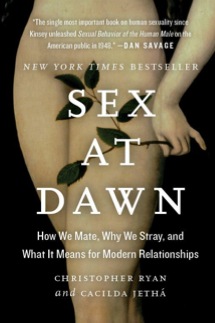
sexatdawnAmong the books that I would rate very important, Christopher Ryan and Cacilda Jethá’s Sex at Dawn would need to be on top, or nearly so. As I’ve often stated on this blog, religion and sex are very closely related. Every religion, in some way or another, intimates itself into sexuality. Like religious belief, however, it is something about which we blush, look at our feet, and politely change the subject. Perhaps it would be helpful to shift focus, then, to the subtitle: How We Mate, Why We Stray, and What It Means for Modern Relationships. Well, not even that reaches the depths to which this book plumbs. Ryan and Jethá actually peer back deep into prehistory and look at the changes that agricultural life brought onto humanity. Comparing that information to conclusions drawn from evolutionary theory and serious biological study, they derive a picture of a much more equitable culture for which humans clearly evolved. Agriculture, and just plain culture, changed all that.

With culture, you see, comes the materialist idea of possession. Hunter-gatherers, even today, are the best sharers in the world. Their generosity isn’t noble, as Ryan and Jethá point out, but entirely practical. In addition, their lives are longer, healthier, and happier than those of the modern, stressed-out, perpetually frustrated, “cultured” individual. We are constantly trying to get ahead, and own more. Of course, we don’t want to mention or think about the fact that when we die, all that ownership will mean nothing. We invent complex laws that so only our biological (we think) offspring will carry on that legacy until the last bit is parceled out so fine that all that remains is a name that few will remember millennia down the road. For that we suffer nearly constant frustration. I’ve not read a book in decades that made me want to throw all of this off and head out to the woods, sharpened stick in hand. (Problematic, since I’m pretty solidly vegetarian.)

Some of the larger implications, however, that Sex at Dawn doesn’t address, are the roles that religion plays in problematizing what we’ve evolved to be. Of course, sex scandals in churches are referenced, since they are such crucial evidence. What is overlooked, for the purposes of the book, is that religions have always tried to define and control sexuality, at least since the dawn of agriculture. We don’t often consider that agriculture, in addition to making us fat, and lazy, also gave us organized religion. It may be that religion came first, but it only grew into a coercive social force with the temple culture of ancient Sumer, and it has been with us ever since, dictating who may love whom, when, and for what purpose. Sex at Dawn is not for those who are set in their ways, nor for those who take a one-size-fits-all attitude toward life. For the rest of humanity, however, there is hope that perhaps we can learn to be a little more true to what nature intended us to be, and to understand that nature may be many things, but it is seldom evil.


New York Calvin

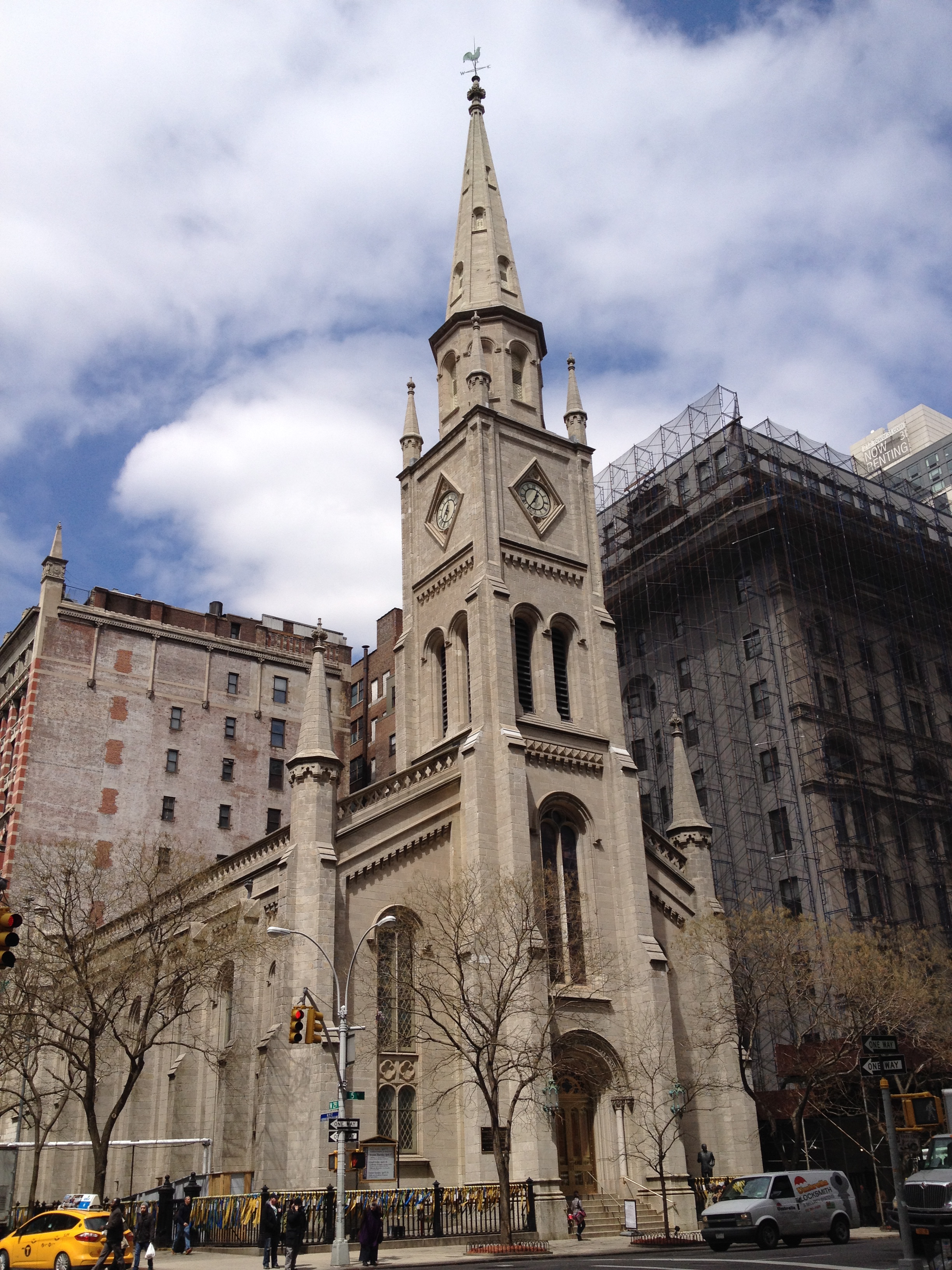
So I’m standing at the corner of Fifth Avenue and 29th Street, gazing at Marble Collegiate Church, of the Reformed Church in America.  A cold breeze is blowing, and I wish I’d thought to dress a bit more warmly.  Although the building in front of me was erected in the nineteenth century, the church was founded in 1628, making it among the oldest continuous Protestant congregations in the New World.  It is regularly passed by tourists and shoppers who give it nary a glance, not realizing that the Dutch who gave us New Amsterdam also gave us a Reformed Church that has stood the test of time in an increasingly secular New York City. 

IMG_1294
 
I am not now, nor have I ever been, a Calvinist.  That may seem odd coming from a religion scholar who attended a very Presbyterian College and earned a doctorate at a Presbyterian department at the University of Edinburgh.  Nevertheless, despite the many belief systems I’ve indulged, the Reformed wing has never appealed.  That’s not to say that I don’t appreciate what Calvinists have to offer: where would we be without the many good things Presbyterians have brought to us?  In any case, I was recently considering how I automatically equate Calvinism with Presbyterianism, and how I really need to get over that habit.  The Swiss reformers were a far more fragmented sect than the Lutheran contingent ever became.  That still shows in the many historic Calvinistic traditions out there.
 
Presbyterianism, on its own, is not a uniform denomination anymore.  For the time being, however, if we consider all Presbyterian groups as one stream of Calvinism, we need also to consider the Reformed groups.  Although all Calvinists are reformed, the Reformed Church had its historic stronghold in the Netherlands.  Doctrinal differences continued to fracture the Reformed Church into several denominations, two of the most prominent in the New World being the Reformed Church in America and its splinter, now larger, of the Christian Reformed Church (not to be confused with the Christian Church, (Disciples of Christ)).  Congregational churches, which have no overarching governing body, frequently fall into the Calvinistic theological tradition, although that is not necessarily the case.  Other Protestant denominations, such as Methodism, have equally diverse origins.  Others, like the Baptists, have an early history that is unclear even today.
 
The Calvinist theological family tree is well studied, and it stretches back from where I’m standing to Huldrych Zwingli and John Calvin and their peers, some five centuries ago.  Although it never reached the size of the Baptist and Methodist growth spurts during the Great Awakening, Calvinism did make a lasting imprint on the landscape of North America, and still continues to bring some of us out on a chilly day just to look and wonder.


History Department

Rather like an embarrassing personal blemish, many universities tend to hide the fact that they were originally servants of the church.  Ouch!  I know that hurts.  When I was working at Routledge I had to educate some of my fellow employees about the strange interaction between religion and higher education.  Most of the earliest universities were founded primarily as theological colleges.  That stands to reason, since as light slowly began to dawn at the fading of the Dark Ages, the practice of literacy had largely been the domain of clerics, and even today, the clergy are among society’s most dependable readers.  Universities sprang up because churches desired leaders who were informed—educated, even.  Men (at that point) who knew how to reason well.  This impetus eventually led to the kind of thinking that allowed science to emerge, although it soon had fights with its parents over who had the better perspective.  Some things never change.

University or church?

University or church?

Even considering the Ivy League here in the United States, we have schools that were generally founded for clerical purposes.  Harvard was founded mainly to train Puritan ministers.  Yale was intended to provide clergy and leaders to the colony of Connecticut.  Brown was founded by Baptist clergy, while Columbia owes its origins to the missionary wing of the Church of England.  Princeton was founded for the training of Presbyterian clergy.  Dartmouth’s Puritan clergy founded wanted a school for preparing missionaries.  Even non-sectarian Penn had clergy among its early leaders.  Cornell was the lone gunman of the truly secular schools.  The pattern even reaches to state universities that now cower at the thought of expanding or sometimes even maintaining their religion departments.  Rutgers, where I had the privilege to teach as an adjunct for a few years, was originally founded as an enterprise of the Reformed Church in America, scion of the old Dutch Reformed Church, thus giving rise to the small New Brunswick Theological Seminary that still sits in the middle of the College Avenue Campus of the State University of New Jersey.

Every now and again, I ponder this state of affairs.  Religion, love it or loath it, is foundational not only for higher education, but for civilization itself.  If the evidence of Göbekli Tepe is to be believed, religion may have been the very glue that brought societies together in the first place.  Despite the decline in mainline denominations, public survey evidence indicates Americans are just as religious as ever, or at least spiritual.  How quickly we forget that it was biblical mandates to go out and spread the news that led to the idea of a literate, educated society.  The lure of money and technology is great, and has managed to reshape the higher education landscape.  If you look, however, at the lists of institutions of higher education in the United States, even today, the largest subset is either currently affiliated with, or had been founded by, Christian groups wanting to offer education to their children. Today there are still hundreds of universities and colleges affiliated with religious groups.  Somehow I get the sense that the affection showed is not completely mutual.


Clearly Religion

GoingClear“There is no point in questioning Scientology’s standing as a religion; in the United States, the only opinion that really counts is that of the IRS;” so Lawrence Wright partially concludes Going Clear: Scientology, Hollywood, and the Prison of Belief. This is an important book, and one which once again demonstrates how seriously religions should be taken. New religious movements offer a ringside seat to how orthodoxies are born. Facts may be distorted or covered up, but there is information to be had on L. Ron Hubbard, Joseph Smith, and Mary Baker Eddy. We can learn from the way their ideas may move from fiction to fact, and how intelligent people still feeling spiritual yearning can turn to a religion invented recently as well as those invented millennia ago. As Wright points out, all religions make improbable claims. Fact-checking, however, is much more difficult for periods long gone that left only meager records. The distance in time may lend ancient assertions the benefit of the doubt, but the real decision-maker is money.

Given universities’ interests in lucre, one might logically conclude that religions would be of great interest. It is telling that, especially in the case of Scientology, that the factor most important to the status of the church is its money. Religions may claim tax-exempt status, setting them apart from purely commercial enterprises. This gives religions an advantage when they are careful with their finances, and the whole question of whether a religion is a religion is not left to scholars but to the lawyers of the Internal Revenue Service. The truth of religion lies in its bank-books, not its holy books. No doubt in the case of Scientology this is because of the high-profile court cases in which the status of the religion was challenged by government agencies. Nevertheless, when it comes to the laying down of the law, only money really matters in defining a religion.

As Wright discusses, one of the problems we face is that religion is poorly defined. Nobody can really assert much beyond that religions involve belief of some kind. Beliefs, in this case, about L. Ron Hubbard and his ideas. Although facts about his life are disputed, there can be no doubt that Hubbard was an intriguing man. He was a prolific writer with great imagination, and he clearly had keen insight into psychology. A religion used to be measured by the good it produced. Now it is measured by the dollars. As Going Clear illustrates, trying to construct an unbiased account of Scientology is a fraught enterprise. Like many modern religions, Scientology is very secretive. Even the early Christians knew that if everybody could join, then the club loses its appeal. Apart from belief, religions also must have outsiders and well as insiders. In a world measured by consumerism, wealth is the surest sign of blessing. No one should be at all surprised, therefore, that it takes the IRS to decide that which used to be taken by faith alone.


Dark Sight

TimeDarkBarbara Brown Taylor is a name about which I wish to learn more. Although Time magazine predictably runs a religious-themed issue around Easter, the year’s cover story, “Finding God in the Dark,” hit some resonant chords immediately. A friend of mine writes a blog called Bleak Theology, and my own posts often linger in those nether regions where, if we’re honest, we don’t know what we might find. Barbara Brown Taylor has been exploring these themes for years on a spiritual journey that has her deciding, as many of us know, that the dark is not evil. Fear is a kind of spiritual elixir. I watch horror movies. I read gothic novels. I awake daily before the sun, and do my best thinking in the dark. The key, as I would humbly suggest, is to be honest about life. When I preached, the students who understood that would say they appreciated my honesty. After all, before the beginning, all was darkness.

The article on Taylor, by Elizabeth Dias, is moody but appreciative. Taylor has the experience of being an Episcopal priest, a professor, a preacher, and a recognized author as her journey has led her to appreciate the dark. Some of us understand that the biblical books that are the darkest—Ecclesiastes, Job, and Psalms—are also the most honest. These are books to read in the dark.

Nature has evolved us to trust our eyes for survival. Fear of the dark is not something instilled in humans by protective parents—it is a consequence of having to survive in a jungle where you too are prey. We can’t see well at night, so that is the time we close our eyes and make ourselves vulnerable to the nocturnal beasts. Those beasts are, of course, spiritual. Somewhere on our journey to shallow religions of the modern era, we’ve come to believe that religion is all about sunshine and light. Evangelicals often believe that feeling good is a sign of blessing and depression is from the devil. Religion, however, from the beginning, has not shied away from the heavier side of human existence. If all were clear and bright, what need would we have of religion? In our experience, however, life has a substantial amount of trials and difficulties. There’s a lot of fumbling in the dark. If we can learn, with Barbara Brown Taylor, that not seeing is true insight, we might indeed learn a lesson about life in a world that is dark, literally, half of the time.