Baptizing Virgil

Dante Alighieri was curious as to Heaven and Hell. Like most mortals, he wasn’t sure of his way around and so he needed a guide. Descending to the nether regions, he enlisted the services of Virgil. Virgil is best know for his epic poem The Aeneid, the early Latin account of the Trojan War. I’ve often wondered why Dante chose this particular writer as the “good pagan” who might lead him through the inferno without becoming ensconced within it. Then I found out about Virgil’s Fourth Eclogue. In addition to The Aeneid, Virgil wrote The Eclogues, or idylls of rustic life. In the fourth of these he included what some early Christians considered to be a pagan prophecy of the birth of a special child, although Virgil was never a Christian and indeed overlapped with Jesus by a decade or two. He is the author of the Roman national epic, as Aeneas was believed to have escaped Troy and gone on to found Rome. Virgil tells the tale. What would he be doing, predicting Rome’s spiritual conqueror?

Virgil; photo credit, A. Hunter Wright, Wikicommons

Virgil; photo credit, A. Hunter Wright, Wikicommons

When Rome became Christian, under the knowing gaze of Constantine, the fourth Eclogue of Virgil was reinterpreted as a prophecy of Jesus’ birth. You see, the special child born ushers in a golden age, and what could be more golden than imperial Rome? Virgil’s foresight suggested him to Dante as a reliable guide through the infernal regions where, despite his suspect religion, he never falters. This whole episode once again highlights just how influential Christianity was to become even in the secular world. Prophecy can be read back into any significant passage, biblical or not, and new religions are founded all the time on such a basis. Such is the power of the written word. It is not just Mormons who baptize those who don’t believe.

Rationally we know that Virgil did not predict the coming of Jesus some three decades in advance. Yet, even such a brilliant scholar as Dante Alighieri was swept along by the tide of belief that had convinced the eternal city of its heavenly pedigree. All roads lead to Rome, and all prophecies point to Bethlehem. Beatrice was, however, a real woman, who, Dante believed, was tasked with revealing Heaven to him. He fell in love with her when he was but nine, and when he married it was to another woman, pre-arranged by his family. Beatrice was married to different man and yet she would succeed where Virgil had failed. Ever after it would be known as the Divine Comedy indeed.

Bread Line

“Her smoke rises up forever,” apart from describing the fall of Babylon the Great, can also describe our toaster. The thing has been with us for many years now and the lifespan of a toaster is often measured in months rather than decades. I suppose I could go to the store, but the internet is right here, so when I began searching for toasters I found, yes indeed, The Jesus Toaster. I’m sorely tempted. Of course, I haven’t had breakfast yet, but I wonder whether this device is diabolical or devotional. Often it is difficult to tell the difference. Pareidolia, the tendency to see human faces and forms where they don’t exist (false positives), seems to be an evolutionary device to get us to pay attention for possible dangers in our environment. Now that we live hermetically sealed lives, our minds still find faces, and often attribute religious significance to them. We’ve all read of cases of Jesus casting his divine face upon a humble piece of toast, or a tortilla. Or a bruised toe or a garden shrub—the holy visage is not just for breakfast any more. So some clever wag decided to engineer a toaster that puts Jesus right on your bread. A private sacramental, still, you might want to go lightly with the jam. But is Jesus toast used for good or evil? What is your houseguest is Hindu or Jewish? Will they awake to conversion or controversy?

JesusToaster

The association of Jesus with bread is deep and abiding. Seminary students everywhere learn that Bethlehem, the place where Jesus was born according to Matthew, means “house of bread” in Hebrew. We know that Jesus had a reputation for feeding vast crowds with a few loaves of bread. By the time we get to the Gospel of John he is lingering long over the matzah at the last supper after claiming that he is the bread. In many churches he is weekly served in pressed little wafers without much flavor, but, we are told, with infinite substance. Jesus and bread go together like, well, bread and butter.

So, should I buy the Jesus Toaster, as seen on TV, or just some regular box of hot coils to warm my mornings? I’m not sure there’s ever any going back once you’ve seen the other side. But wait, there’s more! You can buy a Poe toaster, or a Virgin Mary toaster. They may have a surfeit of meaning, but do they satisfy as toast? As I sit here the time for work draws inexorably closer, and I haven’t decided on my toast yet. Does the Jesus Toaster do bagels? Will my English muffin include Joseph of Arimathea? Does whole wheat toast suggest an African Jesus? My morning has suddenly become too full of options. Besides, the day is usually downhill from here. I think maybe I’ll just have cereal instead.


10 More Questions

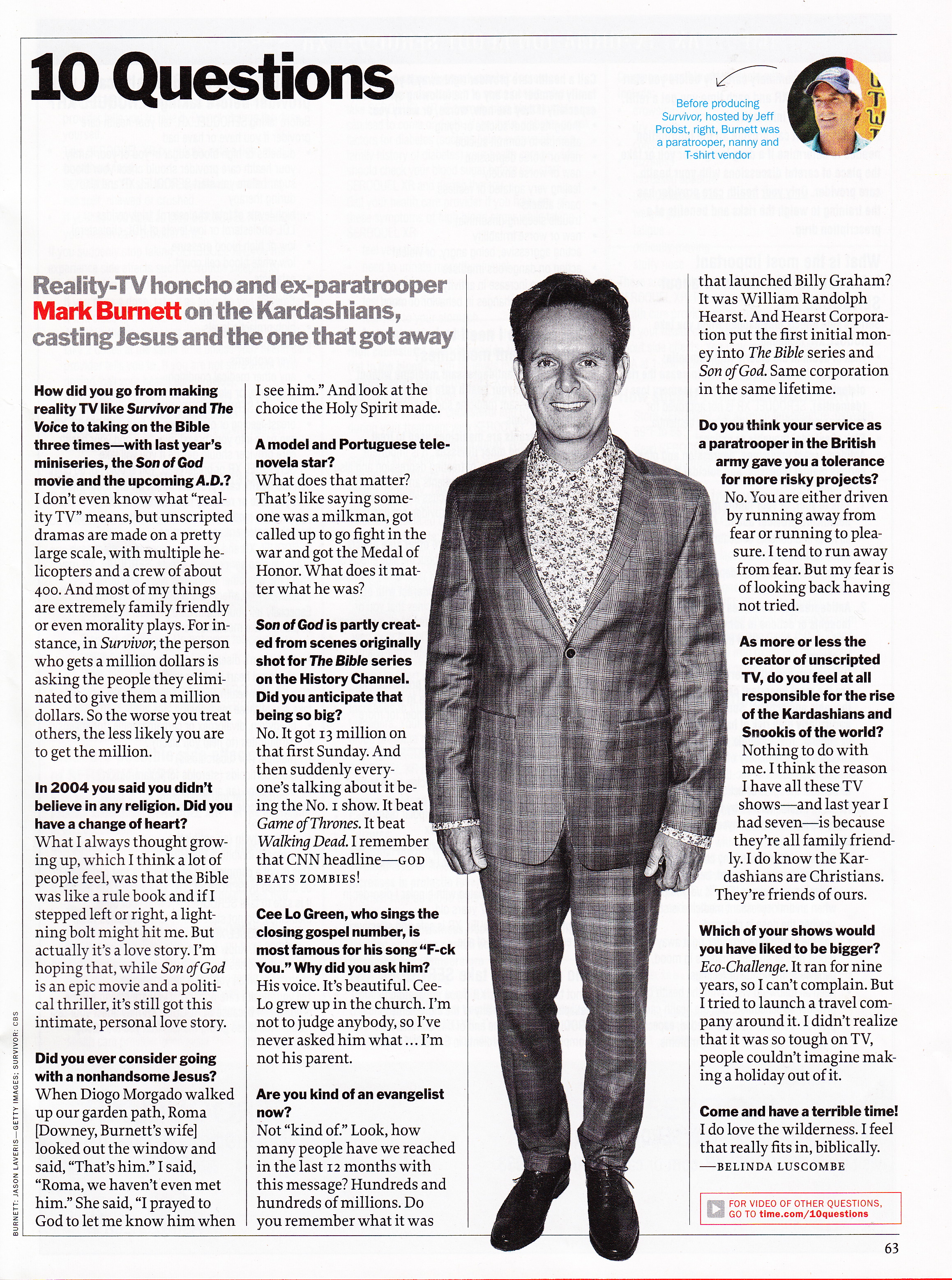
10QuestionsI don’t watch television. This is not some moralizing, high-brow stance—it’s just the fact that it isn’t cost-effective with the little time I have for the tube. Growing up, however, television was at times my best friend. I see we’ve grown apart over the years. Who’s to blame? In this week’s Time magazine, the 10 Questions are directed to Mark Burnett, whom, prior to reading them, I couldn’t have identified with my TV Guide atop a Bible. Burnett is the mind behind the movie Son of God, originally a History Channel television show that managed to beat out even Game of Thrones. The laconic remarks left to Burnett reveal a man somewhat cagey about religion, but with a sense of mission nonetheless. What had never occurred to me is that even evangelists have corporate sponsors. According to Belinda Luscombe, Burnett said, “Do you remember what it was that launched Billy Graham? It was William Randolph Hearst. And Hearst Corporation put the first initial money into The Bible series and Son of God.” The first money into the son of God, Billy Graham, and the Bible. Who can match such a pedigree?

The public airing of faith lacks something without big money. The Crystal Cathedral, Lakewood Church, Heritage USA. Where would we be without the media moguls to lead us? There’s gold in them thar hills. All it takes is those willing to ask the gullible to mine it. Where your treasure is, there will your heart be also, n’est-ce pas? Seems like the Son of God raced past the Lego Movie on its opening weekend, but fell behind Non-Stop, although he’s still gaining. This is the sign of true divinity. Who will ultimately win? Does anybody have an ark?

Crystal Cathedral Ministries went bankrupt in 2010 and sold the Cathedral to the Catholics. Heritage USA lost a slug-out with Hurricane Hugo, as Jim Bakker was checking into a cell with Lyndon LaRouche. Can even the Son of God rock the critics with such a record? Mark Burnett is also credited with helping to create reality television. As we watch the rise and decline of the Duck empire, and the tearful admissions of personal failings from evangelists so rich that we have to admit a funny thing happened on the way to the Compaq Center, can there be any doubt where reality really lies? Who can really tell the difference between The Bible and The Game of Thrones?


Shining Meaning

AllThingsShiningWriting with the hopes of eventually being included in the Western Canon, I suspect, is often somewhere in the back of an author’s mind. We want our efforts to be noticed and our voices to be heard. The Western Canon, however, is a very exclusive club, and the members don’t get selected easily or quickly. We value our classics. More amorphous than the biblical canon, the list of books that define western culture is slightly different with every analyst, but the biggies always make the cut. Hubert Dreyfus and Sean Dorrance Kelly see the great classics as a source of meaning in an increasingly secular world. All Things Shining: Reading the Western Classics to Find Meaning in a Secular Age is a fascinating consideration of how the writing we’ve turned to for inspiration has changed over time. Older members—including the Bible—don’t drop off the list, but newer ones are continually added. According to Dreyfus and Kelly the polytheism of Homer shone with possibilities, and monotheism led to necessary changes where the shining shifted to new characters and new stories. It is an intriguing concept.

Reading about writing generates a fire within. Some of the classics All Things Shining discusses are those you’d expect: The Divine Comedy and Moby Dick. Others are more personally meaningful, such as the work of Elizabeth Gilbert or David Foster Wallace. We all have the authors that shine for us. Moby Dick, of course, has been on my personal canon since seminary and the chapter on Melville helps to bring the thesis of this brief book together. We all know the white whale is more than an albino cetacean, and the world has benefitted from that fact ever since Melville put pen to paper.

As enjoyable as All Things Shining is to read, I was left with the impression that meaning itself has become greatly fragmented in the modern world. Without the social glue of religion, we’ve been left to chart our own course through parts of the universe yet unexplored. We select our crew by the books we read, and we decide whether Jesus or Captain Ahab is better able to guide us through such dangerous waters. They both, in their way, captain ships. Since this is an exercise in fragmentation, we don’t know upon which shore this craft will ultimately land. While Dreyfus and Kelly are philosophers, many of us have followed other paths and have come to our amateur ways of finding meaning. Some of our ships never come ashore at all. “One does not have to believe that the Greek gods actually exist in order to gain something deep and important from Homer’s sense of the sacred.” Well said! If only we could learn the lesson to be literary rather than literal, religions would allow for many ships upon this vast ocean. And still we hale each other with the words, “Have ye seen the great white?”


Prehistoric Steps

Britain has always had a share in the great events of the past (speaking strictly from a western hemisphere point of view). Not only did the ten “lost tribes” of Israel end up there (according to some, with apologies to Joseph Smith), but young Jesus traveled there with Joseph of Arimathea (according to others, with no apologies). While these stories are obviously non-historical, Britain does have an illustrious heritage that has left Stonehenge and the Cerne Abbas giant in its wake. It is thrilling to read, then, that fossilized footprints from some 850,000 years ago were recently discovered. Coastal erosion, similar to the event that revealed Skara Brae to the world, uncovered the footprints for a short time in Happisburgh, near Norfolk. About 50 footprints were discovered, according to The Independent, with a group comprised of women, men, and children. They were walking alongside a stream, apparently looking for the Pleistocene version of carry-out fish-n-chips at least 844,000 years before Adam and Eve.

The British landscape boasts an ebullient antiquity. Our years spent in the British Isles involved exploring everything from Lanyon Quoit in Cornwall to the Ring of Brodgar on Mainland, Orkney with our friends. It is a land where the past lives on into the present. No wonder some speculated that the biblical past made its way here as well. At least now we know that some very early humans did as well. Homo antecessor, the makers of the prints, visited a Britain replete with elephants, hippopotami, rhinoceri, and hyenas. It is speculated that they may have domiciled on off-shore islands to keep safe from the predators that roamed pre-Roman England. One thing we know for certain about people is that they do get around.

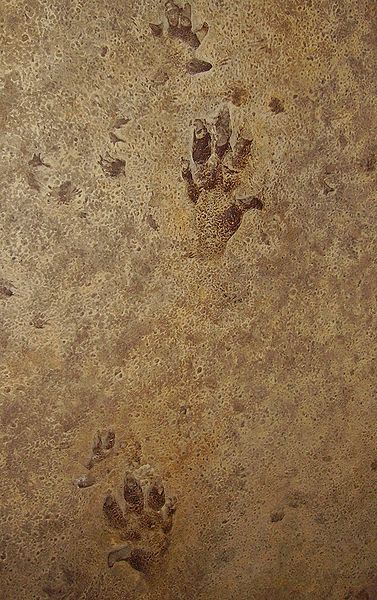
Chirotherium storetonense  trackway, photo credit: Ballista

Chirotherium storetonense trackway, photo credit: Ballista

Homo antecessor is an extinct species. Many of the hominids that contributed in some way to the possibility of our existence are long gone, creating endless headaches for scriptural literalists. Their lives, as The Independent speculates, may have involved being preyed upon by large predators and the constant search for food. They also liked to walk on the beach. I wonder how far they had come on the road to religious belief. Constant fear of predation must surely have played into it. We don’t know how far back the evolutionary chain religion goes, but we do know that it is a profoundly human outlook. You can’t stand beneath the towering Neolithic menhirs of the Ring of Brodgar and not feel it. Sometimes a walk along the shore is all it takes.


Raptor Attention

Comments on internet sites are quite revealing. Not that many comments ever make their jolly way to this blog, but, like many people I spend too much time on the internet, and you can’t help but read a few now and again. My wife sent me an ad for the Jesus-raptor tee-shirt offered by Six Dollar Shirts. The image has been floating around the web for some time now, but I haven’t been able to determine its origin. It could be from creationist groups that believe dinosaurs coexisted with people as an end-run around evolution, but more likely it represents an effort to belittle that view. Creationists are the ultimate backward-looking crowd. Fearful of Hell, they see evolution as tantamount to damnation, and must eradicate the biological evil for the sake of their immaterial souls. Reading through the comments on the Six Dollar Shirts page, I had to wonder. Why are we so concerned with getting the past right?

Don’t get me wrong—I have an undying interest in the history of religions and the origins of religious thought. Nobody wants to get the past wrong, otherwise the present is incorrect. Dinosaurs, however, are the great corrective to a major historical error. It is easy to assume that homo sapiens represents the highest point possible on the earthly scale of measures. Dinosaurs remind us that anything can happen. Up until about 65 million years ago, there would have been no reason to suppose that dinosaurs wouldn’t be here forever. Of course, Adam was over 65 million years in the future, and even if he evolved, his primate lineage was tiny and trying to avoid the gigantic footsteps of their distant Jurassic cousins at the time. Some scientists theorize that if the asteroid never hit, the dinosaurs may have evolved distinctly humanoid features. After all, we’re clearly at the top.

The past must always be approached with humility. Relativity may tell us that it is still here, but I can’t even access the moments just seconds ago as I typed these words. The delete key is a dangerous thing. Science has pretty much unequivocally demonstrated the evolution is a fact of life. It is our past. No matter what Ken Ham says, I’m pretty sure even Moses would’ve noted the spectacle if dinosaurs trudged aboard the ark. So Jesus never met any raptors in real life. Some of the commentators on the tee-shirt page appear offended at the blasphemy of the joke. Or maybe they’re just being ironic. In either case, that’s now the past and the best that any of us can do is comment on it and watch out for the big feet that are stomping this way.

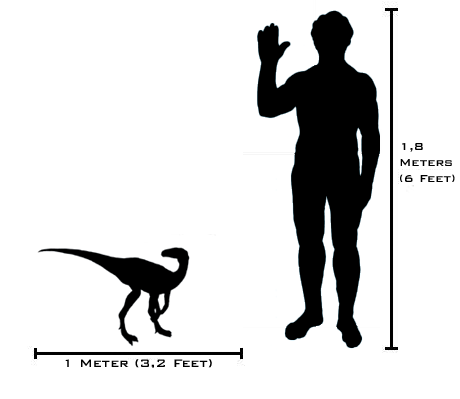
Image credit: Dropzink, Wikicommons

Image credit: Dropzink, Wikicommons


No, Uh

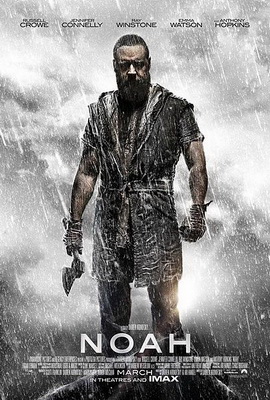
Noah2014Poster

“Give me any two pages of the Bible and I’ll give you a picture.” The words belong to Cecil B. DeMille, according to Stephen Whitty’s weekend write-up about Bible movies in the New Jersey Star-Ledger. The story was inspired by a trio of big-budget Bible films—Son of God, Noah, and Exodus—set to be released this year. While Mel Gibson put me off of Jesus movies, perhaps forever, I’ve been planning to see Noah ever since my wife first pointed the poster out to me in a local theater lobby last month. The flood story has always spoken to me, lasting well beyond the nursery years with all the fluffy animals aboard the ark. One of the points that Whitty is making, however, is that Hollywood knows something the New Atheists do not—there’s big money in religion. People will pay to see it on the big screen. The Bible still speaks to a secular nation.

Noah’s story has been dramatized many times over in the entertainment media. It is often a theme in popular fiction, although well hidden, and reemerges in the occasional search for the lost ark documentaries or Veggie Tales shorts. There’s something timeless about the world-wide flood. For me it seems to go back to the thrill of the impossible. Those first eleven chapters of Genesis teem with the surreal world of lifespans centuries long, primordial gardens full of good food, gods intermarrying with humans, and waters that cover any number of sins. There’s a robust, adventurous air to such stories—they push on the boundaries of human experience and burst beyond them. It doesn’t matter whether Noah’s ark is round, boxy, or extraterrestrial—the flood’s the thing. It appeals to imagination like less mundane disasters simply can’t.

I don’t go to the movies to learn about the Bible. I can do that right at home with a single outlay for a relatively cheap book that can be read over and over again. No, it is these early days of the Bible that give rise to the prepositional phrase “of biblical proportions,” that the movies show so well. I’m not sure that I’ll be able to make the transition from Batman to Moses when Exodus comes out later this year, but next month I do plan to let the waters of the largest event in earth’s fictive history wash over me with all its CGI glory. Seeing is not always believing, but the flood is one of the most powerful stories ever told. Who can resist the calling of deep unto deep? Be warned, the entire theater will be in the splash zone.


Holy Hollow

HollowCityEveryone wants to belong, to fit in. Growing up, I seldom felt I managed it. When you’re very young you don’t know enough to notice that you are more melancholy than other kids, or that you can’t afford the nice things they can. As you reach your teenage years, however, and you know that you come from the kinds of families that other parents warn their kids about (fairly poor, very religious, and just a bit peculiar). No wonder I find Ransom Riggs’ books so engaging. Yes, they’re written for young adults, but just about anything that Quirk Press publishes is worth the read. As an adult, if I’m honest with myself, I’m still waiting to feel like I fit in. The kids in Hollow City, the peculiars, know that they can never fit in. They have special, impossible talents that make them the targets of monsters called hollowgasts, or hollows, who try to gobble down as many as possible. Monsters, outsiders, and very human relationships—it’s a winning combination.

Quite apart from the spellbinding pace Riggs spins out (he’s a master of building tension), there are some quasi-religious elements in the books as well. I read Miss Peregrine’s Home for Peculiar Children a couple years back, and Hollow City develops the mythology a bit more. The real enemies are the wights—mean-spirited malcontents who rule the monsters. They learn that they can become demigods if they extract what makes a peculiar peculiar. That’s a religious concept: the essence that materialists tell us isn’t really there at all that makes us what we are. The children are self-sacrificial toward their mistresses, birdlike and godlike at the same time.

Peculiars have two souls, although most of us don’t know what to do with even one. The soul has, of course, come under great suspicion over the last century or so. There seems to be something that makes us what we are, and it isn’t just cells and DNA. Some call it consciousness, others personality. There are those with élan and others with spirit. We can’t call it “soul” because that smacks of superstition and yesteryear. So we read of children with two souls and none to spare. Even Philip Pullman had souls for his children in His Dark Materials. The soul, in both these book series, leaves a person completely dehumanized when it is excised. Of course, materialism will do that for free. Yes, I know it’s fiction—young adult fiction at that—but my money’s on Ransom here. Let’s hear it for those who have a surfeit of souls!


Med Ed

I’m not really the one who should be on oxygen in this situation. It was a routine, scheduled oral surgery for a impacted wisdom tooth. Not mine, but my wife’s. I sat in the recovery room and they wheeled her in on oxygen. When the doctor stopped in to check on her, he looked at me and said, “My God, get that man on oxygen! He’s going to pass out!” So they took the gas from my wife and laid me down instead. My wife had the magnanimity to think it was cute, but I felt embarrassed nevertheless. I couldn’t go into medicine even if I wanted to. I haven’t the stomach for it. So as I write this in the Urgent Care unit, I’m a bit light-headed. We came in for treatment of a snow-shoveling-related injury for my wife, and my mirror neurons are firing overtime. I hear them call a code red, and I think I hear the helicopter coming down and I think I might pass out. I can’t stand the pain-filled groans coming from the next room.

Compassion is one of the most overlooked of human virtues. I haven’t taken a sick day since 1987, but I’ve had companies tell me I hadn’t earned any yet. You have to earn the right to be sick. Even when I threw up on public transit two weeks ago, in one of the most embarrassing moments of half a century, I still got up at 3:30 the next morning to climb aboard again. So I’m sitting here, feeling ill, although I’m fine, and thinking about how people naturally feel for others. Only practiced cynicism can erode that. Or maybe I’m just a wimp.

It is no coincidence that most religions feature healers or healing as one of their central tenets. Life involves suffering, anticipated or not. There is something more than the physical going on here. Pain is the enemy, and I’m the one who’s well. There may be atheists in foxholes and even in hospitals, but they must be aware that the chemicals chasing one another around the neurons upstairs believe something else. Religion is a coping mechanism, perhaps something even more. So the winter takes its toll, and the snow claims another victim. All those instruments on the wall are beginning to creep me out. My mirror neurons suggest that if only those made of ice could melt with a little compassion, this world would be a more humane place. And when you get a moment, could I get a little oxygen over here?

Scare-Yous


Witch Way

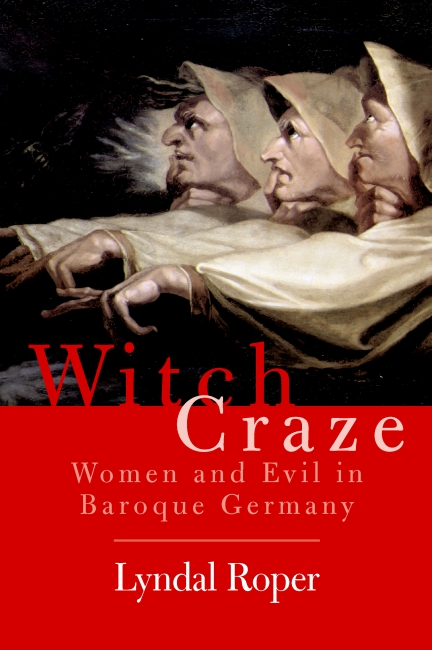
WitchCraze2Women generally bear the brunt of religious intolerance. This is an evil that has proven tenacious and insidious, and which has played out in history far too many times. Lyndal Roper’s Witch Craze: Terror and Fantasy in Baroque Germany brought this home to me once again. Books on witch hunts are deeply disturbing, but we need to engage with the brutality of the past if we want to prevent its reappearance. Roper points out that although many nations persecuted “witches” in the Middle Ages, even into the early modern period, Germany by far had the highest numbers. There were probably many reasons—no simplistic answer meets all the clues. One is clearly related to politics. Germany lacked the central cohesion of other European nations in this period. Feuding princedoms from a fragmented Holy Roman Empire had no strong central authority. When it is everyone for themselves, scapegoats are never far off. Roper doesn’t leave it at that. She points out that the central characteristic of the witch is the intent to harm Christians. Indeed, the witch is a monster born of religion, and which murdered thousands of women in the name of Christianity.

Compounding this unrealistic fear that Christians have always seem to have had, was the emerging Reformation. Distrust erupted in Germany. Was one’s neighbor a Lutheran or a Catholic? In either case, the other was heretical, from someone’s point of view. Distrust ran at premium prices. And women picked up the bill. Yes, there were male witches, most of them associated with women who’d been accused, as Roper points out. Even as the Enlightenment was burgeoning, renewed hunts for witches broke out, leaving innocent women dead in a land that valued fertility perhaps above all else. Women’s bodies, as Roper notes, were to focus of suspicion and fear on the part of a male power structure that dealt with its phobias by the use of violence. Even the Enlightenment couldn’t wipe this slate clean.

Today in the western world, secular thought has replaced superstition for many people. Women are not longer accused of witchcraft. Besides, witchcraft is a chic new religion in many places. But the longed-for equality is still not here. In many parts of the world religious violence is still directed at females by male power structures that should’ve died out with the fading of medieval Teutonic anxieties. Those who perpetrate such violence hide behind scriptures—even the Hebrew Bible acknowledges the reality of witches. Religion creates its own cadre of monsters, and those with stout conviction look for women to blame. The flames of the pyres did not lead to a universal enlightenment and the Tea Party tells us Christianity is still endangered in a world where it may spread largely unhindered. One truth, however, remains. The truly endangered are women, and men who don’t fight against the real monsters do not deserve to be called defenders of the faith.


Under Fire

The tragedy that has been unfolding in the Ukraine has brought to light some unlikely heroes. A story on NBC last week showcased, albeit briefly, priests on the front lines. In a world where joining the clergy is often a way to avoid the dark and dreary reality of war and want, it is strangely heartening to see (in this case) men of the cloth willing to walk into danger. These are people who truly do believe. Sometimes it is easy, sitting safely behind a computer monitor in a relatively quiet neighborhood, to believe that the world is a peaceful place. Even a walk through the “cleaned up” parts of Manhattan will reveal, however, that human need is very real and omnipresent. Perhaps it is just the times when I’m out—it is winter after all, and we do value our comfort—but I seldom see clearly identifiable clergy on the streets of Manhattan unless they are trying to convert. The homeless almost always are sitting alone. The chill this winter has been almost Siberian. Where do the helpless turn?

Seminary is not the training ground for combat. At least not in the way that armed conflict brings. As a student and teacher in a seminary setting, I was constantly watching for signs of hope. It takes a truly remarkable individual to engage in caring for those who need it. Far too often “minister” is a job, with benefits, because that is the only way to get along in a world enamored of capitalism. That clerical shirt can be quite costly—who wants to sully it with human need? The world inside the church is often artificial. If the people are not inspired to go out and help, then we’ve just wasted another hour in a feel-good social gathering. We’ve learned to tune out the bitter lessons of life. Yes, there are war zones. Some with real guns and the dead we see in photographs used to be people just like us. Who cares for them? A cassock can cost upward of 600 dollars. How many warm meals would that buy for the woman sitting on the sidewalk with a baby on her lap and a handwritten sign on cardboard in front of her nearly empty paper cup?

764px-Riischildren

Too often religions become ingrown. The job of missionaries is to convert, not to comfort. We would like to crawl into a world where people are safe and happy, but the moment we wander outdoors—and the mall doesn’t count—we find a different reality at work. It is difficult for me to read about current events. The Olympics are not the only reality of the world of the former Soviet Union. There are others who will never be recognized with gold, silver, or bronze, They may walk into the crossfire holding aloft a brass cross to indicate that they are there to try to help. No great cheer arises, no great ceremony for torches that have fictionally burned since ancient times. There is a fire here, however. It is the fire of human warmth. In this long winter, it is an honest flame of hope.


Weathering the Psalms

Book contracts make me happy. In the case of an academic out of water, they are rare. Few people care what a PhD has to say unless s/he has a university appointment to back him or her up. Still, I wrote Weathering the Psalms while I was fully employed at Nashotah House. I carved the time out by waking at 4 a.m. to do my writing (a practice that has stayed with me ever since), and from 1995 to 2000, the bulk of the book slowly emerged. The day I was terminated at Nashotah I was working on a revision of the manuscript, a bit uncertain of what direction to go. After the trauma of that day, I couldn’t face my little project without the anxiety of association tainting the effort. It seemed to represent my failures in finding the job I knew I was meant to do. Such potent reminders soon weary even those of us who awake well before the sun.

Working in isolation, I had noticed that the weather is a very common motif in the Psalms. The problem is, any attempt to fit the evidence into an overarching scheme is artificial. I undertook a survey of all the weather references in the Psalms, and explained them as scientifically as a layman could. The result was not the smoothest reading, nor was it tied together with a strong thesis, but it was important. Although I have not been in a position to keep up with the research such a project requires, I’ve not seen anything similar emerge. The weather, however, still happens. And people still blame it on the divine. In ancient times there was no natural world. What we call nature was actively directed by the divine. The weather is probably only the most obvious example. We all know the phrase “everything happens for a reason.” This encapsulates the biblical view of the weather. This winter with its series of storms has reminded me of this, forcefully.

Photo credit: Don Amaro, wiki commons

Photo credit: Don Amaro, wiki commons

Ironically, editors started to show interest in the project only after I’d abandoned hope of ever getting it published. It was the fruit of my despair. It represented several years of my academic life, but, like its creator, it was growing older. So last week when a contract landed on my desk from Wipf and Stock, a profound happiness settled in. A sense of completion. I am not in a position to update the contents, but at least one academic publishing house sees the worth in the manuscript that came from so much personal experience. A decade is a long gestation period. I suppose if I had to write the book today it would reflect much more the experience of world-weariness that comes from not ever finding the job you know you were meant to do. Nevertheless, it is a small offering to the deity of the weather, and I am glad that, come next year, others will be able to share in my struggles to make sense of that world.


A Toy Story

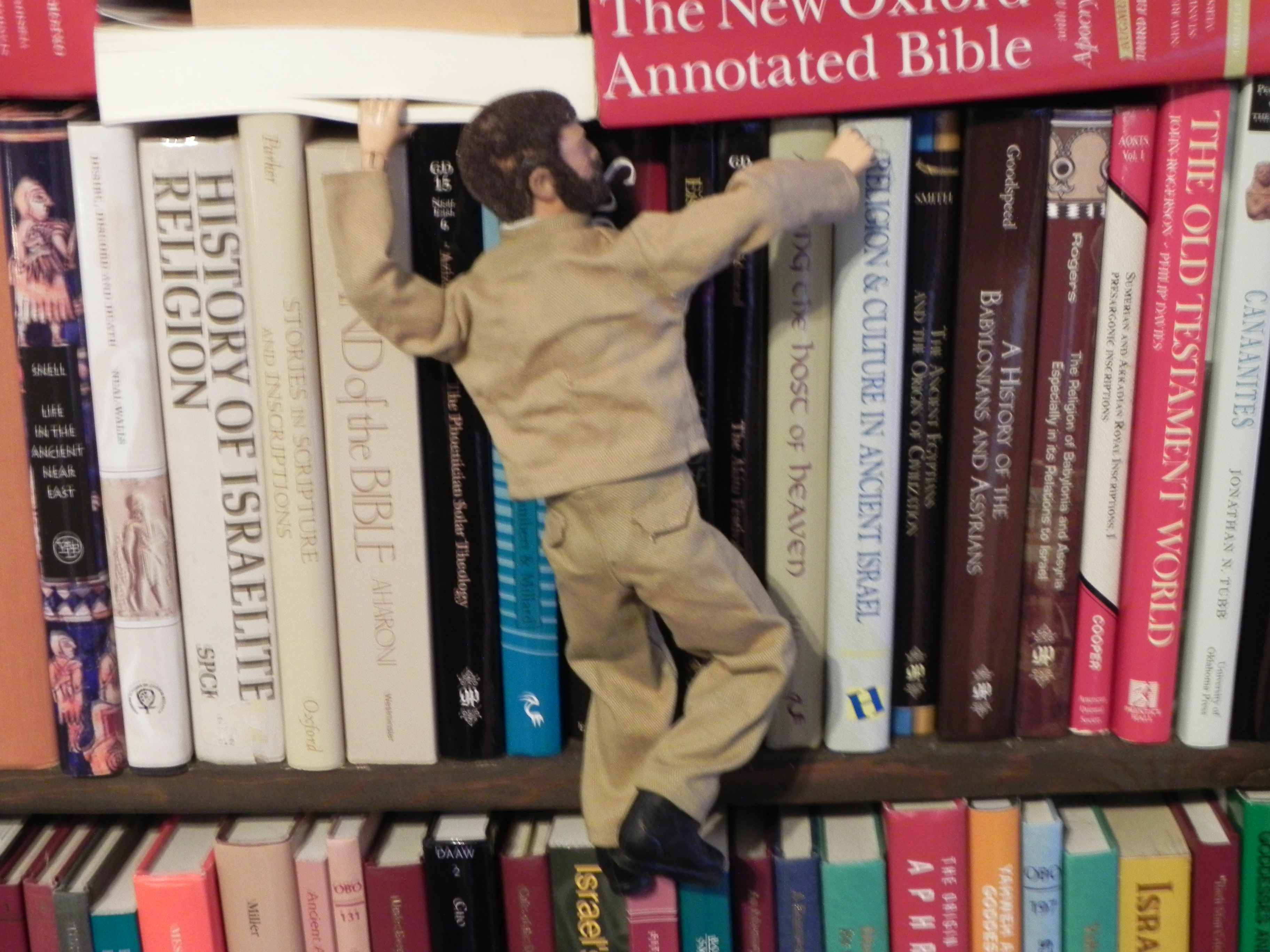
As a life-long pacifist, it might seem strange that I find myself waxing sentimental over a military-themed toy. You see, I just found out that G. I. Joe is turning fifty. For those of us who grew up in the 1960s, G. I. Joe was the acceptable “boy doll” (now, technically, “action figure”) that all the guys had. Some of us had several. We didn’t have much money, but Christmas always gave an opportunity to accessorize Joe with either the latest developments (life-like hair in a buzz cut, pull-string vocalizations, “kung-fu grip”) or the many vehicles that could be purchased separately. As the Vietnam War wore on, Joe turned his interests to science and humanitarian causes, but boys like to anthropomorphize as much as girls do, and Joe continued to get himself into many bizarre adventures. At least in our apartment he was known for fighting dinosaurs, robots, medieval knights, and even General George Custer. Joe was a fighting kind of guy. He had guns and gear and shoes that were almost impossible to remove when you wanted to change uniforms (only when Mom was out of the room). So G. I. Joe has been around for half a century now. I can’t remember childhood without him.

G. I. Joe often had near fatal encounters in our home. One of them, the talking one with life-like hair, suffered a severe war wound that left his bottom half completely dissociated from his top. I don’t think we kept the lower abdomen and legs—there was something slightly unnerving about plastic buttocks—but I did keep his top half, the talking bit. It shocked me when my Mom asked if she could take him to church. We were a “Bible believing” family since it was the days before people much talked about Fundamentalists. My mother was a Sunday School teacher. (Thus my early amazement at the magic of flannelgraphs, still primarily used for religious teaching.) We didn’t believe in evolution, and we certainly thought war was a bad thing. I did wonder, though, why Mom wanted to take a toy to church, particularly a dismembered, violent one.

Being the son of the teacher did have some perks. I knew enough to read my Bible and learn the lessons, but we were not given sneak previews for Sunday School. Seeing the trailer might make actually attending superfluous. So when Joe went to church I learned why: people are not animals. The pull-string voice box, although the sounds emerged from holes in his perforated chest, was proof. People talk, animals don’t. We didn’t evolve after all. The other kids were seemingly impressed by my evangelistic Joe. Who would’ve thought that “G. I. Joe, U.S. Army, reporting for duty” could have ever converted a lost soul? On Ebay, I see, some of these vintage talkers can fetch up to $600. Mine, I’m sure, ended up in a landfill somewhere in rural Pennsylvania where, I have no doubts, he is still preaching to the other toys about the dangers of evolution.

The ultimate adventure...

The ultimate adventure…


Mad Charles

Moving to New Jersey was made easier by Weird N.J. I found out about the magazine while still domiciled in Wisconsin when the series of books produced a Weird Wisconsin edition. I read it cover-to-cover and learned about the magazine. When weirdness would have it that we’d be moving to that self-same New Jersey, I began reading the magazine religiously. Lately, however, it has become more mainstream and less weird, but still, it is a great source of local information. We landed in Somerville because of its educational reputation and closeness to Piscataway, where I worked. I’ve always had a thing about being able to pronounce the name of the town in which I live (and I’ve even resided in Oconomowoc), so Piscataway was out. In any case, Somerville High School has an engineering program and the expected robotics team that goes along with such pedagogy. When my daughter joined the team, the whole family was drawn into four years of endless fundraising and promotion for an underfinanced club. So it was weird when I saw a story called “Rock em’ [sic] Sock ‘em Robot: Somerville N.J. vs. Mad Charles, the World’s First Singer Songwriter Karate Robot” in the latest Weird N.J. In my four years in the club, I’d never heard of Mad Charles.

Robots and religion are topics I’ve often related on this blog, so I read with amazement that about two decades before FIRST Robotics ever got its start, there was a somewhat famous robot in Somerville. Eugene Viscione was the inventor of Mad Charles, a robot that was built to help improve karate moves. The robot, as often happens in small towns, went on to other things, such as cutting records that, according to the article by J. A. Goins, are quite rare. In the 1970’s, however, Mad Charles was a local sensation, now all but forgotten some four decades later. There were even Mad Charles tee-shirts available. While we sat dreaming up new ways to get money out of the locals, and even set up a booth for the Somerville street fair not far from where Mad Charles at one time could have been found, nobody mentioned the karate robot. I doubt anyone had heard of it.

History is a fickle friend. Of course, being from a small town myself, I know it is very hard to get noticed, and even harder to be remembered. So those sleepy, pre-dawn weekend bus rides to robotics competitions, it was sometimes easy to consider how one gets overlooked. This past November, many hardly noticed as NBC didn’t make a big deal of it, FIRST robots opened the Macy’s Thanksgiving Day Parade. Somerville’s latest robot was not among the horde (we have always had a problem keeping enough charged batteries on hand), but as the robots rolled through Herald Square, I was thinking of Mad Charles and a legacy that has been forgotten. Come to think of it, I guess that is weird after all.

A Somerville robot (center)

A Somerville robot (center)


Faithful Places

PlacesOfFaith Is there any more American a diversion than the road trip? Those of us who live on large land masses with relative ease of travel sometimes like to go for, well, the fun of going. If you’re a sociologist, however, you might find funding for a road trip if you can put a thesis behind it. Christopher P. Scheitle and Roger Finke made such a trip and entitled the results Places of Faith: A Road Trip Across America’s Religious Landscape. This isn’t really an academic book, but it does contain some interesting information about faith communities that might otherwise remain off the radar (with the exception of mega-churches, one of which they visit in Houston). Religion, it becomes clear, is still a large part of life for many Americans, and not just small-town rubes like yours truly. Thriving faith communities are found in New York, San Francisco, Houston, Detroit, and Salt Lake City. Scheitle and Finke don’t neglect the smaller venues either, stopping at rural sites in Nebraska and Pennsylvania. Perhaps the biggest take-away from their book is that religion is diverse and deeply embedded in the United States.

While many claim that atheism is humanity’s next big step forward, it has to be admitted that freedom of religion (without which atheism might be problematic) has gone far. Although Places of Faith sticks pretty close to Christianity, Islam, Buddhism, and Judaism, there can be no question that many, many other religions constitute a nation where “mainstream” is not as normative as it may seem. As also became clear from the descriptions and photos the authors provide, religions are fond of splintering. Faith can be made of brittle stuff. As I’ve argued before, we are really each our own entity of personal religion. We share some traits with the larger group, but unless we’re an identical twin, likely nobody thinks quite the same way we do. Religious leaders know this well—uniformity is often a thinly veiled illusion.

Having studied religion for most of my life, I can’t say that there was too much new to me in this little book. It provides a tolerant, and colorful tour through some religions that will be less familiar to those who don’t consider just how broad the landscape is. You won’t become an expert in Mormonism or the Amish, but you might learn a thing or two about both. The authors encourage something that many religion majors know by rote: you learn a lot by exploring your local religious landscape. As a college student I tried not only Presbyterianism and Pentecostalism, but also the Jehovah’s Witnesses and the occasional foray into that mysterious realm of Episcopalianism. There was more diversity, even in that small town of Grove City, than I had the ability to explore on my own. This much was certain, however, people find meaning and comfort in their beliefs. To deny them that is to deny them what makes religious freedom the wonder that it is.