October’s Poetry

October is a beautiful, melancholy time of year.  Edgar Allan Poe died on October 7.  Two years ago today, my mother died.  This was brought home to me forcefully yesterday.  A colleague had invited me to address her class at Princeton Theological Seminary about Weathering the Psalms.  I had vacation days that have to be used up or lost, so I took the day off.  My wife and I drove to Princeton, a town we know well.  When we lived in Somerville, about 15 miles north of there, we’d visit Princeton not infrequently.  I wasn’t really familiar with the seminary grounds, however.  My colleague informed me that her class, on the Princeton Farminary (where a program in ecology and theology is housed) would be meeting in a barn so I should dress appropriately for the weather.  A cold front had come through, so I went for the tweed and turtleneck combo.

So we set off on a beautiful drive along the Delaware.  The leaves aren’t at peak yet, but there was plenty of fall color as we navigated our way toward Frenchtown, where there is a bridge across the river.  The GPS also told us this was the way to go.  On River Road, still in Pennsylvania, a flagman refused to let us on the bridge, although the signs did not say it was closed.  He impassively waved us on.  The GPS insisted we “return to the route.”  We soon found out why.  The next crossing is seven miles further down, along winding roads with a 25 mph speed limit.  The drive was beautiful, but suddenly I was going to be late for my appointment.  The new route added 45 minutes to the estimated travel time.  After uttering some choice words about unplanned bridge closures on a road where there are only a very few ways to emulate Washington’s crossing, we eventually arrived.

The weather beautiful, if a little chilly, the class decided to meet outdoors.  I hadn’t forgotten how much I love teaching.  It was brought back to me with force.  With the trees reminding us that winter is not far off, and the students eagerly asking questions, I felt at home for the first time in many years.  It was a temporary shelter, I knew, but it was a kind of personal homecoming.  Carefully avoiding the Frenchtown bridge, we drove north, crossing to River Road at Milford.  If the GPS had known that to go forward you sometimes need to go backward, it would’ve sent us to Milford that morning.  We arrived home tired but glowing from a day out of the ordinary.  As I put my tweed away that evening I found a pencil from the the funeral home where I last saw my mother in the pocket.  It had been the last time I’d worn this jacket, two years before.  October is a beautiful, melancholy time of year. 

Pan Pandering

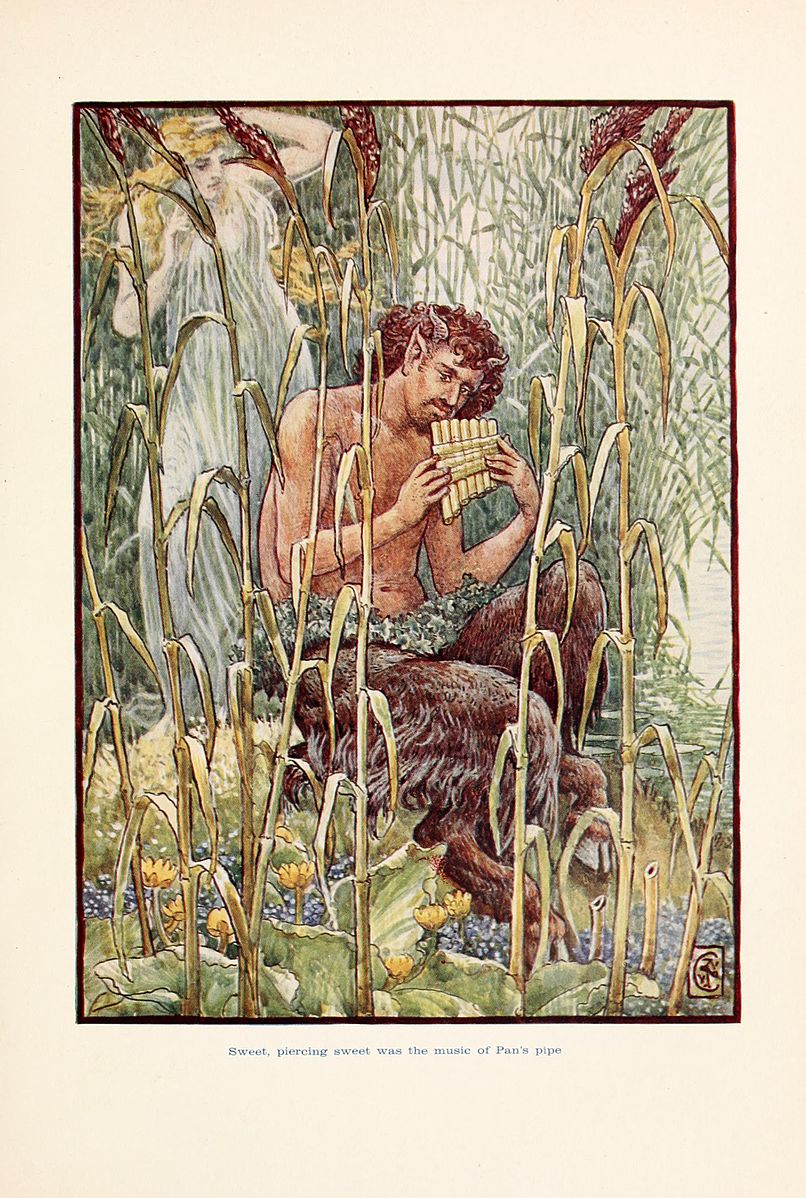
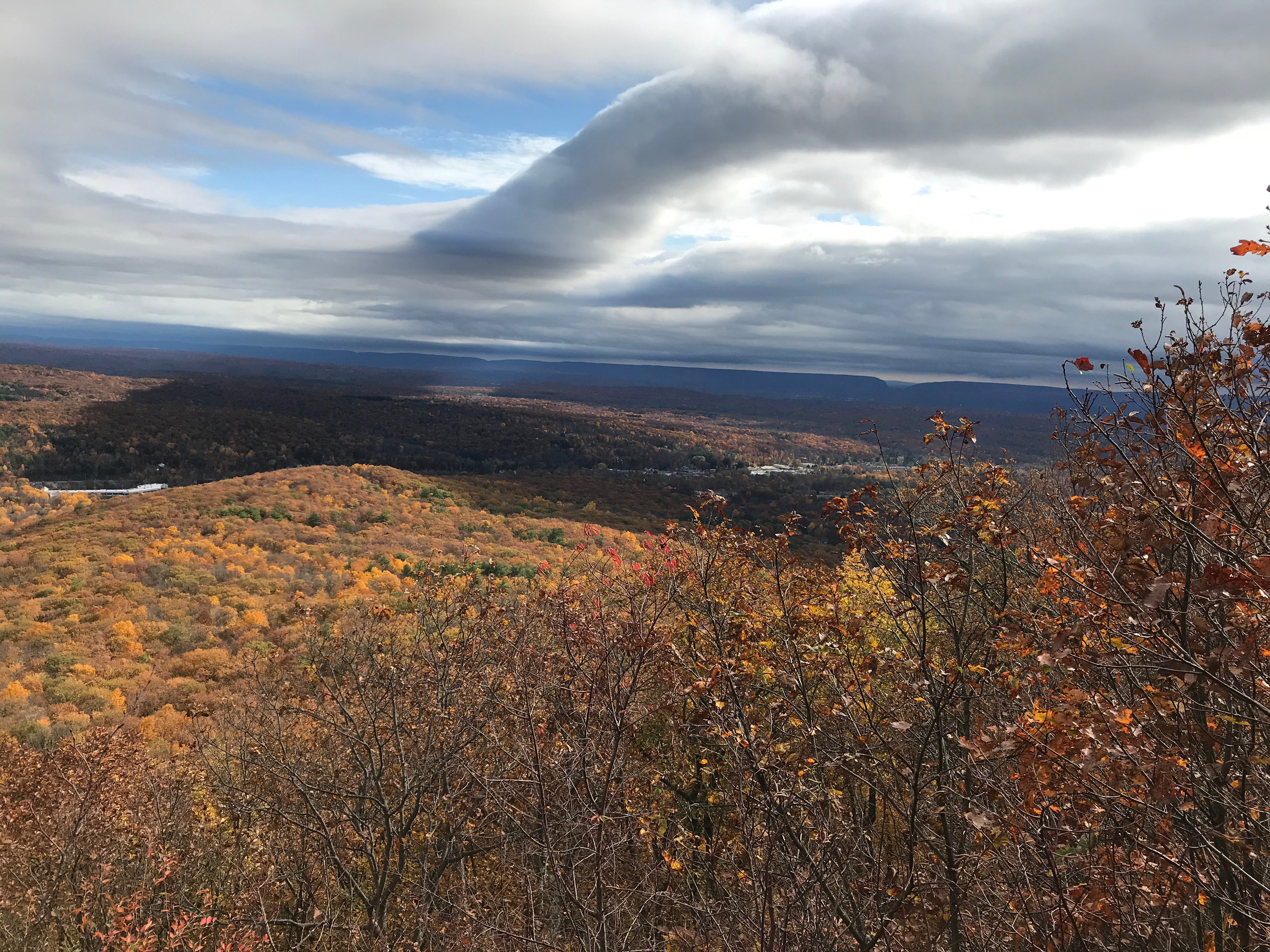
The Greek god Pan has had a rough go of it.  And I don’t mean that his name is a homophone for an essential kitchen item in English.  No, Pan was mistreated by early Christians, made evil, and then good, before finally being largely forgotten.  We’ll start with the bad and move to the good.  As I discuss in one of my publications, Pan was considered evil by medieval Christians for a few reasons, apart from being a “foreign god.”  First, he was associated with nature.  Early Christians weren’t naturalists.  They were looking to escape the world (a trait that continues to be manipulated by politicians even today).  Not only that, but Pan had goat legs and horns.  While horns could be used to represent any deity, including Yahweh, the combination with goat legs suggested Pan might be demonic.

Image credit: Walter Crane, public domain via Wikimedia Commons

Nobody knew what demons looked like.  They are incorporeal, after all.  As I point out in Nightmares with the Bible, the fact that the rarely used Hebrew word for demons is roughly translated to “hairy ones” added to Pan’s sins.  This was a common Hebrew phrase for goats, and over the course of many centuries, when people had the irresistible urge to draw the invisible, they gave Satan the Pan treatment.  Goat lower half and horns on his head.  In many esoteric groups the goat, i.e., Pan, became a symbol of demons.  All of this has a rich and detailed history and it literally demonized Pan.  Yes, he was all for free love, but he was a musician, after all.  Then something interesting happened.  

When the King James Version of the Bible was first printed, the biblical books each began with an illuminated letter.  The book of Psalms began with an L.  This letter was inscribed with an image of Pan.  What the devil was he doing in the Good Book?  Well, by 1611 Pan was considered a type (or foreshadowing, if you will) of the good shepherd.  And we all know who the Good Shepherd is, right?  Not only that but his name, “Pan,” translates to “all” in English.  Since Jesus is “all” to Christians, it was appropriate that he be symbolized by Pan.  This ancient force of nature had gone from being the Devil to representing God.  Indeed, he could, at the same time, be symbolic of both.  Now this is quite an accomplishment for any entity, let alone a rustic god who was never an Olympian.  Pan isn’t much discussed in Christianity today, but he had a fascinating place in its view toward goats, both bad and good.


Word Undefined

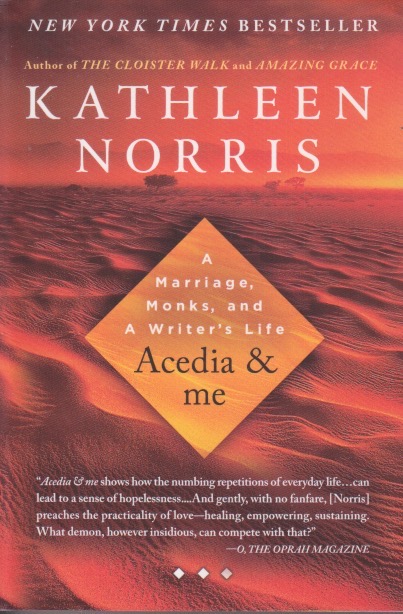
It’s one of those amorphous, uncommon words that can be devilishly difficult to define.  It’s also a churchy word.  “Acedia” was considered both a sin and a demon by various monastics, although the basic idea is listlessness.  Kathleen Norris has made her mark as a spiritual writer, and my wife and I have read a few of her books.  Dakota, her first non-fiction, was stunning.  We just finished Acedia and Me: A Marriage, Monks, and a Writer’s Life.  It revolves around this concept of acedia and for a writer to admit it, it seems, takes courage.  But the question that remains unresolved for me is whether it really exists.  It seems that acedia was devised by monks to name their ennui with monastic existence.  When all you do is pray there comes a time when you just don’t want to.  Or can’t.  They called it acedia.

There is a rich vocabulary for such states, reminding me of The Dictionary of Obscure Sorrows as well as the Existentialist literature I grew up reading.  I think of Kafka.  Of Kierkegaard.  Of angst.  Of boredom.  More to the point in Norris’ case, writer’s block.  This is a terribly personal book for her.  She describes the death of her husband and coping with widowhood.  And on top of it all, that dreaded block of inspiration that is a plague upon writers.  Interestingly enough, the book took me back to my Nashotah House days.  Norris, as do many monks, appreciates the slow reading of the Psalms.  One of the points of contention at Nashotah House—I kid you not—was how long to pause between the halves of the verses in the Psalter.  But is this a demon or only human nature?

“The noontime demon” was another common term for acedia.  This connects it to yet another of its aspects: depression.  We tend to think of depression as a clinical problem, but Norris explores the possibility that it’s a spiritual problem.  Some claim acedia as a sin, as I’ve noted, which shoves it back on the experiencer.  Norris has some interesting definitions of sin in her exploration.  Tellingly, in an appendix she presents the Webster’s Dictionary (1913) words related to acedia and there are over 100 of them.  And these words range from lust to world-weariness.  Is the word too promiscuous to be really useful?  For a writer like Norris, influenced by monastic practice, a poet by trade, and yet a writer of New York Times bestsellers, she makes the word fit.  There’s much to ponder here.


Spirit Storm

Some time ago, we experienced quite a windstorm.  More than wind, there was a dump of rain, thunder, hail, and all that.  My wife and I were attending a Tibetan singing bowls sound-bath with some others in the cancer support community.  I’ve described this practice before, here.  In any case, the meditation is held in a large room with a tin roof—the kind of place you don’t want to be during a tornado.  We’d just got inside when the gust front hit and knocked out the power.  The instructor still went through the meditation, but the storm sounds blended with those of the singing bowls.  Afterwards my wife asked about Job.  Specifically, God speaking from the whirlwind.  I told her that was God on a bad day, but I understood what she was getting at—there’s a spirituality to the weather.  (I was going to suggest Elijah instead, but “but the Lord was not in the wind.”  Alas.

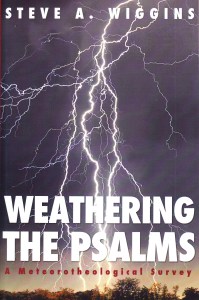
I thought of Weathering the Psalms.  My contribution to biblical studies, had I been allowed to remain in academia, would’ve been further explorations of weather terminology in the Bible.  But the Lord was not in the wind.  I wrote that book because I noticed the juxtaposition of severe weather with daily chapel at Nashotah House.  We were required to attend, no matter what the weather.  (Such is life on a fully residential campus.)  We were reciting the Psalms one day when a storm blew the power out.  It may have happened more than once, since we’re getting on past two decades hence my memory’s a touch imprecise on the point.  In any case, the spirituality of the power of the storm fascinated me.

It still does.  The next morning, out for my jog, I marveled at the number of branches down.  Thousands in the Lehigh Valley were without power.  This is probably why the ancients considered the storm god chief of the rest.  The violence of nature is something that suggests divinity.  Other primates have been observed screeching back at the sky during thunderstorms.  It’s deep in our DNA.  That doesn’t make it any less spiritual.  There’s a lot of weather in the Bible.  I only explored a tiny piece of it by trying to tackle the Psalms.  The Good Book, however, doesn’t say much about the spirituality of weather.  It’s there nevertheless.  Anything that can snap a tree a foot in diameter like a toothpick has a spiritual message for us.  I mused on the way home—we had to take a detour because of downed trees—that had the storm claimed us as victims, dying while meditating is probably not the worst way to go.  Now I wonder, what might God’s nice words from the whirlwind be?


Personal Psalms

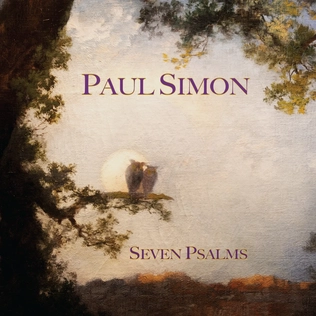
I haven’t heard it yet, but a New York Times article encourages me to.  Paul Simon has joined the ranks of those aging music stars to record albums presaging their deaths.  The article was about Simon’s latest album, Seven Psalms.  And, yes, the religious reference is pretty hard to miss.  Like most kids from the sixties, I grew up hearing Simon and Garfunkel on the radio.  We didn’t have money for albums, but I always liked their songs when I heard them.  After their breakup I really didn’t pay much attention to Simon until Graceland, and since then I’ve listened with half an ear.  You see, I’m wired in such a way that I can’t listen to music while I write.  Or read.  My mind grips one thing at a time.  That means I don’t listen to background music much.

That doesn’t mean I don’t appreciate music.  I do.  Almost religiously so.  On occasion I come back to Simon, with or without Garfunkel.  I posted about his song “Werewolf” some years back.  I eventually listened to that album, and I’m not sure I got it.  Artists are that way.  Some pieces you like, others are just okay.  I am curious about Seven Psalms, though.  I’ve posted about David Bowie’s Blackstar, Leonard Cohen’s You Want It Darker (both discussed in the Times article), and Bruce Springsteen’s Letter to You.  No longer young myself—these guys were young when I was a kid—hearing them reflect on death is powerful, and, if the mood is right, peaceful.  We fear death because it’s unknown.  And also, we all know, deep down, that we’re flawed.

Psalms aren’t necessarily biblical, of course.  Sinead O’Connor’s “Take Me to Church” is a psalm.  So is “Sounds of Silence.”  Artists have been writing psalms for as long as they’ve been writing songs.  The biblical psalms are among the most quoted bits of literature in the western world.  They were likely originally sung as well, but we can only guess what they may have sounded like.  We know that across the world people turn to song to express strong emotion.  I’m not sure what Paul Simon’s Seven Psalms might be, but it seems that thoughts of mortality go naturally enough with emotion.  I don’t write much about music because it’s so deeply personal.  I try to be intellectually honest on this blog, but if you want to talk music you really have to get to know me first.  Then I’ll reveal my psalms.


Cold Psalms

“Ne’er cast a cloot ’til May be oot,” as we heard it in Scotland, was a warning, loosely translated, to “never take off a layer until May is over.”  That bit of lowland wisdom fits this spring pretty well.  As I was donning full winter regalia for my jog this morning my thoughts naturally turned toward the weather.  Memory distorts things, of course, but I keep coming back to my youth and thinking late May used to be reliably warm.  There were chilly mornings from time to time, but yesterday held a touch of November in the air, as if the world somehow switched axes.  Even the usual animals I see—deer, groundhogs, ducks, and the occasional fox or raccoon—all seemed to be sleeping in this morning.  Who could blame them?

I postulated in Weathering the Psalms that the weather is somehow connected in our psyches with the divine.  It’s God’s big blue heaven, after all.  The weather is something we can only control in a bad way, though.  While other people are fixated on surviving the coronavirus outbreak Trump has been quietly (although well documentedly) been relaxing environmental regulations so that when this is all over the beleaguered wealthy will have further income streams.  And so global warming gets a head start on opening the doors of industry again.  Those older than even me tell me the weather is far wilder than when they were young.  Perhaps it’s just the Anthropocene hadn’t had time to settle in yet.  Or maybe environmental degradation is spitting in the face of God.

First light is beautiful.  I’ve been awakening before the sun for so many years now that I can’t recall what it’s like to stumble out of bed when blue begins edging the curtains.  When it does I pull on my sneakers and head out the door.  It’s easy to pretend out here that everything’s okay.  When I do spot a deer, statue-still until I’m mere feet away, I wonder what life was like before the koyaanisqatsi of industrialization.  When our human impact on the earth was humble, like that of our fellow animals.  Now the weather has turned.  It’s chilly out here this morning.  I’m wearing a stocking cap and gloves and I’m watching my own breath forming the only clouds in the sky.  The weather is a kind of psalm, I guess.  I should pull on another clout and consider the wisdom of my elders.


Post Facto

“Yea, though I walk through the valley of the shadow of death,” Psalm 23 asserts, “I will fear no evil.”  Nor should one fear evil when flying over Death Valley, as I did coming out of San Diego, but I did.  There are perhaps not too many national monuments that can be appreciated from 30,000 feet, but the only way I’ve seen both the Grand Canyon and Death Valley is by plane.  My flight home from AAR/SBL had me sitting over a wing, so a photograph of the famed graben would simply show mostly wing and a bit of Death beyond.  This valley holds the record for the hottest ambient temperature recorded on the surface of the earth (134 degrees) and is famed as one of the filming locations for Star Wars.  Still, from the air the juxtaposition of mountains and salty, flat dearth was impressive.  I had no one with whom to share my excitement; the kid next to me was watching a movie on his phone and I had no idea who he was or if he’d be interested.

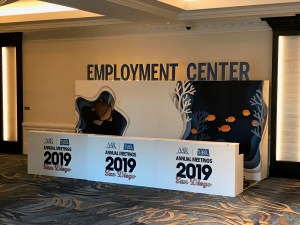
Disneyland, they say, is the “happiest place on earth.”  While I have my doubts about than endorphin-laced claim, I do know one of the opposite locales.  The hotel in which I stayed, the Grand Hyatt, San Diego, hosted the AAR/SBL Employment Center.  The hotel is not to be blamed for holding the most unhappy place on the planet, but as I looked at the booth I wondered if this was truth in advertising.  Should it not read “Unemployment Center”?  That two-letter prefix would make this at least honest, if not cheery.  I have spent some of the most miserable hours of my life in the employee hopefuls’ lounges at past conferences.  Hours and hours wasted, waiting to see if anyone, anyone at all was willing to grant you an interview.  I saw more than a few tears shed in that horrid place.  Some of them mine.

Now I’m high over Death Valley.  It feels far too sanitary to experience it in this way.  The professorate, which seeks to improve the world, is generally a powerless lot.  Signs scattered throughout the Convention Center and hotels asked such things as Does your school have over 50% contingency faculty?  And statements like Tenure track is not the norm.  The psalmist, it seems to me, got it right.  If you want to face the valley of the shadow of death and not fear, you have to walk through it.  The more people who do, the better the hope that we’ll land this plane with some kind of resolve to do be open to visions and to act upon them.


Dayglow

Yellow and orange leaves on a damp pavement.  A sky claustrophobically occluded with gray clouds.  A decided chill in the air.  All you have to do is add a few pumpkins and the feeling of October is complete.  I don’t know why this particular image of the change of seasons grips me the way it does.  As a homeowner I don’t want to turn the heat on too soon because the gas bills will jet up and will stay that way for seven or eight months.  I get depressed when skys are cloudy for days at a time.  Around here the leaves have only just begun to change.  In other words, there’s a decided difference between the way I imagine October and the way that it feels on the ground.  In my imagination there are Ray Bradbury titles, The October Country, The Autumn People, but here in the physical world I shiver and add another layer.

Over the past several weeks I’ve been struggling to figure out why horror appeals to me.  It seems to be the Poe-esque mood rather than any startles or gore.  The sense of mystery that hangs in the air when you simply don’t know what to expect.  Will it be a warm, summer-like day or will it be rainy and raw, a day when you wouldn’t venture outside without the necessity to do so?  October is like that.  It is changeable.  Beginning in late September it is dark longer than it is light and for much of the rest of the year I will go to bed when it’s dark outside.  It’s always still dark when I awake.  Is it any wonder that October has its hooks in me?

Short stories, of which I’ve had about twenty published, seem to be the best way to capture this mood.  You see, it isn’t a sustained feeling.  It’s piecemeal like that extra quilt you throw on your bed at night.  The urge to hibernate creeps in, but capitalism doesn’t allow for that.  October is an artist, and I’m just the guy wandering the galley, pausing before each painting.  This feeling only comes after summer, and it is fleeting.  In November the leaves will be down and the cold will settle in quite earnestly.  The candles we lit for Halloween will be our guide-lights to those we hold out to Christmas when the dayglow will begin to return at an hour that reminds us change is the only thing that’s permanent.  And in this there’s a profound hope.


Horseman Horror

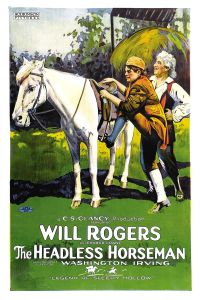
Yesterday was distinctly autumnal around here.  Cloudy and cool, the overcast was definitely moody although the equinox is still a couple weeks away.  Still, the mood was right for the Legend of Sleepy Hollow.  The earliest full cinematic adaptation of Washington Irving’s story is the 1922 silent feature The Headless Horseman, starring none other than Will Rogers.  Now, Irving’s story is fairly brief, and to get nearly a full seventy-five minutes out of it, the tale lends itself to some padding.  The film makes a great deal of Ichabod Crane knowing Cotton Mather’s A History of Witch-Craft, and even being accused of being in league with the Devil that leads to a  disturbing scene where he’s nearly tarred and feathered.  In reality Mather’s book was Wonders of the Invisible World, but the point of the film is better made with the fictional title.

Having watched Tim Burton’s 1999 version—Sleepy Hollow—many times, I was taken by the introduction of the Bible into the story.  The groundwork, however, was laid by Edward D. Venturini’s version.  True to the story, Ichabod teaches Psalmody in his role as schoolmaster.  Venturini’s film has a contrived scene in the church on Sunday that includes a lengthy sermon with everyone—even the usher—falling asleep.  The episode, which is lacking in Irving’s original rendition, introduces the Bible into the narrative.  The connection is thin, but nevertheless present.  Burton picked up on the religious element and built it firmly into the plot as Ichabod Crane’s backstory as a skeptic, raised by “a Bible-black tyrant.”

As someone interested in the integration of religion and horror, early examples, despite the comic aspect of Venturini’s version, are often instructive.  The comedic spirit is actually in the original; Irving’s tale gives a caricature description of Crane that gives the lie to the handsome protagonists beginning with Jeff Goldblum on through Johnny Depp and Tim Mison.  Will Rogers plays the homely image to its hilt, and although lighthearted, the movie has some classic horror elements.  To arouse his dozing parishioners, the minister yells “Fire!” When they awake asking where, he states “In Hell,” which sleeping churchgoers can expect.  Although the eponymous headless horseman is shown to be Brom Bones, a remarkably effective early scene presents a skeletal, ghostly rider that haunts at least the imagination.  The sun is out this morning, and the brooding skies of yesterday have passed.  They will be back, however, as the season for ghost tales is only just beginning.


Plumbing Depths

This past week we had a plumber here for a day.  Our house has been owned by a succession of DIY weekend warriors who had more confidence than ability when it came to things like electric and water (which, I’ve learned, you want to keep apart).  Somehow our home inspector failed to spot these costly fixes, and I try to think of them all as investments—a concept foreign to a guy with my background of living paycheck to paycheck.  In any case, all this plumbing has me thinking deep thoughts about water.  And depth.  Things are seldom what they seem—there’s more below the surface, and those who struggle with the depths often come up with sayings we call profound.  And they often express them in poetic form because, when you get deep enough, words themselves break down.

I often consider this in the context of science.  Physicists break things down into formulas.  There’s a certain uniformity, they tell us, until you reach the quantum level, then the rules change.  I sometimes see this as an analogy with the staid nature of scientific prose versus the depth of good poetry.  Or even, dare I suggest it, profound fiction.  These sometimes explain our world better than the accepted facts of mundane existence, such as water always seeking the lowest point.  There comes a profundity, however, at which down becomes up.  The behavior of water, which we want in our houses but only in controlled locations, is somehow indicative of this.  “Deep calls unto deep” as one ancient source says.  And the plumber walks away with a good chunk of your cash.

Learning about science in school, I was always taught that good science is elegant—there should be beauty in a theory that explains the world.  I’ve often wondered how this fits in with a reality that is often messy—chaotic even.  Ancient peoples from the area that produced our Bible believed water to be chaotic.  It had to be controlled by the gods.  It is vital for life, we need it and yet it wreaks havoc on dry land as those who experience hurricanes know all too well.  The world into which I was born was one of indoor plumbing.  Once water gets in, as our leaky roof attests, it introduces chaos in a place we want to stay dry.  When water won’t behave like we want it to, however, we no longer call on the gods.  We call a plumber and pay our offering with profound reverence.

Young Dr. Wiggins contemplates chaos


Bradbury’s Dream

There’s a Ray Bradbury story—I can’t recall the title, but with the Internet that’s just a lame excuse—where explorers on Venus are being driven insane by the constant tapping of rain on their helmets.  They try to concentrate on discovery, but the distraction becomes too much for them.  Living in Pennsylvania has been a bit like that.  I grew up in the state and I knew it rained a lot.  Here in the eastern end we’ve hardly since the sun since March.  And when you’ve got a leak in your roof that only compounds the problem.  If I were weathering the Psalms, mine would be a lament, I’m afraid.  You see, the ground’s squishy around here.  Mud all over the place.  Rivers have been running so high that they’re thinking about changing their courses.  And still it rains.

There’s a lesson to be taken away from all this.  The fact that we use water for our own ends sometimes masks the fact that it’s extremely powerful.  Not tame.  The persistence of water to reach the lowest point contributes to erosion of mountains and valleys.  Its ease of transport which defines fluidity means that slowly, over time, all obstacles can be erased.  It’s a lesson in which we could stand to be schooled from time to time.  Rain is an artist, even if it’s making its way through the poorly done roofing job previous occupants put into place.  Would we want to live in a world without valleys and pleasant streams?  And even raging rivers?

There’s no denying that some of us are impacted by too much cloudiness.  When denied the sun it becomes easy to understand why so many ancient people worshipped it.  Around here the temperatures have plummeted with this current nor-easter and the heat kicked back on.  Still, it’s good to be reminded that mother nature’s in control.  Our high officials have decided global warming’s just alright with them, and we’re warned that things will grow much more erratic than this.  As I hear the rain tapping on my roof all day long, for days at a time, I think of Bradbury’s Venus.  Okay, so the story’s appropriately called “The Long Rain” (I looked it up).  Meanwhile tectonic forces beneath our feet are creating new mountains to add to the scene.  Nature is indeed an artist, whether or not our species is here to appreciate it.  If it is, it might help to bring an umbrella this time around.


Thunderers

“Storms are the embodiment of Mother Nature’s flair for the dramatic, and the words that we use to write about them are infused with that drama,”—the words aren’t mine, but they express something I often acknowledge.  The quote comes from a Verbomania post about the word “brontide”—a noun for things that sound like distant thunder.  Weather-related words are indeed part of the religious vocabulary as well.  I wasn’t quite daring enough to suggest it in Weathering the Psalms, but it seems that thunder may be behind most basic religious beliefs.  Well, that and bad luck.  Think about it—most cultures have a very powerful storm-deity.  That power is expressed in thunder.  Even in the twenty-first century a sudden clap can made the sophisticated duck and cover.  

We don’t know as much about ancient Mesopotamian culture as we’d like to, but it’s pretty clear that storm deities commanded major of respect.  Eventually in the city-state of Ugarit, in what is now northern Syria, a god named Hadad (aka “thunderer”) became the patron of the city and was known mainly by his title “lord” (Baal).  There may have been more than one lord, but the one in charge of day-to-day affairs was the one who controlled storms.  We’ve entered another rainy season around here (something you tend to notice when the roof leaks), and my thoughts often turn to how very much the weather controls us.  Interestingly, thunder hasn’t been much in the picture.  We’ve lived in our house coming up on a year and I have been awoken by thunder (something that still scares me as much as when I was a kid) only once.  Thunder is the approach of gods.

There’s drama about the weather.  In fact, fiction writers have long known that one of the most effective ways to suggest the mood of a story is the meteorological method.  Weather sets the scene.  The sound of distant thunder has a naturally ominous, almost predatory quality.  The growling, low and loud bursts from the sky sound so like human expressions of rage that it is only natural that they should be interpreted this way.  Since the sky is (or used to be) out of the reach of humans, the sounds from above were from the realm of the divine.  When gods approach the mood is threatening.  We dare not meet them.  That mythology has long informed our perceptions of meteorological phenomenon, acknowledged or not.  Brontide is an underused word that brings the drama of both nature and the divine together.  It could be a psalm word.


Croce’s Lament

So how much time is there?  I mean all together.  I suppose there’s no way to know that because we have no idea what came before the Big Bang.  Those who invent technology, however, seem not to have received the memo.  New tech requires more time and most of us don’t have enough seconds as it is.  Perhaps in the height of folly (for if you read me you know I admit to that possibility) I’ve begun uploading material to my YouTube channel  (I hope I got that link right!). These are cut-rate productions; when you’re a single-person operation you can’t fire the help.  I figured if those who don’t like reading prefer watching perhaps I could generate a little interest in Holy Horror visually.  (I like my other books too, but I know they’re not likely to sell.)

The question, as always, is where to find the time for this.  My nights are generally less than eight hours, but work is generally more.  What else is necessary in life, since there are still, averaged out, eight more left?  Writing has its reserved slot daily.  And reading.  Then there are the things you must do: pay taxes, get physical exercise, perhaps prepare a meal or two.  Soon, mow the lawn.  It may be foolishness to enter into yet another form of social media when I can’t keep up with those I already have.  What you have to do to drive interest in books these days!  I think of it as taking one for the tribe.  Readers trying to get the attention of watchers.

There’s an old academic trick I tried a time or two: double-dipping.  It works like this: you write an article, and another one, and another one.  Then you make them into a book.  I did pre-publish one chapter of a book once, but getting permission to republish convinced me that all my work should be original.  That applies to reviews on Goodreads—they’re never the same as my reviews on this blog—as well as to my YouTube videos.  There’ll be some overlap, sure.  But the content is new each time around.  So you can see why I’m wondering about time.  Who has some to spare?  Brother, can you spare some time?  I’ve been shooting footage (which really involves only electrons instead of actual linear imperial measures) for some time now.  I’ve got three pieces posted and more are planned to follow.  If only I can find the time.


Melting Psalmists

With weather like this, I could use a Psalm or two.  Of course, in my mind, weather and Psalms are closely connected.  Here in the mid-Atlantic states, we’ve been experiencing a heat wave.  Unlike many parts of the west, such heat here in the east is accompanied by very moist air, meaning that cooling down is only possible in a large body of water or air conditioned interiors.  We have neither readily available at our place, so we try our best to keep cool and compose psalms, mostly imprecatory, I fear, about the weather.  Although it was thunderstorms that stirred my interest to write Weathering the Psalms, I included a chapter about temperature, for the Psalter sings of hot and cold as well as lightning and thunder.

The world of ancient Israel was quite different from that of North America.  There are mainly two seasons in the Levant—dry and rainy.  The dry season isn’t always as hot as we tend to imagine it, although the day I visited Masada the air temperature was about 120 degrees.  Enough to make a dip in the Dead Sea look inviting.  The Bible often views high heat as a form of divine punishment.  Although we human beings have expanded to fill just about every ecosystem our planet has to offer, we thrive in central California conditions.  Not all of us can live there, however.  And it’s a good thing that global warming’s a myth since it’s awfully hard to function when it is over 90 degrees for days in a row.  WWDD?  What would David draft?  Perhaps, “I’m melting”?

The interesting thing about the global warming myth is how real it feels.  I suppose the solution is to use more fossil fuels to help keep cool.  Fans, arctic air conditioning, lingering languidly at the open freezer door.  I stand here sweating, wondering what the Almighty could possibly find wrong with a country that is now great again.  One that takes children from their mothers yet insists birth control is evil.  One that loudly and punishingly insists guns should be in every home.  One where the elected head of government is involved in over 3,500 lawsuits, yet gets to appoint justices in the Supreme Court.  David got caught, if not in flagrante delicto, at least within a couple months of adultery with Bathsheba.  Instead of paying her off, he had her husband murdered.  But then—and here’s the key difference—he humbled himself and repented.  The sweet Psalmist of Israel might yet have something to teach us yet about weather and the Psalter.  Until the United States becomes the chosen nation again, I think a cold shower will have to do.


Do unto Yourself

Selfishness goes by many names. One of the strangest is “Christianity.” I wouldn’t presume to define a religion, but some time back my wife sent me a story about the prosperity gospel. Written by Michael Horton, himself an evangelical, the pre-greatest inauguration of all time piece is called “Evangelicals should be deeply troubled by Donald Trump’s attempt to mainstream heresy.” Horton goes on to describe the belief system of the prosperity gospel that includes people becoming gods and the idea of positive thoughts drawing good things to you. Quite apart from completely ignoring most of what Jesus is recorded to have taught, the prosperity folk tend to think the Almighty wants them to be, of all things that most shallow, wealthy. “More for me” also goes by many names. The most common is “selfish.”

I grew up evangelical as well. One of the messages drilled into my malleable head was that Jesus taught putting other people before yourself. “Do unto others” was the least you could get away with and still call yourself “Christian.” Part of the disconnect here is that nobody has the authority to define a religion. Not even the Pope can say unilaterally what Christianity is. Protestants aren’t obligated to agree. And with prosperity gospelers with their enormous cash flow telling us that it’s God’s will, well, heresy looks mighty attractive. We’ve come to see the error of heresy, however. Nobody can claim their brand alone has the answer. It’s a theological anything goes. I suggest we go old school and call a cad a cad. Selfishness by any other name would smell as bad.

It’s poor taste to claim your own self-gain as a benefit to society. I, of all people, would handle my wealth properly so that nobody suffers. Except those I don’t like. Doth not Scripture saith, “ I have said, Ye are gods”? Yet earlier in the same Psalm come those easily ignored words, “Defend the poor and fatherless: do justice to the afflicted and needy.” Missing are “build a wall across your southern border,” and “speak untruths when it is convenient to do so,” and “distrust those who speak a language not your own.” Oh what the Bible would say if only we could write it ourselves! But fear not, for we have many who believe the prosperity gospel. And they’ve already got the task well in hand. And their lexicon doesn’t even include the word “selfish,” so you need not worry about such uncomfortable thoughts. Get rich and all will be well.

Photo credit: Kriplozoik, Wikimedia Commons