Chick Tracks

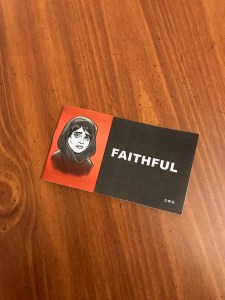
Goodreads isn’t the only booklover’s website, but it is one that publishers pay attention to.  Having a following on Goodreads helps for making marketing manageable.  Or so the thinking goes.  In any case, I recently had a message on Goodreads about Holy Horror.  It seems someone has, against all odds, found the book and is reading it.  This particular reader asked me in a comment about Chick tracts.  I’ve written about Jack Chick before.  He was a veritable one-man evangelical force of super-nature.  He is responsible for many of my personal nightmares with the Bible.  His cartoon tracts were designed to scare the Hell out of kids, literally.  I read them religiously.  My Goodreads reader pointed out that I could’ve made use of them in Holy Horror.

This made me ponder the reticence of academics to address religion as a cultural force.  Chick tracts are extremely common, even today.  As I posted last year, we were handed one while walking between venues at the first annual Easton Book Festival (an event forced virtual this year by, well, you know).  Not that Chick’s intellectual ability deserves study, but his influence is undeniable.  How many of us fundamentalist kids were set on our life trajectories by tracts that looked like mini-comic books but which had an unwavering, uninformed viewpoint held as gospel?  Chick tracts broached no dissent.  The Bible alone, and the Bible as interpreted by fundamentalists alone, was the only possible way of avoiding everlasting hellfire.  Nightmares indeed.

Chick died in 2016 after half-a-century of terror (his first tract was published in 1960).  Apparently Chick was a shy evangelical and his prolific cartooning was a way of assuaging his own fears of not evangelizing.  Ironically, in his tracts he offloaded that burden onto others—kids were made to feel inferior if they didn’t talk about Jesus to their friends, no matter how shy they might have been.  There’s not much information easily available on this influential man.  A motivated scholar, I’m sure, could dig up information—nearly any life can be illuminated to some degree—but I’m not sure the will is there.  If it ever happens, I suspect the study will be done by someone like me, raised on Chick and fed steady doses of childhood Bible reading.  My Goodreads interlocutor was perhaps onto something by suggesting my watching horror has something to do with Chick tracts.  Stranger things have, I’m sure, happened.


Biblerama

Perhaps you’ve heard—the New Revised Standard Version is being updated.  Stop the presses!  I’m sure that everyone has been anticipating this as much as biblical scholars have!  If you’ve not been able to feel the buzz maybe it’s because you’re not in the Bible publishing business.  As the discussions have been going on (rights holders are of course consulting with publishers, because that’s where the money is) a great deal of energy goes into deciding what exactly to call it.  And since Christianity is so fragmented there have to be different versions of the versions.  Some include the apocrypha and others do not.  Some prefer British spelling and others American.  Imperial interests are important, even when it comes to Scriptures.  What may be overlooked in these developments is the connection to the most influential English translation, the King James.

The King James Version was not the first English translation of the Bible, but it was the version that captured the imagination of some as directly inspired by God.  Strangely enough, King James onlyists can seldom name the translators who apparently had the divine mouth to their ears, but never mind that.  The KJV held immense sway especially among literalists because it is so quotable.  In the 1950s it was revised.  (There are, by the way, several differing versions of the King James Version, and the original included the apocrypha.)  That first major revision came to be known as the Revised Standard Version.  Translators seldom begin their task with what original language manuscripts they can find; new translations are based on existing translations in families.  It’s okay, we’re all related.

Bible closet

When I was a kid the RSV (Revised Standard Version) was considered pretty good by many.  Hardly an overwhelming affirmation, but still, it’s something.  The real concern began when the New Revised Standard Version (NRSV) came out in the eighties.  The reason?  It used inclusive language!  See what happens when you allow women to read?  Ironically, the book that has been used for centuries to liberate white men is something you want to keep out of the hands of women and non-whites unless you make it clear that everyone from Adam to Jesus and Paul was a white man and this is his story.  Now the New Revised Standard Version is being updated.  Nobody’s quite yet sure how it will be denominated.  And this is only one family in a vast genealogy of Bible translations.  If you’re not in the Bible business, you’re missing all the excitement.


Anticipation

My work computer was recently upgraded.  I, for one, am quickly tiring of uppity software assuming it knows what I need it to do.  This is most evident in Microsoft products, such as Excel, which no longer shows the toolbar unless you click it every single time you want to use it (which is constantly), and Word, which hides tracked changes unless you tell it not to.  Hello?  Why do you track changes if you don’t want to see what’s been changed when you finish?  The one positive thing I’ve noticed is now that when you highlight a fine name in “File Explorer” and press the forward arrow key it actually goes the the end of the title rather than just one letter back from the start.  Another goodie is when you go to select an attachment and Outlook assumes you want to send a file you’ve just been working on—good for you!

The main concern I have, however, is that algorithms are now trying to anticipate what we want.  They already track our browsing interests (I once accidentally clicked on a well-timed pop-up ad for a device for artfully trimming certain private hairs—my aim isn’t so good any more and that would belie the usefulness of said instrument—only to find the internet supposing I preferred the shaved look.  I have an old-growth beard on my face and haven’t shaved in over three decades, and that’s not likely to change, no matter how many ads I get).  Now they’re trying to assume they know what we want.  Granted, “editor” is seldom a job listed on drop-down menus when you have to pick a title for some faceless source of money or services, but it is a job.  And lots of us do it.  Our software, however, is unaware of what editors need.  It’s not shaving.

In the grip of the pandemic, we’re relying on technology by orders of magnitude.  Even before that my current job, which used to be done with pen and paper and typewriter, was fully electronic.  One of the reasons that remote working made sense to me was that I didn’t need to go into the office to do what I do.  Other than looking up the odd physical contract I had no reason to spend three hours a day getting to and from New York.  I think of impatient authors and want to remind them that during my lifetime book publishing used to require physical manuscripts sent through civilian mail systems (as did my first book).  My first book also included some hand-drawn cuneiform because type didn’t exist for the letters at that particular publisher.  They had no way, it turns out, to anticipate what I wanted it to look like.  That, it seems, is a more honest way for work to be done.


Trade Wars?

A few friends are suffering sticker shock at the cost of Nightmares with the Bible.  I offer my sincere apologies.  To those in the normal world (outside academia) such pricing appears predatory.  It is, but you’re not the intended prey.  One of the pillars upon which capitalism rests is “what the market will bear.”  You price up any product until people stop buying it, then you retreat.  I’m no fan of the dismal science, but I am certainly not in the cheering section for capitalism.  Institutionalized greed.  Still, I can explain a little of why Nightmares comes with such a high price tag.  Publishers have long indulged in “library pricing.”  Although many libraries now buy ebooks instead, the model persists.  The idea is that libraries can afford higher prices than mere mortals.  For those of you not in academia, $100 is actually on the low end.  Believe it or not.

In researching Nightmares I saw monographs I coveted.  Some of them priced at $175.  Considering that some of these were under 200 pages, my primitive math sets the rate at about 87 cents per page (single-sided).  Here’s where the disconnect comes in.  Nightmares was written for general readers.  I long ago gave up the idea that to be intelligent a book must be impenetrable.  And academics wonder why people question their utility?  Only after I signed the contract did I learn that the Horror and Scripture series, of which Nightmares is the second volume, would suffer “library pricing.”  There is a discount code for those who may not be libraries.  But please, have your library buy a copy.  That’ll give me fuel for a paperback argument.

In a “catch-22” scenario, it goes like this: a publisher tells an author, “if your book sells well enough at this price we’ll issue a paperback.”  The truth is your hardcover only sells well if you’re well known or if your choice of topic is truly compelling.  If the unit cost were actually the same as the library pricing I’d be a rich man.  Where does all that money go?  It’s a legitimate question.  It’s not royalties!  Academic publishing is an expensive business to run.  Apart from overheads—there are always overheads—you need to pay tech companies to ready your files so they can be printed.  Unless the print run (generally under 200 now) is intended to sell out you’ll have it done domestically so that you don’t have to pay warehousing costs on unsold stock.  I knew a single-man academic publisher who stored his stock in his basement.  Excuses aside, my apologies that Nightmares costs so much.  I’ll send the discount code to anyone who’d like it.


Arrival

Excitement that comes during the work week gets sublimated.  Work, you see, is like a huge ship chugging ahead at about 30 knots.  It takes some time to stop, or even change direction.  So on Thursday, while I was still at my desk, Nightmares with the Bible arrived.  Since all work—even salaried—is measured by the clock by HR,  I couldn’t take off time to enjoy the birth.  I opened the box, cursorily flipped through a copy, and got back to the task for which I’m paid.  After work it’s time for supper and I can’t stay awake much beyond seven or eight, which meant I neglected my baby.  Friday was another work day, and although I wanted to do all the things marketers tell you to do, I had other duties.

So now it’s Saturday and I can officially say Nightmares have been released.  I have a discount code flyer, about which nobody has yet emailed me, but the offer still stands.  You can get a discounted (but still expensive) copy by following the instructions below.  Feel free to share with your rich friends.  Better yet, have your library order a copy.  I’m hoping for a paperback on this one, but that’ll be a couple years and I know paperbacks seldom outsell hardcovers, even expensive ones.  Raising a child can be a costly venture, no?  Adding another book meant that my display copies had to move out of their cubby-hole onto a bookshelf.  Hopefully, if things go well, there will be more siblings.  Perhaps better priced.

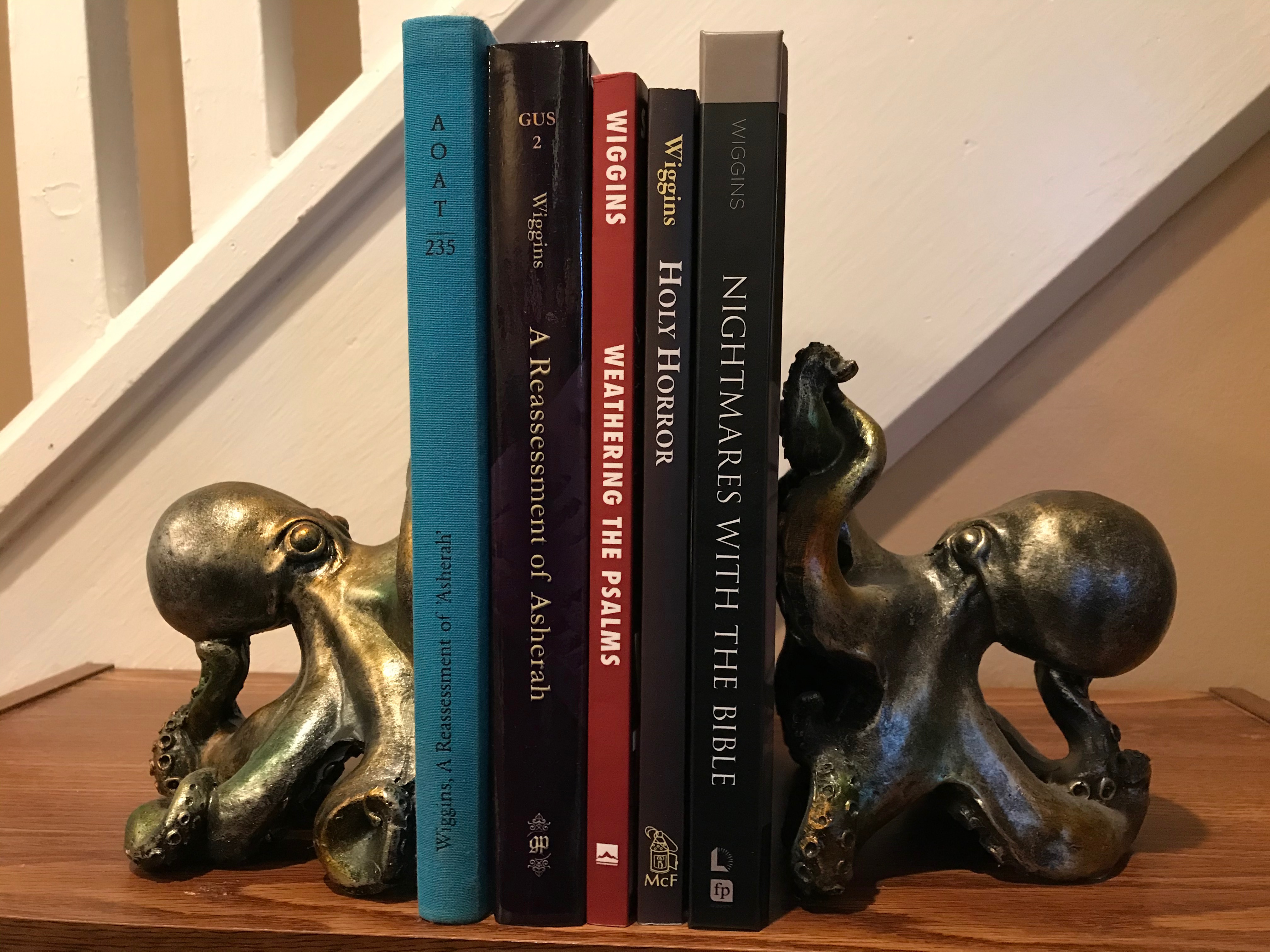
A Reassessment of Asherah was published by a European academic press and put at the incredibly high price of $78 back in 1993.  Gorgias Press reissued it, with additional material, but made it even more expensive.  I can’t even afford to buy a copy.  Weathering the Psalms was only $22, but wasn’t a gripping topic for many.  Cascade Books, at least, know how to price things.  Holy Horror, at the shockingly high $45 for a paperback (McFarland), languished.  It missed its Halloween release and no reviews have appeared.  “Nightmares” might well capture my sense of the price for my second missed Halloween release.  There are other books in the works.  If any of them get completed I’ll be seeking an agent to try to bring the prices down.  Until then, Nightmares will be the final word.  It’s out there now, for those brave enough to engage with it.


Nightmares Awake!

According to Amazon, Nightmares with the Bible has now been published.  Authors are seldom the first to see copies of their own books, strangely enough.  I probably won’t have any physical copies for a couple of weeks yet.  Until then I’ll wait like an expectant mother.  I don’t actually read my own books after they’re published.  Like some other writers I know, I’m terrified of finding mistakes.  And the older I get the less certain I am about anything.  I’m not even sure if it’s officially published yet or not.  I choose to trust Amazon’s opinion on that.

Right now I’m caught up between four or five other book projects, each a good bit along.  Since writing is often a mood-based thing, what I do in the sleepy hours of pre-dawn is what I feel like writing on any given day.  Unless you have a book contract in hand, that’s not, I suppose, that unusual.  I’m trying to guess what might most get the attention of an agent.  Both Holy Horror and Nightmares with the Bible were written for general readers.  I don’t have the name-recognition to command any kind of attention (or affordable prices), so I need to find a topic that’ll do the work for me.  I personally find religion and horror a fascinating subject.  Many other academics do as well, but general readers not so much.  It’ll feel more like reality when I have a copy I can have and hold.  I still haven’t reconciled myself with ebooks.

What usually makes me stick with a project for the dash toward the finish line is a book getting close enough to see the ribbon ahead.  I write incessantly, so I have a backlog from which to draw.  I know my tastes are odd, which means it’s a challenge to get others onboard with my likes.  I know horror fans love to read about movies.  I suspect most of them don’t care much about the religious aspect of what they’re seeing.  That’s why I write about it.  People get information about religion from popular media.  Even if they deny their interest, writers and directors will slip it in regardless.  I’m just calling them like I see them.  The nice thing about movies is you can have instant replay.  And with a fair number of us now publishing books in this niche, hopefully conversation will follow.  Until then, I’ll just be waiting here until my first copy arrives.


Strange Reading

The internet has changed things.  Perhaps forever.  I’m thinking particularly of the way we read.  Not just ebooks, either.  I’m primarily a book reader.  That is to say, I prefer long-format, print writing.  Since we’re fairly isolated (this applied to me even before Covid-19), one of the ways we discuss books is via social media.  There are any number of sites where this takes place such as Book Riot or Goodreads.  I tend toward the latter because that’s what publishers tend to pay attention to.  Each year I participate in a couple of reading challenges.  On Goodreads my goal is a set number of books.  But this has a hidden aspect as well.  What counts as a book?

As a matter of course I don’t count the odd Dr. Seuss book I pick up and read in a matter of minutes.  Nor do I count the many, many books I read as part of my job.  The ideal method of tracking reading on Goodreads is to use the ISBN.  Older books, especially, come in multiple editions, often with differing content.  One way that publishers make money on public domain books is by adding a new introduction or preface to which they own the copyright even though the majority of the text is in the public domain.  The first commandment of capitalism includes the phrase “what the market will bear.”  You can price up until people stop buying.  In order to get value for money, short books are often bound together with other material.  This especially applies to novellas.   Who’s going to pay ten bucks for a book of under 100 pages?

The problem is counting them on Goodreads.  In order for the ISBN to count, you really need to read all the stories in a book.  In steps Amazon.  Making it simple to self-publish, many individuals have rushed in and have saturated the market with public domain material bound and distributed by their own print-on-demand editions.  If I want to read Joseph Conrad’s Heart of Darkness, the older dilemma was you couldn’t buy it alone.  It was almost always bound with some stories I didn’t want to read.  Now, however, some savvy book smith can download an electronic copy, word-process it, format it and sell it to you at a nice markup.  And you can enter the ISBN and get credit for only what you actually did read.  This is a strange new way of reading.  Before I had challenges to complete I’d read a short story or novella and not worry about the rest of the book.  For now, anyway, my reading patterns have changed just to keep up with the challenge.


Dreams and Nightmares

Since posting just a few days back about the cover of Nightmares with the Bible it has now been posted on the Rowman & Littlefield website (more on that in a moment).  I’m pleased with the cover because it includes a photo I took.  It’s a little blurry, but that adds to the effect.  In the days before my commuting began, I could easily stay awake until regular hours and one autumn weekend we arrived home to find the spooky house next door all lit up, under a full moon.  I appreciated the eerie look of the situation and snapped this photo, which I’ve used a few times on this blog.  I’m not sure the house next door was haunted, but it sure looked like it.  More to the point, it reminds me of the poster for The Exorcist.  It has always been a dream of mine to have one of my photos appear on a book cover.

I also received the happy news that the book is with the printers.  That means it will soon be available.  It will be expensive, but I should be receiving a discount code that I will be glad to share.  “Library pricing” is something publishers unfortunately have to do to make books pay themselves off.  In the past several years so many books have been appearing that the bottom has fallen out of the academic library market.  Too much supply, to put it in capitalist terms.  Many publishers, however, will give discounts to individuals who want to buy a copy.  All you have to do is ask the author.  (I don’t have the discount code yet, but I will be glad to share it once I’ve received it.)

Nightmares with the Bible is being published by Fortress Academic.  A few years ago Fortress Press partnered with Lexington Books to handle their library market books, including those in the series Horror and Scripture, in which Nightmares appears.  Lexington Books is an imprint of Rowman & Littlefield.  It’s sometimes difficult to keep track of publishing houses since there has been a lot of consolidation over the centuries, accelerating in recent years.  Publishers don’t sell as many individual books as they used to and with Amazon’s arrival a new shift in the market took place.  It tends to favor trade publishers over academic ones.  In any case, that means even books written for trade readerships, like Nightmares, are priced for libraries.  If you have access to an academic library please recommend they buy a copy.  If the book succeeds in that venue a case can be made for a paperback edition.  In the meantime, the book should be, barring an apocalypse, out on schedule.


War of Egos

As an author you have to believe in your book.  Experience has taught me that if you don’t, nobody will.  Still, there are ways of believing in your book while keeping your ego in check.  Given the ego we’ve seen along Pennsylvania Avenue these last few years it may come as little surprise that even some wannabe authors can nearly match it.  The line, as professionals draw it, is balancing between the importance of your work with the realism that few books sell well.  Your best approach, as author, is humility.  Many people don’t read the professionals.  You quickly learn this if you’re in an editorial role.  It is normal to receive emails from authors telling you how important their work is, some even claiming it as an even on a cosmic scale (I am not joking).

I often consider how much pain authors could spare themselves with just a tiny bit of research.  If a publisher has turned your book down twice already, don’t submit it a third time.  (You already crossed the line the second time you sent it.)  And don’t send your proposal with a list of demands.  What I’ve noted both on this blog and elsewhere is that editors value professionalism.  We don’t like turning down books.  We don’t want to ruin a prospective author’s day.  There are, however, safeguards you can use to prevent the worst kinds of disappointment.  Rule number one is check your ego at the door.  Do you know how many books have been published?  Do you know just how difficult it will be for your book to get noticed?  Take a reality check.

Also, scale your expectations.  How many bestsellers have come from university presses?  If you’re after bestseller status you need to aim for a trade publisher.  This is pretty basic stuff.  Those of us who publish in the academic world do believe our books are important, but many of us also know that they start only small conversations.  Biblical studies isn’t exactly a growth field.  We talk amongst each other, a collegial little group for the most part.  And to keep things on the collegial level it is helpful to remember that we’re not publishing for ego.  We’re publishing to try to move knowledge ahead, even if just by a micron or two.  Good writing, I was once told, is simply clear thinking.  Getting that writing published is part of a conversation and conversation only works if  we are willing to keep our egos on their leashes.


Keep It Covered

I’ve seen it at last.  The cover concept for my book.  I’ve been manicly checking the Rowman and Littlefield (parent company of Lexington/Fortress Academic—a roadmap would be useful) webpage to see what it might look like.  I’ve “seen a sighting” at last.  Nightmares with the Bible seems to be actually happening.  As a writer there’s always some doubt involved with your book.  You wonder, will it really come out?  Will someone pull the plug at the last minute?  Is any of this real at all?  Those kinds of things.  I’ve mentioned before that waiting is a very large part of the process.  Publishing is a slow business and the world changes so fast.  I sincerely hope it doesn’t ever leave books behind.

My waiting hasn’t been idle, of course.  My next nonfiction book is well underway but I’m focusing on fiction at the moment.  I had two short stories published within the last month and I’m inclined to follow where some success shows itself.  Besides, fiction and nonfiction aren’t as far apart as is often claimed.  Seeing the cover of the book, however, nudges me back towards nonfiction a bit.  Since I’m no longer an academic it’s a toss-up.  A few colleagues like what I’m doing, but my fiction work is secret.  So the process continues, waffling back and forth.  It’s all in service of learning how the publishing industry works.  That’s one of the many things they don’t teach you in graduate school.

It’s October and I should be thinking about monsters.  Although I’ve gone through my closet of DVDs, there are many that bear watching again.  If only I could fabricate time!  One of the things I’ve noticed about this pandemic—and I know it’s not just me—is that time seems to have been swallowed up.  A simple walk down the local biking trail now requires masking up before and washing hands after.  Less than a minute of time, for sure, but it adds up.  And if you go after work there’s not enough light left to paint the porch by when you get back.  Such are the contradictions of this wonderful season.  You really can’t pin anything down.  The colorful trees put you into rapture then they’re bare.  The bright blue sky looms under relentless clouds.  You throw off your jacket one day and it snows the next.  And there might just be monsters lurking out there.  One of them, it’s said, will be released in November.  Given the nature of this season we’ll just have to wait and see.


The Hardest Part of Nightmares

In the process of writing a book, there comes the long time between when everything’s submitted and you hear nothing.  In fact, writing a book is often about waiting.  You spend years pounding your thoughts through a keyboard, send them off to some editor (guilty, as charged) who takes months to read and think about it.  If they like it they’ll send you instructions on how to change it and you start banging the keys again.  When it’s finally ready you submit it and wait while it gets transferred to production.  This handover is a complicated process and can itself take a month, easily.  Then the manuscript has to be copyedited.  I’m at the post-copyedited phase of Nightmares with the Bible, and this is, it seems, the longest wait.

There were only a few changes to the proofs I received.  These days your Word files (converted from Pages files for Mac users) get loaded directly into the production software.  What you see is your own words, in a different format.  You type your corrections directly onto the proofs.  Hit submit.  Then wait.  In my head I know that my book is one of many waiting in a queue to be printed.  I’m also a realist so I know the initial printing will likely be about 150 copies.  (When I first started in the publishing world academic books routinely sold 300 copies, but those days are long gone.)  At some point before then I’ll receive an email telling me the cover’s ready.  That’s what I’m waiting for at the moment.

We’re constantly told, in the business, that electronic books are what people want.  I can’t speak for others who write, but when I think of a book I think of a physical object.  Not some electrons sharing a screen promiscuously with any number of other books.  I haven’t published until I hold the printed object in my hands.  That’s still at least a weeks away.  Unless your book is anticipated to be a big seller, this is a period of absolute silence.  You just wait, nervously checking the publisher’s website every other day to see if your page has been updated, all the while working on your next tome.  Although it is priced expensively, I’m hoping Nightmares with the Bible will do reasonably well because of the subject.  Maybe some people will even get curious about Holy Horror, which was the precursor for it.  But for now, I sitting here with Tom Petty, waiting.


BBW

It’s a measure of how busy I am when Banned Book Week has started before I realize it.  Most years I make it a point to read a banned book at this time, but my reading schedule is so crowded that I seem to have missed the opportunity this year—I didn’t see it coming.   I’ve read a great number of the top 100 banned books over the years, and I’m sure I’ll read more.  I’ve recently been reading about America’s troubled history with free expression.  Probably due to a strong dose of Calvinism combined with Catholicism, many of the books challenged and banned, as well as prevented from ever seeing the light of day, have to do with bodily functions.  Sex, especially.  In American society, as freely as this is discussed, we still have a real problem when someone writes about it.

Why might that be so?  Many religions recognize the privacy aspect of sexuality without condemning the phenomenon itself.  The Bible (which is on the list of Banned Books) talks of the subject pretty openly and fairly often.  Our hangups about it must be post-biblical, then.  Much of it, I suspect, goes to Augustine of Hippo.  Although he had a wild youth, Augustine decided that nobody else should be able to do so guilt free, and gave us the doctrine of original sin.  Add to that the legalistic interpretation of Paul and his school, and soon the topic itself becomes difficult to address.  Victorian values, obviously, played into this as well.  Literature, which explores every aspect of being human, is naturally drawn to what is a universal human drive.

Banned Books also treat race—another topic that haunts America—or use coarse language.  Some challenge religious holy grails, such as special creation or Christian superiority.  It seems we fear our children being exposed to ideas.  The wisdom of such banning is suspect.  The publishing industry has many safeguards in place to create age-appropriate literature.  Banning tends only to increase interest by casting the “forbidden” pall over something that is, in all likelihood, not news to our children.  American self-righteousness tends to show itself in many ways, making much of the rest of the world wonder at us.  We seem so advanced, but we fear a great number of rather innocuous books.  The reasons are similar to those behind why we can support tax-cheating, womanizing, narcissists as leaders: our faith blinds us.  I may be late in getting to my banned book this year, so I guess I’ll just have to read two next time.


Large Projects

Now, where was I?  I suspect it’s the same with you.  We’ve got so many things going that it’s difficult to keep up with them all.  When one big project comes along—say reading book proofs for a deadline—everything else gets displaced.  After a week of intense concentration you emerge from a daze and try to remember where you left off with other projects.  What was so dreadfully important before the large project began?  I’m used to deadlines at work, but there aren’t too many in my personal life.  I have goals and targets, to be sure, but due dates slip and slide with the slings and arrows.  When the big project’s done there’s relief, but also a kind of reboot that has to take place.  I’m afraid to look at the news.

The corrected proofs of Nightmares with the Bible have been submitted, along with the index, and now all I can do on that front is wait.  Which of my many other projects, neglected for an entire week, should I take up now?  Part of the difficulty is knowing whether to work on fiction or non.  Given my work-life commitments, fiction is easier.  I enjoy writing it, but I have trouble getting published.  Nonfiction, on the other hand, is simpler to get published but brings in very little remuneration.  I know as an editor that we distinguish between academics (who already have a good paying job) and, say, journalists, who write nonfiction trying to earn a living.  What about an editor who isn’t paid like an academic, but has a regular job nevertheless?  (When talking to an independent, nonfiction publisher a few years back, I heard him respond to the question of if he was non-profit with, “Well, that’s not how I intended it…”)

I have two nonfiction books well along at this point.  I also have several fiction projects, including an eighth novel and a short story collection.  I also have some essays underway for sites beyond my own blog.  A week seems like a long time to put all these things aside and then to pick them up again.  That week wasn’t vacation either.  Nor did it suggest topics for me to address on my blog because if you want to know about Nightmares with the Bible you’ll read the book.  The evening I finished the proofs I had a dream that seemed to stretch through the entire night that I had come up with a complete college curriculum all by myself.  As much as my weary mind wanted to go on to other things it was fixated at that stage.  I awoke to wonder where I’d left off on real life projects, none of which are very near the finish line.  Now, where was I? 


Index Fingers

I’ve occasionally written about how authors obsess over indices, or indexes, for their books.  These days most things are looked up electronically, but this entire week my reading, writing, and relaxing time have been taken up with the index for Nightmares with the Bible.  Creating an index is an odious yet perversely enjoyable task.  Most publishers (at least among the academic crowd) foist this duty onto the author since a freelancer can easily add $4,000 or $5,000 to the book’s budget.  After preparing an index you can understand why.  At least I get to work with searchable PDFs, but I remember doing indexes on paper and having to sort through printed proofs and hoping that you’d catch every instance or a word or phrase.  The searchable PDF helps, but it depends on the material you’ve got to work with.

The Bible, for instance.  Not only are many book names short—Job, John, Mark, James—they are also common.  People have named their kids after biblical characters, or with biblical names, for millennia.  Not only that, but Job can be job.  Unless you put the quotes around it “Eve” will show up on just about every page, believe it or not.  The real strain on the eyes comes from those terms that are important and show up throughout the book.  Words like “Israel,” or “monster,” or “priest.”  I’m not one of those people who writes a book about demons and puts “demons” in the index, though.  Hey, if you know that’s what the book is about, why look in the index?  Just read it!

Meanwhile, the cover copy came this week for my approval.  I haven’t seen the cover proof yet, but last time I actually had time to check (several days ago now) other media outlets had picked up on the imminent arrival of a new book.  It wasn’t on Goodreads the last time I looked, but there’s time for that.  Right now there’s no time for anything, however, other than indexing.  It actually takes longer to do this than it does to read the proofs for the book.  And indexing helped me discover a spelling error that had gone past both me and the copyeditor.  So this is a valuable exercise, but there are many other things to do as the weather turns cooler and other projects are aching for attention.  Four days of intensive indexing and I’m only up to the “p”s.  I’ve been away from it too long, so I’d better mind my “q”s as well.


Proof in the PDF

The proofs of Nightmares with the Bible are sitting right here on this laptop.  If I’ve seemed distracted, now you know why.  My life is unaccountably busy for a mere editor, and I’m afraid my September is being consumed by proofreading and index-making.  I had some fiction I wanted to submit this month, but proofs are a necessary part of writing and for those who take nobody’s word for it, reading them is important.  I have books on my shelves from very reputable publishers literally littered with typos.  I fear that.  I try to read proofs with as much concentration as a busy life will allow.  And yes, proofs come with hard and fast deadlines.  I only wish they’d been here in July.  Or June.  But still, Nightmares are on their way.

Since this was a “Halloween season” book, the goal was to have it out in September or October.  That won’t happen now, but there were a couple of things that transpired along the way: one was a pandemic.  The other was another paper shortage.  Strange as it may seem, both of my last two books came out in a time of paper shortages.  In 2018, the industry had supposed ebooks would wipe out print.  That didn’t happen, and when Michelle Obama’s Becoming took off, well, let’s just say academic books weren’t a priority.  Printing schedules across the industry got bumped and books from small publishers targeted for a specific date just didn’t match the demand.  This year the paper shortage is due to the Covid-19 outbreak.  Paper suppliers shut down for a while and, guess what?  Print came back!

In any case, hoping against hope that we can make the November publication date, I’m trying to read the proofs with record speed (and care).  That means other daily activities may suffer for a little bit.  Those of us who write think of our books as something like our children (not quite literally that high, but not far from it).  We want them to be launched into a world that will be receptive to them.  And so my morning writing (and reading) time has been dedicated to Nightmares with the Bible.  And indexing said book.  I’m not good at many things, but one talent I do have is concentration.  Until these proofs are submitted (hopefully ahead of deadline) there won’t be much else to which I can pay attention.  I’ll continue to post my daily thoughts, of course, and if you can click that “share” button on Amazon’s book page it’d be much appreciated.