Weird Publishing

It’s a weird world.  Publishing, I mean.  In the early days of shock and angst after Nashotah House, when it had become clear that UWOsh—the University of Wisconsin, Oshkosh—wasn’t going to hire me full-time after a full-time year there, I considered that classic fall-back of the academic—publishing.  I wasn’t exactly clear on what an editor did in those days, but I was pretty sure I could learn.  Gorgias Press hired me and after just over two years, downsized.  I’d been in publishing long enough at that point to have learned about Transaction Publishers.  Housed on the Livingston campus of Rutgers University, where I’d been teaching for a few years at this point, Transaction had been founded by the sociologist Irving Horowitz.  Now that Gorgias was out of the picture, I contacted Transaction out of the blue and landed an interview with Horowitz himself.  Although he was most cordial, it didn’t lead to a job offer.

Eventually I was recruited by Routledge.  I was about to learn the nature of publishing in a whole new way.  Early in my time in the Taylor & Francis group (they had a letter signed by Walt Whitman in one of the board rooms) I learned that presses grow by acquiring other presses.  I suggested Transaction, only to be told it was too small of a “concern;” Taylor & Francis preferred larger fish.  When Routledge downsized I found myself again applying to Transaction.  Irving Horowitz had passed away by this point and before I could make an appeal, I was hired by my current employer.  There I have been ever since.

The other day I had cause to look up Transaction.  It was with some surprise that I learned they had been acquired by Taylor & Francis and merged with Routledge.  I’m sure that my suggestion of that acquisition had nothing to do with it, but I pondered what would’ve happened had I been hired by Transaction after Routledge cut me loose.  A few years later I would’ve found myself working for Routledge again.  And likely I would have found history repeating itself.  Publishing is a fairly small industry.  Books are a low-margin commodity (it pains me to type those words, but that’s the way the business world sees them).  Not too many people are interested in a company that has to sell lots of a specialty item in order to make them profitable.  Consumers tend not to buy books in bulk.  My time in publishing has been about connections.  And some of those connections are just plain weird.


Book Signing

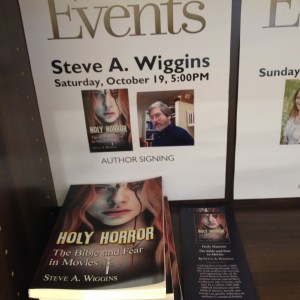
Okay, so I’ve got a book signing for Holy Horror coming up at the Moravian Book Shop in Bethlehem.  And they’ve advertised it in the local paper.  I’m humbled and honored by this, especially since I have no local following.  When I go to the website of the newspaper, The Morning Call, ads pop up on the top, bottom, and center of the page, obscuring the event.  I take this as kind of symbolic.  Life is crowded.  We seem to have turned the corner to autumn around here with nights being distinctly chilly.   After the languorous heat of summer when even thinking about winterizing seemed to add another layer of insulation over already too warm body, now we suddenly have to try to fit it in among an already crowded schedule.  At least I don’t have to commute too much any more.

I’m trying to get ready for the book signing, but I don’t really know what to do.  Perhaps I should try to get some business cards printed up.  Maybe I should think of some catch-phrase to use if anyone actually buys a high-priced book.  What should I wear?  Working at home can make you feel like a recluse sometimes.  I don’t have enough money to be considered eccentric, but I don’t get out among hoi polloi much either.  If most people have as much trouble as I do clicking off the ads to get to the event underneath, those who swing by the table are likely to be few.  Still, I’m looking forward to meeting local horror film fans.  They are, in general, a surprisingly cordial bunch.

After Nightmares with the Bible I’m going to focus on trying to find more mainstream publishers.  The reason is simple: academic publishers tend to be overpriced.  I’ve worked in publishing long enough to be able to decode pricing schemes.  There is a logic to them, even if at times it feels like you’re being overshadowed by pop-up windows.  To get a wide readership you need a pretty big platform, and getting a following on any form of social media takes the one thing I don’t have enough of.  Time.  You see, just the other day it was summer and we felt like we were baking.  Now the equinox has plunged us into the days of getting the furnace cleaned and operational and looking at the prices of insulation and shaking our heads.  Somewhere under all of these pop-ups are ideas waiting to be written down.


Pay Per View

One of the things editors can teach academics is that the latter should pay more attention.  Especially to the world of publishing.  An erstwhile academic, I learned to go about research and publication in the traditional way: come up with an idea that nobody else has noticed or thought of, and write about it.  It is “publishing for the sake of knowledge.”  (Yes, that is Gorgias Press’s slogan, and yes, it is one of my hooks—marketing, anyone?)  The idea behind this is that knowledge is worth knowing for its own sake.  Researchers of all kinds notice details of immense variety and there’s always room for more books.  Or at least there used to be.  The world of publishing on which academics rely, however, is rapidly transforming.  Money changes everything.

The world has too many problems (many of them generated by our own species) to pay too much attention to academics.  Universities, now following “business models” crank out more doctorates than there are jobs for employing said wannabe profs, and those who get jobs pay scant attention to knock-on changes in the publishing world.  Just the other day I was reading about “pay per use” schemes for academic writing that, unsurprisingly, came up with the fact that most academic books and articles lose money.  If someone has to pay to read your research, will they do it?  Especially if that research is on a topic that has no obvious connection with the mess we’re busy making of this world?  Probably not.  Publishing for the sake of knowledge is fast becoming a dusty artifact in the museum of quaint ideas.

For those still in the academic sector that means that research projects now have to be selected with an economic element in mind.  “Would anyone pay for this?” has to be one of the questions asked early on.  The question has to be answered honestly, which requires getting out from beyond the blinders of being part of the privileged class of those who are paid to think original thoughts.  Academia has followed the money.  A capitalistic system makes this inevitable.  How can you do business with an institution that doesn’t play by your accounting rules?  And academic publishers, which have difficulty turning a profit due to low sales volume, are bound to play along.  This situation will change how we seek knowledge.  More’s the pity since some of the things most interesting about the world are those that nobody would think to pay to view.


Gods, Monsters, and Publication

One of life’s great ironies is that those of us not born to wealth have to spend the years we’re young enough to enjoy ourselves stabilizing our situation until suddenly we realize we’re too old to do that kind of thing any more.  I know I’m being overly dramatic, but it often does feel like life operates backwards.  My professional career began where I’d hoped it would end, as a professor.  I taught and published for almost twenty years and really nobody paid much attention.  At least I had my teaching.  I also had a family to support, so I had to accept the shift to publishing when that came along with an offer of a full-time job.  Thus it has been for about a decade now.  Within the last decade colleagues have begun to approach me, asking me to contribute to academic volumes, or to be involved in pursuits that are more associated with professors than editors.  I could do with more irony in my diet.

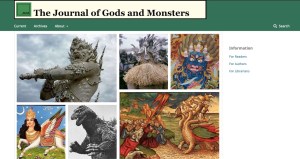
All of this is a long-winded invitation to check out the new Journal of Gods and Monsters.  I probably won’t be writing articles for it; lack of library and research time (both of which I had when invitation-free) assure that my scribbling will be non-technical and hopefully of the more general interest crowd.  Then why am I telling your about this journal, fresh from the box?  I’m on the Executive Advisory Committee and the first Call for Papers has been issued.  Now, this blog really has no way to include attachments that I know of, so if anyone wants in on the ground floor for this journal please contact me (the About page on this website says how).  I contributed to the first number of the first volume of the Journal of Ancient Near Eastern Religions and look where I am now!  You just never know.

In addition to the books on which I’ve been assiduously working, I’ve got a number of commitments to edited volumes and encyclopedias (these invitations waited until I was safely out of academe before rolling in).  The monster crowd is, I assure you, a welcoming one.  As we seem to have turned the corner into autumn a touch early this year, and I see leaves beginning to change before August is out, my mind turns toward the realm of the uncanny.  It may be less academic than ancient religions, but the world of monsters feels much more relevant these days.  If you’re a researcher in these realms I’ll be glad to send you a call for papers.


https://godsandmonsters-ojs-txstate.tdl.org/godsandmonsters/index.php/godsandmonsters


Better Places

I have to confess that I’d never heard of Ottessa Moshfegh before.  Shame on me, I know.  As a wannabe writer, I feel compelled to know other writers’ names.  Hang in literary circles.  Etc.  The good news is, however, that I found Homesick for Another World in an indie bookstore.  I’d gone in for something else that they didn’t have, but I don’t like walking out with nothing, especially when it’s a small store.  Besides, I trust the taste of most independent store owners. 

I can’t remember the last time I read a book of short stories all the way through.  As with most writers some work appeals to you more than others.  In my mind the first and last stories stick the firmest.  The latter, “A Better Place,” is haunting, almost Shirley Jacksonesque.  Others make you uncomfortable in your own skin.  This is a rare talent.

Finding a writer who, using simple words and expressions, takes you to another place is a rare gift.  The short story (the only kind of fiction I’ve actually published) is a versatile and engaging form of literature.  Books collecting them are often good for picking up when you have a little time and putting down for a while again.  I felt compelled to go through this whole work, being drawn into the weird and somehow familiar worlds of characters who seem to have no purpose, no goals.  It’s almost as refreshing as Kafka or Camus.  To be a writer who requires only one name to evoke a genre must be glorious.  These stories are strange without recourse to the supernatural, and they defy easy genre assignment.  (This makes publishers crazy.)

There’s an earnestness and a longing in this collection.  A kind of nihilistic spiritualism.  A wanting with no particular object in mind.  I read a lot of fiction, some of it very good.  The kind that leaves you a little stunned and questioning what reality is.  This is that kind of book.  Had I not gone into that indie shop that Saturday morning I never would have found it.  I certainly didn’t know to look for Ottessa Moshfegh.  Here again I’m reminded of the value of the bookstore experience.  The ability to browse without clicking or scrolling feels like a luxury to me now.  I may have to pay more than Amazon’s competitive pricing, but then this is like a finder’s fee for being in the real world.  Even if the book makes you question that reality when you’re done.


International Standards

I risk being seen as even more of a book nerd by addressing the topic of International Standard Book Numbers, or ISBNs.  For those who’ve purchased a book in the past several decades, you’ve seen ISBNs, but perhaps unwittingly.  They’re represented by a barcode, often on the back cover in the lower left corner, or sometimes the middle.  The ISBN is the edition’s unique identifier, but it isn’t necessarily a guarantee that the contents will be exactly the same since typos corrected for new printings may use the same ISBN already purchased.  Yes, you read right.  Publishers have to purchase ISBNs.  Without them listings on many websites and distributors’ lists would be impossible.  The ISBN is what fulfillers use to order books since neither author nor title is necessarily unique.  Many book titles have been used to the point of dullness.

A typical ISBN

A colleague recently complained to me about being able to request permission to reuse something from a book without an ISBN.  Rights vendors often require them.  The ISBN came into usage, however, only in 1970.  As I’ve learned from trying to load older books into my Goodreads list, there are all kinds of complications and potential confusions if you don’t have the unique identifier for your source.  Titles cannot be copyrighted, and many are consequently overused.  The ISBN is your guide to a specific book.  If the book came before the ISBN system it’s going to take some extra work to ensure that you find the correct way to identify what you’re talking about.  This is only one of the many ways in which the book industry differs from most others.  It’s also the reason that I generally object to corrected printings.

Perhaps it’s odd to see a publishing professional take a hard line on book content.  The fact is almost always an author is given the opportunity to proofread, well proofs.  The copyedited, typeset book is given to them.  Yes, errors may creep in after this stage, but that’s not very common.  If an author didn’t catch mistakes, then a corrected edition ought to be published with a new ISBN.  But that’s not how it works.  Each ISBN should indicate the exact same content.  Although an ISBN must be purchased, just one isn’t expensive (witness all the self-publishing going on these days and that should be obvious).  Publishers that have to buy many thousands of them, however, are disinclined to waste them.  I’m not a fan of all technology, but the ISBN seems like a good concept to me.  Even if it’s not a guarantee that things are what they seem.


The Price of Writing

Academic writing strives to remove personality from your work.  It can be soul-crushing.  I remember well when my daughter—a talented writer—came home in sixth grade with a note from her teacher.  An otherwise ideal student, she was writing her science projects with *gasp* her own voice!  Mr. Hydrogen and how he joins Mr. Oxygen—that sort of thing.  Granted, it would never be published in a scientific journal, but it was a personalized expression that demonstrated an understanding of the concepts.  Having been the recipient of an old school education, I also learned that academic writing should lack personality.  Those who’ve bothered to read my academic papers, however, may have noted that I don’t always obey the rules.  Subtle bits (very small, I’ll allow) crept in amid the erudition.  And now I find myself wishing I’d persisted a bit more.

Pure objectivity, anyone living in a post-modern world knows, is a chimera.  It doesn’t really exist.  We all have points of view, whether they eschew adjectives or not.  I still write fiction, but since my publication history has been “academic” I indulge in it while trying to break through where someone’s voice isn’t a detriment.  I’ve been reading non-fiction by younger women writers and one of the things I’m finally catching onto is that your own voice shouldn’t be the enemy.  It may be so for most publishing houses, but I’m wondering at what cost.  So many ideas, just as valid as any staid publication, never see the light of day beyond some editor’s desk.  That’s not to suggest that anyone can write—I’ve read far too many student papers to believe that—but that those who can ought not be shackled by convention.  If only I could get an agent who believes that!

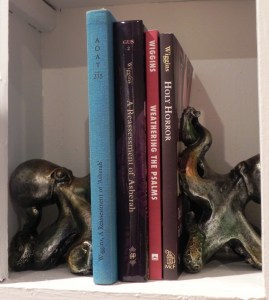
Holy Horror isn’t exactly flying off the press, but it does represent a kind of hybrid.  It’s transitioning to a kind of writing that allows some personality onto the page (yes, I’m old enough to still believe in pages).  A now departed family friend—he’d known my grandfather—was determined to read Weathering the Psalms.  He didn’t make it through.  It was an academic publication.  In the humanities, it seems to me, we need to allow authors to be human.  It’s in our title, after all.  Please don’t take this as professional advice; careers are still broken on the wheel of tradition.  Writing, however, shouldn’t be a caged bird.  But then again, the clock says it’s now time to get to work.


Fearing Errata

Well before I became an editor, I noted mistakes in books.  I go through phases of marking up books as I read them—in pencil only, please!—and not doing so, but I used to mark mistakes when I found them.  At that point I hadn’t realized the complexity of the process of book production and I had no idea of the many ways in which errors might creep in.  I’m a bit more forgiving now.  In any case, errors are a regular part of book publishing.  Older books used to carry pages with incantational-sounding titles like “errata” and “addenda et corrigenda.”  Errors, in other words, were considered inevitable because every time you have another set of eyes look over the manuscript it adds to both the costs and time for the production schedule.  Then I started writing books.

Now, before I get too far I should explain that many book editors don’t line edit submissions.  The standard “editor” is an acquisitions editor, which means you sign up books for your press, but you don’t necessarily (if ever) actually edit them.  I still have the sensibilities of a copyeditor, however.  That’s the main reason I fear to read my own books after they’re published.  I’m afraid I’ll find mistakes.  I do take the proofreading stage seriously, but often a writer has little control over when proofs arrive with a tight turnaround time.  You have to drop everything to get them returned by the deadline.  I’m always worried that errors might’ve crept in.  For example, with Holy Horror, I corrected with website copy for the book.  The errors, however, remain online.  They’re minor, but as the author you’re always considered culpable for such oversights.

Now that I’m working on a presentation to give for Holy Horror, I find myself facing my fears.  I need to go back to a book already published and look inside.  Since writing it I’ve completed another book, Nightmares with the Bible, and my mind can’t help mixing up a little in which book I said what.  To make sure I don’t tell potential readers the wrong information, I need to go back and reread parts of my own work.  What if I find errors?  Will I have to mark up my own copies like I used to do to those of others?  Will I need to compile an errata sheet?  I tend to be a careful reader, especially with proofs.  But facing possible errors is nevertheless a terrifying prospect, even if it’s a regular hazard for those who attempt to write books.


Internet Epistemology

Where do we find reliable information?  I’m asking this question on an internet-based medium, which itself is ironic.  While spending time with some younger people, it’s become clear that the web is their source of truth.  You find purveyors of information that you trust, and you accept their YouTube channels as representing correct data.  This can be a disorienting experience for an old doubter like me.  One of the reasons for studying for a Ph.D., apart from the vain hope of finding a career in higher education, is to hone critical thinking skills.  When I went through the process, that involved reading lots and lots of print material, assessing it, and weighing it against alternative views, also in print format.  You learn who really makes sense and you judge which publishers have good information more frequently.  As you navigate, you do so critically, questioning where they get their information.

Now, I’m not one of those people who think the younger generation is wrong (in fact, there are YouTube educational videos about just that).  The situation does, however, leave me wondering about how to fact-check when you don’t know the publisher.  It may be an older person’s problem, but it’s essentially the same dilemma behind self-publishing—the reason you trust a self-published book depends on the author alone.  Is s/he persuasive?  Did s/he document the sources of her/his information?  Are those sources good ones?  The young people I know seem quite adept at filtering out obviously biased information.  Many YouTube personalities footnote their presentations with links to sources (many of them online), and after an hour of watching I’m left questioning what’s really real at all.

You see, many of these internet personalities have sponsors.  Sponsors bring money, and money biases anyone’s angle toward the truth.  In fact, many of these YouTube sources call out the lobbying groups that influence public opinion for political ends.  Only someone completely naive—no matter their generation—would not acknowledge that government runs on money provided by corporations with interests to be protected.  There have been reliable sources, even from the days of print, that prove beyond any reasonable doubt just how corrupt governments tend to be.  But who has time to fact-check the government when the rest of the information we receive is suspect?  Those of us with training in advanced critical thinking aren’t immune from biased information.  It’s just that there’s so much data on the web that my head’s spinning.  I think I need to go read a book.


Trumping the Bible

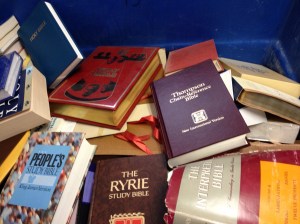
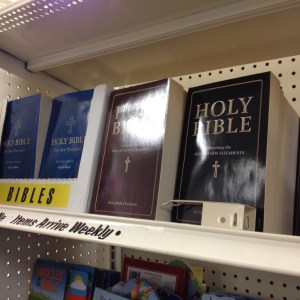
The media is chattering about one of the very many contradictions of evangelicals who support Trump.  Since I have a foot in the world of the Bible business, I read with interest how Trump’s tariffs on China will put Bible publishers in a bind.  You see, the Good Book is generally sent offshore since printing costs (and technologies) are too expensive to replicate in God’s new chosen nation itself.  This lack of divine foresight should be a bit disturbing.  The entire evangelical enterprise is based on their reading of Scripture, and the belief that the divine choice of America is behind such momentous events as 45’s election.  Maybe we should check our pipes for lead.  In any case, Bibles, which are printed cheaply in high volume overseas, are set to become too expensive to give away because of the great pretender’s tariffs.

A few media outlets have picked up this story, including one that noted Trump’s favorite Bible verse is “an eye for an eye, and a tooth for a tooth.”  The famous lex talionis statement was famously, well, trumped by Jesus who said that the ideal was to turn the other cheek.  In a rather Philistine way, evangelicals have sided with a man who says Jesus was wrong.  If you want to check up on me in your Bible you’d better get your wallet out.  Ironically from a Republican point of view, tariffs are themselves the breaking of the commandment of free trade.  Still the party that claims to believe that does nothing to prevent the sale of their souls, cash on the barrelhead.

Many evangelicals may find the idea of Bibles as a business distasteful.  It is, however, extremely profitable for those on the supply end of the deal.  Bibles are printed at a volume that would make most authors green, and due to its size the Good Book requires specialized paper most of the time.  This is so much the case that Bibles not printed on “Bible paper” just don’t feel like sacred writ.  Since costs of living in the United States are quite high, and since this kind of specialized printing would be too expensive in this situation, publishers outsource God’s word.  Some publishers have been pleading with the government to exclude books from Trump’s tariff so the Good News can continue to spread.  The fact is that only one deity, called Mammon in the Bible, runs this enterprise.  And to continue to buy Bibles at the evangelical rate will soon be requiring an act of sacrifice.  I guess the lex talionis still applies.


Best If Used

Used bookstores are like a box of books—you never know what you’ll get.  I perhaps overindulge this particular vice, but it doesn’t feel too sinful to me.  Part of Modern Mrs. Darcy’s reading challenge for the year is three books by one author.  I decided since I’ve been on a Kurt Vonnegut kick that he would be the one.  I figured (mostly wrongly) that his books would be all over the place in used bookstores.  I always found a plentiful supply at the now mourned Boston Book Annex.  At a used shop in Easton I asked where they might put Vonnegut.  “In science fiction,” the owner promptly replied.  I don’t think of Vonnegut as a science fiction author.  Some of his work does fit, but this little exchange got me to thinking about genres again.

Writers, unless they’re strictly commercial, don’t think of genre.  We write.  The novel I’ve been trying to get published for the last decade doesn’t fit into any neat category at all, and that’s probably part of the problem.  Neither fish nor fowl—what is this thing?  I’ve noticed this with my brother-in-law’s books.  Now, I’m holding out on retirement to dig into Neal Stephenson’s books because they require more time than I have in my workaday world, but they aren’t always science fiction.  Still, that’s often where you find him in bookstores.  I was in a local shop in Bethlehem the other day and there he was, in sci fi.  Although I understand why booksellers (and critics) want to use genres, but it seems to me that they limit human creativity.

The past couple of non-fiction books I’ve written aren’t really in genres.  They’re not academic books, but academics (once guilty, always guilty) have a hard time convincing publishers they can do anything else.  Non-fiction may be a more difficult gig than fiction after all.  Holy Horror and Nightmares with the Bible don’t comment on horror necessarily, at least not directly.  They’re not religious books either.  When I try to explain them in one sentence, it quickly becomes run-on.  I began both the same way—I noticed something and began writing about it.  With a little structuring and a little time, you’ve got an entire book.  It may not find a publisher.  It may not fit a genre.  Nobody on Medium is going to come looking for your advice.  And if you’re lucky you’ll find yourself put on a shelf with others who don’t conform to genre expectations either.


See Above

As we slide beneath the hegemony of technology, I’m impressed by the redefinition of vocabulary it demands.  Because new printing technologies assume, for example, that the XML (one of the many mark-up languages) is primary, directional references in texts are inadequate.  An example might help.  If you’re a human being reading a book, and the author has discussed something a few pages ago, s/he might write “see above.”  Now, it’s not literally above in the sense of being higher up on the same page (but it may be considered literally if the book is closed.   And lying face up).  The pages you already read are above those where you left the bookmark.  I remember the first time I encountered this language; having been raised a literalist (and a naive realist) my eye hovered over the header and I wondered about the accuracy of “see above” or “see below.”  The terminology soon became second nature, however, and I knew it wasn’t a literal reference.

In the days of XML (“eXtensible Markup Language,” therefore literally EML), the sense of play is now gone from writing.  I’ve heard editors explain to authors that, in an ebook there is no above or below because there are no pages.  A time-honored metaphor has been sacrificed on the altar of a tech that sees the world in black-and-white.  You can’t point vaguely in the direction from which you’ve just come and say “it’s back there somewhere.”  I sense, given all of this, that most copyeditors haven’t written a non-fiction book (for this is mostly an academic affectation).  As a human being writing, you get into the flow and you don’t think, “Ah, I mentioned that in paragraph 2749; I’d better say it’s there.”  And the reason you need to know the paragraph number is so the ebook can have a hyperlink.  The argument itself suffers for XML precision.

As someone who writes both fiction and non, I am bound to look at this from the viewpoint of a human author.  I’ve been known to paint and make sketches on occasion.  All of these forms of expression have flow in common.  At least when they’re good they do.   If you want to stop a project cold, just say “Hey, I’m writing!” and watch yourself drop like a cartoon character who’s run off a cliff and just realized it.  I’m sorry, I can’t point you to exact where that’s happened.  It’s in many vague recollections of many cartoons I watched as a child.  If the technomasters aren’t watching I’ll just say, “see above.” 


Epistemic Epistemology

I’ve been thinking about thinking, if you’ll pardon my meta.  More to the point, I’ve been thinking about what happens to thinking when it becomes writing.  Thoughts may or may not be safe if they’re left in your head, but once they’re on paper other people start to get concerned.  A diary, of which the weblog is a public variety, is often private.  You may write to remember.  You may write to stab at mortality.  You may do it just for fun.  No matter why you do it, if enough people read it, your writing will be misunderstood.  Ironically, even in a nation with freedom of speech, and the press, the writing rights of individuals aren’t guaranteed.  Take this blog, for example.  Over the decade I’ve kept it, a few jobs—two actual and one potential—have instructed me in what I could or could not write.  Like Niagara Falls, you’re getting only a portion of what flows in my river of thoughts.

Thoughts can change the world.  Considering the news lately that might not be such a bad thing.  In any case, the vast majority of writing remains private.  Even with Amazon and others making self-publishing simple, it’s not easy to get ideas out there.  Getting the attention of a major publisher has odds that are vanishingly small.  And the internet’s a big place, getting bigger by the day.  In cyberspace nobody can hear you scream, I guess.  Even on a smaller scale, my own computer complains that I write too much.  “Not enough space for updates,” it says in its dialogue box dialect, “too many documents.”  Never mind that I purchased it for writing, and a bit of surfing.  It wants more of the latter.  Other’s words, in other words, commodified.

My writing life began young, but not as young as that of many fictional writers like Jo March or Francie Nolan.  Our apartments and eventually small house had no space for one of the kids to hole up and write.  When I did start, in my early teens, I breached the dam without anticipating the results.  I’d been reading a lot, and writing seemed the right way to join the conversation.  I started composing novels before high school, but my first published book (and for many years my only one) was my dissertation.  I always believed that writing could be done on the side for any job, but that’s not the case.  Well, it is if you keep it in your diary, I suppose.  If you open the tap, however, you’d better make sure you have a mighty big glass in hand.


Wag the Book

I was pulling together a bibliography, you know, like one does, when I realized just how outdated the usual formats are.  Particularly the trinity invoked at the end of Chicago/Turabian—city: publisher, date.  Now, to their credit a number of more recent formats have dispensed with the “city” part.  Most presses have multiple offices and even those of us in the biz can’t always tell which one produced the book, which was, in all probability, printed elsewhere anyway.  Why list the city?  In this internet age, no physical copy of the book may have even been in the office.  The real problem, however, is the date.  Scholars want to know when something was published.  Publishers want to prolong the copyright (seventy years after an author’s death apparently isn’t long enough).  They can do this by using the next year as the copyright, as long as a book’s published in the latter half of the year.

Maybe you’ve had this happen too.  You put a book in your bibliography which, at the time, has a date a year later than it is in real-time.  You’re writing the future, apparently.  Or maybe publishers are just optimistic.  The fact is it’s a fiction.  Citations were invented so that you could find where an idea originated.  Dates can be important for a book that’s gone into multiple editions and you want to be sure to look in the correct one.  I had any illusions about permanency shattered when I realized that publishers routinely fix errors in books with no indication that they’ve done so.  It used to be that, if you knew how to read the printer’s key on the copyright page you could even figure out which printing of a book you held.  All of this fun disappears when we go electronic.

This sense of temporariness is problematic.  People ask me “Why don’t you get a Kindle?”  Books are an investment.  Consider iTunes.  How many times have you had to “rebuy” a song because you changed devices?  Or has your battery died right in the middle of something?  Have you tried to sell an MP3 you no longer listen to in a yard sale?  Books are physical objects—more than the words they contain.  They may be dated before they’re published, but they do have staying power.  Besides, citing an electronic source, what with broken links and all, is a tenuous business.  Those who write books want some indication that what they labor over for so long has a real presence in the world.  Even if you can’t say, precisely, when or where it was published.


Price of Learning

Holy Horror, as some are painfully aware, is priced at $45.  Even those of us in publishing have lessons we must learn, and one of them is that writing a trade book involves more than just a “friendly narrator” style and non-technical language.  It also involves a subject the public finds engaging (or at least what a literary agent thinks the public will find engaging).  Holy Horror throws two apparently disparate topics together: horror films and the Bible.  The fans of each don’t hang out in the same bars—the fans of the latter, in some circles, don’t go anywhere near bars!  My thinking was that this juxtaposition was odd enough to qualify as trade, but I also knew that you have to work your way up to that kind of readership.  That’s why I’m on Goodreads, Twitter, and Facebook (followers and friends welcome!).  It’s not like I’ve got tons of spare time, but platforms must be built.

Book publishers face a dilemma: they have to sell books, but as I’ve noted before, they must do so profitably.  There are people like yours truly who’ll occasionally pay essentially a dollar a page (or at least a two-page spread) for a book that’s essential to their work.  As the capitalists grin, it’s “what the market will bear.”  I never thought of myself as a market.  To me, knowledge is priceless.  The effort that it takes to write a book is truly unimaginable to those who haven’t done it.  Obstacles exist almost from the inception.  Getting the resources you need, unless your employment comes with a free library pass, involves sacrifice.  I still look at other books I must read priced at about $45 and groan—how can I justify the expense?  It’s a strange club to which to belong.

My mother asked about Weathering the Psalms: “Is it the kind of book you get money for?”  In theory, yes.  I’ve yet to see any kind of profit from it since the tax forms you need to file for royalties cost more than the actual checks contain.  At least it’s not vanity publishing.  And you truly learn what it means to rob Peter to pay Paul.  It has nothing to do with gentiles.  Publishing is the price you pay for following your curiosity.  My books are very different from each other, a fact that comes with an invisible price tag that has little to do with money exchanging hands.  Well, maybe it does.  And maybe it does have something to do with gentiles.  Or maybe it’s an appeal to a higher power.  In a capitalist nation we all know what that is; herein lies holy horror.