Juneteenth

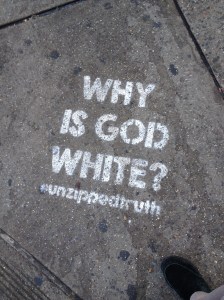
Education is important.  For example, I never really knew what Juneteenth was, although I’d heard the name a few times.  Perhaps because of the “teenth” part I had it in my head that this was something to do with young people.  The amazing thing I’ve been learning over the past several weeks is just how deliberate the “white male” narrative has been in perpetuating the racist mechanism in the employment of capitalism.  Years ago I learned that race is a human construct—it has no basis in science or biology.  It has served various entrepreneurs throughout history, beginning in 1619 and has been perpetuated ever since in order to ring the last possible copper from the coffers.  Now we see what that looks like when a standing president holds these “truths” to be self-evident.

Juneteenth was proclaimed in Texas in 1865.  Even in the extreme and conservative Lone Star State it was recognized over a century ago that all people have the right to be free.  Of course we don’t celebrate it as a national holiday.  Give people too much time off and they might get to thinking.  If, perchance that thinking turns toward the heartless machine of capitalism it might be realized that there are better ways to ensure people are treated fairly, regardless of their skin color.  This year, for the first time I have seen, many organizations—some of them corporations, even—are closing in honor of Juneteenth.  Black lives do matter.  We should be able to see that, but it takes innocent deaths to make the obvious appear.

Yesterday I listened to three Pulitzer Prize winners discussing racial equality.  All three of them had written on the African-American experience.  All three knew the evils of racism.  Research has been done that indicates much of what stands behind white evangelical support of the Republican Party is racism.  Many of the movement’s leaders still buy into myths about race and believe it is something God built into the human soft machine rather than something we made up ourselves.  For political purposes.  We need Juneteenth.  We need reminders that the evil we’ve constructed can be dismantled.  People should not die because of a false human construct.  It wasn’t lack of curiosity that prevented me from learning about Juneteenth when I first heard of it.  No, it was being overwhelmed with the problems Washington was spewing out (and continues to), that I had to divide my energies depleted by the capitalist Moloch.  Now I realize, because by their fruits we shall know them.  Floyd George was murdered on camera and we need to expose the thinking that allowed that crime to happen.


Weather Gods

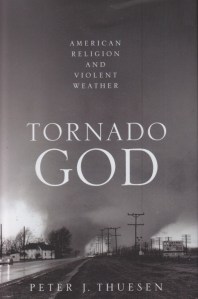
It’s funny how old fascinations have the power to reemerge with the slightest provocation.  I guess writing a book will do that to you.  I just finished Peter J. Thuesen’s Tornado God: American Religion and Violent Weather.  There’s a certain kinship among those of us enamored of this relationship.  Thuesen finds himself in Indiana, and I was in Wisconsin during my research and writing of Weathering the Psalms.  I still haven’t reconciled myself with tornadoes, which were far too likely during my years in the Midwest.  As Thuesen explains, there’s just something about them.  Neither scientist nor theologian can fully explain them and the feeling of awe spans both disciplines.  The book covers a wide range that includes early Protestant settlers and their ideas of providence as well as modern understandings of atmospheric dynamics.  Still, the tornadoes…

Randomness also lies behind both tornadoes and science.  The eerie function of quantum mechanics makes it seem if there’s a kind of willfulness to even particle physics.  Too quick to join in are those among the evangelical camp that want to raise the flag of intelligent design.  Thuesen interrogates their theology as he asks questions about both theodicy and global warming.  Tornadoes are notorious for killing one person and leaving another right next door completely unscathed.  Literally tearing families apart.  Some of those we meet in these pages have turned to black-and-white religion for answers.  Others tend to see things more in shades of gray.  Does God send storms or merely allow them?  Are victims singled out or simply unfortunate to be in the wrong place at the right time?  America’s armchair theologians have their ready answers, but the weather remains unpredictable.

Readers will find interesting connections throughout.  The celestial orientation of religion is pretty obvious as well.  Even though modern believers don’t accept a heaven directly overhead, the orientation is still there.  Their maddening obtuseness when it comes to global warming is more than just a little naive.  Either that or they’re secretly gunning for armageddon.  Whichever it is, Thuesen treats all comers with respect.  Storms are awe-inspiring events.  I recall standing on the edge of a farm field in Illinois and staring up at a lightning display in clouds towering thousands of feet above me.  Looking out the south window one night as a cloud continuously lit by lightning made its slow way from west to east just south of where I stood.  It was a religious experience.  How could it not be?  If any of this resonates with you, this is a book you ought to read.


Biblical Museum

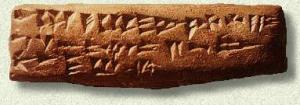
The Museum of the Bible has never successfully steered itself away from controversy.  Just a couple weeks back a story on NPR reported that federal authorities have determined that one of the MOB’s tablets of the Epic of Gilgamesh is a stolen artifact and it must go back to Iraq.  While I don’t question the decision, I was a bit surprised that the Feds knew or cared anything about cuneiform documents.  My academic specialization was Ugaritic, which is a language that was written in cuneiform.  I quickly learned after my doctorate that no jobs exist for Ugaritologists, so you have to style yourself as a biblical scholar.  The Museum of the Bible seems quite aware of the connection, but don’t go there looking for tablets.  They belong elsewhere.

There is a public fascination with cuneiform, it seems.  That doesn’t translate into jobs for those who know how to read wedge-writing since universities have become places of business.  Their product—what they sell—is called “education” but in reality it is accreditation.  Anyone who’s really driven can get a fairly decent bit of knowledge from the internet, if it’s used wisely.  The most reputable sources are behind pay walls of course.  What kind of civilization would give away knowledge for free?  Anything can be commodified, even the knack for reading dead languages.  One of the perks you pick up by studying this stuff officially is that artifacts really belong where they were found.  Unprovenanced pieces are now routinely ignored by specialists because they’re so easily faked.  That doesn’t stop those who can afford to from buying them.  Right, Mr. Green?  You’ve got to beware of the seller, though.

A few years back many of us watched with horror as extremists destroyed ancient artifacts kept in Syria’s museums.  These were objects we’d spent years of our lives studying, and which cannot be replaced.  They were “at home” where they belonged, but where some, at least, clearly didn’t appreciate them.  Those of us who’ve studied ancient history recognized such behavior, I’m afraid.  We’d read about it in documents as ancient as the artifacts being sledgehammered right there on the internet.  Or you can buy such documents illegally sold and put them in a museum dedicated to a book that says somewhere that “thou shalt not bear false witness.”  Such are the ironies of history.  But then, as its provenance shows, that sentiment is apparently a museum piece as well.

Photo credit: Chaos, via Wikimedia Commons


Weathering Frights

It reminded me of a nightmare.  The box, containing a book, was soaked through.  A sudden thunderstorm had come before we knew the box was even there on the porch and memories of several boxes of rain-ruined books came back uninvited.  Water and books just don’t mix.  This particular book, I knew, was Peter Thuesen’s Tornado God, which I had ordered back in December and which has just been released.  The irony wasn’t lost on me.  My own second book, Weathering the Psalms, was a rather inelegant treatment on a similar topic and I’ll discuss Thuesen’s book in further detail here once I’ve read it.  The point is that no matter how arrogant we become as a species the weather just remains beyond our control.  The rainbow at the end of this small storm was that although the packaging was soaked, I found the box before the book itself had time to get wet.

My research, ever since my first book, has largely been about making connections.  The weather is so quotidian, so common, that we discuss it without trepidation in casual conversation.  It is, however, one of the most dangerous things on our planet.  Severe storms kill both directly and indirectly.  Cyclones, typhoons, and hurricanes can do so on a massive scale.  So can their dramatic opposite, drought.  Snow and melting ice caps also threaten life, as do floating chunks of ice in chilly oceans.  It’s no wonder that the weather has been associated with gods from the earliest times.  Even today literalists will say God is in the sky although meteorologists and astronomers can find no pearly gates when they look up.  We just can’t shake the idea that weather is some kind of reflection of divine moodiness.

As weather becomes more and more extreme—it’s already a system that we’ve tipped seriously off balance—I suspect more and more people will start to assign it some kind of divine agency.  This June we’ve already gone from shivering mornings with frost on the roof to nights when sleep is impossible because it’s so warm and humid, all within a matter of a couple of days.  And this isn’t that unusual.  Wait’l the gods really get angry.  Weather is closely related to the water cycle, of course.  We can learn about such things from books.  We can’t take them out during a storm, however, and homeownership is all about keeping water out, or only in prescribed locations indoors.  When the delivery driver leaves a box on your porch, however, it remains within reach of the storm gods.


Wandering

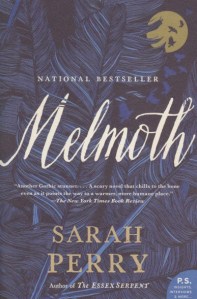
Sarah Perry seems to be a writer who refuses to be pinned down.  Some of us are careful in our fiction to make sure things progress logically, almost factually.  With Perry you’re never quite sure.  Was there a sea monster in The Essex Serpent?  I’m not sure how this played into my decision to read Melmoth.  I knew the title had to have drawn its inspiration from the gothic classic Melmoth the Wanderer, a book I’ve never read.  (The internet has, in some ways, taken the sport out of wandering used book stores, where the possibility of finding such things was once a part of their charm.)  In any case, I saw Melmoth on the front table of Buffalo Street Books in Ithaca, and you learn which bookstore front tables to trust.  It was back when bookstores were open and autumn was in the air.

The concept of the wandering Jew (which I address in Holy Horror) is one that has the power to offend.  By emphasizing the atrocity of the Holocaust, Perry parries that here while maintaining the concept.  The wandering Jew committed some ancient crime and is sentenced to roam the earth until, well, usually the end times.  Perry makes Melmoth one of the women at the empty tomb of Jesus who, when asked to confirm the truth of the event, denies what she saw.  Condemned to walk the world on bleeding feet, she finds sinners and invites them to join her.  Not only finds, but watches—she is the one who sees all your transgressions—and insists that you come to her.

Melmoth is, like the original story, a set of nesting dolls.  The frame story contains other documents that shed more and more light on this dark wanderer.  Characters must own up to their shortcomings.  Indeed, confession is a large part of the story.  Although set in modern times, the book is quite biblical, both in sensibility and in some of the plot elements.  It even has several quoted snippets from the Good Book.  This caught my attention partially because a recent article I wrote (there will be notice here when it appears) suggests that the horror genre goes back to the Bible itself.  Those uncomfortable with the darkness may not realize just how much the two have in common.  Not all the strings are tied up neatly by the end, but this novel will perhaps inspire the reader to do a bit of wandering their own. 


George Floyd

Perhaps for the first time in four years, 45 is beginning to see people are unhappy.  Very unhappy.  The pontiff—excuse me—president wanted a photo-op with the Good Book at a nearby Episcopal Church and had crowds of protesters tear-gassed so the he could make himself look righteous.  My wife pointed out that this was an example of the Bible as a Ding, and she was right.  (If you don’t get the reference, it’s explained in Holy Horror.)  Moreover, it is a clear abuse of power.  Not only have thousands of Americans been needlessly dying from COVID-19, the violence against African Americans is caught time and again on police body-cams.  People are rightfully protesting and the racist-in-chief doesn’t like it.

It doesn’t work unless you open it.

With echoes of Tiananmen Square he’s now threatening to send the military against protestors.  It’s far easier to strike out at people while holding a Bible in your hand than it is to learn empathy.  We’ve been isolating and masking ourselves for over two months now and not one word of sympathy has come from the White House incumbent.  Instead of trying to calm racial unrest, he tweets to conquer, not realizing that divide and conquer is meant to be used against enemies of your nation, not your own people.  Never had we had a president who has so openly played favorites and made not even a pretense of being a leader for the entire country.  He is a figurehead of his base only, which is, it seems to me, a violation of the oath he swore on that selfsame Bible not even four years ago.

Pandering to such a Ding is an abuse of Holy Writ.  After unrest over George Floyd’s murder had entered its third night the response from 1600 Pennsylvania Avenue was silence.  How far is it from here to Tiananmen Square?  Is it not possible to admit error and realize that the economy is going like the Titanic’s maiden voyage and just about everyone knows someone who’s died because of the virus or who’s been racially profiled by one of the “good people on both sides”?  No, grab the Bible and clear the rabble who won’t shout “Hosannah” when he rides his ass outside a church whose door he’s seldom darkened to show his base he really is a Bible-reading man.  Was this some bizarre parody of Jesus clearing the temple or just a mockery of the man who said “By their fruits you will know them”?  There’s only one answer to that.  How different the world would be if Bible-believers actually read the book they love to thump.  


Eternal Returns

Nightmares with the Bible has been submitted.  Those of you who read this blog regularly know that it is my fourth book and that it is a kind of sequel to Holy Horror.  Nightmares looks specifically at demons.  I was inspired—if that’s the right word to use for it—to write the book because the chapter on possession movies in Holy Horror was clearly overflowing.  Not only that, but at the time I started writing the book not many resources were out there on demons.  Almost nothing, certainly, that asked the big question of what they are.  To answer that we need to go to the movies.  People get their information from popular culture, especially when it comes to trying to understand the arcane and even esoteric field of theology.

Movies, studies have shown, often participate in the reality our brains conjure.  Back when Reagan was president—is it even possible to believe those seem like halcyon days compared to these?—he was caught occasionally citing events from movies as historical realities.  We all do it from time to time, but then, most of us, if pressed, can tease movies apart from facts.  Church attendance has been going down for some time (and on Zoom you can tune in and tune out without having to “stay in the room”), and so people have to get their information on demons somewhere else.  Reality television and the internet also play into this as well, of course, but Nightmares sticks with movies because I’ve only got so much time.  The message is pretty straightforward though, we must consider where people get their information.

After you submit a large project, if you’re anything like me, you’re mentally exhausted for a while.  I’ve been working on this book for nearly five years—I started it before Holy Horror was submitted to McFarland.  I had already begun work on my next book, but I yet have to decide which one it will be.  I have several going at any one time.  Hopefully this next one won’t be coming out with an academic publisher.  I’d like it to be priced in the realm where individual buyers might consider it worth the investment.  I know from experience that even books just over twenty dollars are a stretch for most people, especially if they’re on academic topics.  Nightmares will come back, I know.  There will be proofs and indexing and all kinds of further work to be done.  I’m hoping that by that point I will have the next book nearly done.  If only I could decide which one it will be.


Still Evolving

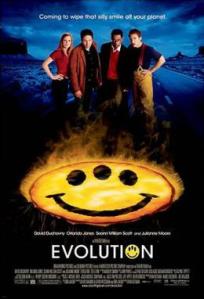
Evolution, the 2001 movie, I mean, is good escapism.  Thinking back on 2001, instead of a space oddessy, another piece of news—another national crisis, in fact, dominated.  The film kind of slumbered in the background until we could sort out what it meant to live in, ironically, an unsafe world.  That’s precisely what the movie was about.  I wasn’t thinking that when I recently pulled it off the shelf.  I was simply wanting some fantasy to relieve the daily pressure of living in stress mode.  Besides, it has some of the best alien monsters you could hope for in a comedic setting.  Soon, however, the parallels began to appear.  A source of contamination from outside.  A growing threat.  A government that doesn’t know what to do and that can’t admit its mistakes.  It all seemed eerily familiar.  Dr. Allison Reed is even from the CDC.

Life isn’t constant crisis.  Funnily enough, when Democrats are in office there seem to be far fewer of these large-scale troubles.  “There will be signs,” I guess, “in the sun, moon, and stars.”  The thing about signs is that we’ve left the reading of them up to Fundamentalists.  And Fundamentalists don’t believe in evolution.  Or science.  Or modernity.  Idealizing medieval thinking does come with a price tag.  So I reach for the remote.  While the government has lots of money that it spends on its own volition, the crisis grows.  The alien menace is set to spread across the country.  Although beginning in a different geographical location, all that red on the map sure looked familiar to me.  How little has changed in the last two decades.  Evolution came out before smartphones even evolved.

Meanwhile, practically unnoticed, the U.S. Navy has been saying UFOs are real.  The story, muted and subdued—we’ve got more immediate concerns, such as getting reelected—has been on major reputable media.  When they land on the White House lawn we’ll ask the aliens if they have respirators and masks aboard.  Preferably the kind with face-shields.  In the movie the monsters are aliens.  They’re like an infection, and even hazmat suits can’t keep you safe.  The solution, of course, isn’t fire-power, but a good shampooing.  Now I know you still can’t go to the salon in lots of places, but washing up at home seems to be pretty good advice.  We put the movie on for simple escapism, but there’s no escaping the fact that we now live in an alien environment.


Tent Pegs

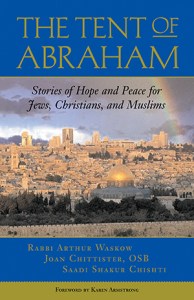
Among the many things that have happened during the pandemic to fill my time, I was invited to join a virtual book discussion group.  While the idea of reading groups has always appealed to me, there’s always the matter of who gets to choose the book.  I’m well aware from both what I post here on this blog and from my Goodreads account, that my reading tastes are eccentric.  I’m also very aware of how little time life really encompasses and I try to make it count.  Work takes up much of it, and beyond that biological necessities such as sleep, and household chores also weigh in.  All of which is to say I didn’t choose The Tent of Abraham to read.  It chose me.

The subtitle—Stories of Hope and Peace for Jews, Christians, and Muslims—pretty much describes what the book is.  Authored and edited by Joan Chittister, Murshid Saadi Shakur Chishti, and Arthur Waskow, the book focuses on the story of Abraham that ties the three monotheistic traditions together.  It is an exercise in creative exegesis, and sometimes eisegesis.  Given the point of the book, eisegesis is okay here, perhaps even necessary.  The reason for much war and hatred is the credulous, literal belief in our founding myths.  Abraham isn’t an historically attested character.  The stories told about him in ancient religious texts differ.  And although he doesn’t always come across sympathetically, he is always seen as a friend of God.  We’re not ever given a satisfying reason for that friendship, it just is.  Abraham is kind of a scary guy, as some of these stories make clear.  He’s not above abandoning his lover and child in the wilderness.  Nor attempting to murder his only remaining son.  Or passing his wife off as his sister to save his own skin.

Interspersed with these tales of imagination and horror, are scriptural versions (and by scriptural I mean biblical and those from the Quran and Hadiths), as well as real life stories of death in the Middle East conflict.  These are difficult stories to read.  Much of the violence between faiths comes down to conflicting claims of ownership.  As the book makes clear, if people resolve to celebrate difference rather than to distrust the other we can all live together in peace.  The only thing lacking to make this happen is the will.  Unfortunately, the conflict draws its energy from religious beliefs, or, more precisely, politics using religion to get its ends.  And for that one doesn’t have to travel all the way to the Middle East.


Divided by Eight

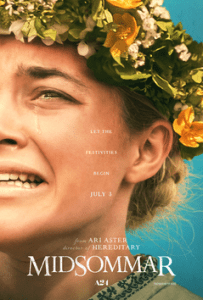
Analogies are useful, but never precise.  When Midsommar came out last year, people were saying “It’s like Wicker Man.”  It’s a good analogy, but not precise.  The plots have quite a bit in common and both are part of the genre that we might call intellectual horror.  Midsommar is a slow burn where you know from the beginning that something’s not right, and you can’t quite figure out what.  I’ll try not to give away too much, in case, like me, you’re late in seeing it.  It involves a group in Sweden, the Hårga, who celebrate a Midsummer ritual every 90 years.  A group of five graduate students—and the writers of the movie actually do know what grad school is like—go to study the ritual.  In central Sweden, far enough north that it’s never really night, they discover a pleasant group of white-garbed believers who use a combination of drugs, sleep deprivation, and folk magic to get the pawns into place.

What fascinates here is just how a fictional religion, with some basis in reality, becomes the vehicle for horror.  The deaths of three of the students are all in the service of a belief system that involves runes, fertility rites, scriptures, and ritual suicide.  It’s self-aware enough that one of the students compares it to Waco early on.  If there were no exotic religion here, there would be no horror.  Tragedy, yes, but horror, no.  The entire energy of the genre draws from four of the students (the fifth is from the community in Sweden) not knowing what is going on.  The village of the Hårga is isolated, and there is no law to keep them within the bounds of secular behavior.  By the end of the film you feel that secular is much safer than religious.

Midsommar foreshadows much of the horror in the illustrations that the community readily supplies.  Paintings show what is coming although the viewers, like the students, don’t know what they’re seeing at the time.  Some of the horror is based on shock, but the director doesn’t stoop to startle scares.  Well, maybe once.  This is horror that you can see coming and you’re fully aware that it’s because the white-robed ones truly believe.  The ending is similar to Wicker Man and the message is much the same.  Religion, when taken too seriously, leads to the sacrifice of those deemed outsiders.  And you don’t have to go to Sweden to find it.


Cross Quarters

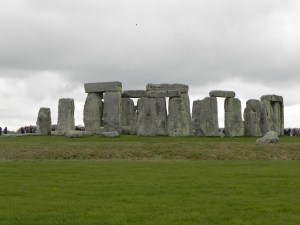
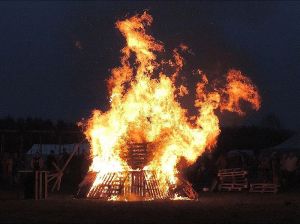
Happy Beltane!  We could use a holiday right about now.  For those of us who are under the spell of intelligent horror, May Day brings The Wicker Man to mind.  Not the remake, please!  I first saw it about a decade ago—my career history has made watching horror an obvious coping mechanism—and I was struck by the comments that the film was a cautionary tale.  One of the problems with being raised as a Fundamentalist is that you tend to take things literally and I supposed that the cautionary tale was against Celtic paganism.  The Wicker Man is about the celebration of Beltane on a remote Hebridean island, and it was only as I watched it a few more times and reflected on it that I came to realize the caution was about those who took their religion too seriously, pagan or not.

Photo credit: Stub Mandrel, via Wikimedia Commons

Lord Summerisle, after all, admits that his religion was more or less an invention of his grandfather.  More of a revival than an invention, actually.  In other words, he knows where the religion came from, and he has a scientific understanding of the soil and how and why crops fail.  That doesn’t prevent him from presiding over May Day celebrations to bring fertility back to the land.  The people, as often is the case with religions, simply follow the leader.  Of course, Beltane is a cross-quarter day welcoming spring.  It is celebrated in Celtic countries with bon fires and obviously those fires are to encourage the returning of the sun after a long winter.  The days are lengthening now.  I can go jogging before work.  The light is returning.

Capitalism, which is showing its weak side now, doesn’t approve of too many holidays.  Like Scrooge they think days off with pay are picking the pockets of the rich.  The government stimulus packages show just how deeply that is believed in this country.  Celts we are not.  So as I watch the wheel of the year slowly turning, and see politicians aching to remove restrictions so that money can flow along with the virus, I think that cautionary tales are not misplaced.  The love of money can be a religion just as surely as the devotion to a fictional deity.  Herein is the beauty of The Wicker Man.  Beltane is upon us.  As we broadcast our May Day it could be wise to think of the lessons we might learn, if only we’d consider classic cautionary tales.


WHO Believes?

These days it’s pretty clear that if you want to listen to anyone for advice it shouldn’t be the government.  I suppose that’s why I spend so much time on the World Health Organization’s page.  I’m no medical person and I certainly don’t understand epidemiology.  Contagion I get, because religion operates that way.  So WHO has been making somewhat frequent references to faith.  A recent status report noted that 84% of the world’s population reckons itself as religious and that many coronavirus outbreaks have taken place because of continued religious gatherings.  To that I suspect they’ll need to add political rallies supporting governments you shouldn’t trust, but what is such blind faith in leaders who don’t know what they’re doing if not religion?  People want to believe.

Religious gatherings also provide crucial support.  The community with which I associate has been using Zoom gatherings since mid-March.  It’s not perfect, of course, but during our virtual coffee hour I’ve been put in breakout rooms with people I don’t know.  I’m starting to get to know people I might be too shy to speak with in “real life.”  More than that, I’m asking myself what real life really is.  Technology has been pushing us in this direction for some time.  We relate virtually rather than physically.  I’ve never met many of the people with whom I have some of my most significant exchanges.  The internet, in other words, has an ecclesiastical element to it.  The words “church” and “synagogue” both go back to roots meaning “to gather.”  Faith, despite the stylites, is not lived alone.

WHO suggests that since religious leaders influence millions of people, if they would turn their message to prevention it could have a tremendous human benefit.  Consider how one man’s personal crusade in the mid-nineteenth century led to elections being decided on the basis of abortion alone.  If faith leaders were to take the good of humankind to heart and spread that message, it could well outstrip the virus.  Alas, but politics interferes.  Many religions also want to determine how people live.  There’s power in that.  We’ve seen it time and again with televangelists.  WHO has faith that these leaders might set aside their scriptures for a moment and read situation reports based in science and rationality.  WHO apparently has faith as well.  Until someone smarter than politicians sorts all of this out we’re probably safest meeting virtually.  Who knows—perhaps there are hidden benefits to that as well?


Bats and Bloodsuckers

In what looks (somewhat cynically) like at attempt to add newness to frightfully old news, the World Health Organization has renamed COVID-19 to the much scarier SARS-CoV-2.  The basics remain the same: the virus is transmitted the same way.  If it lands on a non-organic surface it soon dies without a host, rather like the elected officials of an old party once grand.  Like any parasite, it requires the life of another to prosper.  And so we find Mitch McConnell telling states to declare bankruptcy in a move taken from the Bible’s own playbook.  You see, during a famine in Egypt Pharaoh bailed out the food banks, and by buying all the land made peasants in essence slaves of the state.  The Good Book has all the answers.  A few generations later, however, and Pharaoh had to learn how to swim in the desert.  The divine economy is not without humor.

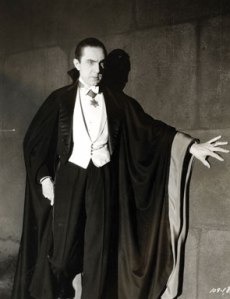
The WHO report also states that the vector has been traced to bats.  Bats make me think of vampires—I can’t help it, I’m a late monster boomer.  While WHO doesn’t make any connections with vampire bats, I researched them when I was younger.  Unlike elected members of the gOP, vampire bats aren’t selfish.  Nor are they greedy.  Finding a victim, the make a small incision with their sharp little teeth and lap up enough blood to survive.  If another bat goes a night or two without success, vampire bats will share their success, realizing in a way that politicians don’t, that helping one another is an assured way of establishing communal strength.  Or you could just be capitalist about it, let the unsuccessful starve, and go seeking another victim of your own.  Bloated bats don’t fly well.

If the Old Party learns from nature we’ll all benefit.  Greed is hardly the basis for sound government.  Nature would suggest that ingesting disinfectant isn’t the best advice to dole out to a nation about which you truly care.  The Old Party refuses to do anything, of course.  Having proven themselves unable to govern, they’re busy pulling together campaigns for November’s election.  With a leader who’s already said on national television that Republicans can’t win without gaming the election process itself, they don’t even blush.  I’m no expert, but it may be because they don’t have enough blood to rise to their cheeks.  If they’re short on blood it might be worth their while to learn a thing or two from vampire bats.


Moralizing Gods

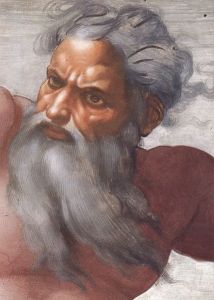
In my more radical moods I sing along with John Cougar about fighting authority.  Living in society means never being completely free.  This pandemic only amplifies that.  What I want may not be best for others.  Not to mention excessively corrupt authority *ahem* Washington DC [coughs into elbow].  Still, a friend sent me an article titled “Did judgmental gods help societies grow?  The piece by Lizzie Wade appeared in Science recently.  The article begins by noting that judgmental gods are rare.  It then suggests complex societies seem to have had judgmental gods at their beginnings.  Moralizing gods demand cooperation.  People want to do what they want.  If we’re going to reap the benefits of a highly specialized society we all need to play our part, however.  Authority always does win, I guess.

Wade’s article suggests that this kind of orthodoxy is now being called into question.  Moralizing gods, it’s suggested, appear after a complex society gets started.  Interestingly, these gods tend to be males.  (That point’s mine, not Wade’s.)  I have been wondering for quite some time just how the data from Göbekli Tepe will influence the re-construction of models concerning how civilization began.  It seems that long before settled populations emerged, back in hunter-gatherer days, people still came together to build temples.  Were they afraid of judgmental gods?  Certainly they thought it was important to gather occasionally at numinous places and ponder the larger questions.  Since they left no written records and they’ve all died out the best we can do is make educated guesses.  Who knows what might’ve been their motivation?

The one thing that seems certain to me, no matter how we nuance it, is that religion is integral to society.  Science is necessary for our survival (ancient people weren’t backward rubes, by the way—they had a kind of scientific outlook, but without all the advanced math).  Religion, however, seems originally to have brought us together.  Outside our comfort zones.  Hunter-gatherer societies limit their sizes to people you can know reasonably well.  They tend not to have private property and they share things most people in “civilized” settings wouldn’t.  To grow larger than a roving band that can sustain itself by moving from place to place once the food’s gone, agriculture was necessary.  But Göbekli Tepe suggests it only followed after religion began bringing people together in the first place.  Were their gods authoritarian?  There’s really no way of knowing that.  So when I’m feeling radical I have to remember than when it’s over I turn the volume down, comb my hair and go back into society.  Well, once the pandemic’s over.


Who’s To Blame?

Back at Nashotah House Episcopal Seminary, we were a closed community.  Well, not completely closed, as much as some may have desired it.  When a communicable illness came to campus it quickly spread.  No wonder—we were required to all gather twice daily in the chapel, and there was the passing of the peace during mass.  And the sharing of a common chalice.  The germs of the Lord were readily spread.  One of the faculty members would refer to the vector of the illness as “Typhoid Mary,” a rather sexist remark in the mostly male environment.  Still, Mary Mallon came to mind as the current crises has settled in.  “Typhoid Mary” was an asymptomatic carrier of typhoid fever.  A working-class girl from Ireland, outbreaks of typhoid followed her in the various houses in New York City where she worked.

Photo credit: National Institute of Allergy and Infectious Diseases (NIAID), National Institutes of Health (NIH), via Wikimedia Commons

The current coronavirus outbreak in New York City seems strangely similar in some regards.  Although COVID-19 is less likely passed by asymptomatic carriers, according to what I’ve read from the World Health Organization, it is still a possible vector.  While out getting necessary supplies in the area I recently noticed store employees without gloves or masks, both of which I had on.  One of us was underdressed.  I went home, washed my hands thoroughly, and pulled my copy of The Andromeda Strain from the bookshelf.  Self-medication can come in several forms.  Some people still look at me funny for wearing a mask, but many other customers are now doing the same.  The Center for Disease Control recommends it.

Before I’d ever heard of Nashotah House, I worked in a grocery store.  I was a college graduate with facial hair that had to be removed.  “Customers don’t trust a man with a beard,” I was told.  Back then if you walked into a store with a mask on there would’ve been trouble.  Contagion can drive you crazy.  Nobody wants to be a “Typhoid Mary,” and yet it’s difficult to be out in public with a mask on.  “Who was that masked man?” they used to ask of the Lone Ranger.  From the theater and psychology I’ve studied, I know that hiding behind a mask can be a liberating experience.  Aware that nobody knows who you are, you are free to act most any way you please.  But this is different.  Maybe it’s because my mask is made of a paisley-ish bandana,  the kind old westerns show outlaws wearing.  Or maybe it’s because of the guilt a religious upbringing so generously left with me.  After all these years the old cliches are coming back to life.