Learning To Fly

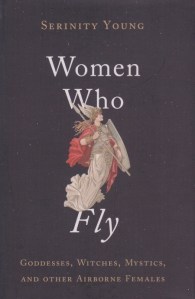
It’s perhaps the most deeply rooted human dream.  Flying.  Women Who Fly, by Serinity Young, is a fascinating book.  Subtitled Goddesses, Witches, Mystics, and Other Airborne Females, the book covers all of these and more.  The dream of flying is played out in many ways here, but often the narrative comes back to how patriarchy imprisons women.  Is it any wonder they want to fly?  Very wide in historical scope, the book can’t cover all cases in equal depth.  It nevertheless demonstrates how pervasive the idea is.  Beginning with ancient female figurines bearing bird-like features, Young moves through the related concepts of captivity, transcendence, sexuality, and immortality, showing how female characters are related to these idea in universal and unrelenting ways in the form of flying females.

There are many lenses through which to view patriarchy.  It can be explained as a consequence of settled agricultural existence with its subsequent division of labor.  Such a scenario raises questions of whether women dreamed of flight before that, and I believe the answer must be yes.  For as long as we’ve observed birds and associated the sky with gods we have longed for flight.  Although birds make it look easy, it is an incredibly difficult and costly adaptation.  Still, women dream of travel without obstacles (let the reader understand) to the realms where deities dwell.  It is difficult to summarize a book that covers so much historical territory.  Young doesn’t limit herself to western religions but also spends a fair bit of time among Buddhist, Hindu, and Daoist ideas of flying women.  She covers mythical, folkloristic, human, and historical flying females all the way up to modern astronauts.

As I was coming to the close of the book the real message hit me—I can be thick at times, although much of my own writing is metaphorical—men have actively tried to clip women’s wings for a long time.  Often under the auspices of religion.  Think of it: for centuries of existence the major monotheistic traditions have refused female leadership.  The one (inevitably male) god has set up a boys’ club of sacerdotal leadership.  As Young points out, even the named angels in the Bible are male.  I used to comfort myself with the explanation that male leaders were simply too self-centered to consider others, but it is becoming clearer, the more I read, that men have always had a tendency to try to keep women down.  And thus they fly.  There’s much in this book for both women and men to ponder.


Holiday Complex

Now that we’re in the midst of a complex of Judeo-Christian holidays (Passover, Maundy Thursday, Good Friday, Easter, as well as other spring rites), I’ve been thinking of obligations.  I’ve had people introduce themselves to me as “Chri-easters.”  This isn’t a new form of religion, but rather a way of indicating that they attend services on Christmas and Easter only.  For others of us it’s never been so easy.  I was raised with the stern belief that Sundays in church were a matter of absolute obligation.  Serious illness was the only reason to miss.  If you were traveling (which was rare for us, being not terribly affluent), you found a local church to attend.  Never mind that you’ll look like strangers and won’t know how it’s done (unless you’re in one of the “liturgical” denominations, where variations are minimal).  Every Sunday was an obligation.

The minister at our church has been offering virtual holy week services.  The idea haunts me.  You see, back in Nashotah House days the sternness of days of obligation was palpable.  Yes, you had to attend chapel twice daily, but there were still days of obligation.  At this time of year we’d have had long rehearsals already for “the Great Three Days.”  Forsaking family and fellowship, we’d be forced to be together for long hours while the dreary events of two millennia ago were replayed.  Of course they were reinterpreted as well.  Made more Episcopalian—even a crucifixion should be done properly and in good order.  Knowing they had to get to their own churches on Sunday, students were kept up until about two a.m. for the Great Vigil and First Mass of Easter.  Obligation, not love, drove all this.

Coronavirus has us separated, of course.  Some of us are daily seeking coping techniques to help us get through a crisis that throws off schedules and sets new priorities.  To have someone suggest in the midst of all this that we could “come to church” (virtually) transports me to those fearful days of obligation.  As a teen I sought them out.  I’d ask to be driven to a different town on Good Friday so that I could spend it in church, hoping to be in connection with the tragic events.  I’d curse the sunshine when I stepped back out after three p.m., if it was shining.  This was supposed to be a dark and dreary day.  Nature, however, had its own ideas.  Spring was in full swing.  It was time to be thinking about life, not death.


All the Tea

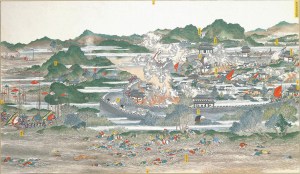
I’ve been reading a lot about China lately.  Political scientists have been interested in its economic growth for some time and it has rivaled the GDP of the United States in such a way that it’s an open question as to which is the larger.  With so many things to keep track of in daily life, I’m loathe to add poli sci to the list, but I’ve always found history fascinating.  China has long been the target of Christian missionaries.  Finding a culture that had developed quite differently, in some sense socially distant, they were anxious to make them in their own image.  China had its own religious heritage of folk traditions, Confucian beliefs, and Taoism (as well as Buddhism and Islam), and Christianity’s claim of being the only true religion caused considerable social turmoil.  One such event was the Taiping Rebellion in the nineteenth century.

Image credit: Wu Youru, via Wikimedia Commons

A complaint of evangelical pastors, even in the United States, after Billy Graham had come through town was that local people, all riled up on revivalism, had unrealistic expectations for what their local churches could do.  Viewing this from a different angle, the issue was that one outlook on Scripture could lead to consequences that others didn’t understand.  The same thing applies to Taiping.  Hong Xiuquan, the leader of the Taiping Rebellion, had read his Bible (the activity encouraged by missionaries) and became convinced he was the brother of Jesus Christ.  He set about trying to establish what is called the Heavenly Kingdom.  This clashed with the government of China during the Qing Dynasty.  Eventually foreign powers even got involved.  The end result was between ten and thirty million deaths.  That’s right, ten to thirty million.

Religious ideas are powerful.  This is one reason that repressive governments often try to outlaw religions.  Other governments (including some not too far from here) use religions for political ends.  True believers are great followers.  I first learned about the Taiping Rebellion only relatively recently.  I’ve been reading snippets about China for several years now.  Its economic power may well be greater than that of the country in which I grew up.  Perspectives are shifting.  Vast numbers of people die because of religious conflicts.  If you’re one of them the real tragedy is that, in Stalinistic terms, you become simply a statistic.  There’s a reason authoritarian governments try to keep the opium from the hands of the people.  I’m no political scientist, but history reveals much about religion and its discontents.


Denying Reality

The science-deniers in the White House have had to accommodate themselves to evidence-based facts and they look none too happy about it.  Science denial has a long and venerable history in a certain type of evangelicalism.  Science teaches us that most things are more complex than they seem and this is also true of religions.  There are evangelicals all over the board, but those claiming the name most loudly have been outspoken Trump supporters.  The administration has had a three-year spree of decrying science and now that a very real virus is killing us they have no choice but to listen, albeit reluctantly.  So why do certain strains of evangelicalism deny science?  Is it all for profit?  Is there some kind of biblical mandate?

As someone who spent many years making a living as a biblical scholar (and it still plays into my work), I often think about this.  There is the underlying reliance on miracle as opposed to naturalism, for sure.  If God can do anything then science is ever only contingent.  Any moment a miracle (a word that doesn’t occur in the Bible, by the way) could happen and there’d be no way to measure it.  The main reason, however, goes back to Genesis and its creation stories.  When you read a book first impressions are important.  The Good Book begins with a theological account that eventually came to be taken literally.  It’s as if someone decided to live by a poem, taken as fact.  Some things can’t be expressed except with metaphorical language.  But since this creation takes place up front, any challenge to it is an affront to the Almighty.

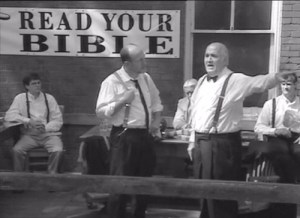
The antagonism set up by Darwin’s discovery of evolution set the whole confrontation in motion.  Evangelicals in the late 1800s were feeling pushed into the corner by the overwhelming evidence that the creation accounts in Genesis were not factual.  This insult to miracle has simmered for well over a century—the Scopes trial, well into this period, took place 95 years ago.  Fear that the Bible’s loss of science authority might somehow lessen its spiritual message became a ditch in which to die.  Big business learned, back in the seventies, that evangelicals made great followers and could constitute a voting bloc if only a cause could be raised around which they’d rally.  We all know what that was.  That issue has led to the denial of science and the acceptance of anyone ill-informed enough to accept such denial.  Only after learning that you must fight pandemics with science has the White House had to start changing its story.  When it’s all over, however, it will go right back to denying everything.


Disease Divine?

I suspect many religious people are wondering where God is amid the current pandemic.   Theodicy (explaining the suffering of the innocent while defending the goodness of the Divine) has always been the bête noire of monotheistic belief systems.  (Polytheism has the advantage of always being able to blame another god.)   People have been pointing articles out to me that show the religious implications of a crisis.  I’m not at all surprised by the irrationality of the subjects.  The first article was an opinion piece in the New York Times.  It makes a good case that the religious right paved the way for the COVID-19 contagion in the United States.  The religious right is anti-science because they (wrongly) believe the Bible is a science book.  Even a small dose of seminary could cure that ill.  Katherine Stewart nevertheless makes a strong argument that the survivors of all of this will know whom to blame.  Science denial is not the same as authentic religion.

From NASA’s photo library

The other news stories that arise are of evangelical leaders defying government bans or guidance, even when delivered by messiah Trump, to large gatherings.  One of the main reasons for this is that said messiah kept saying the coronavirus was nothing to worry about.  Only when re-election seemed unlikely with all the uneducated dead did he finally start issuing warnings to avoid such idiotic congregating.  In the midst of it all, Jerry Falwell Junior (why did all these evangelists have to propagate?) decided to reopen Liberty University.  No doubt confident that God will keep them from any harm, the university officials decided it would be good to gather students from all over the country and put them together in dorms again.  If you’ve ever lived in a dorm I’m sure you can see why the decision is anything but wise.

It’s sad that evangelicalism has decided to pander to the uneducated.  You can believe in Jesus (many mainstream Christians do) without parking your rationality in the farthest parking spot from the door.  Many of us, huddled in our houses, not having seen other living people for days, are trying to isolate this thing and drive it to extinction.  Meanwhile, those who trust their own version of the supernatural are doing whatever they can to ensure the virus continues to spread.  Why?  They have long been taught that science isn’t real.  Never mind that their cell phones work and they get the news of open dorms through the internet, the science behind it all is bunk.  An entire executive branch administration that doesn’t believe in science is as sure a road to apocalypse as any.


Prophets and Exiles

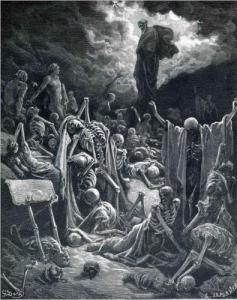
One of the scariest passages in the Bible is Ezekiel 33.7-9.  I first read this before I was a teenager and it scared me deeply.  In case you don’t feel like clicking over to BibleGateway and searching, the pericope is a section where Yahweh is warning Ezekiel about the dangers of giving up hope (in the larger context).  Ezekiel, you see, had lived through the fall of Jerusalem.  Many people of Judah felt that the destruction of the temple was the end of the relationship between Yahweh and the chosen people.  Ezekiel here is being warned to deliver good news.  If Ezekiel doesn’t call out the lie (the sins of Israel weigh it down) he will be punished as if he were the sinner himself.  I knew evangelical friends in college who lifted that verse out of context and said God would punish them if they didn’t warn the people.  They weren’t so worried about the fall of Jerusalem—that was old news by the 1980s—but about some other issue they deemed important at the moment.

Taking verses out of context has a name.  It’s called “prooftexting.”  It can be done to just about any piece of writing, including this blog post.  All it requires is finding a passage that says what you want it to and claim that it means what you say it does.  The Bible’s a big, big book.  Trying to understand its contents in context takes years of dedicated work.  Even then biblical scholars don’t have all the answers because if they did we could all stay home and surf the net for the rest of our lives.  No, engaging with sacred texts is a never-ending task, by definition.  That warning to Ezekiel was for Ezekiel.  What was that message?  Stop saying the exile is the end!  There’s more to the story.  Read the book to the end and see.

The problem with prooftexting, if I might engage in a bit of it myself, is that it takes away from the totality of the Good Book itself.  Not adding too or taking away from the Bible is a biblical command (taken out of context), which means that with the Bible it’s all or nothing at all.  And if it’s the former, it means Ezekiel’s condemnation is contingent upon what follows.  Back in biblical times there wasn’t as much reading material as there is today.  It turns out, however, that there’s a lot more written down than we used to assume.  If we’re going to read it we should do so within its context.  But just in case, please be assured that the exile isn’t the end of the story.


Prophetic Breakfast

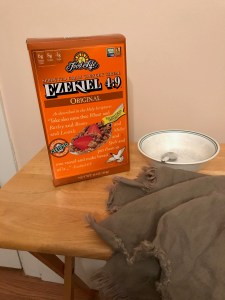
The irony doesn’t escape me—and why does irony always try to do that, anyway?—that Ezekiel 4:9 is about famine.  I’ve posted about the breakfast cereals from Food for Life (yet more irony, from Corona, California) before, but during this time of shortages at the local grocery stores, famine is an apt topic.  I don’t mean to underplay famine.  Death by starvation is something nobody should have to face, but looking ahead, who knows?  The reason I was eating Ezekiel 4:9 is that my usual cereal brand was sold out.  Empty shelves and the prophet seem symbolic, don’t you think?  The box quotes the verse as a kind of health-food recipe, but the point was, in context, that this was not something you’d normally want to eat.  This was food for hard times.

Ezekiel, you see, lived through the collapse of his own society.  In his case it wasn’t because of a virus, but imperial ambition.  The Babylonian Empire under Nebuchadnezzar was expanding and Judah was in the way.  The city was captured and Ezekiel, a priest, was exiled.  His symbolic action of eating poor food was to show people they ought to plan on this as “the new normal.”  Even now we hear people saying, “when things get back to normal…” but I also wonder if that will happen.  Collapse can occur slowly.  The thing about reading history is that we see centuries compressed into a few hundred pages.  Things take time.  Like restocking toilet paper.  Meanwhile empires crumble.

The Babylonian Empire didn’t last long.  Oh, it was long enough to mean some people knew nothing else, but looking back we can see that it held sway for decades rather than centuries.  In the middle of his book, Ezekiel changes his tune.  Once the temple is destroyed, when the worst has happened, he starts looking for a better future.  Many people have been under serious strain since November 2016.  Anxiety levels have been consistently high for damaging lengths of time.  I suspect the book of Revelation hasn’t been so well thumbed for decades.  The seventies were also apocalyptic times, as I recall.  Although we’re living through history, we each do it on the ground.  We experience it in our own little lives.  These seismic shifts can’t help but impact us.  It helps me to act like some things are normal.  I still get out of bed early.  I stumble into the kitchen and fumble on the light.  I settle down for breakfast with a prophet and wait.


The Essentials

The current crisis, in my mind, dates to Thursday, March 12.  That particular day, at least in my socially distant location, the pandemic became a panic.  Decisions were made to have employees work remotely.  Zoom or Skype meetings were substituted for the face-to-face variety.  Church services were cancelled.  There was a run on toilet paper.  This final aspect has me really vexed.  Why toilet paper?  Experts say if we kept to our usual buying habits there would be plenty for everyone, but the survivalist mentality kicked in and people began hoarding.  If the apocalypse was coming, they wanted to go down fighting with clean underwear on.  We were in Ithaca the next day to see my daughter.  We ordered out from a local restaurant.  When we got home we found a role of new toilet paper in the top of the bag.

According to my amateur dating technique, we’ve been in this state for 13 days now.  Toilet paper, tissues, and paper towels are nowhere to be found.  I looked on Amazon.  They can get you toilet paper, but you’ll need to wait until May.  Why?  Ironically, because it’s being shipped from China.  Yes, the nation where the pandemic erupted has toilet paper aplenty.  Here in the greatest [sic] nation in the world, there’s none to be found.  What does this tell us about a country that self-identifies as “Christian”?  Whatever happened to “if someone demands your coat, give them your shirt also”?  Or perhaps more to the point, “turn the other cheek”?  How has a nation of Bible believers responded to a crisis?  By becoming selfish.  By stockpiling toilet paper.

I’ve spent a lot of time camping.  I’m fairly comfortable with the ways of nature.  Like most other people I prefer a nice, private restroom with all the accoutrements, but if bears can do it in the woods, why can’t we?  I have my Boy Scout guide right here.  But it suggests using toilet paper.  If books could be ordered, I suspect How To Poop [this is the family friendly version] in the Woods would be a current bestseller.  Trump says he wants everyone back to work by Easter, but the toilet paper ordered from Asia won’t even be here by then.  And will offices have access to some secret stash that only those who buy in bulk can find?  Hoarding makes any crisis worse, but this particular one seems especially mean spirited.  It makes me realize just how great America has been made.


Silent Sundays

Since walks in the outdoors are a good thing, according to government guidelines, my family has been taking them.  Actually, we tend to take walks anyway since sitting before a screen all day is anything but natural.  One fact we’ve noticed on our perambulations through town is that many churches, as a standard of caution, aren’t holding their usual meetings.  The governor here in Pennsylvania hasn’t ordered churches closed—the fine line between church and state is easily violated—but many of the civic-minded religious are able to draw their own conclusions.  The church I attend has gone to virtual services.  In any case, I’m seeing news stories of clergy, particularly on the far-right end of the spectrum, insisting that the show must go on.  Ignoring government guidelines, they try to cram in as many people as they can until the police come along to limit the size of gatherings.

Throughout history religion has generally been in league with local governments.  We don’t know all the religions that have ever existed, but it is clear that some of the first counter-cultural believers were early Christians.  They defied government orders and sometimes died for it.  Today it’s more likely to end up in a stern rebuke or simply being sent home where the rest of us are sheltering in place.  I read this week about a church that’s encouraging cardboard cutouts of congregants so they can see themselves sitting in the pews during virtual Sunday morning services.  At times like this I think back over the history of religions and reflect on how the COVID-19 situation is one entirely new; we’ve never had a pandemic with the internet before.  And pastors can announce online that defying the government is on the docket for Sunday morning.

We weren’t the only ones with the idea of visiting Columcille yesterday.  An outdoor megalith park, Columcille is a place for spiritual reflection.  Since the vernal equinox passed virtually unnoticed this year, it was rejuvenating to take a springtime walk in the park.  Yes, others were there, widely spaced, but we walked the trails and visited the standing stones as a family group, keeping away from other gatherings.  We spent some time watching the new life emerging from the forest floor.  It’s only March but spring has sent its signals to the plant world and green shoots are reaching for the sun before trees leaf out and block the light.  It’s a wonder and a source of awe.  And in its own way, it’s a kind of gathering we might call church.


CBD

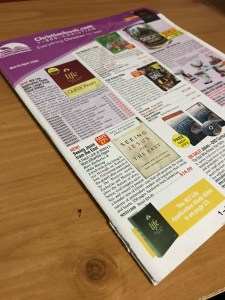
They found me.  I used to call them CBD, but because of the popularity of a certain hemp-based product, Christian Book Distributors changed its name.  Now I knew about them long before they had me on their mailing list when I taught at Nashotah House.  When I was a seminary student in Boston I made occasional trips to CBD’s Peabody warehouse for sales—this was quite a boon to students who never have enough money (little did I know!).  Books you’d heard about in class were there, for a fraction of the price.  At Nashotah I always looked over their bargain page, because, well, professors like books.  I recognized their catalogue in my mailbox instantly.  The name is now Christianbooks.com.  Grab some munchies and sit down.

Not only the name has changed.  Back in my student days I could find academic resources here.  As religion in America has become more and more polarized, what used to be CBD (if I use their current incarnation my computer insists on putting links in) has become radically conservative.  Page after page of study Bibles reveal no hint of the mainstream bestsellers in the genre.  It’s as if they don’t exist.  More than that, if you leave them out maybe people will come to believe they don’t exist.  Even the bargain books are nothing an erstwhile professor would buy.  Instead of academic titles there are all kinds of Barnes & Noble-type gimmicks to get shoppers to spend their money.  Like junk food for the soul.  I look at the books on my shelf.  Some of them were purchased, cash in hand on the ground in Peabody.  Not any more.

There will be those who claim (fake news is the only news now) that what has changed is me, not them.  The fact is places like CBD used to be more open minded.  They admitted the possibility of doubt.  Now your choices are Scofield or Ryrie.  That should be enough for any appetite.  Not only that, but many of the titles now sound militaristic.  Battlefields and all.  Thumbing through, I wonder where Jesus has gone.  The evangelicalism of my youth was clearly Prince of Peace centered.  Now it’s politicized to the point that I’m not sure what it represents beyond GOP values of greed, opportunism, and power.  Anyone who thinks differently need not apply.  How CBD found me after all these years, I do not know.  I wish they’d consider saving the environment rather than printing catalogues to send me.  The climate, despite what they would claim, has changed.


Hearts are Dark

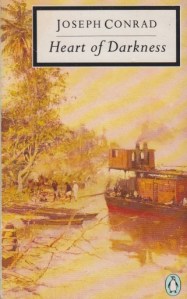
For the most part, reading introductions to literary works is tedious.  Since this edition of Heart of Darkness was brief enough, and the introduction wasn’t as long as the novel, I decided to follow through.  I’m glad I did.  I’ve read Joseph Conrad’s classic before, but it was helpful to have pointed out before this reading just how much darkness is in the story.  Drawn in by Kurtz’s famous last words, I suspect, many readers make the heart of the darkness the life lived by this contradiction of a man.  An individual who’d set himself up as a deity, and who pillaged the region for his own gain.  A man who wasn’t above using terror to acquire his ends.  An enigma.

But in actual fact, the story is about as full of darkness as an early Bruce Springsteen album.  The story begins at sunset and ends at night.  There is darkness to the Europeans’ dealing with the Africans throughout.  Even Marlow participates in that interior darkness that seems present in all people.  Delivering the deceased Kurtz’s letters to his still grieving fiancée, he meets her as darkness is setting.  He lies about her beloved’s last words, preferring to preserve her feelings than to reveal the truth uttered upon the deathbed.  There are layers of interlaced darkness here and Conrad never gives a definitive statement about what it really is.

We live in dark times.  I suspect that, for someone somewhere, that will always be the case.  The corruption of our government is so blatant and obvious that we seem to have fallen under the shadow that must’ve driven Conrad to pen his novel.  When living in darkness it helps to have a guide who’s been there before.  No matter what evil Kurtz has perpetrated, he’s treated as a god by those he oppresses.  He knows their suggestibility and preys upon it.  Although slavery was no longer (officially) a reality when Conrad wrote, the attitudes—embarrassing in the extreme today—lingered.  Even more embarrassing is the reality that they linger even today.  Not just linger, but assert themselves and then deny that they exist.  This is the heart of darkness, I believe.  We cannot allow others to live in systems that don’t kick money back into our own.  Trade on our terms, with our worldview being the only legitimate one.  Like so many writers, Conrad has been made a prophet by history.  And we all know the horror.


Icelandic Gods

There’s a lot to like about Iceland.  It has geothermal heat.  The people are literate and proud of it.  They don’t have an army.  Viking heritage and northern lights—what an interesting place!  A friend recently sent me a satirical piece on Patheos titled “Iceland Declares All Religions Are Mental Disorders,” by Andrew Hall.  I may not be as naive as I once was, but I have to admit I was nearly taken in on the fly.  Maybe because the idea seems so much better than what we have over here in our warmer, but less educated world.  Clearly, however, religion is extremely important to people, and if it is a mental disorder it’s an essential one.  Hall mades the astute point that Iceland didn’t want to become like the United States.  Who would, at this point?

Although this is a satirical piece, like most satire it works because it has chunks of truth in it.  Countries run by religions do seem to get into quite a lot of trouble.  I often think this is primarily a monotheistic problem.  If a nation accepts many gods, then adding those of other peoples is hardly an issue.  With a single deity, however, there is a single truth.  Anyone different is, by default, wrong.  When entire nations self-identify with a religion, it is only too easy to begin seeing those who believe differently just across the border as a threat.  Faith becomes fight.  As if a deity who always claims to value peace is only satisfied when we’re killing those who don’t share our same peaceful outlook.  Irony and satire have met together, it seems.

I’ve never been to Iceland.  It’s on my bucket list.  As a rockhound, the volcanic nature of the place calls to me.  I do wonder, however, how a vegan might fare on a far northern island.  My times in Orkney are among my mental treasures.  Those northern Scottish isles were places of wonder.  Not the most options regarding comestibles, however.  What they lacked in food they made up for in magic.  Iceland, despite the satire’s bite, has a considerable population that believes in the little people.  Anyone who’s too quick to dismiss such things ought to spend some time in the far north.  Driving to the ancient sites of Orkney certainly shifted my perspective a bit.  There’s great value in listening to the wisdom of those relatively isolated from the rest of the world.  You might, however, have to bring your own beans.


Human HU

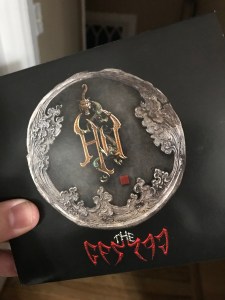
In these times of extreme xenophobia, we desperately need to understand those who are different.  When my brother recently shared his discovery of The HU’s album The Gereg, I was at first a little concerned.  That deep-seated childhood evangelicalism suggests anything that unfamiliar is bound to be satanic.  How unfamiliar?  Mongolian throat-singing unfamiliar.  Songs sung in Mongolian, unfamiliar.  Album art that could be heavy metal.  I’d never come across anything like it.  I suppose it’s a natural, knee-jerk reaction to say anything so unfamiliar is potentially demonic, and it shows just how paranoid a culture can be.  We think of 1950’s America as “the norm.”  I wasn’t alive then, but I’ve seen pictures.  Buzz cuts still give me the willies.  I trust Mongolians more.

I don’t know if The HU is a deliberate play on The Who or not, but the word roughly translates to “human.”  Like many ancient practices, nobody thought to write down the origins of throat singing.  Traditionally it was what Inuit women did when men were out on the hunt.  Like many aspects of hunter-gatherer society, it fascinates.  Some cultures reported that when Christian missionaries came, with their cultural imperialism in tow, they suppressed throat singing.  It looks like I wasn’t the only one raised to be suspicious of that which is different.  I learned, however, of my own cultural biases.  I learned that ones’ own assumptions must be interrogated.  If humanity is to survive, we must learn to try to understand one another.

Although the actual roots of throat singing are lost in unwritten times, I strongly suspect it has a religious, or if you prefer, spiritual, origin.  When women gather it isn’t the same as when men consolidate power and institutionalize violence.  I’ve read that when women rule there is a strong impulse to cooperate, to suppress aggression.  Men can learn this.  Indeed, as those white, male missionaries took up their positions in far-flung parts of the globe they spread the idea that men alone held the divine right of, if not kings, priests.  Conversion, you see, is seldom gentle.  Making the world in your own image, if you’re a man, runs into certain obvious problems right away.  HU means human.  When I feel the cold paranoia of my own government creeping up on me, I cue-up the soundtrack of my life.  I’m no longer a young man, and I don’t fear the different as much as I used to.  I need to hear something different, something human.


VFD

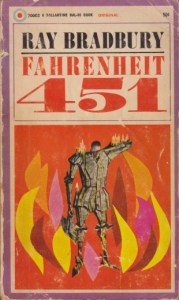
It’s been a few years since I read Fahrenheit 451, the classic novel by Ray Bradbury.  Like so many dystopias, it’s seen a resurgence of interest since 45 was elected.  (I can’t help but notice the shared digits.)  Bradbury was a writer of his time.  So much, I suppose, could be said of all of us who write—how can we be anything else?  Still, it’s difficult not to see that his fear was of television decimating reading.  And intelligence.  We’ve got the internet now, so the effect has been magnified a bit.  The tale, despited being dated, is poignant.  The more electronic we become the more of what used to be termed “real life” we miss.  At this reading it was clear that The Book of Eli was largely based on the last pages.

When Montag confesses to his wife that he’s been secreting books away, and she finds him insane for doing so, he takes the book in his hand to a former acquaintance, Faber.  It turns out that the book is the Bible, perhaps the last in existence (see what I mean?).  On the subway ride he tries to memorize the Good Book.  Now, I’ve been on the New York City subway, and I know the delays can be long, but there’s an error of scale here.  The Bible’s a big book.  Still, he gets pieces of it down.  Now, in the 1950s, when Fahrenheit 451 was published, the Bible was known for its liberating qualities rather than its darker side.  Also the atomic end of World War II was clearly still a painful living memory.  The two may not be unrelated.

Given the age of the story, I won’t worry about spoilers.  In case, however, it’s on your list proceed with caution.  The war that’s been building the entire story takes place the night of Montag’s escape.  Along with the intellectuals forced out of the cities, he becomes part of a human library.  Each person is, through a memory recovery technique, capable of recalling the books they’ve read.  Montag becomes, appropriately enough, Ecclesiastes.  Perhaps the least evangelical book in the Bible, along with Job (with which most evangelicals find themselves cheering on Job’s friends), Qohelet has long been one of my favorites.  It’s an honest book.  The same can be said for Bradbury’s novel.  Primarily a short story writer, Bradbury didn’t sustain the narrative to novel length very often.  But when he did he fashioned a book that, particularly now, needs to be read.


Shifting Perspectives

Perspective.  The ability to change it is vital to understanding.  I’ve been working with the idea of demons for a few years now.  My perspective, however, has been aided by Nancy Caciola’s Discerning Spirits: Divine and Demonic Possession in the Middle Ages.  Noting something that has long been a puzzle—behaviors attributed to saints were also recognized among the demonically possessed—Caciola suggests a solution.  In the Middle Ages very few female saints were canonized.  Delving into records from the period Caciola noticed that when saintly behaviors exhibited by men were experienced by women those behaviors were deemed demonic.  In other words, from a perspective that saw masculine experience as normative, when supernatural events were encountered in women they were seen as diabolical.  Using Hildegard of Bingen’s frame of an “effeminate age,” Discerning Spirits explores the idea of how the Medievals told good from evil.

 My own experience of “discerning spirits” came about through a United Methodist curricular study on spiritual gifts.  I was in either junior or senior high school, and deeply involved in the church.  An adult study (I was close enough) on spiritual gifts explained the laundry list compiled by Paul in 1 Corinthians 12.  The apostle from Tarsus notes that discerning spirits is a divine gift.  I trembled as a teen, wondering if I might possibly have it (that was the point of the study).  It seemed like an immense responsibility.  The issue, it turns out, was nothing new.  Since codified in the Bible it had to be true, but what was it all about?  Smarter people than me were struggling with it.

There’s plenty of provocative and explanatory information in Discerning Spirits.  From ancient times it was understood that gods could possess people.  By the New Testament demons clearly could too.  We hear less and less about divine possession as time goes on.  In fact, it becomes a kind of heresy in itself.  Demonic possession was never really in doubt.  It fell out of favor with the Enlightenment, but it didn’t really disappear.  This book shows a clear trajectory from women’s possession as being demonic straight toward the witch craze that erupted in Europe toward the end of the Middle Ages.  It was no coincidence that the majority of accused witches were female.  The perspective had shifted with the fortunes of the church during the Medieval period.  Fear of schism and fear of unsupervised spirituality in a world where only men could be priests led to results that, in hindsight, look inevitable.  Caciola’s book is an important source for not only ages past, but also a mindset all too prevalent in our present world.