The Essentials

The current crisis, in my mind, dates to Thursday, March 12.  That particular day, at least in my socially distant location, the pandemic became a panic.  Decisions were made to have employees work remotely.  Zoom or Skype meetings were substituted for the face-to-face variety.  Church services were cancelled.  There was a run on toilet paper.  This final aspect has me really vexed.  Why toilet paper?  Experts say if we kept to our usual buying habits there would be plenty for everyone, but the survivalist mentality kicked in and people began hoarding.  If the apocalypse was coming, they wanted to go down fighting with clean underwear on.  We were in Ithaca the next day to see my daughter.  We ordered out from a local restaurant.  When we got home we found a role of new toilet paper in the top of the bag.

According to my amateur dating technique, we’ve been in this state for 13 days now.  Toilet paper, tissues, and paper towels are nowhere to be found.  I looked on Amazon.  They can get you toilet paper, but you’ll need to wait until May.  Why?  Ironically, because it’s being shipped from China.  Yes, the nation where the pandemic erupted has toilet paper aplenty.  Here in the greatest [sic] nation in the world, there’s none to be found.  What does this tell us about a country that self-identifies as “Christian”?  Whatever happened to “if someone demands your coat, give them your shirt also”?  Or perhaps more to the point, “turn the other cheek”?  How has a nation of Bible believers responded to a crisis?  By becoming selfish.  By stockpiling toilet paper.

I’ve spent a lot of time camping.  I’m fairly comfortable with the ways of nature.  Like most other people I prefer a nice, private restroom with all the accoutrements, but if bears can do it in the woods, why can’t we?  I have my Boy Scout guide right here.  But it suggests using toilet paper.  If books could be ordered, I suspect How To Poop [this is the family friendly version] in the Woods would be a current bestseller.  Trump says he wants everyone back to work by Easter, but the toilet paper ordered from Asia won’t even be here by then.  And will offices have access to some secret stash that only those who buy in bulk can find?  Hoarding makes any crisis worse, but this particular one seems especially mean spirited.  It makes me realize just how great America has been made.


Silent Sundays

Since walks in the outdoors are a good thing, according to government guidelines, my family has been taking them.  Actually, we tend to take walks anyway since sitting before a screen all day is anything but natural.  One fact we’ve noticed on our perambulations through town is that many churches, as a standard of caution, aren’t holding their usual meetings.  The governor here in Pennsylvania hasn’t ordered churches closed—the fine line between church and state is easily violated—but many of the civic-minded religious are able to draw their own conclusions.  The church I attend has gone to virtual services.  In any case, I’m seeing news stories of clergy, particularly on the far-right end of the spectrum, insisting that the show must go on.  Ignoring government guidelines, they try to cram in as many people as they can until the police come along to limit the size of gatherings.

Throughout history religion has generally been in league with local governments.  We don’t know all the religions that have ever existed, but it is clear that some of the first counter-cultural believers were early Christians.  They defied government orders and sometimes died for it.  Today it’s more likely to end up in a stern rebuke or simply being sent home where the rest of us are sheltering in place.  I read this week about a church that’s encouraging cardboard cutouts of congregants so they can see themselves sitting in the pews during virtual Sunday morning services.  At times like this I think back over the history of religions and reflect on how the COVID-19 situation is one entirely new; we’ve never had a pandemic with the internet before.  And pastors can announce online that defying the government is on the docket for Sunday morning.

We weren’t the only ones with the idea of visiting Columcille yesterday.  An outdoor megalith park, Columcille is a place for spiritual reflection.  Since the vernal equinox passed virtually unnoticed this year, it was rejuvenating to take a springtime walk in the park.  Yes, others were there, widely spaced, but we walked the trails and visited the standing stones as a family group, keeping away from other gatherings.  We spent some time watching the new life emerging from the forest floor.  It’s only March but spring has sent its signals to the plant world and green shoots are reaching for the sun before trees leaf out and block the light.  It’s a wonder and a source of awe.  And in its own way, it’s a kind of gathering we might call church.


CBD

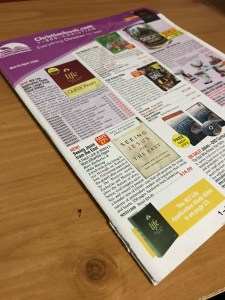
They found me.  I used to call them CBD, but because of the popularity of a certain hemp-based product, Christian Book Distributors changed its name.  Now I knew about them long before they had me on their mailing list when I taught at Nashotah House.  When I was a seminary student in Boston I made occasional trips to CBD’s Peabody warehouse for sales—this was quite a boon to students who never have enough money (little did I know!).  Books you’d heard about in class were there, for a fraction of the price.  At Nashotah I always looked over their bargain page, because, well, professors like books.  I recognized their catalogue in my mailbox instantly.  The name is now Christianbooks.com.  Grab some munchies and sit down.

Not only the name has changed.  Back in my student days I could find academic resources here.  As religion in America has become more and more polarized, what used to be CBD (if I use their current incarnation my computer insists on putting links in) has become radically conservative.  Page after page of study Bibles reveal no hint of the mainstream bestsellers in the genre.  It’s as if they don’t exist.  More than that, if you leave them out maybe people will come to believe they don’t exist.  Even the bargain books are nothing an erstwhile professor would buy.  Instead of academic titles there are all kinds of Barnes & Noble-type gimmicks to get shoppers to spend their money.  Like junk food for the soul.  I look at the books on my shelf.  Some of them were purchased, cash in hand on the ground in Peabody.  Not any more.

There will be those who claim (fake news is the only news now) that what has changed is me, not them.  The fact is places like CBD used to be more open minded.  They admitted the possibility of doubt.  Now your choices are Scofield or Ryrie.  That should be enough for any appetite.  Not only that, but many of the titles now sound militaristic.  Battlefields and all.  Thumbing through, I wonder where Jesus has gone.  The evangelicalism of my youth was clearly Prince of Peace centered.  Now it’s politicized to the point that I’m not sure what it represents beyond GOP values of greed, opportunism, and power.  Anyone who thinks differently need not apply.  How CBD found me after all these years, I do not know.  I wish they’d consider saving the environment rather than printing catalogues to send me.  The climate, despite what they would claim, has changed.


Hearts are Dark

For the most part, reading introductions to literary works is tedious.  Since this edition of Heart of Darkness was brief enough, and the introduction wasn’t as long as the novel, I decided to follow through.  I’m glad I did.  I’ve read Joseph Conrad’s classic before, but it was helpful to have pointed out before this reading just how much darkness is in the story.  Drawn in by Kurtz’s famous last words, I suspect, many readers make the heart of the darkness the life lived by this contradiction of a man.  An individual who’d set himself up as a deity, and who pillaged the region for his own gain.  A man who wasn’t above using terror to acquire his ends.  An enigma.

But in actual fact, the story is about as full of darkness as an early Bruce Springsteen album.  The story begins at sunset and ends at night.  There is darkness to the Europeans’ dealing with the Africans throughout.  Even Marlow participates in that interior darkness that seems present in all people.  Delivering the deceased Kurtz’s letters to his still grieving fiancée, he meets her as darkness is setting.  He lies about her beloved’s last words, preferring to preserve her feelings than to reveal the truth uttered upon the deathbed.  There are layers of interlaced darkness here and Conrad never gives a definitive statement about what it really is.

We live in dark times.  I suspect that, for someone somewhere, that will always be the case.  The corruption of our government is so blatant and obvious that we seem to have fallen under the shadow that must’ve driven Conrad to pen his novel.  When living in darkness it helps to have a guide who’s been there before.  No matter what evil Kurtz has perpetrated, he’s treated as a god by those he oppresses.  He knows their suggestibility and preys upon it.  Although slavery was no longer (officially) a reality when Conrad wrote, the attitudes—embarrassing in the extreme today—lingered.  Even more embarrassing is the reality that they linger even today.  Not just linger, but assert themselves and then deny that they exist.  This is the heart of darkness, I believe.  We cannot allow others to live in systems that don’t kick money back into our own.  Trade on our terms, with our worldview being the only legitimate one.  Like so many writers, Conrad has been made a prophet by history.  And we all know the horror.


Icelandic Gods

There’s a lot to like about Iceland.  It has geothermal heat.  The people are literate and proud of it.  They don’t have an army.  Viking heritage and northern lights—what an interesting place!  A friend recently sent me a satirical piece on Patheos titled “Iceland Declares All Religions Are Mental Disorders,” by Andrew Hall.  I may not be as naive as I once was, but I have to admit I was nearly taken in on the fly.  Maybe because the idea seems so much better than what we have over here in our warmer, but less educated world.  Clearly, however, religion is extremely important to people, and if it is a mental disorder it’s an essential one.  Hall mades the astute point that Iceland didn’t want to become like the United States.  Who would, at this point?

Although this is a satirical piece, like most satire it works because it has chunks of truth in it.  Countries run by religions do seem to get into quite a lot of trouble.  I often think this is primarily a monotheistic problem.  If a nation accepts many gods, then adding those of other peoples is hardly an issue.  With a single deity, however, there is a single truth.  Anyone different is, by default, wrong.  When entire nations self-identify with a religion, it is only too easy to begin seeing those who believe differently just across the border as a threat.  Faith becomes fight.  As if a deity who always claims to value peace is only satisfied when we’re killing those who don’t share our same peaceful outlook.  Irony and satire have met together, it seems.

I’ve never been to Iceland.  It’s on my bucket list.  As a rockhound, the volcanic nature of the place calls to me.  I do wonder, however, how a vegan might fare on a far northern island.  My times in Orkney are among my mental treasures.  Those northern Scottish isles were places of wonder.  Not the most options regarding comestibles, however.  What they lacked in food they made up for in magic.  Iceland, despite the satire’s bite, has a considerable population that believes in the little people.  Anyone who’s too quick to dismiss such things ought to spend some time in the far north.  Driving to the ancient sites of Orkney certainly shifted my perspective a bit.  There’s great value in listening to the wisdom of those relatively isolated from the rest of the world.  You might, however, have to bring your own beans.


Human HU

In these times of extreme xenophobia, we desperately need to understand those who are different.  When my brother recently shared his discovery of The HU’s album The Gereg, I was at first a little concerned.  That deep-seated childhood evangelicalism suggests anything that unfamiliar is bound to be satanic.  How unfamiliar?  Mongolian throat-singing unfamiliar.  Songs sung in Mongolian, unfamiliar.  Album art that could be heavy metal.  I’d never come across anything like it.  I suppose it’s a natural, knee-jerk reaction to say anything so unfamiliar is potentially demonic, and it shows just how paranoid a culture can be.  We think of 1950’s America as “the norm.”  I wasn’t alive then, but I’ve seen pictures.  Buzz cuts still give me the willies.  I trust Mongolians more.

I don’t know if The HU is a deliberate play on The Who or not, but the word roughly translates to “human.”  Like many ancient practices, nobody thought to write down the origins of throat singing.  Traditionally it was what Inuit women did when men were out on the hunt.  Like many aspects of hunter-gatherer society, it fascinates.  Some cultures reported that when Christian missionaries came, with their cultural imperialism in tow, they suppressed throat singing.  It looks like I wasn’t the only one raised to be suspicious of that which is different.  I learned, however, of my own cultural biases.  I learned that ones’ own assumptions must be interrogated.  If humanity is to survive, we must learn to try to understand one another.

Although the actual roots of throat singing are lost in unwritten times, I strongly suspect it has a religious, or if you prefer, spiritual, origin.  When women gather it isn’t the same as when men consolidate power and institutionalize violence.  I’ve read that when women rule there is a strong impulse to cooperate, to suppress aggression.  Men can learn this.  Indeed, as those white, male missionaries took up their positions in far-flung parts of the globe they spread the idea that men alone held the divine right of, if not kings, priests.  Conversion, you see, is seldom gentle.  Making the world in your own image, if you’re a man, runs into certain obvious problems right away.  HU means human.  When I feel the cold paranoia of my own government creeping up on me, I cue-up the soundtrack of my life.  I’m no longer a young man, and I don’t fear the different as much as I used to.  I need to hear something different, something human.


VFD

It’s been a few years since I read Fahrenheit 451, the classic novel by Ray Bradbury.  Like so many dystopias, it’s seen a resurgence of interest since 45 was elected.  (I can’t help but notice the shared digits.)  Bradbury was a writer of his time.  So much, I suppose, could be said of all of us who write—how can we be anything else?  Still, it’s difficult not to see that his fear was of television decimating reading.  And intelligence.  We’ve got the internet now, so the effect has been magnified a bit.  The tale, despited being dated, is poignant.  The more electronic we become the more of what used to be termed “real life” we miss.  At this reading it was clear that The Book of Eli was largely based on the last pages.

When Montag confesses to his wife that he’s been secreting books away, and she finds him insane for doing so, he takes the book in his hand to a former acquaintance, Faber.  It turns out that the book is the Bible, perhaps the last in existence (see what I mean?).  On the subway ride he tries to memorize the Good Book.  Now, I’ve been on the New York City subway, and I know the delays can be long, but there’s an error of scale here.  The Bible’s a big book.  Still, he gets pieces of it down.  Now, in the 1950s, when Fahrenheit 451 was published, the Bible was known for its liberating qualities rather than its darker side.  Also the atomic end of World War II was clearly still a painful living memory.  The two may not be unrelated.

Given the age of the story, I won’t worry about spoilers.  In case, however, it’s on your list proceed with caution.  The war that’s been building the entire story takes place the night of Montag’s escape.  Along with the intellectuals forced out of the cities, he becomes part of a human library.  Each person is, through a memory recovery technique, capable of recalling the books they’ve read.  Montag becomes, appropriately enough, Ecclesiastes.  Perhaps the least evangelical book in the Bible, along with Job (with which most evangelicals find themselves cheering on Job’s friends), Qohelet has long been one of my favorites.  It’s an honest book.  The same can be said for Bradbury’s novel.  Primarily a short story writer, Bradbury didn’t sustain the narrative to novel length very often.  But when he did he fashioned a book that, particularly now, needs to be read.


Shifting Perspectives

Perspective.  The ability to change it is vital to understanding.  I’ve been working with the idea of demons for a few years now.  My perspective, however, has been aided by Nancy Caciola’s Discerning Spirits: Divine and Demonic Possession in the Middle Ages.  Noting something that has long been a puzzle—behaviors attributed to saints were also recognized among the demonically possessed—Caciola suggests a solution.  In the Middle Ages very few female saints were canonized.  Delving into records from the period Caciola noticed that when saintly behaviors exhibited by men were experienced by women those behaviors were deemed demonic.  In other words, from a perspective that saw masculine experience as normative, when supernatural events were encountered in women they were seen as diabolical.  Using Hildegard of Bingen’s frame of an “effeminate age,” Discerning Spirits explores the idea of how the Medievals told good from evil.

 My own experience of “discerning spirits” came about through a United Methodist curricular study on spiritual gifts.  I was in either junior or senior high school, and deeply involved in the church.  An adult study (I was close enough) on spiritual gifts explained the laundry list compiled by Paul in 1 Corinthians 12.  The apostle from Tarsus notes that discerning spirits is a divine gift.  I trembled as a teen, wondering if I might possibly have it (that was the point of the study).  It seemed like an immense responsibility.  The issue, it turns out, was nothing new.  Since codified in the Bible it had to be true, but what was it all about?  Smarter people than me were struggling with it.

There’s plenty of provocative and explanatory information in Discerning Spirits.  From ancient times it was understood that gods could possess people.  By the New Testament demons clearly could too.  We hear less and less about divine possession as time goes on.  In fact, it becomes a kind of heresy in itself.  Demonic possession was never really in doubt.  It fell out of favor with the Enlightenment, but it didn’t really disappear.  This book shows a clear trajectory from women’s possession as being demonic straight toward the witch craze that erupted in Europe toward the end of the Middle Ages.  It was no coincidence that the majority of accused witches were female.  The perspective had shifted with the fortunes of the church during the Medieval period.  Fear of schism and fear of unsupervised spirituality in a world where only men could be priests led to results that, in hindsight, look inevitable.  Caciola’s book is an important source for not only ages past, but also a mindset all too prevalent in our present world.


Peaceful Resolutions

It came as a shock.  Raised as I was in a nation enamored of weaponry, I did not realize that many countries in the world do not have armies.  In some places, such as Israel, service in the military is compulsory.  In approximately twenty nations, however, people are secure enough not to require armies.  It’s probably symptomatic that such nations are fairly small in land area.  The more you’ve got, the more you want to protect.  Without materialism would we even need militaries?  Yes, we fight over different religious beliefs, but those conflicts are tied to a sense of ownership as well.  This is “our land” and don’t “you” tell us what to do in it!  I can imagine a world where armies need not exist.  The key, it seems to me, is love.

In a Simpsonesque way, of course, hostile aliens might invade.  Could we not try to come to a peaceful resolution?  Or could we not learn to protect ourselves without having to be in a position to destroy those who might prefer a more socialistic lifestyle?  Those who might look different?  Those whose moral standards push us to think more broadly?  Like many people I’m dismayed at the unconscionable size of our military budget.  Killing the world once over is no longer enough.  Now we have to try to pollute space as well.  Where are those aliens when we need them?

The fact is nations exist on this earth without standing armies.  They don’t cause trouble and some of them are extremely bookish (no surprise there).  Can we imagine what our world would look like with an education budget swapping places with the military one?  Do we dare even think such dangerous thoughts as peace and mutual goodwill?  Is no-one big enough to stand up to Adam Smith (with kudos to Thomas Piketty for trying!)?  The wealth of nations could be applied to make well-fed security mostly a reality.  We lack the will.  Well, most of us do.  I draw comfort knowing that several small nations around the world feel no need to waste their budgets on weaponry.  Their rich may not own dozens of houses fit for dozens of kings, but they have perhaps a peace of mind that no amount of military might can give.  We don’t seem to understand that weapons cater to fear, and that, as one religious text says, “perfect love casts out fear.”   


Memories of Scotland

I admire those who follow their dreams.  I have been writing fiction for over forty years now, and although I’ve had some success placing short pieces my novels haven’t found much interest.  So when I see the published work of someone who obviously loves writing as much as Ailish Sinclair does, it warms my heart.  Her debut novel, The Mermaid and the Bear, is the kind of historical fiction tinged with a little fantasy, all set in Scotland.  Having spent three happy years in Scotland myself, I like to read native writers.  One of the categories in this year’s Modern Mrs. Darcy’s reading challenge is a debut novel, so all these things came together in this one little book.  There may be a little spoiler info below, so proceed with caution!

Sometimes I read a novel without knowing much about it in advance.  That was the case with this one.  I read Sinclair’s blog posts and appreciate the fact that she doesn’t compose long, rambling essays.  Her posts often make me stop and think.  Her novel follows a love story that turns into a witch-hunt.  Unlike that claimed by those who have the whole world watching them, this was a real one.  The historical notes tell a bit about the characters based on women actually tried in Scotland during those dark times.  In fact, when one of my doctoral advisors gave my wife and me a walking tour of Edinburgh early on in our time there, he pointed out where the witch trials had taken place.  Sinclair captures the rage and frustration of women who had no recourse once such accusations flew.  A religion only too ready to believe the worst about people, women in particular, showed no mercy based on what was only hearsay and jealousy.

It’s difficult to imagine what life would have been like in such times.  Castles and lairds make us think of fairy tales, but reality must’ve been somewhat harsher.  It’s fun to pretend about witches around Halloween, but there’s a sadness that’s difficult to escape as an adult.  That sadness is all the more profound for finding claims of witch-hunts on the lips of abusers and others who do their best to perpetuate inequality.  They dishonor those who actually did die so that men like them could feel smug self-satisfaction in the past.  The Mermaid and the Bear brought a number of these thoughts to mind.  Our society has made some strides towards treating all people as human beings but we’re yet a long way from where we need to be.  Books that remind us of that are always to be welcomed; dreams are worth pursuing.


Space Farce

Okay, so “Space Force” sounds like a gimmick that you’d see in a 1950’s ad geared to dungaree-wearing boys.  These boys, who’d be named “Dick” would show the girls, named “Jane,” just how it was done.  So as I read about the furor of dedicating a King James Bible from the Bible Museum as the official Bible for military branches aimed at the stars, I had to think how very small we actually are.  So 45 thinks, like Reagan thought, that we need outer-space defenses.  These guys need to read more science fiction.  Actually, some plain old science would help.  If there are most advanced civilizations out there—and such seems increasingly likely, given that our understanding of science is subject to change—we are nothing more than cosmic mosquitoes buzzing close to our own planet where we can wail on each other in the name of lucre.  And we call it “Space Force.”

An article on NPR points out the hypocrisy of swearing in the military on a Bible.  One guy in there, I’ve heard tell, was called “the prince of peace.”  He’s somewhere near the back.  The public loves a good warmonger, though.  We can send our tentative rockets into orbit where bug-eyed aliens laugh with bemusement, and say “Just you try something.”  Or we can make business deals with Russia with one hand while pointing our missiles in their direction with the other.  Is that a missile or am I misreading something, Dick?  I can’t ask Jane, because she just follows along.  Maybe we’re inheriting the consequences of those who grew up reading Dick and Jane.  Boys with their rockets, girls with their dolls.

Bringing religion into the military is nothing new.  German soldiers marched out into a couple of World Wars with “Gott mit uns” inscribed on their waists.  Millions died.  No lessons were learned.  So now we want to take conflict so far over our heads that we can’t even see.  Ancient people knew the gods were fighting far above.  That’s how they made sense of the world.  Some, like Erich von Däniken took those stories literally and thought our alien observers were the reason.  Now that we’ve got drones we have no need of UFOs anymore.  All that sci-fi I watched as a kid wasn’t wasted after all.  Only I grew up reading that Bible instead of swearing on it.  I was pretty sure that war wasn’t a good thing, as he rode on a red horse with his sword pointing upward.  Time to dust off William S. Gray and get back to watching Space Force. 

From NASA’s photo library


Bodies and the Fall

Less common than it once was, the term “Dark Ages” was formerly used to denote what in Europe was known as the Medieval Period.  We now know that the pervasive darkness ascribed to the time was only partial: science, legal thinking, and rationalism were well underway.  Nevertheless, the sway of the church was enormous, and even until and beyond the days of Isaac Newton, the supernatural was assumed to exist.  Dyan Elliott’s Fallen Bodies: Pollution, Sexuality and Demonology in the Middle Ages is a fascinating journey through this contradictory time.  Elliott explores how the mysteries of sex (nocturnal emissions and menstruation loom large among them) played important roles in the development of Catholic theology that ultimately led to the close association of demons and witches.  Concerns with priestly purity, largely due to concerns about transubstantiation, led to enforced celibacy and the (further) denigration of women.

It would be difficult to summarize this insightful book.  Although relatively brief, it packs a wallop.  Concerns about purity go back to the Bible and before.  Ancient cultures had recognized aspects of contagion and knew that some diseases spread by contact.  Their perception of biology was “scientific” according to their current understanding, but it lacked microscopes and knew no shortage of supernatural entities.  Demons had great explanatory value in such a world.  As Elliott shows, they often appear in disquisitions about sex.  How can spiritual beings engage in physical relations with human bodies?  What were they made of?  Were they all bad?  Although demons had explanatory value they also raised many questions.

Fallen Bodies draws correlations between the dismissal of priests’ wives and the evolution of witches.  As the Eucharist became more and more holy, stricter controls had to be placed on consecrating hands.  Sex was the great source of pollution, and the Virgin Mary became rather less human through her own miraculously sterile conception.  The implied misogyny may not have been so much intentional as a reflection of the struggle to understand what modern medical science generally explains materially.  We still grapple with the mystery of life.  Conception can be viewed clinically, and biological responses can be “explained” scientifically (anyone who’s been in love will admit to the mystery of it, though).  Denizens of the Middle Ages worked with the tools they had to make sense of a world often bewildering.  Even physics still has to deal with quantum realities.  History teaches by its unfortunate missteps.  Someday those who “govern” the world may learn to read it and exorcise demons now otherwise readily explained.


Truth, Justice, and

Martin Luther King, Jr. attended Boston University School of Theology long before I did.  We remember him today as a great leader, a man willing to die for what he believed in.  And all these years later we’re still struggling to find some semblance of racial equality.  We can’t seem to admit that race is a social construct and not a scientific category.  Indeed, the only race is the human race.  King saw that, and staked his life on it.  Today we’re ruled by politicians who, when faced with the truth immediately shout “fake news!”  “Liberal!”  They may stop short of using some words not because they don’t want to, but because they could cost them at the polls come November.  America is watching.  I’m sitting here thinking how Martin Luther King died when I was just five.  He’d started something righteous and just.  And millions were out marching in the cold on Saturday to say we still believe in justice. 

I didn’t pick Boston University School of Theology just because King was its most famous alum.  The other day a guy noticed my BU stocking cap and asked if it was “Boston University.”  This wasn’t an educated person, but I’m guessing that most school paraphernalia has to do with sports and the game was on in the background, so the question was logical.  I told him it was Binghamton University, a school with which I also have an intimate connection, one step removed.  He said, “Binghamton!  I saw your cap and thought Baylor?  No.  Must be Boston.”  But ironically he ended up with the right school for me, but the wrong school for what I was wearing.  I did pick BU because I realized that strong academics are nothing without social justice.  Of course, academia wanted nothing to do with that.

Recently I read how Republican resentment towards liberals has very solid roots in racism.  Oh, they will deny it—their “fake news” trigger-finger is very itchy—but the whole package is tied up with anger that an African-American was elected president.  Follow that up with an old, white racist.  How will history look back on this insane era?  I think we already know.  While the privileged are trying to build their own legacies, I ponder an African-American preacher with clear vision as the one we remember today.  I went to Boston University naive and full of hope.  I heard a lot about King when I was there.  I knew something of dreams and how costly they could be.  Today I sit here and cuddle the epithet “liberal” and think how it’s become a swear word for some, while its real meaning of “justice” continues to go unheeded.


Social Madness

I’m reading a book written in the mid-1980s.  (All will become clear eventually.)  The author notes the connection between social madness and personal mental illness.  He cites the alarming rise of teen suicides.  This was over three decades ago.  Suicide rates have continued to climb, and this particular author got me to thinking about something that troubled me even as an undergrad.  Although I went to college intending to be a minister, I ranged widely in the subjects I studied.  (Being a religion major in those days allowed for quite a bit of flexibility.)  I took enough courses in psychology to have minored in it, if I had declared it.  Since my mind was set on church work I saw no reason to make said declaration.  The thing that troubled me was I had also taken sociology classes.

Like most people who grew up in uneducated households, I suspect, sociology was something I’d never heard about.  Asking what it was, in college, someone answered along the lines of “psychology of groups.”  My own experience of it was that it involved math and graphs—it was a soft science, after all—and now I read sociologists who say that such numbers can be made to declare what the sociologist wishes.  In other words, psychology.  The point of all of this is that the book I’m reading suggests societies exhibiting illness cause individuals to be sick.  Sociology leads to psychology.  In times of national turmoil, individual mental illnesses rise.  I had to pause and put the book down.  The eighties weren’t a picnic, but the national madness of the Trump era bears no comparison.  We are a nation gone mad, and when society can’t project health, the many who stand on the brink of individual mental illness simply get pushed over.  That sure makes sense of what I’m seeing.

Looking back, I often think I should’ve probably declared that minor.  Raised in a strong biblical environment, however, I wanted to learn as much about the Good Book as possible.  I was teaching Greek by my last year in college and in seminary I specialized in the Hebrew Bible.  It would’ve been a natural place to continue studying psychology.  By that point I’d decided to go on to a doctorate, and psychology required medical training.  For a guy as squeamish as me that wasn’t possible.  Ancient languages, though, they were something I could handle.  It’s rather frightening that those writing at that time already saw America (in the Reagan years, I might add) teetering towards national insanity.  We’ve gone far beyond that now.  And a society that doesn’t know it’s ill will sacrifice many individuals who realize that it is.


United, We Divide

I was a teenage Methodist.  Or, I should say, a teenage United Methodist.  My family had moved to a town where there were no Fundamentalist churches.  Indeed, the only Protestant church was the UMC.  Although very aware of religion, I hadn’t studied it deeply at that point—I’ve come to understand a bit better the marketplace of Christianties and how it works in a capitalist society.  The thing is, the more I learned about John Wesley and the Methodist movement, the more I saw how well it aligned with my own thinking and experience.  I became an Episcopalian largely because John Wesley never left that tradition and urged his followers in the same direction.  Of course, the “United” in United Methodism was due to mergers during the ecumenical period when Christians were learning to overlook differences and a strong base remained from which to draw.

The news has come out that the United Methodist Church has decided to split over the issue of homosexuality.  Most major Protestant denominations have made their peace, albeit uneasily, with the issue.  They recognized that while a source of guidance in spiritual matters the Bible’s a little outdated on its scientific understanding.  If God had revealed evolution to good old Moses things might’ve been a bit different.  We now know that homosexuality isn’t a “choice”—it is found in nature, and not rarely.  Homo sapiens (if I’m allowed to use that phrase) have developed in such a way that sexuality is a main preoccupation of religions.  Some animal species are monogamous and in our case many cultures adopted this as conducive to an ordered society.  Then it became codified in some sacred writings.

While homosexuality is mentioned in the Bible, every book of that Bible has a context.  Like it or not, close, serious study of Scripture raises questions you just don’t get if you read only authors who think the same way you do.  It is far easier to do that—who doesn’t like being right?—but thinking seldom gains credibility by never being challenged.  Iron sharpens iron, someone once said.  The emotion behind the issue, I suspect, is driven by a couple of things: fear of that which is different, and the inability to see the Bible as anything but “da rules.”  In those cases where the rules contradict one another you just have to choose.  At least in Christianity.  In Judaism they ended up with the Talmud.  In any case, we’re now seeing the fracturing of society based on party lines.  We could always use a few more choices, I guess, for competition is what spiritual capitalism is all about.