Like a River

It still gives me the creeps, to be honest.  Although a myth, well, let’s not dignify it with that noble term—although an urban legend, the origin of the “peace sign” with “Nero’s cross” upset me as a child and still has its hooks in me.  I remember distinctly the Christian comic book that showed a “Christian hater” turning a cross upside-down and breaking it.  The physics of it puzzled me even as a youngster—to break something like that you needed to have some kind of tension.  Snapping two arms off a cross simultaneously must’ve required some kind of magic.  In any case, it was a scary thought.  Now I’ll be the first person to admit that I need more time to study the symbols here, but it seems that “Nero’s cross” was a myth—er, urban legend intended to demonize the peace sign.

The “peace sign” has a documented history going back to the 1950s.  Gerald Holtom designed it based on the superimposed semaphore letters N and D which stood for “nuclear” and “disarmament.”  This was part of the British Campaign for Nuclear Disarmament, a cause that even then evangelical Christians did not support.  Being hawkish, this aggressive, masculine belief system wanted no long-hairs wearing a sign that to them looked like an inverted, broken cross.  Back in Nero’s day crucifixions were disturbingly common.  I suspect many people would’ve been only too happy to see crosses broken and government behaving a bit kinder.  Did they actually circulate a “Nero’s cross” as a hate sign for Christians?  You have to wade hip-deep through Evangelical websites claiming so before you can get anywhere near a site that has actual history on it.  Even then you’ll be left scratching your head.

Some liturgical vestments (sorry to talk shop) such as a chasuble, occasionally have a cross with “broken arms” on them.  Back in the 1950s Evangelical cats hated Catholic dogs and even as a kid I heard rumors about how such symbols were “anti-Christian.”  Were they inverted “Nero crosses?”  Religious symbols have long, rich histories.  We know that the “peace sign” first appeared in the 1950s to protest nuclear buildup.  We know that Evangelicals prefer to sacrifice doves on the altar of “national security.”  Might as well use some olive branches for kindling while you’re at it.  Although I know the origins of the “peace sign,”  I still always hesitate a moment before using it.  Such is the power of early indoctrination.  Even if it defies the laws of physics. 

Weaponized Scripture

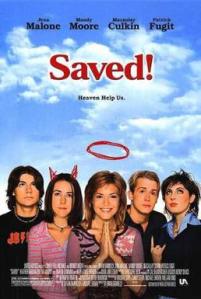
One of the many questions that haunt evangelical Christians is whether it is okay to watch horror films or not.  The same applies to whether it’s okay to listen to rock-n-roll (even as it’s reaching its senior years).  Cultural accommodation is often seen as evil and evangelicalism, as a movement, is frequently offered as a culture all its own.  I recently rewatched Brian Dannelly’s Saved!, a coming-of-age comedy about a group of teenagers at American Eagle Christian High School.  Gently satirical, it portrays well how evangelicals try to redefine “cool” in a Christian mode.  Taking tropes from pop culture and “baptizing” them, Pastor Skip—the principal—assures the young people that they’re every bit as cool as secular culture icons, only the Christians are going to heaven.

The film came out when I was teaching at Nashotah House.  That seminary also had problems with secular culture, but in a completely different way.  Its method was basically to ignore that culture.  Isolated, Anglo-Catholic, one might even say “Medieval” but for the sanitation, it was likely not a safe place for a professor to be watching such films.  Evangelicalism and right-wing Catholicism were beginning to find each other.  Once the cats and dogs of the theological world, they were becoming more like goldfish in their bowl, watching a strange and unnerving world just outside the glass.  A world in which they couldn’t survive.  Now, Saved! is only a cinematic version of this, but it has a few profound moments.  Mary, the protagonist, comes to see the hypocrisy of both the school and her former friends when she supports a boyfriend who is gay.

At one point her friends attempt an intervention.  They try to exorcize Mary, and when that fails one of them throws a Bible at her.  Picking it up, Mary says “This is not a weapon.”  Since this movie isn’t by any stretch of the imagination horror, I didn’t address it in Holy Horror.  As I rewatched it in the light of that book, however, I recognized a motif I did discuss in it.  The use of the Bible in movies is extremely common.  That applies to films that don’t have an overt Christian setting such as this one does.  The iconic Bible is a protean book.  Despite what Mary says it can indeed be a weapon.  It often is.  Many of us have been harmed by it.  Christian separatist culture has its own dark side, even if it’s carefully hidden, its adherents think, from the secular world outside the fishbowl.


Servants and Such

At Nashotah House I met my first real-life servant.  This was a student—a candidate for the priesthood—who’d formally been a “domestic.”  Now, being Episcopalian one doesn’t bat an eyelash at that sort of thing but I was secretly in shock that servants still existed.  I’m woefully uninformed about aristocracy.  Having grown up poor I resent the idea of a person being placed in the role of fulfilling the whims of someone just because they have money.  My wife has more of a fascination about this than I do, and she was recently reading a book about servants.  This post isn’t about domestics, however.  It’s about foreign gods.  In the book she was reading my wife noticed one of the servants writing that old-fashioned stoves were like Moloch.  Were it not for Sleepy Hollow, I suspect, many modern people wouldn’t know the name at all.  Who was Moloch?

Moloch, according to the Bible, was a “Canaanite” deity.  Specifically, he was a god that demanded child sacrifice.  The phrase the Good Book uses is that his worshippers made their children “pass through the fire” for Moloch.  Very little is known about this deity, and the question of human sacrifice is endlessly debated.  Theologically it makes sense, but practically it doesn’t.  Deities want servants and living bodies do that better than dead ones.  Although it’s been suggested that “passing through” could be a symbolic offering, by far the majority of scholars have taken this act as an actual sacrifice.  The ultimate servant is a dead servant.  Moloch, you see, comes from the same root as the word “king.”  And kings are fond of having many servants.

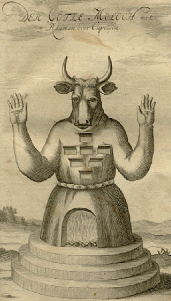
Image credit: Johann Lund, Wikimedia Commons

So how is a stove like Moloch?  The classic image of the god, which looks like a scene from The Wicker Man, holds the answer.  Well circulated since the early eighteenth century, this engraving has captured the imagination of modern people.  A massive, multi-chambered statue intended to consume by the raging fire in its belly.  This is the way in which a stove might resemble a Canaanite deity.  The servant who described cookware thus knew whereof she spoke.  Archaeological evidence for the “cult of Moloch” is slim.  It is almost certain that nothing like this fanciful image ever existed.  Moloch, in other words, lives in the imagination.  One aspect, however, rings true.  Like most tyrannical rulers the deity wants unquestioning obedience on the part of servants.  And this is a viewpoint not limited to deities.


Terror Text

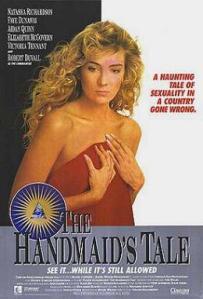
Dystopia reading and/or watching may be more practical than it seems.  History often reveals authors who may be accused of pessimism more as prophets than mere anxious antagonists.  Two books, according to the media, took off after November 2016.  One was George Orwell’s 1984,  and the other was Margaret Atwood’s The Handmaid’s Tale.  I’d read both long before I started this blog, but I recently asked my wife if she’d be interested in seeing the movie of the latter.  While teaching at Rutgers, I had a 4-hour intensive course and to give students a break from my lecturing I’d have us discuss Bible scenes from secular movies.  The Handmaid’s Tale was one of them.  Watching it again last night, I realized the problematic nature of Holy Writ.

The Handmaid’s Tale is a movie (and novel) that involves what I call “Bible abuse” in Holy Horror.  That is to say, the Bible can be used to oppress rather than to liberate.  To cause human suffering instead of eliminating it.  Sure, to make Atwood’s dystopia work a future catastrophe of fertility has to occur, but the military state, the assumed superiority, and the will to control on the part of men are all too real.  We’ve witnessed this in the United States government over the past two years.  A lot more has been revealed than personal greed—that side of human nature that quotes the Good Book while doing the bad thing.  In the movie it’s literally so, while our “leaders” are only a metaphoric step away from it.  Although it’s not horror, it’s a terrifying movie.  I still have trouble watching The Stepford Wives.  Why is equality so easy in the abstract, but so difficult when it comes to actual life?

Aggression is not a social value.  This is perhaps the most ironic aspect of using Scripture to enforce oppressive regimes.  The whole point of the New Testament is self-denial for the sake of others.  That may be why the only Bible reading in the movie comes from the Hebrew Bible, the story of Jacob and Rachel.  Although this isn’t one of the traditional “texts of terror,” to borrow Phyllis Trible’s phrase, it nevertheless illustrates the point well.  A culture that values women only for their reproductive capacities is dystopian to its very core.  When a book, no matter how holy, is divorced from its context it becomes a deadly weapon of blunt force.  Atwood moves beyond Orwell here—the government that sees itself as biblical can be far more insidious that one that only weighs evil on the secular scale.  Not only the Bible ends up being abused.


May Care

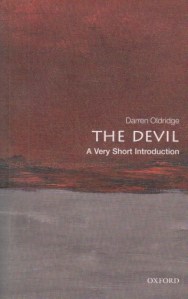
The thing about the Devil is that evil is no laughing matter.  Darren Oldridge had no easy task limiting the dark lord to The Devil: A Very Short Introduction.  He nevertheless does an admirable job packing lots of provocative stuff into a small package.  The historian of religion part of me found his short history of Satan in chapter 2 a compelling synthesis of the character’s background.  Longer sources get tangled in theological weeds once the New Testament’s over, what with erstwhile saints being recast as heretics over some minute point of doctrine.  Lots of ideas about the Devil were floating around in those days, even as they are today.  A particularly important point, however, is made early in this book: even during the Enlightenment most intellectuals—including scientists—assumed the reality of the spiritual world.  It was only when materialism alone came to reign that there could be no Devil because there could be no spirits.

A vast disconnect continues to exist between “public intellectuals” and hoi polloi.  The vast majority of people in the world are religious.  Even in, especially in, the United States a great number of people believe in the Devil.  Many of those same people can’t recognize political evil when it stands naked before them.  Here’s the irony of it all: Oldridge discusses how an evil system, let’s say Nazism, blinded many otherwise decent people to the evil they were asked to perform.  Rhetoric that demonized the other, when dispersed over large crowds, has historically had that effect.  Today we see “Christians” claiming that a social system of helping those in need is of the Devil.  The greatest weapon of the prince of darkness is the sincerely believed lie.

Lies have always been associated with the Devil.  When the number of untruths coming from the White House has broken the very meter for measuring lies, those who claim the name of the crucified man who advocated care for the poor shout all the more loudly.  Not at the lies, but at those who don’t accept them.  Historically, the reign of facts has kept some checks on the Devil.  Even Jesus accused Herod of watching Fox—or was it being a fox?—too bad there are no facts to check.  Oldridge doesn’t tip his hand as to whether there is an actual Devil or not.  Society has, however,  no trouble making up its mind.  All they need to do is turn on the television.


Quiet on the Winter Front

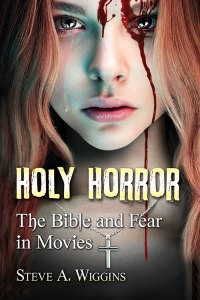
There’s a weird silent time, after a book is published, when you start wondering how it’s doing.  Holy Horror was apparently released November 29, and published December 29, if done according to standard publishing practice.  The release date is when stock is received in the warehouse.  The book is printed and technically available, but not yet published.  Publication is about a month later when the sellers, distributors, etc., have received their orders and can begin sending them out.  Publishing, as I’ve noted before, is a slow business.  Somewhere around this point you start wondering how your book is doing.  Reviews take some time to appear.  The publisher falls silent (I know this from the editorial perspective as well).  You start thinking, did it really happen?

This is the internet syndrome.  We’ve become used to instant results and it’s difficult to believe that can get by without minute-by-minute updates.  The problem is publishing is slow.  Reading a book takes time.  Not all readers review.  It’s perhaps the kind of malaise you expect in late winter.  In my case, however, my book was an autumn book that missed its release date by a few months.  Yes, hardcore horror fans are still chomping at the bit for upcoming features like Us, but the public in general is well on its way to Valentines Day and what comes after.  We are pretty much a holiday-driven culture and Holy Horror was a Halloween book released after Christmas.  That, and the combination of Bible and horror is unexpected, with many, I’m guessing, thinking the book is something it isn’t.

Often at work I ponder how publishing has changed, even if it runs like sap in January.  Professional writers—those who lived from their books alone—used to be rare.  Most authors were otherwise employed, and many of them worked in publishing.  It stands to reason when you think about it.  I’ve worked for three publishers and finding other writers is, and has been, a rarity.  Instead editorial boards consist of people who largely don’t have the experience of writing a book of their own talking about author expectations.  A disconnect has emerged where writers find employment in other industries and find themselves wondering why publishers do things the way they do.  Even with that background knowledge, I do wonder how my little book is doing.  It’s only natural.  And now that we’ve progressed to February, it’s only eight months more until October.


Desert Demons

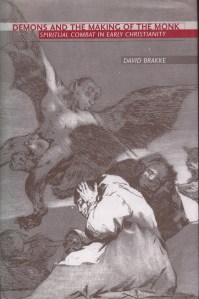
After reading many popular books, coming to a scholarly tome can be a shock to the system.  This is especially the case when said academic volume contains lots of information (not all do, believe me!).  David Brakke’s Demons and the Making of the Monk: Spiritual Combat in Early Christianity has been on my reading list for quite some time.  One of the perils of being a renegade academic is that you have no university library at hand and I’m not sure I want to reveal this side of myself to the local public librarian yet.  In any case, it would be difficult to summarize all that Brakke covers in this insightful treatment.  One of the elements that struck this reader, however, is the protean nature of the demons with which the eponymous monks wrestled.

Keep in mind that although demons appear throughout the Bible in various forms there is no single definition of what they are.  They appear to be spiritual monsters, in short.  Some passages seem to suggest they are fallen angels.  Others that they are foreign (primarily pre-Christian) gods.  Later ideas add the possibility that they are children of the Watchers, or even, as Brakke explains, evil thoughts.  The desert monks didn’t dwell on trying to discern their origin myth—they were out there to purify their souls, not to do academic research.  The Hebrew Bible does suggest that demons were creatures of the desert.  As monasticism began, appropriately in Egypt, one natural resource found in abundance was wilderness real estate.  The mortgage, however, was a constant struggle with demons.

Many of these demons developed into the seven deadly sins.  Not surprisingly, men living alone in the desert found themselves the victims of sexual temptation.  This led to, in some cases, the demonizing of women.  We’d call this classic blaming the victim, but this is theology, not common sense.  Anything that stood between a monk and his (sometimes her) direct experience of God could, in some sense, be considered demonic.  Brakke presents a description of several of these early desert-dwellers and their warfare with their demons.  Much of their characterization of evil would be considered racist and sexist today.  Brakke does make the point that during the Roman Empire—the period of the earliest monks—race wasn’t perceived the same way that it is in modern times.  Nevertheless, some of this book can make the reader uncomfortable, and not just because of demons.  Or, perhaps, that’s what they really are after all. 


McChristianity

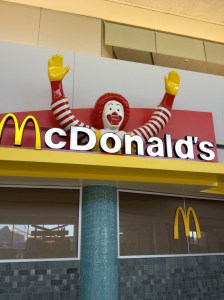
Christianity isn’t known for its sense of humor.  The same can be said of other religions as well, of course.  What else should we expect concerning belief systems that claim eternal consequences?  A story by Colin Dwyer on NPR explains that the Haifa Museum of Art had to remove a sculpture titled “McJesus” due to public violence.  The sculpture depicts a crucified Ronald McDonald, and a number of althoughs follow: although Haifa is in Israel a large number of Christians protested.  Although the practice of crucifixion was uncomfortably common in ancient days it has come to be associated with one particular case.  Although the message might be interpreted as a condemnation of commercialism, protestors took it to be aimed at their faith.  Perhaps it was.  Artists can be notoriously ambiguous in that way.

Ronald McDonald is a liminal, if ubiquitous figure.  Instantly recognizable, he has been challenged before as a threat to christendom.  I once heard a priest lament that children recognized the golden arches more than the cross.  Well, that’s not surprising—we don’t go around telling our kids about crucifixion daily.  (Or shouldn’t.)  A massive Ronnie, on the other hand, floats down Manhattan every Thanksgiving Day.  He’s on posters, commercials, and 42nd Street.  He’s the patron saint of branding.  With his garish clashing color palette, his red and yellow never mix to orange and they linger in our minds to ensure us that no matter where we might be there’s always cheap, if unhealthy, food nearby.  Mr. McDonald has become a religious symbol of capitalism.

Even as a child I noticed the great deal of excitement that accompanied the opening of the local McDonald’s.  In a small, corroded corner of the rust belt, families piled into cars to drive to Oil City to see this wonder.  It was like an epiphany.  Eating out that the poor could afford.  Just about everything in downtown Oil City is now closed, but the last time I was there that McDonald’s still stood.  Back in Haifa an ironic depiction led to real violence.  Angry Christians carrying stones couldn’t see the statue as a condemnation of consumer culture.  Their beleaguered religion was at risk.  Blood flowed and the art piece was removed and packed off to Finland.  Although the point of the display was to question religious appropriation in the support of consumerism, and although that message could ultimately support the teachings of the religion it evokes, the branding came across all wrong.  Church is your kind of place…


Prejudices of the Time

When my daughter was in middle and high school, I made an effort to read every book she was assigned for her English classes.  This gave us something to talk about during the years when many teens grow laconic and uncommunicative.  Some of the books I’d read before, but one frightened me off.  Ken Kesey’s One Flew Over the Cuckoo’s Nest pressed the wrong buttons.  You have to understand that I saw the movie for a class in college.  It disturbed me.  Even before encountering H. P. Lovecraft, one of my deepest phobias was insanity.  Children of alcoholics sometimes fear those who are out of control, and mental patients had become, in my head, associated with the non-rational behavior of my father that frightened me so.  During a clown ministry event we visited the local state hospital for mental patients.  I trembled for about a week after we left.

One Flew Over the Cuckoo’s Nest is in many ways a sixties novel.  One reflection of that is the fact that the religious imagery in the novel is presented in the form of punishment.  Everyone knows the narrative of R. P. McMurphy’s battle of the wills against Nurse Ratched.  The latter uses electroshock therapy as punishment and she tries to wear McMurphy down by using it repeatedly after the fight in the shower.  The electroshock table is described as a cross.  The metal headset is a crown of thorns.  Indeed, one of the patients is described as being crucified to the wall of the ward where he hangs throughout the novel.  The sixties frequently saw religion—especially the staid, conservative evangelicalism of the 1950s—as a form of punishment.  That’s pretty clear here.

Although the novel celebrates the freedom of the sixties, it also reflects the prejudices of the times.  The African-American attendees on the ward aren’t portrayed sympathetically.  The women—nurses and prostitutes alike—are there for the pleasure of the male patients’ gaze, exemplified in the leering laugh of McMurphy.  Still, there’s a kind of catharsis to this tale.  The Chief, from whose point-of-view the story’s told, is arguably cured by the antics and special attention McMurphy shows him.  Beneath the callous, self-serving conman there is a human decency that “the system” fails to find.  Indeed, McMurphy is a kind of Christ figure.  A fallen savior, no doubt, but a liberator nonetheless.  This was a difficult novel to read.  I couldn’t make myself pick it up half-a-decade ago, but I suspect somewhere beneath the surface I’m glad I’ve finally read it.  It didn’t cure any of my phobias but it made me think.


Xenophobia’s Children

There are consequences, it seems, for not paying attention in school.  I have no way of knowing, of course, but I suspect most of us are taught that basic fairness is the social ideal.  Xenophobia is deeply embedded in the primate psyche, but to those who claim we haven’t evolved, there seems to be no way to convince them that “racial” differences are merely a matter of differing collectives separated by natural borders.  Over time traits favorable to the region predominate, and humans therefore have what seems to be a very wide array of potential appearances.  There should be nothing in all of this that suggests one group is superior to another.  Primate evolution, however, helps to explain but not to excuse.  Xenophobia is something from which we can evolve.

Fear is at the heart of any phobia.  In a society that measures the worth of individuals by their wealth, fear that another will take it is constant.  Perhaps, in a part of our souls we’d rather not acknowledge, we know it’s wrong to have too much while others don’t have enough.  It’s very cold this Martin Luther King Jr. Day.  In Manhattan on Saturday I saw many people on the street, those who’d met the wrong end of capitalism.  I’ve seen human beings shivering in Dickensian conditions in the twenty-first century.  I’ve known capable adults who couldn’t find work, even when they’ve tried.  We fear the street person.  We know that, but for slight shifts in capitalism, that could be us.

Xenophobia has come under threat with globalization.  We’ve made travel to remote locations affordable in order to spread capitalism to regions ready to be exploited.  And we see nothing wrong with taking from those who can’t prevent us from doing so.  Then we wonder why people just like us turn out to march in the cold.  Civil rights marches took place half a century ago.  Crowds thronged the nation’s capital seeking basic human treatment.  Fifty years later over a million women and supporters had to show up to make the same point again.  Fair treatment should not be a commodity.  Those who have fear the stranger.  Those who have don’t wish to share.  They claim the name of “Christian” and mock the very tenets upon which that belief system was founded.  It’s cold outside today.  As we huddle inside, we should have time to think.  It is a waste of a national holiday if we don’t at least ponder for a few moments what it is we celebrate.  And the real costs of xenophobia.


OBSO

Oxford Biblical Studies Online is a subscription service for institutions that gives access to many biblical studies resources produced by the press.  It also features current essays that stand on this side of the paywall, written on contemporary issues.  In a shameless self-promoting plug, I’d direct you to this link to see my latest publication.  You see, I’m not alone in looking at Bible through the lens of horror.  As the acknowledgements to Holy Horror reveal, many conversations were going on that led to that book.  While the ideas contained in it are my own, I’m by no means the only one to have noticed that the Good Book makes guest appearances in genre fiction.  One of the points I made to my students when I held a teaching post was that the Bible is ubiquitous in our culture, whether we know it or not.  Just look at the Republican Party and beg to differ.

The idea is not without precedent.  For those who read the Bible real horror isn’t hard to find.  The Good Book can be quite a scary book.  Consider for just a moment the final installment—Revelation, apart from being full of amazing imagery, is an amazingly violent book.  Attack helicopters and atomic bombs may not yet have been invented, but there was no shortage of ways to kill people in the pre-gunpowder world.  Revelation paints the world in the throes of horrible suffering and death.  Indeed, the completely fictional Left Behind series rejoices in the death of the unrighteous who are, well, left behind.  Even today there’s a significant segment of “Christianity” that rejoices in the chaos Trump has unleashed.

In the OBSO article I sketch a brief history of how this came to be.  The history could work in the other direction as well.  The fact is the Bible and horror have always gone fairly well together.  Among genre literature, however, horror is a distinctive category only after the eighteenth century (CE).  Early horror novels, under the guise of Gothic fiction, often involve religious elements.  Culture was already biblically suffused then.  This is a natural outgrowth of a would steeped in violence.  Personally, I don’t like gore.  I don’t watch horror to get any kind of gross-out fix.  My purposes are somewhat different than many viewers, I suspect.  What we do all have in common, though, is that we realize horror has something honest to say to us.  And it has been saying it to us since from in the beginning.


Mephistopheles

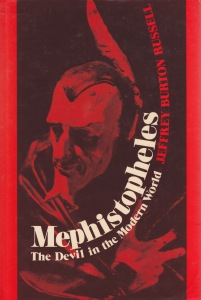
Jeffrey Burton Russell is one of the clearest thinkers I’ve ever read.  I first encountered him in my background reading for Holy Horror, and have subsequently tracked down his books on the history of evil.  In what is a dangerous move for a scholar, Russell admits in The Devil that he believes in some kind of personified evil.  Except for religion scholars employed in seminaries, such thoughts are generally kept carefully guarded as academia has followed the materialist paradigm since it boldly declared that there’s no other way to know the world.  Russell’s intellect penetrates through that posturing and logically lays out what can or can’t be known based on empirical evidence.  And in Mephistopheles: The Devil in the Modern World, he concludes his historical sweep of an idea as old as civilization itself.

This is a wide-ranging book.  The previous three covered long periods as well: antiquity through the Hebrew Bible, New Testament through late antiquity, and the Medieval Period.  Mephistopheles has to cover from the Reformation through the present of the latter 20th century (when it was written).  Finding evil in the modern world is arguably way too easy.  Since 2016 it has become more fashionable to the point that an entire political party can laud it.  Russell writes with the strong conviction that love and the will to goodness can overcome the tendencies of humans to allow hatred, fear, and prejudice to rule.  What seems to be lacking, some three decades on, is the will.  We have given in to our cynicism and elected the worst of our inclinations.

In William Friedkin’s documentary The Devil and Father Amorth, Russell, looking depressed, is interviewed about the reality of demons.  His advice is to look for the good instead.  Nevertheless, having spent years of his life researching how evil appears and reappears, his own fascination demonstrates why we return to the subject time and again.  The world hasn’t righted itself.  His books indicate that there is a way, but we continue to ignore that way, preferring instead to follow the loudest of mouths rather than the warmest of hearts.  Some would personify this into Mephistopheles, the modern, entertaining aspect of the Devil.  Others would claim it’s merely a metaphor.  No matter which may be the case there’s no denying that evil exists.  And if it exists it behooves us to know about it.  And once we learn its identity we must name it.


New Horror

Now that Holy Horror is out I’ve been noticing an increasing number of scholars who are writing on the topic of monsters.  Book writing takes several years, as a rule, and when I began work on my contribution to the discussion the bibliography was a touch slim.  There weren’t many books out there and academics who addressed the topic did so warily.  Now scarcely a day or two will pass when I won’t find another book I should read on the topic.  Publishing may be an industry in crisis, but there’s no dearth of new books being produced.  Monsters—which define horror—are a means of coping with the realities of a world out of control.  Since 2016 many of us have felt a vague, if at times pointed, sense that something is seriously threatening out there.  Horror seems a logical response.

Academia tends to run behind trends rather than setting them.  Academic books in general don’t sell too well, and monsters often have crossover appeal.  The longer I’m at this, the more I think of how knowledge as a whole is gathered.  Having that shiny Ph.D. doesn’t do so much anymore when it comes to credibility.  It may get you in the publisher’s door, but to attract readers it helps to pick topics that scholars have typically avoided.  Monsters are a calculated risk in this regard.  Those who publish in the field become somewhat suspect among their colleagues, as if the subject is one that can only play itself out in naivety, an under-developed sense of sophistication.  Anything popular tends to be devalued in the academic mindset.  It is, therefore, encouraging to see others addressing my beloved monsters.

A new year is starting and, like many people I have high hopes that it will show some improvement over the past.  I can actually dream of a world without monsters and although pleasant it isn’t realistic.  We have evil with which we must deal.  Horror allows for a fair amount of practice in that regard.  I’m very well aware that many people find the topic repugnant, or at least distasteful.  Academics, it seems, are following their restless curiosities to the darker corners of the mind.  It’s getting difficult to keep up with the monster books appearing, even from reputable presses.  Holy Horror is my first contribution to the discussion and Nightmares with the Bible, which I hope to finish this year, will continue the conversation.  It looks like it’s becoming trickier to find a voice in this crowd already.  I wonder if that implies a better 2019, as we run behind the times.


Fossilized Ideas

In our current political climate, perspective helps quite a bit.  Indeed, one of the shortcomings of our conscious species is our inability to think much beyond the present.  In either direction.  Because of the biblical basis of western civilization, a significant portion of otherwise intelligent people believe that the world was created 6000 years ago.  I grew up believing that myself, before I learned more about the Bible and its context.  I also grew up collecting fossils.  Somehow I had no problem knowing that the fossils were from times far before human beings walked the earth, but also that the earth wasn’t nearly as old as it had to be for that to have happened.  Faith often involves contradictions and remains self-convinced nevertheless.

While out walking yesterday I came across a fossil leaf.  Unbeknownst to our movers last summer, I have boxes of fossils that I’ve picked up in various places that I’ve lived.  I find it hard to leave them in situ because of the fascinating sense of contradictions that still grabs me when I see one.  There was an impression of a leaf from millions of years ago right at my feet.  It was in a rock deeply embedded in the ground and that had to be left in place.  Never having found a floral fossil before this was somewhat of a disappointment.  Still it left an impression on me.  Perhaps when dinosaurs roamed Pennsylvania—or perhaps before—this leaf had fallen and been buried to last for eons.  How the world has changed since then!

After that encounter, I considered the brown leaves scattered from the recently departed fall.  Some lay on the muddy path, but few or none of them would meet the precise conditions required to form a fossil.  If one did, however, it would be here after humanity has either grown up and evolved into something nobler or has destroyed itself in a fit of pique or hatred.  We know we’re better than the political games played by those who use the system for their own gain.  The impressions we leave are far less benign than this ossified leaf at my feet.  The Fundamentalist of the dispensationalist species sees world history divided into very brief ages.  God, they opine, created the entire earth to last less than 10,000 years.  All this effort, suffering, and hope exists to be wiped out before an actual fossil has time to form.  It’s a perspective as fascinating as it is dangerous.


Better Late Than

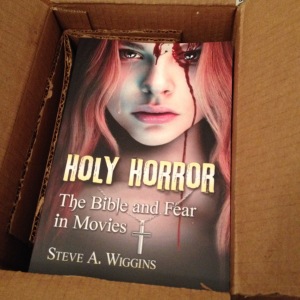
It seems that Holy Horror is now available, although I haven’t seen it yet.  According to the McFarland website it’s in stock just in time for the holidays.  Those of you who know me (few, admittedly) know that I dabble in other social media.  One of my connections on Goodreads (friend requests are welcome) recently noted that he does not like or watch horror.  Indeed, many people fall into that category.  His follow-up comments, however, led me to a reverie.  He mentioned that reading the lives of the saints and martyrs was horrific enough.  One of the claims I make in Holy Horror is that Mel Gibson’s Passion of the Christ is a horror film.  My friend’s comment about martyrs got me to thinking more about this and my own revisionist history.

Traditionally horror is traced to the gothic novel of the Romantic Period.  Late in the eighteenth century authors began to experiment with tales of weirdly horrific events often set in lonely castles and monasteries.  From there grew the more conventional horror of vampire and revenant tales up into the modern slasher and splatter genres.  I contest, however, that horror goes back much further and that it has its origins in religious writing.  Modern historians doubt that the mass martyrdoms of early Christianity were as widespread as reported.  Yes, horrible things did happen, but it wasn’t as prevalent as many of us were taught.  The stories, nevertheless, were written.  Often with gruesome details.  The purpose of these stories was roughly the same as the modern horror film—to advocate for what might be called conservative social values.  The connection is there, if you can sit through the screening.

Holy Horror focuses on movies from 1960 onward.  It isn’t comprehensive, but rather it is exploratory.  I’ve read a great number of histories of the horror genre—a new one is on my reading stack even as I type—and few have traced this phenomenon back to its religious roots.  Funnily, like horror religion will quickly get you tagged as a weirdo.  Perhaps it’s no coincidence that both goths and priests wear black.  As I’ve noted before on this blog, Stephen King’s horror novels often involve religious elements.  This isn’t something King made up; the connection has been there from the beginning.  We may have moved into lives largely insulated from the horrors of the world.  Protestants may have taken the corpus from the crucifix for theological reasons, but for those who’ve taken a moment to ponder the implications, what I’m saying should make sense.  Holy and horror go severed hand in bloody glove.