Religi-Religi-Religi-Religulous, That’s All Folks!

Tell me where is fancy bred,
Or in the heart or in the head? (Shakespeare, The Merchant of Venice)

Every great once in a while, a must-see movie comes out even for religion specialists. We have to lay aside our Biblia Hebraica Stuttgartensias for a while, stare at one of the talkies and scratch our heads. Last year my students asked me what I thought of Bill Maher’s Religulous, but I didn’t have a chance to see it (couldn’t afford it on the big screen, and who has time during the school year anyway?). So I finally got together with a friend to watch it on the small screen.

First off, the film is funny — hey, it was written by a comedian, so it’d better be funny! As Maher ticked off point after point after point where religion falls short of the mark, I felt as though I were watching Christopher Hitchens’ God is Not Great on the television.
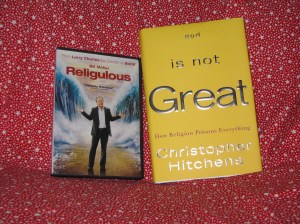
Let's be friends

Let's be friends

Maher scores some big points for having done his homework on mythology and pointing out the mythical elements in mainstream Christian thinking, but I was left with some very basic questions: what about those who hold to religion for good reasons? What about those who don’t strap bombs on in the name of religion? What about those who promote humanitarianism for religious purposes? Can they be classed together with dangerous folk who use religion for nefarious rationales to get back at their enemies (generally anyone they don’t know)? The scenes of religion-inspired violence were extremely disturbing, but I was curious about the benign varieties of religion. Do they do any more harm than taking a toke, as Maher does a time or two in the film?

It occurred to me that religions offer a way out from what can be a very humdrum world. Evolution is certainly fact, but the long, slow process of evolving into something better fit for its environment doesn’t spur on the emotions like the Battle Hymn of the Republic. But isn’t that it in a nutshell? Religions show their flashier colors when they are in conflict, like peacocks competing for the affections of a peahen. Even those interviewed by Maher tended towards the more flamboyant practitioners of their faiths. What should really be on the docket is hatred. Religions may aid and abet those looking for excuses to harm those different from themselves, but religion is often the catalyst, not the cause. As religion goes through the long, tedious, and often painful process of evolution, it is sure to breed virulent strains that are nasty and evil, but once in a while the panda’s thumb emerges and humanity is ready for its next painful step forward.
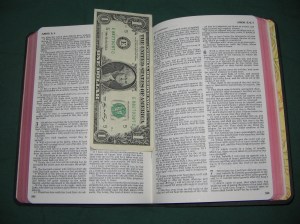



Currying Divine Favor

The name Kerala leapt out at me from a stunning newspaper article that reeked of indulgences and simony just this week. Kerala, a southern region of India, is home to a large number of Syriac Orthodox Christians. In my time at Gorgias Press I often heard their industry praised and was informed how cheaply fellow “Christians” would work. I even saw the position of a great fellow worker at Gorgias evaporate as his duties were “outsourced” to India. Ah, Outsourcing, thy name is Greed.

I recall the days when Greed was considered one of the seven deadly sins. Apparently now it is an acceptable means of replenishing ecclesiastical coffers. An article on Thursday’s New Jersey Star-Ledger front page bore the headline “Recession hits Indian churches offering outsourced prayer”(!). The article explains that Catholic churches in the United States, hard-pressed for priests, have been outsourcing Mass intentions (dedicatory prayers) to their colleagues in India. The mind spins — American families, wanting a Mass intention dedicated to dear departed Aunt Bertha, sells the option to India where prayer is cheaper. As the headline declares, the Recession has cut into the profit margin of the Indian Catholic Church. I’m no mathematician, but it seems that a degree in accounting might help to sort all this out: Americans sell prayer intentions to priests in Kerala, who (when they aren’t working for Gorgias Press in their spare time) send them along to a God who is supposed to be omniscient anyway? And money changes hands for this? In Kali we trust!

Organized religion requires financial upkeep; only a blind naked mole rat can’t see that. Nevertheless, when religions gain enough financial leverage to become power brokers, it seems that they have slipped their moorings. I have watched hypocritical “prosperity gospel” believers benefit from the hard work of the poor, and I have seen the coffee-table books touting the immeasurable wealth of the Vatican, and I have witnessed the homeless curled up on urban church doorsteps on a cold Sunday winter morning. And I remember what Amos wrote, “For I know how many are your transgressions, and how great are your sins — you who afflict the righteous, who take a bribe, and push aside the needy in the gate…” (5.12). And I wonder who might be the safer bet, Yahweh or Kali?

WWAD?

WWAD?


The Dark Light

Like many Americans, last year I was fascinated by Christopher Nolan’s gripping and gritty Batman film, The Dark Knight. Admittedly, the untimely death of Heath Ledger added to the poignancy of the film, but his unfaltering performance as the Joker was no laughing matter. I was transfixed. Not only was this vision of the character previously immortalized by Cesar Romero and Jack Nicholson a sea-change, it was also an epiphany.

In attempting to understand ancient religion, you can’t get far without having to address priests and prophets. Priests appear at the dawn of civilization, the establishment’s religious functionaries. They had (have) a vested interest in the continuation of the reigning power structures. Priests make their living from a population settled enough to tax. Prophets, however, have a far older pedigree. Israel recognized prophets as we all know from the Hebrew Bible, but other ancient religions also had their prophets too. Prophets were religious functionaries from outside the established power structures — they challenged conventions, demanded radical changes, and caused migraines for more than one priest. The prophet seems to have evolved from the shaman.

Not a Joker! An Amazonian shaman

Not a Joker! An Amazonian shaman

The shaman was what anthropologist call a “liminal character,” an outsider. They simply do not play by society’s rules, but they are feared and respected by society. The shaman may see or hear things that are beyond the perception of your average citizen. The shaman may be dangerous. This is what I saw in Heath Ledger’s Joker. A disturbing character who challenges and yet at the same time brings focus and resolution to a fractured society. A wounded healer. He represents a fossil, a shaman in twenty-first century Gotham. The other Jokers, Romero and Nicholson, didn’t quite attain this level of spiritual catharsis. Although I knew Batman was the good-guy, the Joker, laughing when he should have been crying, the agent of chaos, was the most religious character in the movie. He was the Dark Light to Batman’s Dark Knight.


Graven Images

Religious statuary was ubiquitous among the ancients. That which the eye can perceive is so much better for focusing the attention than the amorphous unknown. In methods reminiscent of my days of toy soldiers and action figures (not dolls!), priests of Near Eastern temples would dress their statues, offer them refreshment, and take them for a public parade to reassure the populace that they were still being cared for. Citizens didn’t regularly “go to church” or synagogue, the temple was the work-space of the priesthood. So regularly scheduled public jaunts with the goods, or gods, on the shoulders helped to reassure ancient folk that all was well. If a city-state or nation lost in battle, their statuary was taken captive by the victors — what could you do if they’d taken your gods? Even in the Bible the ark is taken as spoils of war by the Philistines. They knew the drill.

Monotheism and aniconic religion go hand-in-glove. If there is only one god, then multiple images only cause confusion. Although the ancients were more sophisticated than we often suppose — they knew the statues were not the actual gods, thank you Second Isaiah — when monotheism took hold in emergent Judaism, the divine images had to go. Early Christianity shared this antipathy for graven images, for a while. Soon paintings in catacombs represented Jesus and an industry in religious art was about to boom. If the image represents a holy person, the image itself must be holy. It’s a hard idea to shake.

In the paper the other day, an article explained how a couple of people stole Jesus in Hackensack, New Jersey. “2 charged in theft of Jesus” the headline read (in part). Our would-be godnappers tried to sell a 200-pound bronze statue of Jesus for scrap metal. Even with advanced training in religious studies, and a skepticism borne of too many years as a professional religionist, I wouldn’t try to scrap Jesus for cash. The image might have some ark-of-the-covenant-type power! Once while jogging through a church parking lot, a pagan bug flew into my mouth.

An ethical morass

An ethical morass

This posed a serious ethical dilemma — if I swallowed it my decade-long clean record as a vegetarian went down the drain; on the other hand, expectoration on consecrated ground surely posed a potentially personal apocalypse with The Landlord! As I forcefully released the confused (and slightly gooey) insect back into nature, I had a moment of Kierkegaardian aangst that the job I’d recently applied for would now go to someone else. I had defiled a church parking lot with a little spittle! Religious symbols indeed have power. It takes a brave thief to sell a stolen divinity into the hands of sinners. And I didn’t get that job after all.


Yes, Mammon

In the continuing coverage of the most recent New Jersey scandal the Star-Ledger, on Monday’s front page, posted a picture of San Giacomo Apostolo in Hoboken. San Giacomo is traditionally the brother of the equally mythical St. Ann. The statue, which stands outdoors in a public street, has monetary donations tacked to it. The image flashed me back to my Nashotah House days when students became visibly excited nearing the date for the procession of Our Lady of Walsingham at the proto-shrine in Fond du Lac, Wisconsin. Seminarians would beg for an opportunity to hoist the holy statue, or at least be a lowly acolyte. (These were grown men, mind you — many of them seeking the priesthood as a second career.) I never attended Walsingham, but it was my understanding that pilgrims and penitents at the festival also adorned their lady with money in hopes of some gift of grace. I grew up in a blue-collar household where paying ladies for favors was itself considered a sin.

Looks like Our Lady has put on some weight

Looks like Our Lady has put on some weight

While on a recent trip home, I saw a church for sale. As I started to break out my checkbook, I recalled how closely money and religion are tied together. The more I pondered this, the clearer their ancient, entangled roots became. The religiously observant bringing gifts to the temples of their gods was a standard act of piety and civic duty in the ancient world. Temples were expensive and the staff could only be supported by continuous donations. In the Ugaritic tale of Kirta, our protagonist seeks a son and makes a vow to Lady Asherah that if he successfully procures a wife he will make a statue of her in silver and gold. The favors of gods may be purchased. Today credit cards are accepted, but we are still caught in the web of those who claim God has asked them for your money.

For sale, God not included

For sale, God not included

When I was a teenager a friend invited me to attend a public presentation by some visiting Rev. Harrington, a popular evangelist. Several times during his high-energy sermon he sent the collection baskets around. The first time it was for your standard church offering. The second time was for any change you had in your pockets. The third time was for a special blessing. For those who had checkbooks ready, a thousand-dollar donation would get your name on a personalized plaque in his private jet. Years later I saw Harrington on television during an interview on his private estate. He puttered around it in a customized golf cart with wheels designed not to scuff up the gold-plated bricks that constituted the drive before his opulent mansion. “If we’re going to walk on streets of gold in heaven, I want to get used to it here,” he casually explained.

So, as an (unofficial) agent of Asherah, if you are seeking to make a divine investment, get out your checkbooks and I’ll tell you where to send the donations (checks made to “cash” please!).


Not Lion

Being raised without much of a paternal presence, I frequently wondered at how church services were always presided over by men but populated by women. When I grew up (well, part-way at least) I became interested in feminist interpretations of the patriarchal Bible. The idea that just half of the human population seemed to have all the interpretive privileges simply struck me as unfair. Being a man myself, however, I wasn’t sure where to go with feminist interpretation, or even if I was qualified! This penchant no doubt vexed many an official in my Nashotah House days, but the conviction only grew stronger there.

While preparing class materials on the prophet Amos, I recalled how fond the prophet was of leonine imagery for Yahweh. Amos characterizes Yahweh as roaring, hunting for prey. Curious about lions in Israel, my research revealed that the great felines are extinct in that part of the world. The Barbary lion, extinct in the wild, was the biblical lion. As usual, we kill off what we don’t comprehend.

Further research revealed that lions like to sleep even more than most teenagers. It is not unusual for a lion to sleep 20 hours a day! When they have to wake up, however, they are hungry. And here was the interesting tidbit — when lions hunt it is usually the females that do the work! Once a kill is made, the male struts in and takes the proverbial lion’s share, but the lionesses are the hunters. In the ancient world, before television, ipods, or even mindless Ann Coulter drivel, people were keenly aware of their environment. Ancient writers often made astute observations of nature. Would Amos, the shepherd, have known that it is the lioness who makes the kill? Was Amos the first feminist in the Judeo-Christian tradition?

Compare the lions.

Compare the lions.


Which is scarier?

Which is scarier?


Sects and Violence

Religion-sanctioned violence has a long (overly long) pedigree. Early myths going all the way back to the Sumerians incorporate violence on the part of the gods. Depending on one’s school of interpretation, this could be seen as “form following function” — people saw the violence inherent in nature and projected its causation onto the source of nature, namely, the gods. Ancient people did not perceive of the world in terms of natural phenomena. “Nature” behaved the way it did with will and reason, the will and reason of the gods.

The stories preserved from ancient Ugarit stand as witness to this conceptual world. In one story, Kirta by title, the eponymous king Kirta seeks a family and has his wish granted by El and Baal. Hedging his bets, he makes a vow to Asherah that he forgets to fulfill. Asherah sees to it that Kirta’s divine gift comes undone. More obvious is the tale of Aqhat, another divinely granted child. Aqhat is given a bow by the craftsman god Kothar-wa-Hasis, only to have it coveted by Anat. When he refuses to release it to the goddess he is unfortunately pecked to death in a hitchcockian demise by a swarm of buzzards with attitudes. Violence is introduced into the human realm by the gods themselves.

Today, some 3,000 years after Ugarit, we still find ourselves living with violence sanctioned by religion. Whether it is as obvious as extremist factions of a religion calling for outright attacks on others, or as subtle as self-professed righteous believers destroying a colleague’s career in the name of Jesus, religion is used as a mental crutch for striking others. While I can not walk all the way with Christopher Hitchens, I do have to acknowledge that when it comes to human-on-human violence religion is a socially accepted motivation, no matter how pure its original intentions.

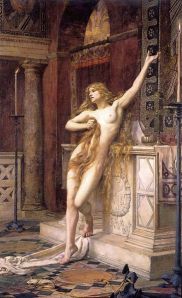
Hypatia, a scholar-martyr due to religious violence

Hypatia, a scholar and martyred victim of religious violence


God is Great (not)?

As a teacher/editor with an “advanced” degree in religious studies, I was intrigued by the sudden popularity of Christopher Hitchens’ God is Not Great (Twelve Books, 2007) a couple years back. I bought it as soon it was available and read it cover-to-cover after a morning out picking strawberries.

Reading Hitchens’ analysis I found myself nodding my head quite a bit; he scores a substantial number of points on which various religions should plead “guilty.” And while I found many of his arguments persuasive, part of me still wonders if perhaps religion, that most ancient of cultural forms, has not had at least some positive impact on humankind. In the most basic sense, our civilization would not be here to critique religion if religion had not been an impetus to get our civilization to begin its motion towards today’s civilization. Black and white are not in the palette of serious religious studies.

For the scholar of religion, however, Hitchens should be required reading. Sometimes we have to stare hard into the face of the facts of what our object of study has become and wonder, with Samuel F. B. Morse, “what hath god wrought?” Religion bears the mark of Janus, and scholars of religion have to pay attention to what people are saying about it.