The Safest Place to Hide

One of the most poignant stories in religiously motivated violence, at least in the consciousness of Americans, was the series of disastrous events of 9/11. In the wake of that event, several previously assumed privileges of United States citizens came under scrutiny and were subject to curtailment. I know that on the rare occasions when I fly I feel demeaned by some uniformed stranger telling me to partially undress and explaining that if s/he has to feel me up it will be with the back side of the hand, to protect my modesty. Still, I never complain. Freedom has its price, they say.

Another place where we have funneled our abundant national resources is the Department of Homeland Security. We are willing to pay quantum-sized price-tags to feel safer at home. Then today’s newspaper announces that a fugitive from justice has been working at Homeland Security for two years. A woman nationally wanted for insurance fraud, arrested once after the bulletin was posted, was just now discovered to have been working for Homeland Security. Having watched concerned parents have to go through extensive background checks and even fingerprinting to accompany their kids on a school fieldtrip, I’m not sure that this news makes me sleep any more securely. If we can’t find a criminal who is a government employee (politicians excepted, of course), who has presumably undergone a background check (regularly required for those of us subjecting ourselves to applying for job openings), well, maybe we ought to address the religious violence issue instead.

A friend once told me of an acquaintance who’d failed a test to work in a fast-food restaurant who went on to be hired by the Transportation Safety Administration. So that guard reaching a latex glove toward me may not have had the wherewithal to attain to fast-food service, but will be keeping terrorists off our airplanes. If religious leaders would lay down their ungloved hands and seek to understand their enemies perhaps none of this would even be necessary.

Billion Dollar Babies

Yesterday I attended a holiday-themed concert. It was an unusual mix of the archaic and post-modern in that although many traditional holiday pieces were sung, the readings were from an assortment of writers, some still living. The theme, not surprisingly, was the wonder of birth. One of the readings was from D. H. Lawrence, a writer more often associated on the making of babies end of the equation. Nevertheless, as the soporific music flowed I found myself once again thinking of special babies.

The concept of a special child marked at birth has an ancient pedigree. Long before Samuel, Samson, and Moses there were ancient heroes known from their unusual births. The theme is at least as old as Sargon of Akkad, and probably even older. Those who grow to achieve great things in life must, by back-formation, have had a wonderful birth. Of course, when they were born nobody knew they were special yet, and so our mythopoeia demands we devise incredible births for them. Anyone who is a parent knows that time stops and the entire world stands in rapt silence as your own child is born. All babies are billion-dollar babies.

The subtext to all of this is that without even looking for a special child we should realize that all people have inherent value. If religions truly taught that message there would be a lot less religious violence in the world and the dreams of many more infant dreamers might be attained. Perhaps all religions should take the stories of their own origins more to heart and hear them more often than once a year.


Algernon Sydney v. Estelle Walker

A headline in yesterday’s paper read “Mom expected God to provide food, daughter testifies,” regarding a New Jersey court case on child endangerment. Back in 2006 an unemployed mother decided, based on what her religion dictated, that God would sustain her family. Her children nearly starved to death after eleven days without food. In a society where those who take their religion literally like to wear it on their sleeves, and politicians receive excessive adulation for their piety, this case is a splash of ice-water honesty. Reality is, people starve to death. Many of them children, many of them religious.

The non-biblical adage “God helps those who help themselves” can properly be traced to Algernon Sydney, a seventeenth-century British philosopher. Quite apart from this noteworthy comment, Sydney was also aware that taking the verses of the Bible out of context you could prove just about anything. He famously wrote, “If you take the scripture to pieces you will make all the penmen of the scripture blasphemous; you may accuse David of saying there is no God and of the Apostles that they were drunk.” Found guilty of treason for his own words taken out of context, Sydney was sentenced to death. Today many people believe his words are biblical.

God help the man who speaks the truth

Perhaps the reality is that people do not want to own up to responsible religion. Believing that God dabbles almighty fingers into the realms of physics, biology, and chemistry every day, violating the laws of nature, they suppose that our little planet is the focal point of a grand cosmic scheme. Meanwhile, a glance at the paper reveals evil perpetrated in the name of God, and a glance at history reveals sensible thinkers facing the gallows.


Sacraments and Sea Cucumbers

Directly across the fold from each other on pages 4–5 of today’s New Jersey Star-Ledger are two articles that my brain comprehends as related by more than mere proximity. On page 4 the headline reads, “In sunless depths, marine life thrives.” In an Associated Press article bi-lined New Orleans (where many of my colleagues are currently enjoying the Society of Biblical Literature annual meeting), scientists reported that over 17,000 deep-seas species have been found below the point where sunlight ends. What was thought to be a barren zone just decades ago, it turns out, is teeming with organisms adapted to living without light.

One page 5 the headline reads “Bishop admits barring Kennedy from sacrament.” In a ploy that has become distressingly frequent of late, the Roman Catholic bishop claims that Representative Kennedy’s political views on abortion effectively excommunicate him. I find it unconscionable that clergy feel that they have the right to direct public policy when they are not publicly elected officials. Any clergy attempting to coerce officials democratically elected are guilty of abusing their putatively divinely appointed trust. The millions of Catholic laity who privately support freedom of choice they may rhetorically chastise from the pulpit or by some papal bull but they do not deny them the sacrament. Let’s be honest here, this is about politics, not theology.

I have been reading Max Blumenthal’s Republican Gomorrah, perhaps the scariest book I’ve ever read. In it Blumenthal demonstrates how the Catholic Church got onto the pro-life bandwagon in the intricate political maneuverings of the “Religious Right.” They quickly learned techniques up to and including lying to get their agenda across. It should distress all members of a democracy that their leaders are being led by dishonest clerics of all stripes. Those who mix their religious views with politics seek to end the religious freedom that allowed them to be born in the first place. They practice late-term religious freedom abortion.

What does this have to do with the wondrous world of the great deeps? They represent, to my mind, two forms of life that thrive far from the enlightening rays of the sun.


False Profits

December’s edition of the Atlantic Monthly features a disturbing article by Hanna Rosin entitled “Did Christianity Cause the Crash?” What is disturbing about this article is not the insinuation that many conservative Christian groups have caused far more problems than they’ve solved (“guilty as charged”), but the utter duplicity of the movement. The deception begins with the claim of the Prosperity Gospel pundits that they are holding true to biblical principles. In reality they rewrite the Bible to make it fit their vision of personal gain at the expense of the weak and needy. You can hear the sounds of Amos and Micah being ground beneath their wingtip heels.

The Prosperity Gospel is a particularly virulent disease in the United States, a nation of incomprehensible contrasts. The clergy of the Prosperity Gospel (churches of this stripe are among the largest and fastest growing in America) demand tithes on the part of their sometimes poor but always hopeful congregants. Most of them are being set up for failure. But it will be failure with a smile. As I read Rosin’s article, I was saddened that a growing number of those buying into this “Gospel” are those among the exploited Hispanic community. The message they are being given is the worst kind of blasphemy. One such believer, according to Rosin, claimed “the rich are closer to God.” A message farther from the actual Gospels would be difficult to concoct.

Prosperity Gospelers, decidedly not mainstream Christianity in theological outlook, judge a book by its glitzy cover. Its leaders, often fabulously wealthy, hold out unrealistic hope to their gullible and disappointed followers. It is so easy when a congregant looses everything simply to blame it on a lack of faith. This bogus idea of material payoff for spiritual righteousness is not only dangerous, but it is redefining the religious scene in North America. The article follows the story of Fernando Garay, the leader of Casa del Padre, a Prosperity Gospel church. When asked by Rosin about buying a house (a sign of God’s blessing) he tellingly replied, “Ten Christians will say that God told them to buy a house. In nine of the cases, it will go bad. The 10th one is the real Christian.” Americans have a fondness for snake-oil and entrepreneurs. Now the hucksters are the ones claiming the right to define what Christianity really is. It is a religion that even Jesus would fail to recognize.


Religion’s Double-Edged Sword

This podcast discusses a recent visit of Westboro Baptist Church’s “protesters” to Rutgers University. The issue is whether religious freedom includes the right to encourage hate crimes on the part of those not directly involved in the “protests.” Religious freedom is the phenomenon that allows such groups to develop in a democracy, but the end results of such groups is destructive to the democracy that engendered it. This is compared to the Scientology case that is simultaneously taking place in France and noting the differences between them.


Smiling Goddess

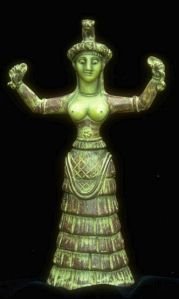
One of the enduring myths of the Victorian Age is that of the benevolent “mother goddess.” Amorphous, unnamed, this protective goddess of archaeological imagination was used to explain unlabeled figurines and frescos of the peaceful feminine archetype. As real goddesses were discovered and catalogued, they were frequently discovered to have a violent and fierce aspect, one feared and revered by ancient worshipers. Even today, however, some persist in this blissful pre-conflict image of the mother goddess.

This morning I was sorry I even glanced at the paper. The reality of the violence in the name of religion was everywhere. In Kabul a mob of angry protesters, fueled on by rumors that American troops had desecrated the Quran, burned an effigy of the President Obama. In Jerusalem Israeli police stormed the Al-Aqsa mosque on the Temple Mount to subdue angry mobs in tensions over one of the world’s great holy cities. Even in England, metaphorically, Pope Benedict XVI “has parked his tanks on the Church of England’s lawn” in the words of A. N. Wilson in the New York Times. Three clashes: Muslim on Christian, Jewish on Muslim, and Christian on Christian. Where is Mother Mary speaking her famed words of wisdom?

As even the ancients knew, religion was prone to violent outbreaks. In a polytheistic world the accounting was perhaps simpler: one god or goddess was upset. Here in the monotheistic world, we have either an angry God or a bevy of intolerant interpreters of that single God. There is no mother goddess whispering words of calm to the world’s religions. When opening the papers brings such a jolt to weary, Monday-morning eyes, the appeal of a smiling mother goddess is all too apparent.

The myth of the smiling mother

The myth of the smiling mother


For God and For Gold

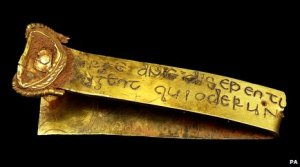
The Associated Press today released a story about an Anglo-Saxon treasure hoard discovered in England this summer. The trove, which likely contains at least 1500 items, many of silver and gold, is calculated to cause substantial reassessment of Dark Age England. Leslie Webster, a former curator at the British Museum, suggested that given the nature of the artifacts, new light could be cast on the relationship between warfare and Christianity.

Apart from the obvious deliria of daydreams of wealth that such finds always drag in their cloaks, this treasure once again underscores the connections between religion and violence. The Anglo-Saxons, Germanic invaders of England following the decline of the Roman Empire, had been early converts to Christianity. Even Alaric the Goth was a good Christian, although he had little patience with the oversight of Rome. The recently uncovered hoard contains mostly military trophies, but among the finds was a gold strip reading “Rise up, O Lord, and may thy enemies be dispersed and those who hate thee be driven from thy face” (Numbers 10.35). Already bloggers are drawing comparison with Jules’ quote from the fabricated Ezekiel 25.17 in Pulp Fiction, but the connection of Christianity and conquest is much more intimate than that. Once Christianity became the official Roman religion under Constantine, the imperial imperative took over. It became a religion of conquest. A similar phenomenon occurred after the advent of Islam. The zeal of the converted should never be underestimated.

I'm trying really hard to be the shepherd

I'm trying really hard to be the shepherd

So, what are we to make of this scriptural quote among sword knobs and doom sticks? Is it simply more evidence that religions, like the Roman Empire (according to Octavius) “must grow or die”? Those who believe carry a deep-seated fear that their religion might be proven false. On it ride serious (and often eternal) consequences. One way to ensure the quelling of that fear is to silence the heretics who decry the one true faith: take up your swords and nukes and threaten the infidel. The road less traveled, however, is to rise above our insecurities and simply enjoy the ride.


The Original Mud-bloods

“Let Nintu mix clay with his flesh and blood.
Let that same god and man be thoroughly mixed in the clay.”

This quote is from the myth of Atrahasis (Benjamin Foster’s translation; my Akkadian’s a bit shaky these days), an early version of the flood story. Although I have a burning itch to write about the flood, I would rather focus on the creation of humanity in this post. Maybe it is because in my unemployed mode it is easy to think of myself as only dirt and blood, but maybe it is because in my evening class we’ve just been talking about creation stories.

One of the benefits of polytheism is the lack of a pressing need to ascribe uniformity to your myths. Ancient peoples who believed in a multiplicity of gods had a wide variety of versions about how the world was created, where people came from, who sent the flood, and so forth. They were not writing about what actually, factually happened — these were myths, for the gods’ sake! Nobody was there to see the creation of humanity, so who’s to say what really happened? One element that is repeated in ancient accounts, however, is the creation of people from dirt.

Perhaps it is because people often treat each other like dirt, frequently with religious motivation, but a more likely explanation is that in ancient times the dead were known to return to soil after they were buried. Logic dictates that if the dead turn to dirt, their living version must have been created from dirt. So far, so good. But dirt isn’t exactly alive. The ancients differed on what animated this soil with a soul.

The Bible presents a lofty account of God breathing air into the soil-man. It is clear that the Hebrew Bible equates breathing to being alive. A person is alive when they first breathe; when they stop breathing, they die. At the same time, blood is an essential component too. This is so much the case that the Bible dictates that “the blood is the life” (Deuteronomy 12.23). For this idea the Israelites were indebted to the Mesopotamians. As seen in the Atrahasis Epic, humans are a mix of clay and the blood of the gods, the original mud-bloods. For all their differing opinions, the ancients realized that in this messy world of dirt and dread, human beings, for all their problems, had a bit of the gods within their very veins.


Harry Potter and the Evangelical Emperor

There’s a chill in the air this morning that warns of impending winter and the visceral melancholy of autumn’s graceful death. As I try to warm up like a lizard awaiting the ascending sun, I think that maybe I’d better write this post before everyone forgets Harry Potter completely. It is the beginning of the witching season as sometime late tonight fall officially begins and people in temperate climes are permitted to show their fears as the barrier between seasons becomes effaced and the darkness slinks in. A few Harry Potter novels ago, a local town in Wisconsin sponsored a downtown release party for the book with a street-fair sporting a feel of general bonhomme. While sauntering down the incongruously sun-lit streets, enjoying the sense of people just having fun, I spotted this man with a placard across the street.

No caption necessary!

No caption necessary!

The truly scary part of this scenario is that I knew exactly where this fellow was coming from: the Bible says it, I believe it, that settles it. Black and white. Right and wrong. Good and evil. Strangely enough, there was no such dividing line for fact and fiction. Yes, I knew that the Bible condemns witchcraft, but I also knew that J. K. Rowling was a fiction writer. I had read the Bible enough times to know that it contains no commandments about what genre of fiction is permissible and to know that some biblical heroes were deeply flawed characters. Jonah and his big fish. David and the giant monkey on his back. Hezekiah and his doubts. I can’t pretend not to know the searing sting of needing a clear answer, and yet I had already discovered the infinite shades of gray that reside between pure white and absolute black. Bible covers should all be gray.

That very year a conservative evangelical administration had axed a highly praised job of over a decade’s duration, believing it to be in the name of righteousness. A conservative evangelical president was unleashing hellish terror on a country that had the misfortune of being the victim of a bloodthirsty dictator. And this man with a placard felt he had to underscore that even a flight of fantasy on a broomstick over a quidditch field of imagination was evil incarnate. Once again my mind turned to Molech, the perhaps fictional Canaanite deity who is never satisfied. In the Bible it was enough simply to believe that people were sacrificing their children to the fiery Molech. “White and black,” I could almost hear the tremulous author whispering as he penned his horrid fiction. History tends to paint a different picture, but then, historians make liberal use of the myriad shades of gray.


By the Numbers

Just when you thought it was safe to go back to the airport, the Bible Code strikes again! This morning’s newspaper carried the story of Jose Flores, a would-be hijacker of Aeromexico Flight 576. Flores boarded the flight with a Bible and fabricated a pretend bomb out of a juice can (the story doesn’t specify exactly what kind of juice —) and instructed the pilot to fly around Mexico City a Jericho-esque seven times. Flores informed the flight attendants that he was part of a set of four hijackers, the other three, he later revealed to police, were the Father, Son, and Holy Ghost. The flight landed safely and Flores was extricated from the plane. Why all the fuss? Yesterday was 9/9/09. Flores realized (with or without the help of his three co-hijackers) that upside down this would be 666. Safely on the ground he told reporters “Christ is coming soon!”

So once again we meet a believer in coded messages in the Bible. Clearly one of the most misrepresented books in the Bible is Revelation. This book is a textbook example of apocalyptic writing, a genre wide-spread and easily recognized in the ancient world, but which suffers from being taken literally by people living a couple millennia after it was penned. Even before the ink slipped from John’s pen (we don’t know John’s last name), people were looking for a new world to burst in on this old one in need of radical repair. That urgency has continued unabated for two thousand years.

Is life really so bad that we need it to end? Apocalyptic outlooks are perfectly understandable among the disadvantaged and persecuted that they were intended to console. It is a strange phenomenon, worthy of a sociological dissertation, why many affluent, educated people strain for the end of this god-awful world where they are so comfortable. Perhaps it is that we evolved from lemmings rather than primates, but it seems to me rather another example of the wealthy taking from the poor. Even their hopes of sticking it to the rich have been co-opted.

Something to look forward to?

Something to look forward to?


Go and Dust No More

Finally getting around to reading Philip Pullman’s The Golden Compass (I hate to admit that it took the movie ads to prod me into reading the book), I have been surprised by the depth of the story. Spoiler warning! From the very first chapter I have been pondering what dust might be, and I have just discovered that it is Pullman’s metaphor for original sin. In the chapter where this is finally revealed to the protagonist, Lyra, her father reads an explanatory passage from Genesis 3 (somewhat altered). Indeed, dust drives the plot of the story.

With apologies to the magisterium

With apologies to the magisterium

Pullman’s treatment of the topic once again throws into relief a popular, but mistaken, concept. “Original sin” is simply not a biblical idea. Nowhere in either the Hebrew Bible or the Christian Scriptures does the text suggest that people are born with the taint of a physical liability passed on from the first human coupling, as Augustine hypothesized. In fact, the Bible hosts several potential explanations for the origins of human troubles. One solution that it never reaches is a genetic passing on of an original sin.

Tradition often makes Scripture into its own image. Ideas are inevitably read back into the story and a chimera of hazy concepts emerges. Pullman’s treatment of the human condition is to be applauded, and to his credit he does not attribute the concept of original sin directly to the Bible. Although he alters the text a bit he doesn’t add this most damaging concept to it. The belief that people are inherently defective has allowed for some of the worst crimes imaginable against our species. As a concept original sin is dust in the wind.


Edoc Elbib Eht

A number of 40-year commemorations of the Manson Family murders have brought these gruesome events of my childhood years back to memory. I was really too young to understand what all the fuss was about then, and now that I am old enough, I’m not sure I want to. Nevertheless, I have committed myself to exploring sects and violence in a religious setting, and the Manson murders have prongs of both phenomena. While recently refreshing my memory on these horrific events on a gray and rainy day, I noticed something I had not seen before.

Looks like someone's been on the yellow submarine a little too long

Looks like someone's been on the yellow submarine a little too long

Charles Manson was (probably still is) a believer in hidden codes. He allegedly cracked a code in the Beatles’ White Album that led him to the belief in an apocalyptic battle that he was determined to begin. I wondered why the Manson Family tends not to be listed among other apocalyptic groups such as the Branch Davidians or Heaven’s Gate. They all share several traits, and although Manson’s revelations came from the Fab Four rather than the Holy Trinity, a revelation from on high spurred him into actions that had a tragic outcome, just as David Koresh or Marshall Applewhite.

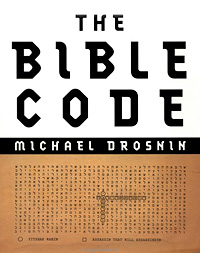
The whole Helter Skelter code also reminded me of another, equally bogus pawning of randomness as divine messages: Michael Drosnin’s The Bible Code. When I read this bestselling bit of intellectual dry rot a few years ago, I was amazed that anyone could possibly take it seriously. God writing hidden messages in a holy book like some hormone enraged high schooler? And figuring out that a singular genius would figure it out just before the apocalyptic end without realizing that it is possible to read messages back into any media after they occur? It seemed all too much for a rational mind to take. In one of my courses at the University of Wisconsin Oshkosh I gave students the option of reading it for a secondary project. To my chagrin, when I had the papers in one particularly tear-stained paper wailed (seriously) that the writer wished she had been warned sooner! This book changed her life! Everyone must know! Unfortunately I left Oshkosh without finding out what became of her.

God may not play dice, but apparently he likes crosswords!

God may not play dice, but apparently he likes crosswords!

I felt bad for introducing an undergrad to such “academic” sleight of hand; some college students just haven’t developed the critical facilities to see through the remarks of Balaam’s various sidekicks. Come to think of it, Manson’s followers accepted his revelations uncritically as well. Maybe the real lesson in all of this is that we must examine very closely those who claim special revelation, whether it be from Lenin, McCarthy, Starr, and Harrington, or just from God Almighty.


For the Love of Aqhat

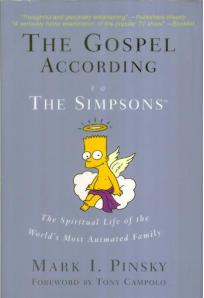
It seems that a new season of The Simpsons is upon us. With the release of season twelve on DVD last week, recession-ridden families everywhere are piling up on their couches to be entertained. Initially I had a hard time accepting The Simpsons; I had seen too many failed adult cartoons to give me much encouragement that this would be something worth wasting my time on. Surprisingly, it became clear after just a couple of seasons that The Simpsons was witty, smart, and surprisingly ethical. This final point was so pronounced that Mark Pinsky wrote a book focusing on it entitled The Gospel According to The Simpsons (Westminster John Knox, 2001). As to be expected in a book with a foreword by Tony Campolo, it was a little devious, but still retained a kind of sugar coating. Nevertheless, I found the book worth reading.

Bart after the birds?

Bart after the birds?

The Simpsons frequently pokes fun at all of us who take ourselves too seriously. Most of the time it is evident that the writers have done their homework as well, pulling in sometimes obscure references to classical or biblical literature. Recently while watching the episode entitled “Bart the Mother” I was struck by an ancient theme which was surely accidental. In the episode, Bart, trying to prove himself to the neighborhood bully, shoots a mother bird with a b-b gun. Guilt immediately sets in and Bart is haunted by his cold-blooded act. In a dream he sees a bird tribunal doling out the punishment for his crime — having his face pecked off. I’m sure this owes more to Hitchcock than to Ugarit, but I can’t help shaking the idea that the scene is somehow informed by the Epic of Aqhat. In one of Ugarit’s classic stories, Aqhat is given a divine bow that is coveted by the goddess Anat. When he won’t relinquish it, Anat has Aqhat pecked to death by raptors, “twice upon the noggin, thrice upon the ear!” Ugarit remains shrouded in cultural obscurity, so no easy cultural reference can point to it. Everyone has seen Hitchcock’s The Birds.

The story of Aqhat, although sadly broken, is a classic of ancient literature. So much more to pity is that it remains nearly as unknown today as it was while buried under the ground for three and a half thousand years. A colleague of mine approached Penguin a few years back trying to pitch the idea that they sell a translation of the Ugaritic texts in their classics series. They flatly turned him down on the basis of “no public interest.” If the publishers won’t put these world heritage classics out there, how will there ever be interest generated? Perhaps those of us bitten by the Ugaritic bug simply circulate in circles too small to have any impact on what the world thinks. Beyond a few souvenir-hawking vendors in Syria and a few crusty scholars sheltered away in dusty academic libraries, nobody knows the story. It seems that Aqhat’s fate is equally grim — pecked to death by birds and completely forgotten because the story just doesn’t possess sales potential.


Momma Maya, Is It the Apocalypse Already?

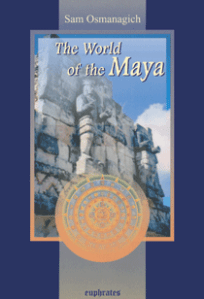
Where have all the Maya gone, long time passing?

Where have all the Maya gone, long time passing?

While recently reading a Gorgias Press book on the Maya (Sam Osmanagich’s The World of the Maya) I couldn’t help but notice the concern of the author with the year 2012. Actually, Osmanagich is looking forward to 2012; it will be when a new era in human existence begins. Since he freely admits throughout the book that extraterrestrials provided technical support in the Mayan monumental architecture, I suppose the fixation on 2012 should not be surprising. The book is charming as a folksy travelogue and disarming in its innocent sense of wonder, but academic it is not.

Concern with the end of the world as we know it seems to have entered the Judeo-Christian tradition with Zoroastrian contact. As soon as the idea was conceived it was immediately apparent that this was going to be a very large baby, and it has not disappointed. Back in my rural Pennsylvania high school, concern that the world would end in 1980 was seriously rampant. (Considering that the Reagan-Bush years were about to begin, it makes sense in retrospect, at least on a metaphorical level.) Worry ran so high that on the stated day — noon was the confirmed hour of doom — my English teacher laid down her grammar book and had us spend our final earthly minutes writing an essay arguing why the world was, or was not, going to end that day. When the class-bell rang, other than some soiled undergarments, everyone seemed pleased still to be there.

I was at Nashotah House for Y2K. A prominent administrator insisted that we all prepare for the likely event of a societal collapse. (From my present vantage point, I’d rather have taken my chances just about anywhere else.) Yet here I am to recount the tale.

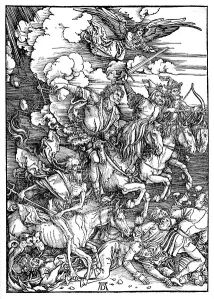
Now only a dozen years down the road from Y2K we are being told to prepare for yet another apocalypse. People I speak to seem genuinely concerned about this one, and even I had a shiver or two as Osmanagich calmly laid out how the Maya just didn’t make mistakes like that. As I see it, there are two choices: people should study the origins and rationale of apocalypticism or someone should start a business selling Apocalypse insurance (the name Four Horsemen might be catchy). People seem ready to believe that extinct civilizations knew something about our fate that we just can’t see. And if the world does end in 2012, well, you wouldn’t want to have all those premiums weighing you down by then, would you?

The Four Horsemen -- would you buy insurance from them?

The Four Horsemen -- would you buy insurance from them?