Stay Curious

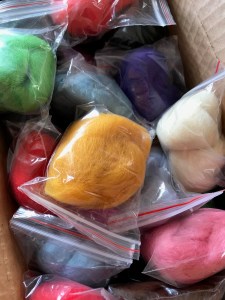
Needle felting.  I’d never heard of it.  I’d got along some five-plus decades without knowing a thing about it.  My daughter received a needle felting kit as a Christmas gift and, being the kind of person I am, I had to research the history of felt.  I always knew felt was different from other fabrics, but I couldn’t say precisely how.  I came to learn it is perhaps the oldest textile in the world, known by the Sumerians.  Felting is a process for making non-woven cloth.  The natural fibers of some wools are scaled, like human hair is, and when compressed and worked with moisture (wet felting), becomes cloth.  Finding out how things work is one of the great joys of life.  It also made me think again of how anyone could possibly be arrogant.

The longer I’m alive the more I’m learning what I don’t know.  Granted, felt has appeared in my life at numerous junctures—how many crafts do kids make of felt?  And I have a felt hat—but I had never thought much about it.  My wife likes to read about pioneer women who had to make pretty much everything by hand.  We call such people “rusticated” these days, but they know far more than most urbanites, simply by dint of having to do things for themselves.  Modern conveniences are great, but I often wonder how many of us might survive if we had to make it on our own.  Just the last couple of weeks we worried about losing power with the storms that blew through.  What do you do when the thermostat no longer works in winter?  Something as simple as that vexed me for days (I had to work rather than worry, so it couldn’t properly use my brain power).

I’ve known many people impressed with their own knowledge.  I can’t imagine how actually learning new things doesn’t make someone humble.  The universe is a vast and mostly uncharted space.  Down here on our somewhat small planet we have so much yet to learn.  I’ve studied the beginnings of agriculture, metallurgy, writing, and religion.  There’s still so much I don’t know.  I wouldn’t do well on Jeopardy—I second-guess myself too much.  Staying curious about the world is a good way, it seems, to keep humble.  I entered into this holiday season thinking I knew a fair bit about various crafting options.  As a family we cover the creative spectrum fairly well.  Then a small, soft thing such as felt made me realize just how little I really understand.  Any invitation to learn is one that should be accepted.

Ghost Stories

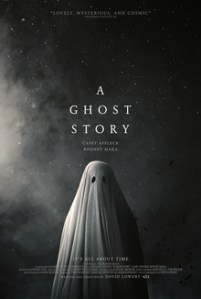
Those of us who confess to watching horror are fond of noting that the Christmas season has long been associated with ghost stories.  Charles Dickens wasn’t the first to make use of the trope and certainly won’t be the last.  After reading about elevated horror movies, I decided to watch A Ghost Story (David Lowery, 2017).  Many wouldn’t classify the film as horror at all.  It is quiet, slow paced, and has no gore.  It is nevertheless a haunting film.  I suspect its poignancy comes from a situation we can all imagine and which many people face in life—being left alone after the death of a loved one.  The idea that the dead never really leave us can be both comforting and unnerving at the same time.  The film plays to those strengths.

The premise of the film is simple: the ghost of one of a couple finds his way home and tries to reconnect with his widow.  He ends up staying there until, many owners later, the house is demolished and a high-rise is built in its place.  It’s essentially a story from the point-of-view of the ghost.  There isn’t too much dialogue included, but one significant monologue comes when a party is being held.  One of the party goers, or perhaps the current owner of the house, explains that because of what we know of physics everything on our planet will eventually be destroyed.  His beer-fueled lament is that whatever we do is therefore in vain.  He brings God into the discussion.  The ghost listens intently, but seems to disagree with his conclusions.  For someone like me the introduction of religion into the story is a Venus fly-trap, since religion and horror can’t seem to keep away from each other.

Death is a dilemma, a point that I made in a recent Horror Homeroom article on Pet Sematary.  Horror, like religion demands that we confront it.  Science can only offer cold comfort regarding the cessation of life.  Religion (and horror) open the dialog into the unknown, the realm into which mere human instruments cannot reach.  Sad and reflective, A Ghost Story hits on an essential question in the nexus of religion and science.  If a spiritual world exists, there may be some survival even of the earth’s eventual heat death.  As time passes, the titular ghost continues to learn.  Life is a learning experience, and although many modern forms of religion join in the cultural denial of death, horror is always ready to remind us that confronting it may be the wisest course of action.  Ask the ghost.  He knows.


Conflict Management

Conflict has come to dominate the twenty-first century in an unhealthy way.  No longer do religions, political parties, or even scholars of different disciplines want to try to see it from somebody else’s point of view.  Such “I’m rightism” is distressing, given that the greatest minds in history always left some room for doubt.  Einstein tried not to say too much about God, but his occasional references left some space for admitting he just didn’t know.  He was following closely in the footsteps of Sir Isaac Newton, who, ironically and iconically stands as one of the founding fathers of empiricism.  I say “ironically” because his real driving interests, as became clear only after his death, were religious.  With the science and religion conflict paradigm, it took a long time for many to admit that Isaac Newton was fascinated by religion.

A story in The Guardian recently noted that Newton’s unpublished notes on pyramidology have gone on auction.  These papers are even further indications of just how much religion mattered in the mind of the man who gave us a clockmaker God who wound up the universe and left it to run according to scientific principles.  My wish isn’t to cast any aspersions on Newton.  No, quite the opposite.  I wonder if we mightn’t use his wide-ranging interests to raise a relevant question: why do we see religion unworthy of attention while science, because it can be “proven,” is all we really need?  Especially since scientifically-based hypotheses about the origins of religion tell us that human beings need it.

Admittedly Newton was just as human as the rest of us.  Perhaps far more intelligent than most, but still human.  The humanities are the part of the human curriculum that has been under duress for many years at “universities.”  As business interests and money have taken on larger and larger roles in how schools conceptualize themselves, the humanities—which don’t make money—are undervalued and cut.  Capitalism takes no prisoners.  Education that has bought into that paradigm is bound to overlook certain facts.  Newton’s “arcane” interests were well hidden for a couple of centuries because who wants to think of the great rationalist as beholden to such a paltry thing as religion?  We’d rather keep our eyes firmly closed.  A conflict paradigm seems the better way to eradicate this troubling, so very human, aspect of even geniuses.  As long as there’s money to be made conflict will be the reigning model. 


Truly Exceptional?

Exceptionalism seems to be in the air these days.  Most recently it’s become a plank in the Republican platform—America is God’s own chosen nation (despite what the Bible actually says).  It’s also been a trait of nearly all human endeavors.  Human exceptionalism, that is.  The idea, whether admitted or not, is based on the Bible.  Even those bespectacled scientists who make no time for religion insist that humans are different from other animals.  Why?  The Bible tells them so.  Evolution certainly doesn’t.  And so we go about thinking how superior we are to other lifeforms.  And not only that, but to other humans in other geographical locations.  It seems Homo sapiens sapiens could use an ego check every now and again.

Not only does our sense of superiority go downward over the animals, it also reaches to the very boundaries of this infinite but expanding universe.  We are alone, scientists declare.  The only intelligent life in a universe far beyond the ability of the human brain to comprehend.  There can’t be any alien visitations with (laughably) superior beings crawling out of their flying saucers.  No, we were the best that evolution could do.  And we elected Donald Trump to be our president four years ago.  What’s that about an ego check?  Especially since we’ve learned that there is water on the moon.  Almost certainly there was once liquid water on Mars.  There may even be traces of life in the atmosphere of Venus (although the earthly jury is still out on that one).  Only humans can make that declaration.

Photo credit: NASA

I have to wonder at this arrogance that comes along with consciousness.  Do we believe we’re the best simply because we learned to apply the laws of rationality to our gray matter?  Back when I was a seminarian the word “pantheism” was rather like a swear.  To suggest a universal connectivity (literally) was an offense against the deity portrayed in the Bible.  (I would hope that a God that big would encourage us to understand the implications of a universe so large.)  We humans have our good points, of course.  I love people and their foibles.  Were we not so dangerous we might even look cute in the cosmic eyes above, as well as the inferior eyes of our pets.  Exceptionalism, it seems to me, ought to be the dirty word.  It seems far more human and humane to throw the gates open wide and consider the possibilities.  I love people, but if we’re the best there is, the universe is in serious trouble.


Internet Nowhere

So I wake up early.  I’ve been trying for years now to learn to sleep in a bit.  Somehow my body got to thinking the outrageous commute schedule to New York City was normal and I can’t convince it otherwise.  That means my most productive time comes before others awake.  It also seems to be the time favored by internet service providers to take their systems offline for a while.  You see, like any system the internet needs down time.  I slept in until 3:30 this morning and awoke to find internet access unavailable.  I use it during my writing, looking up answers to questions which both my fiction and non raise.  When the internet’s out there’s little I can do, but I’m already awake.  Society prefers conformists, but some of us maybe hear a different beat on our march.

The fact is we expect constant connectivity.  Many of us pay a significant monthly amount to ensure that we have it, but this is no guarantee.  Calling your local service provider at 4 a.m. on a Saturday (I’ve done this) is like dealing with IT at work: they really have no clue what’s wrong but they can talk technical to you, if that makes you feel good.  After all, it’s in the middle of the night.  So I try to decide on something else to do.  Reading works.  Books, however, often lead me to want to look something up.  But the internet’s down, at least around here.  We are utterly beholden to the tech industry that can (and does) wink out from time to time.  When the robot uprising occurs we just need to wait for the service maintenance hour.

I reboot my router.  It’s the first course of action when the internet’s out.  I think I’ll check out a personal hotspot, but to do that I need the internet.  It’s a great, constant feedback loop.  I suspect I’m not the only early riser who faces the internet dearth in the wee hours.  I know I’m overpaying because my data (whatever that is) plan on my phone always shows a monthly surplus.  When it comes to the techies, you just nod your head and pay your bill.  I do wonder what’s happening in the wider world.  Without the net you feel especially isolated in pandemic times.  It’s Saturday morning and the internet’s unavailable.  Back in my teaching days I know just what I’d be doing.  Instead I’m waiting for technology to catch up.


Anticipation

My work computer was recently upgraded.  I, for one, am quickly tiring of uppity software assuming it knows what I need it to do.  This is most evident in Microsoft products, such as Excel, which no longer shows the toolbar unless you click it every single time you want to use it (which is constantly), and Word, which hides tracked changes unless you tell it not to.  Hello?  Why do you track changes if you don’t want to see what’s been changed when you finish?  The one positive thing I’ve noticed is now that when you highlight a fine name in “File Explorer” and press the forward arrow key it actually goes the the end of the title rather than just one letter back from the start.  Another goodie is when you go to select an attachment and Outlook assumes you want to send a file you’ve just been working on—good for you!

The main concern I have, however, is that algorithms are now trying to anticipate what we want.  They already track our browsing interests (I once accidentally clicked on a well-timed pop-up ad for a device for artfully trimming certain private hairs—my aim isn’t so good any more and that would belie the usefulness of said instrument—only to find the internet supposing I preferred the shaved look.  I have an old-growth beard on my face and haven’t shaved in over three decades, and that’s not likely to change, no matter how many ads I get).  Now they’re trying to assume they know what we want.  Granted, “editor” is seldom a job listed on drop-down menus when you have to pick a title for some faceless source of money or services, but it is a job.  And lots of us do it.  Our software, however, is unaware of what editors need.  It’s not shaving.

In the grip of the pandemic, we’re relying on technology by orders of magnitude.  Even before that my current job, which used to be done with pen and paper and typewriter, was fully electronic.  One of the reasons that remote working made sense to me was that I didn’t need to go into the office to do what I do.  Other than looking up the odd physical contract I had no reason to spend three hours a day getting to and from New York.  I think of impatient authors and want to remind them that during my lifetime book publishing used to require physical manuscripts sent through civilian mail systems (as did my first book).  My first book also included some hand-drawn cuneiform because type didn’t exist for the letters at that particular publisher.  They had no way, it turns out, to anticipate what I wanted it to look like.  That, it seems, is a more honest way for work to be done.


Wild God

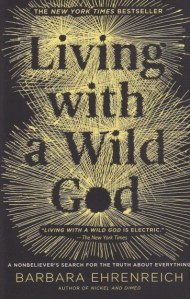
Living with a Wild God, by Barbara Ehrenreich, is one of those books I wanted to put down gently after reading it, for fear that it might explode.  Or maybe it was my head I feared might combust.  Describing it is difficult because it is so wide-ranging.  On the one hand it is an atheist’s view of religion.  On the other hand it is a spiritual biography.  On a third hand it is coming to terms with having had a profound mystical experience.  It is one of those books where, knowing my life has been so very different, yet I feel that Ehrenreich and I have had so much in common that we’d be friends if we ever met.  It is also the work of a woman who is scary smart and whose teenage thoughts were so intense that my own seem puerile by comparison.

But that mystical experience!  I’ve had many of them in my life, but I don’t know you well enough to share them here.  They’ve been recorded in an unfinished book that I may or may not try to publish some day.  (Ehrenreich was smart and took a job as a journalist, which means others assume you know how to write.  Even those of us in publishing have trouble convincing agents and others who hold the keys to non-academic pricing that we understand the craft.)  Mysticism quickly becomes a staid discipline, not at all like the life-directing experiences such encounters themselves actually are.  It’s difficult to explain without sitting down and talking to you.  It’s something academics tend to avoid like Covid-19.

The books that mean most to me are like conversations with an absent author.  Drawn in by an openness, or perhaps by the fact that we’ve lived in a few of the same places over the years, perhaps passed one another unknowingly on the street, you feel that they’ve invited you into their very head.  What you find there has a strange similarity to what is in your own head, while being completely different at the same time.  We should all strive for such honesty in our writing.  In the end Ehrenreich, with a doctorate in science, suggests we need to be open.  That kind of validation is important for those of us who’ve poured our lives into the study of religion.  She was drawn in from atheism, and I have been trying to escape from literalism all my adult life.  We have ended up in places not dissimilar from each other and I’m glad to have met her through this profound book.


The End of Snow Days

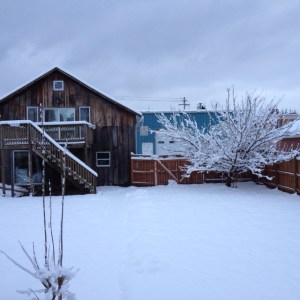
It’s a chilling thought.  An article in the New York Times said it, but we were all thinking it.  Snow days may well have become another victim of Covid-19.  No, it’s not snowing yet (but give climate change a chance!), but New York City schools have figured out that if students can learn from home then one of the truly treasured memories of our youth may no longer be necessary.  In fact, snow days ended for me when I began working remotely.  My supervisor had suggested, even before that, that I take my company laptop home daily, in case of inclement weather.  The idea of awaking, wonder-eyed, at the world covered in white—that cozy feeling of knowing you had no obligations for the day but to enjoy the pristine world out your window—is a thing of the past.

Technology has changed our lives, and some of it is even for the better.  It hasn’t made work easier for some of us, but has made it longer.  We used to talk about kids and their continuous partial attention, but now work is always at home with you and that time signature on your email says something about your work habits.  As the days are now shorter than the nights, as they will be for six more months, finding the time to do what you must outdoors (it may be cooler, but lawns still insist on growing) is always a bit more of a challenge.  And when the snow does fall you’ll still have to shovel the walk.  All time has become company time for a truly linked-in world.

The real victim here, it seems to me, is childhood.  Snow days were a reminder that no matter how strict, how Calvinistic our administrators wanted to be, the weather could still give us a smile now and then.  A legitimate excuse not to have to go to school and, if parents couldn’t get you to daycare, a day off for everyone.  The strict number of limited holidays allotted by HR had limited power in those days.  Although we all know that well-rested, happy workers tend to do better jobs than those who are constantly stressed out and who have trouble sleeping, we’ve now got the means to make the sameness of pandemic life the ennui of everyday life, in saecula saeculorum.  Thanks, internet.  At least now we work where we have a window and can look out on nature and can see what we’re missing.


Watery

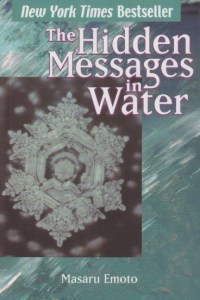
Having watched What the Bleep Do We Know? a few weeks ago, I became curious about Masaru Emoto’s The Hidden Messages in Water.  The book is highlighted in the film, and in a world where money decides truth, the fact that it was a New York Times bestseller must count for something, right?  I am of a skeptical bent, but I like to keep an open mind.  This itself is a delicate waltz at times since just about anybody can make truth claims and find a following.  Curiosity, as they say…  So instead of critiquing Emoto’s obviously slipshod methodology, I want to reflect on whether he really might have been onto something.  Many people around the world thought so, after all.

What it comes down to is water.  If you haven’t seen the movie or read the book, I owe you a brief explanation.  Emoto suggests that water crystals reflect the influences to which they’re subjected.  For example, water frozen as classical music plays forms beautiful crystals.  If heavy metal is played, it doesn’t.  Water frozen in beautiful surroundings forms beautiful crystals.  If that’s not controversial enough, Emoto suggested that emotionally freighted words typed on paper wrapped around the water bottle as it was frozen would reflect the emotions on the paper.  There are lots of problems here, but what I wonder is if water might not somehow be related to consciousness.  Emoto makes that claim, but since science can’t yet explain consciousness there’s no way to test it.  Could it be that water is a recording medium in some way?  Without raising the woo factor too far, some ghost hunters (it is October, after all) suggest moving water has something to do with “recording” spirits.

Like most critical readers, I left Emoto’s book not at all convinced.  I also left thinking that we shouldn’t throw the bath water out with the baby.  There are crazy ideas in the book, for sure.  But there may also be just a hint of insight as well.  That insight comes in the recognition of spirituality as an important aspect of human life.  The book was a bestseller.  Not all people are credulous.  We are, however, spiritual.  Many deny it.  Some violently rail against it but still have feelings along with their rationality.  Water can lift spirits.  The negative ions of breaking water tend to make people feel at ease.  We visit the coast where waves break against beach or rocks.  We visit waterfalls where cascades scatter water particles.  Even a fast-flowing stream will do.  Emoto clearly went too far with his ideas, but I think, deep down, he might’ve been onto something.


What Smells

One of the stories I recently read had a character commenting on the smell of a place.  Although humans can’t rival many other mammals and some birds for sense of scent, smell is a keen reminder of location.  It is also one of the more personal aspects of the senses.  We get nervous when people start talking about smells.  We all know, however, that places have their own fragrances.  Home smells a certain way.  You always notice it going home from college, where the dorms have their own smell.  When I was visiting campuses as part of my editorial expectations, I returned to Boston University School of Theology.  Apart from the main corridor of 745 Commonwealth avenue appearing smaller than I remembered, the smell was so familiar as to be overpowering.  I hadn’t been there for at least a couple of decades, but my brain remembered it well.

I trust science.  I also think science can’t explain everything, particularly in the life of emotions.  One of the natural limitations of science is the data with which we have to work.  We have limited input.  I remember in chemistry class in high school we worked with chemicals that replicated scents.  The particular ethyls used to reproduce fruit scents were similar only by suggestion.  I remember thinking the banana combination only smelled like bananas because it was suggested to me that it did.  Smell is a complex world, and we know many animals do it better than we do.  Dogs, bears, even mice, know more of the world through their noses.  I suspect Fido knows home primarily by its smellscape.  We, the “masters” tend to miss a lot.  And that makes me wonder what science might be missing by our limited sense of smell.

If there is a supernatural world, I wonder what it might smell like.  We’ve all known someone whose dog wouldn’t go into a certain room, or who reacted to something we couldn’t see.  Perhaps Fido couldn’t see anything that we couldn’t but could smell it.  I often think that when dogs are tested humans try to understand their visual acuity because that’s how we experience our world.  Dogs, however, experience their world through scent.  We could stand to learn quite a lot about this planet we inhabit if we could somehow access the smells that we simply lack the capacity to reach and analyze.  We are only beginning to scratch the surface.


Mother of Life

Homeostasis is, if I recall correctly, the state of equilibrium that entities and systems seek.  When we’re too warm we seek someplace cooler and when we’re hungry we look for something to eat.  It’s a great process of evening things out because we live in a world of extremes.  Well, relative extremes for a planet that suited to life.  Autumn came in with a chill this year, at least around here.  We had a couple of nights with frost before apple-picking season even began.  Over in Denver they went from a heat wave to inches of snow overnight.  I often wonder, if our species manages to survive long enough, what life will be like once everything evens out.  Until then, because of human climate degradation, we’ll be facing more extremes.  That’s the way the GOP likes it.

Meanwhile, there may be evidence that life exists on Venus.  Or at least in the atmosphere of the hottest planet in the solar system.  Up through my college years I toyed with the idea of being an astronomer.  I’d learned in high school (for we were a Sputnik-era school in rural Pennsylvania that had a working planetarium) that it was mostly about math.  I’m afraid I have no head for such things.  Still, I remain fascinated by other planets and their potential.  I’m in the market, you might say.  Venus had captured my young imagination not only because Ray Bradbury and C. S. Lewis wrote stories about living there, but because of the images from the Russian Venera (blush, giggle) probe program.  I knew in high school (planetarium, remember?) that Russia had landed probes on the rocky surface of Venus that had only functioned for a couple of hours at most before breaking down in the extreme conditions.  Extremes, again.

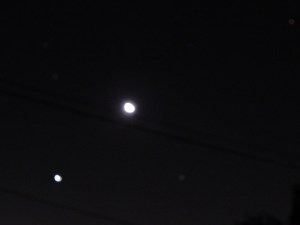
Venus could, it was thought, never have supported life.  The new evidence, however, stands to show us just how little we understand life.  It exists in the most inhospitable environments on our planet.  When life was found near black smokers on the ocean floor it was considered a fluke.  Maybe life is the norm instead of the rarity our exaggerated sense of self-importance suggests.  Venus, after the sun and moon, is the brightest natural object regularly visible in our skies.  Both the morning and evening star, it beckons to us.  Although not definitive, we’ve found evidence of life on both Venus and Mars.  And yet many of us prefer science deniers to lead our nation.  So I think of homeostasis as I look at Venus out my early morning window.


Eureka?

It’s weird to feel yourself becoming a curmudgeon.  Especially when it’s about technology.  Someone asked me the other day if I could send an audio file of something I’d recorded.  I stopped doing podcasts because I lost track of the server that had been hosting the files.  My “inbox was full” or some such nonsense—they’re just electrons, folks.  I’m already paying for the space to host this blog and one thing I know about audio files is they take up lots of space.  My laptop reminds me of that every time it wants to update.  Well, I recorded the requested audio file and wanted to send it along.  I couldn’t find it.  Now, I’m one of those people who started using Apple computers because they were intuitive.  You could easily guess, or reason out, where things were.  It’s not that way anymore.

I had to do a web search (use Ecosia!  They plant trees for your searches!) for where Macs store your audio recordings so that I could send it.  Buried deeply in a directory that has a nondescript name that you’d never possibly guess (it’s as if someone were to assign you Concluding Unscientific Postscript during a game of book-title charades), the helpful site said, you’ll find it.  It’s in your “Library.”  Well sir, Mac had decided that you no longer needed to navigate your way to your Library and that directory was hidden.  Another Ecosia search—more trees—and I learned that you could do a special preference tweaking (it only took four or five steps) so that your computer would display your own Library and you could find your renamed file that you’d created.

Back in the day (here’s the curmudgeon part) when you had to swap discs—floppies—and the computer had the memory capacity of a Republican senator, you knew which disc had your files.  To access them, you simply inserted the disc.  Later they were stored on the hard drive itself and the directory told you right where you’d find them.  Now who knows where your created content is stored—out there on a cloud somewhere, I hear.  That doesn’t help when a friend asks you to send a file.  I had no idea where it even was.  It’s job security for the tech sector, to be sure.  At least it helped me to plant some trees along the way.  Back in the day we used to say you can lose sight of the forest for the trees.  It works, it seems, the other way around as well.


Upgraded at Last

Those who pay close attention to labels may have noticed the tag “Neo-Luddism” appended to some of my blog posts.  Luddites were nineteenth-century protestors against machines because, their thinking went, machines denied people jobs.  I’m not fully in line with this way of thinking, of course, but I do occasionally point out the ironies of how our technological life has become, well, life.  Tech seems to have taken over life itself and some people really like that.  Others of us miss the outdoors and even the “free time” we used to have indoors.  Our computers, phones, iPads, left behind and maybe a physical book cracked open—this seems a dream at times.  I really do enjoy our connected life, for the most part.  It makes this blog possible, for instance.  What I object to is being forced to upgrade.  That should be a decision I make, not one thrust upon me.

Which cloud is it?

This is just one small instance of what I’m talking about: my laptop wants an update.  It has for a couple of months now.  Since it’s in rather constant use I can only devote the time to it on the weekends and the past four weekends have all been used up with other things, including two that had over eight hours of Zoom meetings scheduled.  Now, you see, the update isn’t just a matter of simply updating.  You need to clear space off your computer first.  I like to keep my files and the tech companies want to pressure me into keeping them on “the cloud” so they can charge me for the privilege of accessing the things I created.  Instead I back them up on terabyte drives, sorting as I go.  Photos, formerly iPhotos, take seven or eight clicks to upload and delete for each and every set.  If you snap a lot of pix that translates to hours of time.  It also means when I want to access my files I have to remember where I put the terabyte drive, and then connect it to the computer.  At least I know where my files are.

But do I?  If I were to crack open the drive would I have any means of locating what, on my laptop, looks like memories of family, friends, and places I’ve been?  Are they real at all?  If you’re sympathetic to this existential crisis created by the tech world in which we live, you might understand, in some measure Neo-Luddism.  Of course memory is available for purchase and it will surely last you at least until the next upgrade.


Marching down the Middle

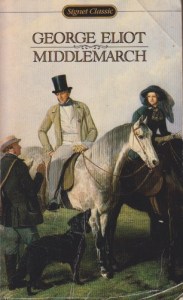
It is true that I have a fondness for nineteenth-century British novels.  Even though they often lack a strong speculative element they tend to be gothic, at least if written by one of the Brontë sisters.  I’d only ever read one of George Eliot’s novels before, and that was in ninth grade.  Middlemarch has been on my list for many years, but due to its intimidating size I’ve kept putting it off.  Now that I’ve read it I feel like I’ve accomplished something.  I had no idea what the story was about in advance, and no idea how it ended.  Unlike many pieces of literature of its time it hasn’t made a huge impact in pop culture, so this was the opportunity to lose myself for a few months in a world completely unknown.

I’m not foolhardy enough to try to summarize an 800-page novel here, but one aspect that the reader can’t help but notice is the prominence of clergy.  And not only prominence, but prestige.  In a world built around the solid belief in different classes of individuals, where pride takes a place in marriages that are supposed to be within class, the clergy are minor nobility.  Since this is the Church of England the vicars can marry and indeed, one such marriage sets off the tension that lasts throughout the hundreds of pages to come.  The clergy of the time were often gentleman scholars—the role that was envisioned for Charles Darwin as a young man.  Eliot plays on that idea with some of her preachers being amateur scientists.

The conflict—that now feels inherent—between science and religion has less to do with older forms of Christianity than it has to do with evangelicalism.  A relatively new expression of Christianity, evangelicalism set itself against modernity and its science.  Quite often today when commentators rail against “religion” it is really evangelicalism that they have in mind.  In the world Eliot sketches, she sees no difficulties between a rational view of things and an ecclesiastical one.  Clergy are often seen at the whist tables and taking long walks down country lanes.  The distinction between them and the average citizen is that they have been to university to study.  Today, in mainstream Christianity anyway, clergy are educated at least to the master’s level.  They’re no longer among the minor nobility, however.  Middlemarch has more than a hint of nostalgia to it, and the clergy roles show that clearly.


Agade

The word “listserv” feels abrupt to me, as if someone couldn’t be bothered to type one more “e” to give the reader a sense of satisfied completion.  Technology terms are often like that—not really descriptive of what they are and leaving us older folks wondering about the words and not quite comprehending what they’re supposed to signify.  Back in the early 1990s I joined a listserv that eventually came to be known as “Agade,” since it carried news of the Ancient Near Eastern variety.  Since I seldom have the opportunity to work in that field any longer, I long ago ceased to be on the Agade listserv and consequently have lost track of what’s happening in real time.  Or at least close to it.  An author with whom I was working recently asked me to post about his book on Agade so I had to resubscribe.  It’s nice to see the listserv, whatever that is, still alive and kicking.

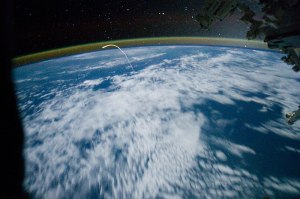
One of the articles posted recently had the intriguing title “Burnt remains from 586 BCE Jerusalem may hold key to protecting planet.”  I’m not sure, beyond evangelicals chomping for Armageddon, who doesn’t want to protect the planet, so I read on.  Archaeologists, I know, sometimes feel put upon to defend their work.  Yes, it’s sexy and cool, but it’s also expensive and not as well funded as it needs to be.  It does occasionally lead to real scientific breakthroughs.  This particular story is about Earth’s magnetic field.  It is vital for life as we know it, and we know that it is constantly shifting.  In fact, some pundits are fearing a flip in magnetic poles which, for a guy who can’t even understand listserv, sounds really catastrophic.  The article, however, is about the fact that the destruction of the temple in Jerusalem by fire that led to a trapped picture of the magnetic field at the time, and we know the date.  Magnetic materials under high heat preserve indicators of the Earth’s magnetic field, whether it had been discovered or not.

Image credit: NASA/ISS Expedition 28, public domain from Wikimedia Commons

The book of Genesis says nothing about the creation of the magnetic field that makes life on our planet possible.  Knowing that we understand so little about something that makes our existence possible, I suspect, indicates that there are many factors of life we haven’t even begun to comprehend.  There are further discoveries to be made.  We’re not even sure if our definition of “life” is entirely accurate.  One thing our history has taught us, however, is that if we build great structures there will be those eager to burn them.  As we sift through the rubble we might discover something about the direction in which we’re going.  And a listserv will be there to share the news.