Exercising Exorcism

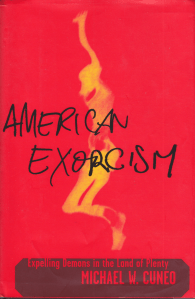
About the last people, ironically, that you’ll find researching demons are religion scholars. That’s perhaps a slight exaggeration, but there’s an embarrassment to the topic that serious academics just can’t shake. Nobody wants to be thought truly believing in that stuff. Michael W. Cuneo, who teaches sociology and anthropology at Fordham University, isn’t afraid to look. His American Exorcism: Expelling Demons in the Land of Plenty is a user-friendly, often witty look at what is an amazing phenomenon. Exorcism had pretty much gone extinct by the middle of the twentieth century. Then The Exorcist happened. Cuneo makes no bones about it—Hollywood wrote the script on what was to become a somewhat bustling business through the end of the millennium and beyond. And it wasn’t limited to Catholics. Protestants, mainly of Evangelical stripe, cottoned onto Deliverance ministry and joined the fray against the demonic.

American Exorcism reflects Cuneo’s personal account of attending exorcisms. As he puts it at the end, no fireworks occurred. In fact, he’s skeptical that demons exist and he strongly suspects exorcisms work in the same way that a placebo does. He’s well aware that the majority of people he met and talked with in the making of this book disagree on that point. Cuneo himself attended at least fifty exorcisms, both Catholic and Protestant, and shysters among the exorcists were rare. Most were sincere, devoted people who are helping others in distress for no fees, no glory, and no promotion. They see a need, believe they know the diabolical cause, and take the devil by the horns (metaphorically speaking).

There is a solid mistrust between academics with their studied skepticism and exorcists with their eyewitness accounts that defy belief. Cuneo suggests that even what they think they see may not really be happening in the real world. My question, coming down to the end of the fascinating book, revolves around what exactly this real world is. There can be no doubt that present day concepts of exorcism are largely based on “the movie.” Cuneo seems just a bit reluctant to say what I also declared in my forthcoming book—pop culture, the movies, dictate reality for many people. At least in the realm of religion. Sacred institutions have lost their authority to make ex cathedra pronouncements about what is real and what is not. Few bother to, or can, delve into the tedious work of reading academic studies on the subject. It’s far easier to let the unseen presences behind the camera take over. Isn’t that what possession is about, after all?

Getting Medieval

Who doesn’t have a devil of a time keeping up with technology? My day is divided in almost Manichaean terms between having internet access and not. Once I climb on that New Jersey Transit bus—they don’t have restrooms, let alone wifi—I enter radio silence for God knows how long. Once safely ensconced at work, I once again have the net but I can only use it for work. The even longer commute home spells the end to internet access for the day, since supper and sleep await at the other end of the line. So when websites change in the course of a day or two, it’s difficult to keep up. The other day, for instance, I noticed on Wikipedia, in an article about the Devil, that the dark lord has a coat of arms. “That,” I thought, “would make an interesting blog post.”

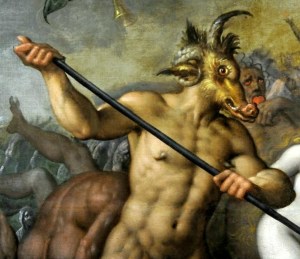
That idea, like most of mine these days, had to be put on hold until after work. And between after work and getting ready for work again, the delay lasted a week. Maybe two. Then I went back to the page and the reference was gone. I can still remember that the coat of arms had three frogs on it—somewhat unfairly to amphibians, I felt—and I even recall precisely where on the page it was. When I finally had time to look it up, it was no longer there. Cached pages used to be easy to find, but who has time any more? There’s a reason that people of my generation still prefer print books. Yes, there are times when it’s difficult to remember where you read something, but at least the reference is still there when you open the cover again. It hasn’t vanished in a pique of editing enthusiasm. The strangeness of it all was worthy of comment—a coat of arms was a sign of medieval prestige. There’s no doubt that the Devil had his day in the Middle Ages.

I hear about people being bored in retirement. I’m so busy, though, that I’m going to have to request a desk in the afterlife. Not that retirement’s anywhere within sight, but I have so many projects going that I don’t know when I’ll ever have time to finish them all. Even a holiday weekend’s too short to make much of a dent. I don’t need another technologically driven mystery to occupy any more of my waking hours. Looking for a Wikipedia factoid that was deleted doesn’t make it any easier. They say the Devil’s in the details, but that presumes you can find the details where you left them. And if you happen find the reference, can you please also keep an eye out for my car keys?


Science of Unbelief

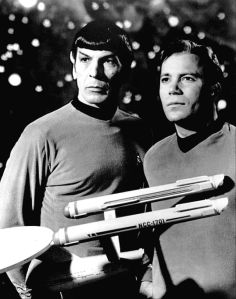
An article a friend sent me from Science Alert back in December recently came to mind. Titled “Thinking About God Might Make You Sweat, Even if You’re Not Religious,” the article by Brittany Cardwell and Jamin Halberstadt discusses how religious ideas are deeply engrained in human psychology. Like people who say they’re not afraid of spiders or snakes, people who don’t believe in the supernatural have made an effort to become this way. For reasons poorly understood, human beings are natural believers. As the article takes pains to state, that doesn’t mean a non-believer isn’t sincere. Thinking, however, doesn’t come only from rationality. Many people hold to the Mr. Spock fallacy—the belief that reasoning can solve anything. We all know from experience that it can’t. The big decisions in life—whom should I marry? What house should I buy? For whom shall I vote?—are often made with the emotions rather than rationally.

Which one’s the captain?

Reason has taught us to be expert deniers. We can learn to overcome our natural aversion to snakes and spiders and we can learn not to believe in God. Sometimes that belief can even be knocked out of us by the silly, unthinking behavior of “true believers.” But deep down it’s still there. Funnily, those who claim that reason alone answers all things are in denial about their own evolution. The human brain is a direct adaptation of the “reptilian brain” with its fight or flight impulses. That viper doesn’t plan to bite your ankle—it’s reacting to fear. Emotions are an integral part of thinking. Crimes of passion are committed by otherwise rational people sometimes. That thing you keep on bumping into in the room is, in fact an elephant. As irrational as that may seem.

The Science Alert article discusses the empirical proof that people fear to dis the Almighty. Were the brain a computer I’d say it was hardwired into us. We’re not wire and circuits, however. We’re messy, organic, evolving stuff that at one time lived beneath the waves. It took a certain amount of lungfish faith to believe we could survive on dry land. As mates approved of such irrational behavior, the trait multiplied and became more common. Today our smart phones and our cubicle window posters tell us there’s no such thing as a deity beyond our own scientific rules. The truth is, however, at some level we don’t really believe it. You can learn not to believe, but you’ll still sweat the big stuff, even in laboratory conditions.


Of Our Being

It happens every year. What with my commute schedule and personal disposition, I read a lot. This blog and Goodreads are my accounting system for keeping track of the thoughts that arise during all of this. Every year I get stopped by my first really important book that I’ve read since December’s roundup of last year’s titles. Paul Bogard’s The Ground beneath Us is this year’s first such book. Subtitled From the Oldest Cities to the Last Wilderness, What Dirt Tells Us about Who We Are, this tour of several fascinating locations is a wake-up call. Divided into three sections—Paved and Hallowed, Farmed and Wild, Hell and Sacred—Bogard’s book offers a kind of travelogue with the additional reminder that how we’re treating the land is the most terrifying example of what lack of foresight imaginable (why, Prometheus?) looks like. In a world with a rapidly growing population, we’re paving and building at unprecedented rates. World harvests, experts say, will last only another sixty years. Then we starve.

A dilemma I’ve struggle with here before is the fact that nobody owns this world. Nobody but those driven by money. There’s little that can stop them. This is exemplified by his chapter on fracking in my native Appalachia. Companies protected by loopholes—nooses, actually—devised by Dick Cheney can take over a town and destroy its environment. And this was even before Trump. And this is only but one example. Those who look soberly at where we’re going—and the melting permafrost in the northern hemisphere is about to make the globe nearly uninhabitable for our species—are ignored because they stand in the way of profits. Everybody loses. As a species we have neither the will nor the power to prevent it. Epimetheus reigns.

Not just doom and gloom, The Ground beneath Us is a thoughtful reflection on the human spirit. The titles of the subsections reveal that sacred ground—one of my recurring themes on this blog—is very real. Bogard isn’t a religionist, so you can’t accuse him of special pleading. His moving accounts of visiting sites hallowed by any number of factors, whether violence or simple belonging, reveal what home really means. What a dangerous, maybe even sinful, concept ownership can be. With chapters covering areas as diverse as Mexico City sinking under its own weight, to Ames, Iowa where what we’re doing to the soil is studied, to parts of Alaska accessible only by air, Heaven and Hell are daily and plainly played out before us. This is a very important book. We can only hope enough people will read it before it’s too late.


Frankenfear

While re-reading Frankenstein the uncomfortable thought kept recurring that our tendency to save lives leads to undiscovered fears. I’m not suggesting that we should just let people die, but even from my own experience of doctors, the sense of personal agency has become somewhat eroded. You go to the doctor and s/he tells you, “You should have this done.” I’m still too busy trying to figure out what this box that’s attached to my TV should be called, so how am I qualified to assess a professional opinion about my health? We mend bodies with plastic and metals and chemicals. Some modifications, like fillings and glasses, seem no brainers. But what about plastic tubes and computers to regulate body functions? They’re all good, but have we thought this through, I can hear Mary Shelley asking.

Religion, which is now also eroding, was a traditional way of coping with the fact of our own mortality. Everyone dies. From the beginning of the world, with the possible exception of Elijah—and even he had to come back—everyone has died. Religion traditionally said that it wasn’t the last word. The body wears out, and in a materialist world there’s nothing that can be left. Technology can prolong life, but some may not want it to be prolonged beyond a certain point. I’m not being morbid; I just don’t like arguing with what can’t be changed. Religion, it’s easy to forget, is about finding peace. Some people misunderstand that, for sure, but that doesn’t change the facts.

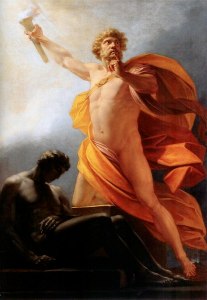
Did Prometheus overstep his bounds? Mary Shelley seemed to think so. In her recollections the story was intended to scare, not to predict. Victor Frankenstein creates the monster simply because he can. He does it alone, without thinking through the consequences even with a convenient Igor. Religion has often been cast as that annoying, moralizing sibling to science. (Philosophy could well join the ranks too, as some prefer it to religious thinking.) Without that sibling, however, how can we make informed decisions? Science, by its very definition, can’t tell us what should be done. The only values it knows are quantifiers. We live in a piecemeal world where some parts have been removed while others have been added. We don’t know if this is right or wrong since religion is one of the pieces excised without being replaced. Prometheus, ironically, translates to “forethought.” The problem with Frankenstein is precisely that Prometheus is missing.


Creating Science

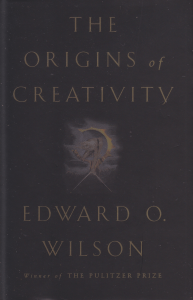
Religion and science. Cats and dogs. We’re used to hearing these two just can’t get along. High profile scientists sometimes denounce religion tout court, and some religionists doubt science’s claims implicitly. Human beings, truth be told, are both rational and spiritual. Often not both at the same time. Edward O. Wilson is a biologist who believes, as expressed in The Origins of Creativity, that the humanities and science are both essential and that the hope of humanity is that both will be embraced. It’s a fine vision—guided by science but aware of the values brought by art, we would live in a world utilizing the best our species has to offer. So, why don’t we?

Apart from the obvious fact that humans are also irrational and non-religious—what else could justify wars?—Wilson has a rather odd answer. The belief in creation myths, he avers, is what leads to much unrest in the world. Not religion per se, but creation myths. Muslims, Christians, and Jews share basically the same creation myth. Their divergences come in other forms. Many don’t much care about the creation myth of their tradition so much as about issues that are based on outdated understandings of humanity. Wilson doesn’t condemn religion per se, which is refreshing, but he does seem to circumscribe it far within its natural boundaries. I suspect his real target is creationism.

In this very insightful little book, another curiosity lurks. Wilson, although he supports the humanities and advocates for them, stresses that they are problematic by being limited to humans. I think I get this, partly. There is much to the world beyond human ability to perceive. Our senses of smell and taste are especially limited. We can’t see as well as an eagle or hear as well as a bat. Incorporating their experiences into the humanities would be way cool, but we would never experience them ourselves. This is terribly speciesist of me to say, I know, but humanities are all about what it means to be, well, human. We are limited. Rationality is limited. We don’t have all the facts, and if history is anything to go by, we never will. Accepting limitations is very human. So is attempting to exceed them. The humanities at their best embrace both. Wilson acknowledges that the study of religion is important, and that our universities let us down by not giving the humanities their due. Science can take us only so far. Creativity is about the most godlike trait we possess.


Frankenstein and Co.

Authors, I expect, don’t anticipate that their work will be annotated. Since I deal with annotated Bibles on a daily basis, I often ponder that the anonymous writers—we know of few biblical writers with any degree of certainty—had no idea that they were writing the Bible. Nor did they realize that some day many people would make their livelihood from interpreting that book. Among the interpreters are annotators. When my wife gave me Mary Shelley’s Frankenstein for Christmas I was at first puzzled. I have a copy of Frankenstein already. In fact, I read it again just last year. Then I realized it was an annotated edition: Annotated for Scientists, Engineers, and Creators of All Kinds. Edited by David H. Guston, Ed Finn, and Jason Scott Robert, the book contains the original text and an introduction, as well as the said annotations. Like a typical study Bible, it also contains essays. The editors joke that it’s kind of like a Frankenstein monster itself.

The “value added” material isn’t all about science. In fact, quite a lot of it has to do with human relationships, and particularly women’s rights. Mary Shelley was an early feminist and her novel shows what goes wrong when men try to reproduce without women. Another recurring theme that, amazingly, had never dawned on me while reading Frankenstein was the Adam and Eve story. Victor Frankenstein, like God, creates a man. Then he creates a woman. Well, almost. Afraid what might happen should his creature find a companion too companionable, he destroys the second creature before she’s finished. The biblical parallels are nevertheless there.

Originally subtitled The Modern Prometheus, the novel was based on pre-Christian myth as much as on Holy Writ. Nevertheless, the Bible suffused British culture in the nineteenth century just as it has continued to overwhelm American culture to the present day. We ignore it at our peril. Morality in science is a major focus of the essays in this volume, but I wondered how many scientists might be enticed to read a piece of feminist fiction in order to learn some ethics. The largest ethical conundrum we face in the United States is that so few people read for personal growth. Spending time with a book is a sacred activity for those committed to the principles of literacy. Frankenstein isn’t a prefect novel; the pacing is pretty slow even for a gothic masterpiece. There are loose ends left hanging. The protagonist is often insufferable. Still, as the editors and annotators have demonstrated, there’s much to learn from this old story. All it takes is the willingness to read and deeply reflect. And perhaps read the annotations.


Emulating Icarus

According to a story by Sarah Kaplan in the Washington Post, NASA is preparing to send a probe closer to the sun than any human-made object has been before. If you’re like me, this might conjure those childhood fascinations of being blasted by impossible heat—maybe in a science fiction story of a colony on Venus, or a crew hurtling out of control in a capsule being pulled inexorably toward the inferno of the heavens—on a hot summer’s day. The Post story makes an inevitable reference to Icarus, the character from Greek mythology who flew too close to the sun. The tale has long been a parable for human overreach, but this time it seems that scientists are taking it literally. The technology used to shield the craft from Old Sol is incredibly impenetrable, and it may have applications as we try to figure out how to escape this planet we seem bent on ruining completely.

Earth flies around its personal star in what’s become known as the Goldilocks Zone—that place where it’s neither too hot nor too cold for life. But don’t wander outside in the northern hemisphere in February without a coat. The weather down here can be fatal. We live on that teeter-totter of the extremes in which our frail bodies can survive. Temperatures range from -88 degrees at Oymyakon, Siberia (at this point whether Celsius or Fahrenheit hardly matters, but for the record, it’s -126 F) to 136 in the Libyan Desert. In this incredible range of 262 degrees people can be found at all shades between. Stepping out my front door one January in Nashotah, Wisconsin the thermometer read -42. That was without wind chill. It was the kind of cold you could feel immediately through all the layers. Humans can’t survive it without artificial means of heat. And yet we have a star overhead where temperatures reach 27 million degrees in its core. Out beyond Pluto our universe reaches near absolute zero, at -459 and change, on the Fahrenheit scale.

It’s a universe of extremes. That friendly sun in the sky was recognized as a deity from earliest times. Even the Bible retains hints of clandestine solar worship. Icarus, however, lost his fear of extremism. There was nothing too outrageous to try. As long as wings of wax can hold you aloft, why not attempt to reach all those zeroes? Millions sound great until they’re exceeded by billions. At that point even the sun isn’t hot enough for some.


Heal and Farewell

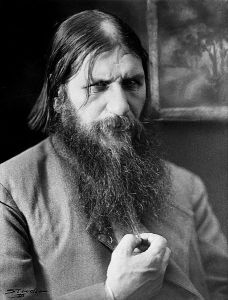
What could Aimee Semple McPherson have in common with the devious Russian monk Rasputin? Apart from being contemporaries for a couple decades, they were both faith healers. Well documented cases exist for both of them, and the medical profession has started to come around to the idea that belief can, and does, heal. The stories of Sister Aimee’s healings, witnessed by thousands, make me fear being thought gullible just for bringing it up. That doesn’t mean it didn’t happen. Cases exist even today where healing inexplicably takes place before scientific eyes. Often it occurs in response to religious stimulus. We may have proof that it happens, but we tend not to believe. This is a curious state of affairs. We trust in reason to the point that it may prevent us from being healed by faith.

Some object, of course, to the theological element. It’s pretty tricky to believe God has healed you if you don’t believe in God. The thing about faith healing, though, is that it seems to work no matter the religion of the person healed. This, it would seem, suggests we should be applying our rational minds to understanding belief. Instead we use it to find new ways to make money or to build smarter weapons to kill one another more efficiently. The more we come to understand the physical world around us, the less we know. As our research institutions take on the shape of the businesses that increasingly fund them, interest in this phenomenon shrinks. Medicine, in all its forms, is big money. Living in central New Jersey you can’t help but notice the palatial campuses of the pharmaceutical companies, nor ignore the mansions on the hill they have built. If only we could believe.

Faith healing was this aspect of her ministry that propelled Sister Aimee to fame. She constantly underplayed it, not wanting to be considered a healer of bodies so much as a healer of souls. Rasputin, of course, had political motives. Both lived—not so long ago—when faith was taken very seriously. Judging from the posturing around the least religious president in decades, whatever faith is left has been sorely effaced. Maybe it’s our minds that have the capacity to heal, but even that well seems to have been drained with the leaky bucket of rhetoric. History can teach us so much, if we’re willing to invest in it. How does faith healing work? I have no idea. Nor, it seems, does anybody else. So it will remain until it becomes commodified.


Augustine’s Secret Sin

I’m curious: what do you think of Augustine? Augustine of Hippo was an odd blend of saint and sinner. I don’t mean “saint” in the sense of being so designated by the Roman Catholic Church, but in the sense of having reputable and progressive ideas. For example, Augustine argued that science, such as it existed in his day, had to be taken into account when understanding Christianity. If the Bible’s account of creation didn’t match what we knew of the world, then literalism had to go—that kind of thing. This was quite liberal for someone in the fourth-to-fifth centuries. He believed in reason, to an extent. The sinner side of the equation goes beyond his Manichean days, however. The sins I’m referring to are his dangerous and long-lasting theological assumptions that’ve helped to hold back civilization throughout history.

It was Augustine, for example, who gave us the idea of original sin being involved in sexual reproduction. The church has always been cagey on why we should reproduce when the second coming is right around the corner, but Augustine declared that from our very conception (which he couldn’t understand scientifically) we were tainted with sin. But that’s not the particular sin to which I’m referring. Augustine also spread the persistent idea that curiosity itself was a sin. Christianity, in his view, was a “need to know” religion, and curiosity about the natural world could lead to uncomfortable answers. He held this in tension with his belief that we should accept what science teaches, but there were many questions, he decided, we simply shouldn’t ask.

Religions have often come to this crux. Science has a strong explanatory track record. Religion is frequently based on old texts, written in an age when science was but an infant. As the power of rationality grew, the role of miracles shrank. Over time the proof of theological structures began to crumble. And since life was all about correct theology, those edifices had to be shored up against the onslaughts of reason. If this sounds hopelessly outdated, I’ll have to confess that many of my students at Nashotah House believed reason was tainted by original sin. Augustine had the answers they believed; somehow rationality had stopped with him. Human curiosity, Augustine felt, was a sin. All questions should’ve ended with his arguments. It’s this kind of theological bravado that gets us into the mess we find ourselves in today. Voting blocs that never question what their religious leader tells them. Never curious enough to ask “Why?” Augustine was a brilliant man, in many respects. He was also a sinner of the highest degree.


Noah’s Phone

The world-wide flood is a great story. We find it in many cultures, so the idea obviously captured the attention of ancients as well as moderns. What’s strange is that, with the development of human knowledge so many people continue to accept it literally. The only science that can be bent enough to make it work is one where God breaks all the laws of physics and biology to kill everyone, just to make a point. Why bother to make it rain 40 or 150 days? Why not just create the requisite water instantaneously? It would be just as believable. Nevertheless, literalists look for explanations for how this might’ve happened. It’s not to convince God, of course. The goal is to convert unbelievers by showing that the myths of Genesis are literally true.

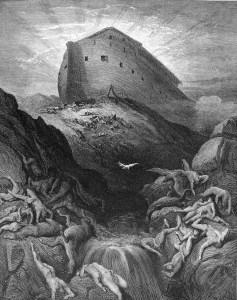
When I came across a story on Mysterious Universe by Paul Seaburn titled “Academic Claims Noah had Cell Phones, Drones and Nuclear Power,” I was hooked. The academic is a Turkish professor of marine sciences. Using modern technology—rather like the detritus seen scattered in the background of Darren Aronofsky’s recent movie version—he postulates that this could’ve happened. The real issue is why. Not why the flood; the Bible answers that. Why would a scientist feel the need to prove a myth scientifically? Biblical scholars call the flood story an etiology. An etiology is a story to explain the origins of things. That’s its purpose.

Noah’s flood explains why it rains. It also explains why this dome that covers our flat earth doesn’t fill all the way up anymore. It explains why animals are sacrificed and why rainbows occasionally appear to grace the sky after it rains. We also know that the story borrows from an even earlier Mesopotamian myth where the god who causes the flood isn’t even Yahweh. The people of Israel were conquered by the Assyrians and Babylonians and they told flood stories about their gods. The Bible counters with two stories (yes, just like the creation accounts) mixed together in this snow-globe universe of Genesis. Is it easier to believe this or to claim that Noah had access to Verizon, steel manufacturing, Einsteinian physics, remote-control flying machines, and artificial insemination (to help the animals recover)? It’s like when someone suggests natural explanations for the plagues of Egypt. Such special pleading doesn’t prove miracles, but rather it demonstrates that all this could happen without any gods involved. And you’re still going to have to mop up all that water when it’s over. I’m sure it will make for a great story some day.


Plain Speaking

When the president of the United States utters words too vulgar to print here, I think of the old They Might Be Giants’ song “Your Racist Friend.” The song is all about the indefensibleness of racism. We knew that back in the 1980s. What has made it acceptable now, in the highest office in the land? The fact that Trump is a racist was known to most of us well before he was “elected.” And, of course, the Republicans stand beside him. I feel sorry for the GOP, I really do. Those who simply wanted a fiscally conservative leader (wrongheaded in my view, but understandable) decided to go with a man who would want to revisit 1776, if he knew the meaning of the date, to ensure that this would always be white-man’s land. Hear this Republicans—by standing by Trump now you’re declaring, “He’s only saying what I’m thinking.” There’s no way to defend what he’s said about Africa, along with several nations elsewhere.

As we watch this bizarre space opera of an administration do its best pratfalls we don’t even have to go back all the way to the 1770s to wonder what went wrong. Bill Clinton was impeached for having an extramarital affair in the 1990s. Less than 30 years later we have a misogynistic, racist bully who’s on his third wife running this country like a casino. And the “Party of Lincoln” laps it up. They refuse to censure anything this bumbling excuse for a leader does. They’d be embarrassed, of course, but they haven’t considered, and refuse to consider, the consequences. I’m wondering what the musical 2016 will be like, but I have a guess.

As the Russia probe gets closer, the GOP tries to shut it down. That’s how we handle facts we don’t like now. Who would’ve thought that three decades on we’d be saying “mere adultery” was grounds for impeachment? Perhaps there were good people on both sides of that affair too. Science has demonstrated that “race” is a fiction, a human construct. But science no longer matters. Anything we disagree with we call “fake news” and FOX will be there to slurp it up and spew it wide. As Friday unfolded after 45’s statement about the status of an entire continent, his verbal incontinence still dribbling, his party rushed to defend “what he really meant.” What he really meant, he said. And what he said, if you don’t denounce him, is what you’re thinking too.


How Did We Get Here?

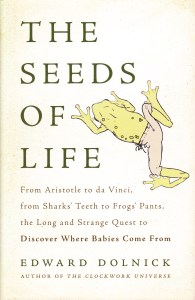
Where do we come from? Leaving aside the puerile snickers of our younger selves, we eventually learn “the facts of life” and get on with it. The funny thing is, conception wasn’t really understood until the late nineteenth century. Obviously people had been reproducing from the very beginning. Chances are they were curious about the matter even then. Scientific investigation was a long way off, however. Edward Dolnick tells the story of the discovery in a wide-ranging, entertaining, and informative way in The Seeds of Life. The subtitle gives an idea of the range and quirkiness of the account: From Aristotle to da Vinci, from Sharks’ Teeth to Frogs’ Pants, the Long and Strange Quest to Discover Where Babies Come From. I used to tell my students that using the Bible for sexual ethics was difficult because biblical writers really didn’t understand what was going on “down there.” I think Dolnick would back me up on that.

Ancient people generally made the connection between sex and babies, of course. What was actually happening, however, wasn’t understood because sex cells require a microscope even to be seen, and that doesn’t make it obvious what they’re doing. Dolnick’s tale looks at advances in various sciences and, perhaps more importantly, the religious constraints under which they operated. The idea of the atheistic scientist is a fairly new one. Up through most of the nineteenth century scientists tended to share the worldview of others that God was assumed and that religious rules applied to such mysteries as life. That’s amply demonstrated in this book. True insight was slowed down considerably by religious presuppositions.

That’s not to say Dolnick blames religion—this book is much too congenial to do any blaming. A number of ideas had to coalesce, however, before it was understood that both women and men contributed to the developing embryo. Medicine was often looked down upon by science, and religion often crossed its arms and stood in the way. Despite all that, careful observation, and putting unexpected things beneath a microscope, finally led to the answer. It was sea urchins who finally yielded up the mystery’s clue. This book will take you some strange places. The individuals described are a curious lot. For the most part they’re also a religious lot. Persistent theorizing and persistent peering through a microscope and a willingness to question convention all had to combine to answer a question as basic and profound as where it is we come from.


Middle Age Demons

One of the consequences of watching horror movies is the interest in the origins of various monsters. Since many such films feature demons, their backgrounds and origin stories have always been a point of curiosity. Time is always an issue and Juanita Feros Ruys obliges that hurried sense by packing a lot of information into her short book Demons in the Middle Ages. Covering the basics in the introduction, she moves on to discuss demons in the desert—the bane of the early monastic, and demons in the monasteries of populous Europe. A chapter on the Scholastics describes how early science was applied to incorporeal beings, and a final chapter on learned magic, i.e., raising demons via magic books, finishes off this brief study.

What is particularly striking here is that the Bible says surprisingly little on the topic. It says, however, just enough to kickstart the Late Antique and Medieval interest in the subject. Vast amounts of speculation were raised in the Middle Ages concerning what exactly demons were and what they were made of and what they could or couldn’t do. Ruys points out the trajectory of the male necromancer giving way to the female witch just as early modernity was getting started. The results, we all know, were horrific. Throughout it is remarkably clear that belief in demons was strong. People took them very seriously—the Bible says they’re there, so there. Belief, as always, has consequences. Beginning with the Scholastics, however, a reasoned understanding of the spiritual world was deeply desired.

Reason and faith aren’t really the strangers they’re often portrayed to be. Medieval monks could be quite clever and scientific in their outlook. Human mental faculties, created, as they believed, by God, were necessarily good. Something I’d never considered, but which Ruys explores, is the belief that God cannot experience emotions. Being an “unmoved mover” meant not experiencing emotion (which, she points out, includes a noun of movement). This also meant that demons, according to some, had no feelings. This is a very cold spiritual world, particularly when it’s put into conflict with the human one. Spiritual, rational beings subjected to emotions, we’re the ones at the mercy of supernatural beings more powerful than us, yet incapable of the warmth we crave. About a millennium and a half of shifting beliefs in demons crowd this tiny book. Although not intended to be especially profound, it gives the reader plenty to ponder. Including why some of us watch horror movies at all when religion can do the trick all by itself.


Science and

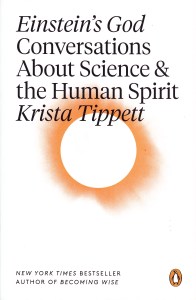
Do science and religion have to fight? It’s not evident that they do, but some on each side of this divide like to keep the conflict going. Many religious believers feel threatened by the incredible success of scientific explanations. The gods who used to explain everything are now responsible for so little that it’s easy to feel foolish for believing. It doesn’t help that the most vocal scientists have made religion their personal court jester, adding ridicule to the mix. Krista Tippett’s book of interviews with scientists, Einstein’s God: Conversations about Science and the Human Spirit, is a refreshing counter to this trend. Although it’s a few years old now, the book just landed under my tree, so I started off the new year with it.

A blend of interviews with scientists, quotes from their books, and personal observations, Einstein’s God is a fascinating and quick read. Covering topics from the wonder many scientists feel about their discoveries to medical understandings of how spirit effects healing to the ongoing debates about evolution, this book looks at the big picture. The scientists Tippett interviews, although some are atheists, don’t dismiss religion. In fact, many of them suggest religion in some form is necessary for healthy human living. As scientists they don’t dismiss science either. It’s refreshing to read about how those with scientific bona fides sometimes come to the same conclusions that those of us without the credits have surmised.

Once I began working at age 14, one of my earliest purchases was a subscription to Discover magazine. I was a charter subscriber. I was also a Fundamentalist. Not realizing that science and religion should be squabbling, I read science that could be digested by someone without professional training. Until I felt the tug of the ministry, I had intended to be a scientist. The only professional religionist interviewed in Tippett’s book is John Polkinghorne. A physicist cum priest, Polkinghorne has come to prominence among those involved in the debate between how we know what we know (the fancy term is epistemology). I wondered as I read this how it might differ from the other direction. Some of the interviewees were raised religious—Jewish and Hindu, notably—but none started out as professional religionists who went into science. That, I learned after college, is a much harder transition. Perhaps it says something about the nature of reality that to move into science as a career you must start with the undergrad prereqs if you ever hope to make the switch. Otherwise, those who start out with A’s in high school physics end up watching from the sidelines while others set the terms of the conversation.