Infinite but Expanding

What could be more humbling than living in an infinite but expanding universe? Since the days of Copernicus, Brahe, Kepler, Galileo, and Newton we’ve known that the apparent reality of both our own lives and that portrayed in Holy Writ is inaccurate. The earth doesn’t hold still, and the sun doesn’t rise or set. The universe isn’t a layer-cake with Heaven above and Hell beneath. Instead it’s mind-numbingly massive. The only appropriate response, it would seem, would be silent awe. Marcelo Gleiser, whose work I’ve mentioned before, is a rare scientist. Rather than continually slapping the rationalist card on the table and declaring science the trump suit, he brings an element of humility to his writing. So much so that he’s willing, almost eager, to engage religion. Not in debate, but in conversation.

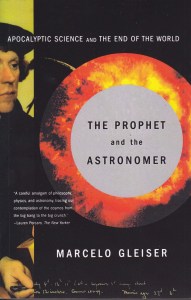
The Prophet and the Astronomer is a wide-ranging book that is tied together around the theme of the end of the world. A few weeks back we had yet another brush with a biblical literalist declaring the end of all things. Gleiser, although his book was published over a decade ago, was called in to comment in various places. This book opens by discussing ancient ideas of the end of the world. These are necessarily religious ideas. We don’t fully understand ancient concepts, but enough remains for us to see that apocalypses have their origins in Zoroastrian thought. Judaism encountered such thinking and the book of Daniel ran with it. Early Christians also had the world’s end on their minds, and the book of Revelation developed into a full-blown apocalypse. The world, or at least the western hemisphere, has never been the same since. Centuries of living under the threat of a cataclysm that could come at any second surely takes its toll.

Gleiser then shifts to the real harbingers of potential apocalypses. Comets and asteroids still exist and could theoretically deliver what the Bible implies might happen—a fiery end to the planet. This is sobering stuff. But the book doesn’t stop there. Bidding adieu to the dinosaurs, The Prophet and the Astronomer sweeps us into this great, expanding universe and how it may end, scientifically. Black holes and the heat death of the universe can be truly terrify. What is remarkable about the book, however, is that Gleiser openly acknowledges that science can’t give the comfort and meaning that religion can. Instead of saying, “be tough, face facts” he suggests that scientists might consider a narrative that adds value to a cold, dark universe. That’s not to say some of the story isn’t technical and some of the concepts aren’t difficult to grasp, but it is to suggest that science and religion should sit down and talk sometime. Hopefully before the end of the world.


Uncomfortable Truth

Ugly. That’s not a word I use lightly. The phenomenon of racism is ugly. More than that, it’s insidious. I recently attended a community course on racism sponsored by the Central Jersey Community Coalition. Since our government won’t condemn racism our communities must. This five-hour course was an eye-opener for me. I had known that race was a social construct with no basis in biology or any kind of science. What I hadn’t realized is that race was invented as a means of maintaining “white” power. And it was done so deliberately. The course leaders outlined the history of the modern concept of race and showed how it is primarily an American phenomenon (not exclusively, but it was intentionally orchestrated here). The idea was to keep property in the hands of wealthy whites.

During the discussion many topics came to mind. The primary two, for me, were capitalism and the Bible. These strange bedfellows are far too comfortable with one another. Both can be made to participate in the racism narrative. Capitalism appeals to the basest and most vulgar aspects of being human. Greed and selfishness. Wanting more for me and less for you. As one participant put it, it’s a zero-sum game. Your loss is my gain. We support this system every time we buy into the myth that life is about consuming. Buying more. Contributing to the economy. That which is lost is mere humanity. This is the narrative our government has adopted. The election of one of the uber-wealthy has demonstrated that with a nuclear missile shot heard round the world.

And what of the Bible? As the story of the flood unfolds in the book of Genesis, Noah develops a drinking problem. Naked in his tent, his shame is seen by his son Ham. Hungover the next morning, the only righteous man alive curses his son’s progeny. Then after the tower of Babel story, those cursed races, in biblical geography, end up in Africa. Christian preachers long used this myth as the justification of slavery. Races, after all, were decreed by God at that very tower. The tower shows us for who we truly are. Human hubris led to divine folly. And now we have a nation of liberty built on the basic premise of inequality. Racism is beyond ugly. It’s evil. The Bible may be complicit, but we need to take over the narrative. Race does not exist. Scientifically there is no such thing. Although race doesn’t exist, racism most assuredly does. Like all evils we must bring it to the light to make it disappear.


The Deity Electric

The title set me back. “Deus ex machina: former Google engineer is developing an AI god.” The article in The Guardian is surprising in several ways. Firstly, technocrats tend to suggest that since there is no deity, worship of said non-entity is a waste of precious time. Is this, then, an acknowledgement that those of us who’ve spent our lives on religion may have had at least an inkling of the truth after all? Scientific studies have repeatedly shown that religion is an inherent, and perhaps unavoidable, aspect of being human. Whether you call it inspiration or superstition, we think in religious terms. It’s entirely natural. Perhaps it’s evolved behavior. It’s anything but absent.

Another aspect of the article that generates wonder is the idea that we can create God. Yes, analysts have long claimed that we humans made God in our own image. Traditionally, however, the very concept of God was based on the idea that there was something non-human about the deity. Artificial Intelligence, however, makes the hubristic assertion that human intelligence knows enough to create a god. We don’t even know enough to elect a sane person as president. Looking at the wider world—let alone the universe—there is so much we don’t know. Our five senses are limited. There are realities which we have no way to measure. Is is perhaps not dangerous to make a divinity when our own way of looking at the universe is so terribly limited? What if I don’t like the god you build? At least with the old fashioned one we can shrug our shoulders and sigh, “that’s just the God there is.”

Any fulfilled future humanist will need to find an outlet for this need to worship. Can we truly respect a deity whose transistors we’ve manufactured? This Godhead will be, at the end of the day, only 0s and 1s. And what’s more, we will know that. Traditional religions have given us gods from the outside. Some of them are flawed, some are perfect, but they all have this in common—we didn’t make them. The universe imposed them upon us. Throughout history people have attempted, in various ways, to build their own gods. It generally doesn’t end well. It’d be like designing your own parents. They made you what you are and what would you be if you could somehow reverse engineer them into more perfect versions of themselves? Can we invent gods? Oh yes. We do it all the time. But when we set about making one that our disembodied, downloaded consciousness can worship we might want to consider the history of such attempts.


Learning to Evolve

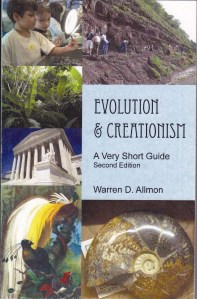
Not to beat a dead hadrosaurus, but creationism is in danger of driving us extinct. On a visit to the Paleontological Research Institution’s Museum of the Earth in Ithaca, I picked up a copy of Warren D. Allmon’s Evolution and Creationism: A Very Short Guide. Although I’ve read plenty of books on the subject, a refresher is never a bad idea. When it came to statistics, though, it grew scary. The majority of Americans do not accept evolution, despite all the evidence for it. What’s even scarier is that a large percentage of physicians—particularly Protestant ones—do not accept it either. Allmon is writing for a local readership, but these issues are quite large. World-wide, in fact. One thing most scientists don’t understand is that “religion” isn’t to blame. Literally reading of texts is.

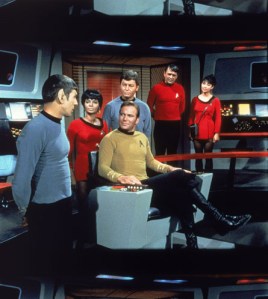
Were it not for the creation myth in Genesis 1 there would be no conflict over evolution in Christianity or Islam. The question comes down to how one understands a sacred text. Many religious believers can’t get beyond the basic issue of if it took more than six days to create the world then that house of cards called biblical truth collapses. There’s a panic involved here. A very real and visceral fear that heaven itself is on the falling end of the balance. No amount of scientific reasoning will help with that. Hell is just too scary. And reason tells us that reason can’t solve this dilemma. Those raised religious by caring parents can’t believe that Mom and Dad would teach them wrong. Emotion plays a stronger role here than reason. More Kirk, less Spock. When even a majority of high school science teachers feel that “teaching the controversy” is okay, we’re in trouble.

Allmon’s book is well-intentioned. Of course, it was written before the post-fact world evolved. The stakes for not accepting reason (think Trump) are extraordinarily high. Having a figurehead that doesn’t accept rational explanations for what the educated can see plainly encourages widespread copycat ignorance. In the rational world there is no doubt about evolution. Most mainstream biblical scholars and clergy accept it. Don’t try to convince others with an argument, however. This is a matter of belief. Allmon does point out that science can’t speak to non-physical processes. It can say nothing about God. But a certain book can and does. Had it been written in modern times none of this might have become an issue. Until we realize the power of that book, we’re going to continue to struggle to come to grips with simple facts.


Small Wonder

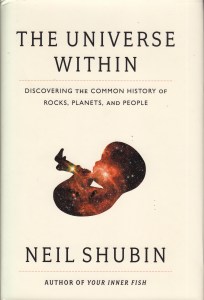
Nothing makes me feel small like thinking about the universe does. Never a large individual anyway, thinking how this apartment encompasses me and it is dwarfed by the small town in which I reside, it’s only a matter of moments before I become a mere microscope slide. And that’s before I even reach the level of just our planet. I’m sure Neil Shubin didn’t mean to make me feel bad when he wrote The Universe Within: Discovering the Common History of Rocks, Planets, and People. In fact, I’m pretty sure that he intended it to be a book that makes the reader feel connected to life, past and present, as well as to the stars that long ago spewed out the elements that have made such life possible. This is a big picture book. From the perspective of a paleontologist the very rocks that entomb the fossils live. The stream of particles is unbroken from the Big Bang to our little corner of the Orion Spur.

The great orthodoxies of science, however, require faith. No matter how the math works, it seems impossible to the rational mind the the entire universe could fit inside the space of the following period. Then, for some reason not yet known, bursts out to infinite but expanding size. Shubin brings many concepts together here—the effects of Jupiter on bringing earth into the Goldilocks Zone, the impact light and dark have on our bodies, whence the dinosaurs might’ve gone—and weaves a tether through it all that ends up in the hand of humanity. Evolved beings we are, but evolved from stardust as well as primordial soup. And then there’s the fact that the earth itself, as is inevitable, is slowing down. Days are growing longer yet we don’t get any more done. And we have maybe a billion years left before the sun goes Trump on us.

There is a strange comfort in being connected to all of this. And also a sense of shame as well. We are, as far as the fossil record reveals, the only species to initiate a mass extinction single-handedly. We have this whole planet and we want even more. It comes as no surprise that religious language crops up now and again in a treatment like this. After all, words divested of such concepts can take us only so far. The Universe Within is a book with a universal perspective, placing us squarely somewhere within a context that we simply can’t comprehend. And yet, reading it somehow leaves me feeling small.


Deep Web Religion

The bases of truth are ever shifting, it seems. What was once decided by spiritual tests now finds technological solutions. A friend sent me a story from IFL Science (which, surprisingly, often focuses on religion) concerning a nun in seventeenth-century Italy. What makes this nun stand out is less than she had a mental disorder but more that she wrote that it came from the Devil. Her letter, however, was written in an indecipherable script and has only just been decoded. How? By using decoding software on the Deep Web. As someone who’s still lost on the surface web, I’m not sure whether diabolical possession or this mysterious sub-web is scarier. An even more profound question is why someone in this scientific age would resort to the Deep Web to diagnose the illness of a sequestered religious long dead.

Like Manhattan, which, I’m told, has many layers underground, the web has places you shouldn’t go. Computers linked promiscuously together have an amazing power, and apart from those of us who can while away hours looking at photos and videos of cats, there is a darker, more sinister area that can’t be accessed with Google. Down there, according to IFL Science, resides powerful code-cracking software that might be profitably turned to Linear A or Hurrian, but is used to decipher the centuries’ old note of a woman who believed she was possessed. I’m not knocking the achievement. Decades of research have apparently solved the conundrum of the Voynich Manuscript—we can’t stand having the ancient talk behind our backs—and yet try to get funding to hire an Assyriologist at your school. The vast majority of ancient Mesopotamian clay tablets remain untranslated in cellars as dark as the Deep Web.

There seems to be little doubt that Sister Maria Crocifissa della Concezione suffered from some form of mental illness. Even today some psychologists are starting to suggest that “possession” should be considered a viable option for diagnosing some cases that otherwise defy satisfactory resolution. This isn’t medieval superstition, but it is our understanding of a materialistic universe shoved up against a wall. We can’t stand not to know. Mental illness is as old as mentality. We can’t comprehend the vastness of this world, let alone this galaxy or this universe. Even very interesting stuff gets lost on the world-wide web. I don’t even want to think about what goes on in the infernal regions below it.


Beam Me Where?

It’s kind of like the transporter dilemma on Star Trek. Where is the person/Vulcan/Klingon when their atoms are being disassociated in one location and reassembled in another? In the classic series, McCoy was never happy with the technology, and even today our doubts linger about what constitutes a person. The other day in a routine medical procedure, I underwent anesthesia. Lying there in the corridor, staring at the calmly themed over-head light colors (no, they actually were themed covers; the drip hadn’t started yet), I wondered where I was about to go. I’ve only had anesthesia once before that I can remember, and I recalled awaking suddenly from the most profound, dreamless sleep ever. It was very different from ordinary sleep. So where was my consciousness at the time?

We have no satisfactory answer to the question of what consciousness is, let alone where it is. Materialists would say, literally, it’s all in your head. Consciousness is a happy mixture of electro-chemical signals in a dull gray organ that’s busing churning out this illusion that Steve A. Wiggins is something more than, well, a mixture of electro-chemical signals. Those of us who’ve experienced enough to question such simple answers wonder a bit more deeply about it. What is consciousness? We’ve all had that feeling, I suppose, of awaking from a dream and being disoriented, even throughout the day at points, as to whether it was real or not. Or, alternatively, remembering something but not being sure if it “really happened” or might’ve been a dream. Ordinarily we recognize the difference between waking and dreaming consciousness, but sometimes the line is blurred.

My experience this time around was the same as last. One moment you’re talking to an anesthesiologist and the next you’re awaking from a completely blank state of mind, a little confused about where you are. You haven’t been in dreamland since there was nothing there. The exact mix of chemicals isn’t the same as when you fall asleep. For all intents and purposes, you are completely gone for that span of time. When I woke up I remembered the anesthesiologist and the watch he was wearing. His accent. His assuring me that the bubbles in the tube were okay. Between that moment and this, nothing. A complete blank. I went in hoping that I might explore alternate states of consciousness in those few disassociated moments, but that’s not how it happened. I think I’m ready to beam back aboard now, though. I trust my consciousness will follow my gray matter, even as I’m being beamed through the ether.


Trees, Please

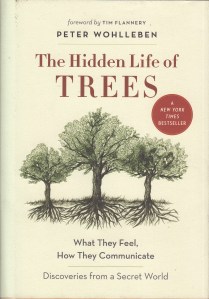
One thing we know about nature is that we don’t know much about nature. We can be a pretty self-absorbed species. Peter Wohllenben’s The Hidden Life of Trees is a good corrective for that. When we’re young we’re taught the difference between plants and animals. What Wohllenben shows is that such differences are more a matter of degree than we realize. Trees move, but slowly. Their timescale can be vast, compared to our brief, get-rich-quick outlook on life. It has been demonstrated pretty clearly that trees communicate with one another. They help one another, and they can, in their dendritic way, think. They cooperate with fungi to maintain connections between their root systems. Trees might even have what we would call personalities, were they fortunate enough to have been born human.

In a little like a medieval fantasy world, Wohllenben is a German forest keeper. He knows trees and their ways intimately. The trick, of course, is that we have a difficult time seeing things in timeframes that exceed our own. There are living trees that are 9,000 years old. That’s before the Sumerians ever showed up to invent writing. In human eyes, a lot has happened since then. And although we don’t know how to define consciousness, we’re sure that it’s limited to our species alone. Grudgingly we may admit some “higher” animals to the club, but our predilection for conquest of our world would be sorely diminished had we not other creatures to dominate. Looking at the world through a sympathetic lens, however, the fact that we’ve evolved these traits from the common ancestor we have with the animals should tell us something. As Wohllenben points out, animals diverged from plants at some stage, but we do ultimately come from the same stock.

Even on a practical level, we can’t live without plants. No matter how gourmet our foodies may be, our nutrition cycle begins with plants photosynthesizing food from pure light. There is perhaps a danger in recognizing our kinship with trees too closely. We depend upon them for food, shelter, warmth, and the oxygen we breathe. We might be inclined, as Wohllenben notes, not to use them at all. The key word here, however, is exploitation. We evolved along with plants and other animals and we all rely on each other. We are all connected. We should care for those with whom we share the planet. Trees have a much longer view than we do. When the desires of one species set the terms for all the others, we soon feel the pain of the trees.


Warnings Ahead

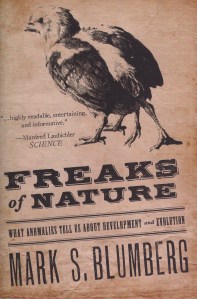
As a noun, “freak” is akin to a swear word. To refer to another person in such terms is often considered derogatory and degrading. Still, we all know what it means—an individual who doesn’t conform to expected models. I was a little worried about Mark S. Blumberg’s Freaks of Nature: What Anomalies Tell Us about Development and Evolution, then. It had the word “evolution” in the subtitle, and that sounded scientific enough. Besides, those of us interested in monsters know, deep down, that they are essentially freaky things. Indeed, Blumberg starts his book with teratology, the study of monsters. And monsters come from religious backgrounds. Their name is related to the root “to warn.” I’m a squeamish sort, though, and reading about freaks of nature requires a constitution I sometimes lack. Especially when it comes to science.

Yet I couldn’t put the book down. To begin with, the concept of developmental evolution (devo evo, for those in the know) is utterly fascinating. If you grew up, like I did, being taught that genes govern evolution solely, this book will surprise you. Evolution can happen at the level of the phenotype, based on environmental pressures. This is well documented and hardly a matter of dispute. Bodies can change according to what they need. Blumberg offers case after case where this dynamic may be seen. The idea that we are “programmed” falls, ironically, at the feet of biology itself. We, and all animals, are adaptive creatures. Humans may not be able to regenerate lost limbs, but many amphibians can. Sometimes it’s a matter of age, and sometimes it’s a matter of matter. I found such a quantity of astonishing stuff here that I overcame my queasiness to see what the next page might reveal. When I hit the chapter on reproduction I realized once again that nature does not agree that “man plus woman equals marriage.”

This must be one of the most threatening areas of science to Fundamentalists. The sheer variety of ways that “genders” interact in nature, and appear in human bodies, will have purists calling out for heavenly clarification. Reproduction, in other words, isn’t in the service of conservatism. Fish, for example, that change “genders” instantaneously after mating, taking turns being female and male with a mating partner, must surely call for theological justification of some sort. And female lizards that don’t require males to reproduce, but are helped along by being mounted by another female so as to jog some ancient reptilian memory, require us to rethink our rather simplistic terms of endearment. Not for the the faint-hearted, but amazing for those who dare, this book takes our appreciation for “life finding a way” to a whole new level. Even if it’s a little freaky.


Eating Earth

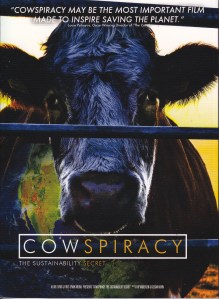
Some things are hidden in plain sight. That doesn’t make them any the less insidious. One such hidden truth is that the earth is of a finite size. Another is that, consequently, its resources are limited. Our species is easily led, as are most herd animals. Standing out can be embarrassing. Painful even. This is the recipe, along with a generous dash of greed, that has put us on the brink of worldwide catastrophe. We live in an unsustainable system, and some of the largest culprits are our appetites. As a fan of horror movies, I can honestly say Cowspiracy is the scariest movie I’ve seen in a long time. It’s a documentary, not genre fiction. Scientists had generally already thrown up their hands because we’ve passed the tipping point for global warming, and then we elected ourselves the stunning leadership of Donald Trump.

No one can predict exactly what form the collapse will take, but we’ve set the key factors in place. We’ve been warned for years. Cowspiracy demonstrates something we don’t want to admit—the agricultural lobby is extremely powerful and the least sustainable aspect of life on this planet is animal husbandry. In early civilization, where technology did not exist to support large-scale farming, meat was not a staple of the human diet. Families that could afford animals gained more value from their beasts alive than on the plate. And they had only a few. As mechanization increased in the last century, we made livestock valuable commodities. When I was a kid word on the street was you were even poorer than we were if you couldn’t eat meat every day. Humans were the absolute, if blind, masters of their own domain. Now agriculture is the single largest force of degradation of the environment on the planet. And nobody wants to listen.

Cowspiracy is not an easy movie to watch, even for a vegetarian of many years’ standing. So why watch it? Because our reliance on animal-based food is destroying our planet. Not slowly either. If this is true, why haven’t we heard of it? Kip Andersen and Keegan Kuhn spend an hour-and-a-half exploring that in this important film. While it can’t be fully summarized here, in a word it can be said: money. There’s huge money to be made in a business rightly called animal husbandry. Wedded to profits at the expense of the very soil that gives us life, we eat our way to the grave. And we do it even when technology has already offered viable alternatives. They are also hidden in plain sight.


Self-Conscious

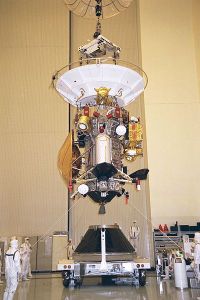
Cassini is no more. The Saturn-bound satellite was launched in 1997 when the earth was a very different place. As it’s four-year sell-by date passed, the little robot who could kept on snapping photos around the ringed giant and its moons. Remote controlled from three planets and an asteroid belt away, it was decided that the explorer had to be destroyed in Saturn’s thick atmosphere rather than contaminate one of the moons where life might someday be found. Yesterday the probe burned up on its way through Saturn’s perpetual cloud bank. This has led to many emotional tributes, even among scientists who believe Cassini was just a machine. It also shows us how little we really know about consciousness.

During the two decades that Cassini was in space, we’ve learned quite a bit about animal consciousness here on our own planet. Many are now finally becoming convinced that we share this strange quality we can’t even define with other biological entities. Well, at least the “higher” kind. And we can’t help but think that maybe our more intelligent machines possess it too. We treat them as if they’re alive and willful. That could be a case of our own consciousness projecting itself onto inanimate matter—that’s something consciousness is pretty good at too—but since we lack the ability to measure consciousness, we can’t know if it’s there or not. To hear the astronomers talk, we’re going to miss Cassini, a machine that outperformed expectations. Ironically, once we get machines off the earth they tend to do that, even without oil changes every 5000 miles.

Down here on earth we complicate consciousness with cash. Devising an elaborate economic system to demonstrate who can buy power in the White House and who can’t, we want to know who is more important than whom. It’s a simple metric. Bank accounts tell the truth, no matter what the level of consciousness—or even of sentience—that the account holder may have. And then we wonder why a nation that can send a satellite three planets away can’t even figure out that all races should be treated equally and fairly. Cassini was a collaborative effort. Different races, genders, and economic classes contributed to its remarkable voyage. Eyes around the country were moistened when its last image was projected to earth. We wisely decided to immolate our satellite before we could contaminate another world. Meanwhile on our own planet we’re barely conscious of what we continue to do.


Reason to Believe

Gods, the experts say, are on the way out. Have been for some time. The loudest voices in this arena are the New Atheists who suggest science alone explains everything. Problem is, the gods won’t let go. My wife recently sent me an article from BookRiot. (That’s a dangerous thing to do, in my case.) Nikki Vanry wrote a piece titled “Dallying with the Gods: 16 Books about Gods and Mythology.” Most of what she points out here is fiction, and that makes sense because gods and fiction go together like chocolate and peanut butter. The first book she lists is Neil Gaiman’s American Gods—a book I read years ago and which has subsequently become an American phenomenon. There’s even a television series based on it now. Like Angels in America, only more pagan.

What surprised me most about this list is the books I hadn’t read. Or even heard of. After American Gods, I got down to number 10—Christopher Moore’s Lamb—before reaching another I’d read. Then down to 16, Till We Have Faces, by C. S. Lewis. There are, as Vanry notes, many more. Our experience of the world, as human beings, suggests there’s more to it than what we see. Not everyone would call these things gods, nevertheless there certainly does seem to be intentionality to many coincidences. Things pile up. Then they topple down on you all at once. Seeing such things as the works of the gods makes for a good story. At least it helps explain the world.

Many materialists do not like to admit that humans believe. Call it the curse of consciousness, but the fact is we all believe in things. Even if that belief is as strange as thinking fiction only comes from electro-chemical reactions in a single organ in our heads. Gods often appear in fiction. Frequently they’re in the background. Sometimes they’re called heroes instead of deities. At other times they’re right there on the surface. Such books carry profound messages about believing. It doesn’t matter what the authors believe. Believe they do. And such books sell. As a culture, we may be in denial. What we sublimate comes out in our fiction. There are gods everywhere. Singular or plural. Female, male, or genderless. Almighty or just potent. Reading about them can be informative as well as entertaining. We’ve got to believe in something, so why not gods?


Hurricane Warming

Image credit: NOAA, public domain via Wikimedia Commons

My heart goes out to those suffering from Hurricane Harvey in Texas and Louisiana. Natural disasters like this are often tied to the “wrath of God” model, and outdated though it is, it still captures how it feels. The sheer amount of rain dumped by this one storm is literally inconceivable. Trillions of gallons. Coupled with a completely ineffectual president, the disaster is even greater. Like many others, I’ve been watching since the weekend as the numbers and statistics of woe rise. Lives lost. Property washed away. Once more it reminds us just how small we are in the face of the weather. Some of this same awe was in my mind as I wrote Weathering the Psalms. Ancient Israel did not experience hurricanes—the bodies of water nearby aren’t large enough to generate them. A single thunderstorm, however, is enough to put the fear of God into a person. In ancient times, with an under-developed meteorology, all of this was the provenance of providence. How else could you begin to explain such tragedy?

One of the books that got me started on my meteorotheological quest was Erik Larson’s Isaac’s Storm, about the Galveston hurricane of 1900. Thousands died in that storm, and it remains the most deadly natural disaster in US history. Although Hurricane Harvey developed quickly, there was warning. The death toll is remarkably small (at least at the moment) compared to the fury of the storm. The natural tendency of human psychology is to look to supernatural explanations for such devastation. What have I done to deserve this? How could God do this? Are we being punished? Questions such as these come to mind, although we know that hurricanes are entirely normal features of this planet. Somewhere in the back of our minds, though, we probably are aware that global warming causes more radical weather.

Even as Trump continues to surround himself with climate change deniers, we see what global warming looks like. The weather is an intricate mechanism. Small things effect it. Large-scale changes throw it into chaos. Those who see climate change as a pain in the pocketbook will do anything they can to deny its reality. More powerful than a freight train or battleship, the weather can’t slam on the brakes and suddenly resume a more milder form. No, we’ve already started the process, no matter how many billionaires disagree. My heart goes out to those who continue to suffer from the hurricane. We need strong leadership and clear thinking at such times as this. We will need more of that in years to come. But we must also keep in mind this isn’t the anger of God. Unfortunately the wrath of human greed can be just as devastating as the wrath of the Almighty.


Eclipse 2017

It’s the day after the eclipse. Perhaps it’s because of the internet, but the excitement about this somewhat common event reached a fever pitch. Maybe it was because we all wanted something other than Donald Trump to talk about. Maybe it was because we hoped that the eclipse might have brought about some profound change. In the days before science was a thing, eclipses were divine events. The sky doesn’t darken at noon. It is an uncanny, an eerie thing. The last eclipse—alas, only partial—that I experienced was at Nashotah House. My wife was still a student in Illinois at the time, and without her to remind me, I went about my classes as usual. When I stepped outside the eclipse was already in progress. Nashotah’s quite rural, but the birds and insects were silent. The light was weird. The shadows of the leaves were scooped crescents on the ground. I could understand why pre-scientific people trembled.

These days we know there’s nothing more to life than scientific formulas and a bit of sloppy chemistry. So why do we bother getting bothered about eclipses? The fact is they remain religious in our minds. This is nature acting in a way not normal. Apocalypses generally include the sky growing dark. One of the plagues of Egypt was darkness. In the ancient mind the sun did not so much cause light (the moon could give light too) but it lived in the realm of light. If something blocked the sun that was one thing. If something invaded the realm of light, that was another. An eclipse was such an invasion. Even as monotheism began to take hold, people thought of the sun as a deity. It, after all, directs our lives.

In New York City I wasn’t sure what to expect. I went to street level with a couple of colleagues about 10 minutes before maximum coverage (about 71%) began. Knots of people stood on the corners on the eastern side of Madison Avenue—those who build skyscrapers don’t think of eclipse viewing on the streets below. What struck me most, however, was a kind of peace and awe. Strangers sharing various viewing devices with each other and looking up expectantly. Clouds had begun to move in, and I found myself talking to complete strangers, sharing out the eclipse-viewing glasses my wife had given me. We were participating in a moment of transcendence. Such moments are rare today. No, an eclipse is more than simply the moon moving in front of the sun. It is a human event as well. And one which, in the absence of the sun, brings out the best in us.


On the Rocks

This universe is indeed a mysterious place. You don’t have to believe in the paranormal anymore to see it. A look at the headlines makes my point. There are those, however, who do look at the genuinely strange, and once in a while this realm crosses paths with that of religion. A friend pointed me to a story on Mysterious Universe about floating rocks. Apparently this story is going to be on the mainstream Travel Channel, so it’s not completely bonkers. It caught my attention because it’s about rocks. While of decidedly poor qualification to be a rock-hound, I have more than a passing interest in geology. Itinerates shouldn’t collect rocks, but I can’t help myself. Anyway, I’ve been known to go to publicly open mines and tap away with my rock hammer hoping to find some not-so-hidden treasure.

According to the story, there is such a publicly open mine in Arkansas. Crystals (I expect quartz) are available for surface excavation, for a fee. Then the owners, the Murphys, noticed the anomalous rocks. Since they are conservative Christians (this is Arkansas after all) they feared what powers might be behind rocks that don’t obey the laws of gravity. The mine didn’t get closed and hushed up because of an unusual source of inspiration. An article by Billy Graham on divine mysteries led them to keep the mine open and to allow for investigation. Once the Travel Channel comes out with its program Crystal Mine is sure to experience an influx of business. Mainstream scientists, one expects, will not be among them.

The universe is vast. We haven’t explored all of our own planet yet (we’re kind of busy destroying it at the moment, so if you don’t mind…) and yet we gleefully claim what’s impossible. I don’t know if there are levitating rocks in Arkansas, but I do think we’ve been a bit hasty about some of our conclusions. We may yet find things that will force the concepts—the laws—to change. Consider gravity, which seems particularly relevant in the case of floating rocks. Sir Isaac Newton (devout theist that he was) ending up having to relinquish the “correct” explanation to Albert Einstein. Some have been so bold as to suggest that maybe even Einstein might not have gotten the whole skinny on gravity. We continue to learn. Levitating rocks are indeed strange. Not so strange, however, as Billy Graham being the one to rescue an anomaly for the world to see.