The Computer of Dr. Caligari

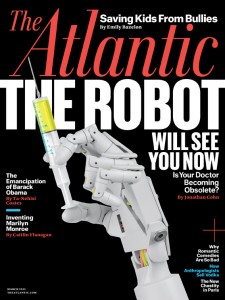
TheAtlanticTo be human is to be ethical. Not always in the best way, unfortunately. Nevertheless, our moral sensors are pretty much constantly running as we try our best to make the right moral decisions. This thought occurred to me while reading Jonathan Cohn’s article, “The Robot Will See You Now,” in this month’s The Atlantic. Having been a sideline watcher of FIRST Robotics for about four years now, I have heard countless stories of how robots perform some surgeries more efficiently than clumsy humans can. Cohn’s article starts off with the impressive potential of IBM’s Watson to sort through millions and millions of bits of data—far beyond any human capacity—and make more informed recommendations about medical treatments. After all, Watson won on Jeopardy!, so we know “he”’s smart. But he isn’t really a he at all. Still, in our reductionist world where humans are just “soft machines” computers and robots should be quite capable of helping us heal. To survive longer.

I am a veteran of Saturday afternoon science fiction movies and weekday episodes of Star Trek and Battlestar Galactica (original series, both). The present is starting to feel like that impossible future I watched as a starry-eyed child. But what of Dr. McCoy? I remember literally cheering (something I haven’t done much in recent decades) when DeForest Kelley’s name appeared on the opening credits of Star Trek when season three began. Bones was always one of my favorite characters—the doctor who didn’t trust the machines upon which he relied so heavily. He was a down-to-earth country doctor, who seemed to feel out of touch with the human (and occasional alien) element with machines interposed between them. Medicine is, after all, a very personal thing. Our bodies are our souls. I know; scientists tell us we have no souls. Embodiment studies, however, suggest otherwise. That robot coming at me with needles and scalpels may know how to heal me, but does it have my best interests at heart? Where is its heart? Its soul?

Better health care is certainly much to be desired. But in a country where our lawmakers continually debate whether the poorest should have access to Watson and his ilk, I wonder where ethics has gone. Robot doctors, I’m sure, will not accept patients with no insurance. Does not compute. Having gone without health insurance myself for several years, despite holding advanced degrees, I know that if I’d had a health crisis I’d have been rightly ranked down there with the blue collar folk that I consider kin. You see, to be human is to be ethical. That doesn’t mean we’ll always make the right decisions. It’s a safe bet that Watson can play the odds mighty finely. And the soulless machine may be making the decisions about who lives and who does not. Now that I have insurance again, when I’m on that cold slab I may have a shot at seeing a robot doctor. If that ever happens, I’m going to hope that Dr. McCoy is at least standing in the corner, and that those waiting outside the comfortable walls of affluence will somehow enter Watson’s scientific calculations with me.

Guidance

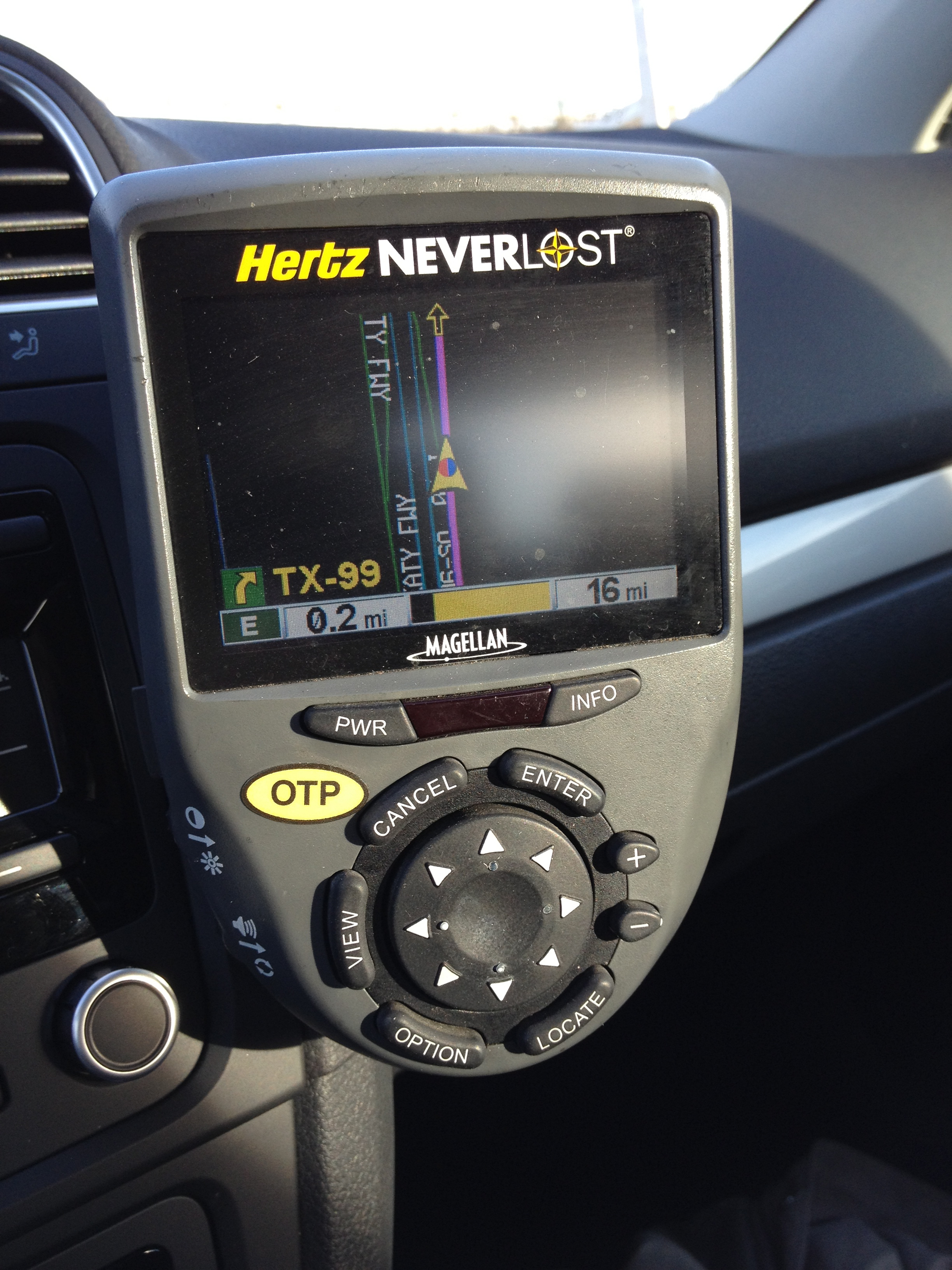
My relationship with Shiri is a love-hate relationship. Shiri is what I called my “Neverlost” GPS in my rental car in Texas. My iPhone has a female voice called Siri, so I figured my talking navigator must be her electronic kin of some sort. Finding my way around has been a lifetime vocation, but it is job most of us are never paid to do. I learned the trade using maps and the occasional compass. What a God-like feeling to look down at a map and visualize it from way up in the sky—it’s a kind of power-rush. Seeing the country, state, or city laid out below you, knowing that you want to travel particular roads based on traffic, tolls, or scenic beauty. Shiri and I had our first argument just after I disembarked in Houston. I’d never been to Houston before, and, being parked in a concrete bunker of a parking deck, Shiri was a little groggy and unclear about where she was when I spelled out that I wanted to go to Austin, avoiding major highways and tolls. Do I turn left or right out of the garage? She still hasn’t decided.

Shiri likes highways. Not a fan of urban driving, I’ll take a smaller road if possible. My first appointment wasn’t until the next day anyway. I can’t help attributing personality to Shiri. Was that a hint of disappointment in her cheerful voice as my driving made her recalculate the route yet again? Shiri has trouble determining if I’m on an interstate or a parallel access road. She sometimes sees roads that the naked human eye can’t discern. We fight, but she does eventually get me there. I have a feeling that she crawls into the back seat and weeps when I lock the doors and stagger to my hotel. It’s not that I don’t love Shiri, but she doesn’t respond quickly enough to real life conditions. A “slight left” across four lanes of rush hour traffic is purely academic to her. To me it is impressions of my fingers deeply embedded into the plastic of the steering wheel.

Shiri doesn’t understand that Houston’s many toll roads only accept EZ Tag and, being a visitor, I don’t have said tag. On the way to the airport—do I really have to see George Bush again?—she keeps trying to steer me onto roads that state “EZ Tag Only.” Texans are swearing at me as I suddenly change lanes and Shiri doesn’t help by repeating “At soonest opportunity, make a legal u-turn.” Shut up! Shut up! Where is the airport? I should be able to see it by now. Did I really leave the hotel two hours ago to travel this forty miles into… where? Is that a tumbleweed? When I see the Hertz rental return sign I break into spontaneous prayers of thanksgiving. I poke Shiri’s power button and leave without saying goodbye.

But now, a thousand miles away, secure in my own home, I miss her electronic voice.

IMG_0590


Monkey’s Uncle

T.H.Huxley(Woodburytype)

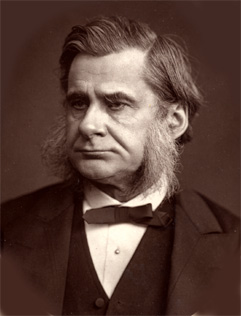
An opinion piece in Saturday’s New Jersey Star-Ledger highlights the 150th anniversary of T. H. Huxley’s Man’s Place in Nature this month. Well, Huxley may be forgiven for writing in the idiom of his day—he was Darwin’s contemporary after all—when he really meant humanity’s place in nature. The article, by Brian Regal, points out the common fallacy that evolution, as propounded by Darwin, says that we descended from monkeys. Quite apart from the insult to monkeys, Huxley was the one, as Regal notes, who made explicit something about which On the Origin of Species kept decidedly mum: the evolution of humans. People did not descend from monkeys. Nobody except religious opponents ever suggested that they (we) did. Evolution is a biological fact, and monkeys are evolved just as we are evolved. We had a common ancestor somewhere back a few millions of years ago.

This neverending story of religion (of some sorts) fighting evolution should capture the fascination of anthropologists, sociologists, and psychologists. It shouldn’t be ignored. Darwin wasn’t trying to start any fights. Huxley, well, he may have been, but with good cause. The facts, even in the 1850s, were definitely pointing to descent with modification. In fact, breeders of dogs and pigeons and other animals had known this for centuries. All that Darwin and Huxley attempted was to be intellectually honest with the evidence. It was religious believers who, reading between the lines, picked this fight. The Bible, after all, seemed to say we’d been created on day six (or day one, if you read Genesis 2 literally), and that meant science had to be wrong. Religion is used to setting its own terms. The debate is in the cathedral, not in the academy. Although by the end of the nineteenth century nearly all major branches of the church had come to some kind of understanding of the facts, the issue flared up with again around the time of the First World War with the advent of “social Darwinism.” Then, the religious objectors claimed, we did not descend from monkeys.

Funny thing is, Darwin and Huxley would’ve agreed. Instead, insidious motivation was attributed to some of the greatest minds in science. Accusations were made that everything in the lives of both Darwin and Huxley gainsaid. Natural selection made Darwin ill with its implications, but he could not shy away from the evidence. He believed in truth. Although Huxley coined the term “agnostic” to define his position, he had good reason. The biographies of these scientists are well worth reading before making accusations. So as we stand (or more likely, sit) on the sesquicentennial of Man’s Place in Nature, it might be a good opportunity to assess whence the friction is arising. We claim, in our still limited understanding, that monkeys can’t speak. (I’ve seen the movies and I know differently, nevertheless…) If they could, I imagine the debate would go something like this: “those hairless creatures who say that we are less important than they, they have the audacity to claim a common ancestor with us? Maybe evolution is a myth after all.”


Continental Drift

So this is the way epiphany works. (I know it’s Lent, but I’ve got bigger fish to fry.) I sat down to check my personal email after a horrid day at work, and since I have a Verizon account, I can’t help but see the news headline that’s on the page when I open it. When the headline said something about a new continent discovered by scientists under the ocean, I’ll have to admit that Atlantis sounded better than anything I’d heard in the office. So it was worth a click.

Athanasius_Kircher's_Atlantis

Turns out that this isn’t Atlantis at all—I have this habit of making naive assumptions—but a continent just north of Madagascar that sunk some nine million years ago. No happy lemurs or Homo sapiens around then. So when this Atlantis sank, there was nobody around to see it. At least not Plato.

The story was broadcast by Newsy and it made mention of Science World Report. Here’s where the epiphany piphed. I’d never heard of Science World Report. When I went to their site, the wonders of the universe spread out before me. “Dying Stars Reveal the Clue to Extraterrestrial Life: Earth-like Planets Unmasked” read one headline. “How Dinosaurs Evolved the World’s Longest Necks While Giraffes Fell Short.” These are the things I need to brighten me after a rotten day. A world with wonder in it. A world where money is not the sole, or even the highest good. A world where an intellect need not go to waste.

“Human Language May Have Evolved from Birdsong: New Meaning for Communication.” This website is like my eternal monologue in headline format. I’m not naive enough to suppose this website will be the nepenthe for all my workaday woes. But it does serve to remind me that science and religion are not always foes. A religion only becomes belligerent when it takes its truisms too seriously. We evolved in a world of wonder, but we’ve taken great care to remove the wonder from it. As if joy and delight were puerile phantasms with no place in the serious adult world of finance and industry.

I became an educator because I’ve always been in love with ideas. I lost my job in education because I was an idealist. Yes, continents do indeed sink. And while it may not be Atlantis down there, a simple click led me to a world of wonder. And that is, if anything can be, cause for hope.


In Touch with History

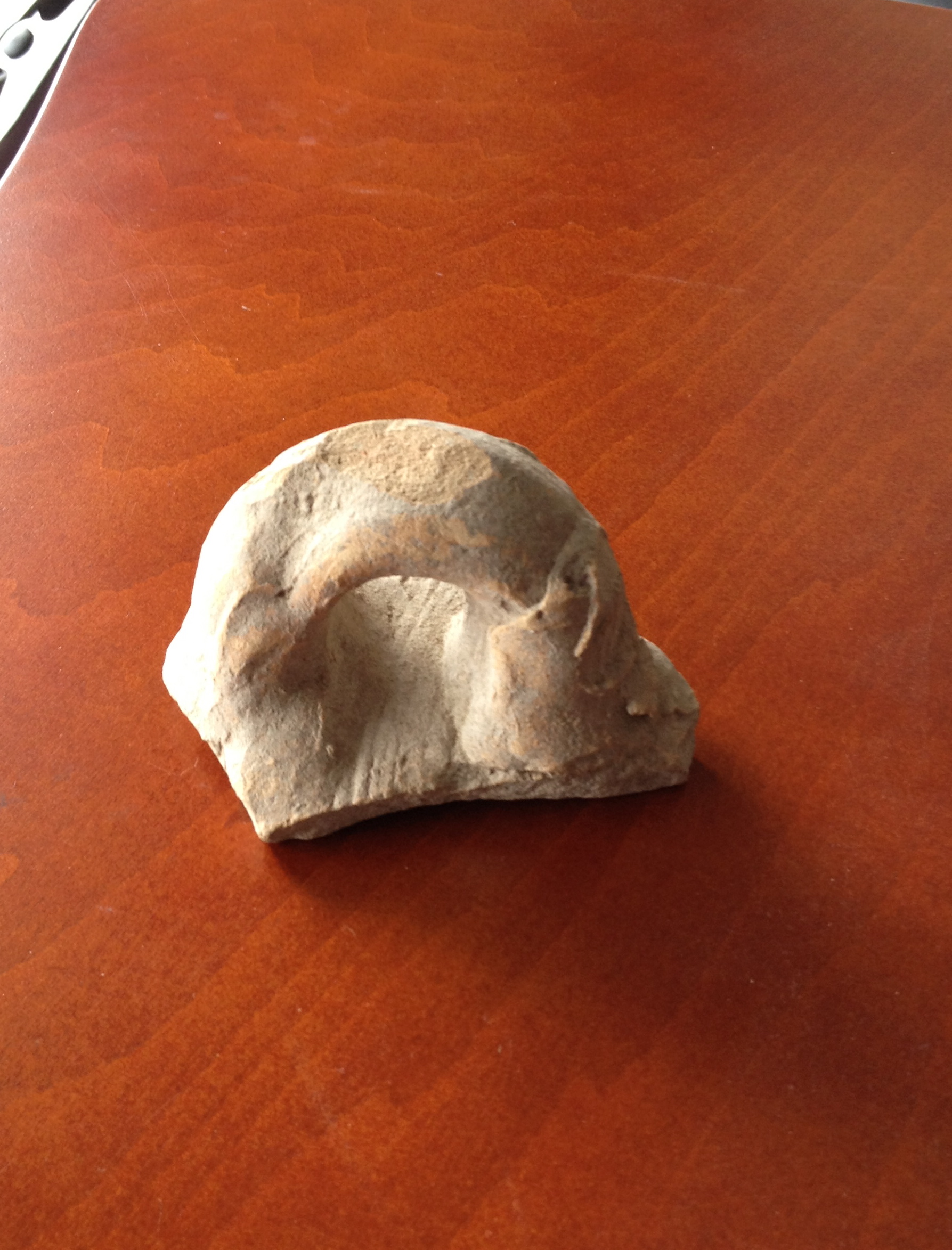
A friend recently sent me a package with a Roman jar handle from Caesarea Maritima. It’s not everyday that I receive 2000 year-old artifacts in the mail. Holding that ancient jar handle reminded me of my short stint as a wannabe archaeologist, not far from Caesarea at the site of Tel Dor. There’s no thrill like unearthing an artifact that has been buried for millennia, knowing that you are touching something a fellow human being dropped for the last time back in the days of the early Roman Empire. It is a humbling experience. In all probability the final touch was a heave into the dump, since clay jars are easily broken. But as I finger this ancient piece of useless junk, I can plainly make out how fingers like mine twisted the clay and pressed it on the jar body, much as I once did in art class, decades ago. I am connected with a stranger over the millennia by this simple bit of clay. We are united in an ancient family.

IMG_0555

Archaeology began as a biblical venture. Anyone who watches Raiders of the Lost Ark with archaeological sensibilities, after rolling their eyes (yes, it’s deserved) can’t help but realize a kernel of truth is buried here. Archaeologists don’t search for the ark, but it was religion that gave them the idea in the first place. Travel to the Middle East and begin digging up the places mentioned in the Bible. Those early archaeologists wanted to prove that the Bible story happened just as it was laid out. Only it didn’t. Archaeology soon began to reveal a more complicated picture. Jericho was uninhabited in Joshua’s day. And was there even a historical Joshua? What began as a charge to demonstrate that the Book of Books never gets it wrong transformed into a science with its immutable commitment to objectivity. And objects.

The desire for historical proof meets a deep need in people. We want to know what really happened. This simple jar handle before me tells a mute story of a person like most of us—never famous, never noticed in the noise of first century Palestine. Just some Jane or Joe throwing out the trash. That is the story of archaeology. That is the story of human life.

Every once in a while I ponder how insignificant we are. The vast majority of us will be remembered only a few years or decades beyond our demise. What will our artifacts say about us? One of the relics that will be found in the rubble of my life will be a Roman jar handle from an even earlier age. Long ago deemed junk by a person so different, but not so very different, from me. It was discarded two millennia ago. When it was found in the twentieth century it was a treasure. Thanks, Susan, for putting me in touch with history.


Near Earth Objects

Even before the Chelyabinsk meteor, Time magazine had committed to the printers with a story on asteroid 2012 DA14. From our terribly parochial viewpoint, such cosmic invaders are in our airspace (or at least in our satellite zone), as if we owned the very heavens above us. They are somehow an affront to our religious sensibilities. Many religions revolve around a celestial orientation. We all know that God is “up there” and the Devil is “down there.” What we’re discovering “up there,” however, is scarier than the Devil for many people. Space rocks are just part of the debris from the messy business of universe creating. Although space may be mostly empty (but dark matter has us reevaluating even that), it is far from tidy. Rocks rain down on us every day, and our user-friendly atmosphere that we’ve polluted so badly still begrudgingly incinerates those that enter at the wrong angle, brightening many a night with spectacular meteors. I’ve even seen some bright ones while driving in traffic in New Jersey. Wondrous indeed.

adoration-of-the-magi-1306

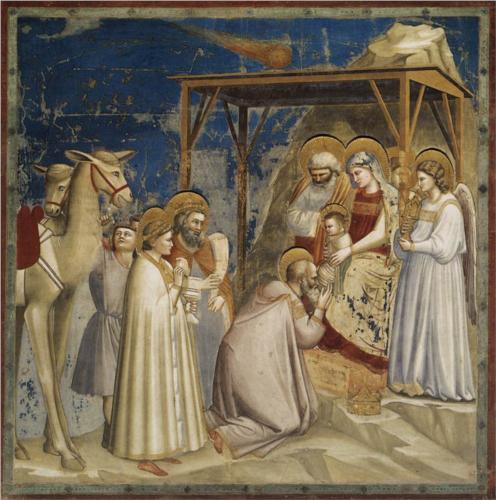
Back in seventh grade I did a science report on comets. This was a fascination that led me to take astronomy in my Sputnik-era high school—complete with planetarium—and in my older, more conservative college—sans planetarium. Comets were, until fairly recent times, religious harbingers. The Time story even has a detail of Giotto’s Adoration of the Magi from the early fourteenth century, complete with Halley’s Comet hovering overhead as the ersatz Star of Bethlehem. In a pre-Copernican universe signs in the sky had to be divine. There was no other logical way to explain them. Of course, in science class I stuck to the facts. As a religious kid, however, I knew there was something more to it.

Our skies are not our own. The universe isn’t here for us. These scientific revelations are frightening on a religious scale. We haven’t quite gotten to the point where we’re ready to let go of the Heaven above that no telescope can see. We don’t even have any way to spot hunks of rock the size of Chelyabinsk’s unbidden visitor with any kind of accuracy. We don’t even know how many there are. Before the second Russian explosion, Time prophetically noted that about a million stones of a hundred feet or more are near our planet and that one 150-footer could be 180 times more powerful than the bomb dropped on Hiroshima. Our recent brush with God’s dropped stone was only about 30 times the size of the terrors unleashed on Japan. According to ABC a Father Dimitri of Chelyabinsk said, “This event happened the day of the big Orthodox holiday that means meeting with God and this has to make people think.” I know I’m thinking. I sure hope his aim is good.


Implausible Deniability

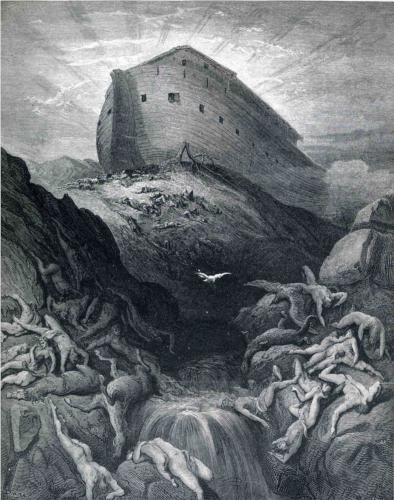
Sandy gave us a little taste of dampness under the gunnel. You see, people live by the water because it beckons to us. That was actually Rachel Carson’s idea, but nevertheless, we do find ourselves drawn to the sea around us. Historically our great cities grew in the littoral because communication across the big water was, prior to jet travel and trans-oceanic cables, the best way to stay in touch. Have a business meeting in London, but live in New York? No problem. We can get you there in two-to-three weeks. And the ship sets sail. Since that day we’ve become more electronic. Those of us who experienced Sandy near New York City know that one of the biggest problems was that salt water and electrified trains don’t mix. Of course, conservative lobbies have insisted that Congress and the White House keep their eyes firmly shut about the possibility that a more unstoppable flood is coming. We may not need an ark, but we’re going to have to take some steps back.

A story on the Weather Channel shows the “smoking gun” of global warming. Oh wait, that’s just a myth. Industrialists tell us so. But what a devastating myth! The Gulf Stream waters of yore have kept the climate mild in northern latitudes. While in Scotland we spent a wonderful weekend with some friends on the Island of Arran in the Hebrides. Palm trees growing in Scotland? Yes! The warm Gulf Stream means that much of the British Isles remains relatively temperate despite their latitude. The Gulf Stream, due to climate change, is slowing. In less than a century, climatologists now predict, the oceans will rise three feet. Looks like I’ll need to wear my gaiters to work. We’ve known for about half of my life that we’ve been changing our environment. And not for the better. Those who are too wealthy stand to lose a little so we do what we can to protect them, the poor dears. The rest of us had better learn to swim.

We don’t worry when the people of some Indonesian island point out that their entire world may submerge. Put a little ocean water in the subway and, well, that’s an entirely other story. How are the peons to get to work? Let them wear hip-boots. Word from the top one percent is that there is no global warming. If the Gulf Stream is slowing down it’s because it’s lazy. What a moocher! Suppose it will be wanting a health plan next. That’s the problem with the weather—it changes like, uh, the weather. Unlike the minds of some people that are already made up and never change, no matter what the facts. When the one-percenters start speaking, I’m glad I’m wearing my hip-boots after all.

Where can I get me one of those?

Where can I get me one of those?


Grown up Fish

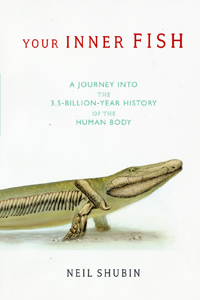
InnerFishEmbryonic recapitulation. That’s what it used to be called. I didn’t learn about this in biology class, but rather in the Creationist literature that challenged the very concept. I suppose those deep evolutionary roots are what led me to read Neil Shubin’s Your Inner Fish: A Journey into the 3.5-Billion-Year History of the Human Body. Not that anyone who’s considered the facts can question evolution, but this book nevertheless took me back along my own evolutionary descent from Fundamentalism to a reluctant rationalism. I recall the frequently repeated Fundie catch phrase, “no transitional forms.” Probably what they were looking for was a mermaid-like creature that was half reptile and half bird, divided down the middle. Even at a tender age, while accepting their rhetoric, I wondered why archaeopteryx didn’t qualify. A flying feathered lizard? Sounded pretty transitional to me. Shubin opens his fascinating account with the discovery of Tiktaalik, a transitional form in every sense of the word. Here is a fossil that shows the tell-tale limbs and organs of moving from fish to amphibian. Yes, Virginia, there is evolution.

Shubin doesn’t stop there, however. He traces the various features of human bodies back to our piscine ancestors. From gills to gonads, we are bipedal, air-breathing, mammalian fish. No surprises there, really. One gets the sense that Shubin’s book wouldn’t be such a wonder if there weren’t organized Creationists out there constantly challenging the obvious. All living things on this planet are clearly related. Some of the cousins may be very, very distant, but we are all part of the same family. This threatens Creationists and others who need to feel different, special. People are related to God, they suppose, in ways that mere animals are not. Biology gainsays that concept, so no matter how much evidence we might marshal, the Fundamentalist is duty-bound to reject it. We’re trying to break up a personal relationship here, after all.

While Shubin does a wonderful job of explaining whence our biological features, I was nevertheless heartened to read him referring to the essence of being human. Some scientists reject “essence” as a vague concept that can’t be examined in a laboratory. That may be true, but we all know what an essence is. As a concept it too has explanatory value. It would be very difficult to read Your Inner Fish and come out doubting evolution. At the same time, Shubin realizes that people write books, and fish do not. That’s not to say that we’re superior to our fishy family, but that we are different. We have our own essences. That doesn’t mean we were created this way—maybe we’ve just evolved with them. Either way, Shubin is charming romp though 3.5 billion years of our history.


Rational Religion

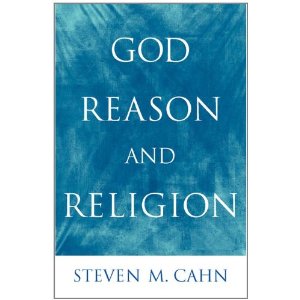
GodReasonReligionGod, Reason and Religion, the title of Steven M. Cahn’s book, fit uneasily together. Or so it would seem. Cahn, a philosophy professor, collected together in this little book a set of sixteen short, provocative essays keyed to major topics of the philosophy of religion. I’m always skeptical when I see Reason and Religion together on a book cover. It seems like an unholy plotting is going on. Perhaps it’s because those of us who study religion are often classed together with those who use slipshod techniques to “study” a subject they’ve already made up their minds about. Any scientist who’s seriously tried to learn Akkadian might have to reevaluate that premise. Happily, Cahn is not trying to promote such an idea. He states in the introduction, “My conclusions may be surprising, for although I am not a traditional theist, I find much to admire in a religious life, so long as its beliefs and practices do not violate the methods and results of scientific inquiry.” For books with Reason and Religion on the cover, that can be quite a concession.

One of the biggest faults of religions is their lack of introspection. That is a gross generalization, I know, but there is truth in it. Most religions have been severely challenged by the empirical method. Reason, it turns out, can explain most of what required one—or a multitude of—god(s) to accomplish. At the same time, religion makes people feel secure and happy. My experience of science has often been enlightening, but decidedly prickly. I’m sure I’m not the only one. Nevertheless, Cahn takes the reader through a maze of ways to think about religions from different angles. What is the tie between religion and ethics? How do we tell a good deity from a bad one? What is faith and is it a safe bet? Do miracles happen? These kinds of questions, when viewed rationally, don’t always have the dreadful results so often feared. So maybe the laws of physics aren’t violated, but that doesn’t mean you have to stop praying. Did I mention that Cahn makes concessions?

We are the cultural children of our logical, Greek forebears. They taught us to trust our reason and we’ve developed that to a high skill. Yet reason has its limits. Consider the Republican Party, for instance. Or Snooki. In life not everything adds up. Facing their final moments, few have the fortitude to keep their thoughts purely on the rational. What lies beyond we just don’t know. Science has no way of answering. So Reason and Religion should get along. There may be more than one way of knowing, and some things in our world may bridge that deep gulf between Reason and Religion. That bridge may sometimes be difficult to find. If you decide to seek it out, however, I would recommend taking Cahn along for some good reading. Even the most serious search must offer some concessions.


Neander Valley

Because we can—but should we? This is technological ethics in a nutshell. While we are still debating what it means to be human and the majority of people in the world address that question in religious terms, is it right to play with our own genetics? This is an unavoidable question when considering George Church’s search for a volunteer. Church, currently at the Harvard School of Medicine, would like to grow a Neanderthal baby. With DNA extracted from fossils, it is theoretically possible to clone a Neanderthal with a loving mommy. The usual argument against human cloning is, well, it’s human. Neanderthals are often considered not-quite-human, although our common ancestors hung together in the biological family tree much longer than our chimpanzee cousins. I still recall from my school days that a Neanderthal dressed in a suit and put on the streets of New York City would pass for a large, barrel-chested human. I think I may have seen him on my way to work once or twice, in fact.

Genetics are ethically frightening because they go down to the level of what used to be called essences. Some scientists today dispute that there is anything called an essence; all we have is building blocks. What you make of those blocks contains no essence—you can’t see it in a microscope or cyclotron, or spin it out of DNA. Therefore it must not exist. If there is no human essence, what is the problem with experimenting around a bit? Funnily enough, the question of natural selection enters into this equation. In the arboreal climes of Pleistocene Europe Homo sapiens sapiens bested their big-breasted cousins in the struggle for survival. Would the same be true in our technological era of easy obesity where work is considered tapping on a keyboard all day? After all, Neanderthals had bigger brain capacity—are we ready for that kind of competition? Neanderthal economics might take care of the one percenters even.

I have no insight to offer on such a thorny ethical issue. I do, however, believe in essences. I’ve never seen or measured one, but even concepts like good and evil are meaningless without their essences. What is the essence of a Neanderthal? I suppose it is such a question that leads Dr. Church to seek a volunteer to bring one back into the twenty-first century world. I have to admit I’m a little curious too. Just think of all the opportunities for cute commericals. Still, if natural selection already vetoed the race, maybe we should abide by that decision. This time around we might find ourselves on the losing end—who knows what Neanderthal ethics consist of? Secretly I think their essence might just be trickle down economics and they’ve been among us all along.

Me, on the way to work.

Me, on the way to work.


Angels of Ages

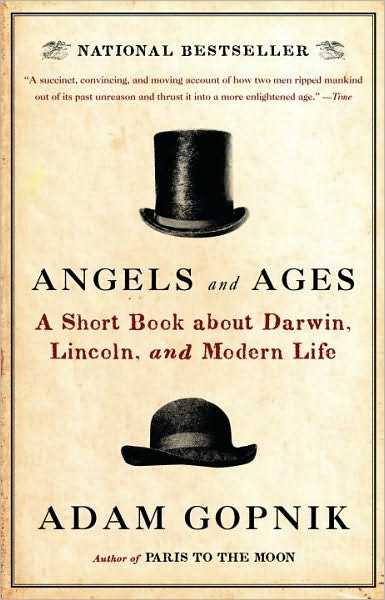
Angels&Ages February 12, 1809. Both Abraham Lincoln and Charles Darwin were born. Some days can be momentous that way. Although I’d known about this coincidental birth for some years, I had supposed it was one of history’s curiosities and nothing more. Adam Gropnik’s Angels and Ages: A Short Book about Darwin, Lincoln, and Modern Life changed all that. What’s more, while both Lincoln and Darwin are secular characters, the book has a strong dose of how religion influenced and perhaps even emanated from ideas both of these giants had. Religion actually surfaces throughout much of the book, although Lincoln grew up as a skeptic, and certainly was not a “church goer,” and Darwin was groomed for the clergy but came, through nature, to have serious doubts about God’s existence. Religion may not be Gropnik’s main point, but it has a way of following these two historical figures around.

Using a biographical and intellectual parallelism, Gropnik lays the two men side-by-side in their Victorian lives and shows how death was really a factor that bound them. Both lost a beloved child at about the same age, and both found death’s pervasiveness a problem for believing in any kindly God. Of course, we all know that none of us would be here now if our forebears had not passed on, making room for us. It is the way of nature. Nature is hardly kind or just, however. Ringing throughout this fascinating exploration is the ubiquitous problem of theodicy—in a world of such palpable suffering, where, indeed, has God gone? How do we continue to believe when all the evidence is contrary? Some of our greatest doubters have become our greatest guides.

I appreciated especially how Gropnik ends his little book with some thoughts on religion. He makes the essential point that Darwinism, by definition, cannot be a religion. Even better is the clear-eyed vision that he has that religion and science are both needed by people and they may both be held as true. Even when they’re fighting. The truth is nobody has all the answers. Those who brashly dismiss religion or science are equally wrong. In his eloquent style, Gropnik makes a decidedly sane suggestion that we should learn from our assertions of pluralism. We are accustomed to thinking about much of life and culture as being equally valued, no matter where on the planet we find it. Why can we not do the same with truths? Some will find meaning in science and have little time for faith. Others will find religion to be their ultimate and will not be bothered by science. The vast majority of us are somewhere in the middle. And what brought us to this point was the fact that February 12, 1809 was such an extraordinary day.


Deep Things

Religion concerns itself with the big issues. The biggest. As a child, I remember wondering how anyone could be concerned with less than the ultimate. No, I wasn’t a nascent Tillichian, I was just someone who saw things in what I supposed was a practical light. If you’ve got the temporary, the fleeting, the insubstantial over here, and the permanent, immortal, supreme over there—who wouldn’t go for the gusto? I suppose by my reasoning that all people would end up clergy of some sort, we would all be fixated on why we’re here and what our purpose was. You’ll still find pockets of theologians here and there who debate these kinds of issues, but our existence has grown comfortable enough that, for some people at least, if this ends up being all there is then, gosh, it’s been a fun ride thank you very much. But I don’t want to get out of the train just yet. I wonder if there’s more than the ultimate. It is a religious question.

For a while I grew enamored of the trappings of religion. Ceremony, ritual, strong rhetoric in sermons—these things can move you, and become beguiling. Somehow, knowing there’s an infinite universe just outside the church doors gives me pause for consideration. The ultimate must be very big. Walking through a large city helps to provide some perspective. I find myself next to buildings that cause me to tremble when I consider the implications. Next to those tons and tons of stone, steel, and glass, I am the smallest spark. But those buildings are dwarfed by the city that contains them, and that city a mere pinpoint on a map of the country. Even the planet is less than an atom in the universe of infinite size. Who can help but to be concerned about the scope of it all? Ever since I was a child I’ve worried about this.

In the media today, religion is all about hypocrisy and whose pants are at what latitude vis-a-vis whom. While matters of love are ultimate in their own way, we, as people, have a much larger space with which to concern ourselves. Science has stepped up to the dock when it comes to sworn testimony about the universe we inhabit, but even scientists shrug once we get back before the big bang. Time is even more inexorable than space—there’s always got to be a time before time. Like any child we can always ask, and what happened before that? Perhaps time is the true ultimate. Thank you for spending a bit of your ultimate reading this. It’s time for me to catch the bus, but work will never inspire me the way the rest of the universe does.

Hubble's eye view

Hubble’s eye view


The Splice of Life

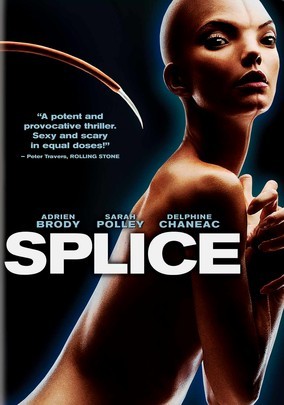
Splice Although not really scary, and although almost attainable with current technology, Dren is a curious monster. Many movies of the horror genre have explicit religious elements, but Splice may be a little too much science fiction for that. Or is it? The story is simple enough: a couple of geneticists have gene-spliced a couple of viable creatures that can be farmed for important chemicals and enzymes to solve diseases. So far, so good. But then the idea occurs to them: if the chemicals that can be used to help cure animal diseases had a human element, couldn’t they be used to cure our own diseases? And here is where the ethical quandaries begin. Adding human DNA to the mix, even when in small portions, suddenly throws open the moral dilemmas. Dren is the somewhat human result of these experiments, but the movie ends with the haunting, unanswered question—what is it to be human?

Although today the field of ethics is largely claimed by philosophers, morality is a measure of beliefs about right and wrong. In many cultures, including our own, religion has quite a lot to say about the issue. Once human DNA is mixed in the creature morphs from a bumpy slug into a creature that looks mostly human. The ethical dilemmas that surround human potential—abortion, stem cell research, cloning, and in past ages eugenics—all focus on the rights of the human person. Once a person is born, however, we almost immediately begin to curtail those rights until most of us become cogs in an unfeeling corporate machine. We are valuable, but for whose purpose? Who, sitting in their cubicle, or on their assembly line, or behind the wheel, says, “For this they defended my right to be born”?

Oddly, we privilege the potential of life without tirelessly working to improve the lot of those who’ve already been born. Perhaps, indeed, this is some form of evolutionary advantage—protect the future of the species at all costs. This idea becomes religious when it is deemed God’s will. In the movie, Dren’s creators ultimately deem her unhuman, a monster who must be destroyed. They, however, nurtured her humanness all along. While not the most profound movie ever filmed, Splice highlights the fact that ethics reflect the values of society. And society sometimes withdraws even humanity from those who’ve lost its favor.


Here’s the Church, Here’s the Steeple

Americans seldom seem to fuss much about religion unless they perceive that it is under threat. We’re real believers in religious liberty that way. The threat angle is a vector worth measuring every once in a while. What gets our collective goat? A story on CNN last week about the National Cathedral caught some attention. Those who think about freedom of religion, liberty of conscience, and all that, might find the implications of a national cathedral itself a tad troubling. Of course, it really isn’t a cathedral for all of the United States, but it is used for many displays of civil religion including several presidential funerals and inaugural prayer services. The cathedral, historically and ironically, is of the Episcopalian brand. Episcopalians boast perhaps the smallest number of mainline protestants in the country, and since they are the remains of the “established church” of England in the States, it is not just a little odd that such an edifice should be associated, however informally, with government in its former colony. The reason that CNN ran the story related to a perceived threat to American religion: same-sex marriages.

Now that same-sex marriages have been approved in three states, some couples desire the symbolism of a wedding in the National Cathedral. It is a victory of social justice that highlights one of the deepest and most persistent of religious concerns—human sexuality. Although many religious denominations have made their peace with evolution by natural selection, few have really considered the implications of reproduction and its discontents. Formally ever since the Enlightenment (and certainly informally for all of human history) sexuality has been a subject of scientific scrutiny. And not just for humans either. As naturalists observe the world of our fellow creatures, we find all kinds of sexual behaviors labelled “unnatural” in humans are quite normal in nature. The reason is the religion that is invested in reproduction. People, many religions teach, are somehow different. Besides, in the days before scientific interest in animal reproduction, few bothered to consider what other animals did, far from human eyes.

For those willing to admit that nature can teach us something about ourselves, same-sex couplings are not limited to humans. They are a part of nature. As Martha McCaughey suggested in The Caveman Mystique, reproduction is only one of a variety of reasons that humans and other animals mate. For us, however, it is a strangely sacral act. All religions have something to say about sexuality, and many express strong feelings about what marriage means. So the Cathedral Church of St. Peter and St. Paul (two men, one might note) is in the news because of what marriages symbolize for many. Marriage is about commitment, not just sex. In a nation where commitment is only fair-to-middling, shouldn’t we applaud the use of the National Cathedral to reinforce such family values? Unfortunately, for many gender differentiation trumps love in what is understood as a legitimate religious outlook.

Carol M. Highsmith's National Cathedral

Carol M. Highsmith’s National Cathedral


Leviathan’s Sibling

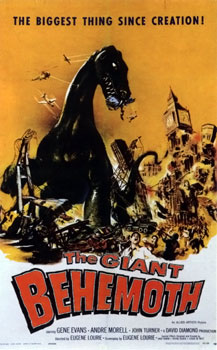
TheGiantBehemoth Formulaic to the point of plagiarism at times, 1950s science fiction movies often follow the deeply worn ruts left by countless forgettable monsters. One such film that I managed not to see until recently was the biblically entitled The Giant Behemoth. In a more biblically literate society the poster’s catchphrase “The Biggest Thing Since Creation!” may not have been necessary, even though leviathan’s lesser known companion stole the title this time. Of course the movie begins with stock footage of nuclear explosions, and although I’ve seen such renditions hundreds of times, they remain troubling to the core. Those 1950s that many consider so carefree were days of insidious freewheeling with the environment, days before human infatuation with the power over nature revealed its horrifying consequences. The behemoth, a sign of Yahweh’s great creativity in Job, here becomes the human-wrought agent of destruction.

Poor Tom Trevethan is blasted by the beast’s radioactive breath in a scene more fitting to Revelation than to Job. In the funeral scene, the priest somewhat insensitively reads a description of behemoth before Tom’s sole surviving family, his daughter Jean. So like the 1950s the minister then declares that the Bible gives comfort to those left behind, when the Lord said to Job, “Gird up thy loins like a man.” Indeed. Loin girding was a masculine activity in the days before Fruit of the Loom had been grown. Comfort for the woman comes in acting like a man. Yes, the 1950s considered the man the default model of human being. It says so in sacred writ. Genesis 3, to be exact.

When the scientists can’t figure out what killed the old man, along with thousands of fish, they ask Jean if her father said anything before he died. She tells them about behemoth. Being scientists, they have no idea what a mythical, biblical creature might be. Jean informs them, “It’s some prophecy from the Bible; it means some sort of great, monstrous beast.” Well, Job is technically not prophecy. Actually it’s not even untechnically prophecy either. In the 1950s, however, if it was biblical, it could be interpreted as prophecy. The real foretelling, though, is clearly atomic. Such films can easily be forgiven their biblical infelicity for the sake of their good intentions of reigning in human self-destructive behavior. In the end science destroys the biblical beast, but I’m left wondering if it isn’t more of a parable than a prophecy. I guess it’s time to gird up my loins and go find out.