Coexistence

Sometimes I think I’m a punching bag. Not uncommon among scholars of religion, I suppose. I have read my fair share of overt attacks on religion: Hitchens, Dawkins, and even Jillette, and sometimes limp out of the ring wondering why I even bother. Still, science doesn’t completely explain the universe I inhabit either. Thus is was with some glimmer of hope that I read a story in Monday’s Chronicle of Higher Education entitled “Does Religion Really Poison Everything?” There can be no doubt that religious behavior has a track record of some execrable atrocities—some very bad behavior has been engendered by fervent religious belief. At the same time, those who despise religion have a hard time explaining it. As the Chronicle piece points out, religion is likely an evolved trait. There is some survival value in it, otherwise it would, by natural selection, disappear. Religion is seldom a rational enterprise. That doesn’t mean that it can’t be rationally studied, but rather that religion is primarily experienced as an emotional phenomenon. We find ourselves motivated by feelings, although reason will often drive us to do things we don’t feel like (like going to work). And emotion is necessary to be truly human.

It is often difficult to respond to those who castigate religion as an evil or poison, not for lack of reason, but because of feelings. Having spent most of my life with religion, it is not surprising that attacks on it often leave me feeling ashamed. But ah, that is an emotional response! It seems rational on the surface, but really, shame and embarrassment are typical emotional responses. This is the realm of religion. Reason may indeed indicate with great accuracy the way the universe works—of this I have no doubts. At the same time, I’m not sure the entire universe is something that humans can adequately comprehend. I have a hard time remembering what’s on a short shopping list if I accidentally leave it at home. Our brains aren’t equipped to the task of comprehending universes. Feel overwhelmed when facing a physics test? That overwhelmed feeling is an emotional response. With considerable cheek, might I suggest it might even be a little bit religious?

The Chronicle is a high-profile source for academic rectitude. I am pleased to see Tom Bartlett pointing out that the line-drawing in the sand between religious Fundamentalists and pro-science New Atheists will not solve anything. Religion is often guilty as charged. It is not, however, pure evil. There is enough evidence out there to suggest that religion is a tremendous coping mechanism for billions of people. And coping is not a bad thing, all things considered. Wisdom that is often attributed to the Greeks suggests that “all things in moderation”—the golden mean as it’s known—is the way to human happiness and success. The idea is older than the Greeks, and indeed, can even be found in the Bible for those who are willing to look. One need not be religious to see that, like most human inventions, religion has both good and evil uses. Evolution gave us religion, and it gave us science. It also gave us brains divided down the middle and strong reasoning that must dance with creative emotion in a tango that frequently makes abrupt shifts of direction. Our job, as humans, is to learn the steps to the dance.
Different, but equal.
NDEs

I love science. Like many young boys, I was probably enticed to science through science fiction. While I didn’t follow science to a career, I used it to study religious texts. Those who’ve never undertaken the challenge of trying to figure out what something written thousands of years ago—on clay!—really says may be surprised to learn just how much science is involved. Nevertheless, as comforting as reductionism may be, something just doesn’t feel right about it. Science is how we explain and understand our world, and it does a spectacular job of it. The problem arises when science becomes what Stephen Jay Gould called a “magisterium.” Magisteria have all the answers. Yes, science explains how matter and energy work and interact, but it has yet to explain satisfactorily what it feels like. Most days I feel like the person I’ve become accustomed to show to the world. That person is very much like every other—being born, eating, breathing, dying. Medical science can explain most of it, but what about the parts it can’t?

I just finished reading Ornella Corazza’s Near-Death Experiences: Exploring the Mind-Body Connection. I remember when the craze about this hit in 1981 with the release of the movie Life After Life. I was fascinated and terrified by it. Since a materialistic view of science dismisses anything that has the residue of spirits or souls, the phenomenon of the resuscitated dead reporting seeing their bodies from above, shooting through tunnels into the light, and sometimes meeting the dead (or God), were explained as last nano-second hallucinations as the brain prepared to shut down or reboot (upon resuscitation). That’s that. The answer, however, didn’t satisfy everyone. What about those cases where the dead person reported, in detail, what happened in other rooms, or things they couldn’t have seen in their own room, had they been conscious? Corazza takes these considerations seriously and tries to understand what may be going on. Obviously, her explorations will not convince a reductionist, but they may give pause to some of us.

What makes her approach so interesting is that Corazza takes into account an alternative way of looking at consciousness. While the facts of science are, by definition, universal, the contexts within which those facts are viewed are not. Having spent considerable time with Japanese scientists exploring consciousness, eastern ideas of the body inform her research. In the western world we have an easy familiarity with the Cartesian dualism of body and soul that does not fit into other worldviews. Corazza takes the interesting step of asking what if we apply an eastern paradigm of the body (one that understands soul as body, and not just in a materialistic sense) and apply it to the question of Near Death Experiences. The results are mind-stretching. I feel as if my consciousness got up from months of laziness and ran a marathon (or at least a 5-K). It’s a bit winded and parts of it are starting to ache a little. No reductionists need worry, however, because in that worldview none of this exists.


Isaiah Thwarted

Back in January, out of a sense of curiosity on a number of points, I began tweeting the Bible. I wondered how long it would take, at 140 characters a day, to type the King James Bible into Twitter. Since that time, I have not missed a day. Until this week. International travel and business travel with uncertain Internet access have been overcome as I flew with Bible in hand to keep it going. On Monday I was just wrapping up the flood story. Clearly this was going to take a long-term commitment. Then early this week a message popped up on my Twitter account stating, “You cannot send messages to users who are not following you. Learn more,” so naturally, I learned more. Unfortunately I am not now, nor have I ever been, a techie. Just a sentence in and words I don’t understand begin to flummox me, building confusion on confusion. What it appears to be telling me, in layman’s language, is that I can no longer post to Twitter.

Apart from the personal rejection such impersonal messages inevitably engender, this development brought to mind the famous verse from Isaiah 40.8, “The grass withereth, the flower fadeth: but the word of our God shall stand for ever.” Hath the Lord been stopped by Twitter? Technology changes rapidly, and those of us who’ve never had any formal training in it sometimes feel like we’re driving a car on a dark country road at night with no headlights. I’m not really sure how this all works, but I try to send daily thoughts out into cyberspace and, yes, what you say can and will be used against you. And I wonder about old Deutero-Isaiah sitting there in Babylon peering into an indefinite future.

Our abject dependence on the Internet has changed us as a species. I’ve recently read about how technological innovations have become the evolution of the human species. This collective brain we refer to as the Internet has revolutionized the way we do business, but it has also introduced a component of fragility into the equation. Electronic information is untested in the long term. Some of my earliest writing projects now exist only on three-and-a-half inch floppies, most of which are tucked away in some musty corner of the attic. And what if the earth passes through a comet’s tail or a nasty solar flare jets out our way? Doomsday scenarios have been based on such things (just remember Y2K and smile). So maybe Second Isaiah was onto something after all. Printed books have been known to survive for at least half a millennium, and in rare instances, a couple thousand years. And the pagan sources on which parts of the Bible are based, written in clay, last even longer. And one of the earliest stories recorded was that of a worldwide flood.


Danger de Nuit

I am on a boat—maybe it’s the Titanic. Far from land. For some reason, vaguely unclear, the ship is sinking. There’s panic—people are running and flailing, trying to save themselves. I’m frozen with terror as the icy water encroaches. I can’t swim. I prepare to die. So goes a nightmare I had several times in association with a former place of employment. Nashotah House felt traumatic to me with forced liturgies and daily reminders of my inferior status. The terror of the nightmares was very real, and the day I was fired did nothing to improve them. As a child I was plagued with phobias and frequently experienced horrific nightmares. They still come once in a while, but since I’ve left the employment of the church, they have become, gradually, less frequent. Nightmares are just dreams gone bad, and I’ve always been a dreamer.

Last month Time ran a story on nightmares. The subject of nightmares has now caught the attention of the military because of cases of Post-Traumatic Stress Disorder. When the military decides to show its humane side, it doesn’t fear backing it with big bucks. Soldiers confess to frequent nightmares after witnessing the atrocities of war. (One psychologist said that many at Nashotah House seemed to be suffering from a similar phenomenon.) Theorists now suggest that nightmares might lead to mental illness, and sleep deprivation, as we all know, can lead to bad judgment. Not a good thing on the battlefield. Or behind the wheel of a car. Or, in a recent real-life nightmare, while flying a jet.

In many ways nightmares seem like minor annoyances—they don’t physically hurt anyone, and they end when you wake. Time probably wouldn’t have reported on them if it hadn’t been for the military angle. This seems a paradigmatic situation. A common problem goes ignored until it affects the military, then it is deemed worth research funded by tax-payers. I am well acquainted with nightmares. As a child they became part of my identity. I am heartened that serious research is considered worthy of federal money. It seems, however, that perhaps a better way to end battle-induced nightmares would be to stop the horrors of warfare. When war ends, some nightmares will cease. Of course, I’ve always been a dreamer.

Is all that we see or seem
But a dream within a dream?
-Poe


Seedtime and Harvest

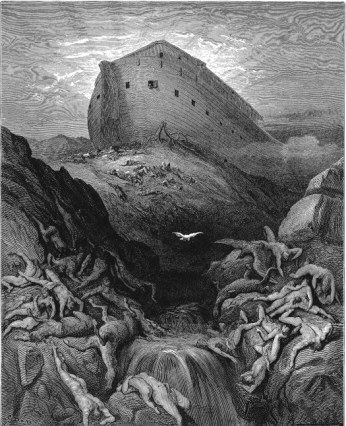
With the drought deepening over about half the United States, it is with not inconsiderable irony that I am reading the story of Noah’s flood. I have been tweeting the Bible for some months now and am just reaching the end of the fascinating account of the deluge. The difference in the case of the drought is obvious, but similar. Having spent some time in the Midwest, I came to know how intimately and intensely many of the citizens trust God’s providential care (this is true elsewhere, of course, but I noticed it more in that region). When disasters come, however, just like an animist would suggest, answers will be sought in the divine world. “While the earth remaineth, seedtime and harvest, and cold and heat, and summer and winter, and day and night shall not cease.” Genesis 8.22 rounds out God’s plan for the perpetuity of nature’s cycles, stating in just the previous verse that he knows people to be wicked and will never punish them for it again, as he did in the flood. Such biblical assurances, however, do little to allay fears when crops are dying in the field.

The problem in looking for answers in nature is their ambiguity. Just consider the record number of church picnics that haven’t been rained out this year—the number of prayers I’ve heard for the staying of rain for human convenience is surely a reflection of how intimate divine interaction with the workings of nature is supposed to be. One of the benefits of science has been its ability to straighten out all the cards in the deck, tapping them on the table-top and squeezing them into line. How would God weigh prayers for no rain so that an outdoor wedding of a devout couple could take place versus the prayers of a backslidden farmer for much needed precipitation (without hail)? Are decisions made by majority request? Wouldn’t that be excessively dangerous, given humanity’s track record of deciding what is good for itself?

The drought is a serious concern, and I do not mean to suggest otherwise or make light of the situation. What concerns me is the human tendency to look for a divine bailout. Many politicians of certain persuasion (usually the greenback kind) tell us that the climate is just fine. Our greenhouse gasses are not unduly affecting it. Now that a drought is upon us—and even a child can understand that all weather is related—the focus shifts to God. This dancing around the elephant in the room is tiring and dizzying. We can spend billions of dollars making bombers that are almost invisible to radar and so oddly shaped that they get reported as UFOs and yet we can’t get politicians to consider our impact on the very skies they fly in on their bombing missions. The atmosphere is larger than us all and it is warming up. And when we bake ourselves out of existence isn’t it a comforting thought that seedtime and harvest will continue, at least until our sun burns out?


Thinking Zombies

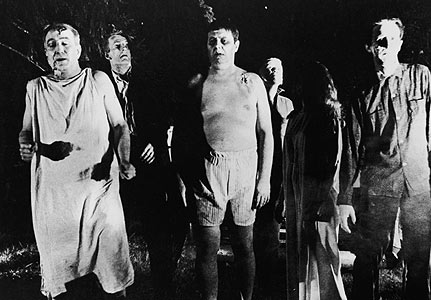
Religion seldom makes as big an impression as when it concerns itself with the undead. Popular culture has gone after zombies to such a degree that they have engaged academic discourse well beyond the field of African-Caribbean religions. In fact, religious specialists tend to shy away from the topic in a kind of first-date embarrassment. Perhaps it’s because zombies in popular culture are so much cooler than their Vodou forebears. Within the past several months, however, zombies have shown up in Time, on the Center for Disease Control website, and now in the Chronicle of Higher Education. An article this week explores the academic implications of a paper by neuroscientists Bradley Voytek and Timothy Verstynen on the zombie brain. The two took on the project as a lark at the behest of the Zombie Research Society. Science fiction writer and head of ZRS, Matt Mogk gave an interesting take on zombies. He’s quoted in the Chronicle as saying, “Zombies are rooted in science, not superstition and myth.”

At the risk of sounding extremely uncool (one that I take rather frequently, I fear), I would point out that exactly the opposite is the case. Zombies are rooted in superstition and myth, i.e., religion. The entire idea that a person can be made to rise from the dead—originally to be made a slave—comes from that heady blend of Christianity and African religion that developed as part of slave culture. Slavers were notorious in not wanting slaves to accept Christianity because that might make slaves think that they were equal with their owners. By suppressing Christianity among slaves, the African religions in which many were raised came to blend with the Christianity that they’d garnered. One of the bi-products was the zombie. The zombie partakes of the Christian concept of resurrection, but in a twisted way. Once the new vision of the zombie presented by George Romero took off, yes, they did move into the realm of science fiction, often the forerunner of science.

A very serious issue underlies the zombie myth—the very religious concern about death. While not all religions comfort with an afterlife, they all in some way deal with ultimate issues. The end of life is about as ultimate, from our limited experience, as they come. Science loudly and repeatedly insists that death is the final frontier. We don’t cross back this way again, according to the available evidence. Scientists do not study ghosts or souls, and are very cagey about near-death experiences. The zombie, who is now threatening the careers of young scientists, is a most religious monster. Everything about the zombie points to its origin as a religious trope. Voytek and Verstynen wanted to interest people in science by taking a comic look at zombie brains. The problem is that zombie brains are brains on religion, not science.


Liberating Science

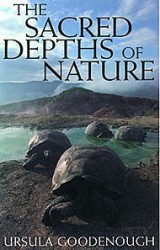
The fact that prominent scientists occasionally take time from their busy schedules to fire off a broadside against religion and religious believers freely bare their fangs at science shows that we need some efforts at reconciliation. I am reminded of schoolyard bullies when specialists in either realm make claims of exclusivity. Religion and science are both here to stay, and they’d better learn to get along. I just finished reading the remarkable little book The Sacred Depths of Nature by biologist Ursula Goodenough. While declaring herself a non-theist, Goodenough, the child of a Methodist minister, preserves a profound respect for the sacred in a concept she calls “religious naturalism.” Her brief book, which a colleague compared to a daily devotional, contains more good sense than all the enraged professionals bellowing at each other from either side of an unbreechable gulf. Uncompromising in her science, Goodenough is not suspicious of the human religious impulse, but embraces it in the expressions of nature. It is an approach I found liberating and amazingly conciliatory. It lacks the territoriality of Stephen Jay Gould’s Non-Overlapping Magisteria (NOMA) and preserves the integrity of the human person in all its complexity.

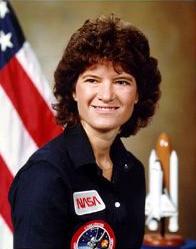
The day I finished the book the headlines of the paper announced the premature death of Sally Ride, another woman who moved science in the right direction. Ride’s sister is a Presbyterian minister, while Ride herself was a physicist as well as the first American woman in space. Aboard the space shuttle Challenger, she made history also as the youngest American in space. Typical of the imperialist national attitude that unfortunately still reigns supreme, space had been tacitly declared a man’s world. Sally Ride shattered that glass ceiling at 17,500 miles per hour. Even so, change seems to have decelerated once again to far below sub-orbital speed. Religion is partly to blame. A deep component in our culture, religions in the western world have traditionally asserted male superiority. Even those who claim God to be sexless can’t really conceive of a big person without some gender. The day after her death and the headlines had shifted from mourning to astonishment that she was gay.

The loss of Sally Ride is a loss to science, for she was in the heaven formerly occupied by God, showing women the way. I am, however, comforted by the efforts of Ursula Goodenough to keep the dialogue open. Too often, it seems, that conflict is the cost of disagreement. One of the observations of astronauts is that long periods confined with the same small coterie of people lead to inevitable disagreements. The question facing us all—for our planet is not so large after all—is how we will choose to deal with differing worldviews. It was declared that science would eventually bury religion, once reason had taken hold and superstition had run its course. Although the grave was dug, it has never been filled. Maybe we should all read the sensible approach of Goodenough and just be glad that we’ve all had a chance to be here at all. And remember Sally Ride as a fearless explorer, a hero rather than a spectacle.


Explanatory Value

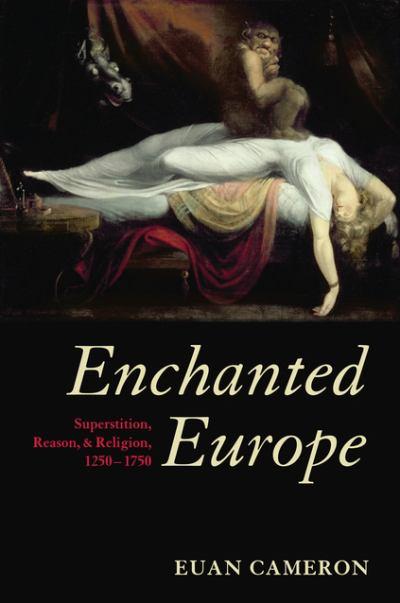
The dividing line between superstition and religion is thin and growing more effaced all the time. Nowhere does this become clearer than in studies of the history of religion. One of the critiques early made between “true religion” and superstition is that the latter involved magic, but today anthropologists find that line difficult to discern as well. Many religions are defined by their insistence on supernatural occurrences. The world as is, is by definition, secular. That’s one of the reasons Euan Cameron’s Enchanted Europe: Superstition, Reason, and Religion, 1250—1750 is so interesting. Cameron, an historian with a precise grasp on theological nuance, traces Christian responses to the world of the supernatural through the Middle Ages. Various theological responses are then explored as the author searches for that elusive distinction that makes one belief religious and another superstitious. It is really a matter of perspective.

Nowhere is this clearer than in the late Middle Ages. As Cameron notes, physics, to the mind attuned to God’s direct intervention in the cosmos, looks like the occult. How could a person seriously believe that two physical bodies, such as the sun and earth, or earth and moon, could attract each other? If you put God back into the equation just to take him out for an instant, this sounds extremely occult. Does not attraction imply volition? How can physical objects attract one another? Thus scientists such as Galileo and Newton often found opposition for their ideas based on the fact that science and superstition can also bear a passing resemblance.

As science’s superior empirical evidence became clearer, the God who’d stepped out of the room temporarily was eventually locked out. This vast universe could be explained without the supernatural at all. What was needed was better glasses. Microscopes and telescopes, and now cyclotrons and space telescopes, provide a consistent and ever sharper image of a universe that gets along just fine without the divine. But what of superstition? Has it gone away? We still routinely construct buildings without thirteenth floors. The sigh of relief from the worker or guest on floor fourteen seems never to be obviated by the fact that they are really on a renamed, empirically thirteenth floor. Your daily newspaper (although quickly growing extinct) will still offer you your horoscope before you hurry off to the lab. Call it what you will—superstition, religion, occult, magic—as long as we’re human no scientist or theologian will ever convince us that there’s not at least some whisper of a ghost in the machine.


Your Brain on Plastic

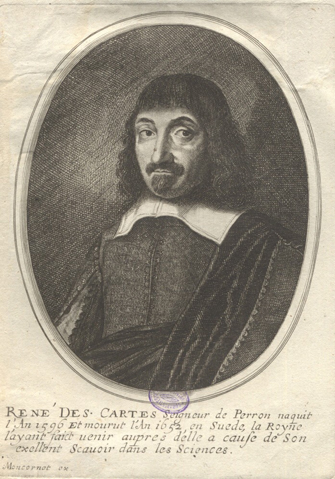
“Cogito ergo sum,” Descartes famously, and apparently erroneously, wrote. As technology races wildly ahead, those of us of biological origin are left feeling somewhat insignificant. An article in Monday’s Chronicle of Higher Education on “The Strange Neuroscience of Immortality” touches on many of the issues that are the very pulse of religion. Revolving around the theory of Dr. Ken Hayworth that a preserved brain, sealed in plastic instants before death, may in the future be thoroughly mapped and resurrected, Evan R. Goldstein explores the idea of immortality. Hayworth’s belief is that a thoroughly mapped brain, reconstructed artificially, would be the ego of cogito. The self. Despite all our advances in science, we don’t know what it is.

As Goldstein makes clear in his article, this transfer of consciousness and possibility of immortality is not mainstream science. In fact, most scientists rapidly distance themselves from it. Many cite the unscientific nature of the very enterprise, but I wonder if it might not have a more religious basis. Immortality is the ultimate of religious ideals. Christians generally recognize it as resurrection, and other monotheistic traditions offer a heaven after death (sometimes, to some people). Is that not all at stake here? If we manage to assure some kind of human immortality, have we not just robbed ourselves of heaven? Quite apart from the technological hurdles and uncertainties about what the self/mind/soul is, is not immortality what separates gods from humans?

The problem with gods is that they don’t get to go home at the end of the day. Would Heaven be so great if you just left another tough day in the universe full of sadness, violence, and pain? Hayworth suggests that a reconstructed brain placed in a mechanical body (robotic, probably) would have the potential of lasting forever. It will, however, be expensive. That means that only the very wealthy will be able to afford the procedure, if it ever works. Imagine that world: a planet full of immortal, wealthy entrepreneurs who can spend eons without sleep, trying to acquire yet more for themselves while knocking the competition on its metal rump. It really doesn’t sound like Heaven to me. But then, what would I know? To me cogito sounds like a snack food.


Just You Wait, Professor Higgs

They finally found him. Peering deep into the invisible world of the sub-atomic universe, his hiding place has practically been discovered. I knew that when it happened my alma mater, Edinburgh University, would be part of the equation. That’s just the kind of thing you know deep down in your sub-atomic parts. Scientists are now coming very close to announcing definitive proof of the “God particle,” or Higgs boson. Named for theoretical physicist Peter Higgs, who predicted the particle, this elusive piece of physics has been nicknamed the “God particle” by journalists who want to express just how great its explanatory value is. The average citizen knows very little about the inner workings of science—thus we have Creationists and Tea Partiers—so we require striking neologisms to help us comprehend that this is not only important, but really, really important. For explaining the way the universe works, the Higgs boson has been likened to Newton’s discovery of gravity, although apples had always fallen from trees even before he learned why.

I have always found it curious that when we need a superlative we dash back to the biblical worldview. As John Heilprin and Seth Borenstein of the Associated Press make clear, “God particle” is not utilized by physicists (although coined by one), but is used “more as an explanation for how the subatomic universe works than how it all started.” To get us to read about science they have to use mythology. The more we understand about science and the way our minds work, the more perplexing it becomes. Humans are meaning-seeking creatures and we often find story more meaningful than fact. Facts, however, determine what actually happens or what actually is. The Higgs boson is getting close to facticity. We whimsically call it the “God particle.”

Could the great gulf between science and religion, I sometimes wonder, be bridged by good, liberal arts education? The liberal arts, particularly the humanities, are all about understanding what it is that makes us, well, human. They aren’t precise like science, or profitable, like business. At the end of the day, however, in those few quiet moments, don’t we dwell among the realm of humanity? When we stop posturing for our co-workers, the media, or our neighbors, when we are who we truly are—then we are engaging in the humanities. Education can be in the service of becoming human as well as becoming rich. In one of its latest triumphs, it has produced physicists who have discovered the footprints of the Higgs boson, potentially revolutionizing the universe as we know it. And many of us would have never even heard if they hadn’t called it the “God particle.”

Like atoms over our heads


Holy Hypothesis

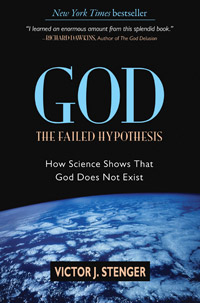
The angry atheists have been center stage in the God debates over the last few years. Many of them have become household names. Often giving sweeping generalizations about what God is, they tear apart this highly improbable image with aplomb. Not that I like to get in the way of somebody’s innocent fun, but their approach to the question only antagonizes the opposition without converting them. I just finished Victor J. Stenger’s God: The Failed Hypothesis. Like many who argue for atheism, Stenger is a highly regarded scientist. Unlike many, he offers a systematic, even-keeled account of his reasons for rejecting the divine. Indeed, the sub-title is straightforward—prosaic even—How Science Shows That God Does Not Exist. As befits a physicist, Stenger is careful to define his terms and is cordial enough to state that his book doesn’t cover the non-existence of deities per se, but the interventionist God of yore in particular.

Although I can’t agree on every single point Stenger makes, he does a compelling job of laying out logically how, if God is taken as an hypothesis (theory is a little too strong a category, implying substantial scientific concurrence), there should be some measurable result in the universe that God created. Choosing to differ from many theologians and scientists, Stenger argues that science can say something about God, given that God reputedly acts in a physical world. Outside these parameters something one may choose to call God may exist, but that kind of God does not answer prayers or oversee evolution.

Like many scientists, Stenger feels compelled to undertake this argumentation at least partially because of the weary insistence that evolution is “just a theory.” Creationists have tried to distort science for nearly a century now and have been successful really only in the United States. As Stenger shows, their method is often science, but wrong science. Just because an idea is scientific does not made it valid science. Stenger also points out that the premises of creationism, no matter how measured, are just plain wrong. Throughout, however, there is no belittling of those who believe in God. What is offered in this little volume is a rational, non-hysterical account of why a physicist who follows the law of the kingdom finds there is no God above it. And like a true scientist, Stenger leaves open the possibility that new evidence could overturn his verdict. Nevertheless, if his work is taken seriously, such a turn of events appears highly improbable.


Gods Will Be Gods

“And it came to pass, when men began to multiply on the face of the earth, and daughters were born unto them, That the sons of God saw the daughters of men that they were fair; and they took them wives of all which they chose.” Genesis 6 begins with one of the most unusual stories in the entire Bible. And that’s saying something! The sons of God mating with the daughters of men? A couple verses on we hear about giants roaming the earth in those days, presumably the children of this divine-human miscegenation. What is this stuff straight from pagan mythology doing in the pages of Holy Writ? Over the centuries, translators have tried to tidy up the boldly direct language of the King James here, making the sons of God into angels or some lesser beings. It is too hard to accept that sacred scripture admits of polytheism.

Monotheism, it is clear, came to the Israelites somewhat late in their history. The Bible is full of bold clues that other gods exist, and, worse yet, they are sometimes as powerful as Yahweh. In the light of later theological development, translators often bow to popular pressure and clean up the Bible’s language a bit. Fact is, Israelites, like most ancients, lived in a world populated with mythical creatures. Gods galore, monsters, demons, angels, witches, giants—they all haunt the pages of the western world’s sacred book. But that’s not what we expect the Good Book to say. The Hebrew text here is unequivocal, these are the “sons of God” we are talking about. Either that, or worse, “the sons of the gods.” More and more deities.

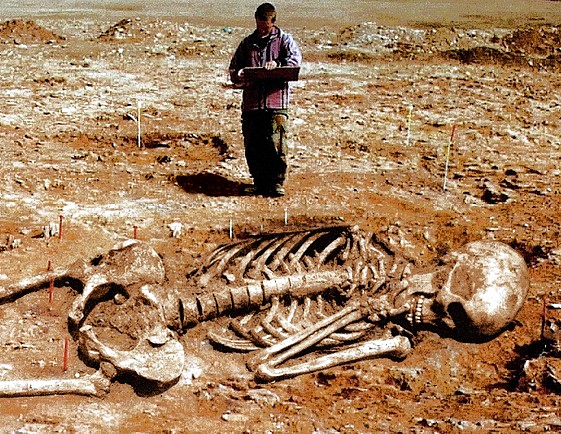
We can’t be sure why the ancient believed in monsters and giants, but it seems likely that such creatures had explanatory value for their world. Lacking science—paleontology was millennia in the future—they had to explain the huge bones found in the earth. We do know that dinosaur bones had been discovered in the Mediterranean basin in antiquity. These big bones often look human to a non-specialist. Heads are frequently missing. It has been suggested that these give rise to our biblical giants. Yet another response has been the recent trend of fundamentalists with Photoshop skills to post photos of archaeologists actually discovering giants on the Internet. Some of these doctored images are very impressive. It is an effort to save the Bible from the truth. A Bible that requires saving, however, should give even the most fervent believer pause for thought. Isn’t it just easier to suggest the sons of God were typical guys and that little has changed since the world was young?


After Before the Dawn

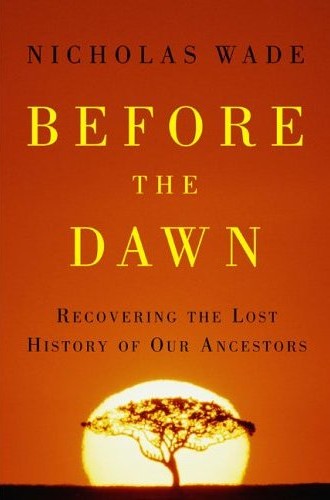
Apropos of reading Nicholas Wade’s Before the Dawn, as a sometime scholar of religion a number of points struck me. According to both material artifacts and DNA, several changes took place among human beings some 50,000 years ago. Having just read P. W. Singer’s Wired for War as well, the early coalescence of war and religion in human history was unavoidable. Wade ties the emergence of both with the development of language. It is only when we can speak that we can begin to express our theological speculations and, as history continues to teach us, despise those who disagree with us. It becomes clear quite early in the tome that Wade has an interest in explaining religion. Like many science writers he struggles with the issue of why religion persists, despite the explanatory value of science. We know how multiple aspects of our world work, yet we still defer to a divine that no one has ever seen or registered in any empirically verifiable way.

Not only does this tendency stretch back to our distant, distant relatives. The Natufians, about whom I generally lectured my students (itself ancient history), are marked as well by the dual achievements of religion and war. Wade is one of the few scholars I’ve discovered who concurs with my assessment that religion was among the earliest of human behaviors. In my mind, it is tied to consciousness and its evolution. Once we begin to realize that we are not in control of our destiny, we start to seek explanations from above, and hope that God loves us. Otherwise the picture isn’t so pretty. Indeed, Wade suggests that religion evolved as a socially cohesive force. Tying the concept to ethics and trust, he suggests early people had to learn to get along with strangers and religion cemented that bond.

I’m not a scientist, so I cannot assess whether this explains religion or not. It does seem clear, however, that if Wade is right religion itself has evolved into a more aggressive beast. Sure, religions still serve to bind people together—but only so far. As populations separated, their various religions evolved and led them to distrust one another. Instead of bonding humans together, religion began to put them into competition for the truth. Here, Wade’s analysis is sadly true—religion and war evolve together. Our small planet is yet too big for everyone to get along, to know and trust the stranger. Religion had helped us at the critical stage when we needed social bonding, and now it has naturally evolved into the opposite—a socially divisive force of orthodoxy and heresy. If Wade is correct, we all need religion to take on its most ancient role and bring people together instead of giving us excuses for war.

Waiting for the dawn


Enoch’s Dilemma

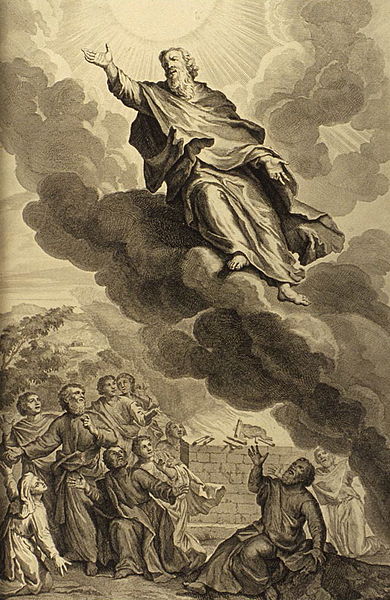
“And all the days of Enoch were three hundred sixty and five years: And Enoch walked with God: and he was not; for God took him.” These two verses from Genesis 5 convey just about all we know of Enoch. That, and he was the father of the oldest man ever, Methuselah. With this intriguing introduction, however, the religious mind insists on a backstory. Over the centuries of antiquity, books grew about this mysterious character as he became the prototype of the person who never died. The Bible doesn’t state that Enoch didn’t die. Nor does it state that he did. Plenty of wiggle room for the mythic imagination. In what appears to be an unrelated story, the Chronicle of Higher Education this past week reported on technology that builds on the strange but natural idea of phantom limbs.

When a person loses a limb, sometimes they report still feeling it. Their brains grew in a body that possessed the limb, and once it is gone the brain still has memory of it. The term used for this is a phantom limb. Knowing that mind does control matter to some extent, robotics experts have figured out ways to wire a robotic limb to the brain of a paralyzed person that responds to brain signals sent to the phantom limb. As much like science fiction as it sounds, this is already happening. The robotic limb responds just like a biological limb. This technology is just developing, of course, and is very expensive. It also implies that cyborgs, once the fodder of futuristic fiction, are becoming reality. Some theorists, such as Raymond Kurzweil, suggest that the brain itself can be converted to electronic signal and transferred into mechanical storage. Once that is achieved, we will have Enoch without any God to take him.

The world that we’ve been engineering bears a strange resemblance to the world of the Bible. For the people of ancient Israel death was the final word, and with rare exception (the only unquestioned case of the undying man was Elijah) people simply accepted the inevitable with no concept of an afterlife. Contact with the Zoroastrians convinced some Jews of the possibility of life beyond death and the quest for immortality was on. It has been a desideratum of human aspirations ever since. We invented machines to help us do what nature has not equipped us to attain. Finer and finer lines have been drawn between the biological and the mechanical. While it make look like immortality to some, to others it seems that we have been kidnapped—taken, if you will—by technology. What really happened to Enoch? The Bible doesn’t say, but it seems that we are getting very close to finding out on our own.


Convergent Evolution

Back when my opinion mattered—in higher education, you must realize, a scholar’s outlook only matters when s/he has a teaching post, no matter how abysmal the school. Once that post is gone you just become another guy with an opinion—I was invited to a conference. This is quite an honor for someone consigned to the bargain basement of academia, and for my paper I read from a burgeoning book that died a sudden death along with my academic career. In that stillborn tome I argued that many aspects of ancient mythology—including some in the Bible—made better sense in the light of science. I suggested that some of the infelicities in ancient texts might be the signs of continuing evolution of the human brain. Ancient people were able to believe what we find troubling. By the end of the conference many respectable scholars were looking askance at me when I stepped into the room. Honestly. I heard the word “Wiggins” uttered as if it were an archaic curse. Shortly after that I found myself working out of some guy’s basement for a salary fit for a knave.

Imagine my delight, then, at finding a reputable scholar who argued that the human brain indeed continues to evolve. In fact, it has speeded up the pace as new challenges have emerged. Before the Dawn: Recovering the Lost History of Our Ancestors by Nicholas Wade was recommended to me by my brother-in-law. As I was updating myself this week on how we became human, I was surprised to see Wade suggesting what I had suggested in my paper—the patterns of human behavior (we both have an interest in religion, it seems) are tied to the evolutionary state of our brains. Sitting on a bus next to many other drones commuting like ants to New York City, I felt strangely vindicated. I had an idea scorned by my colleagues that is being suggested by science. Not that everyone will accept Wade’s conclusions. Many scholars of ancient religions will never even read them. When I explained my thesis to a colleague after losing my academic status, he said, “I don’t give much credibility to science.”

Convergence is the phenomenon of two species evolving an adaptation independently. Often it is difficult for people to believe that a trait shared by two populations is simply nature’s way of trial and error that happened to work twice, in different situations. Nicholas Wade and I experienced convergence on this point. He, of course, is a famous writer and I am nobody. Nevertheless, my unpublished idea was presented at a conference the year his book must have been in production. We had both been reading about evolution and wondering what its effect on religion might have been. I will comment more on Wade’s specific ideas about religion in the book in another post. He, of course, went on to write The Faith Instinct, which was widely acclaimed. At that time I was struggling to find work and it seemed that natural selection hadn’t selected me at all. I am glad, however, that my idea made it into print, even if it was evolved by someone else who is far more fit for survival.