Creepy AI Doll

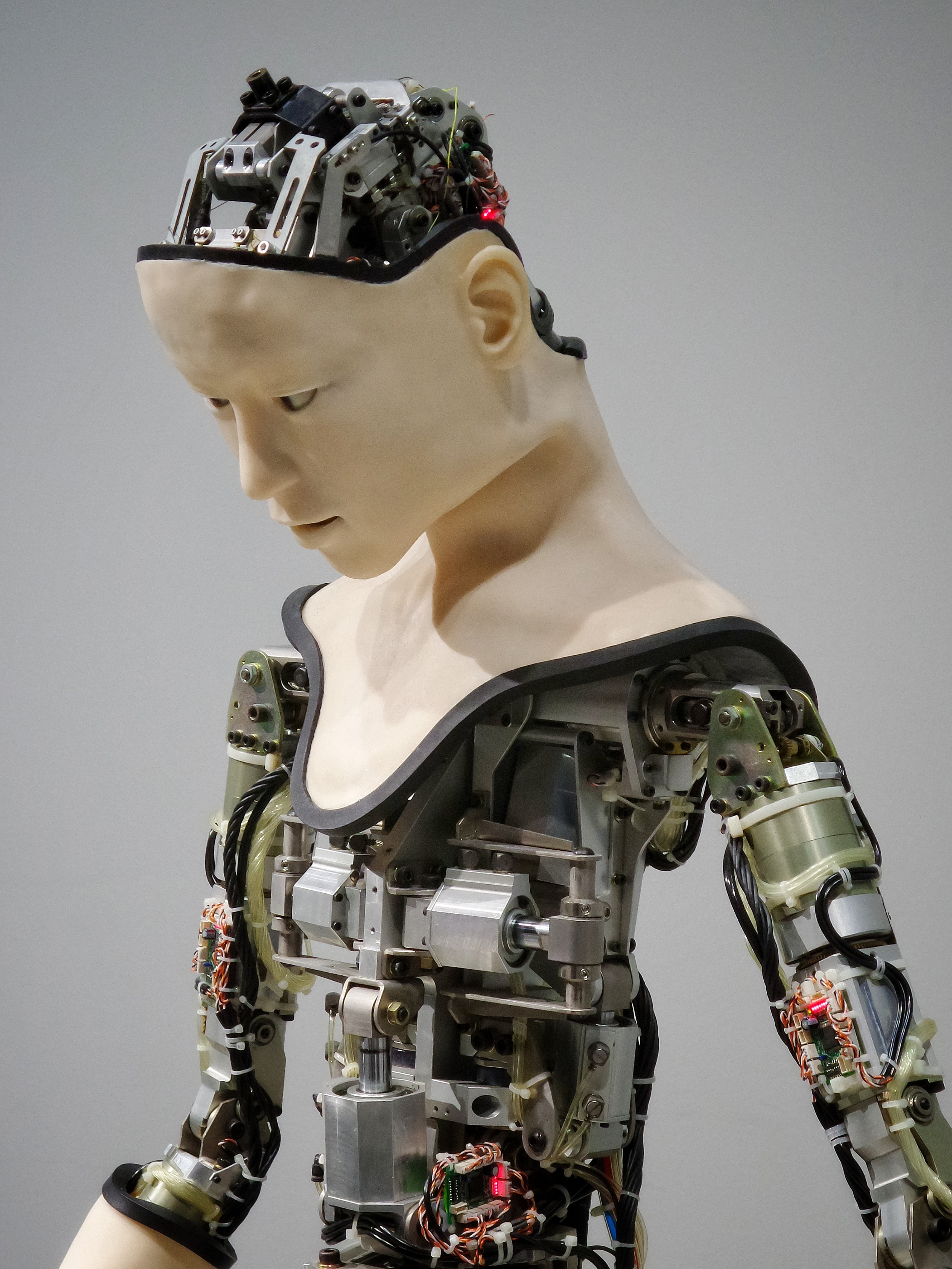
We’ve all seen the killing doll horror movie before, of course.  Who hasn’t?  What makes M3GAN different is the whole artificial intelligence angle.  Okay, so you understand it’s about a killing doll, but unlike Chucky or Annabelle, M3GAN has a titanium frame and a super-advanced, wifi-connected brain.  Like generative AI, she’s able to learn on her own and even able to use her own reasoning to get around her basic programming.  Now, you’re likely smarter than me and I didn’t catch what the critics call the “campiness” to the film.  Yes, there are places that made me snicker a little, but although the killing doll premise made the results somewhat predictable, I watched it seriously.  Some websites list it as horror comedy, while others prefer sci-fi thriller.  Nevertheless, it isn’t really that funny.  And there’s a cautionary element to it.

Funki, a Seattle-based toy company, is always trying to stay ahead of the competition.  Animatronic toys are the rage, and Gemma (brilliant choice to have a female mad scientist here) is a visionary programmer.  She wasn’t expecting, however, to become her niece’s guardian after Gemma’s sister was killed in an accident.  The M3GAN prototype was already underway, but Gemma kicks it into high gear to help make up for her own lack of parenting skills.  M3GAN becomes her niece’s companion—soulmate, even—and since the two are bonded with biometrics, her protector.  Bullies, lend me your ear; you don’t want to mess with a girl who has an android as a bestie.  And nosey neighbors, fix that hole in your fence.  Or at least curb your dog.

Instead of I, Robot this is more like You, Robot.  There is a wisdom to the othering that goes on here because none of us know in what kind of reasoning generative IA might engage.  In real life computers have been discovered communicating with one another in a language that their programmers couldn’t read.  We’re all biological, however, and thinking, as we know it, involves many biological factors.  Logic is part of it, but it’s not the whole story.  So techies who idolize Spock and his lack of emotion feel that they can emulate thinking by making it a set of algorithms.  My algorithms lead me to watch horror films out of a combination of curiosity and a need for therapy.  Where does a computer go for therapy?  The internet?  Well, you might find some good advice there, but don’t be surprised if it comes at you with a paper-cutter sword in the end.  You’ve been warned.


Generation Tech

You can’t be lazy in a technocracy.  I find myself repeating this mantra to myself when dealing with many people who use technology only when strictly necessary.  They don’t realize the war has already been lost.  If you want to thrive in this new world order, you need to keep up at least a modicum with technology.  I deal with a lot of people for whom biblical studies means handling only pens and paper.  J. C. L. Gibson, one of my doctoral advisors, wrote all his books longhand and had his secretary type them.  That’s simply no longer possible.  For authors, if you’re not willing to put notice of your books on Facebook, Twitter (or, as it seems to be going, Threads) people aren’t going to notice.  Publishers don’t send print catalogues any more.  My physical mailbox has been quite a bit less used of late.

There’s an irony to the fact that the generation that grew up on Bob Dylan’s “The Times They Are a-Changin’” are now refusing to accept our robo-overlords.  AI is here to stay and shy of a total collapse of the electrical grid, we’re not going back to where we were in the sixties.  The times have a-changed.  And you know what Bob says to do if you can’t lend an appendage.  Now, if you read my blog regularly, you know that I don’t go into this future with a sincere smile.  But at least I try to keep up with what I need to to survive.  I have to stop and remind myself how to write a check.  Or fold a roadmap.  I suspect that many of those who object to doing academic business electronically also drive by GPS.  It beats getting lost.

How does this connect to the internet?

No, I’m not the first in line.  I still wouldn’t be using a headset for Zoom/Teams meetings if my wife hadn’t given me an old one of hers.  This despite the fact I complain that I can’t hear others who insist they can speak clearly without and whose voices are muffled by the echoes in their work-at-home room.  Nevertheless, if you want to be a professional of any stripe, you need to reconcile yourself with technology and its endless changes.  You wake up one morning and Twitter is now X and you find yourself xing rather than tweeting.  I need to get more followers on Threads, but you can’t do that on your laptop—I guess times are still a-changin’.


Animate Magnetism

The Magnetic Monster is listed as sci-fi and horror on industry websites.  It falls into that period when horror had shifted to Hammer Studios in the UK and the US had entered that white-shirt, button-down period known as the fifties.  There were still monsters out there but they generally had to do with radiation.  In this case, it’s magnetism and its relationship to electricity.  The movie came out in 1953 and introduces what may have been the forerunner of the X-Files, namely the Office of Scientific Investigation, the OSI.  This team of A-men (yes, this was the fifties) study anomalies in order to keep America safe.  There were a total of three OSI films, of which this is the first.  The eponymous magnetic monster is alive only in a philosophical sense—it’s actually an irradiated element gone wild.

An unrestrained scientist had subjected a radioactive isotope to alpha particles for several days and this started a chain reaction.  He takes the substance onto a commercial airline—in his carry-on, no less (it was the fifties)—but the plane is diverted so the A-men can intercept it.  Every eleven hours this isotope divides and doubles, eating all the energy around itself to do so.  This creates an immense magnetic field.  So immense, in fact, that in a mere matter of days it will throw off the earth’s core and our planet will spin helplessly off into space!  Don’t panic, dear reader, the A-men are on the job.  They find a scientific means of overfeeding this monster and destroying it, which is why we’re all still here.

Interestingly, this is one of the more highly rated movies of the era, perhaps because of its scientific optimism.  Scientists can solve all our problems.  And yet you’ll find them without fail in church on Sunday morning.  The fifties were developing a kind of split personality for this country that was trying to hold two conflicting impulses together in an attempted fusion.  The problem is, overthinking either (or both) of them would demonstrate that they really have separate paths to take.  They may well be compatible, but in ways that relegating religion to Sunday morning simply doesn’t work.  Even today many scientists—generally not the outspoken kind—still hold religion and science in tension.  There is something to this impulse we call religion, but it always seems to have to wait while we use science to destroy the monsters we create ourselves. 


Next Gen AI, Truly

Okay, so it was a scary meeting.  It was about AI—artificial intelligence.  Specifically Generative IA.  That’s the kind that makes up answers to questions put to it, or does tasks it’s assigned.  The scary part, to me, is that we are being forced to deal with it because tech companies have unleashed it upon the world without thinking through the consequences.  Such hubris gets us into trouble again and again but it never stops us.  We’re sapiens!  You see, GAI (Generative AI) is under no obligation to tell the truth.  It likely can’t even understand the concept, which is a human concept based on perceptions of reality.  GAI simply provides answers based on the dataset it’s been fed.  It can generate texts, and photos (which are so doctored these days anyway that we need a photo-hospital), which means it can, to borrow the words of a sage, “make a lie sound just like truth.”  We already have politicians enough to do that, thank you.

My real fear is that the concept of truth itself is eroding.  With Trump’s “truth is whatever I say it is” administration, and its ongoing aftermath, many Americans have lost any grip on the idea.  Facts are no longer recognized as facts.  “Well I asked ChatGPT and it told me…”  It told you whatever its dataset told it and that dataset contains errors.  The other scary aspect here is that many people have difficulty distinguishing AI from human responses.  My humble advice is to spend more time with honest human beings.  Social media isn’t always the best way to acquaint yourself with truth.  And yet we’re forced to deal with it because we need to keep evolving.  Those Galapagos finches won’t even know what hit ‘em.

Grandma was born before heavier-than-air flight.  Before she died we’d walked on the moon.  About two decades ago cell phones were around, but weren’t ubiquitous.  Now any company that wants its products found has to optimize for mobile.  And mobile is just perfect for AI that fits in the palm of your hand.  But where has truth gone?  You never really could grasp it in your hands anyway, but we as a collective largely agreed that if you committed crimes you should be punished, not re-elected.  And that maybe, before releasing something with extinction-level potential that maybe you should at least stop and think about the consequences.  I guess that’s why it was a scary meeting.  The consequences.  All technological advances have consequences, but when it takes a lifetime to get to the moon, at least you’ve had some time to think about what might happen.  And that’s the truth.


Thinking Power

Thoughts are powerful.  An idea can change everything.  While materialism tells us that thoughts are only electro-chemical signals in an organic mass of tissue, those who have them know differently.  I don’t know you, kind readers, well enough to share the full truth of the matter, but I am more and more convinced that materialism is woefully overconfident in its ability to explain everything.  As a friend once told me, science accomplishes a lot and it clearly works, but it also sweeps anomalies off the table as statistically insignificant.  So when we read accounts of educated, rational individuals describing the impossible we laugh it off.  We shouldn’t.  Science and spirit working together is a powerful combination.  Getting the mix right is part of the process.

Our thoughts affect the world around us.  This can be as simple as deciding to mow the lawn.  By doing so, based on a thought, you physically altered the environment in some small way.  Isn’t it merely a matter of degree to let the thought do more of the work?  We’re a long way from mowing the lawn by mind power alone, but we’re at the point where belief (and I’m not talking facile follow-the-leader kinds of belief) should be allowed to grow a little bit.  There’s a lot more to the world than we’re often told there is.  What’s happened to our curiosity that we don’t explore it?  I have some theories regarding why we’ve cut ourselves off from potentially world-changing thoughts—thoughts that really could make the world a better place for all.  We’re tied to old paradigms.

We tend to be too busy to put large amounts of time into thinking.  As a society we undervalue that, in any case, until we need a professor in a specific specialization.  Thinking can lead to action.  We still can’t explain, scientifically, how the thought that I should mow the lawn translates to me standing from my chair, grabbing my hat and gloves, and a battery-pack, going to the garage, and hauling out the mower.  We do know that a thought starts a chain of events, but how does that thought move arms, legs, hands, and feet?  “For verily I say unto you, that whosoever shall say unto this mountain, ‘Be thou removed, and be thou cast into the sea,’ and shall not doubt in his heart, but shall believe that those things which he saith shall come to pass, he shall have whatsoever he saith.”  Or so the perhaps most influential sage in history once said. 


All Connected

The physical world is interconnected.  It’s not the only world, I’m convinced (there’s simply too much evidence that it’s not), but it’s certainly entangled.  We’re clearly part of a planet-wide system.  More than that, perhaps life is endemic in the universe.  We like to think our planet is exceptional, but what if it’s quite common (as the stats would seem to indicate)?  Sometimes physical objects can influence the spiritual world.  We don’t really know what the spiritual world is, so how the physical and spiritual interact we can’t always say.  My brother, knowing we needed some hope, sent my family some small gifts.  Things like this can cross worlds.  What he sent me was the replica of the famous “alien nickel” reported in the news last June.  (He knows me.)

A coin collector in Michigan was going through a roll of quarters in 2022 looking for any that might contain some silver.  You see, until 1964 US dimes and quarters were still manufactured with a portion of silver.  I very seldom use cash any more, but I always used to glance through my change to see if there was anything unusual before putting it in the coin jar.  In any case, the Michigan man found a buffalo nickel that, instead of the American Indian head on the obverse, it had an alien head.  “Experts” (numismatists, presumably) declared it a “hobo nickel,” as the homeless used to redefine currency to their own liking, apparently.  The interesting thing about this news story is that it disappeared from attention soon after the coin was found although the pictures indicate a high degree of artistry for a homeless person etching with a penknife.  It’s not alien currency, I know, but I do wonder from whence it came.  With hope.

For all the advances our society has made, we still defer to ridicule to explain the unexplained.  This is wrong-headed.  I have my own theory about why it is so, but in part it’s because science as we know it, in its Enlightenment form, was born in a Christian context.  Scientific thinking has been around for as long as humans, but the Enlightenment marked the point when the interconnectedness of the world began to be dropped from discussion.  Why?  Because science grew in cultures based on the biblical view of humans as exceptional.  If biblical events occurred here, on this planet, to us, we must be pretty special indeed.  Even as science has become more materialistic, its cultural matrix remained largely unchanged.   Ironically that matrix now excludes the interconnected world.  Life is pervasive, and who are we to say that stones, or this entire globe, are excluded from the party?  We’re all connected and there is wisdom in rocks and metal, if only we could see it.  If we believe.


Employment Opportunities

It’s important to be reminded that stories can also be told by what’s not said.  Non-narrative fiction can be a little tricky to follow, but often contains admirable aphorisms.  Such as “I believe in the future.  I think you need to imagine a future and then live in it.“  This is from Olga Ravn’s The Employees: A Workplace Novel of the 22nd Century.  One of the many things driving me insane at the moment is where I found out about this book.  I know I ran across a recommendation somewhere and I can’t recall the place.  It would be helpful to know since I wonder what it was about the description that convinced me I had to read it.  In any case, there will likely be spoilers below since it’s difficult to describe the book without them.  I’ll start off by saying it’s classified as science fiction, but it’s not your typical 1950s kind.

The story’s told via a series of employee statements to the company that owns a space freighter.  The ship has a mixed crew of humans and humanoids—androids that aren’t easily distinguished from biological humans.  They discover some mysterious, perhaps organic, objects on a new planet and the humanoids begin to request, or even demand, equal treatment.  The outlooks from the two perspectives, human and non-human, are quite different, but they argue that fair treatment is only, well, fair.  The situation gets out of hand and the company, as such entities often do, decides on the economical solution of killing everyone aboard the ship but preserving the exotic objects.  Though generally described as “comic,” I picked up on the seriousness of the issues of prejudice and inequality.  The quote above is from the very last statement from the ship.

Ravn has established a reputation as a poet and that shows through in this novel.  The quote above is an example.  According to the article about her on Wikipedia, she graduated from the Danish School for Authors.  That made me wonder why we don’t have such things.  This isn’t the same as an MFA program.  Indeed, the nordic countries seem to have abandoned their viking ways for literature.  There’s a deep wisdom in this.  Costs of living are high in such places, but so are happiness levels.  What’s not to like about a school option where budding poets and novelists can become acquainted with one another and imagine a better world?  Writers sometimes give us challenging stories but the reason, I believe, is that we can learn from them, view a better future, and live it.


Parthenogenesis

It’s only a matter of degree, isn’t it?  I mean between reptiles and mammals.  While our common ancestor was quite a bit older than Lucy, we’re still fam, right?  I’m not the only one, I’m sure, who read with interest the New York Times story about the female crocodile who recently gave birth without the help of a male.  It’s called parthenogenesis and, according to the article, it’s not as rare as we might think.  Birds and amphibians do it.  Some fish even change gender under reproductive pressure.  And if you’ve seen Jurassic Park you know the implications might be larger by an order of magnitude or two.  My mind, however, wanders to mammals.  Then primates.  Then humans.  If our distant cladistic cousins can do it, can we?

The key appears to be males leaving females alone long enough.  As Malcolm says, “life will find a way.”  Life amazes me.  While we can’t count on it happening for each individual, life has a way of reemerging when you think it’s gone.  Previous owners of our house neglected a green ash tree growing in a location far too close to the house itself for many years.  Granted, it was on the north side where you seldom have any reason to go, but that tree sent out progeny that I’ve had to try to eradicate for five years now.  As much as I love trees, when they’re growing into the foundations of your house, they’re a bit of a problem.  I snip off the water shoots whenever I find them but they keep coming back.  I’m sad to cut them but I admire their persistence.  Life’s persistence. It’s will to carry on.  It continues even when we think it can’t.  Never forget the water bears!

Just a few days later the Times ran an article about the strong possibility of life on Enceladus, one of Saturn’s moons.  Personally, I wouldn’t be surprised.  I’m absolutely certain there’s life elsewhere.  It makes no sense for it not to be.  Life evolves to a point, it seems, where the “intelligent” variety seems to become arrogant.  I embrace our reptilian and amphibious and piscine cousins.  Even our insect and arthropod family.  Our plants and fungi.  Life is amazing and we seldom stop to ponder just how wonderful and mysterious and resilient it is.  A lonely female crocodile decides to have a family.  Phosphates spewing from an ice-cold moon whirling around a colossal planet that wanted to be a star.  Life!  How can we not be stunned into trying to admire it in its many, many forms?


Optimism

On the homepage of my website (of which this blog is a part) is the statement that jaded optimism lurks here.  I’ve been thinking a lot about optimism and hope lately.  Trying to change the way you think is difficult.  Musing with my wife the other day I realized—and this should’ve been obvious—that my optimism became “jaded” when I lost my job at Nashotah House.  You see, our lives have been uncertain since then.  The steady income of an academic job with a retirement plan, a future mapped out (at least a little) with summers free for research and travel, the flexibility to have time to contemplate; all of this fits my neurodivergent way of thinking.  Having suddenly to cope with finding an apartment, finding jobs (not vocations), losing retirement options, all of this has led to a turmoil that has lasted going on two decades now.

I need to challenge my jaded optimism into becoming real.  I keep coming back to Mark 9.24, “Lord, I believe; help thou mine unbelief.”  I’m not a materialist, although academia led me close to it a time or two.  The universe, however, is an untamed place.  We don’t know the trillionth of it, let alone the half.  We’ve figured out a good bit of the physics of this world and think that it applies the same everywhere in this infinite, expanding space-time.  Then we discovered quantum physics and quantum entanglement which looks more like religion than science.  It seems to me that optimism—hope—lies in a combination of what science tells us and what is traditionally called religion tells us.  You may call it “belief,” “intuition,” or “hope.”  Yes, when Pandora’s box was opened, only hope remained.

John William Waterhouse, Pandora (1896), public domain, via Wikimedia commons

There’s a parable in the story of Pandora.  As told by Hesiod, Pandora’s jar contained the gifts of the gods which escaped when Pandora opened it.  Thereby evil entered the world.  Yet one gift of the gods remained for humankind, and that was hope.  Arguably the most valuable gift of them all.  I have been letting my career malfunction at Nashotah House dominate and drive my outlook for far too long.  It will never cease to hurt, I know, but it’s time I learned the meaning of what the Pandora myth teaches us.  Myth, please understand, functions like religion.  It provides insight and guidance.  And the tale of Pandora, especially when things turn unexpectedly frightening, reminds us that hope is the only necessary gift of the gods.


Surviving AI

A recent exchange with a friend raised an interesting possibility to me.  Theology might just be able to save us from Artificial Intelligence.  You see, it can be difficult to identify AI.  It sounds so logical and rational.  But what can be more illogical than religion?  My friend sent me some ChatGPT responses to the story I posted on Easter about the perceived miracle in Connecticut.  While the answers it gave sounded reasonable enough, it was clear that it doesn’t understand religion.  Now, if I’ve learned anything from reading books about robot uprisings, it’s that you need to focus on the sensors—that’s how they find you.  But if you don’t have a robot to look at, how can you tell if you’re being AIed?

You can try this on a phone with Siri.  I’ve asked questions about religion before, and usually she gives me a funny answer.  The fact is, no purely rational intelligence can understand theology.  It is an exercise uniquely human.  This is kind of comforting to someone such as yours truly who’s spend an entire lifetime in religious studies.  It hasn’t led to fame, wealth, or even a job that I particularly enjoy, but I’ll be able to identify AI by engaging it with the kind of conversation I used to have with Jehovah’s Witnesses at my door.  What does AI believe?  Can it explain why it believes that?  How does it reconcile that belief with the the contradictions that it sees in daily life?  Who is its spiritual inspiration or model or teacher?

There are few safe careers these days.  Much of what we do is logical and can be accomplished by algorithms.  Religion isn’t logical.  Even if mainstream numbers are dipping, many Nones call themselves spiritual, but not religious.  That still works.  We’ve all done something (or many somethings) out of an excess of “spirit.”  Whether we classify the motivation as religious or not is immaterial.  Theologians try to make sense of such things, but not in a way that any program would comprehend.  I sure that there are AI platforms that can be made to sound like a priest, rabbi, or preacher, but as long as you have the opportunity to ask it questions, you’ll be able to know.  And right quickly, I’m supposing.  It’s nice to know that all those years of advanced study haven’t been wasted.  When AI takes over, those of us who know religion will be able to tell who’s human and who’s not.

What would AI make of this?

Inventing Chaos

A recent (in my personal interaction with time) article from the New York Times recounts two bad inventions by Thomas Midgley Jr.   Namely, leaded gasoline and the practical use for chlorofluorocarbons.  Besides making me interested in Midgley, the article got me thinking about inventors and inventions.  We never know, in real time, if innovations are good ideas or not.  We have no crystal ball and what seems like a good idea now may prove to be a catastrophe.  I’ve given a couple of talks on the Antikythera mechanism.  If you’re not familiar, it is essentially an analogue computer invented in the first century.  Experts suggest there were likely multiple such devices, but they never caught on and transformed society.  Why?  Nobody saw the practical benefits.

A replica of the Antikythera mechanism

The Antikythera mechanism was made essentially to predict eclipses and track the movement of heavenly bodies.  The fact that such a thing existed within a century of when Jesus of Nazareth lived and died is mind-blowing at first.  Still, it makes a point.  We never know when an invention will take off and change the world.  And we never know if that change will ultimately be good or bad.  There are many who suggest that the invention of agriculture was a mistake.  We eat less healthily than our hunter-gatherer ancestors, and they may have been much happier (in general) than we are.  Still, agriculture (despite creating desk jobs) has its benefits.  We live longer.  We have medical science.  And we can entertain ourselves with clever people on YouTube.  While we sit around too much and eat things that really don’t benefit us, we seem to be doing okay.  We’re living longer, at any rate.

The problem, it seems to me, is when capitalism takes an idea and blows it up into a huge money-making venture.  People just can’t take their eyes off that shiny, shiny gold.  And ideas, when they start making unreasonable demands (a new cellphone every other year?  Really, is that necessary?) tend to lead to the same results as leaded gasoline and chlorofluorocarbons.  If they can be monetized, ideas will push themselves into this unbroken feedback loop we call economy.  Often at the price of ecology.  Inventors are both necessary and dangerous.  Their efforts often make the world more comfortable, more convenient.  They might, however, cause immense harm.  Being a vegan, I’d have a difficult time surviving as a hunter-gatherer.  Gathering is more my style, in any case.  If only I had a way of tracking the movement of heavenly bodies, I might just be content.


Planting Knowledge

In an effort not to harm other living creatures, I became a vegan about seven years ago.  Generally it’s not too difficult, although many eateries still think you have to exploit animals to eat anything.  Vegan fare is quite good, and some of it is remarkable.  Then I saw the article in Popular Mechanics, “So It Turns Out Plants Have Had Voices This Whole Time” by Jackie Appel.  Well, “voices” may be stretching it a bit, but they do make sounds.  According to the article, plants “talk” at the same volume as humans tend to, only it’s in a range that we can’t perceive.  Other animals, however, may.  That’s right, your dog may be able to hear the noise plants make.  This is one of the reasons I marvel at scientific arrogance.  Human senses simply can’t perceive all stimuli—how can we claim that what we term “supernatural” doesn’t exist?  We don’t have nearly all the data.

Meanwhile, we live with animals whose sense of smell would send us running even more frequently to the showers.  Animals who can hear plants “talking.”  Animals who can perceive magnetic fields.  We’ve evolved knowing what we need to know.  (At least in part.)  What then do plants communicate?  Can they hear one another?  The sounds plants make, if “translated” to human perception, seem to be “I’m thirsty,” “I’ve been hurt,” or “I’m fine.”  The terminology here is Appel’s but you get the idea—plants broadcast their status.  Can plants scream?  One of my students reminded me a few years back that I once wondered to her what a tomato felt when it was being sliced.  I responded, “That sounds like something I would’ve said.”

They know.

So now I’m a vegan and plants are joining the conversation.  My hope is that they don’t feel pain.  As far as we know, plants don’t have brains.  Even so, heliotropes are smart enough to follow the sun across the sky.  And even fully grown trees move—very, very slowly—to optimize the light they require.  Such intelligence in nature always leaves me in a state of wonder.  We’ve been told for centuries of human exceptionalism.  Sure, we have opposable thumbs and have figured out how to communicate intricate things vocally.  So much so that we can represent them in written form (such as you’re reading right now) and can know what someone’s saying even at great distances.  That doesn’t mean we’re the only remarkable creatures.  But it does leave me with the dilemma of what to eat.


Pondering Origins

I’m not a numbers guy.  I never had any interest in statistics, and I tremble when I see my accountant’s number pop up on my phone at tax time.  But exponential sequences have an inherent fascination.  Think about your ancestry (I recently wrote about genealogy and that got me pondering).  You have two parents.  And they each had two parents.  By the time you get back to ten generations (eight greats before grandparents) you have 1,024 ancestors of roughly the same generation.  That’s a lot of people just to make one individual.  Think of all the circumstances that might’ve led to any two of them having been kept apart—then where would you be?  Of course the numbers double each generation which is where my reasoning capacity shuts down.

At some point, doesn’t it seem, that there wouldn’t be enough people available to make you?  I know that’s not true—you’re reading this and that proves this false—but it does make each individual life a thing of wonder.  Or even at the level of your own parents.  If you have siblings you know how different even biologically similar people can be.  And there are many others who could’ve been conceived instead of you or me.  The chances are astronomical that we’re here at all.  I often wonder if such circumstances are why our minds seek religious answers.  People are meaning-seeking creatures.  And against such long odds, it seems that maybe we’re a miracle after all.  Naturally, a driving force behind it all suggests itself.

Photo credit: NASA

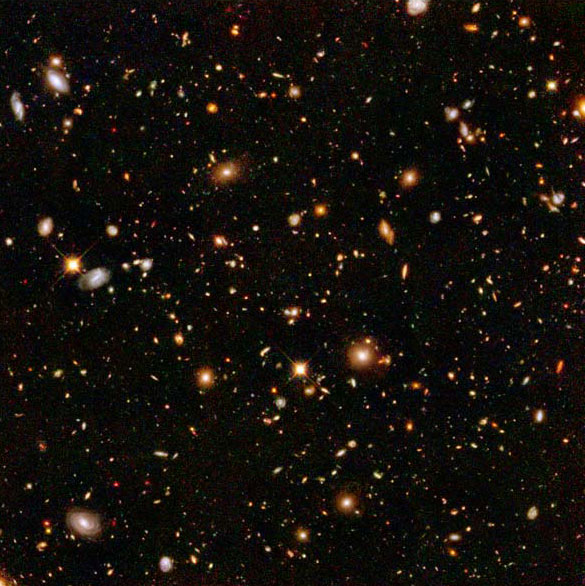
Science has been a real boon for the billions of us alive today.  There’s no doubt that dispassionate, rational thought can lead to amazing outcomes.  At the same time, the doubt creeps in that this is the only explanation.  It occurs to me when watching the birds in the spring.  How do they know their own species and with whom to mate?  Is all of this driven by that notorious fudge factor we call “instinct”?  I have no answer to what the source of that will to keep life going is.  Biology tends to be among the slipperiest of sciences.  Life is difficult to define when we don’t even know everything that’s out there in our infinite but expanding universe.  The numbers are just too massive.  All I know is that by the time you get back to twenty generations (eighteen greats) it took over a million people to make just one of us.  And that’s by the numbers.


Friends and Dreams

The mind is a labyrinth.  Ever since the time change (especially), I’ve been waking with the weirdest dreams.  One involved someone I haven’t really thought about for years.  Someone I knew in college and who was a close friend, but who’s fallen out of touch.  (And who would likely not approve of my evolving outlook on things.)  Why she came out in a dream is a mystery to me.  It does give me hope, however, that all those things I think I’ve “forgotten” are really still in there somewhere.  A friend once told me that it’s not a matter of “remembering” but of “recollecting.”  He claimed that the memories are still there.  Ironically, I can’t recollect who he was, although I think it was someone I knew in college.

My generation’s ambivalent about the internet.  Most of my college friends I simply can’t find online.  I recall one of my best friends saying he would never use a computer.  I suspect he’s had to backslide on that, for work if for nothing else, but he’s not available online at all.  The same goes for people my age at seminary.  Some I occasionally find through church websites, but honestly, most of them have better pension plans than I do and have retired to become invisible.  We children of the sixties are likely the last generation that might be able to make it through life claiming never to have given in to computers.  It took quite a bit of effort to get me over the reluctance.  One of my nieces set up this blog for me nearly 13 years ago, otherwise I’d still be hard to find.

But minds.  Minds can, and do change.  My mind was dead-set against computers in college.  For one class I was required to do one assignment via computer, and I did that task and that task only.  Seminary was accomplished with a typewriter and snail mail.  Even my doctorate, done on a very old-fashioned Mac SE, was purely a feat of word processing.  Nashotah House was wired during my time there, but that was mainly email.  My mind was slowly changing at each step of the way.  I wasn’t becoming a computer lover, but I was realizing that I was learning something new.  Now I can’t get through the day without writing and posting something on this blog and sharing it on Twitter and Facebook.  And checking email—always email—to see if anything important has come in.  And, perchance, someone I had a dream about might actually email me out of the blue.


Actual Intelligence (AI)

“Creepy” is the word often used, even by the New York Times, regarding conversations with AI.  Artificial Intelligence gets much of its data from the internet and I like to think, that in my own small way, I contribute to its creepiness.  But, realistically, I know that people in general are inclined toward dark thoughts.  I don’t trust AI—actual intelligence comes from biological experience that includes emotions—which we don’t understand and therefore can’t emulate for mere circuitry—as well as rational thought.  AI engineers somehow think that some Spock-like approach to intelligence will lead to purely rational results.  In actual fact, nothing is purely rational since reason is a product of human minds and it’s influenced by—you guessed it—emotions.

There’s a kind of arrogance associated with human beings thinking they understand intelligence.  We can’t adequately define consciousness, and the jury’s still out on the “supernatural.”  AI is therefore, the result of cutting out a major swath of what it means to be a thinking human being, and then claiming it thinks just like us.  The results?  Disturbing.  Dark.  Creepy.  Those are the impressions of people who’ve had these conversations.  Logically, what makes something “dark”?  Absence of light, of course.  Disturbing?  That’s an emotion-laden word, isn’t it?  Creepy certainly is.  Those of us who wander around these concepts are perhaps better equipped to converse with that alien being we call AI.  And if it’s given a robot body we know that it’s time to get the heck out of Dodge.

I’m always amused when I see recommendations for me from various websites where I’ve shopped.  They have no idea why I’ve purchased various things and I know they watch me like a hawk.  And why do I buy the things I do, when I do?  I can’t always tell you that myself.  Maybe I’m feeling chilly and that pair of fingerless gloves I’ve been thinking about for months suddenly seems like a good idea.  Maybe because I’ve just paid off my credit card.  Maybe because it’s been cloudy too long.  Each of these stimuli bear emotional elements that weigh heavily on decision making.  How do you teach a computer to get a hunch?  What does AI intuit?  Does it dream of electronic sheep, and if so can it write a provocative book by that title?  Millions of years of biological evolution led to our very human, often very flawed brains.  They may not always be rational, but they can truly be a thing of beauty.  And they’re unable to be replicated.

Photo by Pierre Acobas on Unsplash