Mere Christianities

While reading about the experience of an American Catholic who’d gone to Rome (check out this post), something in particular struck me.  Although the setting was in the 1960s, the author noted a truth that is still with us: Americans take religion much more seriously than do their parent bodies overseas.  This may be true elsewhere in the world as well, but those of us in this former frontier know that American isolation means religion developed here in a way different from much of the rest of the world.  To get a grip on that we need to realize that Christianities in America are largely of European origin.  That’s important because the roots of these traditions lie elsewhere and the question of how they measure up against the religion started by a Galilean peasant bears close scrutiny.

First of all, if we take what we can gather from the Gospels the things that Jesus might’ve actually said, we find contradictions.  This isn’t unusual.  Nobody was writing things down as he said them and Jesus probably taught off the cuff (not the maniple).  These traditions were recalled a couple decades after the crucifixion.  Try remembering exactly what you said just a year ago and you’ll get a sense of the difficulties.  Paul of Tarsus took this teaching in a new direction, both in doctrinal and physical senses.  Christianity became a European religion.  Fast forward by a few centuries and we find its much-changed Protestant forms inspiring people to go look for a place to practice it their own way.  Politics never follows far behind religion and so the American Indians became victims of those seeking religious freedom by fleeing from home.

Meanwhile, back in Europe, much of the fire that had led to sparks flying over here had been banked.  The Enlightenment and its application to these various traditions had shown that literal interpretations were historically unlikely.  Indeed, Americans trained on the frontiers by clergy with little education had taken Christianities in entirely new directions.  Literalism was often assumed, although its expressions varied wisely.  When you look closely at how religions develop you learn that the rank and file believer is out of touch with “official doctrine” and those who specialize in it find they can’t course correct without looking hypocritical.  The book I was reading had Vatican officials complaining Americans too Catholicism too literally.  It seems this is the fate of any faith that allows itself to become a mere religion.

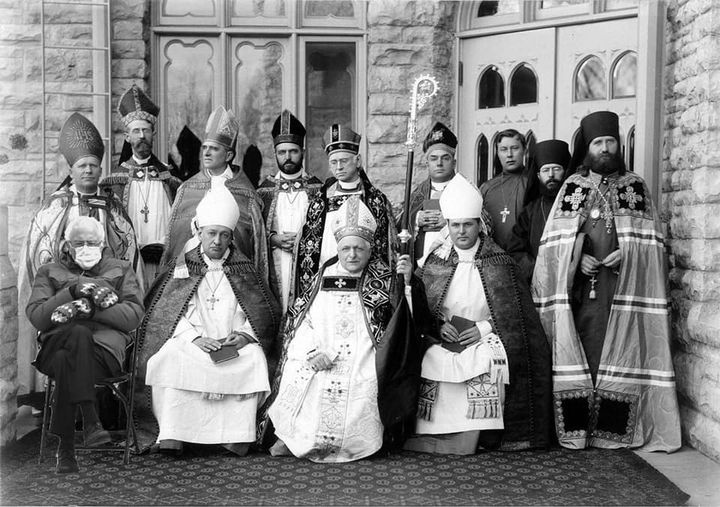
Photo credit: Mapham J (Sgt), No 5 Army Film & Photographic Unit, via Wikimedia Commons


Money Days

Those of us who live in caves (figuratively) have trouble filling all this in.  Not a great fan of capitalism, I find “Black Friday” a troubling add-on to the holiday schedule.  Now I’ve lost track of all the expanding special days: Small Business Saturday, Cyber Monday, Giving Tuesday.  Must we celebrate capitalism so much?  I have no problem with non-Christian holidays, but when money becomes the sole basis for special days I have to wonder.  Mammon is a deity of which we’d been warned a couple of millennia ago.  The real irony is that it’s the very religion that posted that warning that now seems most closely related to the capitalistic system that perpetuates its worship.  It wouldn’t be such an issue except that the religion that has bought into the system so readily is the one that is putatively based on its condemnation.

Irony is something for which historians are always on the lookout.  Perhaps this is especially so among historians of religion.  Religion has come to denote a codification of our highest ideals and aspirations.  When did money attained such spiritual status?  It seems that Christianity was the vehicle.  Although it’s most obvious in American politics, the relationship goes back to the whole colonial enterprise.  Once Christianity became an imperial religion under Constantine, its focus began to shift.  Even those splinter groups that started off with higher ideals soon came under the overarching umbrella of the capitalistic system sprung from the teachings of a poor carpenter from Nazareth.  And so we find ourselves amid a creeping array of money-based holidays that provide the secular answer to Advent.

Of course, Advent itself became a season of anticipating the commercialized holiday of Christmas.  And here as the calendar year winds down the financial year hopes for a shot in the arm because economy is the doctrine of this new religious thinking.  And the irony is that the system is set up so those who already have too much get more while those who don’t have enough end up with even less.  Sounds biblical, no?  Ever since my ouster from academia, I’ve had to cash in vacation days to make myself a little semester break.  A body gets used to a certain schedule, and those rhythms are difficult to shake.  As we work our way through pandemic-laced spending holidays I’ve got my eyes on a bit of time off from my small part in supporting this all-consuming machine.  


No Dolls Required

Moving is a never-ending process.  We’ve had some new neighbors move in next door over the past couple of weeks.  Seeing their boxes reminded me that we have many we still haven’t unpacked and sorted after over two years.  (That’s what attics are for.)  One of the novelties I found while doing so recently was one of those bookstore impulse buys at the checkout counter, “Voodoo Lou’s Office Voodoo Kit.”  This was actually a joke gift given to my wife some years ago.  In all probability it was me that insisted we not throw it out.  Perhaps I was saving it as an object lesson.  One of the religions I very briefly discuss in Nightmares with the Bible is Vodun.  This African diasporan religion is frequently demonized as “voodoo” because of its supernatural beliefs.

Many religions, of course, harbor supernatural beliefs.  The ballots are still being counted on whether such things exist because we can never wrestle them into the laboratory to measure them with instruments designed for physical applications only.  Vodun isn’t the source of evil perpetrated by the cheap (and often exploited by horror) “voodoo doll” narratives.  It is a complex blend of traditional African religions brought into forceful contact with Roman Catholicism.  We shouldn’t treat it as exotic, nor should it be a codeword for evil.  Like most religions vodun is an attempt to navigate the world of the gods and spirits that people everywhere believe in, even if they can’t be quantified.  The religion was mysterious when first noticed by travelers from the United States and it quickly became fodder for horror films.

We tend to judge religions just because they’re different.  One of the more insidious aspects of global religions is that they create the illusion among their believers that they are the “only true religion.”  Those who study religion professionally know that all religions are “syncretistic.”  There is no such thing as a “pure” form of any religion.  Just try getting a Calvinist and Catholic to come to a common understanding of what Christianity is.  Both want to claim their version as the true one.  Religions, however, have developed as ways for people to cope with the world as they’ve experienced it.  Just because fewer people believe one way we can’t assume their religion is inferior.  Vodun, in which I’m no expert, is far more complex and sophisticated as might be suggested by and impulse buy for frustrated office workers.  Still, it works as an object lesson.


Recent Religions

A project at work has made me curious about Christian Science.  Oh, I know the basics, as many religionists do, but when trying to find a neutral treatment of the tradition I was struck by how little was out there.  It is a symptom of academia, I fear, to ignore that which isn’t conventional.  I’m fascinated by what are called New Religious Movements (NRMs)—many of which have sprung out of some form of Christianity.  New religions never cease to emerge, but the nineteenth century was a hotbed of new faith explorations.  The Mormons, Jehovah’s Witnesses, the Shakers (started a little earlier, now extinct), Christian Science—these traditions hold fascinating beliefs and even though some are thriving (Mormons), others seem to be slowly dying out (Christian Science).  

While in Boston as a student I made a point of visiting the Mother Church of Christian Science.  The campus is impressive and architecturally pleasing.  I took a tour and I still remember the vast and impressive map room.  The denomination is having difficulty because, I suppose, of lawsuits against parents refusing medical treatment for children.  This puts their theology at odds with the larger society’s understanding of children’s rights.  Indeed, if you look for books on Christian Science the most prominent are those from people who’ve left the religion.  Many NRMs have become extremely secretive and some have tried to make leaving difficult.  The same, however, could be said for mainstream Christianity.  We tend to think moderate Christianity benign, if benighted.  But all religions possess the power to abuse.

Religious beliefs make people behave in unconventional ways.  I think of how politics in this country is dominated by a biblicist agenda.  It doesn’t matter which party is in power, it’s the material with which we have to work.  The beliefs, from any quasi-objective point of view are strange.  The Bible, for example, says nothing of abortion.  Life in the biblical world began with the first breath.  Their concept of conception didn’t involve eggs and sperm.  In other words, it’d be ill-advised to take your biology lessons from the Good Book.  But this single issue drives many thousands of voters to one particular party.  I don’t know about you, but I would think that few topics deserve more thorough consideration than religion.  It’s what motivates people.  Instead, we live in a fascinating array of beliefs, often merging official teaching and personal experience and when we try to investigate we find a dearth of interest.


Raven Wisdom

Just twenty pages in and I was reflecting on how Christianities and the cultures they cultivated have caused so much suffering in the world.  Assuming there is only one way to be, and that way is pink, European, and monotheistic, has led to so many displaced people thrown aside as collateral damage.  Ernestine Hayes’ The Tao of Raven is a remarkable book.  A native Alaskan, Hayes participated in the colonialist venture of higher education to try to also participate in the “American dream.” If this book doesn’t make you feel uncomfortable in your own skin, I don’t know that you’re human.  As I mentioned in a recent post, I have a deep interest and lasting guilt to learn about indigenous peoples of the country where I was born.  About the culture that is so Bible-driven it can’t see the human beneath.  The capitalism that takes no prisoners.

The Tao of Raven is one of the most honest books I’ve ever read.  Hayes refuses to sugar-coat the alcoholism, the broken promises, the poverty offered to native Alaskans.  Even as Trump’s final rages go on, he has opened the Alaskan Wildlife Refuge for drilling, to the highest bidder.  Apart from those whose wealth will increase as a result, we will all suffer.  Those who lived in Alaska before the colonists arrived the most.  The idea of colonizing, without which capitalism just can’t work, reveals its evil here.  When a voice like that of Hayes is able to make itself heard we cannot but feel the condemnation.  When over seventy-million people vote for a hater, we all tremble.

The book ends much as it begins.  A sincere regret for those who’d been fed the contradictory messages of missionaries.  Those told to accept suffering on earth so that they could go to the white person’s Heaven, while those inflicting the suffering lead comfortable lives with modern conveniences.  The double-standards that allow people to die on the street like dogs.  The double-standards that can’t see that you need not be Christian to upend the tables of money-changers.  Indeed, the last time someone dared to such a thing was two millennia ago.  When Christianity slipped its fingers between those of capitalism a monster would surely be born.  The cost would come in human lives, even as a quarter-million lay dead in this country from a virus a rich man can’t be bothered to address.  Do yourself, do the world a favor.  Read this book.  Read it with your eyes open and learn from Raven.


Black Bible

In such a bibliocentric culture, I wonder why we lack curiosity about the Bible.  Not only do we not study it much in religion classes, we often accept it as a fixed cultural object.  Saying that it’s the word of God, as if that explains anything, many Protestant groups take it as the 39 books of the “Old Testament” and the 27 of the New, ignoring the 66 total that stands like a warning sign of impending idolatry.  Roman Catholics and some Anglicans add the books of the Apocrypha, or Deuterocanon, bringing the number closer to 73 books.  I say “closer to” because some of these books seem to be expansions on other books already in the canon.  Over the years the National Council of Churches has added a few more books, considering various other groups (mostly Orthodox) that recognize some further works as canonical.

In this era of recognizing the importance of black lives and black culture, I’m amazed there’s so little curiosity about the Ethiopian Orthodox canon.  I’ve spoken to many biblical scholars who could care less that the fantastic books of Jubilees and 1 Enoch are in the canon of the Ethiopian and Eritrean Orthodox Churches.  It’s almost as if these groups simply don’t matter in the world of Christendom.  I note that biblical scholars I ask about this are usually Protestant or Catholic themselves.  It seems to me almost a racist slight not to include books that are recognized among some Christian groups, but not others.

What is the scientific criterion for determining a book is the word of God or not?  It surely can’t be fear of contradiction, for the Protestant Bible—the briefest in mainstream Christendom—has plenty of contradictions of its own.  The Bible itself famously does not name the books included.  Various authorities made decisions at various points about which books should be included and which should be left out.  It is such a very human process.  But when it comes to including the books of churches that total nearly 40 million members, suddenly people just aren’t that curious.  Those of us interested in demons have to take Jubilees and 1 Enoch seriously.  They are fascinating books.  And Biblical for millions of people.  The past several years have made me think quite seriously about the borders built around the Bible.  Whose choice is it not to include books already in the canon for their neighbors?  Or, as might be more accurate, who has the authority to cut out books that already belong for many African Christians?


Documented Error

Back in September I wrote a post on documentaries.  One of those I’d watched was Hostage to the Devil, on the life of Malachi Martin.  Curious, I began looking for biographical information, only to find conflicting reports.  Robert Blair Kaiser, a journalist, was interviewed in the documentary and he claims that Martin is not to be trusted.  Given that Martin had academic credentials and academic publications, it’s clear that something is up here.  So I decided to read Kaiser’s Clerical Error.  As an award-winning journalist, Kaiser had written a book on Vatican II that sold fairly well, establishing his own credibility.  Clerical Error is a book, in large part, that was intended to discredit Malachi Martin because Martin had an affair with Kaiser’s wife.  That spices things up a bit.  (And explains the cover photo.)

It’s an odd book, overall.  Kaiser begins by describing how he became a Jesuit.  Autobiographical works are generally most interesting during the early years, and Kaiser does a good job illustrating how he was naive and probably joined the Jesuits out of fear of sexuality.  Some of the disciplines (including self-flagellation) are difficult to reconcile with the twentieth century (when they took place) but demonstrate the command religion can have over life.  Confronting church politics, he decided to become a journalist instead of a priest.  When he was assigned to Vatican II a couple things happen—his book gets lost in the weeds, and, he meets Malachi Martin (spelled Malachy throughout).  At first taken with Martin, the two became friends.  Martin helped him access places in the Vatican that would’ve otherwise been blocked to him, as a layman, even if a former Jesuit.

Then the tale becomes sordid.  According to Kaiser, Martin, still a Jesuit priest, began an affair with his wife.  The final third of the book has the draw of a soap opera as Kaiser tries to confirm what he suspects.  Overworked, he checked into a mental health facility, and this fact gave his detractors the grounds for claiming that Kaiser was mentally unbalanced and that Martin was really as he presented himself—a Jesuit priest, academic, and exorcist.  According to this book, which never made a large splash, the evidence is clear.  And the ability of the church to cover up scandals is legendary.  The most damaging parts, in my purposes for reading the book, are the allegations that Martin was a pathological liar.  (Why do we have so many of these?)  If true, nothing he wrote can really be trusted.  This is the very reason that of late I’ve been obsessed with the idea that lies are a clear sign of the one the Bible calls “the father of lies.”


Bible Lesson

I was recently reading the revised preface and “To the Reader” (in draft form) for the NRSVue.  In case alphabet soup’s not your thing, that’s the New Revised Standard Version updated edition.  Of the Bible.  As I read through these seldom referenced pages it occurred to me, not for the first time, the care and concern with which scholars approach the original text of the Bible.  No matter what Fundamentalists may say, we do not have the original text.  In some places the translations you read are the best guesses of those who’ve spent their lives trying to understand what an obviously corrupted copy was intended to reflect.  Such care reflects the widespread (but shrinking) sense that this text somehow magically informs daily lives and should lead to political action.  I’m sure Jesus would’ve arched an eyebrow over that.

Biblical scholarship is hampered by the fact that the manuscripts that have survived are copies of copies of copies (etc. etc.).  Translators—yes, including those of the King James Version and the New International Version—are making some informed guesses on an Urtext we simply don’t have.  Lives, however, are often sacrificed on the basis of the belief that we have here some object to be worshipped instead of read and understood.  I like to tell my skeptical friends that the Bible is actually full of really good things.  There’s some nasty stuff in there too, but we can learn from the parts that convey deep spiritual wisdom.  Listening to your elders is a good idea, but it’s not the same as worshipping them.

Humans have a deep desire to make things sacred.  Maybe it’s because after watching us muddle around down here we want to believe there’s something better out there.  It’s problematic, however, when we make an earthly object, put together by humans, into a deity.  There are those who get around this by claiming the Bible is from God in the original.  The point is we don’t have the original.  There are some words (especially in Hebrew) of which the connotation and denotation are unsure (for words have no inherent meaning).  Reading, we know, is a complex enterprise.  That’s why it takes years to master it and constant practice to maintain it.  Those who leave off reading after school may, I fear, fall back into literalism when they encounter a text.  Bible scholars take great care at trying to reconstruct the original, and all of that can be undone by a failure to just keep reading.


Please Vote

If you haven’t done so already, please vote.  This day has never felt so portentous before.  I’ve been voting since the 1980s and we’ve had some real unsavory choices in some past years.  Never had we had a monstrous incumbent set on destroying the very nation that made him what he is.  Those who don’t, or won’t read the facts haven’t learned what’s obvious even to lifelong Republicans I know—Trump cares only for himself.  His family confirms it.  His policies, such as they are, show it.  He provides lip service to anti-abortion while using stem cells from fetuses to cure his own case of Covid-19 that he caught only by ignoring the science that tells us masks and distancing are necessary.  Even as our infection rates pass what they’ve ever been before, he fiddles while America burns.

Some of us have noticed a profound quiet for the past week or so.  It’s like the country’s running a low-grade fever.  Republicans have been attempting to prevent people from voting, wanting a country more like them, mean and unforgiving, that they can call “Christian.”  To me this feels like 9-11 did, only we have known the plot all along and have been too stunned to do anything about it.  Democracies are founded on the principle of the choice of the electorate.  The only way that we can make that choice known is to vote.  It’s the only way left to be a patriot.

Dietrich Bonhoeffer was faced with a similar situation in his native Germany.  An evangelical Christian, he didn’t acquiesce to Hitler, glorying in the rush of power.  He wrote that when a madman is driving the wheel must be wrenched from his hands.  Bonhoeffer was hanged by the Nazis he tried to displace, but his spiritual eyesight was clear.  Faith can blind believers to the truth.  We’ve seen this happen time and time and time again.  Instead of condemning we need to help them since they cannot help themselves.  This is the truest form of what Jesus stood for.  Read the gospels if you doubt.  This year the decision isn’t for Democrat or Republican, it’s for clear-eyed assessment or self-adoring narcissism.  If a mirror’s held too close, we can’t see what’s truly reflected.  We must vote today to show what we want America to be.  The eyes of both the past and the future are upon us.  How will we want them to be remembered?


Hot Breakfast

Cooking in a pre-dawn kitchen has a certain appeal as the weather cools.  Knowing that something with warmth will set you right before the nighttime cold forces the furnace on for the next six-to-nine months.  After a recent tooth extraction I was told to keep on a soft diet until the wound healed.  A fan of crispy breakfast cereals, I faced a new dilemma—what to eat before work?  Being vegan means bacon and eggs won’t do (there is passable vegan bacon available, but so far the plant-based eggs haven’t managed not to taste like mung beans).  On a recent frenzy of nostalgia I had purchased a box of (now mostly empty) farina.  Often known by its commercial name “Cream of Wheat,” farina is more like flour and milk (many vegan options available) but with a better texture than paste.  It reminded me of childhood Saturdays.  Then the box was empty and grocery day was the better part of a week away.

Grits seemed a little more challenging.  The particle size is larger and might cause problems in the healing wound.  Still, I gave it a try.  Since my father was from South Carolina I grew up eating things like grits and black-eyed peas.  This makes for a hearty breakfast as long as you keep the grits on the other side of your mouth.  When the black-eyed peas were gone, I turned to oatmeal.  Bigger pieces yet, but still soft.  Oatmeal works best with some kind of sweet accompaniment.  Brown sugar and cinnamon is a standard. Sweets bother my teeth, however, so I need to be careful there.

The problem with all of these options is that one serving of these hot cereals was too little to keep me going.  I wake early and eat breakfast early, so I need about six hours of energy from this meal.  Two servings are too much.  Ratios are beyond me.  So I turn to my religious roots.  Whenever I think of breakfast I’m reminded that our cereal-eating culture (hot or cold) was largely influenced by Seventh-Day Adventist sensibilities.  Adventists are vegetarians, and some prominent among them by the name of Kellogg launched massive, religiously motivated campaigns to have the day begin with grains, back in the day.  It stuck.  I suspect Kellogg was good with numbers.  I wish I could figure out how third-cups and quarter-cups relate to one another.  Like most things in life, it’s falling midway between that is difficult.  It’s chilly in here and I too hungry to do math.  At least the religion part I partially understand.


Electricity

After the oven incident (see last Monday’s post), I took some time to examine the burned out bake element from the range.  Clearly a break in the piece led to some arcing like you might get in Frankenstein’s laboratory.  By the time I’d arrived on the scene (I always seem to be behind my time), the fire was snaking along the element itself and now that the piece is cooled and removed I was fascinated by the damage it caused.  I suspect this is why I leave any electrical repairs to experts.  This is dangerous stuff.  Interestingly, in the realm of monsters electricity is most frequently associated (in my mind, anyway) with Frankenstein’s creature.  Mary Shelley’s novel isn’t explicit about how galvanism resurrected the patchwork human, but it was clearly part of the tale.

Electricity retains a certain element of mystery for some of us.  If we stop and reflect on how recent our understanding and harnessing of it is, that further adds to the drama.  People have been thinking about and trying to understand religion for thousands of years.  Like early electricity, religion involves invisible forces.  Of course, lightning and sparks and arcing oven elements can be seen, but seeing isn’t the same as comprehending.  We are a curious species and we want to understand.  Being inside the situation, however, our understanding will never be complete.  We can get a pretty good grasp, a functional one even, but our brains will always limit just how much we can understand.

It should come as no surprise that those of us who chose to study religion are intrigued by mysteries.  The divine, the transcendent—no matter what you want to call it—can never be fully understood.  Thus the impatience with evangelicals and others who pretend they’ve got all the answers.  No, we’re all still attempting to get to the bottom (or top) of this mystery.  Like electricity, religion can do an enormous amount of damage.  Motivating those who have only a cursory understanding how it works has historically led to debacle after debacle.  It has generated wars and perpetuated human misery.  Like electricity, when used properly religion has done a tremendous amount of good in the world as well.  The thing is, as my bake element shows, we have all come to learn that electricity should be handled by those who know what they’re doing.  Ironically, religion has never gathered the same level of respect for the specialists.


Hypersensitivity

Tell people you’re hypersensitive and the first thing they’ll say is “I’m sorry.”  The way I use the term is, however, somewhat literal.  Some of us experience sensory input in especially intensive ways.  Psychologists say that those of us who do often stop and assess in new situations.  We can become overstimulated and sometimes “shut down” if too much is going on.  It doesn’t mean I’m going to burst into tears if you insult my haircut.  (It’s homemade, we’re in a pandemic, after all.)  The reason I bring hypersensitivity up at this point is two-fold.  The first fold has to do with the fact that I no longer get out much, which means much of the “ordinary” now seems new.  The second fold is that I wonder if hypersensitivity had a role in leading medieval people into monasteries and convents.

Back to point one.  If sensory stimuli can overwhelm one, going back into TMI territory can be almost traumatic.  I commuted into New York City for about seven years.  Manhattan is difficult for a hypersensitive person to take.  Over time I became accustomed to it, and familiar environments are more easily navigated.  The pandemic, however, has me spending about nine or ten hours a day in the same small room at home.  Actually, working remotely had already done that, but I used to get out on weekends.  We recently took a safe weekend trip, stopping only at places with few people and staying with family.  Less than 24-hours out from home I realized I was feeling overwhelmed.  Too much interaction.  We had stopped at a town I’d never visited before.  The trees were spectacular.  I soon regained my bearings, because no matter how late I stay up, I still awake early to write.

This leads to the second point.  I suspect things moved much more slowly in Late Antiquity and the Middle Ages, but I can see why certain individuals might like to cloister themselves.  While I disagreed with the theology, I taught for fourteen years at Nashotah House, a cloistered seminary.  You saw the same people day in and day out.  The campus was suspicious about this thing called “the internet” for quite a long time.  You ordered books through the mail and waited a month or more for it to arrive.  In some ways this was a comfortable existence.  Of course, it blocked me from much of what was happening in the wider world.  The pandemic has, in some measure, brought me back to that space.  I wonder if, historically, they might be connected.  But right now it’s time to get to my ten-hour room and work.


Dangers of Experience

I’m so used to being behind everyone else that when I turn out to be ahead of the curve it occasions genuine surprise.  That’s the way it appears when I think about the dominance of the far right in American politics.  As an editor I get to read proposals for other editors on the board.  Political scientists are trying to analyze how we’ve come to be a nation of religious far-righters when we seemed so progressive that we put a smart phone in everyone’s pocket and Alexa in everyone’s voice range.  I grew up as a far-righter when it certainly felt alienating.  Apart from people we met at church I didn’t know any others outside my family.  People we knew were, well, just different.  Back in those days we didn’t judge them.  We accepted them for who they were.

One of the aspects of my life to which I’ve grown accustomed is being ignored.  I’m not a big person, nor am I a loud one.  It isn’t unusual for me to be overlooked at work and even at religious gatherings (a field in which I’m a bona fide expert).  Nevertheless, I have a wealth of experience among the far-righters and I think it might help to understand our political climate.  I think I have a pretty good grip on what motivates this crowd.  Since I grew up (serious study will do that to you) and am no longer arrested at that stage, I’ve blended into the crowd as someone just as perplexed as everyone else.  I do, however, have an idea of what they’re after.  Our particular sect didn’t push this—we seemed more worried about our own souls staying out of Hell—but many fundamentalists wanted to take over the nation.  In fact, they have.

The fact that 45 isn’t one of them is immaterial.  Power is the thing.  Power to make others conform or suffer.  This particular faith is built on fear, not love.  It’s as if their New Testament lacks the gospel of John.  You see, I was ahead of the curve.  I was part of it before it took over congress, the White House and the supreme court.  Things move so far these days that thinkers just don’t have time to think about everything.  Work days are long and covid still complicates everything.  Who has the time to seek out those who grew out of the very source that now endangers our democracy?  I think I prefer running a little behind, don’t you, Cassie?


Belief and its Discontents

In this day of self-driving cars and instant, world-wide video conferencing, it is difficult to believe we still prejudice belief in God.  Village Atheists: How America’s Unbelievers Made Their Way in a Godly Nation isn’t exactly what I thought it would be.  Leigh Eric Schmidt is an historian, so this is an historical treatment.  Specifically focusing on four characters from the nineteenth (to early twentieth) century (Samuel Porter Putnam, Watson Heston, Charles B. Reynolds, and Elmina Drake Slenker), Schmidt focuses on a term I’d seldom heard before his book, “the village atheists.”  These men and women objected to the preferential treatment accorded to Christian believers in a nation founded on religious equality.  In the epilogue Schmidt shows that we are still not a nation committed to fairness.

The only crime these people committed (and two of them were clergy) was honesty in their search for the truth.  This was an actionable offense into last century.  Such was the hold of biblical religion in America that holding public office, being on a jury, or even protection under the law was disallowed for those who questioned the existence of the Almighty.  For sure Schmidt has picked out some colorful characters to sketch, but their common theme was that they were simply following where reason led.  In America this was a crime.  Secularists today who claim it’s not still haven’t come to terms with the power of religious ideology.  A deep distrust of the unbeliever remains, even after the four horsemen of earlier this millennium.

For me the question comes down to honesty.  Belief shifts over life, depending on your circumstances and your outlook.  Most people unreflectively stay with the religion into which they’re born.  Those who study it learn to ask questions and the result is belief that may shift over time.  Making what you believe a measure of your integrity is therefore a temporary thing.  This is well illustrated in Village Atheists; some of these people began as fervent ministers.  They, however, were honest about their thought process and were counted criminals.  You have to wonder about a religion that punishes honesty.  Perhaps it’s no wonder that evangelicals have no trouble with Trump’s incessant lying.  To be honest is to be vulnerable.  The people profiled in this study, tried for things we would have trouble believing count as a crime (consider what 45 has been able to get away with), came out of their trials with integrity.  It would be great if the same thing could have been said about their accusers.


Behind the Exorcist

Some books from the 1970s are difficult to locate.  Since that was some half-century ago I suppose that’s not at all unusual.  One of those that I had been anxious to read since working on Nightmares with the Bible was Diabolical Possession and Exorcism, by John J. Nicola.  The main reason for my desire was that many people involved in the narrative about demons in the modern world are difficult to document, at least on the internet.  For academics, or even journalists, with budgets and release or research time, there’s the possibility of travel and interviews and archive searching.  I have none of those things, and I was curious about Nicola’s book since he wrote a forward to The Amityville Horror, vouching for its authenticity, and he was also technical advisor for The Exorcist.

I didn’t locate a copy of his book until after Nightmares was well into production, but research, even as I conduct it, is never-ending.  The book is kind of a memoir and kind of a “you should listen to your priest” lecture.  What’s fascinating about it is Nicola has no difficulty accepting both the paranormal and the standard Catholic teaching in matters of faith.  He does come across as somewhat credulous, and somewhat academic in this book.  His chapter on his role in The Exorcist is quite informative.  One of my main questions regarding both the man and his book was what his particular expertise is/was (even finding out if he’s still alive, via the web, is difficult; he is on the 2017 honor roll of giving for a Catholic charity).  The book provides a partial answer, but it also raises many questions.

This book is rare enough to have given rise to its own kind of mythology.  I would classify that in the same category as the various stories about The Exorcist production being plagued with curses and strange phenomena.  They’re all part of a culture of creating a belief structure that allows the supernatural back into an overly materialist worldview.  Kind of like Einstein’s “spooky action at a distance,” it causes pleasant shivers because it doesn’t really explain anything.  The book itself is though-provoking, but like the books of Gabriele Amorth, expends pages on the wonders of the Virgin Mary and building up a Catholic outlook on the spiritual world as the basis for combatting evil.  Nicola, correctly in my opinion, points to the (then impending) influence of The Exorcist movie.  This is a topic that I take up in Nightmares, for those interested in knowing more.