Pagan Values

“Pagan” used to be a pejorative term. If we’re honest we’ll have to admit that it is still used that way by many people. All the term really denotes, however, is a believer in “non-Christian” traditions. The classical pagan was someone who’d “never heard of Jesus,” and therefore hadn’t bowed to the obvious truth. In the current religious landscape a pagan is someone who makes a conscious choice to follow different gods. Looking over history, there are plenty to choose from. If you don’t limit yourself to monotheism, there’s no compunction to stop at just one. Paganism is a flourishing religious choice today. Getting over the stigma will require effort for a long time to come, as a video a friend sent me from Heat Street shows.

This video show pagans in the US Army at Fort Jackson. It’s worth the three minutes of your life that it’ll take you to watch it. Pay special attention to what the chaplain says. We’ve been acculturated, through monotheistic lenses, to ridicule those who believe in many gods. We’ve also evolved beyond the stage where E. B. Tylor could inform us that the most natural form of religion is animism and we have to be taught to unlearn it. We’ve also had the natural human tendency to believe in magic laughed out of us. We can’t accept that anything could exist that doesn’t conform to the laws of physics as we currently understand them. One size fits all. And many think even one god is one too many. As the chaplain says, religion takes on a whole new meaning when your job is asking you perhaps to sacrifice your life for others. You need to allow belief to thrive. The military is coming to grips with paganism.

Belief systems aren’t necessarily rational. I’m reminded of this whenever someone comments that, Mormons, say, believe strange things. I think of what Christianity asks of us and realize it’s only a matter of distancing. All religions ask their adherents to accept the unbelievable. To the great frustration of materialistic reductionists, it is human nature to accept a spiritual world. We are conscious beings and we see intention in the world. Apart from the Whitehouse, the universe seems to be filled with intelligence. We may call it different things. The labels may come in foreign languages. Deep down, however, we all know the feeling. We can teach ourselves to ignore or deny it, but believing is as natural as breathing. If the Army allows pagans—and there’s more than just a few—we should open up both our eyes and our minds. Entire worlds await those willing to do so.


The Ezra Puzzle

America loves the Bible. Thing is, most Americans have no idea how complex the Bible actually is. Jewish, Protestant, Roman Catholic, and Christian Orthodox Bibles all have different contents. I was reminded of this the other day while trying to look up 4 Esdras. If you’re scratching your head saying, “4 Esdras? Is that even in the Bible?” it only makes my point. The books we call “the Apocrypha” are also known as “the Deuterocanon” by Catholics. The reasons are complicated, but the Apocrypha consists of books that were never in the Jewish Bible. Jerome, the 4th-5th-century biblical scholar translated the Bible into Latin (it was originally written in Hebrew and Greek, mostly). When he came to the Apocrypha, he translated those books too, but with a special heading saying they weren’t in the Jewish Bible. During the Middle Ages the headings were often left out and the Apocrypha was included with the “Old Testament.” During the Reformation, Protestants rejected all kinds of excess, including excess scripture. The Apocrypha was out. The Counter-Reformation, living up to the title, led to the definitive inclusion of the Apocrypha in Catholic Bibles. Meanwhile, different Orthodox groups kept some, rejected others, and added still others. When Americans say “the Bible,” they generally mean the Protestant Bible.

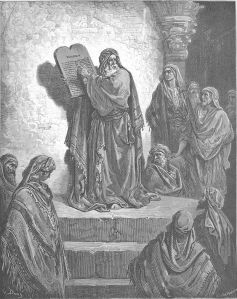
There are some implications to be thought through here, given that we’re talking about holy writ. Not all Christians agree on the same Bible. What’s more, the disagreements about what to include started pretty early. Does it count if you swear on an incomplete Bible? Would a New Testament do in a pinch? What if you’re Jewish? Having a national holy book is somewhat problematic when we can’t all agree on the contents. Many people would have some trouble opening right to some of the less popular books, say Ezra. Unless you’ve got a New Testament only, you’ll have Ezra. Go ahead, take a look. (It’s somewhere in the middle.)

Everybody’s complete Bible has the book of Ezra. So far, so good. 1 Esdras (“Esdras” is Latinized “Ezra”) is not in the Deutorcanon of the Catholic Church. It is, however, included in an appendix. It is part of the Orthodox canon, and it also goes by the names of 2 Esdras and 3 Esdras. Just to make it interesting, the Vulgate, or Latin translation of the Bible associated with Jerome, calls Ezra and Nehemiah 1 Esdras and 2 Esdras. Need a score card yet? It gets more confusing later! So 1 Esdras is either Ezra, 2 Esdras, 3 Esdras, or 1 Esdras, depending on whose Bible you’re borrowing. But where’s 4 Esdras? Well, there is a 2 Esdras (not the same as 1 Esdras or Nehemiah) in Slavonic, but not Greek, Orthodox Bibles. 2 Esdras is known as 3 Esdras and 4 Esdras, the latter when it is in the Vulgate appendix. The fun’s not over yet! 2 Esdras is broken into 3 parts and they are called 5 Ezra, 4 Ezra, and 6 Ezra. There is, however, no 1, 2, or 3 Ezra (unless the Latin name is Anglicized). If you’ve got a headache, take two Esdras and call me in the morning.


Fundamental Law

Last year I posted a piece on Fundamentalist Church of Jesus Christ of Latter-Day Saints fugitive Lyle Jeffs. The occasion for my venturing into this sect was that Jeffs’ lawyer, after Jeffs had escaped house arrest claimed the Rapture was responsible for his disappearance. Now that an unraptured Jeffs has been recaptured, I begin to wonder about the special immunity of lawyers. Surely Jeffs’ attorney knew that his client hadn’t been spirited to heaven in the fictional escapade we all know as the Rapture. Indeed, all criminal lawyers—or at least most—know the facts behind a case before they step into the courtroom. While their witnesses are guilty of perjury if they lie under oath, lawyers, through careful wording, are permitted to insinuate the opposite of the truth with no hint of wrong-doing. It’s just their job.

Legalism and religion go hand-in-hand. After an interesting preamble, the Bible begins by laying down the Torah. Among its stipulations is not bearing false witness. But then, that was before the modern legal system. Religions tend to serve as moral compasses—and that’s the phrase that’s frequently used. A compass helps to find direction, ensures that we go the right way. What exactly the right way is can be a matter of debate, however. It all depends on where it is we want to go. When religious law, such as polygamy among Fundamentalist Latter-Day Saints, and civil law (generally recognizing one spouse at a time) clash, lawyers debate with the comfort of knowing they need not be accountable for the truth.

I’m no legal expert—in fact, I wouldn’t even have known about this had not a friend sent me the piece by Ruth Graham on Slate—but the question does trouble me. Religion is often all about laws. Specialists in Islam are called jurists, and in Judaism rabbis know the Torah inside out. Religious laws sometimes—often, actually—conflicts with the laws of the land. Believers either accommodate the differences or get into trouble in the secular courts. It’s headline news when religious law becomes civil law in this modern day and age. Isn’t there something cynical, however, when a lawyer pleads the Rapture as probable cause for a disappearance? Knowing the law, they need not reveal the truth they know. And yet, if you personally implicate any wrongdoing in another you can be sued for liable or slander. Lyle Jeffs wasn’t in heaven. He was living out of his car, keeping off the grid. Of course, following religious law can be like that some times.


Fishers of Cars

The car was drunkenly weaving across lanes in substantial traffic along Interstate 80. Erratic driving that, although not breathalyzer confirmed, suggested impaired operating. It’s something you never like to see. We stayed behind the vehicle, knowing that it was safer to keep such a car in view rather than attempting to overtake it when the driver veered into the left lane. Since the same muted colors recur on vehicles these days, we needed a quick way to identify this driver at a glance. The Jesus fish on the rear served the purpose well. This situation struck me as a kind of parable, although it really did happen. One of my brothers is a driver by profession. He often tells me that if someone cuts him off in heavy New Jersey traffic, more often than not the car bears a Jesus fish. WWFD?

The ostensible purpose of the Jesus fish is to witness to the world “here is what a true Christian does.” While the New Testament, if I recall, indicates that the true believer puts others before him or herself, the rule of the road is somewhat less spiritual than that. None of us are saints when we get behind the wheel. We’ve got places to go and the drive isn’t really much fun with thousands of other cars bunging things up constantly. Still, if you take the extra effort to put that Jesus fish on your car, aren’t you signaling that this driver holds her or himself to a higher standard? Or maybe the fish is a talisman, like “Baby on Board,” that will somehow protect from the careless, aggressive driver thinking only of self.

The irony here is not that the driver is making poor, or aggressive decisions behind the wheel—let the one without sin cast the first stone—but rather that s/he implicates Jesus in the act. There’s a ready, steady market in evangelical paraphernalia. The WWJD bracelet keeps the question within sight much of the time—but keep your eyes on the road! One of the main problems with the Ichthys symbol is that it is generally on the rump of your car. Out of sight, out of mind. As you finish that last drink before climbing in behind the wheel, the fact that your personal Lord and Savior is being announced to the world may just slip your sodden mind momentarily. The real question is whether a car is the best place to announce your religious commitments. It was the the man in front of the fish, after all, who said “do unto others as you would have others do unto you.” Except in heavy traffic, of course.


Scaping By

Failure is a part of life. We don’t like stories about failure, however, unless the protagonist goes out with a memorable bang. So it is that when we fail we start looking for a scapegoat. Now it’s a little too early to tell if Ken Ham’s Ark Encounter can be considered a failure. According to a story on Friendly Atheist, “Ken Ham is Now Blaming Atheists for the Economic Failures of Ark Encounter,” the ark may be loaded with dinosaurs, but not money. People need their myths, yes, but myths that take themselves too seriously often fail to convince. Atheists, even the friendly variety, have always been convenient scapegoats. I wonder how many scapegoat species are in the Ark Encounter.

I don’t know about you, but I’m curious about the Ark Encounter. I don’t want to go because I don’t want them to have any of my money. As I’ve told academic friends who visit—I just can’t see contributing to their cause. Although the Right seems to implode when it reaches power (there are far too many selfish people in the Party, and selfishness leads to easy splintering) one thing that it has is money. Think about it, the extremely wealthy are on their side. If I was given a free pass I might find it worth my while to wend my way back down to Kentucky. Who doesn’t like a spectacle? And I would like to see how they represent scapegoats in their dioramas. Besides, with sea levels rising from “fictional” global warming it might not be a bad idea to get a few tips on how to build an ark, no matter what you believe.

You only fail when you fail to try. That was a phrase a friend used to repeat to me before disappearing from my life. A friend from college once told me that I had to stop admitting my failures if I wanted to move ahead in life. There is a danger in easy appearances of success, however. Failure can be a very noble teacher. There are mornings when I’m walking across Manhattan, passing the homeless in their blankets on the street, and I realize that I would not be where I am were it not for failures. I could hide them, but if I haven’t learned from them they’ll only burst out of the closet again when it gets too full. Is Ken Ham’s Ark Encounter a failure? It’s far too early to tell. One thing we know for sure, however, is that scapegoats will never be an endangered species even if there’s a world-wide flood.

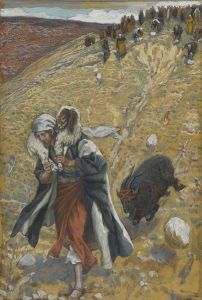
James Tissot,Agnus-Dei: The Scapegoat (Brooklyn Museum via Wikimedia Commons)


Analyze This

Reading other people’s scripture is a privilege. Although somewhere in my long study of the history of religion I must have read excerpts of The Analects, I have not concentrated on reading them through before. Reading other people’s scripture is like being invited into their houses. You can learn a great deal in a little time, but that doesn’t make you an expert. Confucianism is about the same age as classical Judaism. The foci of the belief systems are clearly culturally bound, and those of us raised in cultures heavily influenced by Judaism and Christianity find scriptures like The Analects somewhat bewildering. For those raised in Confucian cultures, the Bible must also be like coming into an unfamiliar country. That’s the way scriptures are, and it doesn’t mean that any are more or less valid than others. That’s often difficult to accept.

I don’t know much about Confucianism, but it is clear that The Analects are intended as a guide particularly for those who seek public office. In Confucian thought, unlike that of the current United States, only the brightest are believed to be worthy of high office. Indeed, it is impossible to read The Analects at this time in history and not see that Trump is so wrong in multiple languages. Master Kong’s description of “the small man,” the petty sort who has no business governing, is the job description of the GOP right now. Is it possible that one political party has ruined two religions? Probably far more.

Learning—even in small increments—of the religions of others takes away the need to feel superior. In fact there are many commonalities between religions, particularly on the ethical front. Reading other people’s scriptures isn’t easy. There’s so much that’s foreign in them. But like the fact that foreign trade brings desirable things from abroad for us, so should be the study of other religions. There is much of value here. I don’t read Chinese. I’ve never been to China. Reading The Analects, however, demonstrates that the noble minds of different cultures have much to learn from one another. No scripture is perfect. All are necessary. It’s only when one faith decides that it alone is true that religious strife begins to replace religious respect. I’m not about to become a Confucianist, but I do have a a slightly better sense of what it might mean to be one. And small steps can lead to impressive places for those willing to learn.


Filmy Substance

It’s all about Jesus. Well, that’s an overstatement, even in context. One of the amazing things to me about books addressing the Bible in film is just how often Jesus movies come up. If it’s not Jesus movies, it’s movies that have a “Christ figure” or some such Christian trope. Don’t get me wrong—I have no issues with Jesus. It’s just that the Bible and film have so much more in common than this. David Shepherd’s edited collection, Images of the Word: Hollywood’s Bible and Beyond, has some insightful pieces in it and some of what has become “standard fare” already in a field that’s so new. I found Richard A. Blake’s response fascinating. Maybe this was because he doesn’t approach the topic from a biblicists’ point of view.

I’m not really complaining about scholars who look to cinema for a rich source of reception history. I do it myself from time to time. Most of the books on this topic are collections of essays and collections are, by default, uneven. There’s an amazing amount of biblical material in movies that simply goes overlooked. Also, I would suggest, movies offer valid interpretations of the Bible. Somewhere along the development of the discipline we seem to have slipped into thinking that only certain people can legitimately interpret the Good Book. If it is a sacred text, however, it is as much in the public domain as any text can be. And texts in the public domain can legitimately be interpreted by hoi polloi. That’s the nature of being a text with universal assertions, I suspect. Directors and writers, therefore, are legitimate interpreters. We could learn a lot about the Bible from going to the theater.

Like many who’ve taught Bible to undergrads, I sometimes discussed films with them. I always believed students were legitimate interpreters of Scripture, too. This is a dialogue. One of the more interesting aspects of Shepherd’s collection is the pieces that focus on non-Hollywood movies. I don’t see a problem discussing Hollywood since we can assume a larger body of those who’ve seen the film. It is nice, however, to be reminded that “foreign” films also delve into what is sometimes treated as propriety material by Christians. Hindu representations of the life of Jesus? That’s a very interesting idea! Of course, not everyone likes to know how “outsiders” see them. That’s one of the beauties of using cinema as a means of interpreting the Bible. Those of us who study it don’t have the money to influence movies enough to make them in our image. It’s fun to watch someone else’s interpretation.


Incident at the Wailing Wall

While reading about Jerusalem lately, I recalled my first visit to the Wailing Wall. The Wailing Wall is the only standing part left of the temple that Herod the Great refurbished on the site of the temple originally built during Solomon’s reign, destroyed by the Babylonians, and rebuilt under the Persians. This was called the “Second Temple” because the first had been razed and although Herod had basically rebuilt it, the second one had never been destroyed (that would happen a few decades down the road). Today the Wailing Wall, the western wall of that magnificent temple, is a sacred site to Jews, and to not a few Christians. My visit took place in 1987. I was volunteering on a dig at Tel Dor, and on a free weekend I’d taken the bus to Jerusalem with some friends to look around.

It was late Friday afternoon. I was on my first trip overseas, and, like most fresh-eyed youngsters, photo-documenting as much as I could. I raised my camera. A guard walked up to me. “No pictures on the Sabbath,” he said. He had a machine gun and I didn’t, so there was no arguing the point. Besides, I had just finished the roll. (Does anyone out there remember film cameras?) I stepped into the shade of an alcove to change the roll. A couple of Hasidic men stopped me. “No photos on the Sabbath,” they warned. I assured them I was just changing my film. It was clear, however, that no more pics would be snapped. I rejoined my party and took out a notebook—at least I could jot down a few impressions. Another guard approached, “No writing on the Sabbath,” he said.

This episode has stayed with me over the years. With Trump’s international tour, I’m reminded that I’ve always striven to avoid the “ugly American” syndrome. I respect the local rules. The incident at the Wailing Wall, however, was a case of religious rules, wasn’t it? Does the enforced rest of the Sabbath apply to Protestants? Indeed, I’d been warned that if I didn’t catch a bus before sundown I’d never make it to Jerusalem on a Friday evening at all. Conflicting theocracies have led to more than their share of international sorrow. Why not take the high road and simply absorb what is going on around me? There’s a profound wisdom in that. Travel should inform our worldview. Those who encounter walls should stop and consider all they might mean to all who will eventually face them.


Cloaking Device

America’s book is seldom read. Those of us who spend an unusual amount of time with the Bible know this from personal experience, but others are starting to notice too. Kenneth A. Briggs’ The Invisible Bestseller: Searching for the Bible in America is a rambling account of the way a variety of everyday people from prisoners to academics and clergy use, read or not read, and perhaps inwardly digest the Good Book. There are moments of stark insight in this book, but with no narrative arc it is somewhat easy to feel like you’re reading about what random people say about the Bible. I don’t need a book to tell me that I’m odd, but much of what I read here was old hat to a guy who grew up Evangelical, went to seminary but never got ordained, completed a doctorate and taught the Bible nearly two decades before being booted out of its company. I’m not sure what I expected to find. Perhaps redemption?

Briggs does provide some useful statistics, and not as maniacally as sociologists do. We learn that few people read the Bible and the numbers are declining. Still, people buy the Bible and tend to have multiple copies in their domiciles. It is cheaper than insurance, after all. Holy Writ, however, is an alien among us. Few people have any idea what it was like to live before smart phones, let alone before the smelting of iron. The concerns and dialogues of the Bible seem so terribly provincial and, to be honest, unenlightened (if one can say such a thing about divine revelation). Still, we won’t accept a president who doesn’t lay his (and it’s always his) hand on the Good Book and swear to uphold America.

The Invisible Bestseller gave me plenty of information to ponder. Some of the tales Briggs tells are interesting. Others are so mundane as to be stultifying. The overarching fact is that the Bible is an established object in our culture. Some take it seriously enough to read it and stick with it—this isn’t easy to do, and I speak from experience here. Such people are rare. After all, apart from getting you a hall pass out of Hell, the Bible doesn’t seem to do much for people these days. Still, when I take a moment to read the Sermon on the Mount, I can’t help but feel we might be missing some wonderful rhetoric by ignoring the Good Book so much. But then again, I’m fully aware that I’m the one that’s odd. Briggs’ book stands as a testament to a couple of testaments that continue to wield enormous power without ever being read.


Becoming

It’s pretty difficult to summarize the feelings when watching your own child graduate from college. Of course, she’s not a child any more, but that’s always the way you’ll think of her. Binghamton University, a “public ivy,” is a competitive school to attend. Hard to get in, and hard to get out. And you know that there were serious struggles to get to this point. Courses conceptually impossible for a humanities ex-professor to understand marked the trail to this point. The academic robes, the positive energy, and the overall sense of accomplishment make this one of those joyous occasions that mark the transition from being the instructed to becoming the instructors. It’s a time unlike any other.

Most of my collegiate thoughts, despite my three degrees in religious studies, have focused on science and engineering. It’s not that the basis of truth has shifted, but the practicalities of “finding a job” have to take precedence these days. The STEM universe may be the only real one, according to those smart enough to know such things. It’s difficult not to feel that studying religion was chasing a chimera, if not a little deluded. Tomorrow, though, the college of arts and sciences will send forth even more graduates into a world where employment itself may be a reverie. Still, I can’t help but think these engineers from the Watson School are just a little brighter than their more humanities-inclined classmates. Parenting is its own kind of bias.

Commencement is a singular moment. Parents sitting in the crowd want to attract their child’s attention for just a moment. Each one down there is a star. You want to be seen by them, recognized if only for a fleeting smile or subtle wave. They’ve accomplished something and everyone is here to cheer them on. Your meaning is tied up in being associated with that person that you’ve coached through so many aspects of life, and you hope you’ve done it well. They’re ready to leave academia behind and experience a bit of the wider world. It’s a cycle as old as this planet’s first molten rotations as it revolved around a distant star. And as those walking across the stage are growing in magnitude, those of us cheering them on try to recollect what it was like to have so much loving goodwill focused on us. It’s difficult to summarize these feelings, but I’m pretty sure I’d call them religious.


Spiritual Spelunking

Looking at the headlines it’s sometimes difficult to believe we’ve evolved. I still trust evidence-based science, despite official government policy, however. So when a friend sent me a story about a new human cousin I knew it was worth a look. Homo naledi bones date from much more recent times than they should. At less than 400,000 years old (which means they might fit GOP ideology pretty well) they are almost contemporary with Homo sapiens. And, apparently, they buried their dead. Now much of this is still speculation. The bones were found in caves with openings so small that onlyfemale spelunkers could fit in, and the question of whether dropping bodies in a hole counts as burial has raised its head. Still, the human family tree is being redrawn, and in a way conservatives won’t like.

I became interested in evolution because of Genesis. My mother gave us a few science books as children even though we were Fundamentalists. One of them talked about evolution and I was intrigued. Clearly it didn’t fit with the creation story—I was young enough not to notice the contradictions between Genesis 1 and Genesis 2—and yet scientist believed it. They likely weren’t Christians, I reasoned. College gave the lie to that deductive thinking when I ran into Christians teaching the required “Science Key” who believed in, and yes, taught, evolution. I’d missed something, obviously. Once I discovered evolution could coexist with Scripture I was eager to learn as much as a non-biologist could. In my teaching days I focused on the early part of Genesis and even began to write a book on it.

Image credit: Margaret A. McIntyre, from Wikimedia Commons

It’s much more honest to admit that we’re related to the rest of life on this planet than to set ourselves aside as something special. Evolution has done something that the Bible never could—brought all living things together. There are too many towers of Babel and chosen people themes in Holy Writ to allow for real parity with our fellow humans, let alone other creatures. Yet the human family tree is wondrous in its diversity and complexity. We now know that Neanderthals were likely interbreeding with Homo sapiens and I wonder how that impacts myths of divine chosen species. Did Jesus die for the Neanderthals too, or just our own sapiens sapiens subspecies? You can see the problem. For a literalist it’s just easier to crawl into a cave. But only if the opening is large enough to admit males, since the Bible says they were created first, right?


Sideliners

Sidelines can be interesting places to sit. You’re close to the action, and you’re privileged with a close view that few others have. You can’t, however, play the game. Sidelines are familiar to biblical scholars. I can’t count the number of times and/or ways the input of those who spend their lives trying to comprehend the Good Book are, well, sidelined. In the publishing world those who work with Bibles are simply ignored by most others, despite the enormous revenue Bible sales generate. In the academy religion departments overall are fair game for any potential budget cuts. And since what religion study survives tends to be intercultural, the Bible faculty are deemed somewhat less necessary than other sub-disciplines. It’s easy to forget that Christianity is the largest organized religion in the world and that some 2.2 billion persons claim that name. The Bible’s their foundational book. It tells us what motivates them. And yet, it’s easier simply to ignore the whole thing. Then something insane like an Evangelical-fueled Trump election, and everyone continues to say, “we can safely ignore this.”

I recently saw an article by scientists which explored why people engage in dangerous behaviors. The main idea was that although we know certain things are bad for us individually or as a planet, we still do them. We do them with the full knowledge that they’re deadly and will likely hasten our demise. Ignoring religion (and in the case at hand, the Bible) is very much like that. A well-armed true believer can ruin your day pretty quickly. Religion, in recent years, has generated over $82 billion in revenue per year. At least those in the dismal science ought to sit up and take notice of that! Hey, for once, the numbers are with us! Statistically, religion is very important. Sounds like a good thing to pretend doesn’t exist.

Having grown up a Fundamentalist, I often ponder this state of affairs. The Bible, we all knew, was the most important thing. Studying it formally does tend to force new ways of considering it, but few Bible scholars would want to dismiss the Good Book out of hand. It still means too much to too many people simply to ignore. Far safer is the proper handling of Holy Writ. This is much easier to instill when institutions support it. It really is a necessary kind of education. Still, it gets sidelined for industries with lesser profits and lesser baggage. I grew into a career defined by the Bible, but even if I hadn’t I’d hope that I’d be able to recognize that some things just shouldn’t be ignored. Yet I’m on the sidelines cheering on those who consider such a career a tragic mistake.


Good Newsists

In the interest of avoiding conflict thereof, I cannot yet give a review of Randall Balmer’s Evangelicalism in America. Since I’m writing a review of it for Reading Religion, I’ll use it as a springboard into a topic that should concern all who believe in religious freedom. One of the resounding themes of Balmer’s treatment is that Evangelicalism, after it wedded to the Religious Right, lost its soul. Those are my words, not his, but the sentiment’s about right. For anyone who wasn’t politically aware in the 1980s, it may seem a surprise that religion didn’t enter into politics before that decade. With the exception of the fear of the Catholic in the case of John F. Kennedy, religion wasn’t used as a political wedge until the presidency of Jimmy Carter. The Religious Right, unhappy with the born again Southern Baptist in the White House, moved to solidify the Evangelical bloc.

Evangelicals had been an underground movement for half a century. Many had no idea what being “born again” meant when Carter first claimed the sobriquet. Balmer points out that it was the threat of the withdrawal of tax-exempt status to discriminating Christian schools that led to political action. Bob Jones University, fearful of racial intermarriage, didn’t admit African American students. Leaders of the Religious Right saw the loss of tax-exempt status as a move against their sacred segregated culture and a push that required a shove. Coopting the abortion issue (historically Evangelicals had supported women’s rights, including the right to abortion in many cases), they nailed together a platform for political activism which put women “back in their place,” kept racial “purity,” and romanced a total aberration in Christianity—the “prosperity gospel.” All of this is well documented. And well hidden.

Looking at Evangelical politics today, abortion—the control of women—has become THE issue. It’s hard to believe, as Balmer amply illustrates, that Evangelicalism used to be allied with the Social Gospel. It was a religious view with a conscience and it supported issues that are now polarized as “liberal” and leftist. This shift came about gradually, but not accidentally. There were political players—Balmer names names—who had one goal in mind, and that goal wasn’t Jesus or what he’d do. It was the sweet prize of political power. Evangelicals, you see, are born followers. A leader with a strong voice can lead them just about anywhere. Many Evangelicals today would deny their more liberal history, but it is right there for anyone who’s willing to learn something about who they once were.


Weather Vain

The other day I was awakened by a severe thunderstorm. It’s been quite a while since that’s happened. Unlike when we lived in the Midwest, thunderstorms in New Jersey tend to be widely scattered and somewhat uncommon. (It’s all a matter of perspective, I know.) My basis of comparison is how often I notice such storms. I’ve never been able to sleep through one. Thankfully this one came at around 4:30 a.m., past when I’m usually awake on a weekend. I’d forgotten the raw power of just how loud and bright such a storm can be. Danger seems all around. The feeling is primal and urgent. As I got out of bed and walked into the dark kitchen, windows filled with electric blue followed by and tremendous blast, I thought once again of Weathering the Psalms and the story behind it.

By the way, when I speak to young scholars about publishing I tell them this isn’t the way to go about finding a topic. That having been said, my book was born in the Midwest. Life at Nashotah House revolves around required chapel twice daily. Weather does not stop it. In fact, holding the daily office by candlelight because a storm had knocked out the power was not uncommon. Morning and evening prayer—indeed, all of the canonical offices—are built around the recitation of the Psalms. Reading the Psalter in slow, stately tones while thunder raged outside, rattling the ill-fitting stained-glass windows, left an indelible impression. It was only natural in such circumstances to notice how often the Psalms mention the weather. Thus a book was born.

I’m currently at work on a new book. I can’t say the topic just yet because someone might be able to beat me to it. (Knowing the way I come up with book ideas, however, I doubt it.) Sitting in my darkened living room, in my writing chair with the fury just outside, I was strangely inspired by the storm. Then it was over. Silence followed by birds singing, just like in Beethoven’s sixth symphony. The thunderstorm is one of nature’s psalms. As at Nashotah House, in the Midwest we had perhaps too many of that particular kind of psalm. Nevertheless, in the silence that followed I was left strongly in touch with my muse. These are the states that lead to poetry and song. Every great once in a while they might even lead to a book idea. As I tell students, just don’t expect that anyone else will get it.


Russian Watchtower

From time to time I’ve good-naturedly poked fun at the Watch Tower Society members who used to visit with some frequency. I don’t belittle anyone’s belief system, however. Believers of any faith are generally sincere and certainly entitled to follow the dictates of their own consciences and reasoning. Still, as John Cale sings, “nothing frightens me more, than religion at my door.” Some of us prefer to keep our religious preferences private, while musing publicly about the wider world of religious diversity. The Jehovah’s Witnesses have come to mind again because of an article in the New Jersey Star-Ledger my wife clipped out for me. According to Amanda Erickson, writing for the Washington Post, Russia has now classified the Witnesses as religious extremists. She points out the irony since the Watch Tower Society is officially a pacifist group, opposed to any violence. It’s difficult to radicalize a pacifist.

I’m not at home enough any more to be here when the Jehovah’s Witnesses stop by. I know they still come because I can see their tracts. There is a Witness who occasionally stands outside my gate at the Port Authority Bus Terminal in New York. He stands, patiently smiling, next to the entrance holding up the Watchtower while anxious commuters and day trippers give him nary a glance. He seems like a nice guy to me. Always neatly dressed. One day I noticed him commenting to a New Jersey Transit employee that a particular denizen of the Post Authority was acting oddly. He was right, and, as a daily user of that facility, I know it takes quite a lot to earn that kind of notice. Ports, after all, bring in many with diverse outlooks on life.

What’s behind the Russian rage against the “extremist activities” of a peace-loving sect? I suspect the real problem has to do with the fact that Jehovah’s Witnesses are so typically American. And, like the Mormons, a fairly successful New Religious Movement. Religions, it seems, do grow a bit stale with age. Once in a while, something new comes along and revitalizes old systems of belief. Russia, however, is not the Port Authority. There is a repression there that is the envy of New Jersey Transit and every other carrier, I’m sure. Right, United? If only people would conform. Wouldn’t we all be happier if everyone else just believed like us? I’m not sure that history concurs on that point. Perhaps the safest alternative is to remain private. You don’t, however, grow a religion that way. If Russia wishes to inherit these States, they’ll need to learn a bit about the joys of religious diversity. Pacifism is a risk you have to take.