The Evil That Men Do

The graveyards of humankind are filled with the victims of religious violence. That fact does not seem to have lessened the impact of religion as a whole on humankind. One reason may be that religion has been a focal point of the good and humanitarian deeds of which people are capable, as well as a justification of the most heinous. The irony is that adherents of a religion claim that a just, true and righteous god is their motivation, for good or for ill. In the same church, mosque, or synagogue, there are widely differing views that live together. Sometime the truce is an uneasy one. Sometimes the adherents are united against a common enemy.

The furor over whether a mosque should be permitted near Ground Zero has become a major political whipping boy. Heavyweights like Newt Gingrich and featherweights like Sarah Palin are quick to fire off their half-cocked mouths about the impropriety of it. Michael Bloomberg, the mayor of New York City has been given the task that kindergarten teachers around the country – around the world – should incorporate in their curriculum, the task of teaching tolerance. In an excellent speech delivered yesterday, the mayor reminded citizens of what many appear to have forgotten: without religious freedom nobody is free.

Muslims are not to be blamed for 9/11 any more than Christians are to be blamed for the Inquisition. Every religion has members that misuse their sacred trust as a vehicle for hate and repression. By forbidding religious freedom to any religious group, America sets a precedent of a growing intolerance that can only lead to more, and greater suffering. Already the Gingriches and Palins of our nation tell us that there are indeed lesser citizens and greater citizens. Those like them deserve freedom of religious expression, of marriage recognition, of family size, of medical care, and those who believe differently and therefore deserve less. Speaking only for myself, I would rather have tolerant Muslims as my neighbors than supersessionist Christians.


Hoax Folks

The internet bores me sometimes. I can’t keep up with the pace of blogs that chug away like a neverending newsfeed. Information comes at me so fast I want to cower in a corner and start constructing my own printing press from scraps of lumber and bits of broken screws and bent nails. Slow things down a bit. Write something of substance. Of course, electronic information has its advantages – I frequent online dictionaries and thesauri where looking up words is much quicker than flipping countless pages. While hovering on the thesaurus.com page this morning, I noticed one of the blog entries entitled “Relax, Bill Cosby isn’t dead — it was a hoax. Is it true that the origin of ‘hoax’ mocks Christianity?” I’m glad for Bill Cosby’s sake, but what really caught my attention was the subtitle. We are all subjected to hoaxes almost as regularly as we are fed real news. Was this blurb suggesting that Christianity originated hoaxes or had given us the word “hoax”? Okay, too much information, but I had to find out.

The blog post states, in part, “The Eucharist, a central Christian prayer, contains the Latin ‘hoc est enim corpus meum,’ meaning ‘for this is my body.’ Jesus is said to have spoken these words at the Last Supper. The British clergy John Tillotson speculates in 1694 that hocus pocus is not only a corruption of this key Latin phrase, but a parody in keeping with the occasionally vulgar humor of prestidigitators.” Having taught for more than a decade at the avowed queen of “Anglo-Catholic” seminaries, I’d heard the gist of this before. For a blog on a website supporting grammar, however, I winced at “a central Christian prayer” and “The British clergy John…” phrasing. The Eucharist is not a prayer, but a sacrament, part of which is the Eucharistic prayer. Clergy is a collective, not an individual. Not to mention that if one was speculating in 1694 it ought to have been in the past tense.

In any case, the story as I received it was that Protestants coined the phrase “hocus pocus” to abjure the idea that anything “magical” was happening at the Eucharist. Protestants generally held communion to have been symbolic rather than a literal act of changing bread to flesh and wine to blood. So it seems that from a Protestant point of view the Eucharistic prayer was a hoax, but from a Catholic viewpoint it was salvation. As with most things religious, it is a matter of perspective. The word “hoax,” it turns out, likely derives from “hocus.” Having found this gem nestled in among so many grammatical errors, however, shakes my confidence a bit. That, however, is just my perspective.

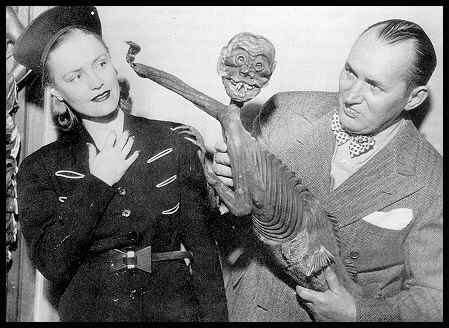
A hoax or Dagon's sister?


The Return of Christendom

Well, the Internet is shaking because Anne Rice has left Christianity. Not exactly, however. In her own words, according to her Facebook page, “I remain committed to Christ as always but not to being ‘Christian’ or to being part of Christianity. It’s simply impossible for me to ‘belong’ to this quarrelsome, hostile, disputatious, and deservedly infamous group.” For years I have observed decent people “quitting” Christianity because the name has been co-opted by intolerant, bigoted Neo-Cons who more often than not have political agendas in mind. I think the battle has been lost, the trademark name of Christianity must be surrendered to those who claim it most loudly. The meek have disinherited the earth. How many Catholic students have introduced their comments to me with “Christians say…” as if Catholics aren’t part of the club?

There was a perfectly good word for what Neo-Cons are calling themselves. It used to be “Christendom.” Harkening back to the imperial days when Orthodox Christianity ruled the East and Roman Christianity ruled the West, Christendom implied the power and the glory in its very name. Beyond a religion, it was a system of rule. The world was fine as long as everyone stepped in line to a magisterial faith that held the only set of keys to Heaven. Then Islam. Then Reformation. Then Enlightenment. The keys began to jangle amid many others on that divine keyring. Christendom seemed pretentious when there was no military might to back the strappado or red-hot iron. Christianity was but one belief system, deeply fragmented, among others.

Under the vision of James Dobson, Ronald Reagan, George W. Bush, and their minions, Christianity in its Neo-Con armor has once again become a forum for abuse and intolerance. Bearing little resemblance to the ethics and outlook of the carpenter of Nazareth, this religion would find an easy home in imperial Rome or medieval Aragon. As Ms. Rice notes, she is committed to Christ, but not a Christian. Although my impotent voice bears little weight in this overly loud and hyper-productive world-wide web, I would humbly suggest that Christendom be reinstated, instead of Christianity, to describe the Neo-Con religion. Christendom, after all, retains the imperial bearing and absolute authority the movement craves. Those, like Ms. Rice, who prefer to follow the teachings of Jesus might then have use of the traditional term of “Christian” once again.


Jesus’ Broken Dates

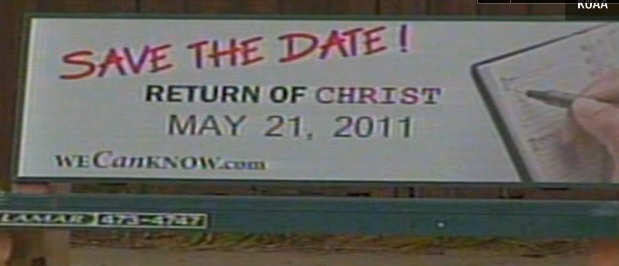
Jesus apparently has his calendar out. Again. This time it looks like May 21 is a red-letter day (he has a predilection for red-letters too). Well, at least it’s penciled in, like many other broken dates. An unemployed woman in Colorado Springs has decided to spend her dwindling reserves on bus bench advertisements reading “Save the Date / Return of Christ / May 21, 2011,” according to CNN. She states in the interview that she believes her job until judgment day is to get the world ready. She will find herself standing in the unemployment line on May 23 (the 22nd is a Sunday), more likely than not. Even more disturbing than the mostly harmless neurotic behavior of the unemployed (who am I to cast the first stone?) is the choice of Jerry Jenkins as an expert witness in the story.

Who questions a bus bench?

Jenkins and perennial Paleo-Con Timothy LaHaye wrote the “Left Behind” series that made more than a cottage industry out of repackaging Christian apocalyptic mythology into slick, science-fictionesque novels. They have more than a vested interest in promoting “and they lived horrifically ever after” scenarios. There is good money to be made by trolling the fears of the gullible. Very good money.

Our Colorado Springs prophet took her date from a billboard in Texas, a leading purveyor of rapture-mania. The thing that’s been left out of this – and many other apocalyptic episodes – is a serious consideration of the Bible. As most biblical scholars know, doomsday predictions generally derive from misinterpretations of ancient metaphors. Jesus, at least according to the canonical Gospels, was much more concerned about fair treatment of the poor and disadvantaged than he was about raining down brimstone on Babylon. Instead of spending money to warn the folks of Colorado Springs about yet another end of the world, why not donate the money to a local food bank and try to make the world a little bit better place?


True Colors

Over the past year several colleagues have urged me to join Facebook. To put this in context, I am one of those dinosaurs who made it through a Master’s program without having touched a computer – all theses and term papers were typed on a typewriter. It was only with the sheer volume of written material for my doctorate that I finally gave in to the technological revolution. Since then I’ve been sucked further and further into it, always a little bit reluctantly. When I read I like to have a book or magazine or newspaper in hand. When I communicate, I prefer a conversation to an electronic chat. Well, there are advantages to the technological world, but Facebook seemed a little too much. Caving to pressure, however, I eventually gave in and became a Facebooker.

One of the things I’ve learned from the daily updates of people – many of whom I’ve not seen since high school – is just how religiously conservative many of my friends are. I get daily, sometimes hourly, news updates about what the Lord is doing. He’s a pretty busy guy. Sometimes these friends look at my blog and wonder what has happened to me. When they ask, I have to wonder how deeply down the rabbit hole do they really want to go. I’ve been a professional religionist for nearly 20 years now – unfortunately several of those years have not included regular employment, but the work it took to get here can’t be undone – and prior to that I spent nearly 10 years in school studying religion. Anyone who makes it through an advanced degree in this field and comes out with the same viewpoint as when they entered it has had their mind firmly closed all along.

Religion is a phenomenon that can be studied, just like pottery or fashion history. Once a genuinely open mind is brought to it, perspectives begin to shift. Some of my friends who are less gracious about this respond by quoting the Bible at me, as if I’ve somehow learned how to forget the Bible while earning a Ph.D. in it. What they don’t realize is that if you want to learn about your religiousness in any serious way, there will be several Rubicons to cross and some pithy snippet from Paul is not going to change that. I don’t use Facebook to announce my religious thoughts to the diverse body of “friends” on my account. I use this blog for that. Those who are truly curious about religion might learn something from someone who’s been in the biz for nearly three decades. Others are content to announce to the world what the Lord is doing through Facebook.


Mythology Gone to the Dogs

Today’s New Jersey Star-Ledger reports an inter-species religious scandal that highlights the vast difference between god and dog. Last month a Canadian Anglican priest fed a dog a communion wafer. The gesture, a spur-of-the-moment reaction to a visitor who brought his dog to church (somewhat of a rarity in itself) was likely just a reflex to seeing that inevitable lolling tongue at the communion rail. Priests see lots of lolling tongues, mostly human.

In my long years at Nashotah House, where daily communion was a requirement of all faculty and students, I’m sure I consumed several pounds of communion wafer. I also received many stern warnings that this particular food item – if communion wafers can really be considered food – was unlike any other and must be treated with the utmost sanctity. Ironically, more than once I was handed a wafer by a priest with an out-of-control head-cold who’d clearly just contaminated an entire paten full of the sacrament with an eager virus. Within a week most of the student body would be hacking up an holy phlegm, not dissuaded from sharing the common cup. Despite the obvious fact that the ritual had become a disease vector, the mythology of its sanctity lived on.

The history of Christian ritual is a specialized field with experts who know the minutiae of each subtle gesture and the history of each preposition in the Anaphora. The ritual itself has become an object of worship. For some the fate of the wafer has become the fate of the world. This is mythology in action. Nevertheless, I have often received unbelievable hostility from those crowned with righteousness. As long as the right words are pronounced in the right order with the appropriate gestures, it is perfectly acceptable to stab another human being in the back.

I grew up with dogs. With the rare exception of the occasional biter, canines have treated me very well. Some on the verge of worship. If it comes down to choices, I’ll take my chances with the dog with a lolling tongue rather than with the priest with the magical bread.

Belief in dog is not a bad thing


Presbyterian Penance

Over the past week the Presbyterian Church (USA) has been in the news because of its overtures toward accepting gay clergy in committed relationships into ministry. While this is undoubtedly an honest approach to the issue, a disturbing subtext lies beneath the surface. That subtext, which may be practically impossible to escape completely, is that heterosexual clergy claim to have the right to “allow” homosexual clergy into “their” sanctioned leadership roles. The implied superiority is troubling. People have always found it easy to believe what suits them, the facts be damned.

Homosexual clergy is a picture-perfect example. Until society had evolved far enough to recognize that homosexuality is not a matter of choice, those who were homosexual existed in a kind of limbo. There was no lifestyle that could be displayed, just a secret predilection that could cost a person’s life if discovered. There were homosexual clergy, however, even in those days. They have very likely been part of Christianity from the first century on. In a society without the conceptual fortitude to realize that some people are born homosexual and others heterosexual – let alone the possibilities of evolution or stem-cell research – the lot of the homosexual clergy was one of pretense. There can be no doubt that homosexuality existed among the clergy, but the idea simply had no way to be delivered.

Many clergy, many of the best clergy, in my personal experience of the church, have been homosexual. Sexual orientation should make no difference in their ability to function as regular members of the clerical ranks. Only those with their eyes solidly closed can fail to recognize that Jesus never said anything about homosexuality, according to the Bible. What the early church taught was that all members should be equal. Somewhere along the past couple of millennia, however, the illusion slipped past actuality and the heterosexual (mostly male) clergy began to make all the rules. Perhaps we all have something to learn from the Presbyterians after all.


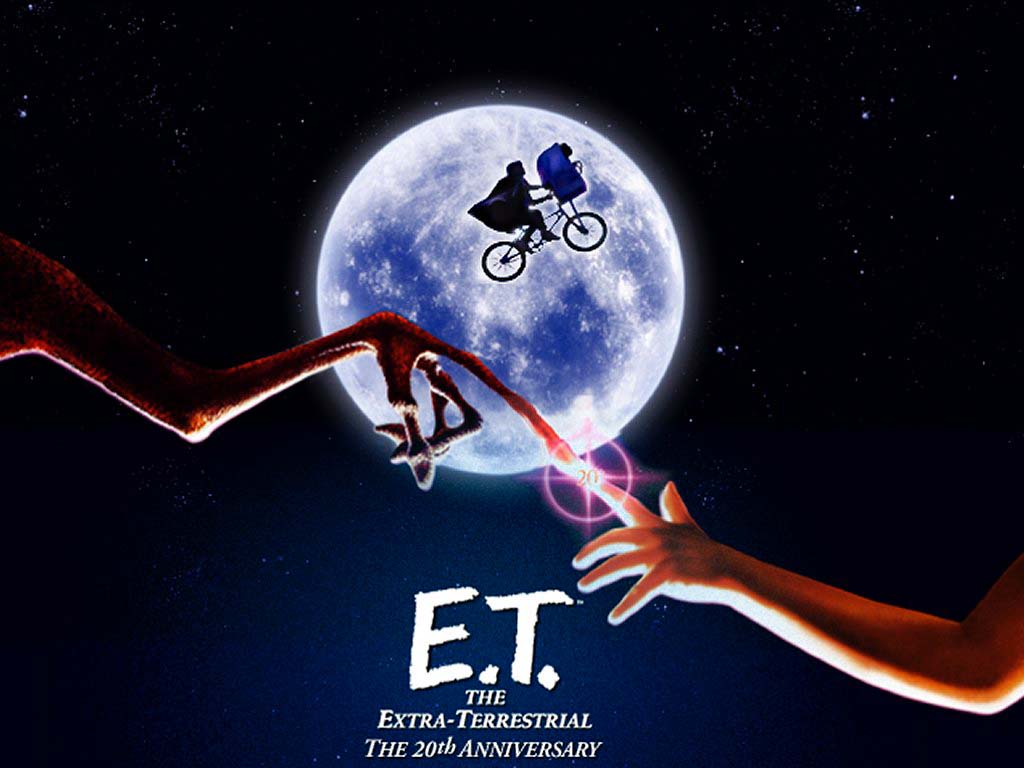
E.T. Go Home!

Now that my family is back from vacation, daily life is starting to regain a focus. One of the goodies my wife brought me from out west was an article from the Spokesman-Review, a Spokane, Washington, newspaper. The article is actually a letter to the editor, so it should not be taken as representative of the views of the paper, or of reality, for that matter. Obviously written in response to an article I missed, the letter is concerned that “Conservative Christian” viewpoints towards illegal aliens are being ignored. With a bravado that might be termed Christian jihad, the letter writer claims that “our nation’s laws are based on the laws God has laid down.” The authorities she cites? “Beck and Palin.”

Beck and Palin would make a great comedy team were it not for their crazed intolerance. Although devoted to this dynamic duo, our writer goes one better and cites the highest possible authority, “the Lord God.” Specifically, Numbers 15:15-16: “As for the assembly, there shall be for both you and the resident alien a single statute, a perpetual statute throughout your generations; you and the alien shall be alike before the Lord. You and the alien who resides with you shall have the same law and the same ordinance.” Problem is, this passage doesn’t refer to the state assembly of Arizona, but of an ancient Israel that is largely the creation of the writers. The Torah, explicitly, applies to Israel, not to other nations.

Quite often in my classes I have students claiming that our laws are based on the Bible. To extent there may be a modicum of truth in the claim, but in fact, American law is based on English Common Law, influenced by, yet not taken from, the Bible. I’m no legal expert (I wouldn’t be jobless if I were), but I do take the Bible at its face value. The laws apply to Israel alone. It is a mark of how little our religious leaders have been able to educate the public that we see this ingrained prejudice masquerading as divine truth. Fair treatment is a secular as well as a religious value. In addition to doling out abuse, the Bible itself continues to be a constant victim of abuse at the hands of Neo-Con nonsense.

Isn't God an alien?


Sharks and Apostles

There are sharks in the water. For the third day in a week, some New Jersey beaches have restricted access to the ocean because of sharks. As a particularly hot July trundles along, this is not really welcome news. Also yesterday, the Vatican codified revisions to its clergy sexual abuse crisis. According to an Associated Press article in the New Jersey Star-Ledger, women’s ordination groups are angry because sexual abuse and the ordination of women are classed together as crimes against the church.

Venus of Willendorf

Even before civilization began, it seems, religion and sexual dimorphism were tied together. Beginning back 35,000 years ago Paleolithic humans carved female figurines. In a hunter-gatherer society where struggle for survival was the best paying job available, the execution of such objets d’art in a brutish, hostile environment reveals religious sensitivities. Stone Age humans knew something that organized Christianity forgot within its first century: sexuality is never far from religion. The Bible itself, particularly the Christian Scriptures, emphasize that celibacy is a putative gift, not something that can be learned or forced on someone. In typical Roman fashion, however, the church quickly mandated celibacy as the norm and ruled that women were the source of evil.

Nothing could be further from the indications of both Paleolithic remains and scientific thinking. Women, long the source of spirituality, were now cast aside in an arrogant aberration of earlier practice. Largely based on the angry writings of one man, the church decided that men alone should determine the eternal fates of others. Masculine men who knew self-control and who could turn off millennia of evolutionary pressures by a sheer act of will. Centuries later, and the Vatican with its own Pontifical Academy of Sciences, the church still can’t get beyond basic reproduction and sexuality issues. I would go to the beach to try to think this one out, but there are sharks in the water.


Acts of God Algorithm

One of the oddest industry-standard phrases in use in secular contexts is “acts of God.” In a recent edition of Bostonia, the Boston University alumni magazine, an article entitled “The Acts of God Algorithm” seemed to promise some insight into this bizarre phenomenon. The piece, it turns out, is about an insurance analyst named Karen Clark. Of course, the place where “acts of God” are regularly invoked is in the insurance business. The reason this is so interesting is that in a nation as religiously motivated as the United States, people simply accept the slush-pile, default “act of God” as a given. The phrase, however, betrays a depth of fuzzy thinking and bad theology.

Does an “act of God” apply to an atheist? Does a devout Hindu have to accept any disaster that the monotheistic god and insurance companies present her or him with? Who tests to see if “God” is behind any of these acts? Given that monotheists differ widely on the day-to-day involvement of God in the natural world – certainly the world of insurance companies – how are any acts allocated to God? Legally! Predestinarians would assert that all acts are acts of God, and thus their insurance companies should be prepared for all such contingencies (they would, of course, have been predestined to deny this). Even those who accept less regular interference from on high would have trouble discerning whether a human-caused accident might or might not have had some hidden message from God. Are insurance moguls the ones qualified to decide?

To call any natural event an “act of God” betrays a level of jaded, if not indolent thinking that is inappropriate to all except those in the business of making money. Life is uncertain; it comes with no guarantees. Somehow our society accepts that if we pay good money to top-heavy, overly wealthy companies, bad things won’t happen to us, and if they do we get paid back. This kind of theology is diametrically opposed to the worldviews of the Bible and many monotheistic religious outlooks. Yet we accept that hurricanes, earthquakes, and floods are “acts of God.” The sneeze that causes a motorist to accidentally run a red light is not. And insurance brokers are weeping all the way to the bank.


Jesus Friends Me

From Jesus' Facebook profile


Jesus has a Facebook page. Given the circumstances it is highly doubtful that he set it up without some help from his friends. I went to the page to check out his friend list, but apparently he’s not accepting invites. Over 125,000 like the page, however. I wondered if it might be a stunt, since when I found Facebook they insisted that you could only sign up with your real name. While there is no doubt that this is a stunt, it turns out that it is considered an evangelistic tool wielded by a John 3:16er. On his info page, Jesus writes, “Please invite your friends to ‘Like’ (love) Jesus Christ,” an upgraded “honk if you love Jesus” if ever I read one. If you read the comments on his wall, it is clear that some people believe Jesus himself really reads his own page. It doesn’t mention the car accident.

A Rutgers student once told me about the “six clicks of separation” phenomenon on Wikipedia. Apparently, no matter how obscure a page you’re on, just six link clicks can get you to the page on Jesus. Don’t get me wrong: with his impact and importance Jesus certainly should have a Wikipedia article. There can be little doubt that anyone else can claim his level of influence in both the Dark Ages and Twentieth Century America, now creeping into the Twenty-First. The sad part is, those who constantly link to Jesus have latched onto a chimera grafted together from disparate sources. And they are his followers on Facebook.

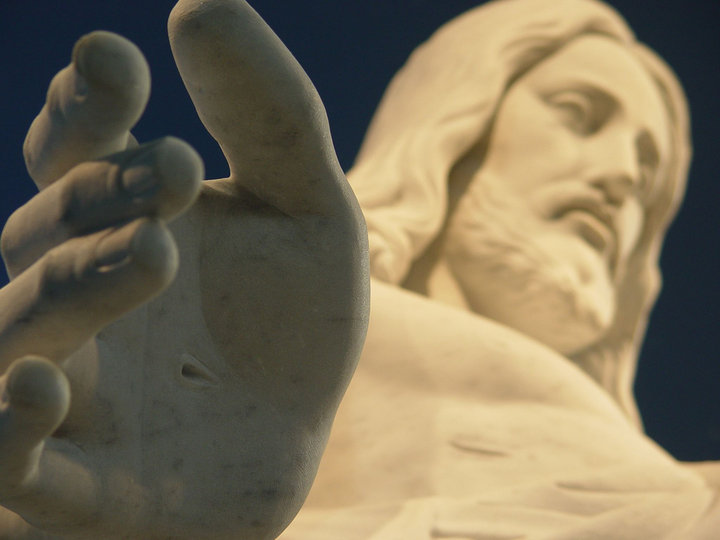
I wonder who has the audacity to speak (type) for Jesus. Who is it that believes they have the deep insight into who Jesus was – deep enough to speak for him? WWJT? Technology speeds along and fans of Jesus fear he may be left behind. By making your Facebook admiration for Jesus public, I suppose, a kind of “witnessing” is going on. It would seem to me that a better way to show support for Jesus would be to care for others, the poor, the disadvantaged, the lonely. Feed the hungry, provide healthcare to the sick, offer justice to those who have been treated unfairly. If a friend invitation came from this faux Jesus, who would be inclined to accept it?


Green Bible


One of the most heinous theologies to emerge from Christendom is the idea that exploitation of our planet is good for the soul. The idea, apart from having been foundational to Bush II’s administration, is based on the idea that if we mess up our world badly enough we will force the divine hand into sending Jesus back to clear up our detritus. The Second Coming apparently will be in a garbage heap rather than a garden. Christian businessmen rest secure knowing that their exploitation of our natural resources is all part of God’s master-plan. This “theology” is alive and well among many Neo-Cons and it insists that the fact of global warming is a myth and the myth of creationism is a fact.

One of the unexpected perpetrators in the war on our planet has been the Bible. Accurate records of the number of Bibles actually printed were not kept in the early days of Gutenberg’s dream machine, but current estimates place the number of Bibles printed at over 8 billion. That’s more than enough for one per person. Some of us would have to confess to owning multiple copies, making us perhaps guiltier than the rest. It was in an effort to stem the dendrite slaughter of this industry that I shifted to the Green Bible for my classes last year.

Some people treat the Bible as an object of veneration, never laying it on the floor or putting other objects atop it. Some people object to making Bibles out of “inferior” products – the Green Bible is printed on recycled paper and is biodegradable – but to me this seems to be the most responsible way to produce a book with the enormous environmental impact that the Bible has. I could live without the “green letter” sections intended to prooftext the Bible’s environmental concerns, but care for our planet trumps good taste at times. If anyone from Oxford University Press is reading this, the eco-friendly aspects of this Bible are what reluctantly switched me from 15 years of requiring students to purchase the New Oxford Annotated Bible! It is time that the Bible owned up to its part in our planetary plight.


Faith Healing

Having dissociative reading habits sometimes leads to fortuitous coincidences. My interests have always been widely dispersed, and although I have a few perennial favorites that I keep coming back around to, reading about new interests predominates. One of my favorite reading topics is science. Apart from the requisite intro courses in college, I have unfortunately had little formal training in the sciences, so I read extensively in the field. A number of my recent reading projects, books on widely divergent areas of science, have coincidentally mentioned faith healing. Being books written by scientists, there is little by way of physical explanation except that people who believe they are improving generally do. The mechanism remains undiscovered, but the phenomenon is well documented.

Faith healing has long lain among the taboo subjects of snake handling and snake oil hawkers. Those who approach the phenomenon from a religious angle claim that it is no less than divine power that causes a person to heal. Physicians and scientists who rely on empirical evidence, however, declare that a physical cause must exist, albeit a yet undiscovered one. With no way to test results, the objective approach simply must accept that it happens, we know not why.

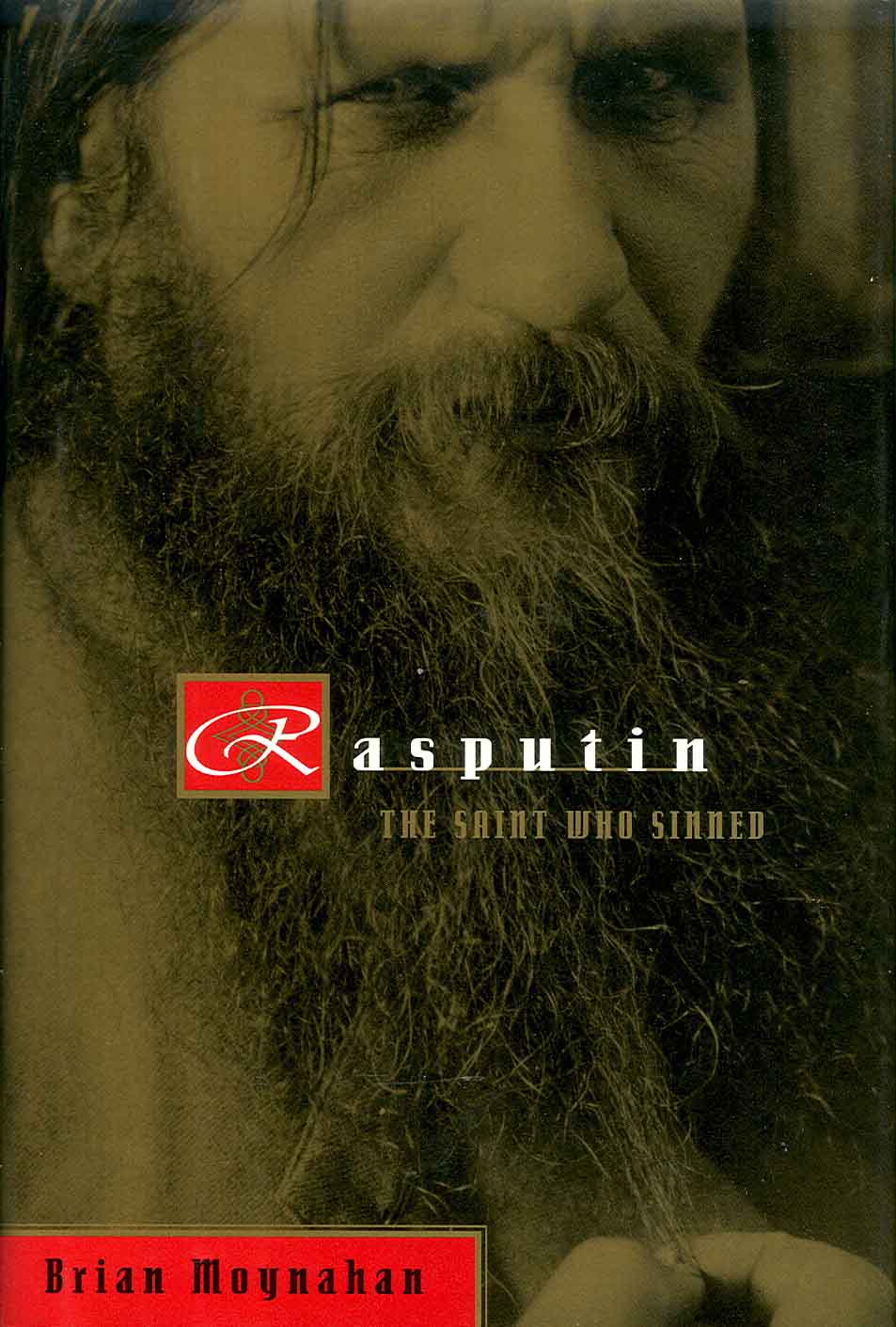
A number of years ago I read a book about Rasputin (Rasputin: The Saint Who Sinned by Brian Moynahan). At the time I was teaching at Nashotah House, a monastery-like seminary heavily influenced by Orthodox pretensions. “Rasputin” was a common slur on campus, particularly for a slovenly prelate-in-training. I had no idea who Rasputin was until I read this book. Apart from the distinctly creepy vibes his photographs give off, there are many documented cases of Rasputin’s ability as a faith healer. Few today would consider the “mad monk” as any kind of saint, but he apparently had a salubrious effect on those who believed in his power. This would shift the cause from supernatural to the suspect, unwashed hands of a notorious sinner.

Who wouldn’t want the ability to heal and make the world a place with a little less suffering? While faith healing has become a kind of holy grail for scientists, there are some not-so-holy religious folk who’ve unlocked a door that many never even suspected was there in the first place.


Under God

As one of the more flamboyant of national holidays in the United States nears, there is a whiff of discontent in the air. The North Carolina Secular Association has been sponsoring billboards that provocatively read, “One Nation Indivisible.” Those who, since 1954, have grown accustomed to reciting the “pledge of allegiance” with the words “under God” inserted after the “one nation” bit, grumble that one more icon of civil religion has come under fire. I first became aware of civil religion as a student in a self-identified Evangelical Christian college. I was astonished that the religion faculty, all believers, suggested that civil religion was not true religion at all. True religion was an inner commitment, not social bravado – often in the service of political aims. I was pointed to the writings of Richard Niebuhr and Dietrich Bonhoeffer and told to think for myself.

Since that time, I have kept a wary eye on civil religion. It is a dangerous force in society since few people think deeply or seriously about their religion. It fosters knee-jerk mob mentality. Civil religion is a slurry of a variety of religious outlooks, mostly Christian, predominantly Protestant, but now gaining a dose of conservative Catholicism. No one denomination would accept all its tenets as true faith, but weighed against the “godless alternatives” most conservative believers would much prefer the shallow public display of religiosity to “one nation indivisible.”

The Pledge of Allegiance was first composed in 1892. It read, “I pledge allegiance to my flag and the republic for which it stands: one nation indivisible with liberty and justice for all.” (That flag didn’t have 50 stars.) The North Carolina Secular Association has, arguably, simply reverted to the original formulation. In 1954, with Cold War concerns heating up and decent Americans associating themselves with Evangelical Protestant values, the phrase “under God” was added – take that you godless Communists! That other great icon of civil religion, the United States motto, “In God we trust,” was placed on currency during the battle-torn era of the Civil War. Once again, the Cold War brought it into prominence. In 1956 the Congressional Record noted that “In God we trust” should be designated as the United States motto. With the collapse of many of the Cold War threats, the fully charged civil religion front had to find a new outlet for its excessive energy. One needs only a casual glance at the American political scene to see where this insipid, lukewarm version of civil religion has resurfaced. One nation indivisible?

Does it really stand for freedom of religion?


Misappropriated Prophets

There seems to be a can of worms lying open on my desk, released by the comments yesterday’s post engendered. I thank all my readers and commentators. The issue most pointedly thrust among the worms appears to be that of prophecy. Teaching about prophecy constitutes a large part of my meager income. And since prophecy plays a large role in many Evangelical associations not only with the Deepwater Horizon disaster, but also Hurricane Katrina, 9/11 and just about any other major catastrophe, it is worth exposing. In the Bible prophecy is not about predicting the future.

Prophecy was a widespread phenomenon long before Israel appeared on the scene. One of the roles prophets shared in ancient times was the declaration of outcomes to momentous events. Unfortunately that aspect of their duty easily became equated with predicting the future. Its actual milieu, however, was that ancient people believed prophets to be “effective speakers.” When a prediction came true it was not because a prophet could “see the future,” but because the spoken word of the prophet participated in the reality of the world. The belief was that the effective word came from God/a god, and therefore would be true by definition.

Apocalyptic, the familiar literary form of Daniel and Revelation, is not prophecy. Zoroastrianism, the religion of ancient Persia, had influenced many ancient religions, including Judaism. Apocalyptic, like prophecy, has a predictive element. Like prophecy, however, apocalyptic has a different purpose. The books most heavily farmed for future predictions by Evangelicals, Daniel and Revelation, are both thinly veiled accounts of contemporary events of the authors’ own days. Daniel consoles Jews persecuted by Antiochus IV Epiphanes and Revelation consoles Christians persecuted by one of the early Roman emperors (the jury is still out on precisely which one). Neither book predicts the end of the world. Both, however, declare the comeuppance of the arrogant oppressor. It is here, perhaps, that the true relevance of the Bible speaks to the scars human beings inflict on their own planet and on each other.

sic semper tyrannis