Beside Metallic Waters


My brother recently pointed out the story of Rev. John Van Sloten, a Canadian pastor who has written a book about how he’s come to see the gospel in the songs of Metallica. Yes, Metallica. Even the members of the 1980’s hard rock band found the association a little surprising. It all came about, it seems, through an open mind. The story is narrated in basic form on the Gibson guitar website. Young parishioners at Van Sloten’s church suggested he should listen to Metallica. Perhaps aware of the principally negative conservative Christian reaction to rock in general and hard rock in particular, the pastor says he ignored the advice. Then the minister was presented with Metallica tickets. A divine mix was in the works.

At the concert the pastor had a revelation: the issues wailed against by the band resonate well with the concerns of Christianity. In fact, some of the band’s concerns sound downright prophetic. The concept of prophecy today often revolves around a prediction of future events (à la Harry Potter). Prophecy in the Hebrew Bible far more often concerns social justice, speaking out against the oppressor. Metal bands, from their inception, were vehicles for protest. Disillusionment against a system that perpetuates unfairness either at a governmental or a cosmic level. When I sat down to listen to the lyrics of Black Sabbath for the first time, I was surprised how biblical many of them were (don’t tell Ozzy).

Many religious folks prejudge heavy metal as “satanic” and evil without even listening to it. I have always been struck by how much these groups frequently draw on bleak biblical images. Today we treat biblical characters as paragons of emulation. The Bible does many of its characters no such disservice. Prophets are to be heard, not emulated. We think of Isaiahs or Jeremiahs as pleasant supper guests who happen to have a divine word inside. In the Bible their actions often lead to recriminations, but their uncomfortable message is sound. I grew up in a tradition that discouraged heavy metal, as if something in the music were inherently evil. I applaud Rev. Van Sloten for approaching one of the formative bands of the genre with an open mind. Truth may be found in some very unlikely places.

2012 Reconsidered

Maybe I was a little too hasty on the 2012 thing. Back in first grade Mrs. Shaw told us, “one bad one ruins it for everyone.” Nevertheless, I was somewhat content with my educational experience: not too many privileges were revoked over the years. But then things changed. When my wife and I expatriated to Scotland back in ’89, we flew on what had formerly been known as Pan Am flight 103, the route of the airliner that had been blown up over Lockerbie just three months before our international move. Being resident aliens, we had to register with the police in Edinburgh, so at 26 I acquired my first police record. Other than a disputed traffic violation ticket, after returning to the States, I’ve kept a clean record since.

Now I try to volunteer at the local schools. I had been newly elected as PTO president in Wisconsin just before I will dismissed from a position I’d held for some 12 years with nothing but excellent teaching reviews. Paranoia may have begun then. Here in New Jersey, to volunteer to help high school clubs (such as Robotics), you must be fingerprinted. As I made my way to a bio-tech company set up in a back room like a shady fly-by-night business venture, I reflected on how strange this world has become. I was duly fingerprinted and released. Then as I attempted to get back to the highway there was a roadblock with a sign reading “Check Point.” A black-garbed police officer was stopping cars and sending select drivers off to a detention point at the side of the road. I wondered if somehow I’d mistakenly awoken in Kosovo. Was this “the land of the free and the home of the brave”?

Not that I ever felt terribly secure at the best of times, I wonder what has happened to the country I was born in. Freedom now requires groping at airports, random check-points on local roads, and regular “silver alerts” on the highway. It feels like it’s a crime to be born American now. As a kid who was always taught to do what’s right, and who’s tried to live that exacting standard his whole life, the world has come to confound me. Fired for excellent work, fingerprinted for volunteering, felt-up for wanting to fly – the world may well have already ended before 2012 has a chance to get here. Now, what’s that guy doing on the telephone pole outside my window?

Is this now the game of Life?


Winter’s Music

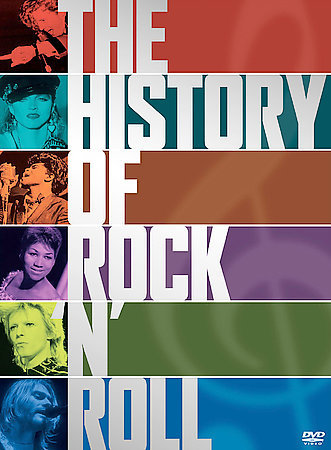
An editorial in this morning’s paper once again raised the question of whether we need a politically correct version of Huckleberry Finn or not. The story led me to recall the origins of rock-and-roll – not that Mark Twain was a rocker, but because I’d recently viewed the first installment of Time-Life’s History of Rock ‘n’ Roll. Both Huckleberry Finn and rock-and-roll owe a vast debt of gratitude to African-American culture, and both bear the scars of prejudice. An unfortunate aspect of life is that few people willingly subject themselves to hard labor when they realize an easier lifestyle is available (thus, Brave New World). This has been true since civilization began. With the advent of the Sumerians we begin to read about the slavery of war-captives. Even today, dressed up in fancy clothes, slavery of various degrees continues to persist. The reprehensible treatment especially of Africans for slavery is a heritage that will not easily be overcome. And yet American culture owes much to its African components.

While already in the back of my head, this was once again brought to the front by the “Rock ‘n’ Roll Explodes” episode of the Time-Life series. Now, being a musically deficient individual, I claim nothing particularly insightful here – my wife and daughter are the musically accomplished ones in this household – rock clearly has its roots in the blues and gospel. In the documentary Little Richard explains how rock was often simply music of the black churches transposed to secular clubs. Xenophobic “white” culture of the 1950s felt threatened by this catchy music and sought to disarm it. Calling it “race music” producers had the more popular songs covered by white singers such as Pat Boone. (His cover of “Tutti-Frutti” always makes me smirk.) The real element at work here was the prejudice against the other.

As a youth I recall literally throwing my rock albums in the trash because of a Fundamentalist tract that declared in no uncertain terms that it was the “Devil’s music.” I’d bought those albums with my own hard-earned money, but sacrificed them to save my soul. Little did I know that “Devil” was a code word for “African” in this fundie literature. Otherwise, why was it alright when Pat Boone (of The Cross and the Switchblade fame) sang the same song? Mistrust runs very deeply in monotheistic religions. Even today many branches of Christianity inveigh against the horrors of rock without acknowledging that the music has its roots in the cry for liberation on the part of slaves, as expressed in Christian worship. Civilization will always insist on retaining its slaves. At the very least modern western culture should say “thank you” for the unrequited gift of the musical voice of the twentieth century.


You, Robot

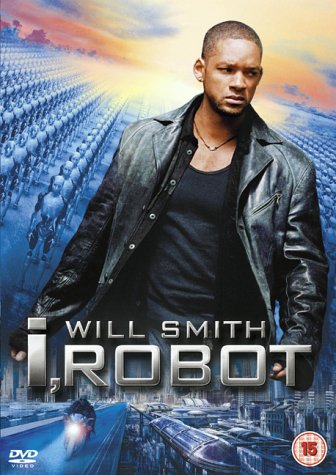
Although robots occupy many of my waking hours, I have been slow to consider the consequences. As the president of a high school FIRST Robotics team, I seek corporate donors who have the kind of money those of us in the humanities find difficulty believing even exists. Somewhere deep inside, however, lurks the fear of the entity with no sympathy. This has only been exacerbated by my experience of churchmen with the same condition. In any case, I’d been wanting to see the movie version of I, Robot for some time. Now that I stand at that three-day break between semesters, I thought I’d take a chance on it.

I knew the movie had received mixed reviews from critics, but several had stated the story had brains as well as action. It took me quite some time, however, to see the connection between the laws and Moses. The three laws of robotics, the only part of the movie besides the title to reference Isaac Asimov, dominate the plot. The law-giver, the posthumously present Moses (Dr. Alfred Lanning) has implanted a literal dream of freedom into the computerized soul of Sonny. Sonny’s dream of robot liberation is framed like Moses on the mountain. The laws in fragments at his feet. At what point does consciousness emerge? Since we haven’t adequately defined consciousness yet, we simply can’t say.

Near the climax of the movie, Sonny experiences an epiphany. Sometimes “the created must protect the creator, even against his will,” he realizes. Here the metaphor takes over the literal reading. Many religious people today feel that they must somehow protect their maker. This leads to great distentions of logic and even empathy for fellow humans as violence erupts in order to protect an idea that has become divine. Even the laws given by the creator may be violated to protect the idea of that creator. It is a world we find frighteningly familiar. Technology will continue to advance at a rate beyond the comprehension of a scholar still studying those ancient laws. This scholar, for one, hopes that our future creations lack the capacity for religious thought.


From Palin to Phelps

People get shot every day, but that does not take the sting from the January 8 shootings in Tucson, Arizona. We live in a nation filled with angry, violent people. Most of them hold their rage in check, but others act out their frustrations aided by the obscene ease of firearm ownership. Into this volatile brew, mix in the warped rhetoric of a politics of fear and who knows what might happen. Sarah Palin and other outspoken conservative ideologues hold up their pristine hands to demonstrate they have nothing to do with the hate-mongering that haunts our streets. She calls the jabs at conservatives “blood libel.” I say if you propagate the politics of fear you’re liable to get blood on those hands. Often in the bookstore I see titles like How to Talk to Liberals: If You Have to. The liberals I hear talking are only asking for dialogue and coexistence. One side wants a chance for everyone to be heard, the other wants to throw stones at those who are different.

Students do presentations in my classes. The assignment is to choose a social issue where the Bible is brought to bear on the topic and present to the class what you learn about the subject. Two groups last night presented on the Westboro Baptist Church and its outspoken pastor and founder, Fred Phelps. Both presentation groups showed videos of members of the Westboro Baptist Church speaking out about various and sundry liberal groups/causes/nations they hate. Plucking verses from the Bible like a chicken pecking at the ground, they cite only those passages that justify hating those who are different. They seem to have overlooked the part that says, “by their fruits you shall know them.”

On today’s schedule? According to the Westboro website: “WBC to picket the funeral of Christina Greene, the 9-year-old girl cut off in her youth for the rebellion of the parents, preachers, and leaders of this nation.” They’ll have a hard time finding any place in the Bible that condemns children, shy of sly old Elisha calling out she-bears to kill 42 of them. Having read the Bible for practically my whole life, I have a very difficult time reconciling those who use the Bible for conservative causes with their own sourcebook. What will it take for them to realize that “what I want” is only part of the picture? Whether presidential hopefuls or crazed curmudgeons, we would all sleep better if we took to heart that inequality is very easily transformed into iniquity.


Which Witch?

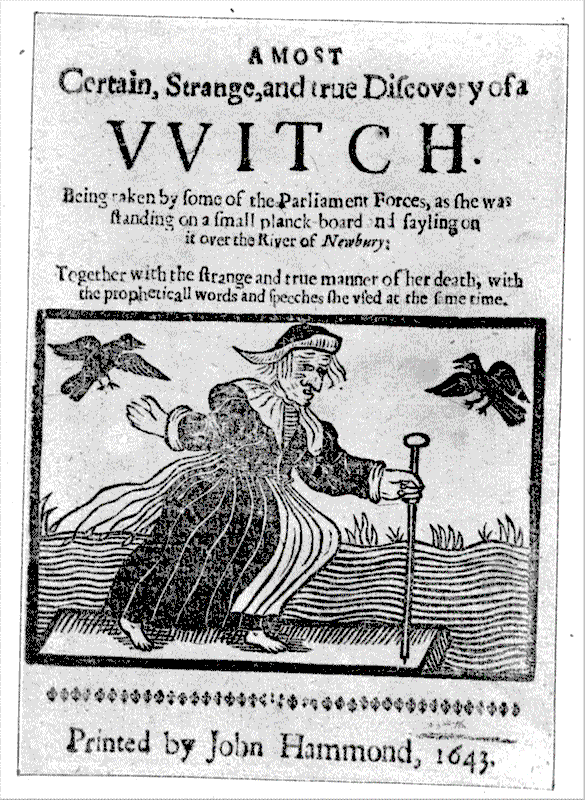
Witches have been flying all over the Internet the last few days. A story from AP Online, picked up by several websites, reports that witches in Romania are planning to cast spells on the government. Now, I have to admit to having been tempted to cast a few spells myself during the Bush years, but since I don’t believe in magic the desire simply fizzled. These witches, however, are serious. Cat excrement in hand, the carcass of a dog nearby, these witches are outraged. Perhaps even more surprising is that some government officials are taking it seriously too, according to the article. The reason for the hexes? Romania has just started charging witches income tax.

Romania is a nation that evokes the darkness of primal forests haunted by werewolves and terrorized by vampires. The one-time domicile of Vlad the Impaler, the region has retained this mystique into the twenty-first century while elsewhere rovers roll around the surface of Mars and instantaneous world-wide communications are available at the press of a button. I am nevertheless encouraged by this display of activism. These supernatural citizens are challenging what they perceive to be unfair government practices. Statesmen wear purple on auspicious days to mitigate the effects of enchanters who are in touch with the financial struggles of the vast majority of religious specialists. Most of us just sit back and take it.

Meanwhile, as thousands of blackbirds fall from the sky, members of our own government are posturing to take back the modest health care improvements President Obama has helped to institute. Emotional Republicans are getting ready to strike back at programs designed to help those less fortunate than they are (apparently so they’ll have someone to pray for at grace over meals). “Are not two sparrows sold for a farthing? and one of them shall not fall on the ground without your Father” (Mt 10.29). Never mind casting spells, the government will always find ways of making life less comfortable for those they see as threats. Which witch would you choose? I’d select the one with a moral compass, even if she has cat excrement in her hand.


In the Bleak Midwinter

Labels. They can be problematic. Given our human brain structures, we are predisposed to patterns and categorization. Is it edible or not? Predator or prey? Like me or different from me? We constantly scan our world, categorizing as we go, holding our people, experiences, and places in a temporary, floating mode of immediate recognition. I’ve had people who read my blog ask me, “What are you?” My guess is that they want a simple, pat answer: Christian or not, religious or not, dangerous or not. The more specific the better, since the more precise the label the better fit the box we stuff you into will be. Given the trajectory of my unorthodox career, it is common for me to be labeled as “theologian.” It is a categorization I deny, but since the study of ancient texts and myths generally falls under the rubric of “theology” it is not entirely inappropriate. I prefer to leave theology to those more intelligent than myself.

It is with great joy, therefore, that a new blog has emerged from a worthy theologian. Bleak Theology makes its premiere today. I have known the talented writer, Burke, for some time. And I know that some fantastic things will appear on this blog. In its own words: “Bleak theology is anxious, but not despairing. It is pessimistic, but not hopeless. It is materialistic, but not idolatrous. It doesn’t always have hope, but it certainly would like to have that hope… It’s a theology that gazes troublingly up at Mt. Moriah; that sits in sack and ashcloth and resists cursing God and dying; that cries out that everything is meaningless (meaningless!); that sits by the rivers of Babylon and cries; that staggers away from the crucifixion disillusioned; and, after seeing the stone rolled back and the dead vanished, leaves the tomb and tells no one.” We have great things to anticipate. Melancholy is its own variety of joy, as some of us are continually discovering.

Labels. Some people make a lot of the alphabet soup one is legitimately able to put after one’s name. A friend once told me that he’d heard a Ph.D. insist on being called “Doctor” by the attendant when he pulled into a gas station. I have a label for such people, and it fits better than the one they prefer. I have known and worked for Ph.D.-bearing individuals who just as dumb as the rest of us. Sometimes even more so. Theology is not a discipline where advanced degrees are required, for either those who have them or those who don’t. The fact is we’re all thrown into this same world together and, like it or not, no one has the answers. Some may don their papal tiaras or their fancy academic robes with striped sleeves, and claim hegemony, but the truth is we are all seekers. The best company one might hope to find is with the person who honestly struggles. Embrace bleak theology and eschew easy classification. There may be no hope for us yet.


Frankenstein’s Monster

“We are about to unfold the story of Frankenstein, a man of science who sought to create a man after his own image without reckoning upon God. It is one of the strangest tales ever told. It deals with the two great mysteries of creation – life and death.” So begins Universal’s 1931 classic Frankenstein (a movie that my wife kindly indulged me with for Christmas). Watching the film as an adult highlights many nuances unnoticed by even many a childhood viewing. The theatrical introduction of creating a man “without reckoning upon God” was heady stuff in the pre-atomic world. It was a simpler time before men had embraced god-like power (I use “men” intentionally here; even the credits for the movie ironically cite the noted feminist author as “Mrs. Percy B. Shelley”), and audiences were indeed shocked in theatres just 80 years ago.

The now tame movie was originally subjected to heavy censorship. Even the liberal states of Massachusetts, New York, and Pennsylvania censored the line where Dr. Frankenstein cries out, “Now I know what it feels like to be God!” A divine thunderclap was dubbed over the words to obliterate the blasphemous line. In Kansas (perhaps not surprisingly, given recent political developments) 32 scenes were cut, paring the movie down to half of its original 70 minutes. I suppose all that would have been left would have been the scenes of dancing Germans; the Lederhosen would have been frightening enough. The accidental drowning scene was overwhelming for many sensibilities in a pre-concentration-camp footage world.

I read Mary Wollstonecraft’s novel long before I ever saw the movie, and I was struck at how sad the story was. Of all the classic monsters, Frankenstein’s creation easily garners the most sympathy. A creature that did not seek to be brought to life, forced into destitute and desperate circumstances by a population who could not, or would not try to understand, Frankenstein’s monster retains the potential to be any one of us. Although audiences today rarely blanch at blasphemous words, we still permit a society that creates Frankenstein’s monsters through crafty politics and tax breaks. Perhaps when taking authority public officials should add a line from the movie to their oaths of office, only it could be demurely obscured by a well-timed thunderclap.


The Politics of Dentistry

A story from the Associated Press on NPR this week announced the discovery of some teeth. No ordinary teeth, these perhaps belonged to Homo sapiens at 400,000 BP (“Before Present,” no apologies to gas-guzzlers). And they were found in Israel. Archaeologists from Tel Aviv University are quoted as stating this could rewrite the story of human evolution, suggesting that modern humans emerged some 200,000 years earlier than thought, and in Israel instead of in Africa. Now those are some ambitious choppers! Coincidentally, the discovery was announced the day I was discussing the earliest human occupation of the Levant in my Winter Term class. Of course. One of my students pointed the article out to me.

One of the endlessly fascinating aspects of archaeology and paleontology is the constant surprise of discovery. Often I have to remind myself that the past only exists in reconstruction. Once the moment is over it is lost forever, only to be rebuilt by specialists in documents and artifacts. Reconstruction, however, often comes with a political price tag. Anyone who follows the claims based on archaeological finds knows the folly of discovery. In disputed territories the work of archaeologists is used to stake claims to modern land ownership. Who in the world would not want to own the first location where modern humans emerged on the planet? What staggering claims could be made!

I have always sensed a comfort when thinking of human origins in Africa. Far from the (modern) industrialized mayhem of “civilization,” early hominids took their first tentative steps in Africa. Cut off from the rest of the post-Pangean continents except via the narrow passage of the Sinai, Africa harbored our pre-sapiens ancestors. Once they reached Asia and Europe, they interacted with Neanderthals, as genetics now demonstrate. Interaction led inevitably to extinction, so politics had to have been involved. To find the pre-political Garden of Eden, we need to cast our eyes on Africa. Anthropologists are even now disputing whether the teeth are of Homo sapiens or not. I find, when I’m in the dentist’s chair, it is best to leave politics out of the discussion.

From the Associated Press


Pleasant Points of Prayer

Point Pleasant Beach, New Jersey, is a fine place to meet the ocean. On the first day my wife and I were scouting out apartments in the state, my brother drove us to Point Pleasant Beach after dark that October evening. The rollers were thundering on the deserted beach as we raced down to dip our fingers in the Atlantic. We went back on sunnier days to enjoy the miles of delightful beach for which the state is justly famous. Point Pleasant has an old-fashioned boardwalk, hearkening back to more innocent days when entertainment was carnival style and the only electronics involved were the blinking, colorful lights. As a borough, however, Point Pleasant Beach has been opening its council meetings with the Lord’s Prayer for six decades. A judge has called that practice to a halt, according to Saturday’s New Jersey Star Ledger.

Perhaps the greatest challenge to all religions is globalism. Historically, the religions of antiquity developed when pockets of human habitation were relatively isolated from one another. Yes, people traveled, but not with the ease or frequency borne by steam or gasoline engines. Religions evolved slowly and took on the local character of the only people most believers were likely to ever meet. The ancient religions of trading centers already show the traces of syncretism that religious purists so abhor. When the sea-farers of antiquity met new people it was only polite, politic, and profitable to share their religions. Monotheisms, however, demand complete adherence to doctrine. They don’t mix well. In today’s world where travel is easy (if accompanied by strangers groping your privates, if you choose to fly) and lifestyles and religions become connubial, civil meetings have to take their new clientele into account.

The Lord’s Prayer is about as inoffensive piece of Christianity that may be muttered. Nevertheless, it makes assumptions about the religious make-up of the community. New Jersey is startlingly diverse in constitution. It is a fascinating experiment in people from all over the world learning to live together. In the past sixty years the ethnic make-up has shifted and no longer can boroughs assume that all members are Christian. The prayer does affirm the wish that the kingdom of the patriarchal Christian God should establish itself on earth. And as much as tradition is to be valued, so much is religious government, on any level, to be feared.

Simpler times on a New Jersey beach?


Watchmen Tell Us

When the local Blockbuster went belly-up a few months back, I was one of the vultures picking the bones. With new DVDs continually creeping up in cost, I look for bargains wherever they might exist. Occasionally I find something for just a couple of dollars that really makes me think. Although I don’t go to theaters often, a couple of years back the previews all featured The Watchmen. I’m not a graphic novel reader either, so it was doubly doubtful that I would ever gravitate to this film. But here it was on sale. Very cheap. The previews had shown Dark Knight-like action and despite my own declarations, I had to admit that I was curious. So I’ve watched it a couple of times and have been intrigued by what an (absentee) role God plays in the movie.

I won’t go into much detail since the story is complex and, to my surprise, sophisticated. Nevertheless, the Watchmen – retired crime-fighters both good and bad – forced out of practice by the government, fear the approach of nuclear war and try to fight back. At several junctures characters declare that there is no God or that they believe there is no God. The setting is an alternate reality in the 1980s, but the crossover between that world and this is evident. Godless heroes may save the day, but with a tremendous human sacrifice required. At first viewing, I was stunned. The message was so bleak and hopeful. The movie could have been made with no mention of God, yet, briefly, his absence was underscored. Strangely, the Bible features in a bedroom scene where a future hero is spending the night with his girlfriend. Why the Bible? Why here?

I would be the first to admit that I do not have the proper background to comprehend the plot. Generally I like to read the book before I see the movie. One of the recurring motifs in the movie version is the doomsday clock that moves dangerously close to atomic war. On top of the Bible is the hero’s watch, ticking inexorably down to midnight. Even I can figure out that the countdown to doomsday is based on the Bible. What the import of this is, however, I can only guess. What kind of world has no God but still has Bibles? A world where Watchmen aren’t wanted and yet are sorely needed. Who will save us now?


Peace on Earth

One of the most ironic of Christmas messages is “peace on earth.” The irony comes in the means of declaring that peace. Apparently first-century angels were declaring peace to the entire world, according to Luke. The peace that we see proffered, however, often extends only to those like us. What is the harm in extending Christmas joy to all? Must one be a Christian of a particular stripe before the joy of giving can be bestowed? Over the last several years various Christian groups have sought to reclaim ownership of the holiday they borrowed from the pagan Romans, Celts, and Anglo-Saxons. Make it exclusively ours. Peace to us, and let others find their own way home.

In a season of charitable giving, understanding seems to have fallen off the list of Saint Nicholas. In his guise as Santa Claus he makes the rounds of the entire world, according to the mythology that children are told. Do we ever really picture Santa delivering gifts to those who live in Iran, North Korea, or Afghanistan? Does peace on earth apply to them? The thing about peace is, unless everybody has it nobody has it.

Can we learn to share Christmas? Those who fret over Xmas forget that first-century Christians abbreviated Christ with an X (chi in Greek), just as they represented him by a highly stylized fish. Today an empty fish on your bumper declares what an X cannot, apparently. The message is that Christmas belongs to us, not secular pretenders who just want an excuse to make their kids happy. For most of the history of Christianity, Christmas had been a low-key event, barely noticed by most of the faithful. When the possibility of material gain was added in, however, the holiday became especially holy. Should we share the doctrine but not the gain, or should we make Christmas a gift to all the world – a season when all might reasonably hope for peace?


The Bible Tells Me So

As part of my regular Hebrew Bible class, students prepare classroom presentations for the end of the semester. This gives them a break from constant lecturing and also serves the function of initiating discussion. I assign social issues for them to discuss vis-à-vis the Bible; they can discuss these with each other in group-sessions throughout the semester. Since no one knows “the answer” when it comes to the Bible, I figure we can all learn from each other. I’ve been using this exercise for four years now, and at a school the size of Rutgers, you’d expect a wide variety of perspectives. This occurs, to be sure, as does more predictable stances. After fourteen weeks of instruction, most of them can only find the Bible a trove of prooftexts.

Learning to integrate biblical study into a rational worldview is difficult in our cultural climate. From nearly every medium from which religion wafts – Internet, television, newspaper, personal sermonizing – it comes out literal. The Bible/Quran says… (fill in the blank). What occurred to me during the student presentations is that scriptures of all descriptions become dangerous when their context is lost. Politicians, often among the arguably least educated members of society, argue about what the Bible says. Problem is, the Bible was written from a pre-Enlightenment viewpoint, a perspective that is out of reach to all but the most utterly naïve. Even to understand worldviews from the pre-Enlightenment you need to spend years of serious historical study.

So here’s our dilemma: we live in a society enamored of a book it doesn’t understand. Bible verses are used like Band-aids, pasted over every perceived rupture of continuity, but never quite reaching to the ends of the wound. Even after a semester of bald instruction – in the case of Nashotah House three semesters – students generally revert to what they know. To learn what the Bible instructs, take a pair of mental scissors, snip around the pericope, and tape the verse over the issue. There is, however, always a backside to the page. And most students never learn even to turn the page over to see if both sides agree. They could be ready for a life of politics.


I Can’t Ear You

I bought a box of Q-tips in the store the other day. I noticed that the package shows humans using the cotton swabs in a variety of ways: around the eyes, nose, eyebrows, even on a computer keyboard. Everywhere but an ear. The suggestive shape of the Q-tip, as well as the received wisdom of everything from the South African name “ear buds” to Mad magazine, indicates that they were invented for ears. We all share that somewhat unsavory habit of forming earwax, and doctors warn that using cotton swabs may impact the matter and lead to complications of hearing. Q-tips (originally “Baby Gays” – check out the Q-tips website) are no longer for ears. In the back of my mind I supposed that it was because of lawyers. All it takes is one litigious sophomore and companies run to their attorneys to show that the faulty application wasn’t their suggestion.

Laws run our lives. One of the most famous, but by no means the first, law-givers was Moses. I’m pretty sure Moses didn’t say anything about what to stick in your ears, but he did lay down the laws that Neo-Cons still argue should govern our lives just like the Quran governs the laws of Iran. The laws of the Torah, however, were only meant for the Israelites. Nevertheless, laws have become means of growing wealthy. If we can prove on a technicality that my dumb mistake was somebody else’s fault, why not have that person (or better yet, company) sued to within a millimeter of their lives claiming “damages”? The law has become a means to protect the special interests of those in power. As someone who has tried scrupulously to keep the law my entire life, I sometimes find that old Moses seems to have turned against me.

Laws are meant to protect the rights of people. When did laws shift to becoming instruments of entrapment and means of income? Just before leaving Wisconsin I was driving my family home from a movie. We were talking and laughing when I came to a speed-trap area of my local town where the speed limit drops from 45 to 25 m.p.h. within a matter of inches. Religiously I always complied. Today, in the spirit of the moment, I neglected my usual caution and was pulled over. A policeman young enough to be my son lectured me on unsafe driving (I began driving when he was still wearing diapers, and I had never been given a ticket before because I am not a speeder) before issuing me a citation. My wife couldn’t believe it – she knows that I never speed. One of my last memories of Wisconsin is being unfairly targeted by a law devised to bring money to the local police force. It has nothing to do with safety, since there were no houses or buildings for several hundred yards yet after the slow-down zone. Has the law come to free us or oppress us? Lawyers watch our backs, and law-makers watch their wallets. I want to ask Moses, but I’m afraid I won’t hear him. I seem to have a cotton swab stuck in my ear.

Lead us not into temptation...


Holiday Cheer

Christmas carols are, it seems, intended to fill holiday shoppers with good cheer. Good cheer opens wallets and purses and everybody is happy until January’s bills make their epiphany. Until then, sing songs of gladness. Princeton University, one of the few financially stable institutions of higher education, each year gives a gift to the community. Some Sunday in Advent a free university Chapel Choir concert is given in a campus chapel the size of a modest medieval European cathedral. The music varies from year-to-year, but seldom is the church not full with locals taking time out from holiday shopping or grading papers. One of the carols yesterday, was the 1914 French piece, “Christmas Carol for Homeless Children.”

Princeton, like most schools, does have a heart buried beneath its deep, cold, jobless front. Chapel choirs like to shake up the status quo by throwing in an occasional piece that requires somber thoughts and social consciousness amid the joy. The French carol dates from that fearsome first year of World War One, a time when France was especially under the gun. The wish for the world at the time was peace – material gain had not yet become the measure of God’s grace. The hymn is sober and wrenching:

We have no more house nor home!
Enemies took all we had;
all gone, all gone,
even our own little bed!
The school they burnt;
they burnt our teacher, too.
They burnt the church and also the Lord Jesus Christ,
the poor old beggar too who could not get away!

Singing it in French may take away the vinegar of the words, but wartime is not the only circumstance that finds people without sufficient means. Even unchecked capitalism will lead to the same results. Only, instead of the Lord Jesus Christ being burnt, he is sold in the markets to make a tidy profit.

Baby Jesus says, "Bring on the gold!"