Response

Chaz,

I am not sure if this cycle has a name—sociologists have noticed it, I’m sure—but is as old as at least civilization itself. My experience with it has been in the realm of religious studies. A number of years ago I read a study that indicated that within a decade of the founding of a religion it will have changed beyond the recognition of its original form. In other words, it will evolve. I suspect this is true of most memes. In literary studies this recognition goes by the sobriquet of “Reader Response” theory. Once an author (or any initiator of something new) produces a written work s/he has lost control over what it “means.” Each reader interprets a piece in the light of her/his own context, some perhaps close to the original intent of the author, some far distant. In the broadest sense of the word, this is a corruption. According to Reader Response theory, it is natural and to be expected.

On a larger scale, human endeavors are often beset with divergent agendas. A founder may start a school with the intention of training teachers. Soon interest and clientele grow and further program options are offered. The teacher’s school becomes a college. If the college meets a larger societal need, it becomes part of a university. Universities, despite all posturing and muttering, are becoming very much alike through the mediation of the Internet. Is this a corruption? Perhaps not in the sense of being a benign development, but it general terms it reflects the dilemma of changing ideals. Various religions point in different directions to explain it, but most explanations are mythological. The “fall” in Eden does not fit the view of the Hebrew Bible, but it is a popular Christian explanation for why corruption sets in.

A more humanistic response might call it “human nature.” We are fully capable of lofty ideals. In my admittedly limited experience, I have found that those with such ideals are often ill-equipped to realize them. Those who grow such ideals into institutions tend to have an entrepreneurial outlook that benefits from following the greatest returns. To court investors, a tangible payback must be included. We see this all the time in churches: popes, archbishops, televangelists—soon they find themselves powerful people with access to great wealth. A far cry from a working-class carpenter preaching love. The pattern is ubiquitous throughout history, and there seems to be no cure other than, as you suggest, to begin again.

Chaz and I would like to invite comments and discussion on this issue. Idealists and more pragmatic types are both encouraged to reply!


Silver Scream

Only within the last couple of decades have movies begun to be taken seriously as expressions of the Zeitgeist. An art form not even 150 years old, commercial movies have been seen primarily as an entrepreneurial exercise—money-making ventures with little serious thought. Now students of society recognize that where our wallets are, there our hearts are also. Even in the depths of recession the entertainment industry maintained its draw. The unemployed could at least watch movies cheaply at home. Yesterday’s newspaper contained an insightful entertainment piece on horror movies by film critic Stephen Whitty. Noting that the film industry began when the Production Code largely mirrored pre-1950’s American cultural values, Whitty observes that clergy were left out of movies, or when they appeared they were strong role-model characters. Then, beginning with The Exorcist, the demonic became a huge theme in movies. As Whitty concludes, “Certainly it’s partly a reflection of a growing fundamentalism” that indicates why such movies are now so popular. Many Americans believe in angels and demons and turn to them to explain the serendipitous or contretemps.

Scary, but not necessary.

Social attitudes help to explain what we see on the big screen. Almost from the beginning religious leaders have castigated the entertainment industry as an unholy counterpart to sanctified living. Theater was earthy and evil, movies immoral, and even the desire to be entertained took away from the struggle for salvation. Ironically, however, movies tend to reflect conservative values. At least when it comes to demons. In the current glut of demonic films—which most Americans rate as the scariest kind of horror movie—the church-sanctioned hero is often the only effective tool against evil. A mythology of a Manichean dimension reigns: good struggles against evil and good will prevail. Unfortunately, this Hollywood scenario falls on the side of simplistic solutions to complex problems. Evil is our own doing—we need no demons to tell us how to be bad. Likewise, help often fails to come from on high.

Over the weekend I watched Dogma once again. Severely criticized as immoral and trashy, the overall message is, however, one of faith and hope. No fundamentalist, Kevin Smith certainly takes his pot-shots at Christianity, particularly Roman Catholicism, but in the end God and angels are real, and demons are defeated. Yes, this comedy is intended to be entertainment, but the audience that views it probably agrees with its core values. As Whitty demonstrates, the past decade has flooded the market with Hell-born foes, and there seems to be no imminent slacking of the pace. People are afraid. Our efforts at free-market Heaven have turned out to benefit too few while too many are still without work or adequate security. No, we need no demons to instruct us in the ways of evil. We are fully capable of initiating our own.


Inventing God

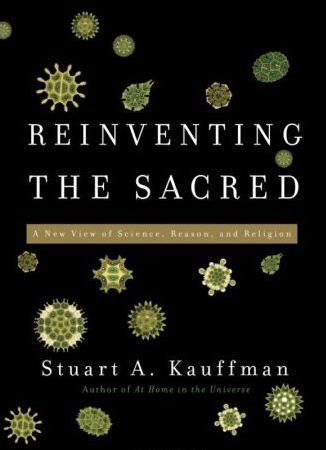
Reductionism has been a hallmark of science for many years with the most extreme forms suggesting a kind of cold determinism in the universe. Having known since my undergraduate days that science is the key to knowing, yet having the experience of believing as well, I wondered how they fit together. If they fit. I have just finished reading a very important book on the topic – Stuart A. Kauffman’s Reinventing the Sacred. A theoretical biologist, Kauffman has come to the conclusion that reductionism cannot account for many aspects of the world we actually experience. Evolution, biologically as well as culturally, demonstrates again and again a creativity that cannot be predicted, no matter how much data is acquired. Kauffman suggests that this non-reducible creativity is what might properly be called “God.” Not a believer in a transcendent creator God, Kauffman does not wish to remove the God meme from our psychological vocabulary, but to reinvent it.

In many ways, I found Kauffman’s work to be some of the most affirming science writing I’ve ever read. He believes there is a place for creativity in the overall human experience of knowing and being. Values are not simply arbitrary points selected by people, nor are they imposed on us from a personified God. Values and beauty are emergent phenomena. As Kauffman argues, they are clearly and blatantly real, but not reducible to physics. He also demonstrates that economics falls into the same category of real but non-reducible. As a researcher in complex systems, Kauffman quickly left me in the dust when he reached the more theoretical material. I am not equipped to assess his scientific conclusions. Overall, however, his book possesses a rare sort of urgency for a scientific exploration, and it values the whole of the human experience.

Demonstrating that ethics emerge not from “on high” but from a human sense of value and “right,” Kauffman suggests that we desperately need a global ethic to realize our full potential. In the ongoing debate between science and religion, Kauffman is a voice of both reason and compassion. Science is the way we know – there is no point in debating that. If you are reading this on a computer, Q.E.D. If you are a human being, then you have also experienced the phenomenon of believing, whether or not it is religious. Kauffman has addressed the question directly and has given both specialists in science and in religion a trenchant analysis of an intractable issue. His irenic approach is to be applauded, and hopefully, widely read.


Able, Baker, Charlie Chaplain

Atheists? Foxholes? Do they mix? An interesting op-ed piece in yesterday’s New Jersey Star-Ledger by Daniel Akst poises some provocative issues. Akst notes that some atheists in the U. S. Army are demanding equal time when it comes to chaplains. Just because they do not believe in God does not mean they don’t have spiritual needs. One of the misperceptions about atheists that abounds in the media is that they are anti-spiritual. Rock-solid rationalists who see nothing beyond this mere physical existence. Well, trying to cast all atheists in the same mold would be like trying to get Baptists and Roman Catholics to celebrate their Christianity together on a Sunday morning. Yes, some atheists are strict materialists. Others believe in a spiritual existence, sans deity. Do they not have the same right to comfort on the battlefield as their theistic co-combatants?

Of course, the other question – perhaps the elephant in the room – is the appropriateness of military chaplains at all. In a nation that does not support any one religion above others (at least in theory) government funding for religious functions is always under scrutiny. Can the military pay the Catholic chaplain, the amorphous Protestant chaplain, the Jewish chaplain, Islamic chaplain and not the atheist chaplain? Many large universities now sport humanist chaplains: Harvard had a very prominent one, and even humble Rutgers has a humanist spiritual guide. No doubt military service is highly stressful and those responsible for destroying others need to be buoyed up in times of deep distress. Should our government not pay for equal opportunity for all soldiers?

Naturally, the unspoken corollary remains a mere whistling down the wind: could we learn not to fight at all? Most religions make the claim that they are here to better the lot of humankind. Still, many wars are sparked off by religious hatred, and distrust of the other would require that we at least keep a national guard around in the best of times. If religions of all stripes could work hard to convey the message that we are all in this together, convince the maligned, disenfranchised, those who feel unfairly oppressed, that we are equally valued, what we would have to fight over? Of course, that would require equitable treatment of all people. It is so much easier to manufacture weapons than to lay down one’s wealth to help someone one doesn’t even know.

Is this humanity?


Reap the Whirlwind

A pillar of cloud by day

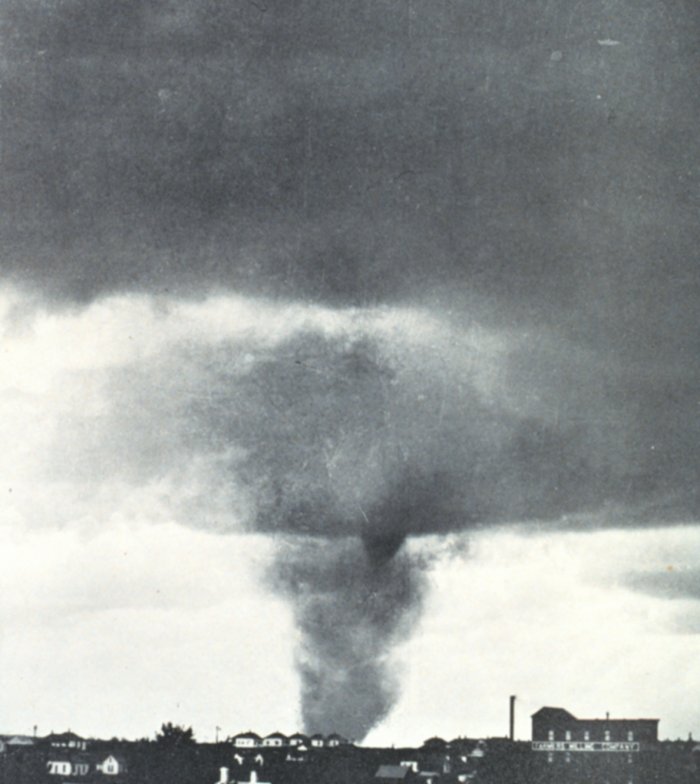
Something seems to be absent. The blazing rhetoric of televangelists and others proclaiming the wrath of God on New Orleans when Katrina blew ashore are strangely silent as a massive outbreak of tornadoes has ripped through the Bible Belt. Hundreds have unfortunately died as nature’s most severe weather-weapon has raked the south. In an apoplectic frenzy rivaling the 1974 Super Outbreak, tornadoes are well ahead of seasonal schedules this year as one wholesome Christian location after another vanishes in a whirlwind the envy of Elijah himself. I do not make light of this disaster. Having lived for many years in “Tornado Alley,” I very much feel for those victimized by these severe storms. They are a great tragedy and the loss of life, for Americans, is mind-boggling.

There is, however, a lack of continuity. Katrina, we were repeatedly informed, was the judgment of the Almighty on the sinful city of New Orleans. The tornado, surely the most divine of windstorms, remains a tragic natural phenomenon. “He makes the sun to rise on the just and unjust,” I recall someone once saying. Human tragedy is never easy to explain in any religious system. Even the self-righteous must acknowledge that – on some level – their pristine, exemplary lives deserve a thunderbolt or two. They speak loudest, however, when lifestyles of which they do not approve are decimated. How does the Bible-believing, rural farmer offend God? Were there no Christians in New Orleans?

The problem is forcing all members of one location into a category fit for reaping. It is sowing the wind. Human compassion demands that we not stand in judgment of the unfortunate, we simply help in what ways we can. One of the greatest dangers of any religion is that it validates one group above all others. Either we are all favored or none of us are. Waiting for a divine answer may take centuries, or even millennia. Lifting a hand to help a fellow human being is the only ethical response. Tornadoes are not the finger of God. Katrina was not the Almighty losing his masculine temper. We are all victims of the world into which we are born, and the sooner we refuse religion’s diabolical temptation to claim our special place, the sooner we will find our own way to a just society.


Aftermath of Easter

Holidays, it seems, are increasingly overloading themselves with baggage. Not only are many of them thinly veiled celebrations of materialism, but many are now being tied to “issues.” As I survey the aftermath of Easter as I saw it this year, it becomes plain that even the message of self-sacrifice and hope springing eternal can be co-opted. The Fellowship of Catholic University Students at Montclair State University hosted a screening of Mel Gibson’s The Passion of the Christ last week. An outcry of biblical proportions flooded university discussion groups over what was deemed cultural insensitivity. Gibson’s version of the gospel failed to impress me when I saw it, stressing as it did Gibson’s sadomasochistic torture scenes in an effort to raise a few welts over “Christ-killers.” Back at Nashotah House I was regularly on the preaching rota. (I’m not now nor have I ever been ordained in any denomination. I have, however had preaching experience going back to my high school years.) My final sermon asked whether we should accept theological truths from a loose cannon of an actor. These physical accidents may have had more than a little in common.

Conversely, my first sermon at the seminary – the very year I was hired, and several years since my last pulpit performance – featured Abraham Lincoln. Nashotah House was a bastion for disgruntled southerners at the time; they were often the only ones conservative enough to fit the seminary’s profile. My admiration of Lincoln was expressed in an innocent expostulation on the merits of freedom. Afterwards I was drawn aside and admonished, being informed, “not everyone here believes Lincoln was a hero.” Lincoln was assassinated on Good Friday, a point that has not escaped those who note that the Civil War began 150 years ago this month. Those at Nashotah who disliked my words felt that I was disparaging the south. With roots in South Carolina, I indeed was not. Slavery is wrong in any ethical system that will stand up to scrutiny. Those who believe in equality, however, often pay the ultimate price.

Holidays do not always bring out the best in us. We need the respite, and we have the Jewish community to thank for coming up with the Sabbath that has led to our weekend lifestyle. Each weekend rival churches fill up with those who believe others to be wrong. Religion seems to have failed in its quest to unite. A colleague at Montclair cited the quotation of uncertain attribution: “having a war about religion is like having a fight over who’s got the best imaginary friend” – this was in the context of the screening of Mel’s Passion. The fact is, when it comes to religion nobody knows the correct answer. The humble response one would like to imagine is the mutual encouragement to continue to strive for the truth. More likely than not, the response is someone will select their weapon of choice and try to prove their point of view the old fashioned way.


Budget Bombs

Budgets are measures of what we value. For a nation that likes to tag itself repeatedly as “Christian,” our priorities belie that claim as surely as the lives of our leaders. Over the past few months, those of us involved in education have watched in horror as governor after governor has attacked education as a pork-belly society simply can’t afford. Considering the salary differences between politicians, CEOs, and teachers, there is no comparison. Many teachers I know must work second jobs to make ends meet: they too have kids to send to college. The problem, however, is not endemically a Republican one. My political leanings are well known to those who read this blog, but a colleague at Montclair State University recently sent me this quote from a 1953 address of Dwight Eisenhower that makes the point clearly:

An unlikely prophet

“Every gun that is made, every warship launched, every rocket fired signifies, in the final sense, a theft from those who hunger and are not fed, those who are cold and are not clothed. This world in arms is not spending money alone. It is spending the sweat of its laborers, the genius of its scientists, the hopes of its children. The cost of one modern heavy bomber is this: a modern brick school in more than 30 cities. It is two electric power plants, each serving a town of 60,000 population. It is two fine, fully equipped hospitals. It is some fifty miles of concrete pavement. We pay for a single fighter plane with a half million bushels of wheat. We pay for a single destroyer with new homes that could have housed more than 8,000 people. This is, I repeat, the best way of life to be found on the road the world has been taking. This is not a way of life at all, in any true sense.” (President Eisenhower’s address “The Chance for Peace,” Delivered Before the American Society of Newspaper Editors, 4/16/53)

The largest slice of our national budget goes toward military spending. Christianity teaches that we need not fear death – that’s what Easter’s all about, is it not? – and yet we pay astronomical amounts to keep ourselves safe. Do we really practice what we preach?

Since Eisenhower’s day we’ve seen an increasing inflation of self-centered motivation and self-importance taking precedence in politics. Republican politics allied itself with extreme right-wing evangelicalism and soon we were being told that Jesus was a free-market economist. The values of one sect hijacked a political party, and indeed, a nation. The force of this movement is so strong that, with some obvious differences, the policies of President Obama are not so far from those of Bush. No forward progress is to be made: backward, Christian soldiers! Our nation is in full retreat from facing square-on the very real problems of social injustice, unemployment, and lack of adequate schooling for many of our children. Those who know no better sit by and say, “well, the Christians are in charge, everything will be fine.” I don’t believe in a divine apocalypse, but then again, I don’t believe we will need one. Unless people wise up, we will be perfectly capable of creating a home-grown apocalypse all on our own.


Good Earth Friday

In a rare superimposition of holidays, today marks both Earth Day and Good Friday. These two special days are a study in contrasts, yet both are holidays that look forward and hope for salvation. Good Friday, the culminating drama of Holy Week, is often paradoxically treated as a day of mourning. If Christian theology be correct, humanity would be Hell-bound without it. Yet many of the faithful weep as if for Tammuz, knowing that resurrection is just two days away. Earth Day, much more recent in origin, is much more ancient in importance. Biology as we know it, whether human or divine, would have no place to call home without Earth. Earth Day began in 1970, but every day is an Earth day for most of us.

Still buzzing with 1960’s activism, on the first Earth Day 20 million demonstrators got involved and helped lead the way to the Clean Air Act, the Clean Water Act, the Endangered Species Act, and the founding of the Environmental Protection Agency. People cared. This was before fashionable complacency set in. Whatever. Today citizens of the United States get stirred up about very little. Good Friday may represent a school holiday for some, others may even go to church although it is not Sunday. But get worked up? Hardly. Legislators in our country drag their feet like spoiled children when it comes to reducing emissions (many politicians positively treasure their emissions) or paying for cleanup of what we’ve done to our planet. Let our children inherit the dearth.

While bully governors seek to slash and burn, it is the responsibility of more reasonable individuals to try to repair the damage their leaders do. This is the spirit of Earth Day. Our leaders make the mess, those of us who care try to do something about it. Good Friday shows what happens when an idealist challenges the imperial status quo. Long-haired liberals get nailed, and guys in expensive suits cut themselves bigger and bigger checks while orphaning those who get in their way. Gaia was never crucified, but that doesn’t stop Neo-Cons from trying to rape her. Just a year on from Deepwater Horizon and oil companies argue they are legally within their bounds not to permanently seal off caps that “meet regulations.” Their friends the politicians politely look the other way. If things are going to get better I suggest that we leave official policy hanging on a cross and do our own best effort to save our mother’s life.

Careful, it's the only one we've got.


Take Your Medicine

Sanofi-Aventis is a local pharmaceutical company. I drive by their massive campus on my way to Montclair a couple times a week. The facility is immense: it has its own three traffic lights on a state highway. Nestled in the center of this large sanctuary to engineered improvements to natural life is the Sri Venkateswara Hindu Temple (it too has its own traffic light). The first time I saw this temple – it is still under construction – I almost drove off the road. It is a stunning structure to see in the edges of rural New Jersey and it is a testament to the religious diversity of the state. Being small-minded in matters of zoning and construction (I’ve never owned property or a house), I wondered how this fascinating building came to rest in the center of a major pharmaceutical company’s strip.

As I considered this juxtaposition, it occurred to me that I was seeing a living metaphor. In our country of (admittedly uneven) advanced healthcare, an industry driven by science and its wonders is still penetrated by a religious institution. A temple to ancient Indic gods surrounded by a temple to human accomplishment. We can lengthen life, if there is cash on the barrel-head. Being technically unemployed, I do not receive healthcare benefits. According to bravado wafting from the governor’s office, other state employees may soon be joining me. Yet it is the cost of healthcare that has consistently caused the stagnation of some sectors of the economy. According to this month’s Harper’s Index, since the year 2000 Massachusetts has allocated $1,200,000,000 (yes, one-billion, two-hundred-million dollars) to decrease class sizes and to increase teacher pay. Of that amount, 100 percent has gone to cover rising healthcare costs. Kali have mercy!

Those of us in central New Jersey, like our Hindu temple, are surrounded by pharmaceutical companies. I have, because of my robotics avocation, been inside some of the facilities of a couple of these companies. Their visitor lounges surpass any faculty lounge I’ve ever witnessed in both opulence of appointments and sense of wealth. Yet I know that legislators refuse to tap these shoulders when it comes to taxes. Those wealthy beyond compare have already paid their dues. Besides, these guys have the keys to life: bad heart? Overweight? Sexual malfunction? All can be cured, given the cash-in-hand. Yet in the center of the capitalism’s campus stands a temple for a time-honored religion. Where your heart is, there will be your heart medication also.


Bell’s Hell

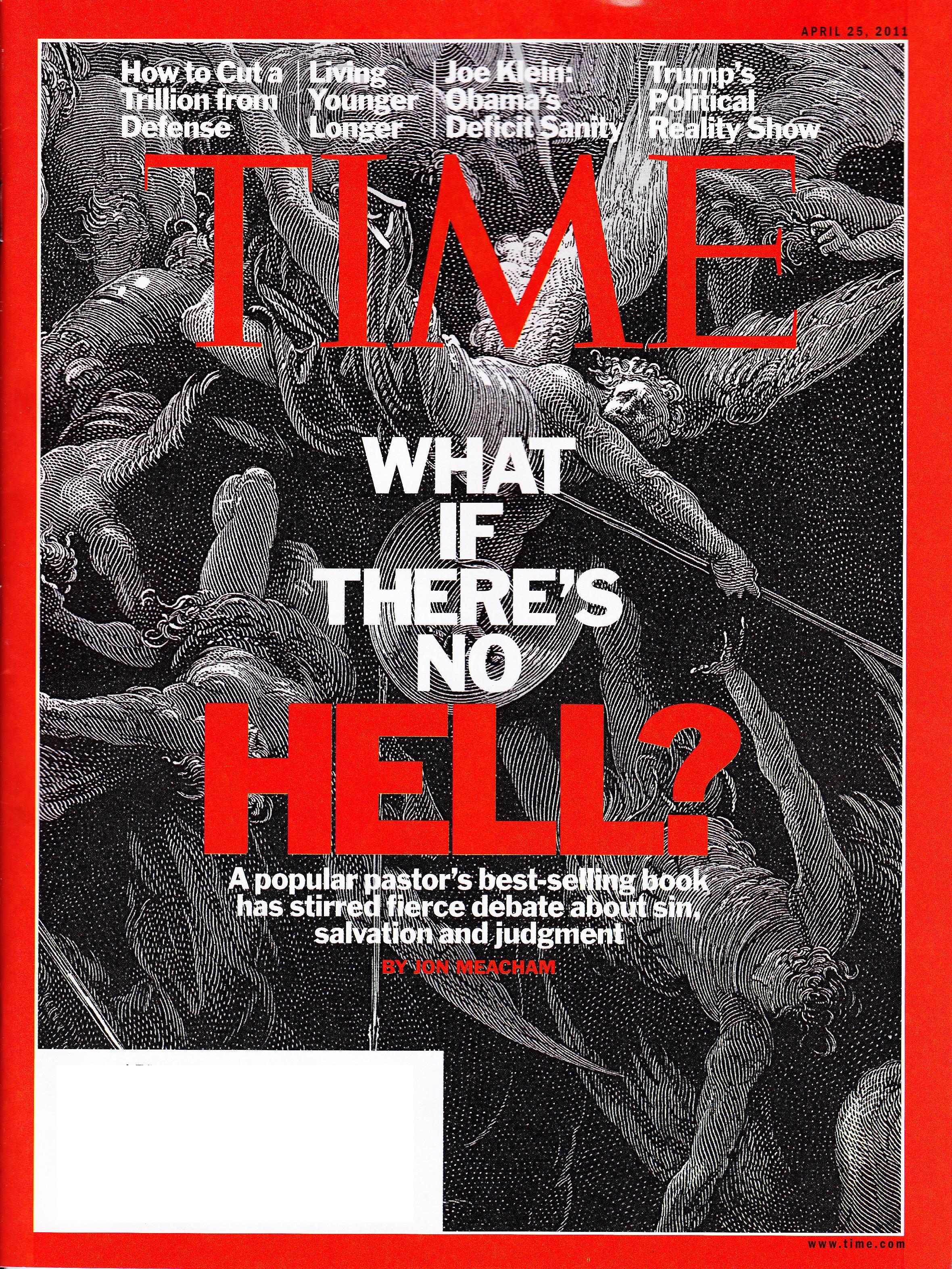
Hell makes the cover of Time. Or at least its absence does. For those of us who’ve delved deeply into the Bible for many years, it is no surprise. In fact, the uproar, as Time confesses, is among Evangelicals. So why Hell? Why now? The Evangelical pastor of Mars Hill Bible Church, Rob Bell, has just published a book questioning the existence of Hell and his fellow Evangelicals are in a conflagration about the loss of the sacred icon of God’s omnipotent stick that threatens them all into Heaven. It is a sad day when love cannot encourage enough that hatred becomes religion’s motivating factor.

The loss of Hell, however, represents so much more than just the loss of the scariest place under the earth. It represents the loss of control. Without Hell to wield and Hell to pay, many of the faithful may wonder what they might get away with. Neo-cons have been eager to court the Hell-mongers because the issue is making others lock-step in their own pattern. Diversity is not encouraged or appreciated. Lawns must be cut to the same height, trees carefully trimmed, shirts must be conservative and cookie-cutter, and one must wear that blessed smile that proclaims “Hell-dodger.” Cast any doubt into this fabled world and the results might be, well, realistic.

The Hebrew Bible knows no Hell but the one we make for ourselves. We hardly need a Devil to tutor us in the ways of evil. Human history reveals that we’ve had it in us all along. Instead of celebrating the death of Hell, several Evangelical pastors are simply adding Bell to its numbers. Time’s news is not news for many of us, but for those who haven’t considered seriously the implications of their faith as Holy Week rolls around, this may be a good time to take stock of options for eternity. What do we gain by fabricating an eternal torment devised by the most loving deity ever conceived? Hell can now claim its rightful place as a metaphor for the wickedness Homo sapiens devise for each other and for their planet.


Blue Monkey God

A friend of mine pointed me to the following YouTube video:

Having spent many years in Wisconsin, I have to admit that this isn’t the weirdest thing I’ve witnessed. Not even the weirdest thing in the name of religion. Nevertheless, the fact that grown adults are running around the Wisconsin woods dressed as Na’vi and throwing toilet paper onto innocent trees shows just how diverse religions can be. My ears perked up at about the 3:50 mark on the video where Tsu’tey says “I didn’t believe in God before Avatar” – a statement that catapults James Cameron into the role of father of God, I guess. What will it take to make some people believe?

I have said for years that movies are the new mythology. At the risk of showing my age, and blowing my coolness factor, I recall the episode of Northern Exposure (“Rosebud”) where Leonard Quinhagak, a Native American shaman, tries to discover the healing myths of the Caucasians. The inhabitants of Cicely simply don’t know any myths. Meanwhile, in a separate plot, Ed Chigliak attempts to make a movie. The juxtaposition illustrates quite nicely how movies are indeed modern myths. The sense of transport many viewers reported upon seeing Avatar (critics, be quiet) also illustrates this phenomenon. Movies take us outside ourselves in a way most religions would kill (some literally do) to achieve.

Donning a blue body suit and freezing your tail off in Wisconsin may not be everyone’s favored form of religious expression. It is healthier than much of the religion I saw expressed at Nashotah House. In fact, when Tsu’tey and Eytukan are shooting arrows at the manikin of a woman I thought I had slipped back into my accustomed pew for a spell. The myth of Avatar is that peace, love, and tolerance may indeed coexist without the greed of the sky people who only want the money. There is a truth deeply buried here. If a few more cassocks could be shed along with a few more human tears perhaps we could embrace the contents of Pandora’s box unafraid.


One Percent Solution

A colleague just pointed out an article in Vanity Fair that should be required reading for all Americans and it should be offered with a generous quaff of nepenthe. Please pardon any excess indignation you may find in today’s post. Whenever I’m teaching my course on the Hebrew Prophets I tend to get swept into the spirit of their oracular outrage. The latest statistics reveal that 40 percent of American income goes to only 1 percent of the population. Despite protests to the contrary, wealth does not trickle down like milk and honey (even though the latter takes its sweet time). The disparity between the ultra-wealthy and the middle class, as suggested by the article, has its closest analogues in Russia and Iran. Once the top is reached all political systems begin to look the same. Even President Obama’s budget will continue the legacy of tax cuts to the wealthy.

Where is the outrage? Americans are among the most complacent people in the world. Kept at the cusp of sufficiency, most people will not complain. Louis XVI himself could waltz into congress and be heartily greeted by his peers. All things being equal, if we the bottom 99 percent have enough then complaint is only sour grapes. All things being equal, however, is always hypothetical. All things are not equal. While many hard-working people are caught in a cycle of diminishing returns the bloated oligarchs help themselves to performance bonuses lofty enough to support hundreds of suffering families for a year. “Let them eat fake,” one can almost hear them say.

In the idealistic world of the Bible a pipe-dream was touted. Wealth itself is not evil, but it comes with an obligation. Trickle-down is a dried wadi in summertime. The wealthy are obligated to make certain that their fellow citizens all have enough. No one gets two houses before everyone has one. Once this level of fairness is reached, go ahead and get stinking rich. But that principle has never been realized. Those who have always require more. From those in such stratospheric positions magnanimity cannot be expected; for others to benefit some of their astronomic wealth must be taken. What are taxes for? Josef Stalin is laughing in his grave and shaking hearty hands with P. T. Barnum. They share a cigar and neither one of them need speak the motto they both know to be as true as the gospel.

Trickle-down economics


This Year’s Apocalypse

Sundays are notoriously slow news days. The local paper, therefore, ran a whimsical headline: “Will the world end on May 21? Are you ready?” Nearly 40 billboards are asking Garden State commuters (as if they aren’t already stressed enough) if they are prepared to meet their doom. This year’s apocalypse is sponsored by Howard Camping, a California prognosticator with an history of calculating the world’s end. Given that our daily experience confirms uniformitarian processes on this planet have been in place for millennia – and even longer – the belief in a cataclysmic termination of billions of years’ work is rampant as ever. The end of the world, as touted in the media, is always based on religious precepts of some sort or another. Our scientifically scheduled apocalypse is about five billion years away when the sun becomes a red giant. (The biggest threat to capitalism since the collapse of the Soviet Union.)

Why do so many religions want to see it all burn? Life certainly has more than its fair share of misery and suffering. Apocalyptic scenarios abound in disadvantaged communities – the final leveler of all inequalities will put us all in the same place. Privilege creates as many problems as it does boondoggles. A truly evolved race would wish to share its good fortune to those without access to resources of the more fortunate. It is a severely effaced line between inequality and iniquity at the best of times. Those who don’t get a fair shake in this life look for a better lottery pick in Heaven’s jackpot.

But why do affluent people share this urge to watch it all explode to a theological fantasy-land? The local electrical engineer funding the billboards, is quoted by Star-Ledger staff as saying, “Seven billion people are facing their death! What else could I do?” My humble suggestion would be to put that money toward helping those who do not have enough. The underprivileged could be made to suffer considerably less with the obscene income of the Left Behind franchise. Instead that money is being funneled into questionable political causes. Maybe it is best that the world end next month after all. I’ve put it on my calendar, but I’m still expecting to be around for the 2012 apocalypse as well.

An apocalypse worth waiting for!


Waiting on a Miracle

A Google search for Morgan Freeman and FIRST Robotics will bring up an online invitation to the FIRST Robotics national championship in St Louis. After having spent yesterday at the Philadelphia FIRST Robotics regional competition I was once again struck at how emotional such events can be. I reflect on how emotion often drives religion and it is obvious that humans crave this kind of fulfillment. We look for something to believe in. Science and technology fields of inquiry are offering answers to age-old questions and present-day problems. God has been removed from the machine, but a divine residue remains. Whenever I attend these competitions I am alert for how religion manages to cling on to this highly humanistic art of robot building. I’m never disappointed.

The Dean of Temple University’s College of Engineering (which was hosting the event) spoke of the emotional rescue of the Chilean miners last year and how the press hailed the feat as 75 percent engineering and 25 percent miracle. The Dean espoused that the goal of engineering is to bring the engineering factor up to 100 percent. A world where we no longer rely on miracles. Any of us who’ve every waited on a miracle know that the outcomes are chancy at best. And yet the religious language was not over. DuPont, one of the corporate sponsors for FIRST Robotics, had a promotional slide on the projection system reading “The Miracles of Science.” Of course, that is one of their corporate logos, but the question left lingering in the air is: does the miracle come from God or human engineering?

Teams from a wide variety of high schools participate in the FIRST Robotics Competition. The founder of FIRST, Dean Kamen, was present yesterday to celebrate the final regional event. Several parochial schools compete in the competitions, and religious language is evident in team names, logos, and mascots. One of the winning alliance members yesterday was the Miracle Workerz (I didn’t catch what high school they were from) making a hat-trick of miracle references. Another team mentor was caught on the camera making the sign of the cross as he left the robot to make its way into the finals. Even though my team did not make it out of the elimination rounds this time, I left feeling inspired. Dean Kamen revealed new ways that FIRST is promoting technology to better the future while the headlines remind us how dangerous religious extremists can be. At the same time, even in this future that our engineers are designing, God is still hidden in the machine.

A gift of the gods or human innovation?


Born to Shun

Being of rather slight build, I have always held a natural antipathy toward bullies. I’ve always liked to believe that, were I in any position of power, I would care for those under my authority. Emulating this ideal as much as possible in the classroom seems to have made me a popular teacher. The message we send our young, however, shouts at decibels I cannot hope to achieve that throwing your weight around is the only proper way to govern. And some governors carry considerable excess weight. New Jersey used to pride itself on its educational system, a system that is currently being gouged in nearly every possible way by an insatiable governor. And now he is taking shots at Bruce.

I seldom write about my admiration for Bruce Springsteen because it is a very personal matter with me. Having grown up in a working-class family, I discovered Bruce at a fairly young age and I suspected his concern was authentic. That suspicion has grown over the years as he has campaigned for the common worker, never forgetting where he began. Now Chris Christie is attempting to besmirch the Boss. Using the newest entry in the Neo-Con lexicon of swears, Christie has leveled the “L-word” at New Jersey’s native son. Seems liberal is always a bad thing. Good thing Jesus – the original liberal – isn’t here or the Neo-Cons would nail him as well.

I'll see you after school

The Neo-Con movement delights in out-shouting the competition. Shut down National Public Radio because if reason is broadcast on the airwaves some people might end up looking ridiculous. Let us have no dissension here! If you leave the wealthy alone, they will leave you alone. Seems that “conservative” social responsibility was crucified some two millennia ago. Instead of Christ we now have Christie. The devil himself, however, would make a more compassionate governor, if we could ever get him away from the endless tea parties of perdition that occupy all his time.