Bethlehem

Now that the holiday season is upon us, I guess it’s okay to post about the upcoming.  It’s actually pretty hard to avoid, living so near Bethlehem.  While Easton claims the first Christmas tree in America, Bethlehem was settled on Christmas Eve and named accordingly by the Moravians.  It’s a tourist destination for Christmas aficionados everywhere, and, as my wife quotes about 2020, “we could use a little Christmas.”  So we headed to the Christkindlmarkt over the weekend.  Apart from an abundance of consonants, Christkindlmarkt is a chance for vendors to bring their wares to where tightly shut pandemic wallets are willing to open up a bit.  This year, however, the “markt” was completely outdoors rather than under the usual four large tents with heaters running.

It was an enjoyable morning out, with temperatures near sixty—certainly not something you can count on for late November.  There were fewer vendors here for a variety of reasons.  You get a boost, for example, by getting people gathered together.  Our herd instincts kick in.  Seeing others spending, we decide to take our chances.  Outside the great rusting behemoth of Bethlehem Steel’s famed stacks stands sentinel.  This year, however, socially distanced tents and booths meant having to walk and stay back while others browsed, all while wearing masks so that smiles could not be seen.  Gathering without gathering.  With no interest in leading a charge against the disease on a national level, we’re all left to muddle through.

Several of the vendors had novelties portraying the year 2020 as the disaster that it’s been.  Instead of ending it with wishes for national peace, the incumbent is trying useless lawsuits to prevent the voices of voters from being heard.  Stirring up his followers to protest against frauds that never happened, while having hundreds of lawsuits awaiting outside his own door as his actual deeds have been examined seriously for the first time.  Bethlehem reminds us that peace and hope ought to be in the air at this time of year.  Thinking of others rather than ourselves.  Do we see that being modeled by 45 and his ilk?  Instead I’m standing here outside where there used to be a warm gathering tent.  A place where we each donate our body heat to help keep everyone warm.  Giving, even as the Republican-controlled senate withholds any stimulus package they think is too generous.  Yes, we could use a little Christmas right about now.


Money Days

Those of us who live in caves (figuratively) have trouble filling all this in.  Not a great fan of capitalism, I find “Black Friday” a troubling add-on to the holiday schedule.  Now I’ve lost track of all the expanding special days: Small Business Saturday, Cyber Monday, Giving Tuesday.  Must we celebrate capitalism so much?  I have no problem with non-Christian holidays, but when money becomes the sole basis for special days I have to wonder.  Mammon is a deity of which we’d been warned a couple of millennia ago.  The real irony is that it’s the very religion that posted that warning that now seems most closely related to the capitalistic system that perpetuates its worship.  It wouldn’t be such an issue except that the religion that has bought into the system so readily is the one that is putatively based on its condemnation.

Irony is something for which historians are always on the lookout.  Perhaps this is especially so among historians of religion.  Religion has come to denote a codification of our highest ideals and aspirations.  When did money attained such spiritual status?  It seems that Christianity was the vehicle.  Although it’s most obvious in American politics, the relationship goes back to the whole colonial enterprise.  Once Christianity became an imperial religion under Constantine, its focus began to shift.  Even those splinter groups that started off with higher ideals soon came under the overarching umbrella of the capitalistic system sprung from the teachings of a poor carpenter from Nazareth.  And so we find ourselves amid a creeping array of money-based holidays that provide the secular answer to Advent.

Of course, Advent itself became a season of anticipating the commercialized holiday of Christmas.  And here as the calendar year winds down the financial year hopes for a shot in the arm because economy is the doctrine of this new religious thinking.  And the irony is that the system is set up so those who already have too much get more while those who don’t have enough end up with even less.  Sounds biblical, no?  Ever since my ouster from academia, I’ve had to cash in vacation days to make myself a little semester break.  A body gets used to a certain schedule, and those rhythms are difficult to shake.  As we work our way through pandemic-laced spending holidays I’ve got my eyes on a bit of time off from my small part in supporting this all-consuming machine.  


Recent Religions

A project at work has made me curious about Christian Science.  Oh, I know the basics, as many religionists do, but when trying to find a neutral treatment of the tradition I was struck by how little was out there.  It is a symptom of academia, I fear, to ignore that which isn’t conventional.  I’m fascinated by what are called New Religious Movements (NRMs)—many of which have sprung out of some form of Christianity.  New religions never cease to emerge, but the nineteenth century was a hotbed of new faith explorations.  The Mormons, Jehovah’s Witnesses, the Shakers (started a little earlier, now extinct), Christian Science—these traditions hold fascinating beliefs and even though some are thriving (Mormons), others seem to be slowly dying out (Christian Science).  

While in Boston as a student I made a point of visiting the Mother Church of Christian Science.  The campus is impressive and architecturally pleasing.  I took a tour and I still remember the vast and impressive map room.  The denomination is having difficulty because, I suppose, of lawsuits against parents refusing medical treatment for children.  This puts their theology at odds with the larger society’s understanding of children’s rights.  Indeed, if you look for books on Christian Science the most prominent are those from people who’ve left the religion.  Many NRMs have become extremely secretive and some have tried to make leaving difficult.  The same, however, could be said for mainstream Christianity.  We tend to think moderate Christianity benign, if benighted.  But all religions possess the power to abuse.

Religious beliefs make people behave in unconventional ways.  I think of how politics in this country is dominated by a biblicist agenda.  It doesn’t matter which party is in power, it’s the material with which we have to work.  The beliefs, from any quasi-objective point of view are strange.  The Bible, for example, says nothing of abortion.  Life in the biblical world began with the first breath.  Their concept of conception didn’t involve eggs and sperm.  In other words, it’d be ill-advised to take your biology lessons from the Good Book.  But this single issue drives many thousands of voters to one particular party.  I don’t know about you, but I would think that few topics deserve more thorough consideration than religion.  It’s what motivates people.  Instead, we live in a fascinating array of beliefs, often merging official teaching and personal experience and when we try to investigate we find a dearth of interest.


Wild Oats

The day after Thanksgiving, although it’s too late for millions of industrially slaughtered animals, is a good time to think about plant-based diets.  I’ve been a vegan for three years now, and it has led me to some interesting places.  One of them is oat milk.  Like most Americans, I eat cereal for breakfast most days.  (When I volunteered for the dig at Tel Dor in 1987, however, olives, Nutella, and bagels made quite a passable morning meal.)  Apart from cereal breakfasts being a religiously motivated practice, they’re easy to prepare but difficult to do without milk.  You can (and many sometimes do) eat dry cereal, but we’ve been conditioned to pour milk on it to make a kind of soupy, grainy start to our day.  It feels familiar.

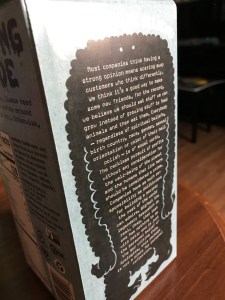
We started out, after much research, using soy milk.  It has to be a particular brand, though, because it can have an oily taste.  We eventually switched to oat milk.  Unlike soy, I can actually drink it like regular milk.  We’ve been buying Planet Oat, but recently we tried Oatly.  Now, I’m one for a working breakfast.  Time is precious and work begins uncompromisingly early.  That means I don’t read cereal boxes or milk cartons any more.  That changed with Oatly.  I found an entertaining and eloquently stated kind of creed on the back of the carton.  When’s the last time someone brought spirituality to the breakfast table (apart from introducing the eating breakfast cereal craze)?  It makes me feel more grounded.

The intricately interconnected web of life makes me think that we should be cognizant of our food.  What we eat should be approached reflectively.  If we had government subsidies for fields of oats rather than industrial farms for the inhumane treatment of “food animals” it seems to me the world would be in a better place, spiritually.  There’s been some comeback of wildlife since Covid-19 forced us all indoors.  I am glad to see it.  These creatures are our siblings.  Even if that seems to be going too far, it’s becoming increasingly difficult to deny that animals have emotions and minds, particularly those that humans eat.  Given the foodieness of contemporary society (everyone’s talking about food rather worshipfully these days) it would seem that pondering at least how we treat animals before we eat them should be a matter of common courtesy.  Being so far removed from our sources of sustenance has done something to us, I fear.  There are great alternatives out there, and some even make you smile while munching your cereal.


Rest and Be Thankful

Many years on Thanksgiving I find myself distressed.  Don’t get me wrong, I’m thankful for all the good things in my life—and they are more than I regularly stop to count—but life has a way of tossing reality bombs into the mix.  This year, though, there is much for which I’m feeling particularly grateful.  Family and friends foremost.  Fairly good health and a day or two off work.  These are all wonderful.  This year gave us a couple more great gifts: the rejection of a leader who always and only thought of himself and convinced millions that he cared for their interests and beliefs.  A “leader” who refused to acknowledge defeat but just this week began a transition that should’ve begun nearly three weeks ago.  Many are inexpressibly thankful for this.

Although on a much smaller scale, I’m thankful for Nightmares.  Nightmares with the Bible, that is.  Although it’s expensive (I’ll thankfully give a discount code to all askers), it is with a publisher that will promote it better than Holy Horror.  It was a very pleasant surprise to receive the book before Thanksgiving, even with its Halloweenish theme.  Anyone who puts years of their life into a project knows the gratitude in seeing it come to fruition.  Nightmares was a labor of love and I hope all who venture to read it will be thankful that they did.  I know I”m grateful for having lots of other book ideas.  That’s one area where there’s a substantial surplus.

Like many people I’m becoming aware of the dark under-narrative to the American Thanksgiving myth.  What we were presented in state-sanctioned school curricula was a story of grateful pilgrims wanting to share abundance with the American Indians.  History shows that their motivations in colonizing were actually subjugation and making slaves of the indigenous people, something we now recognize as a form of evil.  Such lessons are difficult to learn as an adult when the holiday has so many happy, cozy memories associated with it.  We have just been through four years of national chaos in which “othering” became a wedge intended to fracture the fragile unity of this country.  Yes, the guilt is real.  We cannot, or at least should not, deny what history reveals about our motives.  Instead we should widen our tables.  Invite others to join us.  (Virtually this year.)    And be truly thankful for the many good things—some very large, and others very small—which we have.


Timely Terror

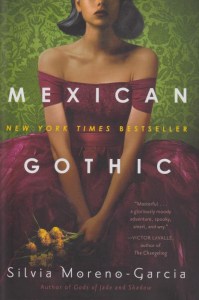
Fear comes in many colors.  Silvia Moreno-Garcia’s Mexican Gothic was getting such positive press that I didn’t wait for the paperback.  At first the title threw me a bit, but creepy old houses can be found in many places around the world, and the gothic often lurks in such structures.  The story builds slowly until the supernatural begins to seep in steadily and the reader realizes they’ve been hooked along the way.  In some ways it reminded me of Jeff VanderMeer’s Annihilation, but the setting in Mexico gives Moreno-Garcia’s tale its own kind of zest.  Having a strong hispanic, female protagonist is a nice corrective to the political rhetoric we’ve been fed for the past four years.  As I said, fear comes in many colors.

Perhaps I’m not as afraid as I used to be when I read fiction.  Gothic, however, is all about setting the right mood.  It’s a creepy sensation that boundaries are being crossed and such things often take place in isolated locations.  The house owned by the Doyles—not exactly colonialists, but symbols are seldom exact matches—is marked by greed and power.  A kind of rot is everywhere evident, but the family must keep power within its own circle.  The parallels to a Trumpian outlook were perhaps not intentional, but national trauma can make you see things in a different way.  As Noemí attempts to rescue her cousin from the house, High Place itself participates in thwarting their escape.

Reflection after reading draws out some further insights.  Not only is the white Doyle family the  oppressive element here, they do so by religion.  Secret rituals and practices have made the patriarch a god—and here let the reader ponder—who builds his power on the oppression of others.  I have no idea if Moreno-Garcia was influenced by the nepotistic White House we’ve just experienced—eager to use political office for overt personal gain, and yes, worship—but she’s laid bare the ugly truths of white power.  I dislike racializing people, but race was invented by Europeans as a mean of oppression and keeping wealth within the grasp of a few individuals who would be surrounded by an empowered “white” race.  It worked in Nazi Germany and it came close to working officially in the United States that fought to vanquish it just seventy years ago.  Mexican Gothic is a moody book indeed.  It’s also a book, whether intentionally or not, that is an object lesson for our times.


Toilet Paper Redux

So we find ourselves needing to clean up again.  Maybe you’ve noticed it too.  Since the second wave of the Covid-19 outbreak has wiped across the nation toilet paper has once again become a hot commodity.  Not finding a single roll in Target, I decided to test the waters on Amazon.  Sure enough, many brands are now listed as “out of stock.”  Could it be a coincidence that Trump will be leaving office and we need a lot of toilet paper right now?  Inquiring minds want to know!  Capitalism is like that.  Supply (or lack thereof) and demand.  Instead of making sure people have access to the basic necessities, we would rather have panicky citizens with soiled underwear looking for leadership where none exists.  And voting for lack of leadership yet again.  Flush!

Still, you’ve got to wonder—why toilet paper?  What is it about thin paper on a roll that presses the fear factor?  If people can know to avoid embarrassing smells, why haven’t they plugged their noses when the breeze blows across Pennsylvania Avenue?  Logic fails here.  Have we educated a nation to fear for their backsides but not to see clear and president danger in front of them?  Now that we’re nearing two weeks since the results were announced, we have had nothing but pouting from the Oval Office.  That, and drilling in the Arctic Wildlife Refuge.  Seems like we’ve got to be dirtying the world somehow.  We could use some toilet paper.  Maybe America needs more fiber in its diet.

Those who still support Trump don’t seem to realize that his response (or lack thereof) is the main reason a quarter-million people have died in this country and the virus is completely out of control.  I guess it’s that way with messianic figures.  Ironically the Bible (printed on thin paper itself) warns of someone who acts messianic while lying all the time.  He’s called the Antichrist.  You can tell him because just about everything Jesus did, he does the opposite.  Welcome the foreigner?  Feed the hungry?  Heal the sick?  Talk about God and how to deepen your relationship with the divine all the time?  Have you got any boxes checked yet?  Or are you waiting for the Charmin supply truck to go rolling on by?  Perhaps it’s time to invest in paper.  We print our money on it and hope somehow it will save us.

White gold or pay dirt?


Raven Wisdom

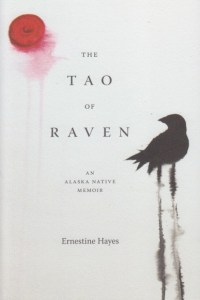
Just twenty pages in and I was reflecting on how Christianities and the cultures they cultivated have caused so much suffering in the world.  Assuming there is only one way to be, and that way is pink, European, and monotheistic, has led to so many displaced people thrown aside as collateral damage.  Ernestine Hayes’ The Tao of Raven is a remarkable book.  A native Alaskan, Hayes participated in the colonialist venture of higher education to try to also participate in the “American dream.” If this book doesn’t make you feel uncomfortable in your own skin, I don’t know that you’re human.  As I mentioned in a recent post, I have a deep interest and lasting guilt to learn about indigenous peoples of the country where I was born.  About the culture that is so Bible-driven it can’t see the human beneath.  The capitalism that takes no prisoners.

The Tao of Raven is one of the most honest books I’ve ever read.  Hayes refuses to sugar-coat the alcoholism, the broken promises, the poverty offered to native Alaskans.  Even as Trump’s final rages go on, he has opened the Alaskan Wildlife Refuge for drilling, to the highest bidder.  Apart from those whose wealth will increase as a result, we will all suffer.  Those who lived in Alaska before the colonists arrived the most.  The idea of colonizing, without which capitalism just can’t work, reveals its evil here.  When a voice like that of Hayes is able to make itself heard we cannot but feel the condemnation.  When over seventy-million people vote for a hater, we all tremble.

The book ends much as it begins.  A sincere regret for those who’d been fed the contradictory messages of missionaries.  Those told to accept suffering on earth so that they could go to the white person’s Heaven, while those inflicting the suffering lead comfortable lives with modern conveniences.  The double-standards that allow people to die on the street like dogs.  The double-standards that can’t see that you need not be Christian to upend the tables of money-changers.  Indeed, the last time someone dared to such a thing was two millennia ago.  When Christianity slipped its fingers between those of capitalism a monster would surely be born.  The cost would come in human lives, even as a quarter-million lay dead in this country from a virus a rich man can’t be bothered to address.  Do yourself, do the world a favor.  Read this book.  Read it with your eyes open and learn from Raven.


Black Bible

In such a bibliocentric culture, I wonder why we lack curiosity about the Bible.  Not only do we not study it much in religion classes, we often accept it as a fixed cultural object.  Saying that it’s the word of God, as if that explains anything, many Protestant groups take it as the 39 books of the “Old Testament” and the 27 of the New, ignoring the 66 total that stands like a warning sign of impending idolatry.  Roman Catholics and some Anglicans add the books of the Apocrypha, or Deuterocanon, bringing the number closer to 73 books.  I say “closer to” because some of these books seem to be expansions on other books already in the canon.  Over the years the National Council of Churches has added a few more books, considering various other groups (mostly Orthodox) that recognize some further works as canonical.

In this era of recognizing the importance of black lives and black culture, I’m amazed there’s so little curiosity about the Ethiopian Orthodox canon.  I’ve spoken to many biblical scholars who could care less that the fantastic books of Jubilees and 1 Enoch are in the canon of the Ethiopian and Eritrean Orthodox Churches.  It’s almost as if these groups simply don’t matter in the world of Christendom.  I note that biblical scholars I ask about this are usually Protestant or Catholic themselves.  It seems to me almost a racist slight not to include books that are recognized among some Christian groups, but not others.

What is the scientific criterion for determining a book is the word of God or not?  It surely can’t be fear of contradiction, for the Protestant Bible—the briefest in mainstream Christendom—has plenty of contradictions of its own.  The Bible itself famously does not name the books included.  Various authorities made decisions at various points about which books should be included and which should be left out.  It is such a very human process.  But when it comes to including the books of churches that total nearly 40 million members, suddenly people just aren’t that curious.  Those of us interested in demons have to take Jubilees and 1 Enoch seriously.  They are fascinating books.  And Biblical for millions of people.  The past several years have made me think quite seriously about the borders built around the Bible.  Whose choice is it not to include books already in the canon for their neighbors?  Or, as might be more accurate, who has the authority to cut out books that already belong for many African Christians?


Constipated Democracy

Vows apparently mean nothing anymore.  I suppose that’s what happens when you begin your administration with “alternative facts” and keep it up for four years.  When you vow to uphold the Constitution—hand on the Bible—that means you’ll play by the rules.  Instead we find ourselves with a bad case of constitutional constipation and we all know that we need a national enema.  It has been a week now since it’s been mathematically impossible for Trump to win the electoral college.  Yet even his evangelical followers can’t seem to recall that hand on the Bible, that promise to obey.  Apparently it’s okay to lie before God, if you think like we do.  If you don’t want to have conversation but want to talk at others and say you’re right.  It saddens me that so many Americans simply don’t care what the majority clearly wants.

This is especially the case because Trump is being treated as some messianic figure.  An overweight, womanizing, pathologically lying Jesus.  And people are saying, “Yes, that’s what the Bible tells us is good, and right, and just.”  Those who are settled in good paying jobs—people of my generation—have been beneficiaries of the systems of education and government programs that the Trump administration has spent four years dismantling.  And they have the audacity to call themselves Christian while their lives are saying “I got mine, I don’t care about anybody else.”  And they’re the ones who wore WWJD paraphernalia just a couple decades ago.  WHCB?  What Has Christianity Become?

Many of us (the excluded majority, in fact—Trump won the 2016 election while losing the popular vote) knew the greatest danger would be that he would be “normalized.”  This would all come to be seen as the normal course of politics.  People from Trump’s own family have gone on record that his run for office was a publicity stunt meant to drum up business for his failing empire.  And those who acted/wrote/supposed that he had any “plan” or “strategy” at all were simply failing to see a career grifter fleecing the country while playing golf and having his “fixers” do the work.  Until he one-by-one threw them under the bus.  This was all done in the public eye and yet his followers think he really has the best interests of this country at heart.  He has torn countless families apart, and not just at the border.  And now that he’s been defeated he keeps the charade going while his followers bow down and worship.  Excuse me, but I think I need to use the restroom.


Childhood’s End

Childhood.  It’s a time of many lessons that we soon learn to apply to all of life.  One of those earliest lessons is “Don’t be a sore loser.”  When someone else wins you congratulate them with a smile, even if you’re inwardly aching.  Fair play, it’s called.  Or morality.  All of these characteristics are sadly lacking in the Grand Old Party, it seems.  There has been no evidence of voter fraud, Biden currently leads by over 5 million votes, and yet Trump refuses to concede.  Not only that, the dissembler in chief, Mitch McConnell encourages such behavior.  In my fundamentalist church you’d have failed Sunday School for less than that.  And where are the biblical literalists?  Right there with them, thumping their Bibles but not reading them.  What happened to turn the other cheek?  Or even, for God’s sake, an eye for an eye?

Instead the world is watching as a putatively grown man throws a temper tantrum about losing.  Hilary Clinton conceded on the night of the election.  I’m sure it didn’t feel good to do so.  Nor did it feel pleasant for the 44 other losing candidates (in fact, more) who had to go home with their hats in their hands.  Not content to act like a king, Trump is behaving like a monarch for life.  His followers, perhaps aware that Americans will never again put up with such a travesty of a presidency, insist that someone must’ve miscounted by about five million.  They won’t be content until they can count themselves, throwing away any ballots they disagree with.  And they’ll continue to call themselves Christians.  Because, like the Donald, they can.

I’ve reached the stage in life where childhood has become a lingering preoccupation.  I sure got some things wrong.  Not being a sore loser isn’t one of them, however.  Like all people I’ve lost my fair share of contests.  Sometimes the stakes have been very high.  If you want to retain any dignity or moral standing at all, you know you simply have to admit, “I lost.”  We knew as soon as Trump was nominated in 2016 that he wouldn’t admit he lost then, even if he had.  We knew four years ago he’d never admit he lost when he would.  The Republican enablers stoked those fires in which to burn the Constitution.  Some of us, at least 77 million at latest count, are tired of all this political theater.  Big boy pants, it seems, are difficult to locate this season.


Bible Lesson

I was recently reading the revised preface and “To the Reader” (in draft form) for the NRSVue.  In case alphabet soup’s not your thing, that’s the New Revised Standard Version updated edition.  Of the Bible.  As I read through these seldom referenced pages it occurred to me, not for the first time, the care and concern with which scholars approach the original text of the Bible.  No matter what Fundamentalists may say, we do not have the original text.  In some places the translations you read are the best guesses of those who’ve spent their lives trying to understand what an obviously corrupted copy was intended to reflect.  Such care reflects the widespread (but shrinking) sense that this text somehow magically informs daily lives and should lead to political action.  I’m sure Jesus would’ve arched an eyebrow over that.

Biblical scholarship is hampered by the fact that the manuscripts that have survived are copies of copies of copies (etc. etc.).  Translators—yes, including those of the King James Version and the New International Version—are making some informed guesses on an Urtext we simply don’t have.  Lives, however, are often sacrificed on the basis of the belief that we have here some object to be worshipped instead of read and understood.  I like to tell my skeptical friends that the Bible is actually full of really good things.  There’s some nasty stuff in there too, but we can learn from the parts that convey deep spiritual wisdom.  Listening to your elders is a good idea, but it’s not the same as worshipping them.

Humans have a deep desire to make things sacred.  Maybe it’s because after watching us muddle around down here we want to believe there’s something better out there.  It’s problematic, however, when we make an earthly object, put together by humans, into a deity.  There are those who get around this by claiming the Bible is from God in the original.  The point is we don’t have the original.  There are some words (especially in Hebrew) of which the connotation and denotation are unsure (for words have no inherent meaning).  Reading, we know, is a complex enterprise.  That’s why it takes years to master it and constant practice to maintain it.  Those who leave off reading after school may, I fear, fall back into literalism when they encounter a text.  Bible scholars take great care at trying to reconstruct the original, and all of that can be undone by a failure to just keep reading.


Favorite Color

Blue has always been my favorite color.  Even growing up Republican, I preferred it.  Like many Americans I awoke last Wednesday to a national map mostly red and pink, and watched gradually as more and more states turned blue.  I don’t mind confessing I wept when Biden took the lead in Pennsylvania.  These past four years have been torture against all that’s descent and humane.  White people killing blacks and being told there are very fine people on both sides of the issue.  Watching a virus run out of control here like nowhere else in the world because one man can’t be bothered with the troubles of 330 million (stop and think about that number) people.  A man personally enriching himself while not paying his own taxes and getting breaks for those wealthy like himself.  Endless lies.  Loud, brash, and crude.  Groping women as if they are commodities to be owned.

We have, at the embarrassingly late age of 244, finally elected a female vice-president.  Many other nations have realized that gender should not be the basis for electing leaders.  Poisoned by various forms of Christianity that assert male superiority, our culture has feared female leadership since it has become a real possibility.  I voted for Geraldine Ferraro as much as for Walter Mondale in that fateful year of 1984.  We’ve actually reached Orwell’s vision of it in 2016, but now it seems there might be legitimate hope.  I could never have imagined a presidency that would make me think Nixon, Reagan, and Bush weren’t so bad after all.  (And they weren’t good.)  This reconstruction of the Republican Party has been courtesy of the religious right, which is really neither.

Today, however, I’m enjoying my favorite color and thinking that hopefully we’ll have some peaceful years to work on true equity and the ideals on which this nation was founded.  I’m hoping it will signal to the other fascists of the world that gaming elections only works if people with consciences are complacent.  I’ve been told that many Trump supporters think Democrats incite violence.  The Dems I know are tree-hugging, owl-saving, vegan types.  We value all people, even Republicans, and ask only that all people be accepted.  We don’t tote weapons to state houses or threaten those who are counting ballots.  Yes, we may fear election outcomes—we’re just humans—but we believe in the process.  The many protests in which I’ve marched over the past four years have all been peaceful.  And I breathe, as I tear up again at the sight of blue, dona nobis pacem.


State of the Nation

It has been a long week.  With an incumbent who refuses to tell the truth, we’ve faced three days of knuckle-biting so far and each day stirs up the butterflies of election day.  How we could’ve become a nation that is so easily duped into following a man who’s told a record number of bald-faced lies in the West Wing (and anywhere he appears, in fact) is an inscrutable mystery.  I guess many people don’t read.  Or think critically.  This should’ve been barely a contest at all.  The Associated Press national map is seared into my eyeballs like a computer monitor left on the same page too long without a screen saver.  Going back every few minutes to check for a touch more blue.  A sign of hope.  Meanwhile, 45 is doing his best to prevent votes already cast from being counted.

We’re a nation under extreme stress.  Whoever wins will need to bring deeply divided people back together, but here’s the rub.  We know from four years of terrible first-hand experience that Trump can’t do it.  Won’t even try.  He’s already compared himself to the greatest leaders we’ve ever had.  He has no reason, and no capacity to change.  Joe Biden is about as mild a Democrat as they come.  In saner times he’d likely have been considered a closet Republican.  Still, 45’s supporters rail as if he’s some socialist seeking to overturn the American system.  Excuse me, but look at the past four years—what precisely do you think was overturned during them?  The coronavirus rages, hitting record numbers.  The response from the White House?  Absolutely nothing.

Even with this there’s uncertainty in the air.  I wonder what America’s collective blood pressure is right now?  I know my systolic doesn’t feel too good.  Any legitimate leader would never fear an honest election.  One who tries to tamper with the results has already shown his true character.  And priorities.  And so we wait.  Yesterday the lines from V kept going through my head—“Remember, remember, the fifth of November.”  I finished the poem somewhat differently but the word “treason” remained.  I could use a little fantasy just about now.  As I write this the counters are all asleep.  Biden leads in the popular vote by almost four million, a greater lead than Hillary had just four years ago.  And it is now November 6, but just barely.  At least it’s Friday.  We need to appreciate the small things as they come.


Looking to the Stars

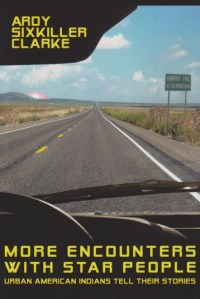
American Indian culture fascinates me.  As my usual readers know, so does the unusual.  A few years back I read Ardy Sixkiller Clarke’s Encounters with Star People.  Clarke is an American Indian who holds a Ph.D. and had several years of university teaching and administration to her credit.  She has degrees in psychology and education.  In other words, she’s credible.  Being American Indian she’s also aware of the cultural belief in star people.  Those of European descent, often expressing their self-supposed superiority, deny such things exist.  Interestingly the mainstream media seems to have taken an interest in the subject of UFOs lately, and that is also the phenomenon that Clarke investigates in her books.  Her follow-up More Encounters with Star People: Urban American Indians Tell Their Stories is another compelling glimpse into a different way of looking at the world.

The book consists of contextualized interviews with people of American Indian ancestry, and, as Clarke points out, with nothing to gain by telling their stories.  They don’t want their names or locations to be revealed.  They don’t want money.  Many of them don’t even want to be mentioned in a book.  These stories will take you into very strange places.  Places without the filters most of Anglo culture puts before anything that might hint at the paranormal.  I’m intrigued by the nearly universal (outside a narrow European outlook) belief that the world is not as it seems.  Because European-based cultures developed the most sophisticated weaponry and an economic system that takes no prisoners, its view, by default is considered the accurate one.  Time may tell on that.

I read quite frequently about indigenous cultures.  Often widely separated and not in any direct contact, such groups often drew very similar conclusions about the world.  These views are actually shared by those of European stock, but only when carefully labeled as fiction: fantasy, science fiction, speculative stories of any sort.  All of these are widely consumed.  They are also safely considered “not real.”  I’ve been rewatching The X-Files over the past several months.  Its success and its continuing fan base show that as long as we can agree that we’re watching something not true, we enjoy monsters and aliens.  And besides, Halloween wasn’t that long ago.  Still, I wonder if we’re missing out on things we might learn if we’d be willing to consider what the original inhabitants of this continent have believed.  It would take us to some strange places, but we might just emerge wiser.