Silent Sundays

Since walks in the outdoors are a good thing, according to government guidelines, my family has been taking them.  Actually, we tend to take walks anyway since sitting before a screen all day is anything but natural.  One fact we’ve noticed on our perambulations through town is that many churches, as a standard of caution, aren’t holding their usual meetings.  The governor here in Pennsylvania hasn’t ordered churches closed—the fine line between church and state is easily violated—but many of the civic-minded religious are able to draw their own conclusions.  The church I attend has gone to virtual services.  In any case, I’m seeing news stories of clergy, particularly on the far-right end of the spectrum, insisting that the show must go on.  Ignoring government guidelines, they try to cram in as many people as they can until the police come along to limit the size of gatherings.

Throughout history religion has generally been in league with local governments.  We don’t know all the religions that have ever existed, but it is clear that some of the first counter-cultural believers were early Christians.  They defied government orders and sometimes died for it.  Today it’s more likely to end up in a stern rebuke or simply being sent home where the rest of us are sheltering in place.  I read this week about a church that’s encouraging cardboard cutouts of congregants so they can see themselves sitting in the pews during virtual Sunday morning services.  At times like this I think back over the history of religions and reflect on how the COVID-19 situation is one entirely new; we’ve never had a pandemic with the internet before.  And pastors can announce online that defying the government is on the docket for Sunday morning.

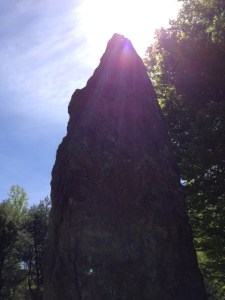
We weren’t the only ones with the idea of visiting Columcille yesterday.  An outdoor megalith park, Columcille is a place for spiritual reflection.  Since the vernal equinox passed virtually unnoticed this year, it was rejuvenating to take a springtime walk in the park.  Yes, others were there, widely spaced, but we walked the trails and visited the standing stones as a family group, keeping away from other gatherings.  We spent some time watching the new life emerging from the forest floor.  It’s only March but spring has sent its signals to the plant world and green shoots are reaching for the sun before trees leaf out and block the light.  It’s a wonder and a source of awe.  And in its own way, it’s a kind of gathering we might call church.

Proceeding 17-108

This is important!  Please share it.  If you don’t like sharing blog posts please at least share this link: https://www.fcc.gov/ecfs/filings/express.  During this time of international crisis, American politicians have decided to discuss making the internet free again.  But because a certain political party doesn’t want this, they are doing it in an obscure way.  Since many people are working remotely and their livelihoods depend on internet connectivity, the FCC is accepting public comments on Proceeding 17-108, whether to restore internet neutrality or not.  The form will take you only two minutes to fill out but you’ll need “Proceeding 17-108” and your zip code plus four.  And you’ll need to hit “enter” after filling in your name.  The very form seems designed to discourage public input.  This is not a joke.

I had sincerely hoped that the COVID-19 crisis would bring out the best in the GOP.  It hasn’t yet.  Hearing the recorded comments of people like Mitch McConnell on how the Republican Party really doesn’t want to offer any stimulus packages but realizes that the economy will grind to a halt without them, my faith in the human spirit tanked.  Not only that, but now that internet neutrality, which is the very way life goes on for many of us, is back open for public input, Ajit Pai is doing his best to make sure people don’t know about it.  Please take just a moment to go to the FCC website and make your voice heard.  And please share this.  If you’re reading this post, remember, you’re using the internet.

Maybe it’s just living life “under the dome” that makes me feel this is so important.  Right now my entire family is working remotely.  Our house looks like a computer lab.  Big Cable, since the end of net neutrality, has been allowed to drop users into “slow lanes” on the web, unless they are supporting causes those companies want.  This has ended up wasting a lot of time for those of us who rely on the net for our daily bread.  You can make your voice heard.  This crisis is the opportunity to say something.  Please do.  In the best of all possible worlds, or even in a pretty good world, governments would listen to the will of the governed.  We’ve been caught in a loop where the governed are exploited for personal gain.  The coronavirus has led to the rare chance to make your voice heard.  Tell the FCC what you think.  And please share the link.


Virtual Church

All the way back in seminary my friends and I used to joke about virtual church.  What made it so funny was that the idea seemed ridiculous.  The very raison d’être for church (which essentially means “gathering”) was, well, gathering.  We joshed about putting a communion card into an ATM and getting bread and wine.  Little did we know we’d live to see virtual church become a reality.  While I prefer not to tip my hand as to my affiliation (I began doing this when teaching at secular schools, for if a professor of religion is being academic about their specialization their affiliation should have no bearing on the class) I confess I am the member of a religious community.  That community has become virtual, as of today.

This isn’t a permanent thing.  Unless coronavirus is a permanent thing.  As I spoke with my clergy person about it, I wondered how many people would attend virtual services.  Sermons would need to be stellar.  Who would hear if I tried to sing hymns (this is not a pretty thing, take my word for it)?  My laptop doesn’t even have a disc slot into which I could insert my offering.  Churches, synagogues, mosques—they’re about community.  What does community feel like when you’re sitting there in your pajamas, at least on the part that the webcam doesn’t pick up?  Does the minister see you in virtual church?  Have I, like number 6, been reduced to a numeral?  I suspect the current crisis is going to be a real test for faith communities.  Meeting together would make us all feel like snake-handlers now.

The funny thing was, back in seminary it was a joke.  At Boston University School of Theology in the late 1980s we knew that churches weren’t really growing.  Some megas had started and we now see them following the mushroom cloud to its dissipation stage.  As little as we meant it, we could see devices creeping into the mix.  I did not use a computer until after seminary.  Funnily enough, thinking back to the pre-1990s, we survived without cell phones.  If you were going to church you were going. To. Church.  These days of pandemic in the pews will be a real test of the preacher’s power.  For Episcopalians the mediating of grace had to be done in person.  I remember watching worriedly as the priest, clearly with a sniffle, was the first one to take a sip from the community chalice before holding it out for others to drink.  We wondered about efficacy of ATMs dispensing consecrated hosts.  It was only a joke, then; really it was.


Travel Ban

I’m not at home.  I know in the current crisis that sounds like heresy, but I can honestly say that getting out of the usual routine where COVID-19 is all you hear about feels right.  More and more organizations are instituting work from home policies—many of them mandatory.  I’ve worked from home for going on two years now.  You need to get out a bit.  I know travel isn’t recommended, but I’m really not afraid to die.  Besides, I put a box of latex gloves in the car and when we stopped for a restroom break, wore them until they could be safely removed.  Exposed surfaces in the rest area were being continually wiped down.  Don’t get me wrong—for an introvert like me working at home is fine.  It’s just the idea of feeling like this virus is some zombie apocalypse happening just outside my door that I needed to dispel.

When I told a friend I was no longer going to be commuting on a regular basis he said if it were him he’d only ever buy sweatpants again.  Now that my reality is life with my wife being the only person I regularly see, I’m beginning to realize just how much our clothes purchases are for impressing others.  My haberdashery is akin to that of Henry David Thoreau; I wear clothes until they’re no longer functional.  They can be badly out of date but they still work.  The fashion industry is built on pride.  To put it in the words of my old friend Qohelet, vanity.  We want others to see what we’re wearing.  If we’re still donning last year’s gay apparel we’re not playing the game.  Never mind those of us whose wardrobes could be carbon-dated.  The pandemic can be revealing.

So I’m away from home for what is really the first time in months.  I had to stop in the grocery store for a few things.  Only one person I saw was wearing a mask, but I was wearing prophylactics, so who’s going to cast the first stone?  Many shelves were bare.  The CDC has become our new gospel provider.  I’m limiting my outside exposure.  Driving door to door, greeting no-one along the way (that actually is the gospel, but substitute the walking for the driving part).  I know when this weekend’s over I’ll be back to my cloistered existence as the rest of the world tries to get used to the loneliness of the sweatpants crowd.  If you’re one of them take it from me—the rest of the world is still out there.


Die Besuch

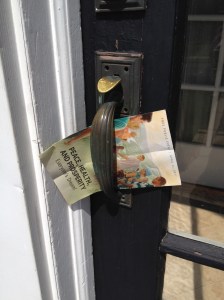
It was both sweet and perhaps misguided.  I’ve not written much about the coronavirus because I’ve really had nothing to say on the pandemic.  Also I’m squeamish.  Being a remote worker I spend most of my time alone anyway.  So when the knock came to my door, I wasn’t sure I should answer.  Afraid that some vital bit of information was to be conveyed, I gave in.  Two young ladies stood there and at first I thought they were selling Girl Scout cookies, but one of them had some copies of The Watchtower in a folder and I knew that the Jehovah’s Witnesses had come calling.  I didn’t invite them in.  I don’t mean to be inhospitable, but those who go around knocking on doors might have been exposed to who knows what.  They were here, the older one said, to give good news.

Although she didn’t mention the coronavirus directly, she said people were feeling anxious.  But God—our creator—had promised everything would work out.  She read me Revelation 21.4, about God wiping every tear from our eyes, from an iPad.  I’ve read that verse many times on my own, and, tainted with decades of specialist knowledge, knew a good deal about the context in which it was written.  The Witnesses didn’t stay long.  As they walked away I couldn’t help but think how this current scare has been affecting us all.  We are afraid.  I don’t need any advice when it comes to social distancing (I am an introvert, after all), but there’s a kind of hopelessness afoot.  I don’t read the papers but every headline is about the virus.  The world seems awfully quiet.

This will go down in history, I suspect, as a strange episode.  I feel guilty for conducting normal business, as if there is anything I could do to prevent the disease beyond isolating myself even further.  It’s perhaps the waiting.  Those of us in circumstances where joy is more fleeting than a visit from the Jehovah’s Witnesses often invest huge amounts of time waiting for things to get better.  The news, for example, that a piece has been accepted for publication.  Or that a long wished for promotion has come.  Or that somebody has actually read your book.  Such news is rare indeed and outside a disease rages out of control.  What else beyond missionary zeal would send you to strangers’ doors at such a time as this?  They didn’t even leave any tracts.


Merch

I recall the time I first heard the word “merch” used as a verb.  I was with some wonderful ladies on the second annual Women’s March, in New York City.  We had to leave fairly early to get there from Jersey and as we made our way to the march route, we saw the goods.  Vendors had all kinds of things on sale, from the ubiquitous tee-shirt to refrigerator magnets.  One of the women in the group said, “I guess you can merch anything.”  And so you can.  People will buy all kinds of identifying marks.  It’s a craze I personally don’t get into.  I buy plain clothes, having more of an Amish aesthetic.  Still, I was a little surprised to notice that the Society of Biblical Literature is now merching itself.

Now, who can blame a non-profit for trying to score a little on the side?  We all know what that’s like.  What I find myself most curious about is who would want to advertise that they’re working on a degree that will, in all likelihood, find them on the breadline when it’s all over?  I’ve known many who’re proud to be nerds—they’ve got employment to give them creds.  Those of us tormented by the meaning of it all, not so much.  My decision to go to grad school was accompanied by the blessed assurance that there’d be plenty of opportunities, but there was no merch.  Indeed, I was two years into my doctorate before  I even found out what the SBL was—the great connector whence came jobs.  At least in theory.  I found my post at Nashotah House because a friend told me about it.  I still have some of their merch.

Knowing what I do now, would I have done it any differently?  It’s difficult to say.  Who can recall the frame of mind of his younger self with such clarity as to know his choices?  Having studied Bible I was curious whence it came—to turn back even further the pages of history.  As I sit here in the early morning I have on my last two remaining pieces of Edinburgh merch.  My moth-eaten woolen divinity scarf and my blue alma mater sweatshirt.  I try hard not to think how close to three decades ago it was.  I was so sure I’d find a job with that rare Scottish degree, imprint of John Knox’s breeches still fresh upon my head.  Instead the merch of my current employer—a coffee mug—stands before me, reminding me that work alone awaits.


Half of Us

Today is International Women’s Day.  We need to pause a moment and think.  We can’t change the past, but we can improve on it.  I think it’s fair to say that historically—before the Enlightenment anyway—domestic arrangements were the product of evolution rather than intention.  Like religion, however, domestic arrangements have a difficult time keeping up with change in real time.  By the time healthcare improved and women’s chances of surviving childbearing grew, men had become set in their ways.  Even now we still have trouble getting a female on a presidential ballot in “the most advanced” country in the world.  The week before International Women’s Day Elizabeth Warren stepped out of the race.  The rational world is so desperate to get the anomaly out of the White House that it hasn’t really dawned what a lost opportunity this was.

Although for most of history their roles have been hidden, half the advances of the human race belong fairly to women.  Males often have difficulty admitting that they require help, or had any assistance getting to where they are.  In fact, though, we know they had mothers and those mothers helped make them who they were.  Many of them had spouses who kept the situation stable enough that they could go on and follow their preoccupations.  History, unfortunately, would record only the names of the men.  In the western world this was often reflected in the changing of names during marriage.  Domesticity comes with a price, but it can be balanced out.

Capitalism, it seems to me, rewards the greedy.  Instead of evening things out so that those who don’t have the same opportunities can be cared for, our economic system rewards selfishness.  I often wonder if women would’ve been so suppressed had a more humane measure of human worth been adopted.  When I think of billionaires whose names I’ve never heard of before, I always mentally add, “they wouldn’t be billionaires if the rest of us refused to play the game.”  It’s only because we agree to an arbitrary and artificial valuing system that we allow the obscure to “own” far more than the rest of us.  Women, it seems to me, would know the realities of this way better than most men do.  What if the value system we shared measured worth in having had a mother?  It’s something we all share.  Yet in this nation we still haven’t passed the Equal Rights Amendment.  The time has come to ask ourselves what’s really important.  Today should be the answer.


Without Peer

Peer review makes the world go round.  Well, at least the academic world.  It’s based on a simple enough premise: if your academic work is passable other scholars will be able to tell.  It’s a process fraught with peril, however.  Scholars, being human, are subject to fits of pique or of hypersensitivity, or just having gotten out of the wrong side of bed that morning.  Perfectly good projects can be shot down with a single, well-placed arrow.  Or even dart.  Problem is, there’s no better system for deciding if academic work is adequate, or even good.  There may be some objective measure out there in the universe, but if there is we don’t have access to it.  We have to rely on peer review.

During my teaching years, which numbered nearly twenty, I was never asked to peer review anything.  My first invitation came while I was working as an editor.  Of course I said “yes.”  A number of scholars, however, don’t share the basic reality that if nobody peer reviewed their work, they’d never get published.  Many scholars decline offers to review their colleagues’ work.  I even had a very senior scholar once blithely tell me that he had his own research to do, so why should he take time to review that of others.  Professional reserve prevented me from pointing out that if his colleagues felt the same way he’d be as unpublished as a fresh doctorate-holder.  Scholarship is a cooperative venture, no matter how many Lone Rangers ride the cuesta.  So why is it so difficult to find peer reviewers?

I’ll read your book if you’ll read mine!

Something I’ve noticed is that many scholars are coddled.  Constantly told that they’re brilliant and gifted, they come to believe it like miniature Trumps.  More to the point, perhaps, is the shrinking number of academic positions.  The few who hold actual jobs are bombarded with other tasks, including committee work, advisory duties, and sometimes even teaching (depending on the adjunct pool).  I know it’s tough.  Been there, done that.  Nevertheless, academia cannot survive without the basic peer reviewer.  Education is a cooperative venture.  We may imagine the academic alone in her or his study, but breakthroughs generally come through when people work together.  Of course, my job is one performed in isolation.  Increasingly, academics can be found not in their offices, but working remotely from home.  Is the sense of “peer” itself breaking down?  My own book, Nightmares with the Bible, was slowed down by peer review.  In a sense I’m glad it was.  Hi ho Silver, away!


CBD

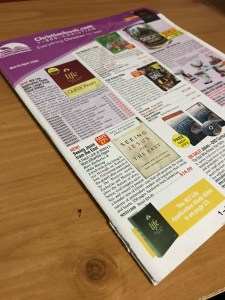
They found me.  I used to call them CBD, but because of the popularity of a certain hemp-based product, Christian Book Distributors changed its name.  Now I knew about them long before they had me on their mailing list when I taught at Nashotah House.  When I was a seminary student in Boston I made occasional trips to CBD’s Peabody warehouse for sales—this was quite a boon to students who never have enough money (little did I know!).  Books you’d heard about in class were there, for a fraction of the price.  At Nashotah I always looked over their bargain page, because, well, professors like books.  I recognized their catalogue in my mailbox instantly.  The name is now Christianbooks.com.  Grab some munchies and sit down.

Not only the name has changed.  Back in my student days I could find academic resources here.  As religion in America has become more and more polarized, what used to be CBD (if I use their current incarnation my computer insists on putting links in) has become radically conservative.  Page after page of study Bibles reveal no hint of the mainstream bestsellers in the genre.  It’s as if they don’t exist.  More than that, if you leave them out maybe people will come to believe they don’t exist.  Even the bargain books are nothing an erstwhile professor would buy.  Instead of academic titles there are all kinds of Barnes & Noble-type gimmicks to get shoppers to spend their money.  Like junk food for the soul.  I look at the books on my shelf.  Some of them were purchased, cash in hand on the ground in Peabody.  Not any more.

There will be those who claim (fake news is the only news now) that what has changed is me, not them.  The fact is places like CBD used to be more open minded.  They admitted the possibility of doubt.  Now your choices are Scofield or Ryrie.  That should be enough for any appetite.  Not only that, but many of the titles now sound militaristic.  Battlefields and all.  Thumbing through, I wonder where Jesus has gone.  The evangelicalism of my youth was clearly Prince of Peace centered.  Now it’s politicized to the point that I’m not sure what it represents beyond GOP values of greed, opportunism, and power.  Anyone who thinks differently need not apply.  How CBD found me after all these years, I do not know.  I wish they’d consider saving the environment rather than printing catalogues to send me.  The climate, despite what they would claim, has changed.


Future Warming

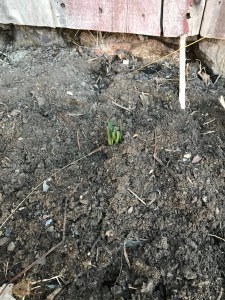
It’s a good thing global warming is a myth, but somebody forgot to tell the hyacinths and lilies in my backyard.  February in Pennsylvania is not when you expect to see spring flowers.  Now I’m fully aware that unseasonal warm snaps and cold spells aren’t an indication of the global climate; they’re far too localized.  One thing I’ve learned in my several decades of life is that heat takes time to transfer.  If you’ve ever had to wait for a pan of water to boil when you’re hungry, you know that to be true.  On cold morning’s my coffee’s ice coffee before I finish the mug, but it does take time for that transition to happen as the cup empties.  With something so inconceivably large as the atmosphere, it takes time.  As our hemispheres take turns pointing at the sun and warming up, the air tries to reach equilibrium and so the weather goes.

Scientists are now talking about, once we get the deniers out of the White House, what long-term remediation plans we have to make.  We’ve already set in motion extreme weather events.  We’ve had decades of warning, but those who control the money just can’t bear to let any of it go.  It’s a safer bet to wreck the planet.  You can just cash in your insurance money and buy a new one.  That’s the way it works, isn’t it?  So I’m standing outside in my shirtsleeves in February staring at April flowers who think winter’s over already.  I don’t know what to say to them.

You can’t drive a car without a license, nor can you practice law or medicine.  To be a world leader you don’t even have to be literate.  I often imagine what the future survivors will say.  They’ll likely be there, since people have a way of getting by.  They may wonder if we knew this was coming.  Of course, the internet won’t be up and running then, and who knows what’ll happen to electronic information when there’s no power left to keep the servers going.  In any case, my perhaps futile answer to their imagined question is yes.  We did see this coming.  Some of tried every legitimate tool in the box called “democracy” (you’ll need a dictionary for that one) to introduce sanity into the discussion, but bluster wins over hard thinking every time.  I cup my hands around the tender, if resilient leaves.  They’re only doing as nature directs.  If only our species could pay such attention to what the planet is saying.


Hearts are Dark

For the most part, reading introductions to literary works is tedious.  Since this edition of Heart of Darkness was brief enough, and the introduction wasn’t as long as the novel, I decided to follow through.  I’m glad I did.  I’ve read Joseph Conrad’s classic before, but it was helpful to have pointed out before this reading just how much darkness is in the story.  Drawn in by Kurtz’s famous last words, I suspect, many readers make the heart of the darkness the life lived by this contradiction of a man.  An individual who’d set himself up as a deity, and who pillaged the region for his own gain.  A man who wasn’t above using terror to acquire his ends.  An enigma.

But in actual fact, the story is about as full of darkness as an early Bruce Springsteen album.  The story begins at sunset and ends at night.  There is darkness to the Europeans’ dealing with the Africans throughout.  Even Marlow participates in that interior darkness that seems present in all people.  Delivering the deceased Kurtz’s letters to his still grieving fiancée, he meets her as darkness is setting.  He lies about her beloved’s last words, preferring to preserve her feelings than to reveal the truth uttered upon the deathbed.  There are layers of interlaced darkness here and Conrad never gives a definitive statement about what it really is.

We live in dark times.  I suspect that, for someone somewhere, that will always be the case.  The corruption of our government is so blatant and obvious that we seem to have fallen under the shadow that must’ve driven Conrad to pen his novel.  When living in darkness it helps to have a guide who’s been there before.  No matter what evil Kurtz has perpetrated, he’s treated as a god by those he oppresses.  He knows their suggestibility and preys upon it.  Although slavery was no longer (officially) a reality when Conrad wrote, the attitudes—embarrassing in the extreme today—lingered.  Even more embarrassing is the reality that they linger even today.  Not just linger, but assert themselves and then deny that they exist.  This is the heart of darkness, I believe.  We cannot allow others to live in systems that don’t kick money back into our own.  Trade on our terms, with our worldview being the only legitimate one.  Like so many writers, Conrad has been made a prophet by history.  And we all know the horror.


Reading Education

Perhaps like me you’re afraid of the news.  Not because it’s fake, but because it’s real.  Then every once in a while curiosity gets the better of me and I uncover my eyes.  Sometimes you can’t help but see.  With the utter mess we’re in over here, it’s difficult to keep up with news from other countries we know.  I’ve lived in the United Kingdom and I’ve worked for British companies.  Needless to say, I wonder what’s going on over there from time to time.  Lately I’ve been getting auto-replies to my emails to British colleagues stating that they’re on strike.  I asked a friend in the UK about this.  It used to be the professorate was treated with some regard in Her Majesty’s domain.  Not being a financially minded person, I haven’t been aware of how deep or devastating our capitalism-induced recessions and depressions are.  Apparently they’ve been bad enough to derail even British higher education.

Compensation for the professorate has been eroded away.  Their pension plans have been depleted.  Knowing the problems we have over here with professors refusing to retire, I was surprised to learn the UK has the opposite problem—professors unable to afford to retire.  Now, lecturing isn’t physical labor, but class preparation (and committee work) take a considerable amount of effort.  I could see not retiring if it meant lecturing only, but with everything else required, not retiring would be, well, exhausting.  As over here the root of the problem is that higher education is the route into which many smart people are steered.  You’d think it’d be a wonderful problem to have too many highly educated people.  It’s not.  With advanced study comes advanced debt.  And limited employment prospects.

There are nations in the world where higher education is deeply valued.  Where educated people are respected.  Ironically, the nations enamored of capitalism aren’t those places.  The only learning that’s required is how to get money from someone else.  Beyond that, the rest is commentary.  British higher education has fallen on hard times since I read for my Edinburgh doctorate.  Schemes have been put in place to ensure faculty are being productive.  Yes, there are some lazy ones.  The majority, however, pull their weight and then some.  And now they’re being told they must do so until the grave.  No retired professor wants to spend her or his old age bagging groceries at Sainsbury’s.  And so they’re going on strike.  If only the world valued knowledge more than money there might be some news worth reading.


Families in Trees

Genealogy is one of those things that’s fascinating as long as it’s yours.  It’s not hard to lose a few (or many) hours, trying to find ancestral connections.  When someone you don’t know begins to tell you, however, about other people you’ve never heard of, your eyes begin to glaze over.  My wife kindly gave me a gift of a local genealogy class that we attended the other day.  Along with some dozen others we gathered to learn some tricks of the trade.  The presenter began by having us introduce ourselves, “briefly.”  It’s a dangerous move in a genealogical crowd.  A few of our fellow students went into great detail about their ancestors, forgetting, for the moment, that we were there to learn how to do the research, not to find out about their families.  It’s a natural enough mistake.

None of us ask to be born, and we spend our lives wondering why we are here.  How did our parents meet?  Where were they from?  What did they do?  And the generation before that?  Some time ago I figured out that, due to the exponential nature of ancestors, that by the time you get back to just eight “greats” before for your grandparents, it took over a thousand people to make you.  It boggles the mind.  Suddenly it seems as if there would never be enough chance encounters or arranged marriages or tumbles in the hay for you to ever get here.  So many ancestors!  By the time I was in college I’d managed to trace it back to almost sixteen family names.  I was able to break through a barrier on this just over a year ago when talking to some family members about a lost ancestor at the turn of the twentieth century.  Genealogy is a search for meaning.

Both my wife and I share this interest.  Of the dozen or so others at the session, four others were married couples.  Almost all of us had done the voluntary DNA test to find our nations of origins—to confirm or deny family stories.  And that’s what it’s really about: stories.  Although we may be squeamish about some aspects, we want to know where we came from, the story of how we arrived here.  As if there’s some cosmic clue in it that gives us information on why we’re here.  It brought several of us out on a February afternoon.  We didn’t know each other.  If we traced back far enough, however, we would have found we were all related.  We are all family.


Icelandic Gods

There’s a lot to like about Iceland.  It has geothermal heat.  The people are literate and proud of it.  They don’t have an army.  Viking heritage and northern lights—what an interesting place!  A friend recently sent me a satirical piece on Patheos titled “Iceland Declares All Religions Are Mental Disorders,” by Andrew Hall.  I may not be as naive as I once was, but I have to admit I was nearly taken in on the fly.  Maybe because the idea seems so much better than what we have over here in our warmer, but less educated world.  Clearly, however, religion is extremely important to people, and if it is a mental disorder it’s an essential one.  Hall mades the astute point that Iceland didn’t want to become like the United States.  Who would, at this point?

Although this is a satirical piece, like most satire it works because it has chunks of truth in it.  Countries run by religions do seem to get into quite a lot of trouble.  I often think this is primarily a monotheistic problem.  If a nation accepts many gods, then adding those of other peoples is hardly an issue.  With a single deity, however, there is a single truth.  Anyone different is, by default, wrong.  When entire nations self-identify with a religion, it is only too easy to begin seeing those who believe differently just across the border as a threat.  Faith becomes fight.  As if a deity who always claims to value peace is only satisfied when we’re killing those who don’t share our same peaceful outlook.  Irony and satire have met together, it seems.

I’ve never been to Iceland.  It’s on my bucket list.  As a rockhound, the volcanic nature of the place calls to me.  I do wonder, however, how a vegan might fare on a far northern island.  My times in Orkney are among my mental treasures.  Those northern Scottish isles were places of wonder.  Not the most options regarding comestibles, however.  What they lacked in food they made up for in magic.  Iceland, despite the satire’s bite, has a considerable population that believes in the little people.  Anyone who’s too quick to dismiss such things ought to spend some time in the far north.  Driving to the ancient sites of Orkney certainly shifted my perspective a bit.  There’s great value in listening to the wisdom of those relatively isolated from the rest of the world.  You might, however, have to bring your own beans.


A Stiff Salute

From the way he writes, Charles F. French was a Marine.  I don’t know that for certain, but those of us who venture into fiction put ourselves into our stories.  Those who blithely reject something into which you’ve poured yourself are either boorish or unfeeling.  Yes, even literary types can be so.  This year’s reading challenge includes a book from a local author.  Since I live within a (long) commuting distance of the city, I suppose I could count New York as local.  That felt like cheating, though.  To find local authors you have to haunt independent bookstores.  I do that anyway, and a few weeks ago I found a copy of French’s Maledicus.  It fit the bill.

Although the story is about the titular demon, the ensemble protagonists are mostly military men.  There’s a strong sense of combat-readiness among them, and a good deal about military honor.  I have to admit this made me a little sad.  Don’t get me wrong, I have respect for those who are willing to fight to protect their country.  I’m sad because we need military forces at all.  I’m also a born pacifist.  My father was a veteran of the Korean War.  The military was present at his otherwise sparsely attended funeral.  I grew up reading the Bible and committed to the peaceful resolution of disagreements.  In my idealized world, we really wouldn’t need weaponry at all.  There are bad people, yes.  But like Eli Lapp, I wonder how humans can judge such things.  There are good people too.  More of them than there are bad.  More often than not, they are the victims of weaponry.

Given my work on demons, I’m always interested in their origin stories.  Maledicus gives us an evil Roman lieutenant to emperor Caligula (ahem), who is a climber and a sadist.  After his nasty and brutish life, he’s approached by a demon in the next world and joins it.  This even worse Maledicus is then taken on by the Investigative Paranormal Society, which consists of three old men, two of them retired Marines.  So you see how the military comes into it.  I won’t give any spoilers, although to my knowledge I have no local followers here in eastern Pennsylvania.  It’s a nice area for peace, actually.  The same could be said for the rest of the world.  If we put our fears aside and pooled our resources to help the vast majority of good and innocent a good number of our demons would be banished naturally.