Bats and Bloodsuckers

In what looks (somewhat cynically) like at attempt to add newness to frightfully old news, the World Health Organization has renamed COVID-19 to the much scarier SARS-CoV-2.  The basics remain the same: the virus is transmitted the same way.  If it lands on a non-organic surface it soon dies without a host, rather like the elected officials of an old party once grand.  Like any parasite, it requires the life of another to prosper.  And so we find Mitch McConnell telling states to declare bankruptcy in a move taken from the Bible’s own playbook.  You see, during a famine in Egypt Pharaoh bailed out the food banks, and by buying all the land made peasants in essence slaves of the state.  The Good Book has all the answers.  A few generations later, however, and Pharaoh had to learn how to swim in the desert.  The divine economy is not without humor.

The WHO report also states that the vector has been traced to bats.  Bats make me think of vampires—I can’t help it, I’m a late monster boomer.  While WHO doesn’t make any connections with vampire bats, I researched them when I was younger.  Unlike elected members of the gOP, vampire bats aren’t selfish.  Nor are they greedy.  Finding a victim, the make a small incision with their sharp little teeth and lap up enough blood to survive.  If another bat goes a night or two without success, vampire bats will share their success, realizing in a way that politicians don’t, that helping one another is an assured way of establishing communal strength.  Or you could just be capitalist about it, let the unsuccessful starve, and go seeking another victim of your own.  Bloated bats don’t fly well.

If the Old Party learns from nature we’ll all benefit.  Greed is hardly the basis for sound government.  Nature would suggest that ingesting disinfectant isn’t the best advice to dole out to a nation about which you truly care.  The Old Party refuses to do anything, of course.  Having proven themselves unable to govern, they’re busy pulling together campaigns for November’s election.  With a leader who’s already said on national television that Republicans can’t win without gaming the election process itself, they don’t even blush.  I’m no expert, but it may be because they don’t have enough blood to rise to their cheeks.  If they’re short on blood it might be worth their while to learn a thing or two from vampire bats.


Thoroughly Earth Day

It’s difficult to say, since I don’t get outside much, but reports have come in that the earth is healing itself while we’ve been sequestered.  Rivers usually polluted have begun to run clean.  Smoke-smuggered skies have turned blue.  Animals have begun to explore human-made environments abandoned while we all shelter in place.  Could there be a more poignant statement about the reason for Earth Day?  If our worst behaviors are ceased even for a little while, the damage we do to our home planet begins to come undone.  To me that has been the most profound hope brought to light by this crisis.  Living more simply might be a virtue after all.

From NASA’s photo library

Going without can be difficult.  Every time the fleeting thought comes that I need to run to the store for this or that—and I’ve been taught that shopping is normal and natural and good for everyone—I have to stop and weigh the options.  Do I really need whatever it is?  Can I do without it?  Even bank accounts, for those fortunate enough to be able to keep working, have started to recover.  The frenzy we normally live under—earning money to keep buying things we don’t really need—is suddenly cast into perspective.  Times like this Earth Day I think of Henry David Thoreau.  Sometimes we like to laugh about our American saints, but his desire to live more simply does have appeal.  

Like many students who find themselves in Boston, I once made pilgrimage to Walden Pond.  The day I went there with some friends I believe we were the only car in the lot.  We lived simply in the way that grad students do, being under the sword of educational debts and loans, but we had come to see the place where nature had called one harried philosopher to solitude.  I knew, even as I stood by the marker of the cabin site that we couldn’t all live like this and still enjoy the benefits of medical science and technology (such as it was in the 1980s).  Perhaps it is possible, however, to reflect on better ways of living now that we’ve all been placed in a kind of enforced solitude.  I’ve begun reading more poetry.  I’ve started painting again.  Life has, in the midst of a pandemic, begun to feel more healthy.  It’s Earth Day.  Normally I’d be looking for an opportunity to join a community cleaning event, or even to go out and pick up trash on my own.  Since these are ill-advised, I stand before my bookshelf and reach for Walden instead.


Moralizing Gods

In my more radical moods I sing along with John Cougar about fighting authority.  Living in society means never being completely free.  This pandemic only amplifies that.  What I want may not be best for others.  Not to mention excessively corrupt authority *ahem* Washington DC [coughs into elbow].  Still, a friend sent me an article titled “Did judgmental gods help societies grow?  The piece by Lizzie Wade appeared in Science recently.  The article begins by noting that judgmental gods are rare.  It then suggests complex societies seem to have had judgmental gods at their beginnings.  Moralizing gods demand cooperation.  People want to do what they want.  If we’re going to reap the benefits of a highly specialized society we all need to play our part, however.  Authority always does win, I guess.

Wade’s article suggests that this kind of orthodoxy is now being called into question.  Moralizing gods, it’s suggested, appear after a complex society gets started.  Interestingly, these gods tend to be males.  (That point’s mine, not Wade’s.)  I have been wondering for quite some time just how the data from Göbekli Tepe will influence the re-construction of models concerning how civilization began.  It seems that long before settled populations emerged, back in hunter-gatherer days, people still came together to build temples.  Were they afraid of judgmental gods?  Certainly they thought it was important to gather occasionally at numinous places and ponder the larger questions.  Since they left no written records and they’ve all died out the best we can do is make educated guesses.  Who knows what might’ve been their motivation?

The one thing that seems certain to me, no matter how we nuance it, is that religion is integral to society.  Science is necessary for our survival (ancient people weren’t backward rubes, by the way—they had a kind of scientific outlook, but without all the advanced math).  Religion, however, seems originally to have brought us together.  Outside our comfort zones.  Hunter-gatherer societies limit their sizes to people you can know reasonably well.  They tend not to have private property and they share things most people in “civilized” settings wouldn’t.  To grow larger than a roving band that can sustain itself by moving from place to place once the food’s gone, agriculture was necessary.  But Göbekli Tepe suggests it only followed after religion began bringing people together in the first place.  Were their gods authoritarian?  There’s really no way of knowing that.  So when I’m feeling radical I have to remember than when it’s over I turn the volume down, comb my hair and go back into society.  Well, once the pandemic’s over.


Who’s To Blame?

Back at Nashotah House Episcopal Seminary, we were a closed community.  Well, not completely closed, as much as some may have desired it.  When a communicable illness came to campus it quickly spread.  No wonder—we were required to all gather twice daily in the chapel, and there was the passing of the peace during mass.  And the sharing of a common chalice.  The germs of the Lord were readily spread.  One of the faculty members would refer to the vector of the illness as “Typhoid Mary,” a rather sexist remark in the mostly male environment.  Still, Mary Mallon came to mind as the current crises has settled in.  “Typhoid Mary” was an asymptomatic carrier of typhoid fever.  A working-class girl from Ireland, outbreaks of typhoid followed her in the various houses in New York City where she worked.

Photo credit: National Institute of Allergy and Infectious Diseases (NIAID), National Institutes of Health (NIH), via Wikimedia Commons

The current coronavirus outbreak in New York City seems strangely similar in some regards.  Although COVID-19 is less likely passed by asymptomatic carriers, according to what I’ve read from the World Health Organization, it is still a possible vector.  While out getting necessary supplies in the area I recently noticed store employees without gloves or masks, both of which I had on.  One of us was underdressed.  I went home, washed my hands thoroughly, and pulled my copy of The Andromeda Strain from the bookshelf.  Self-medication can come in several forms.  Some people still look at me funny for wearing a mask, but many other customers are now doing the same.  The Center for Disease Control recommends it.

Before I’d ever heard of Nashotah House, I worked in a grocery store.  I was a college graduate with facial hair that had to be removed.  “Customers don’t trust a man with a beard,” I was told.  Back then if you walked into a store with a mask on there would’ve been trouble.  Contagion can drive you crazy.  Nobody wants to be a “Typhoid Mary,” and yet it’s difficult to be out in public with a mask on.  “Who was that masked man?” they used to ask of the Lone Ranger.  From the theater and psychology I’ve studied, I know that hiding behind a mask can be a liberating experience.  Aware that nobody knows who you are, you are free to act most any way you please.  But this is different.  Maybe it’s because my mask is made of a paisley-ish bandana,  the kind old westerns show outlaws wearing.  Or maybe it’s because of the guilt a religious upbringing so generously left with me.  After all these years the old cliches are coming back to life.


Bug Eyes

Science fiction and horror are close kin.  Once relegated to the cheap rack of “genre fiction,” both have now developed considerable literary sophistication, perhaps in the wake of their ability to bring in money.  I used to attend used book sales.  Two of the big ones in central Jersey were the Bryn Mawr sale, held just outside Princeton, and the even larger Hunterdon County Friends of the Library sale.  Both were springtime events and highlights on my calendar.  I always had a list with me when I went, but there were also so many books I’d never heard of and that looked fascinating.  One such book was the science fiction anthology, Bug-Eyed Monsters, edited by Bill Pronzini and Barry N. Malzberg.  The garish cover was half the appeal, and, well, monsters go without saying.

Although I’ve mostly moved to the horror end of the spectrum, there were some good stories here.  Bug-eyed monsters were a staple of 1950’s sci-fi, gracing the covers of pulps, often menacing women with their tentacles.  Some of the tales here share that kind of wide-eyed wonder at the sheer power of imagination, while others are much more subtle.  Monsters, of course, lurk between genres, bursting into consciousness when something unexpected is discovered.  They also have strains of religious awe associated with them.  That’s obvious in a couple of the stories as well.  Since I’m trying to read through my own books while stores are closed, I decided to spend some time with my monsters.  The problem with story collections, however, is you can’t discuss them all in the short format to which I limit myself here.  Besides, some of them I didn’t like.

Monsters deserve to be treated with respect.  In the “golden age” of sci-fi they were often played for titillation.  Most of the monsters in this collection are from outer space.  Some are homegrown, generally in the scarier tales.  We are afraid of those who are different.  Monsters, as more than one of these stories indicate, can be more humane than humans often are.  It’s no surprise that they tend to represent the foreigner, the person whose culture and appearance are different than our own.  Titillation apart, these narratives often ask us to stop and consider what might happen if we really did listen.  Would we not improve ourselves if we could learn from those we fear?  In these days of government-approved xenophobia, perhaps we should dust off our copies of the old genre fiction.  Even in those days we were encouraged to be open minded like our monsters.


Learning To Fly

It’s perhaps the most deeply rooted human dream.  Flying.  Women Who Fly, by Serinity Young, is a fascinating book.  Subtitled Goddesses, Witches, Mystics, and Other Airborne Females, the book covers all of these and more.  The dream of flying is played out in many ways here, but often the narrative comes back to how patriarchy imprisons women.  Is it any wonder they want to fly?  Very wide in historical scope, the book can’t cover all cases in equal depth.  It nevertheless demonstrates how pervasive the idea is.  Beginning with ancient female figurines bearing bird-like features, Young moves through the related concepts of captivity, transcendence, sexuality, and immortality, showing how female characters are related to these idea in universal and unrelenting ways in the form of flying females.

There are many lenses through which to view patriarchy.  It can be explained as a consequence of settled agricultural existence with its subsequent division of labor.  Such a scenario raises questions of whether women dreamed of flight before that, and I believe the answer must be yes.  For as long as we’ve observed birds and associated the sky with gods we have longed for flight.  Although birds make it look easy, it is an incredibly difficult and costly adaptation.  Still, women dream of travel without obstacles (let the reader understand) to the realms where deities dwell.  It is difficult to summarize a book that covers so much historical territory.  Young doesn’t limit herself to western religions but also spends a fair bit of time among Buddhist, Hindu, and Daoist ideas of flying women.  She covers mythical, folkloristic, human, and historical flying females all the way up to modern astronauts.

As I was coming to the close of the book the real message hit me—I can be thick at times, although much of my own writing is metaphorical—men have actively tried to clip women’s wings for a long time.  Often under the auspices of religion.  Think of it: for centuries of existence the major monotheistic traditions have refused female leadership.  The one (inevitably male) god has set up a boys’ club of sacerdotal leadership.  As Young points out, even the named angels in the Bible are male.  I used to comfort myself with the explanation that male leaders were simply too self-centered to consider others, but it is becoming clearer, the more I read, that men have always had a tendency to try to keep women down.  And thus they fly.  There’s much in this book for both women and men to ponder.


Cancelled Easter

The year they cancelled Easter.  Well, not exactly.  Perhaps I’m merely a product of the commercialization of my time, but my thoughts go back to the Grinch.  “It came without boxes,” he said, “it came without bags” (and any more might be copyright infringement).  You get the point—holidays aren’t reliant upon their trappings.  Can Easter come without colorful eggs?  Without baskets and bonnets?  Without Peeps and chocolates?  Yes, it can.  We’ve taken another holiday with religious origins and associated it with what you can buy.  I know it’s more than that for some people.  It’s singing stirring hymns (all of which can be found on YouTube), and dressing nice (which can still be  done at home), but mainly I think it’s the sense of togetherness that’s missing.  The freedom of bursting from our personal tombs in which we’ve been stuck for three weeks.

Around here snow was falling on Good Friday.  A friend told me her company decided since everyone was working remotely they would give them an extra holiday that day.  Others of us slogged on as usual, for unlike Christmas, the Easter/Passover complex is not about getting days off work.  These are, I guess, working class holidays.  Our capitalistic outlook wants us to spend money, though, on holidays.  Halloween (on which I foresee a plethora of plague doctor costumes) has become almost as lucrative as Christmas.  The spring holidays—St. Valentine’s, St. Patrick’s, and Easter—encourage spending as well.  Can we not get to the heart of a holiday without pulling out our wallets?  Spring holidays are all about the return of life after winter.  It was snowing, but I could hear lawnmowers in the distance.

With capitalism growing old and sluggish, the next spending holiday isn’t until Mother’s Day, yet another spring celebration associated with flowers and life.  My wife has been saying that what she misses is being out to see things coming back to life in spring.  Some of the trees are putting on quite a show already.  Magnolias and dogwoods have started to scatter their petals with the snowflakes.  Our daffodils have been blooming since March.  The forsythias are already going green.  Life is returning.  That’s what Easter, and in its own way Passover, is all about.  Life after imprisonment—freedom.  Liberation.  We have to put them off this year, but they’re all movable feasts.  We keep quietly apart in the hopes that life really will return after disease and death.  And it will come regardless.  It always does.


Bunny or No?

Since we’re in the midst of a smaller holiday season (capitalistic societies can only get away with one major holiday season because the workers must work) many people are wondering whether they should go to church for Easter tomorrow.  I’ll confess I woke up from a nightmare this morning where I accidentally forgot about COVID-19 and went to church.  I stepped inside and the building was full.  I tried to find an empty pew to socially distance myself from all but the Divine, and there was no room.  I felt infected as others started to cough around me.  In real life I’d just read from the World Health Organization’s situation report (number 80, located here, in case you want to see) that we’ve just reached day 100 since WHO received its first notification of this new disease.  The report has guidance for those who feel compelled to gather for religious services.  It makes for very interesting reading.

WHO, like certain political parties, knows that people will listen to their religious leaders rather than reason.  (And still our universities cut positions in their religion departments since, apparently, it is best not to know about such things.)  Recognizing that a secular, science-based organization simply can’t compete, WHO urges religious leaders to spread the word about evidence-based responses to the outbreak.  Don’t gather large Easter-day crowds (they also mention Passover and Ramadan), but, interestingly, do keep the services going.  WHO recognizes the psychological (you can’t say “spiritual”) value of religious belief.  It gives people hope and comfort.  It keeps them going in difficult times.  Call it mental health, but the World Health Organization has wellbeing right there in its title.

Photo credit: ItsLassieTime, via Wikimedia Commons

Ironically, the same day I saw an email from the other acronym in my life, SBL (the Society of Biblical Literature).  They were releasing their annual report showing the dismal job market figures for the discipline over the last year.  These jobs are fading and although WHO recognizes billions of people are motivated by religion our smartest institutions are shifting their money away from understanding it.  The COVID-19 outbreak puts us in this strange place where disjunctures become focal points.  If you look at a field of uniform gray long enough you’ll stop seeing anything at all.  You need contrast for vision to work.  WHO recognizes that religious observance constitutes a major challenge for the effort to keep people isolated.  Universities now in isolation, continue to see no reason to study this.  I’m waiting to awake from this nightmare.


Post-Pandemic

Something I’ve noticed: throughout this crisis business people have been fretting how hard it will be to reestablish everything “like it was” when this is all over.  I wonder if they’re not thinking big enough.  It seems to me that a system as fragile as capitalism is bound to tumble when something suddenly becomes more important than money.  Humans and mortality.  Most people fear death.  Religion, historically, has come to fill in that space, but as we grew more and more confident in our ability to prevent large-scale death capitalism, the real opiate of the people, stepped in.  Make money!  Buy things so that those of us with lots of money will get even more!  We’ll live extravagant lifestyles and laugh at those of you who’ll keep spending to keep us where we are!  Then people stop spending.  Nobody’s laughing now.

Is there not a better way to construct society?  Sure, some means of exchange is necessary, but do we have to give such power to an abstract concept such as money?  Granted, gods are abstract concepts too, but at least they’re spiritual rather than material.  That which is made of mere physical stuff is bound to disappoint eventually.  When our sun balloons out into a red giant, everything we know here on earth will be gone.  The physical stuff anyway.  I know this opens me to accusations of wishful, wistful, escapist thinking—maybe something spiritual will come rescue us—but I assure you it’s not that.  What I’m referring to is meaning.  There’s value in it, and you can’t buy it.

The coronavirus crisis has us all, on some level, asking about the meaning of it all.  God hasn’t intervened, and the numbers are still climbing.  Nature dictates that they will eventually stabilize, and decline.  Our capitalist society, however, is scrambling to figure how to make sure everyone pays their taxes, their bills, and somehow manages to find toilet paper (which is a great investment at the moment).  Are these the bases for meaning in life?  Can’t we do better than that?  Can’t we find a system that values what is truly unique and rare?  Each and every person on this planet.  And some of us would go a step further and include our animal people too.  Life.  Life is value.  Money can be thrown away, as we all know.  Sometimes quite easily.  As long as it lands in the coffers of those with too much, everybody’s happy.  Well, not everybody.  Maybe not even most.  Perhaps it’s a good time to reassess our priorities.


Look, Don’t Touch

It’s spooky.  Going to the grocery store, I mean.  In the best of times I don’t get out much, but since groceries are only really in supply (somewhat short) after senior hour, and since I’m an early riser, I head to Giant at 7:00 a.m.  Nobody’s talking to anybody else, unless the check-out line is long.  Even then it’s brief.  Most people (including myself) are wearing rubber gloves and face masks.  I’m pretty sure I’ve seen this in a horror movie or two.  As in The Body Snatchers, we’re afraid of each other, not knowing who might be “one of them.”  Gun sales, meanwhile, are booming.  Since I get in once the seniors have checked out the toilet paper and high fibre cereal are decimated.  I’m glad I’m vegan because most of that stock remains untouched.

The funny thing is daily life for me is otherwise pretty normal.  I’m an introvert who normally works from home and has no one beyond family check in on me.  I don’t normally buy out the grocery store, however.  I don’t hoard.  (Yes, I have a lot of books but they’ve been bought slowly, over many years.  And only one copy of each.)  So it seems that when non-introverts are forced inside they hoard.  And purchase firearms.  Or maybe I’m missing something.  I think back (if I can) to before this all started.  Going to a crowded grocery store on a Sunday afternoon where nobody was wearing gloves.  You could see their faces.  There was chatter.  Now when we get home we’re supposed to leave our groceries outside where the squirrels will get them before we do.  Then we disinfect them and wash our hands before and after washing our food.

A work colleague in New York City reported seeing grocery delivery individuals wearing hazmat suits.  We can’t see with whom we’re dealing any more.  The truth about introverts is that we’re social creatures as well.  We just require smaller doses than most.  That doesn’t mean we all want to live on a desert island.  Our quietness is a mask, you see.  We observe.  We try to help when we can.  That’s why it’s me in the grocery store.  My special talent is waking up early.  I’m not yet a senior, according to public transit or grocery shopping guidelines.  My hair is turning gray, though, and my beard is white.  You won’t see it though, if we pass in the grocery store.  Like everyone else, I’m wearing a mask to get through this crisis.


All the Tea

I’ve been reading a lot about China lately.  Political scientists have been interested in its economic growth for some time and it has rivaled the GDP of the United States in such a way that it’s an open question as to which is the larger.  With so many things to keep track of in daily life, I’m loathe to add poli sci to the list, but I’ve always found history fascinating.  China has long been the target of Christian missionaries.  Finding a culture that had developed quite differently, in some sense socially distant, they were anxious to make them in their own image.  China had its own religious heritage of folk traditions, Confucian beliefs, and Taoism (as well as Buddhism and Islam), and Christianity’s claim of being the only true religion caused considerable social turmoil.  One such event was the Taiping Rebellion in the nineteenth century.

Image credit: Wu Youru, via Wikimedia Commons

A complaint of evangelical pastors, even in the United States, after Billy Graham had come through town was that local people, all riled up on revivalism, had unrealistic expectations for what their local churches could do.  Viewing this from a different angle, the issue was that one outlook on Scripture could lead to consequences that others didn’t understand.  The same thing applies to Taiping.  Hong Xiuquan, the leader of the Taiping Rebellion, had read his Bible (the activity encouraged by missionaries) and became convinced he was the brother of Jesus Christ.  He set about trying to establish what is called the Heavenly Kingdom.  This clashed with the government of China during the Qing Dynasty.  Eventually foreign powers even got involved.  The end result was between ten and thirty million deaths.  That’s right, ten to thirty million.

Religious ideas are powerful.  This is one reason that repressive governments often try to outlaw religions.  Other governments (including some not too far from here) use religions for political ends.  True believers are great followers.  I first learned about the Taiping Rebellion only relatively recently.  I’ve been reading snippets about China for several years now.  Its economic power may well be greater than that of the country in which I grew up.  Perspectives are shifting.  Vast numbers of people die because of religious conflicts.  If you’re one of them the real tragedy is that, in Stalinistic terms, you become simply a statistic.  There’s a reason authoritarian governments try to keep the opium from the hands of the people.  I’m no political scientist, but history reveals much about religion and its discontents.


Denying Reality

The science-deniers in the White House have had to accommodate themselves to evidence-based facts and they look none too happy about it.  Science denial has a long and venerable history in a certain type of evangelicalism.  Science teaches us that most things are more complex than they seem and this is also true of religions.  There are evangelicals all over the board, but those claiming the name most loudly have been outspoken Trump supporters.  The administration has had a three-year spree of decrying science and now that a very real virus is killing us they have no choice but to listen, albeit reluctantly.  So why do certain strains of evangelicalism deny science?  Is it all for profit?  Is there some kind of biblical mandate?

As someone who spent many years making a living as a biblical scholar (and it still plays into my work), I often think about this.  There is the underlying reliance on miracle as opposed to naturalism, for sure.  If God can do anything then science is ever only contingent.  Any moment a miracle (a word that doesn’t occur in the Bible, by the way) could happen and there’d be no way to measure it.  The main reason, however, goes back to Genesis and its creation stories.  When you read a book first impressions are important.  The Good Book begins with a theological account that eventually came to be taken literally.  It’s as if someone decided to live by a poem, taken as fact.  Some things can’t be expressed except with metaphorical language.  But since this creation takes place up front, any challenge to it is an affront to the Almighty.

The antagonism set up by Darwin’s discovery of evolution set the whole confrontation in motion.  Evangelicals in the late 1800s were feeling pushed into the corner by the overwhelming evidence that the creation accounts in Genesis were not factual.  This insult to miracle has simmered for well over a century—the Scopes trial, well into this period, took place 95 years ago.  Fear that the Bible’s loss of science authority might somehow lessen its spiritual message became a ditch in which to die.  Big business learned, back in the seventies, that evangelicals made great followers and could constitute a voting bloc if only a cause could be raised around which they’d rally.  We all know what that was.  That issue has led to the denial of science and the acceptance of anyone ill-informed enough to accept such denial.  Only after learning that you must fight pandemics with science has the White House had to start changing its story.  When it’s all over, however, it will go right back to denying everything.


WHO Cares?

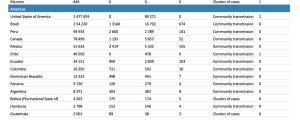
During this time of crisis my employer has suggested keeping an eye on the World Health Organization website.  I’ve been doing that with a nearly religious fervor.  I’ve been looking over the daily situation reports.  These not only contain advice not poisoned by government agendas, but also list the new outbreaks and provide pages of statistics.  The numbers differ from many news sources, but WHO tracks new cases, the number of deaths, and the vectors of transmission.  I’m trying to make a learning exercise out of this, instead of just further cause for panic.  More secretive world states, WHO warns, are preventing containment by under-reporting.  You’d think that in a time of global crisis that even autocracies would want to cooperate.  You’d think wrong.  

Photo credit: National Institute of Allergy and Infectious Diseases (NIAID), National Institutes of Health (NIH), via Wikimedia Commons

WHO has indicated that some nations (the usual suspects) are keeping numbers down not through effective measures, but through not reporting them.  Since honest reporting helps to trace, track, and understand transmission, such nations are essentially holding out hope that they’ll somehow bend this crisis to their advantage and appear stronger than they actually are.  I’m guessing these nations are male. 

Interestingly, the names of the countries on the overall list don’t always match those I’ve learned in my own study of geography.  The Vatican, for example, is listed as “Holy See.”  I know that’s its name, but it seems kind of odd against Lichtenstein, Peru, and Mozambique.  The Holy See, last time I noticed, had 6 cases.  The number gave me pause.  With a population of just over 600, Vatican City does seem to be a male nation.  It’s a country of clerics. 

Those in ministry toe a difficult line during a pandemic.  Governments are telling people to isolate themselves to halt the spread of disease, and yet clergy, like medical professionals, often have to put themselves in harm’s way.  I think of how Pope Francis had laid hands on the sick, even when it must’ve been difficult to do so.  Local churches have, for the most part, shut down.  Clergy are self-isolating, social distancing.  It is the socially responsible thing to do.  How it fits within an ecclesiastical view of life, however, must be quite a balancing act.  I often think of how I’d be acting if I were a minister.  Would I go to the home of someone suffering in isolation, or would I be afraid of infecting my own family?  Would I be a nation reaching out to the rest of the world with largess, or would I be a holy see cut off from the people?  I don’t have an answer.  I wonder if anyone does.


More Than Books

Careers.  A pandemic is no time to think about changing jobs unless you’re forced to, but I often wonder if I got it wrong.  No matter what my job was, I wanted it to be about books.  When I was considering ministry it was largely because of the Good Book, and I did a lot of reading of books about it.  Over time my mindset morphed to that of a professor and the book-lined study was my icon.  I admit I’m fixated at that stage.  Now I’m an editor.  Life would’ve been different if I’d become a librarian.  Susan Orlean’s The Library Book is a volume that opens up the cloistered lives of librarians and shows just how vital libraries remain.  I have to confess that before reading this I don’t recall ever having heard of the central Los Angeles library fire of 1986.  Now I can’t forget it.

More than just an account of the fire—although a suspect was arrested it still isn’t clear that he was guilty—this is a book about libraries.  An account of the fire alone would not have been so interesting.  Orlean tells us about this history of the Los Angeles Public Library and the importance of libraries around the world.  She introduces us to several librarians and gives us insight into why they became such and what it is they do.  Here’s a hint: it’s a lot more than re-shelving books.  And there’s the sad tale of an unsolved fire that destroyed millions of dollars’ worth of books.  Having had hundreds of books destroyed by water myself, some parts of this book were difficult to read.  Books are vulnerable, like butterflies they must be treated with care.  The idea of them burning, then being soaked, is distressing.

Like many people, I suspect, I began this book thinking libraries were on the way out.  The internet has changed things.  What I didn’t fully appreciate is that libraries have been evolving to keep up with the times.  And that they provide social services, such as a place out of the weather for the homeless.  I experienced this myself in Montclair, New Jersey.  When accompanying my wife there on Saturdays when she had to work, if I finished with the bookstores early I’d head to the library.  You could sit there for free.  I always have books with me, so I could read.  I could use their wifi for free.  Libraries, you see, are all about giving.  They give so much to the community.  Now that we’re living hermetically sealed lives, it might seem strange to think of libraries as places of social gathering.  And of course they’ll have books.  Orlean’s account makes me think perhaps my career has been off-track.  Perhaps I should’ve been a librarian.


Disease Divine?

I suspect many religious people are wondering where God is amid the current pandemic.   Theodicy (explaining the suffering of the innocent while defending the goodness of the Divine) has always been the bête noire of monotheistic belief systems.  (Polytheism has the advantage of always being able to blame another god.)   People have been pointing articles out to me that show the religious implications of a crisis.  I’m not at all surprised by the irrationality of the subjects.  The first article was an opinion piece in the New York Times.  It makes a good case that the religious right paved the way for the COVID-19 contagion in the United States.  The religious right is anti-science because they (wrongly) believe the Bible is a science book.  Even a small dose of seminary could cure that ill.  Katherine Stewart nevertheless makes a strong argument that the survivors of all of this will know whom to blame.  Science denial is not the same as authentic religion.

From NASA’s photo library

The other news stories that arise are of evangelical leaders defying government bans or guidance, even when delivered by messiah Trump, to large gatherings.  One of the main reasons for this is that said messiah kept saying the coronavirus was nothing to worry about.  Only when re-election seemed unlikely with all the uneducated dead did he finally start issuing warnings to avoid such idiotic congregating.  In the midst of it all, Jerry Falwell Junior (why did all these evangelists have to propagate?) decided to reopen Liberty University.  No doubt confident that God will keep them from any harm, the university officials decided it would be good to gather students from all over the country and put them together in dorms again.  If you’ve ever lived in a dorm I’m sure you can see why the decision is anything but wise.

It’s sad that evangelicalism has decided to pander to the uneducated.  You can believe in Jesus (many mainstream Christians do) without parking your rationality in the farthest parking spot from the door.  Many of us, huddled in our houses, not having seen other living people for days, are trying to isolate this thing and drive it to extinction.  Meanwhile, those who trust their own version of the supernatural are doing whatever they can to ensure the virus continues to spread.  Why?  They have long been taught that science isn’t real.  Never mind that their cell phones work and they get the news of open dorms through the internet, the science behind it all is bunk.  An entire executive branch administration that doesn’t believe in science is as sure a road to apocalypse as any.