Mail In

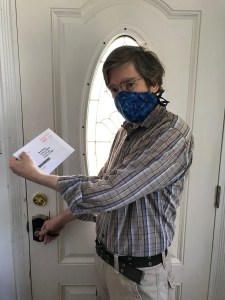
As the Republican war on democracy continues, I’m wondering about mail-in ballots.  The good news is that I live in a state where such a thing is possible—there are just enough Democrats left to ensure that people can vote—but when you read of close races, particularly in Republican districts, disregarding mailed in ballots you have to wonder.  A few weeks ago on national television Trump said that if everyone was allowed to vote Republicans would never be elected.  It seems the alternative—cheating, that is—should be the game plan for retaining power.  We tend to think of such things being employed by the many pseudo-democracies of the world.  And I wonder who steps in to intervene when officials cheat.

Many world governments are dictatorships.  The GOP would like that to be the case in the United States.  Perpetual power where you don’t have to worry about women or African-Americans getting elected.  It’s the rule not of law, but of complete and utter corruption.  It’s rule that permits 100,000 people to die rather than being bothered to try to put safeguards into place.  It’s rule that places the economy over the lives of those it’s supposed to benefit.  No wonder it can’t be legitimately elected!  Those of us who’ve been trained in morality, and who’ve even been schooled in it at work are told we should obey our leaders.  Even if they wish to kill us, I suppose.

So I’m sitting here wondering if I’m throwing away our one chance to ousting such dangerous ideas from Washington if I send in my ballot by mail.  The party in power has openly admitted that it cheats to win.  On the other hand, there are plenty of sick people out there, particularly in these parts.  Do I want to stand in line with them, hoping they’ll keep six feet away?  Are you allowed to vote wearing a mask and gloves?  Where is the Lone Ranger when you need him most?  My grandmother had a saying, “Where was Moses when the lights went out?”  I often wondered what it meant.  Said when someone walked into a room just too late to help, it seems to imply that even a miracle worker does no good if s/he arrives too late.  Even Moses wore a mask when he came down the mountain with his face all shiny.  But then, he didn’t have to worry about those in power cheating, and the orders came, so they believed, directly from above.


Somebody Elsism

It’s 5:30 a.m. the day after Memorial Day and I’m out jogging.  I go out at this time because there’s not much likelihood of encountering many other people.  Oh, I know others are awake, but few are out on the trail at this time of morning.  I’m made a bit sad by the amount of trash I see along the path.  Yesterday turned into a pleasant afternoon and I suspect lots of people were out here then.  I even find the remains of some kind of homemade fireworks launcher, reminding me that it was supposed to be a patriotic holiday.  I’ve seen an uptick in Trump signs around here and I wonder if it has anything to do with the rampant somebody elsism that I see strewn along my jogging trail.

Somebody elsism is the attitude that I can make a mess of things and let somebody else deal with it.  (It’s my right as an American!)  Maybe you’ve seen it too.  The doggie doo-doo bags that are filled and left beside the trail for somebody else to pick up and dispose of.  It’s my right to own a dog, and although I may feel compelled to bag its leavings, somebody else will have to throw it away.  The idea’s pretty rampant.  I’ve even found such things on my front sidewalk.  I suspect this is a chapter in the myth of rugged individualism.  I have a right, but somebody else has the duty.

Life itself is like this, I guess.  We have to leave wills to help those left behind sort out the various messes we’ve made in our lifetimes.  Still, the Trump administration has all been about somebody elsism.  There is no such thing as controlled chaos.  The coronavirus should have taught us that, if we hadn’t figured it out long before.  Living together with other people requires a commitment to some basic things.  As much as I dislike yardwork, you can’t own a house and let the plants take over.  Your wild growth will seed somebody else’s weeds.  I’d rather be sitting inside reading.  It’s a holiday weekend and I have so little time to read during the week.  Won’t somebody else take care of the grass that has been loving the rain and warmer temperatures?  If only.  So I’m out jogging early, but I have to wait until it’s light.  There are so many things you can’t see before twilight kicks in, and unless somebody else picks them up I’m bound to step in them.


Remembering Cautiously

Memorial Day has a special poignancy when thousands of people are needlessly dying from a disease.  As the unofficial kick-off to summer, the holiday also marks the loosening of restrictions (most likely prematurely) and we can only wonder how many more will die when our usual carelessness resumes.  I’m not alone, I suspect, in hoping that this crisis will have brought some permanent changes, such as thinking about others.  It’s almost impossible to hope that such consciousness will rise to the level of government, of course, but if we the roots of the grass care for one another won’t that care naturally grow to a national level?  Americans have long loved the myth of rugged individualism.  There may have been a day when that was plausible, but we are now so interconnected that anyone considered successful has become so only because of considerable support of others.

This holiday is all about remembering.  Unfortunately remembering our war dead hasn’t done much to prevent wars.  If they’re not the acting out of our fears (as every belligerence since World War II seems to have been) then what are they?  Phobias of communists, terrorists, and assorted “others” lead us into mass killing, often for economic gain.  What if we were to put those vast military resources toward fighting a deadly disease?  What if we had a national will to take care of our people rather than to enrich ourselves?  Wouldn’t we be all the richer for it?  Instead we face more needless deaths, more people to remember on the next Memorial Day.  Maybe the sun will be shining then.

Those of us non-essential workers who’ve nevertheless been working remotely these past two-and-a-half months have a day off today.  Many will want to gather, but we know it’s not really a good idea.  We know the way infection works.  We have no battle plan against COVID-19.  We’re chomping at the bit for economic vitality, forgetting that those who are on the front lines are continuing to get sick.  It’s strange to have a holiday under such circumstances.  The warmer weather invites us outdoors while the plague drives us inside.  There’s a place for bravery, but when bravado masks itself with foolishness there will be a price to pay.  It’s Memorial Day and we can honor our dead by not rushing to join them with unreflective premature relaxing of safety measures.  Let’s stay safe this holiday by remembering what we’ve learned.


Ancient Technology

The pandemic, like any news event these days, has generated a whole new vocabulary.  I had to look up PPE on Google (Personal Protective Equipment, if you live in a cave like me).  I want to help with the effort to curb the coronavirus, but being a non-essential worker, I’m not sure what I can do.  Then my wife found an organization making PPEs.  In this case the equipment they make is face-shields.  And they were looking for, believe it or not, transparency paper.  Well, it’s really not paper, but acetate.  Although we’ve had to move several times since being pushed out of the Nashotah House nest, when I went looking for that box of transparency film that I paid for out of my own pocket in the PPPD (Pre-PowerPoint Days), I found it without too much trouble.  We still had 25 unused sheets left, and we donated them to the cause.

Nashotah House used to have one semester of required Hebrew and one semester of Greek.  Since the curriculum was highly regulated in those days, there was no opportunity for further courses in either language.  If you teach Hebrew you know that no textbook assumes just fourteen to sixteen weeks to learn it.  I quickly gave up using textbooks and had students begin translating as I walked them through it.  I had to use an overhead projector since Nashotah had no internet connection until the turn of the millennium.  It was such a small account that the cable companies didn’t want to go all the way out there to lay the physical lines then necessary for connectivity.  So I bought transparency film.  I even learned how to run it through my printer which, thankfully, wasn’t dot-matrix.

Over the years I bought quite a few boxes of the stuff.  Then the Enlightenment.  Let there be PowerPoint.  I converted all my teaching to PowerPoint slides while others made fun.  When my services were no longer required, I had to purchase a projector so that I could continue to teach on a freelance basis.  But I kept that expensive transparency film.  Now it is out there covering faces, and hopefully, unlike seminary education, saving lives.  As an erstwhile teacher of Greek and Hebrew I’ve found myself having to make some flashcards to learn the new words the crisis is giving us.  It’s a good thing, then, that when I was looking for transparency film I also found a couple packs of unopened index cards.  Sometimes antiquated pedagogy is commodious after all.


WHO Knew 2?

According to Mark Twain’s taxonomy there are lies, damned lies, and statistics.  Right now about all we have are in the last of these categories under the most statistical administration in history.  Still, if we want to get out of the house once in a while we need to look for some facts.  I keep coming back to the World Health Organization daily situation report here.  That’s because I trust WHO.  It’s an ethical, international organization not in the rear pocket of the self-proclaimed genius that puts that pocket beneath his holy posterior in the Oval Office.  In fact, just this week said genius threatened to make the United States’ contributions to WHO disappear forever unless they met his demands.  China, on the other hand, upped their contribution by a couple billion.

I don’t have the time, or certainly the numerical capacity, to read the entire report daily.  Nor to internalize all the vast numbers of cases and deaths worldwide.  It’s too much.  Still, I stop to check the places I know, including the one in which I happen to live.  There may be a time delay here since I check the reports early, and since the data from which I’m drawing came from yesterday, but still I have to wonder.  According to the stats provided by our grand ole US of A, there were no new COVID-19 cases on Wednesday.  We went from 1,477,459 to zero in one day.  Actually, the day before (Tuesday) we reported 31,967 cases.  Don’t believe me?  Go ahead and check; I’ll wait.

Not born yesterday (not by a long shot), I know that numbers sometimes have to be adjusted.  I receive a salary, so I know that well.  At the same time, we have a statistician-in-chief that had only days before threatened—blackmail is what we used to call it, if the other party had actually done something wrong, which doesn’t really apply—to remove all funding in saecula saeculorum.  Can I get an amen?  Many of us, perhaps even most, learned early in life that you don’t get what you want by throwing a tantrum.  Of course, most of us didn’t grow up filthy rich.  Most of us can’t afford to buy the presidency.  Heck, most of us have trouble making the rent or mortgage.  So we have this great statistical anomaly whereby one spoiled kid says if you don’t play by my ruse, I’ll take my marbles and go home.  And I’m not lying.


Qohelet’s Washcloset

Cast your bread upon the water, as Ecclesiastes says, and it will come back to you when you need it.  Since bread is a common slang word for money, and since the toilet paper has arrived that I ordered two months ago, I see the truth in this.  Paper spent for paper to use.  While I’m pretty sure that’s not what old Qohelet exactly had in mind, it is the reality in which we live.  There are experts that tell us the toilet paper shortage isn’t due to panic buying, but over eight weeks into this crisis and the shelves in Target and grocery stores still look like Mrs. Hubbard’s cupboards.  All those people working from home must need more fibre in their diets.  Or is it less?  I can never remember.  What other than bread satisfies?  Clearly toilet paper does.  And the fact that the nearest yeast, according to Siri, is in Tennessee, clearly has nothing to do with panic buying.  Nothing at all.

People will go to any lengths to prove that we’re rational beings.  We don’t like the image of being the panicky herd beasts we are.  When I first realized the crisis was hard on us, it was March 16.  That was my first grocery store trip where beans were as rare as moral Republicans and we still can’t find pasta or flour around here, even with stores stocking daily.  The announcements on the loudspeaker beg buyers to get only what they really need, and leave some for others.  The thing about panic, though, is that it’s anything but rational.  It’s based on emotion washed in the myth of scarcity.  It also shows what an unregulated economy soon devolves into.  I’m sure many people rationalize panic buying as “just until things get back to normal.”  Vanity, vanity, says Ecclesiastes.

Instead of the myth of scarcity we should believe in the myth of normalcy.  That should’ve ended, for any reasoning being, in November of 2016.  It isn’t normal for a prosperous nation to offer up someone who clearly has no governing ability for the most powerful office in the land.  Two months into the largest crisis we’ve seen since the days of FDR and the White House response has been the null set.  Meanwhile, I ordered toilet paper from abroad on March 16.  The ship slowly made its way across the Pacific from China where, I understand, toilet paper is abundant.  I’m just glad that there’s a rational explanation for all of this.


Straining Andromeda

As corona-life settles into just the way things are, I pulled out my copy of Michael Crichton’s The Andromeda Strain.  I read this in high school, and, judging from the state of my copy I originally found it in the book bin at Goodwill.  I actually didn’t remember how the book ended, but some of the scenes—particularly the bizarre suicides that the virus first initiates—stayed with me.  I really felt no compunction to read it again until our daily reality was one of infection, protection, and fear.  In other words, the time was right.  I can say that I found Crichton’s confident prose a bit overblown at times, especially given the resolution of the crisis, which I will not give away here.  Some of the rest of you may want pandemic-themed reading, after all.

Something I had forgotten, and since this is near the beginning I don’t mind giving it away, is that the Andromeda Strain was brought to earth by military intentions to develop new biological weapons.  Although the death toll is nowhere near what that of COVID-19 has been, the potential lethality of the strain is what keeps the compressed five-day story tense.  That tension makes for quick reading, and it seems pretty clear that some of the ideas here have been used for other pandemic story-lines.  I’ll write about one of them later this week.  The extraterrestrial life form of Andromeda is cause for discussion in the novel, but the explanation is never clarified.  Crichton’s later novels improve on this score.

A clear point in the novel is that the government, although aware of and complicit in the experiment, lacked the foresight to successfully see it through.  Governments are only human, after all, and can function effectively only when those with superior abilities are in charge.  Looking out for oneself and exploiting others are not superior abilities.  We can see the result of this with our own, nonfictional pandemic.  Still, the novel does raise the specter of dabbling in things we don’t fully understand and can’t, in any real sense, control.  The thread of the plan being military in origin isn’t fully seen through, but it does raise the larger question of morals.  Some of us go through ethical training for our jobs.  Some of us have it often.  It’s obvious, however, that the real deficiency of governments tends to be their lack of ethics.  In this current day and age that qualifies you for the sobriquet of evangelical Christian.  And now we have our own strain to deal with.


Tent Pegs

Among the many things that have happened during the pandemic to fill my time, I was invited to join a virtual book discussion group.  While the idea of reading groups has always appealed to me, there’s always the matter of who gets to choose the book.  I’m well aware from both what I post here on this blog and from my Goodreads account, that my reading tastes are eccentric.  I’m also very aware of how little time life really encompasses and I try to make it count.  Work takes up much of it, and beyond that biological necessities such as sleep, and household chores also weigh in.  All of which is to say I didn’t choose The Tent of Abraham to read.  It chose me.

The subtitle—Stories of Hope and Peace for Jews, Christians, and Muslims—pretty much describes what the book is.  Authored and edited by Joan Chittister, Murshid Saadi Shakur Chishti, and Arthur Waskow, the book focuses on the story of Abraham that ties the three monotheistic traditions together.  It is an exercise in creative exegesis, and sometimes eisegesis.  Given the point of the book, eisegesis is okay here, perhaps even necessary.  The reason for much war and hatred is the credulous, literal belief in our founding myths.  Abraham isn’t an historically attested character.  The stories told about him in ancient religious texts differ.  And although he doesn’t always come across sympathetically, he is always seen as a friend of God.  We’re not ever given a satisfying reason for that friendship, it just is.  Abraham is kind of a scary guy, as some of these stories make clear.  He’s not above abandoning his lover and child in the wilderness.  Nor attempting to murder his only remaining son.  Or passing his wife off as his sister to save his own skin.

Interspersed with these tales of imagination and horror, are scriptural versions (and by scriptural I mean biblical and those from the Quran and Hadiths), as well as real life stories of death in the Middle East conflict.  These are difficult stories to read.  Much of the violence between faiths comes down to conflicting claims of ownership.  As the book makes clear, if people resolve to celebrate difference rather than to distrust the other we can all live together in peace.  The only thing lacking to make this happen is the will.  Unfortunately, the conflict draws its energy from religious beliefs, or, more precisely, politics using religion to get its ends.  And for that one doesn’t have to travel all the way to the Middle East.


Really Celebrate

It’s a dilemma.  How do we celebrate Mother’s Day during a lockdown?  The COVID-19 pandemic has changed a lot of things.  Given that it was snowing around here yesterday (not to be blamed on the virus), even May doesn’t seem very cooperative this year.  On Friday night I made an emergency trip to Target for essentials.  One of my ulterior motives was to purchase a Mother’s Day card for my wife.  Given the lack of social distancing at the card rack, I wasn’t the only one who had this in mind.  The remainder of the store had shelves of daily necessities picked clean.  How to celebrate moms during a pandemic?  I guess by trying to stay alive.

Those of us far from childhood homes can’t visit our mothers.  Even if we could we couldn’t take them out for dinner.  If we send flowers we can’t send gloves to protect their fingers—the stores are out of those.  If we send flowers to plant we have to send plastic to cover them too, having had four nights with freeze warnings in a row.  Talking to my Mom yesterday she recollected the year that it snowed on Memorial Day.  I shouldn’t complain.  Mom would rather I didn’t.

Perhaps the best we can do for Mother’s Day is to start treating all women better.  One commemorative day a year doesn’t make up for a lifetime of second-class citizenship.  Our mothers are the reason all of us are here.  Isn’t that reason enough to see we’re all part of a single family?  Women put up with a lot to take care of us.  Even so we deny them an amendment granting them equal rights.  Politicians are saying “Happy Mother’s Day” even as they continue to withhold basic human rights from women.  We could celebrate Mother’s Day by putting our sentiments into action, transforming daily life into equal pay and equal protections.

There’s a pandemic outside.  There’s some snow out there too.  But there’s a warmth inside and for that we have our mothers to thank.  If we really mean it when we send our mothers cards and flowers, if we really mean it when we call, if we really mean it when we give her a hug, we’ll show it by our actions every other day of the year.  We need to be sincere when we say it, or don’t say it at all.  Happy Mother’s Day!


Leg Up

It’s amazing how often J. D. Vance’s Hillbilly Elegy comes up in conversation.  The book struck a nerve.  Reading it wasn’t easy because there were so many shades of my own childhood that I felt uncomfortable at several points.  Not from the same circumstances as Vance (his family seems to have been better off than mine, from the descriptions), I was more a hillwilliam (shoutout to the author of Verbomania for the portmanteau) than a hillbilly.  We weren’t educated people, but my mother’s family wasn’t as poor as the one she married into.  We were socially mobile alright, but in the wrong direction.  Anyone who hasn’t come home from school to find carp swimming in the bathtub simply can’t understand.  The way of the poor is inscrutable, but something Vance gets spot on—it is almost impossible to improve yourself without a leg up.

The chapter where this really hit me was as he was describing how easy his life was after being admitted to Yale Law School.  He made connections and learned to work them.  That part never came in my case.  Like Vance I grew up without a father.  Unlike him, I didn’t have grandparents to come to the rescue.  It’s a long story, but when I left home my life became a search for a father figure only to discover than nobody really wants to help somebody else’s kid.  Although I was accepted into the high profile schools, I had no one to coach me to go there.  Even now people barely recognize Edinburgh for the wonder that it is.  It didn’t connect me the way Yale Law apparently does.  My career has been in freefall a time or two because of this lack.  As Vance explicitly notes, when you grow up poor you don’t have the training or family experience to know what to do.

Many people, I realize, are much worse off than I was growing up.  What Hillbilly Elegy, written by a Republican, shows is that the government simply does not care for the poor.  In what used to be the wealthiest nation on earth there is a tremendous amount of poverty.  Vance has a keen analysis of what the abnormal psychology of want does to people.  I grew up more of a Pennsylvania redneck than a full-blooded hillbilly, but many of the same lessons apply.  While some of us can muster the willpower to escape, we know we are in the minority.  We learn as adults that others don’t share our concern for those who struggle daily to get by.  This is an important elegy, and if only it were read seriously by those able to make policy there might be some glimmer of light in these dark hills.  The right leg up can do wonders.


Resurrectionists

“Resurrectionists” was the name given to those who supplied the black market for human bodies when medical science had scant access, back in the eighteenth and nineteenth centuries.  They’d rob graves, and sometimes kill their own victims, for the money medical schools paid for cadavers.  It’s just business, some would say, I suppose.  It was illegal, however, and carried its own death penalty at times, if a resurrectionist were caught.  I was surprised to learn that somehow the United States has learned to do large scale resurrection.  Clergy, hang up your stoles—the government’s got it covered!  I discovered this in the most unlikely of places, the World Health Organization’s daily situation reports.

Like many people I wonder when COVID the 19th’s reign of terror will end.  I don’t trust anything that comes out of the White House, so I look to WHO.  The daily situation reports give the recorded number of cases of the virus, which, despite progress, keep going up.  The US, as always, is the world leader.  In addition to giving the number of cases, the website also records the numbers of deaths.  This is a sad and sobering statistic.  Additionally, it informs reader of how many new cases and how many new deaths have been recorded in the last 24 hours.  Here’s where I learned of our godly ability.  On Tuesday the number of new deaths in the United States was -1696.  This represents a mass resurrection indeed.  If only we’d share the knowledge with the rest of the world.

Here’s the insidious nature of statistics and governments who abuse them.  Stalin famously noted that one death was a tragedy but a million deaths are a statistic.  The US isn’t the only nation to play with the numbers—we’re all just statistics after all—but it is a matter of record that the Trump administration wouldn’t let the Diamond Princess land, although in American waters, because it didn’t want those cases listed as part of our stats.  So it still stands.  They are listed, of all the nations of the world, as “Other.”  Lest there be any doubt, the Tuesday WHO situation report ended with a note that American authorities “retro-adjusted” the figures.  You’d think that we’d want to announce with trumpet blast that we’d figured a way of retro-adjusting 1696 deaths.  For those of us listed as non-essential employees this is perhaps meant as a ray of hope.  Our work may be just icing, and we may be a single digit in our uncaring government’s eyes, but we can be brought back from the dead by political fiat.


Koyaanisqatsi

I recently saw Koyaanisqatsi for the first time.  This was initially prompted from an excellent blog post over on Verbomania, suggesting words to describe our current crisis.  I had never heard of the movie before.  In case you’re in that same jolly boat, Koyaanisqatsi is a feature-length film from 1982 with no plot and no spoken lines.  A score by Philip Glass underlies, and sometimes dominates, images of an earth beautiful in desolation (the Badlands, Monument Valley, Grand Canyon) juxtaposed with technology.  The images are fascinating and disturbing.  The title translates to something like “life out of balance” and the images of sausages being mass produced cross-cut with humans being lifted by escalators speaks volumes.  The long, slow footage of 747s on the ground was enough to make me wonder if they really can fly.

Frenetic is perhaps the word that best captures images of life in the early 1980s.  The images of Grand Central during rush hour show just how like ants we are.  On the other hand, some of the scenes of people waiting for trains show a high percentage of them reading—we have perhaps lost ground in the last four decades.  The mechanized, technologized way of life has perhaps made us something less than we could be.  There are people in the movie, but not many of them look happy.   Back when I commuted into New York I can’t think of any reason I would’ve been smiling on my way too or from work.  Crowded streets, often smelling bad.  Harried and harassed even before I reached the revolving door to my building.  I watched the movie that was a slice of my life and wondered if so much of my time commuting couldn’t have been better spent.

Of course, I did read on the bus.  On average I was able to finish about forty books more per year than I do now.  Even home owning participates in koyaanisqatsi.  It’s spring during an epidemic.  Cold, yet rainy, the grass continues to grow and there’s no sunny time off work to mow it.  It’s now May and it feels like we haven’t moved since March.  Watching Koyaanisqatsi during the pandemic was itself a haunting experience.  All those crowds.  So many people bunched so closely together.  I don’t miss the crowds.  The cross-cut images of computer chips and city layouts made me wonder just what it’s all about.  The SARS-CoV-2 reality has plunged me into a philosophical mood.  I’m hoping when the crisis is over we might strive for a better sense of balance.


Ethics of Nations

If it hadn’t started two world wars last century, Germany would likely have a stellar reputation.  I don’t say this because of my own Teutonic blood, but rather because as a nation they seem both intelligent and troubled.  Philosophical, if you will.  A story in Times Higher Education explains how Germany is planning its reopening with the input of humanities experts as well as scientists.  The stance is driven by ethics.  We know that when strictures are loosed more cases of COVID-19 will break out.  More people will inevitably die of it.  Germany realizes that this makes it an ethical issue as well as an economic one.  And ethics are best discussed by those who study humanities.  I noticed that they’re even including theologians on their panels.  This seems smart to me.

Meanwhile Boris Johnson’s reopening team in Britain is secret.  Not wanting the public to know who’s making the decisions that will certainly kill some of them, they prefer to act under cover of darkness.  The thing about the cone of silence is that it never works.  Historians will scratch their heads over how, in the course of one century, the good guys became the bad guys and the bad the good.  Have the Allies become an—to borrow a phrase—axis of evil?  The wealthy alone are worth saving, and the economy takes presedence over the welfare of the greatest number.  Back in my philosophy classes we learned about utilitarianism and also its problems.  You see, being a humanities specialist means learning to think through thorny issues, looking at all different angles.  Being a conservative means looking only at the bottom line.

Humanities are related to the concept of humanitarianism.  I know that’s a big word, and it doesn’t bring in much mammon, but still, it encompasses all of us.  This crisis could bring out the best in humankind, or we can let the narrative go to the Clorox-eaters and those who believe winning elections are all that’s important, even if there’s nobody left to govern when its all over.  Being a politician is a zero-sum game I guess.  Looking at the numbers, Germany seems to have brought the number of deaths down when measured against the count of established cases.  That to me seems like a human goal worth striving for.  Of course, we could just incite riots in our own countries to infect even more people.  Being reelected so as to give oneself even more tax breaks is all that really matters.  At least among the axis powers.


Quiet Quarantine

I’m an introvert.  I require quiet time—quite a lot of it—to recharge and prepare myself to be social.  Some people think introverts don’t want to be around others.  That’s not true.  The fact is being with other people is enjoyable, but it requires a special kind of energy that introverts don’t have in great reserve.  When the COVID-19 outbreak began introverts collectively (yes!) felt a need to help their extroverted friends and colleagues deal with the “new normal” of isolation.  Now that we’ve been in the situation for over a month, I have seen a different pattern emerging.  Extroverts are now taking over the quiet space and trying to make it noisy.  I don’t think it’s intentional, but I do think that introverts may be the ones most stressed out by this situation.

Here’s an experiment.  Put an extrovert in self-isolation with a room full of communication devices.  What do you think will happen?  If you’re on the introverted receiving end, you already know.  Days interrupted by cheeps, dings, and chimes as someone needs to talk to you.  Why you?  You’re quiet, you know how to listen.  The extraverts can’t become quiet, and of quiet and noise the same one is always on the receiving end of violence.  Quiet shatters, noise doesn’t.  Five weeks into this and the introverts have bags under their eyes and the extroverts are exclaiming “It’s not half so bad!”

While Nashotah House ruined it for me, for many years I had considered whether I shouldn’t join a monastic community.  I need quiet as much as I need air, and although I can be outgoing when I have to, I need quiet at the end of the day to make up for it.  My case is somewhat mild.  I know introverts who truly struggle when they have to spend a lot of time in a crowded place.  The internet, my friends, is a crowded place.  It took these weeks for me to figure out why I have so much less time now than I used to.  The demand of making noise has been upped.

Sitting at home with quiet streets outside can be eerie.  It can also be rejuvenating.  Embracing the silence isn’t a bad practice.  One of the reasons, I suspect, that I still awake around 3:00 a.m. is that it is quiet.  Very seldom am I interrupted then.  Work will have its pound of flesh, of course, and from there on my day descends, or ascends, back towards quiet.  It’s not a bad way to live.  It just takes practice.


WHO Believes?

These days it’s pretty clear that if you want to listen to anyone for advice it shouldn’t be the government.  I suppose that’s why I spend so much time on the World Health Organization’s page.  I’m no medical person and I certainly don’t understand epidemiology.  Contagion I get, because religion operates that way.  So WHO has been making somewhat frequent references to faith.  A recent status report noted that 84% of the world’s population reckons itself as religious and that many coronavirus outbreaks have taken place because of continued religious gatherings.  To that I suspect they’ll need to add political rallies supporting governments you shouldn’t trust, but what is such blind faith in leaders who don’t know what they’re doing if not religion?  People want to believe.

Religious gatherings also provide crucial support.  The community with which I associate has been using Zoom gatherings since mid-March.  It’s not perfect, of course, but during our virtual coffee hour I’ve been put in breakout rooms with people I don’t know.  I’m starting to get to know people I might be too shy to speak with in “real life.”  More than that, I’m asking myself what real life really is.  Technology has been pushing us in this direction for some time.  We relate virtually rather than physically.  I’ve never met many of the people with whom I have some of my most significant exchanges.  The internet, in other words, has an ecclesiastical element to it.  The words “church” and “synagogue” both go back to roots meaning “to gather.”  Faith, despite the stylites, is not lived alone.

WHO suggests that since religious leaders influence millions of people, if they would turn their message to prevention it could have a tremendous human benefit.  Consider how one man’s personal crusade in the mid-nineteenth century led to elections being decided on the basis of abortion alone.  If faith leaders were to take the good of humankind to heart and spread that message, it could well outstrip the virus.  Alas, but politics interferes.  Many religions also want to determine how people live.  There’s power in that.  We’ve seen it time and again with televangelists.  WHO has faith that these leaders might set aside their scriptures for a moment and read situation reports based in science and rationality.  WHO apparently has faith as well.  Until someone smarter than politicians sorts all of this out we’re probably safest meeting virtually.  Who knows—perhaps there are hidden benefits to that as well?