Integrity

I’m not lying when I say untruth has been on my mind a lot.  A few days ago I posted on freedom of speech and how it’s an ideal rather than an actuality.  What with lies being lobbed at us daily, I got to thinking about the ethical implications for honesty.  Integrity.  The freedom to state what we actually think is something a little different.  How often in daily life do we act authentically?  And when we’re with others we act differently than when we’re alone.  Which is truly us?  Someone pointed out to me recently that if you walk with someone your body language is different than if you walk alone.  Even walking alone your body language shows your interior frame of mind.  A sad walk isn’t the same as a happy walk.

As social creatures, the ideal of being forthright all of the time would lead to chaos.  All of us lie, one way or another, at times.  That’s where integrity comes in.  Integrity, it seems to me, indicates someone who is honest, all things being equal.  I once noticed a politician who blinked every time he said the word “God.”  That blink, I believe, was a form of “scare quote.”  I don’t know, but I suspect said politician didn’t have any strong belief in a deity.  Some circumstances require that you pay lip service anyway.  Ethics dictates that we try to be honest, but even keeping secrets is a kind of lie of omission.  Our own personal wants—which are honest—often have to be suppressed for the sake of fairness.  Again, we live in a situation where the most powerful pursue their own desires while neglecting the needs of others.  Is this then integrity?
Often I ponder what it means to be social creatures.  Some of us are naturally introverts.  We nevertheless rely on others because society is too complex.  What any one person could build an iPhone single-handedly, and then set up the 3G, 4G, or 5G network on which to use it?  Could that same person grow their own food, manufacture their own automobile, and construct their own house?  The self-made rugged individualist is a myth we cherish, but it too is an untruth.  We rely heavily on others and we count on those closest to us to be honest.  When lying becomes a lifestyle integrity lies in tatters on the floor.  Just three years ago I wouldn’t have been having such thoughts, if I’m honest with myself.

Now You Don’t

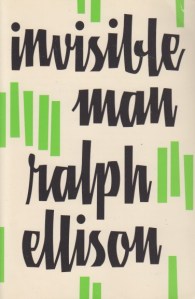
Quite some time ago I realized I should read Ralph Ellison’s Invisible Man.  What put me off, as usual, was length.  Long books take a real time commitment, but since Black History month is coming up, and we’ve just celebrated Martin Luther King, I planned ahead and read.  A profound book, at several points I felt like a voyeur reading it.  The African-American experience of life is something I always feel uncomfortable approaching.  I’m afraid of appropriation, and I’m afraid of not paying attention.  I grew up not having a sense of racism, but nevertheless am implicated in the whole.  Maybe that was intentional.  As a story Invisible Man is often described as a picaresque, but having an unreliable narrator who was a victim of my own culture was difficult to countenance.  It was hard to know what to think.

We never understand another person’s experience of life.  We sympathize, we empathize, but we can’t really get inside the head of even our best friends.  I can’t help but think we’d all be better off we recognized that race is a social construct, and a potentially evil one at that.  We are all human beings and we should act that way.  But this novel left me wondering if it’s really possible.  Good novels will do that to you.  So I’m sitting here scratching my head and a little bit flummoxed by what I’ve just experienced.  Was it authentic or can I not help but project my own experience as an non-minority upon someone else’s writing?  Even questions like this are socially conditioned.  I too am trapped in my own mind.

You might think that by this time we would have evolved beyond our distrust of those long separated from us by natural barriers.  Homo sapiens are distrustful of strangers, and even the internet hasn’t brought us the understanding we require.  Not yet, anyway.  The background to “race relations” in the United States can’t be separated from slavery and the attitudes it engendered.  On almost every page of Invisible Man its traces can be seen.  That kind of cultural memory, and other cultural memories such as Jews being routinely castigated by Christians, or monotheists being raised to combat polytheism, are deep dividers.  Our cure for these evils is understanding.  I had to keep reminding myself that this was a work of literary fiction.  It rings true, however, and although it represents a world I do not know the fact of its publication invites  those of us outside the tradition to read.  Indeed, doing so is one way of attempting to reach understanding.


Truth, Justice, and

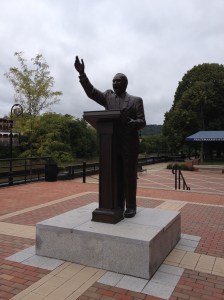
Martin Luther King, Jr. attended Boston University School of Theology long before I did.  We remember him today as a great leader, a man willing to die for what he believed in.  And all these years later we’re still struggling to find some semblance of racial equality.  We can’t seem to admit that race is a social construct and not a scientific category.  Indeed, the only race is the human race.  King saw that, and staked his life on it.  Today we’re ruled by politicians who, when faced with the truth immediately shout “fake news!”  “Liberal!”  They may stop short of using some words not because they don’t want to, but because they could cost them at the polls come November.  America is watching.  I’m sitting here thinking how Martin Luther King died when I was just five.  He’d started something righteous and just.  And millions were out marching in the cold on Saturday to say we still believe in justice. 

I didn’t pick Boston University School of Theology just because King was its most famous alum.  The other day a guy noticed my BU stocking cap and asked if it was “Boston University.”  This wasn’t an educated person, but I’m guessing that most school paraphernalia has to do with sports and the game was on in the background, so the question was logical.  I told him it was Binghamton University, a school with which I also have an intimate connection, one step removed.  He said, “Binghamton!  I saw your cap and thought Baylor?  No.  Must be Boston.”  But ironically he ended up with the right school for me, but the wrong school for what I was wearing.  I did pick BU because I realized that strong academics are nothing without social justice.  Of course, academia wanted nothing to do with that.

Recently I read how Republican resentment towards liberals has very solid roots in racism.  Oh, they will deny it—their “fake news” trigger-finger is very itchy—but the whole package is tied up with anger that an African-American was elected president.  Follow that up with an old, white racist.  How will history look back on this insane era?  I think we already know.  While the privileged are trying to build their own legacies, I ponder an African-American preacher with clear vision as the one we remember today.  I went to Boston University naive and full of hope.  I heard a lot about King when I was there.  I knew something of dreams and how costly they could be.  Today I sit here and cuddle the epithet “liberal” and think how it’s become a swear word for some, while its real meaning of “justice” continues to go unheeded.


Protest Day

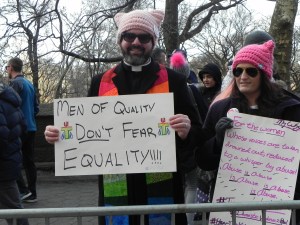
Today should be known as Protest Day.  Three years ago with over a million others I marched in Washington.  The media still routinely underreports the numbers there, despite the metrics used on the ground.  “They’re only women,” it seems to say.  I marched the last two years in New York City.  The protest can never stop.  Once a democracy has opened the door to evil, it can never rest again.  It’s cold outside.  There’s a winter storm in the forecast.  Women everywhere are out marching.  This mansplained world must come to an end.  We must hear all voices.  Despite having control of all branches of government, the Trump message isn’t being heard.  Perhaps there is justice in nature.  I like to believe it, even when it’s hard.

Patriarchalism wears many disguises, such as biblicism.  If all you take from the Good Book is the idea that men are more important, then you’ve missed the point.  The Bible is a book with a context and those who can quote it without knowing what it originally meant are left wondering why so many other Christians disagree.  The message must be heard.  Liberation theologians long ago realized that Jesus’ gospel had been drowned in the voices of legalism.  They did what we all should be doing today; they protested.

Signs of national and international weariness are everywhere evident.  Trump-supporting senators strike out with ad hominem attacks for all reason has failed them.  Used to be if you aided and abetted a criminal you’d get in trouble.  Now you just get bumped to a more influential committee.  So we protest.  History hasn’t forgotten Watergate.  It will never forget the disaster of 2016 when a political party sold its soul.  

A restaurant not far from here is owned and operated by a young woman.  A sign on the register says “The Future Is Female.”  I hope it’s so.  Our hunter-gatherer sensibilities have been suborned by the possibilities of agricultural surplus.  Where there’s surplus there’s mammon to be made.  In the Middle Ages mammon became the name of a demon.  Today it’s inscribed on the hearts of those who follow cash, no matter where it may lead.  Once upon a time a man from Galilee said the wealthy wouldn’t inherit the kingdom.  Like Caesar they dedicate the temple to themselves.  We may not all be able to get out to march today, but we can make our consciences heard.  Women deserve every right men have.  It’s time to learn to share.  Until that happens, we must protest. 


Search Yourself

I was searching for someone on the internet (surprisingly, not myself).  Since this individual didn’t have much of a platform, I looked at MyLife.com.  Such sites draw in the curious and you soon end up paying (I suspect) for any salacious information such as arrest or court records.  In any case, what stood out is that we all presumably have a meter on the site that shows whether we’re good or bad.  It’s like a Leonard Cohen song.  Call me old-fashioned, but that’s what religion used to do.  Some forms of Christianity (Calvinism comes to mind) tell you that you can never be good enough.  Others are more lax (Episcopalians come to mind), as long as you go to mass enough and feel some guilt for misdeeds, you’ll get in.  All the various groups, however, have metrics by which you’re measured, largely based on what you believe.

The odd thing—or one of the odd things—about religion is that it is now categorized as what you believe.  Historically religions began as a kind of bellwether of what you do rather than what you believe.  The two are related, of course.  The motivation behind an action might well be good while the end result is less so.  Secular justice regularly seeks to answer the question of why someone did something.  Was there malice involved?  Aforethought?  Was it an unfortunate accident?  Religion drives over this ground too.  Without getting into the many shades of gray that are morality, value judgments as to the goodness or badness of an action (or a person) were traditionally the purview of religion.

The internet itself has become a kind of god.  We turn to it for all kinds of answers.  It’s both a Bible and encyclopedia rolled into one.  When we want to know something about someone we google them.  Some of us have tried to control the narrative about ourselves by making websites.  (This, of course, presumes others will be interested in us.)  Social media also injects us into larger arteries of traffic.  People judge us by what we post or tweet.  Often without ever meeting us or getting to know who we really are behind our physical walls.  So this person I searched had left little to find.  Scraps here and there.  I didn’t believe everything I saw on MyLife.  After all, not everyone wants to subject her or himself to the constant scrutiny of the connected world.  Maybe it’s a religious thing.


Social Madness

I’m reading a book written in the mid-1980s.  (All will become clear eventually.)  The author notes the connection between social madness and personal mental illness.  He cites the alarming rise of teen suicides.  This was over three decades ago.  Suicide rates have continued to climb, and this particular author got me to thinking about something that troubled me even as an undergrad.  Although I went to college intending to be a minister, I ranged widely in the subjects I studied.  (Being a religion major in those days allowed for quite a bit of flexibility.)  I took enough courses in psychology to have minored in it, if I had declared it.  Since my mind was set on church work I saw no reason to make said declaration.  The thing that troubled me was I had also taken sociology classes.

Like most people who grew up in uneducated households, I suspect, sociology was something I’d never heard about.  Asking what it was, in college, someone answered along the lines of “psychology of groups.”  My own experience of it was that it involved math and graphs—it was a soft science, after all—and now I read sociologists who say that such numbers can be made to declare what the sociologist wishes.  In other words, psychology.  The point of all of this is that the book I’m reading suggests societies exhibiting illness cause individuals to be sick.  Sociology leads to psychology.  In times of national turmoil, individual mental illnesses rise.  I had to pause and put the book down.  The eighties weren’t a picnic, but the national madness of the Trump era bears no comparison.  We are a nation gone mad, and when society can’t project health, the many who stand on the brink of individual mental illness simply get pushed over.  That sure makes sense of what I’m seeing.

Looking back, I often think I should’ve probably declared that minor.  Raised in a strong biblical environment, however, I wanted to learn as much about the Good Book as possible.  I was teaching Greek by my last year in college and in seminary I specialized in the Hebrew Bible.  It would’ve been a natural place to continue studying psychology.  By that point I’d decided to go on to a doctorate, and psychology required medical training.  For a guy as squeamish as me that wasn’t possible.  Ancient languages, though, they were something I could handle.  It’s rather frightening that those writing at that time already saw America (in the Reagan years, I might add) teetering towards national insanity.  We’ve gone far beyond that now.  And a society that doesn’t know it’s ill will sacrifice many individuals who realize that it is.


United, We Divide

I was a teenage Methodist.  Or, I should say, a teenage United Methodist.  My family had moved to a town where there were no Fundamentalist churches.  Indeed, the only Protestant church was the UMC.  Although very aware of religion, I hadn’t studied it deeply at that point—I’ve come to understand a bit better the marketplace of Christianties and how it works in a capitalist society.  The thing is, the more I learned about John Wesley and the Methodist movement, the more I saw how well it aligned with my own thinking and experience.  I became an Episcopalian largely because John Wesley never left that tradition and urged his followers in the same direction.  Of course, the “United” in United Methodism was due to mergers during the ecumenical period when Christians were learning to overlook differences and a strong base remained from which to draw.

The news has come out that the United Methodist Church has decided to split over the issue of homosexuality.  Most major Protestant denominations have made their peace, albeit uneasily, with the issue.  They recognized that while a source of guidance in spiritual matters the Bible’s a little outdated on its scientific understanding.  If God had revealed evolution to good old Moses things might’ve been a bit different.  We now know that homosexuality isn’t a “choice”—it is found in nature, and not rarely.  Homo sapiens (if I’m allowed to use that phrase) have developed in such a way that sexuality is a main preoccupation of religions.  Some animal species are monogamous and in our case many cultures adopted this as conducive to an ordered society.  Then it became codified in some sacred writings.

While homosexuality is mentioned in the Bible, every book of that Bible has a context.  Like it or not, close, serious study of Scripture raises questions you just don’t get if you read only authors who think the same way you do.  It is far easier to do that—who doesn’t like being right?—but thinking seldom gains credibility by never being challenged.  Iron sharpens iron, someone once said.  The emotion behind the issue, I suspect, is driven by a couple of things: fear of that which is different, and the inability to see the Bible as anything but “da rules.”  In those cases where the rules contradict one another you just have to choose.  At least in Christianity.  In Judaism they ended up with the Talmud.  In any case, we’re now seeing the fracturing of society based on party lines.  We could always use a few more choices, I guess, for competition is what spiritual capitalism is all about.


Droning On

According to the New York Times (I don’t have a link, but Google will bring it up), nighttime drone formations have been reported by law enforcement in the Midwest.  These obviously precision formations fly over small towns and prairies in Nebraska and Colorado.  Now, I write what I consider to be horror fiction, but this is downright scary.  We know our government is keeping tabs on us using all kinds of technology, and this could be a government program.  It could also, as the article points out, be the mapping project of some corporation (which can be scarier even than the government), seeking natural resources to exploit.  Twice this past year I’ve spotted mapping cars with their camera-stalks protruding from their roofs, multiple spider-eyes recording roads and their surroundings.  Smile—you’re on candid camera!

At least you could see this kind.

Please don’t think that I suppose myself important enough to be spied upon.  Heck, I can’t even get job interviews and my books don’t sell.  Still, I am concerned about surveillance.  I’ve seen articles suggesting that facial recognition software is now being used by some governments (notably China’s) for keeping track of “people of interest.”  I’m more a person of disinterest, but I thought nothing of pausing long enough for the camera at Heathrow customs to record my face and scan my passport as I entered the UK in June.  Coming back the same thing happened in Newark.  And people wonder why I won’t go into the full body scanners at the airport.  Some bits of personal information, particularly those down south, I’d like to keep out of government hands.

Watching the X-Files again has reawakened my suspicion that there are too many secrets.  Yes, I know the X-Files are fiction.  Still, we know black budgets are as real as the electronic money our banks tell us we have.  And some places aren’t even accepting cash any more.  I have no idea why fleets of drones may be flying over the Midwest, but the fact that it’s happening at night raises all kinds of worries.  The X-Files had us looking for UFOs, but drones come from a far more threatening species.  Technology has no controls built in.  Kids these days can run virtual circles (and very precise ones at that) around my generation.  Listening to them talk tech makes me think English might be a foreign language after all.  Nobody requires a permit to fly over your head and take a look.  While they’re up there, I wonder if I could convince them to take some pictures of my roof.  Those on Google maps don’t give enough resolution to tell the roofers where they should focus next.


A Few Days

My fellow blogger over at Verbomania (worth following!) posted a piece on the word Romjul.  In case you haven’t read the post, Romjul is the Norwegian word for the period between Christmas and New Year’s Day.  It’s kind of a liminal period.  Not really holiday and not really not holiday, in northern climes it’s often cold and dark and you don’t feel like getting out to do much.  In many reasonable parts of the world it’s a given that this should be time off from work.  With all the preparation that goes into Christmas and the standard convention of starting the New Year with a freebie, and the fact that the days of the week for the holidays are movable, it just makes sense.  In these developed States, holidays are left to employers.  Mine granted two days off: Christmas Day and New Year’s Day.  What are your choices when they fall on Wednesday?

Romjul gave me a good feeling.  I cashed in a vacation day or two to take some time off.  The years when I’ve worked between the holidays I’ve found nobody in their offices or answering email, and that led to long hours of waiting for the work day to end so that I could actually do something productive.  In America we love our work.  At least employers love our work.  I talked to a young man who had to cut his holiday short to be into work on Monday, December 29.  He’d just returned from an international trip, but his employer insisted he be there.  There was no work he could do because his colleague whose input he needed had taken that day off.  Work is like that.

I recalled a snow day when I had to commute daily to New York City.  New Jersey Transit got me as far as Newark but the trains were shut down from there.  I had to take a PATH train that took me close to my Midtown location.  It was running late.  A woman was panicking about not being on time.  A wise, older gentleman said, “Employers just want you to show up.  They’re not looking for a full, productive day of work.  They just want you to come in.”  I believe he was right.  Employers like to make their puppets jump, no matter if there’s anybody there to watch the show.  In a civilized world, as in much of Europe, we would celebrate Romjul.  If not for religious reasons, then for simple humanitarian ones.  In late December we can all use a week off.


Seaing 2020

It’s funny what sticks in your head.  As a ten-year-old 2020 seemed impossibly far in the future.  And it was very wet.  Not because of global warming, but because of a Saturday-morning cartoon called Sealab 2020.  Suffering from thalassophobia, the idea of living under the ocean was both intriguing and terrifying to me.  I recall that these underwater scientists had “aqua-gum” that they could chew so they’d be able to breathe and talk when not in the giant domes of the lab itself.  While checking out the series online, I was surprised to learn it only had 13 episodes and lasted but three months.  I’ve been thinking about it for over 40 years now, silently waiting to see if we would have such places as the deadline drew near.

This image is protected under copyright by the owner. It is reproduced here under the fair use doctrine, in low resolution. From Wikimedia Commons.

Instead in 2020 we have a record low of scientific projects being supported by a science-denying government.  Ironically the sea levels are rising because of global warming.  We haven’t done our homework and we’re pouting that things aren’t turning out the way we wanted them to.  Ours is no longer an evidence-based reality, but one where a tweet of “fake news” is all we need to make the truth a lie.  And as the water laps our ankles my thalassophobia starts to kick in.  The thing about Sealab is that they had kids there too.  Kid scientists.  Even more ironically, Richard Nixon was president.  His downfall was Watergate—coincidental?—and now we have a president caught red-handed (very Red-handed, even) in crimes while in office and Nixon’s beginning to look like a saint.  When did the water get up to my knees?

They wore wetsuits and swim fins quite a lot in the show.  Moving under water looked so natural—unlike my flailing when I attempted to swim.  It was all about not being able to breathe, in my case.  They showed us all kinds of strange animals under the water in Sealab 2020.  Animals that we could drive to extinction, it seems, if they got in the way of unbridled greed.  I have to admit that I’m a bit disappointed that Sealab misled me.  We were heading for an optimistic future back then, even with Nixon justifying the Vietnam War and spying on his political opponents.  People were still able to look forward four decades ago, in hopes of a better future.  For all these years I’ve been awaiting 2020 only to find the world back behind where it was in 1972.


First Christmas Parable

The Christmas story is full of surprises.  This year near Bethlehem, a parable occurred to me.  Like many parables, it raises questions.  A question for all you men out there: when’s the last time you were pregnant?  Was it because some woman—who can’t be responsible for her urges—didn’t take proper precautions?  Isn’t this the way God punishes people for having the sexual intercourse he created?  Since God gave you an anatomy just like his, you certainly have priority in the cosmic scheme of things, but this pregnancy of yours—what are you going to do with it?  Oh, and don’t look to Onan for answers to your own urges; God stuck him dead for that kind of thing.  But that troubling “what if”… What if Mary had had a choice?  According to the Good Book she did.  “Be it unto me,” Mary said.  She could’ve said “No.”  Many men in your *ahem* delicate condition did not.  The problem with virginal conceptions is that people will talk.

Many people don’t remember at this time of year that Mary and Joseph were immigrants to Egypt.  Had the Nativity occurred today in these States that follow God’s word, Mary, Joseph, and the baby Jesus would’ve ended up in separate cages.  Wasn’t he born in a cage?  Oh, cave!  That’s definitely an improvement.  One wonders how the Gospel might’ve gone from there.  And what of those annoying buzzing creatures overhead calling for peace on earth?  Shoo!  Trade wars!  Tariffs!  Nuclear threats!  These were the gifts of the three wise men, were they not?  Or perhaps we should get biblical and follow Herod’s mandate.  Killing two-year-old boys isn’t abortion, after all.  After giving birth they’re your problem, not God’s.  You’ve got to get them born—that’s the most important thing.  And since women can’t possibly know what it’s like to be pregnant what are you going to say when they walk out and tell you, “It’s not my problem”?  “Be it unto me,” said Mary.

Shepherds, it should be noted, were the poor.  Ironically that first Christmas the good news was first revealed to them.  Herod, half-insane, kept shifting members of his government around.  He had put away his previous wives—perhaps because they made him pregnant—and assassinated all his rivals.  Unless that’s fake news—the old fox was known for that.  So the immigrant family thought it was safe to return after Herod was removed from office.  Jesus grew to espouse the message of love and acceptance—extending it even to foreigners.  The state, believing itself established by divine right, had him put to death.  It’s Christmas, and we’ve seen all this before.  If only those with eyes would see.  But parables, it seems, have gone out of style.


The Truth Lies

I recently saw a Trump supporter claiming, unsurprisingly, that everyone’s lying except Trump.  Of course, I could be lying.  According to the Washington Post, Trump has made over 13,000 lying or deceitful statements since being in office.  For those who did their homework before he became the great protector of the unborn (ah, there’s one born every minute!) he was known as a crooked businessman to begin with.  With well over a thousand lawsuits against him even before being elected, we have no choice but to believe the entire legal system is lying, as well as anyone who’s had business dealings with him.  I’m just so glad that we have such a moral, upstanding paragon of Christ-like behavior in the Oval Office.  Never mind that all those witnesses in the impeachment case were speaking under oath—they all lie, but Trump.  Hey Donald, is that your real hair?

Ironically, some of the people making such claims hold the belief that divorce is not excused in the gospels (see Matthew 5:32, but Jesus could’ve been lying here—he’s not Donald Trump, after all).  It’s a matter of public record that Trump is twice divorced.  It’s a matter of sworn legal testimony that he paid hush-money to cover up affairs while married.  Well, that is if we believe this lying world rather than the one, solid, shining bastion of truth in the White House.  Someone once said (but he may have been lying) that it is easier for a camel to pass through an eye of a needle that for a rich man to get into heaven.  Just sayin’.

I have said before that all politicians lie.  It comes with the territory and only the most naive among us don’t accept that fact.  There is a difference, however, between the occasional mistruth and a lifetime, documented record of indiscriminate lying.  If it weren’t for the fact that all facts are lies (except those Trump makes up) we would see that the phenomenon of pathological lying is well known.  The presidency of the United States has never before tolerated a pathological liar.  But then again, they never had an incumbent more Christian than Jesus himself.  Now I think I remember who made that crack about rich guys.  He also said something about having no place to lay his head.  If he’d been born rich, though, you can bet the gospel message would’ve been very different.  Too bad the Bible lies.  If it didn’t such musings as this would hardly be necessary.  I could be lying, of course.  It is, after all, the new truth.


Shortest Day

This is it.  It’s here.  Today marks the winter solstice, the longest night.  Those who campaign to keep Christ in Christmas prefer not to acknowledge that the date of said holiday was an attempt to displace Sol Invictus, the Roman (therefore pagan) celebration of the invincible sun.  The Romans, like other ancient peoples, celebrated the return of light, albeit slowly, from darkness.  While teaching at Nashotah House a colleague mentioned being “almost pagan” in the eagerness for the return of light.  You can strike the “almost.”  Deep down we all look for signs of hope in dark times, whether Christian, Muslim, or Hindu.  “The people who walked in darkness,” Isaiah rejoiced, have seen light.  Sometimes light comes from an unexpected quarter.

There are two high circulation Christian magazines: Christianity Today and The Christian Century.  The latter is more progressive and was launched as an answer to the former.  One of the founders of Christianity Today was Billy Graham and its readership is largely evangelical.  Just yesterday Christianity Today ran an editorial stating the opinion that Trump should be removed from office.  If I were a card-carrying member of the Republican Church, I’d be trembling.  Long touted as “Trump’s base” evangelical Christians have found themselves besieged by the flagrant and constant contradictions their party has thrown them.  Fear of divorce was enough to keep at least one woman I know in an abusive relationship for years.  Now a thrice-married, philandering man who pays hush money to keep his affairs secret is upheld as the new Messiah.  Many of us who grew up evangelical were certain that their old tribe simply wouldn’t cotton onto a straw man.  But  cotton they did.  They’ve become the very lint in his miserly pockets.

Those encrusted with hardcore hatred, of course, will not be swayed.  They’ve found a poster boy who says it’s okay to claim white male supremacy.  They can pick their political issues (usually having to do with protecting the unborn or the right to shoot those already born) and they can be certain that this protean protestant will have their posteriors.  Their leadership, however, has begun to show itself clearsighted.  Christianity Today is no friend of liberal Christianity.  The editorial makes it clear that Democrats had it in for Trump from the beginning.  There is, however, absolutely clear evidence of his crimes.  Even as southern senators state outright that they have no interest in seeing a fair trial, their base is speaking up.  Tonight is the longest night of the year.  Tomorrow it will be a little bit lighter than today.  At this time of year we fervently hope that the light will continue to grow.


Veg Out

It came to me vividly when I heard a speaker self-deferentially say he was crazy.  This was, I suspect, a way of defusing the fact that when vegans speak others often think they’re being judgmental or preachy.  I’m pretty sure this speaker wasn’t, and I try my best not to be.  It can be difficult when you’re passionate about something.  At the event, which included several people in age brackets more advanced than even mine, the question of “why” was predictably raised.  Apart from the rampant cruelty of industrial farming—some states even have laws preventing people from knowing what actually goes on in such places—there are other considerations.  One of them involves Greta Thunberg, Time magazine’s person of the year.

Global warming is no joke, no matter how much the Republican Church laughs it off.  Greta Thunberg has become the face of a generation with a conscience, but one fact few wish to know is that industrial farming is by far the largest environmental threat to our planet.  The amount of pollution it causes is staggering.  The rain forests are being cleared for grazing land because people will buy beef.  The largest methane emissions come from farms, not factories.  Our lifestyle of eating animals on an industrial scale is one of the many hidden costs to the modern way of living.  Or of dying.   There are doubters, to be sure.  It’s pretty clear, however, that the agriculture business is massive and it is just as powerful as the other great offender—the petroleum industry.

Making facts known isn’t being judgmental.  People’s eating choices are up to them.  I’ve only been a vegan for about two years now and I sometimes can’t comply with my own ethical standards when I go out to eat.  Or when other people give food.  Many places have no concept of dining without animal products.  I’m not trying to make everyone else accept my standards; I have beliefs about animals that are based both on personal experience and lots of reading about faunal consciousness.  I fully accept that many others don’t agree.  What I do hope, however, is that people like the speaker I recently heard will not have to jokingly call themselves crazy because they’re vegan.  The narrative must change.  We must be willing to look at the way we live on this planet, and accept the fact that just because major polluting industries hide behind large, brown cow eyes doesn’t mean we shouldn’t question what they feed us.  We need to look at our plates and count the cost.


Why not try Veg Out, Bethlehem’s new vegan restaurant, if you’re in the Valley?


All in This Together

The rain falling from the dark sky is barely liquid.  The thermometer reads 33 as we step out into the early evening—this is not the kind of night I’d want to be outside, but this is important.  When we arrive in Bethlehem there are already maybe a couple hundred people lining Rose Garden Park with signs.  We park and join them.   Many of the signs are clever and to the point: “I shouldn’t have to miss Nixon,” and “Vichy Republicans—shame on you!”  This winter of discontent, crumbling democracy, we are here as warm bodies on a cold night to protest what has gone on far too long.  The impeachment vote is scheduled for today and across the country people have come out—supper hastily eaten or yet to be started when they get home—to say enough is enough.

Now Pennsylvania isn’t the bluest of states.  I wasn’t sure of what our reception would be on the busy corner of 8th Avenue and Union.  I was amazed.  Large numbers of cars, and even some commercial trucks, honked their horns in support as they drove by.  Thumbs up out windows in the cold air.  Long blasts on horns.  For sure, many drivers remained silent, but only three that I counted bothered to roll down their windows and shout support for Trump.  They were treated respectfully and cordially by the protesters, many of whom were considerably older than my wife and me.  I listened to snatches of conversations as my fingers and toes grew numb.  Vietnam vets, and even one from the Second World War.  Retirees who should be spending December nights in their warm homes.  We all had something important to do.  We had to stand and be counted.

Because of a childhood incident, I suffered mild frostbite on my fingers and toes.  It is excessively painful for me to be out in the cold to this day.  We could only stay for about an hour and a half.  It was a work night after all.  There were many stalwarts still holding signs and chanting as we headed back to our car.  Around a sign for the park where other, more temporary signs stood, a protester said, “Someday maybe we won’t have to do this anymore.”  A younger man corrected him.  This happened because we failed to be vigilant.  Vichy Republicans are a real thing and although the elections are about eleven months away, we need to get ready.  We need to get everyone out to vote.  If the signs of support we saw last night reflect the feelings of Americans, it’s time for us to become a democracy again.