Holy Oak

IMG_2876 copy

It was already ancient when first discovered by the early European colonists of New Jersey. The Basking Ridge oak is a well-known and time-honored New Jersey denizen. Over six centuries old, the white oak, it seems, is dying. Like it’s cousin, the Swamp Oak that I mentioned back in January, this tree is dear to many in the state. It is also historical. An article in the New Jersey Star-Ledger begins with some religious associations: George Whitefield, one of the evangelists responsible for “the Great Awakening” from which we’re still trying to awaken, preached under this very tree. George Washington also knew it. It has been tended and cared for by the town for so long that there is a reluctance to let it go. In the words of another New Jerseyan, “well everything dies, baby, that’s a fact.” Job, in a more optimistic moment, declared, “there is hope for a tree.” Like the Good Book, the good folk of Jersey wax religious about this sexcentarian, and for good reason. The human outlook is far too short.

Think, for example, of what was happening when the Basking Ridge oak was a mere acorn. In the early 1400s there were no Protestants yet. That didn’t stop Jan Hus and Joan of Arc from being burned at the stake, however. Although the Vikings, and perhaps others, had ventured here from across the ocean, North America was blissfully unaware of those waiting to claim for their own any land they could set foot on. Good thing too. The Inquisition was still underway and witch trials lingered on, flying in the face of enlightenment. Cambridge and Oxford University Presses were, in some sense, neophyte businesses. This Eurocentric view overlooks the great achievement of Machu Picchu down south. As the Dark Ages were beginning to lighten, this oak began its life’s journey. We who are a mere blink of its slow eye are still spouting hate for those who are different and are determined that nobody should outlive us.

The Holy Oak, as it is known, stands beside a Presbyterian Church. One of the trustees of the church is in charge of the tree. In the article he stated that this is about eternal life. From our perspective, trees seem to live forever. That’s because we are so dreadfully short-sighted. It’s surprisingly easy to become nostalgic for a tree so old. In terms of accomplishment, we think humans are exceptional for surviving a century of all the misfortune we dish out for one another. The tree, however, seems innocent by comparison. We’re changing the climate even now, making it more difficult for trees to thrive. We continue to shoot people for the color of their skin and although we don’t call it witch-hunting any more we still find ways of oppressing anyone who is different. At this rate we may need six more centuries to come to our senses. If only we had the perspective of a tree.



Sense of Place

Visiting the Holocaust Museum was one of the most wrenching activities of my life. I was in Washington DC for a meeting of the Society of Biblical Literature when my friend Jeff came across the Atlantic to attend. He wanted to see the Museum and I reluctantly agreed to accompany him. About half-way through I found a secluded bench, sat, and wept. I simply couldn’t take the weight of the sadness and cruelty this represented. I have trouble telling another person “no,” let alone striking, or harming them. How could millions of people simply be discounted? Murdered for being born who they were? Could there be anything more inhumane? A quote from the recently departed Elie Wiesel hung on the wall behind my bench. “Never shall I forget those moments that murdered my God and my soul and turned my dreams to ashes.” My wife asked if I would be okay. “I don’t know,” I said.

I have to admit to being a Pokémon illiterate. I don’t know who or what Pokémon is. I do know it/he represents a game universe that originated in Japan. The last “game” I ever played was Myst. Before that it was Pong. I suspect that growing up without computers made real games seem, well, real. I don’t have time for computer games and I wouldn’t know an X-Box if if fell on my head. I don’t even know if they still exist. You’d have to be dead, however, not to know that Pokémon Go is all that anyone cares about any more. An app that lets you “find” Pokémon in various places, adults and kids alike are blindly walking out in front of cars to get her/it. One of the undying lessons of my childhood was, “if the ball rolls out into the street, don’t run after it!” Natural selection at work.

So what do Pokémon and the Holocaust Museum have to do with each other? Nothing at all. Or thus it should be. A story in the Washington Post shares the plea of the museum for people to stop seeking Pokémon there. One of the sites programmed for the whimsical creatures is more sacred than a church, synagogue, or mosque. Genocide is not a game. Headlines boldly proclaim that Pokémon Go is great for businesses. The Holocaust Museum is not about business. It is a mass grave on a scale that the human mind simply can’t conceive. A place to remind us where hatred and fascism lead. As difficult as it may be, we need to visit that terrifying place and we need to remember that it began as distrust of those who are different.

Photo credit: AgnosticPreachersKid, Wikimedia Commons

Photo credit: AgnosticPreachersKid, Wikimedia Commons


Camping Season

Summer is the time for camp. I’m not into extreme sports, like sleeping outdoors in the snow, so in my mind, summer is the time for camp. While in college I spent two summers as a counselor for the Western Pennsylvania United Methodist Conference camps: Wesley Woods, Camp Allegheny, and Jumonville. These were formative experiences for me since I’d never camped as a kid (beyond sleeping on the front porch and an ill-fated attempt at Boy Scout camp one winter), and certainly not in a Christian context. My wife recently sent me a story in The Guardian about Jesus Camp. The documentary is a decade old now, and people are wondering if the religious indoctrination of children is child abuse or what. As always in such situations I tell myself the real issue is that you can’t understand Fundamentalism unless you’ve believed it. Really believed it.

IMG_2856 copy

Some psychologists claim children can’t conceptualize God. Many adults can’t either, but for those who try, what they believe is true. The Fundamentalist parent doesn’t attempt to deceive his or her child. The thought of having your own children suffer eternally in Hell is a wrenching, and very real one. A convinced adult is morally, viscerally, and utterly compelled to teach her or his child the truth. Anything less would be monstrous, hideous, and inhumane. Critics from the outside say that such nonsense damages children psychologically. I have to admit that watching Jesus Camp made left me feeling enraged and, in some measure, victimized. The untold reality, however, is that apart from some cases of deep insincerity, most Fundamentalists truly believe what they teach their children. They’re not trying to abuse any more than a parent who teaches their progeny that the stove is hot. They want the best for their kids and life is full of uncomfortable truths.

Richard Dawkins, notably, has argued that teaching children religion is a form of child abuse. The fact is nobody knows the truth about religion. All we can do, scientists included, is believe. Believe for or against or somewhere in the middle. God, by definition, stands outside the reach of empirical evidence. Perhaps it’s just a trick of consciousness, but we have to leave the possibility open. We don’t even understand consciousness yet. Rare aberrations apart, people love and care for their children. They try to give them the best that they can, and that includes their religion or lack thereof. I saw some strange stuff at church camp. It wasn’t in any sense “Jesus Camp,” but it’s safe to say it changed my life. On the brink of fully legal adulthood I was coming to learn that certainty was impossible, and the only honest way to be in the world was to admit that we all, in some form, believe.


Nazi Religion

CatholicismRootsAs a lifelong pacifist, I’ve never been a fan of war books. Indeed, war seems to be to an utterly useless waste of life and a source of herculean suffering. The fact that wars happen, and books about them depress me, causes me to avoid them. Still, Derek Hastings’ Catholicism and the Roots of Nazism is less about war and more about, as the subtitle phrases it, Religious Identity and National Socialism. As I read through this history of the early Nazi movement, it occurred to me that this was probably the first actual book I’ve ever read about it. My knowledge of the Nazis had previously come from articles, movies, and documentaries. And Hogan’s Heroes. Being largely of germanic pedigree, I suppose I bear some residual guilt. I have to remind myself that my ancestors had left Europe before Germany had even existed as a unified state. I like to think they would’ve left during the rise of the Nazis, if they hadn’t already left generations before.

In any case, I had no idea of how the Third Reich dealt with organized religion. I have heard anecdotal opinions from time to time that the Catholic Church should have been stronger in its condemnation of the atrocities that wartime Germany perpetrated, but I had no sense of their official outlook toward each other. Hastings makes clear that although Catholicism and Nazism came to distrust each other implicitly, at the beginning of the Nazi movement they were considerably more chummy. In fact, anti-Semitism was something they had in common. Many of the early member of the party were Catholics—some of them priests—who felt an accord with the developing ideology. As Hitler’s rise to power increased, his personal antipathy to Christianity widened the growing gap between his own outlook and that of the early Catholic Nazis.

The book has no schadenfreude for the church, however. This is academic history. As Hastings notes, few studies have focused on the early developments of Nazism. In today’s political climate, that struck a chord with me. It seems vitally important to be aware of how such movements start so that we can recognize them as they attempt to rise again. I have little confidence, reading the news, that we are any better in the 2010s than people were in the 1920s when political instability, economic distress, and hatred of those who were different led to a reactionary, fascist regime. Could it happen again? I look around at a culture in love with guns and endless, selfish gain, and distrust of those of different ethnic origins and I wonder. The early stages are, I think, the most crucial to recognize. Surely no German Catholics could’ve anticipated just what Nazism would become.


Buying Intangibles

Perhaps it seems that I’m writing quite a bit about music these days. Being a theoretical and practical failure in the practice of music, it may seem presumptuous. If I’m honest, I’d admit that visiting the site of Woodstock was kind of a religious experience for me. That experience and the fact that popular musicians from my younger days have been in the news of late compel me to analyze a bit. My wife shared a blog post on John Pavlovitz’s website entitled “Bono Called Out Christian Musicians For a Lack of Honesty. He Didn’t Go Far Enough.” The screed is both about the Christian music industry and about current trends in evangelistic super-churches that share in the glitz and glam and leave you wondering what Jesus would do. The message of early Christianity and the sixties was similar: social justice, peace, non-judgmental attitudes, care for others, love all. Don’t worry about the bottom line.

Many churches, it has become clear in this age of nones, are struggling to compete in the spiritual marketplace. Since every institution must have “product”—not books, music, reverence, or worship, but “product”—money must change hands. If you have any doubts look at what the mega-church pastors are driving. Christian bands seem not to have a social conscience so much as a desire to feel good. It’s a thriving industry, for sure. Music that makes you feel safe is delivering false promises, though. The deity thundering on that mountain might ask you to sacrifice your own son, and there could be a good, solid backbeat to that. What is the role of religion in an entrepreneurial society? It used to be that you couldn’t buy what they were giving away. Everything now has a sale tag on it.

Back in college we used to argue about whether U2 was a “Christian band” or not. Clearly they recorded on a secular label. Amy Grant, the darling of 1980s believers, matured and seemed to fall from grace. Larry Norman, never part of the establishment, died too young. Music and religion both stand, in fact, out of the reach of sticky capitalist fingers. Anything that you have to pay for is more a cheap imitation. YouTube has made all of recorded history available for all. Even mainstream churches are experimenting with tablet hymnals and virtual communion. Grace mediated through a touch screen. Debit cards accepted. The only thing that seems to be missing is that human touch. That down in the mud reality of it all. Music that had a message and that message wasn’t about supporting convention. “Upon this rock,” you can almost here the man say, “I will build my church.”

IMG_2833


Things Remembered

IMG_2839 copy

Freedom. Independence Day is our celebration of liberty. Yesterday I happened to find myself at Bethel Woods, the out-of-the-way location in New York where Woodstock was held. Probably no one in 1969 realized just how formative Woodstock and its message of peace, love, and music would become for American culture. Those of us who came of age in the ‘70s learned about it as recent history (I was only seven at the time and, I’m sure, would’ve found the whole thing somewhat unChristian had I been here then). Much has changed in the intervening years. Not many peaceful events get so much airtime any more. Upwards of 400,000, basically unpoliced, youth, gathered in Bethel, New York, for three days of music, chaos, and peace. The Vietnam War was still draining our nation of its youth and murdering its idealism. Fear of the other, racial inequality, and male superiority were part of the context that led to the need for Woodstock. Freedom was free.

Often on this blog I reflect on the sacredness of place. Events that take place in a location leave their impression on the land. Bethel Woods Center for the Arts, the current administrators of the property, have left the field largely intact. As my wife and I stood at the top of the hill and tried to imagine almost half-a-million people here, it was strangely quiet. The nearby museum had plenty of music playing, but standing where it actually happened, there were only ghosts of an event studied in school and which, even today, kids can generally identify. I couldn’t have named every act that played the concert and, although the music was clearly important, it was the gathering that is most remembered. Self-governing youth getting along in an area so remote that still today you have to drive a couple miles to find even basic necessities, sent a powerful message. It was an event that, I fear, can never be replicated. The snake has spoken.

Nearing fifty years later, we’ve become so paranoid that anyone who looks Middle Eastern is under suspicion. Guns, which children of the sixties shunned, have proliferated and may now be carried, wild-west style, in many states. A fear-mongering candidate bellows fascism before the Grand Old Party. Remember, Nixon was president during Woodstock. I may have lived hundreds of miles from here, occupying myself with the matters that seven-year-olds find so pressing. But Woodstock happened. By the time I got to Woodstock, everybody else had gone. I see others milling about the museum, slightly older than me. Perhaps some of them were here for the event itself. We all seem to be searching for something here. The festival had its problems, for sure, but with a sincere belief in freedom, it makes the pre-seventies United States feel like a strangely foreign county. How do we get back to the garden?


Summer of Frankenstein

Two centuries can make an enormous difference. Just two-hundred years ago Napoleon’s defeat at Waterloo was merely one year in the past. North America and parts of Europe were experiencing “the year without a summer.” Perhaps due to that cool and rainy summer, when Mary Godwin and Percy Bysshe Shelley called on their friend Lord Byron, their thoughts turned to ghosts. According to the legend, together with Byron’s personal physician John Polidori, the friends spent a night writing scary stories. Polidori, although not widely remembered today, invented the vampire that would, in Bram Stoker’s hands, become the aristocratic Dracula, and eventually, with Anne Rice’s influence, Lestat, Louis, and Armand. Mary Godwin, soon to be Shelley, gave birth to perhaps the most successful of new monsters ever created—that of Victor Frankenstein’s construction. Many have claimed the monster’s pedigree to have been that of the golem, but Shelley’s creativity went beyond this forebear into the sympathetic misfit who, like all of us, never asked to be born. The two centuries since that summer have been haunted.

477px-Frankenstein's_monster_(Boris_Karloff)

Quite apart from the monster tale, Frankenstein is also about building that which we, in our hubris, can’t understand. Progress without forethought, as Epimetheus could never learn, housed immediate and very real dangers. The two centuries since Frankenstein have proven Mary Shelley a prophet. An early supporter of women’s equality, she profited from her novel, but never managed to thrive. Just six years later her famous future husband would die tragically in the Romantic genre of a shipwreck. Even with important friends, Mary found it difficult to capitalize on her success. The monster was real enough.

We’ve become accustomed to making things we can’t control. When’s the last time you were able to fix a car broken down by the road, apart from the occasional flat tire? Can you really stop your job from becoming completely different from what you signed up to do? What about when that bully wanders from the playground into the political field? Once you’ve figured out how to split an atom, you never forget. It may have been Napoleon still recently in the news, or the fact that 1816 failed to warm up like it was expected after the solstice. Perhaps it was the fact that Mary Godwin was a liberated woman in a world still utterly determined by men. We can’t know her intimate and ultimate reasons for creating a monster, but we do know that once the monster is unleashed we can never bind it again.


Dinosaurs, Old and New

T._rex_old_posture

Tyrannosaurus rex, aside from being a photogenic movie star, was one of the top predators of its day. Ironically, in the Jurassic Park original trilogy (which would have been, more appropriately Triassic Park) tyrannosaurus rex becomes the ultimate protagonist, while unfeelingly killing to meet its own instincts. Since saying “tyrannosaurus rex” wears you out, we’ve become accustomed to calling the great carnivore t-rex. Everyone knows t-rex when they see it. Its a sign of danger, aggression, and unthinking acquisition. In one of nature’s great ironies, however, t-rex had tiny arms, nearly vestigial. What it wanted it had to get with its mouth. To live like that you have to grow pretty big, so big that nobody else can really challenge you. Punching is out of the question.

I’m often struck as how appropriate dinosaur evolution is to the human situation. Dinos (because “dinosaurs” is also too long) grew to be the top life-forms of their day. (We like to think of being the top. The perspective from down here in mammal land, in those days, was pretty different.) If you’re big enough, who’s going to stop you from taking what you want? Endless rows of teeth and a constant hunger can do wonders for evolutionary development. But then, extinction. Recent analyses have shown that it wasn’t as simple as an asteroid strike. It seems that many features of nature conspired against the dinosaurs, including the tyrant lizard king. T-rex had evolved into the monster featured in many pre-teen nightmares, only to be replaced by birds and mammals. Maybe it grew too big to be supported by the planet that allowed it to crawl out of the slime eons before.

In a recent photo of a Trump rally, one of the signs of a supporter had flopped over leaving just the word “rump” visible. I had to ponder this. T-rump. “Dinosaur” is a word used today to mean something that has outlived its time. Ideas, as well as such practices as, say, claiming that one race is superior to others, have rightfully gone extinct. There are those who say that t-rex was less a fierce carnivore than a scavenger. A vulture rather than an eagle. They claim that such a large snout and such small arms better suit one who picks at that which is already dead instead of working hard to bring down the more challenging beasts, often with horns. I’ve always thought dinosaurs were very appropriate metaphors for the human situation. Even Jurassic Park was superseded by Jurassic World, after all.


Half-Way Holy

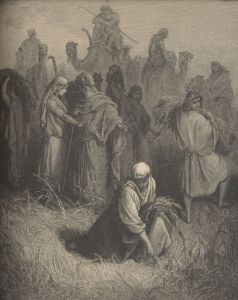
I’ve been reading about Ruth lately. Ruth doesn’t have a last name. She’s a character in the Bible. The book named after her is one of the shortest in the longest, Hebrew section of the Good Book. It’s a fairly gentle story, although it has a body count. Ruth, a Moabite, marries the son of an expatriate Israelite. This was in the days before the West Bank, but there was still some distrust there. Widowed Ruth moved to Israel with her equally widowed mother-in-law, and supported this non-traditional family by gleaning. Unlike modern civilization, shop-lifting (or field-lifting) by the poor was not a misdemeanor. In fact, the Bible insisted that it be allowed. It turns out that the field she’s been gleaning from belongs to a relative who eventually marries her via a tradition known as levirate law. Again, this is something current family values oppose, although it is commanded by the Almighty. Levirate law stated that if a man died childless, his younger brother had to take his wife until they had a child in the name of the dead brother. Creepy, but practical. A widow, in those days, had to have a child to support her.

Dore Ruth

I can’t recall when I learned this was called levirate law. I started reading the Bible before I was a teen, so I knew the story, although I didn’t understand the finer details. It was probably in the heading of some Bible translation that used the word “levirate” that I first encountered the term. I assumed it had something to do with the Levites. I mean, the words share the same first four letters, and Levites were all over the place in the Bible, even if they cross to the other side of the road. So it was that I went for decades with the idea that marrying your brother’s wife, at least temporarily, was because of the Levites. Nothing in the Bible said that Levites did this, and other than the jeans, I didn’t know any other Levi words.

Recently I learned that this is a false etymology. Levirate comes from a Latin root for “brother-in-law” and not from a Semitic root meaning “half-priest.” It may sound strange, but this was a genuine shock to me. I’d never told students that the word came from Levi, but I assumed that anyone could figure it out. After all, things that sound so very similar must belong together, right? Well, I admit to having been wrong here. The story of Ruth, however, is one of the true gems of the canon. Men play a minor role, and it is a woman who shows the way. It is a tale for our time. Family values, according to the Bible, aren’t always what they seem.


Insane Deities

GodsMustBeCrazyIt was 1987. I was in Israel for a good part of the summer excavating at Tel Dor. Between degrees and trying what to do with my life, like many people, I sought out a holy place. One evening while I was there, the locals (I can’t recall if it was the dig coordinators or the local community) sponsored a public showing of The Gods Must Be Crazy. The movie was fairly recent then, and it was the first and only time I’ve seen a movie captioned in Hebrew. I had a seminary friend who often showed me movies at his place, but this was one I had somehow missed, even though it came out when I was in high school. I’ve seen the movie several times since then, but not in the past seven years or so (this blog is a pretty good record of my movie viewing as well as book reading). This weekend we dusted it off and popped it into the DVD player and I noticed a few things for the first time.

Spoiler alert: not for the movie, but for reality. The portrayal of the bushmen in the movie is pure verisimilitude. While living much more in harmony with nature than modern, industrial late capitalists, they are not a completely peaceful people with no violence. We can overlook the “noble savage” viewpoint for the sake of entertainment, but anyone who researches human cultures closely finds that the perfect society doesn’t actually exist. Still, what I noticed in the movie diegesis was the bushmen had no need of theodicy. Theirs was a world where the gods gave them only good. The Coke bottle becomes their “tree of knowledge,” to put a Judeo-Christian spin on it, and they even use it for curing snake skins. The movie doesn’t work, of course, without this fictional view, but in reality all believing people require a theodicy.

Our particular disc of this movie has a less-than-dynamic special feature of someone who never identifies himself following up on the movie. This rambling, twenty-minute featurette shows “current” (for it must be a decade old by now itself) developments among the bushmen. Two hundred miles from the nearest electrical grid, schools are being equipped with solar panels so that the children can learn about computers. A laptop in the middle of the Kalahari. As I reflected on the loss of innocence theme, this struck me as surely as an angry serpent. The world in which we live allows for only one way of existing. It is a world of money where even the self-sufficient must be wired into the matrix. If ever there was a need for theodicy, this was surely it.


Prophetic Shaman

Lewis EcstaticDon’t complain. So I’m told. Work with the system (i.e., the privileged), do your part, and most of all, don’t complain. What would Jeremiah do? Or any of the prophets? It seems to me that prophets had the job of calling out where society had gone wrong and doing so with a healthy dose of complaint. If you don’t call out evil, it only grows. Prophets come to mind because I’ve just finished reading I. M. Lewis’ Ecstatic Religion: A Study of Shamanism and Spirit Possession. Spirit possession is chic, at least in the horror movie industry, but if you get beyond the stereotypes, you soon learn that inspired, or ecstatic, religion is largely based on good possession. The gods can temporarily inhabit the shaman, and, as Lewis points out, there is often an element of the underprivileged being those who are visited by the gods. Interestingly enough, indigenous cultures that feature shamans—or shaman-like practitioners—accept the rebuke of the gods, even when it may be a thinly veiled attempt to right an obvious wrong.

Shamanism is a bit of a misnomer. Not really a religion, but a set of spiritual practices originating among the Tungus of Siberia, shamanism is now conveniently applied to native peoples around the world. In our love of easy classification, we like to say this belief is similar to that belief, so they must be a type of religion. In fact, however, “religion” is much more integrated into the daily lives of indigenous peoples and specific beliefs vary widely. Nevertheless, we understand possession and shamanism, and we apply them as categories to try to make sense of it all. Lewis does so with an anthropologist’s eye, finally in the last chapter addressing the psychological questions. It is often claimed, for instance, that shamanism is a form of mental illness. What seems clear to me is that shamans are responsible for preventing injustice from getting too far established.

And that brings me back to prophets. Prophets, particularly among those who study the Bible, are often seen as religious authorities. It seems to me that prophets, as opposed to priests, grew out of the untamed concern for justice typically exhibited by shamans. Priests are establishment religionists. They support the government and the government supports them. Temples are built. Religion is regularized. Prophets, however, can come from anywhere. They are liminal figures, complaining, in God’s name, when injustice appears. They don’t support the status quo just because it makes people comfortable. In other words, complaint is often the only way to make the divine will known. They are the heirs of the shamans. One thing that’s pretty obvious—whether you live in Siberia, Israel, or America—shamans are still sorely needed.


Industrial Revolution

Everything’s industry. It has haunted me for some years now that we’ve let our corporate greed run away with our imagination so that nothing but “industry” remains. We don’t wish to interfere with the gun industry. The guns we like the best are those designed especially for killing lots of people. We feel happy having them in our homes. We’ve supported industry. Time was when society had more than just industry. Education, for example, was not an industry. It was just education. No measurable outgoes but a better society. Now we quantify and try to measure, thinking there’s something magical about numbers. My, what big ammo you have! The better to shoot you with, my darling. Think of it as the people killing industry.

After all, if you spend all that money on an expensive automatic weapon and don’t kill anyone with it, haven’t you wasted your money? Well, wasting money is good for industry, so we shouldn’t be too harsh. Most people know better than to take their weapons out and blow away those they don’t like. I would feel better if more people were like Pedro Reyes. (We, however, want to build walls to keep his kind out.) Reyes is an artist who had people in Mexico City turn their guns in for useful things. He had the guns smashed with a steamroller, at an army base, no less. The metal from the guns he melted down and made shovel heads so that people could plant trees. Over 1500 guns were turned in. The biblical allusion has already been made, but we would rather, in this country, ignore the good book we love so.

What would the gun industry do if people stopped needing to defend themselves so much? What if people felt less fear? What if politicians, instead of cynically using fear to win nominations, and elections, had the best interest of citizens at heart? Guns are for wars, and wars are useless. We have far more to offer one another than pools of blood and gore and guilt everlasting. Does it not strike anyone as odd that mass shooters intend to die at the end? We could use more shovels to bury them all. Wouldn’t it be even better if, before the shooting began, their guns were melted down and cast into useful tools? One might, in an optimistic mood, call such a thing an industry.

DSCN5084


Human, Nature

Wild EarthSomeone recently told me that a city blocks a certain vibration that people draw from contact with the earth. I know that vibration often sets off “new age” alarms, but this person was rational, scientific, and had grown up in New York City. I grew up in a town on the edge of the woods. We didn’t live on concrete. In fact, the floor of our shack was so thin in some places that you could see the actual soil underneath. Even our driveway was gravel. Although it was a dysfunctional family, I felt more connected to my planet back then. Wild Earth, Wild Soul: A Manual for Ecstatic Culture, by Bill Pfeiffer, is just what it says. It’s a manual for how to get back in touch with nature. Basing his ideas on those of indigenous cultures world-wide, with a healthy dose of shamanism, he explores the vibrations of the earth. I had, at times, to force myself to listen. He’s right about so much that I stayed with the narrative to the end.

Civilization comes with a price tag. A very high price tag. The rates have been set by a small group of “progressives” who operate with the idea—mistaken—that all nature is a machine. Physics, they claim, and chemistry, show that all of life is mathematical. Nothing in the universe doesn’t add up. But biology, as Pfeiffer repeatedly shows, often doesn’t. The mistake is as fundamental as it is reductionistic. Life isn’t quantifiable. Biology messes up the nice, neat system we’ve invented. Indigenous peoples, while not idealized, lived in much better harmony with the land, not over-exploiting. It was a sustainable existence. What “civilized” people wanted was more. More of everything. A surplus, in fact. Without that surplus there is no business, right? Capitalize on that!

We’ve lost touch with nature. Our “leaders” want to exploit it. Mine it, refine it, and make it “useful.” When’s the last time I looked at a tree just to appreciate it as nature? Civilization can’t envision a tree without an axe. If it grew it can be improved. Even our food has to be genetically modified because obviously nature can’t make a profit on its own. No, Wild Earth, Wild Soul hasn’t made the impact on the world it might have. I’d never have found it if it weren’t for a used book sale. That doesn’t mean, however, that it isn’t right. We need to dismantle. We are not electronic devices, as much as the internet tells you otherwise. I knew that as a child. And as my feet ache from walking over acres of concrete on my way to “work” I know it’s true. There are indeed good vibrations out there, but here they’re too deep under my feet to feel.


Business Beating

Politics is about power. Say what you will about the Bible, but at least they were clear about it in those days. Kings were alpha males, not public servants. In the light of Orlando we can see how little has changed. Random acts of violence grow more and more lethal and the politicians filibuster, inflating the room with hot air to avoid this issue because this is an election year. An election year where one of the candidate’s cheers can barely be distinguished from “Sieg Heil” and we have put ourselves into a place where such a tragicomedy was possible. Maybe even inevitable. Meanwhile fifty people are dead, joining the many innocents who just happened to be at the wrong place—is there any right place in a land of abundant assault weapons?—in a land of limited freedom. The press argues about exactly what type of gun was used. Maybe that model should be taken off the shelves.

Our alpha males have, at least in states like New Jersey, and increasingly on the national front, modeled bullying. Bullies are nothing without their threat of power used against you. In the same day when schools and social programs emphasize over and over that bullying is unacceptable, bellowing bulls insist on their way and the crowd goose-steps in ecstasy. Those who are different are dangerous. After all, straight white men were here first. They won this country fair and square through genocide, as any Native American can tell you. And you get your way by refusing to compromise. Refusing to reason. Give vent to testosterone and call your opponent out for being a female. Land of the aggressive, home of the grave.

Gun violence may not be preventable completely in a nation where guns are a commodity just like anything else. Religion is a commodity. The ninety-nine percent are a commodity. The spoils are there for the taking by a bully and his thugs. It used to be that organized crime was illegal. Now it’s politics. How much did you pay in taxes last year? I don’t know about you, but I didn’t know there was an exemption clause just for being rich. I grew up in a family with simple morals. Right and wrong. We learned that taking something that didn’t actually belong to you, or not contributing when everyone must, is wrong. Taking what’s not yours is stealing. And that especially includes lives. How naive we were! Politics is about getting your own way. Guns make that possible. Heil to the thief.

DSCN4678


World of Color

DSCN3311

Albinism occurs across species. In human beings, suspicious and superstitious lot that we are, it’s sometimes an excuse for prejudice. I’ve confessed in the past to reading Weird N.J. (Long story.) When we first moved to the Garden State a series of stories ran about rumors of albinos in a secret town, probably deep in the woods. Don’t scoff—there are deep woods in Jersey! Typical of stories in the zine, people—mostly of the teen variety, I suspect—would write of driving around late at night, discovering these albino enclaves, and being chased out by people lacking pigment and tolerance for strangers. Average juvenile behavior. I had no idea at the time that people with albinism are actually seriously mistreated. This is particularly a concern in Malawi. A story in the Washington Post by Max Bearak describes how albinos are murdered for body parts because of a rumor that, among other fabrications, they have gold in their bones.

As someone who has a love of folklore (and it’s more puerile kin—thus Weird N.J.) this is deeply disturbing. Folklore often focuses on the strange, unusual, or uncanny. Let’s face it, there’s not much of a story to tell when everything’s normal. Humans have the natural predisposition to tell tales when something is out of the ordinary. Our saving grace is that we recognize stories are just stories. When we start taking fiction for fact, we’re all in trouble. Many the night before Snopes I cowered under the covers because of some urban legend spreading by however ideas spread before the internet. There were killers on the road at night, and hiding under your car in the parking lot. At the same time, I could separate truth from the stories my step-dad told of jars of buffalo nickels buried in the woods behind our house. Nobody wants to be thought gullible.

In the sad case of those who are killed for being different, the Post article cites a United Nations specialist stating, “The situation is a potent mix of poverty, witchcraft beliefs and market forces which push people to do things for profit.” Poverty. Market forces. Profit. A new kind of clarity. Violence comes in many guises. One of the most insidious is that which some specialists call “slow violence.” Systems set up to exploit, drain, and yes, enslave others to one’s own benefit. And it’s perfectly legal. The plight of those born with albinism in a nation where their differences plainly show dolefully demonstrates a side of human nature that we would rather hide. Those who have control of resources place others in situations where they contribute to their personal bottom line. We call it business as usual while those who observe closely call it by another name. Witchcraft.