The Lure of the Dark Side

I have to confess that the easy self-publishing of ebooks is a real temptation sometimes. Perhaps it’s one of those inexplicable side-effects of earning a Ph.D., but sometimes you have the impression you have something to say and traditional publishers just don’t agree. In my work life I see many clever ideas that, well, let’s be frank, just won’t sell. Publishers do have to keep an eye on whether a book can earn back the money put into it, and sometimes a good idea leads to no cash payout. So when you can easily sign up online—you don’t even have to talk to anyone—and post your unedited words right on Amazon and call it a book, well, anyone can be an author. So I was looking up books with the terms “Bible” and “America” on Amazon when I came up with Donald Trump in the Bible Code. I found the self-designed cover frightening, and the sentiments expressed in the description grounds for terror. Then I noticed it was only 15 pages long. I’ve written student evaluations that were longer than that.

Trump

At three bucks, that’s—wait while I get my calculator—twenty cents a page. Now anyone who’s been able to read the original Bible Code and not cover a snicker or two will possibly find such a jeremiad palatable. After all, it’s a book! Somebody published it. Well, actually, all you need for self-publishing is an internet connection and at least one finger to type and click. Or a toe. You too can become an expert! No education required. Publishing fiction in such a format is one thing, but when people can’t tell a prestige publisher from a vanity press when it comes to factual material, we’re all in trouble.

There’s an old saying: “those who can’t do, teach.” I think I first came across this wisdom in a Peanuts cartoon, with all the gravitas that such implies. Editors, it seems, are not required for publishing. In fact, some of us who live by the word seem destined to die by the word. Even with connections I have trouble getting my ideas published. More than once I’ve lingered on Amazon’s CreateSpace page with my finger hovering over the mouse. Publication is one click away and some people make six digits a year publishing only on Amazon. Since I produce about 145,000 words a year on this blog alone (apart from my other writing), the urge is very strong at times. Then I look at that cover and I stay my finger as it hovers. I’ll wait a little longer. At least until November.

Moving Mountains

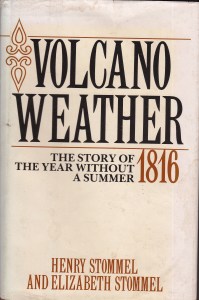
VolcanoWeatherJust 200 years ago, there was a “year without a summer.”  Well, that’s an exaggeration, but the name has stuck and is familiar to those of us with an undue interest in weather.  Although the coldness of that summer was far from universal, frosts came in New England in June, July, and August, killing off the staple corn crop for much of the region.  Snow fell even later than it usually does in the northeast, including a measurable fall in July.  My interest in this particular cooling episode was spurned by reading about the eruption of Krakatoa in 1883.  The connection?  Mount Tambora, a relative neighbor of Krakatoa, erupted in 1815 with an ejected debris volume of about ten times that of its later colleague.  The dust cloud from Tambora has long been a culprit for the dismal summer the following year.  Henry and Elizabeth Stommel researched and wrote a little book on this event entitled, Volcano Weather: The Story of 1816, the Year Without a Summer.  Although the book shows its age (it was written in the early 1980s), it remains a fascinating exploration of the many things that weather can do.  And has done.  Two of my favorites from this book were Napoleon’s adventures and the writing of Frankenstein by Mary Shelley during a rainy summer in Switzerland.
 
I should note, however, that the Stommels do not declare that Tambora was the reason for the year without a summer.  They tend to think the volcano had something to do with it, but the weather, that most protean of phenomena, can be impacted by the very small as well as the very large.  In fact, their description of the eruption includes the recognition that locals felt volcanic eruptions to be normal acts of the gods.  Many island cultures recognize the divine power of the molten earth.  The weather getting out of whack, we can be sure, leads to much prayer even today, thousands of miles from any eruption.  Something that hasn’t changed since the 1980s is that natural phenomena—especially powerful ones—evoke the divine.  Huge, impressive volcanoes, or even the very immensity and complexity of the atmosphere, suggest something we can’t comprehend.  Global warming will soon, however, bring this point home.
 

One of my takeaways from this book is the fact that the weather’s lack of uniformity emphasizes just how little we know.  The year without a summer mainly affected the northern hemisphere, and that only piecemeal.  Parts of northern Europe and North America felt it more intensely than other places.  It was not “the coldest year ever” and anyhow, is it even possible to know whether the coldest year would feel unnecessarily chilly where you are?  I’m pretty sure it’s snowing in some part of the world right now.  Human arrogance when it comes to global warming can be put into perspective by such acts of nature as Tambora.  From a human perspective, we live on a time bomb.  Volcanoes care not a whit for our bidding and wishes and dreams.  They can impact climate more instantly than our trite human efforts and thinking we alone are gods. To prepare for the future sometimes we need to look two centuries back.


Holy Castle

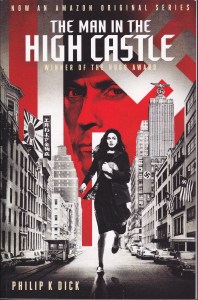
ManHighCastleReading about Philip K. Dick prompted me to read one of his novels. But which one? Some Amazon pick-up lockers on the way to work are painted with a mural of The Man in the High Castle. I haven’t seen the series, but there was the paperback, facing out, at the local independent. It’s been a while since I’ve read Dick, so I have to find my legs for his style. I’m surprised at just how much religious language he uses. Our cultural biases tend to insist that intelligent people aren’t hoodwinked by religion, but it does, nevertheless, appear. The premise of Dick’s novel is based largely on I Ching, the “Book of Changes.” Indeed, the conclusion of the novel relies heavily upon it. Along the way, however, Dick shows his sacred mettle when it comes to Judaism and Christianity as well. His prose is sprinkled with biblical quotes.

More than just a surface awareness, The Man in the High Castle offers some deep reflection for the reader. Mr. Baynes, seated on the rocket to San Francisco, ponders the Nazis who’ve won the Second World War. Reflecting on their hubris he considers how they’ve come to think of themselves as divine. “Man has not eaten God; God has eaten man.” This gave me cause for pause. Apart from Dick’s narrative, the idea of divine anthropophagy is in keeping with much human experience. We often consider ourselves masters of our own fates. Many, however, find themselves dangling like a spider from a web over the fire. Not that of Edwards’ Hell, but simply that of human circumstance. The Nazis didn’t win the battle, but listening to today’s political rhetoric, they may have won the war.

Nobusuke Tagomi explains to Baynes how I Ching, a 5000-year-old book, is alive. “As is the Christian Bible; many books are actually alive.” Far from poking fun, Dick suggests there may be something to all this mumbo-jumbo after all. We are conditioned to mock, dismiss, and ignore religion in this world where rationality leads to presidential races such as this one we’re currently suffering. Follow the trail back, I suggest. Look for clues. Philip K. Dick isn’t the only secular writer who knew more than the average person about what fascism looks like, and about the role of religion in its downfall. The novel may not be easy to read. It demands much of those who approach it. Nevertheless, it preserves the truth that many books, indeed, are alive.


The Devil Made Me

TheWitchesWitch-hunts, I suspect, will become all the rage again if a certain presidential candidate is elected. The fear of witches is not easily explained in a world driven by materialism, but certainly misogyny plays an unholy role in much of it. Stacy Schiff’s The Witches: Salem, 1692 has been selling well. Since my wife is one of the many descendants of the Towne family that suffered three witch accusations resulting in two executions (Rebecca Nurse, Mary Esty, and Sarah Cloyce) we read this book together. It is a detailed account of the year we went mad. A year when being different, especially not being Puritan, and not being male, was dangerous. Religious tolerance was not a gleam in the colonists’ eyes since religious freedom translated into not being forced into the government church, not allowing others the same privilege. Indeed, as Schiff points out, religious tolerance was considered by many to be a satanic idea. If ministers starved due to such freedom, it would be easy for Satan to take over. As it was, the Dark Prince seems to have done a pretty good job among the Puritans without such tolerance.

The idea of the Devil has been (and still is) the ultimate scapegoat. People in a capitalist society are naturally frustrated—surprisingly few see this—and frustration always seeks a reason for its own existence. That is patently clear at Salem: blame the Indians, blame the French, blame the Quakers, blame the women. Any and all may be agents of the Devil. Even the descriptions of the Lord of Darkness varied so much that, were he a human, no one could be quite sure who it was they saw. The Devil always takes the form of your enemy. All it takes is an influential clergy willing to push tense believers over the edge. Soon we begin building walls. Then we build gallows.

Religious tolerance has always been a frightening thought. Protestantism challenged a somewhat uniform Catholicism and the mite of a doubt burrowed deeply into peoples minds: is my religion the wrong one? Tolerating other religions means admitting that yours might be wrong. The logic that plays itself out is a terrifying one to some. Belief is never easily changed. States can’t stand dissenters. The only capital crime for which the federal government still executes citizens is treason. Treason sits uncomfortably on the other side of the coin whose obverse reads “tolerance.” You’d think that three centuries would be long enough to learn something. Unfortunately some lessons—often tragic ones for the powerless—have to be played out over and over before we start to comprehend that Satan can be anyone we want him to be.


Nature’s Voice

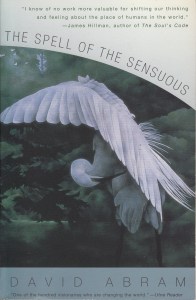
SpellSensuousCivilization isn’t all it’s cracked up to be. Sure, it’s got its moments—modern medicine, indoor plumbing, Honey Boo Boo—but often it’s artificial. It’s like somebody made up a set of silly rules and those who dare violate them are treasonous barbarians. Over the past few years I’ve been reading books that consider our biological development and what nature seems to indicate about how people might exist more holistically in the world. I don’t mean New Age outlooks, although, surprisingly, such treatments often aren’t far off base. I’d never heard of David Abram or his book The Spell of the Sensuous. (For those who think sensuous means only one thing, the subtitle is Perception and Language in a More-Then-Human World.) Although somewhat dated, this is an insightful book. The basic premise is that we are, by nature, part of a much larger world but we have, like spoiled children, decided to take it all for ourselves and isolate our species from all others, claiming a superiority that none dare challenge. In the process we’ve lost much of what it benefits us being animals, and have separated ourselves from the wonders of the world all around us. Working in Manhattan, I have to agree.

Basing his observations on having lived among aboriginal peoples, Abram notes that although anthropologists have denied the tenets of Christian missionaries on the religious front, they have continued in that teaching concerning biases against nature-based belief systems. Peoples who live close to the land observe things which seem superstitious to the “civilized,” but which are, in reality, simply astute realizations based on watching how the world works. Like Thomas Nagel, he notes that consciousness pervades the natural world. Animals, plants, even the earth itself displays forms of awareness that we ignore in our rush to exploit and gain “wealth.” In reality, we suffer for having made ourselves something we’re not.

There’s a lot in this book, far more than a single blog post can say. I don’t agree with all the points Abram makes—that writing may be responsible for our dilemma is a bit of a stretch—but there is great wisdom in this tome. At several points I had to stop and ponder the implications of what he was saying. Yes, nature speaks. Creating a world where “success” is measured in removing yourself as far from nature as possible requires elaborate rules. As far as I can tell, obeying the rules means that if you’re one percent of the one percent you’ll have nothing to complain about. If you have enough money—itself an artificial construct—you can run for president with no other qualifications. Meanwhile, nature suffers at our hands and may only recover once the world is forced from our hands and the sensuous once again takes over, doing what it has always done.


Not for Prophet

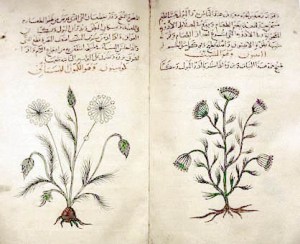
Delicate isn’t a word we’ve been taught to associate with Islam. I remember a priest speaking to me oh-so-earnestly about how Islam by nature wanted to take over the world. I wondered about his education in the history of Christianity. If you turn the clock back far enough, even the early Israelites, according to Judges, attempted genocide. We do religions a grave injustice by reifying them in this way. A recent story on NPR tells about the restoration efforts of a library in Fez, Morocco. As Leila Fadel points out in this story, we tend to suppose Islam is ISIS destroying history, but this library, full of Arabic manuscripts, is one of the oldest in the world. We sometimes forget the great contributions Arabic—yes, Islam—has made to world culture. Including literary culture. Some of the scientific works of Aristotle were preserved only in Arabic. Even the word “algebra” bears the distinct signature of its Arabic roots. What we should be attempting to halt is extremism.

Arabic_herbal_medicine_guidebook

One of my readers commented the other day about absolutism. This was in the context of Christianity, but it applies here equally as well. Absolutism tends to see only sharp divisions in a world where everything, in reality, blends into everything else. Islam emerged from a prophet who was influenced by Christianity and Judaism in the context of Arabian polytheism. Many of the tenets of Islam would settle comfortably in the pew, if we would let them. “Revealed” religions, however, take no prisoners. The concept of “revelation” means that your scriptures come straight from God’s anthropomorphic mouth to your all-too-human ear. When your religion is revealed, you can’t mix it with the best of your competitors. That’s one of revelation’s greatest dangers.

It does my soul good to see the begloved curator of the Qarawiyyin Library touching an Arabic manuscript so gently. It is the very picture of a pair of lovers. Those who love books—truly love books—can wish no harm on their fellow human beings. Reading is, after all, exploring the minds of others. All texts, in this way, are sacred. All are revealed. Too often we listen to those who tell us this is all an apocalyptic struggle to the death. In reality, revelation never ceases. Of its source I’m uncertain. Of its literary progeny I am certain that human minds are only richer for having received the words of the many prophets of the literary endeavor.


Dairy King

In the way that only social pundits can generate stereotypes, people born between 1979 and 1994 are called “the entitlement generation.” Large scale social attitudes, it is alleged, set an almost unbreakable Zeitgeist that defines us neatly so that we can be made easier to handle. Obviously I don’t fit into that generation, but as I watch the super-rich—often old enough to know better—claiming that they shouldn’t pay taxes because they do such good for society simply by existing, I wonder if the pundits might’ve missed the boat. An antonym to entitlement, it seems to me, is social responsibility, gratitude even. That’s why I find a story in Time from back in April so encouraging. Hamdi Ulukaya, the president and CEO of a successful yogurt company (Chobani), decided to give his full-time employees, in a reverse kind of tithing, a 10 percent share of the company. After all, one can only eat so much yogurt.

IMG_2795

This generous action sets out in sharp relief some of the dangers of quotidian capitalism. Many of those who feel that unencumbered free enterprise is the only fair system don’t spend long enough looking around themselves. I’m sure studies must exist that explore what the cubicle mentality does to people. Working in a little cell, open to the view of others to ensure you aren’t slacking, knowing that someone on the floors above is getting rich from your efforts, it’s hard to believe the system’s working. Descend to street level and those who don’t even rate as drones will meet your eyes, if you keep them open. We are in the habit of discarding people as just another resource that can be remaindered and wasted. Let them eat yogurt. Social obligation? What’s that?

No, entitlement didn’t begin in 1979. Perhaps the most obvious idealist in this country the past century was Franklin D. Roosevelt. He repeatedly earned the wrath of the entitled wealthy for wanting to set up social safety nets to help the poor. When the United States entered World War Two, he realized, however, that military contracts had to allow for owners to get rich otherwise they wouldn’t contribute to the effort. If you’ve got the money to keep yourself safe, what do mere concepts as liberty and fairness mean to you? Wealth entitles personal survival, obviously. Let the others fend for themselves. There are companies with a conscience, but the fact that they stand out so clearly against the backdrop of business as usual should be telling us something. As you chew this over, you might consider having a Chobani. Go ahead, you’re entitled.


Holiday Weekend

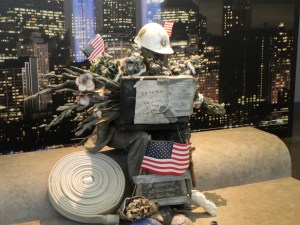
John Seward Johnson II is a sculptor whose work is instantly recognizable by a number of people. Realistic, life-size bronze castings of people doing everyday things, some are painted so as to be difficult to distinguish from quotidian humans. Others are left more abstractly colored or sized so as never to be mistaken. They are, in many ways, explorations of what it means to be human. One of Johnson’s statues, “Double Check” presents a business man sitting on a bench, checking his briefcase. It is most famous for having sat near ground zero and having confused rescuers as a real person traumatized by the events of September 11. Memorial Day seems like a good opportunity to revisit the statue that many thought was human, and which many people still adore.

DSCN6309

While perhaps the most obvious question a sentient being can ponder, what it means to be conscious (and in our case, human) is without an easy answer. We are animals aware of our own mortality in a way that causes many of us angst, or even terror. Humans (and perhaps other conscious animals are) notorious anthropomorphists—we think of other creatures, and even inanimate objects as being like ourselves. We can mistake statues for real people. All too often we treat others as if they were made of cast bronze. Memorial Day is for remembering, but the fallen haven’t only been the victims of the madness we call war. Violence done to others for one’s own gratification is an act of war on a personal scale. Individuals who destroy many others need to stand long before a statue and ponder.

“Double Check” has become an icon of sorts. People left gifts and remembrances for the victims of the attack on the statue. When the real thing isn’t there, sometimes a statue will do. This can teach us something about being human. As we die, at least in this culture, we are buried and a headstone becomes our statue. Our representation for the world to remember that we were here. Our progeny may lay flowers on our grave on this date some day in the future while statues that look just like humans will remain largely unchanged, asking those who remain alive to check again. To think, what does it mean to be human? And when any of us may be tempted to harm anyone else, perhaps we should gaze at a statue and consider the implications.


Literate Madmen

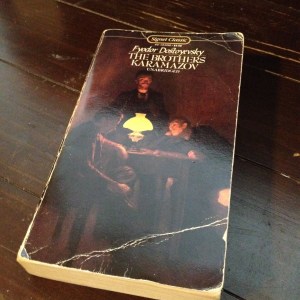
My experience of paternal parents growing up never led me to think Father’s Day was a holiday particularly worth celebrating. (Don’t panic—today’s not Father’s Day!) I do have an ironical sense of humor about the commemoration, though. So the other day when I clicked through one of Amazon’s many daily ads to my email account, I noticed it was for Father’s Day gifts. The first item listed was Fyodor Dostoyevsky’s The Brothers Karamazov. Probably based on my browsing history, I thought. But no, I’ve been looking at non-fiction lately and I bought my well-worn copy of Dostoyevsky before Amazon was a gigabyte in Jeff Bezos’ eye, back when I was in seminary. Then it dawned on me: this is perhaps the most famous patricide novel ever written. Had the Amazon advertisers really thought about what they were recommending? “Here, Dad. It’s a book about sons killing their father.” If marketing is driving America, it may be time to pull over at a rest stop for a coffee break. Or at least read the book first.

IMG_2796

I don’t pay attention to when Father’s Day is. It comes somewhere in that complex of spring holidays that include Passover, Easter, Mother’s Day, and Memorial Day. When my father was alive I sent him a card. It was a card to a stranger, but as Episcopalians know, it’s the done thing. I loved him, but I didn’t know him. Not that I’ve been a parent that deserves a holiday dedicated to my skill either. I confess my fair share of parental failures. They play and replay in my head, in the way the Protestant brain can never quite clear itself of guilt. We, as people, I believe, generally try our best to be good parents. It can be difficult, though. Nothing really prepares you for it.

One of my brothers once told me that, after having a girlfriend with kids from a previous marriage, he better understood how our stepfather viewed us as inherited children. Although I always want to claim the victim role in that scenario (I was only ten, what could I do?, etc.) his insight has stayed with me. It can’t be easy to inherit someone else’s progeny. It’s tricky raising your own child—that new person you want never to experience your own disappointments in life. Even cynics can be sentimental. But then again, I’ve been plowing through The Brothers Karamazov again since January, frequently laying it aside for weeks at a time. It’s not the kind of book I’d give a father on the edge. It’s okay, I think I’m good to drive again. I just won’t pay any attention to the ads I see beside the road.


Mythisotry

Positivism takes no captives. I’m not talking about the philosophical system—not necessarily—but about the phenomenon of assuming absolutes are available for human consumption. Some physicists, for example, assume that because our five senses can detect reality only the perceptions of those senses can be considered real. Material. Nothing more. Nothing less. A similar view plagues those who believe history is the telling of “what actually happened.” No historical event has ever been fully explained. All stories are told from a perspective. This is particularly dangerous when religions get involved. Many mistake historical veracity for “truth.” If it didn’t occur just as “the Bible says” then we should throw out the whole shebang. No point in believing in half truths. This is a myth.

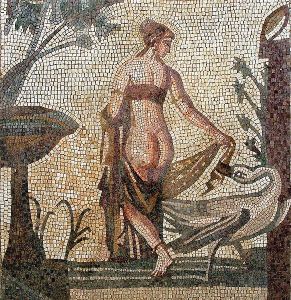
This point was reinforced when a friend send me an article about the production of “The Hollow Crown” on the BBC. Apparently a local politician tweeted that having a Nigerian of Jewish descent (Sophie Okonedo) play Margaret of Anjou, a French queen, didn’t match history. As proof he provided a downy white Medieval illustration of the queen. In a rare moment of academic cool, an historian quickly pointed out that the illustration came from a manuscript that claimed Margaret descended, Leda-like, from a swan. Her whiteness, thus, belonged to her avian DNA. As the story makes clear, history is the modern mythology. We assume we know what happened, but we will only ever have part of the picture.

582px-Leda_mosaic_crop

Prejudice seldom worries about historical accuracy, unless, of course, it helps to uphold the bias. I used to caution my students about taking history as a statement of fact. Certainly there are events with factual elements, but when everything is interconnected we can never untangle precisely what happened. When we “believe” history, we are choosing to accept a certain viewpoint of things. One person’s manifest destiny is another person’s genocide. Peculiar institutions are very peculiar indeed. History, as we’ve come to know, reflects the point of view of the historian. It must be read and evaluated as the opinion of the writer and not as the absolute truth. For me, I rather like the idea that some people are descended from birds. It certainly helps to make more sense of what I see in the behavior of those who claim to be making history today.


Religious Melancholy

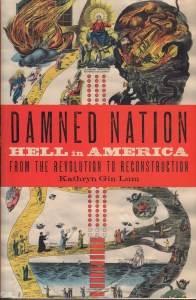
DamnedNationI’d never come across the term “religious melancholics” before, but somehow it seemed to suit me. Perhaps that goes without saying as I’m reading Damned Nation, by Kathryn Gin Lum. While sitting on a bus. We’re sitting in traffic and the guy sitting next to me has obviously just finished a cigarette before climbing aboard. Having grown up as the victim of second-hand smoke for my first two decades in life, I’m thinking about Hell as well as reading about it. You see, Gin Lum’s descriptive subtitle is Hell in America from the Revolution to Reconstruction. The fact that Hell’s alive and well, despite some evangelicals’ attempts at annihilating it, suggests that it’s best to keep informed on the topic. This book’s mostly historical, however, reporting how Americans interpreted Hell in the eighteenth and nineteenth centuries.

As with most histories, I find the earliest material the most interesting. Gin Lum tends to focus, naturally, on preachers at this period since they are the ones most likely to talk about eternity. The thing that struck me the most was the number of people she describes who, after contemplating (a primarily Calvinist vision of) Hell, attempted suicide. I tend to think of suicide as a contemporary problem, but obviously it has been a steady human practice since our species first learned that you don’t have to wait for someone else to help you slough off this mortal coil. It is troubling, however, that it was a “doctrine” barely found in the Bible that led people—most of whom later became preachers—to try to kill themselves. It also seemed a touch odd that evangelicals in those earlier days of our nation didn’t find it troubling that those leading the flock had almost sent themselves to perdition. These early days of literal Hell believing were most interesting indeed.

The phrase “religious melancholics” comes from the resistance. There were those—generally skeptics, doctors, psychologists, and the like—who felt that the preaching of hellfire and brimstone took a toll on the healthy psyche, particularly of the young. As one of those who grew up attending revivals where Hell was a featured guest, I know that my life has been a prolonged attempt to avoid said eternal lake of fire. Even when I rationally learned that there is no three-tiered universe in which it still fit, and that the idea was cobbled together from a variety of religions into the ultimate scary place, Hell still manages to haunt me. Does it keep me moral? I don’t suppose that to be the case, since I have tended to believe people are basically good. Don’t bother trying to convince me logically that Hell doesn’t physically exist. I know that already. It’s the mental one that I’m trying to avoid. And that can be a full-time job for a religious melancholic brought up on a diet of overcooked theology.


The Werewolf in Summer

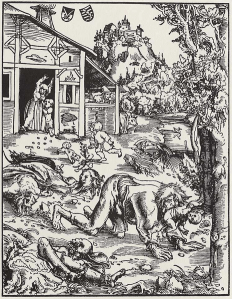
464px-Werwolf

It must be incredibly difficult to write a truly scary song. I don’t mean the kind of scare that most heavy metal can innately deliver, but I mean the kind of thrill that a classic horror movie gives. I’m constantly looking for the movie that can recreate the chills without getting blood all over the carpet. Music, however, soothes the savage beast. I remember when Michael Jackson’s Thriller came out. Now, nothing about Jackson’s musical style shows any hint of being scary. It’s too upbeat. In the end the ghost will be a mere reflection in the mirror, and the zombies will fade with the sunrise. I had some people tell me back then that it gave them the chills just listening to it. Amateurs. A couple weeks back I wrote a post on Radiohead’s “Burn the Witch.” It’s kind of scary, but it doesn’t keep me up at night. I haven’t heard Paul Simon’s new album Stranger to Stranger, but when I learned from NPR that it has a track called “The Werewolf,” I knew I’d eventually add it to my growing stack of MP3s.

Like Thriller, the musical style of the song isn’t inherently scary. The organ in the final minute is pretty effective, though. What’s scary about “The Werewolf”? The lyrics. Simon is, to this child of the sixties, the foremost lyricist of his genre. Rich, complex, nuanced, his words tell a story and that story is scary. While I prefer my werewolves with different baggage, it’s pretty clear that like most shapeshifters the werewolf stands for hunger. There’s violent rage, of course, but like the wendigo, hunger drives those who can’t fulfill their desires in human shape. The Howling, for example, shows how lust can make a werewolf. There is a lust more dangerous than that of the flesh, and that is the greed that leads to societies with one-percenters who just can’t stop eating.

When we see Trump-clones who pay no taxes at all, due to the good that being uber-rich offers the economy, we should listen for howling in the night. Too many an April has rolled around where those of us called “middle class” stare in wonder at just how large a cut our government takes. The werewolves don’t wait for October to come around. No, those who are hungry eat all the time. I don’t find Simon’s music to be particularly scary. The tempo is upbeat and his voice just can’t feel threatening. Still, I’m shivering after listening to “The Werewolf” even though the shortest night of the year is fast approaching on padded paws.


Being Humanity

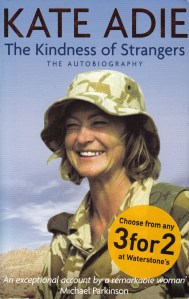
KindnessOfStrangersWhat do you want to be when you grow up? The question kept recurring as I read The Kindness of Strangers. The name Kate Adie may be more familiar to readers from the UK than to those from the US. While spending three years and a bit in Scotland, my wife and I grew accustomed to hearing her name as a reporter with the BBC. I’ve just finished reading her memoir and it brought to mind several points that hit quite close to home. Apart from being engagingly written, her biographical essays highlight the difficulties women still face in much of the world. As a journalist, Adie traveled to many vexed locations where some expressed surprise that a woman would have such freedom as to run around with men, investigating, reporting, and being seen by many, many viewers. Meanwhile, those she sojourned among had to deal with oppressive regimes, low standards of social justice, and, not infrequently, the fear of rape. It is a poignant and at times maddening account. Men the world over seem to share a horrid, deeply ingrained and reinforced concept that women are somehow there to serve them. Here we are in the twenty-first century and we’re still struggling with basic biology.

If I might tear myself away from that particular observation for a moment, I also found Adie’s firsthand accounts of the atrocities she witnessed deeply troubling. In this day of Holocaust awareness and the belief in human dignity, it is distressing to see how cheap life is under many governments in the world. How humans can be so inhumane boggles the mind of those with any sense that we’ve somehow evolved. Often the hatred is based in differing religious outlooks, but often religion is only an excuse. The offending religions that are touted almost all teach the descent treatment of your fellow human beings. Sadly, nothing appears to have been learned from the all-too-intentional violence of the past century. The real issue, reading between the lines, is power, not faith. It is easy to have a scapegoat, and some analysts (not Adie, I would emphasize) like to suggest a simple solution by placing their hands on the head of religion and confessing the deadly sin of being human over it.

The book, I should add, is not all gloom. Adie is witty, sophisticated, and a charming writer. One of the positive takeaways I had from her life story is that the question “What do you want to be when you grow up?” is all wrong. Adie never wanted to be a journalist, but through a series of circumstances eventually found herself one. A much decorated and honored one, no less. This is a lesson for our time. The old stabilities of choosing a career and staying with it seem to have eroded from beneath us. It is increasingly difficult to plan ahead for an uncertain future. Adie is a fine example of how to adapt along the way. More than that—and men pay attention here—she’s an exceptional example of what it means to be human. This is what we should all strive to be when we grow up.


Forgive Us Our Tabs

Forgiveness is somewhat of a specialization among the crowd courted by the new GOP. Although it is forgiveness that goes only one way, at least it’s a start. Think back to Bill Clinton making his non-inhalation declaration followed by W who could not hide from his drug-fueled Yale days. Televangelists who admit, in tears, that they had an affair stand a fair prognosis for at least a limited recovery. The religious right loves a repentant sinner. I suspect it will be the trump card in the deck, come this fall. A host of sins can be banished under this incredibly effective rubric. This past week Mike Webb, Republican hopeful for Virginia’s Congress, having lost his party’s bid decided to run as an independent. No forgiveness required. What’s right is right. During his announcement of his decision, however, he posted a screenshot on Facebook without checking his tabs. As the Washington Post article by Justin Wm. Moyer reveals, some of those tabs included porn sites. In a move no Democrat could’ve made, the conservative candidate thanked God for his mistake and his likes increased by 25 percent.

Technology is a kind of big brother. By their tabs you will know them. Our browser histories reveal who we really are. Browser histories, however, may be cleared. And those who know how to manipulate the forgiveness card can make no mistakes. After all the Gospels declare that you must forgive the repentant 490 times (taken literally), which leaves a comfortable margin to get elected. A little bit of time with the Good Book can do wonders for your campaign. The problem is, it only works with the GOP. If he admitted to inhaling, you can be sure that the War on Drugs would’ve crashed down on the White House. Dems have to keep squeaky-clean records because forgiveness doesn’t apply to that crowd.

Screen Shot 2016-05-21 at 5.38.11 AM

One of the ironies, apart from the Viagra ad on the page telling this story, is that such incidents reveal a basic misunderstanding on the part of the electorate. No tenet is more easily finessed than forgiveness. Who’d hit a dog who’s rolled over on his back, exposing his vulnerability, admitting that he’s just eaten what you left on the counter for your dinner? Apologies can be accepted for some of the most outlandish sins. They’re cheap to make but reap rich rewards. As a former evangelical I know this may sound terribly cynical. All I can say is I’m sorry, please forgive me. And don’t look too closely at my tabs.


Map to Eternity

One of the most remarkable things about Christianity is its fascination with the end of the world. Far from being the obsession of nineteenth-century dispensationalists alone (the other Mr. Darby), the earnestly anticipated end goes back to Paul of Tarsus, the first known Christian writer. Before even a Gospel was penned, this sect was expecting the end to come any day now. It still is, at least among many sub-sects. My wife, however, recently sent me a story on National Geographic about a map collection from the 1480s that depicts a geography of the apocalypse. If you were wondering where to make that left-hand turn, this book may be for you. One wouldn’t want to drive a German mile into Hell without an indicator signal on.

The story by Greg Miller describes this late Medieval manuscript and its assurance that the world will end in 1651—talk about your great disappointment! The unknown author of the codex feared Islam almost as much as Donald Trump but instead of running for the GOP nomination he wrote a book showing just how the end would take place. Illustrated, of course. Map is territory after all. I grew up reading fundamentalist tracts that did essentially the same thing. The more progressive bits of the propaganda left out the actual dates because an earlier Miller seems to have missed the doomsday boat, along with various and sundry telltale timekeepers. There in front of me I could nevertheless unfold the future and once the European Common Market gets its tenth member—wait, what? Has yet another head of the beast been lopped off?

Maps give more than directions.

Maps give more than directions.

Ironically, early Christianities were anti-materialistic. Money was considered the root of all evil and communism was the ideal. If you doubt me ask Ananias and Sapphira. They thought long-term investment was a bit of a foolish notion—something that I have somewhat naively, if unintentionally, followed my whole professional life. You can’t be vested without three years of servitude after all, and I was expecting the Second Coming after one year. Two, tops. If only I’d had a roadmap. It’s only 1777 German miles from Lübeck to paradise, so maybe I can catch the next doomsday boat and still get there in time.