A Writer’s Life

WeHaveAlwaysLivedSometimes, an experienced editor once told me, the author’s life is just as important as the book she’s written. I can’t pretend to know much about Shirley Jackson, beyond that she wrote compelling fiction and that her name is barely recognized today. Best known for her short story “The Lottery” and her novel The Haunting of Hill House, she didn’t match the output of more prolific writers and therefore, in a world driven by capitalism, didn’t receive much notice. Her work is difficult to classify. Not exactly horror, it is nevertheless unsettling by implication. There’s something wrong beneath the surface. Jackson apparently suffered neuroses for much of her adult life, and her ability to translate angst into literature has gathered her a following among fans of ghost stories. I just finished reading her last novel, We Have Always Lived in the Castle, a funny, quirky, and serious story about two young women who live alone and who, one suspects, are thought to be witches by the local population.

This little novel is difficult to lay aside for long. The characters of Constance and Merricat are too compelling to leave alone for any length of time. The fact that they are pariahs makes the reader want to ensure that they are safe as they remain carefully inside the home they’ve always known. Even though you know one of them murdered her family, you want them to be happy and secure, perhaps because the whole town is against them. I wouldn’t presume to say what Jackson meant by this story, but to me it seems a clear description of xenophobia by a woman who felt she was never accepted. Women being persecuted in New England always brings witch trials to mind. Although we don’t know why one of the girls killed her family, it is easy for the mind to fill in the blanks.

Although Jackson died prematurely, her work has influenced novelists such as Stephen King and Neil Gaiman. Uncompromising in her outlook, she allows her characters access to those strange places of the human mind where many of us wander from time to time. Merricat, for example, practices that sympathetic magic that we all, if we’re honest, admit that we attempt every now and again. Hoping in magic doesn’t make one a witch any more than prayer makes one a priest. We Have Always Lived in the Castle, although as old as I am, reflects a world in which reality can’t be pinned down. Assumptions are made and challenged. Protectors turn out to be exploiters, and the only ghosts are very human characters hated by the community in which they live. Still this is an uncanny tale, haunted by a reality that women still face in even the most progressive countries. Listening to their voices, even if from beyond the grave, may demonstrate just how much a writer’s life might mean.


Martian Ethics

MartianIf you need a boot of optimism, look to Mars. Or, more specifically, read Andy Weir’s The Martian. Not that it’s the greatest literature ever produced, but it is a story brimming with humanity. Mark Watney is accidentally stranded on Mars. His crew-mates, in the midst of their multi-month-long return journey, adjust their course to go back for him. Naturally, nothing goes as planned. Although much of the story is far beyond the believability scale, Weir has the technical background to make it all sound plausible. As an engineer, Watney fixes most problems with an optimism that would leave many humanities specialists weeping in the dust. Time after time a potentially fatal situation develops that is solved by technological ingenuity. Relying on his will to survive, and good humor, the protagonist makes a remarkable journey across the surface of the Red Planet to a potential means of escape. I shouldn’t throw too many spoilers into this post since the book is fairly new. I will say it left me feeling good about being human.

Part of being human is thinking about larger issues. Often, throughout the book, Watney wonders about belief in God. Not enough to make it a main theme, but enough to merit mention on this blog. In a somewhat humorous moment, one of the mission controllers says that he’s Hindu, so he believes in lots of gods. In contrast, Watney, alone on Mars, has a vastly different perspective. Without divine intervention, or even any aliens, he finds a way to persevere when the Fates (or the author) have stacked the odds against him. Mark Watney believes in himself, and he believes in human goodness.

The decision of his crew-mates to return for him is one of potential self-sacrifice. There are no guarantees that they’ll survive. Nevertheless, there’s no second thoughts. When they learn Watney is alive, they decide to go back, no matter what might happen to them. The story awoke a strange optimism in me. Although people are capable of horrendous acts against each other and the planet, I do believe that we are basically good. The bad ones make it into the news. We could all be better, I’m guessing. Still, we will help others when we can, even if all we get from it is the good feeling that we’ve done the right thing. Unfortunately, the only people, it seems, that don’t have the best interests of others at heart are our politicians. Watching the posturing before the primaries I do have to wonder if one wouldn’t stand a better chance abandoned on Mars than in the land of the free. This may be one of the times, it seems, that trusting in human goodness might well be equated to a prayer.


The Reign of Rain

I’m on vacation for a week. My job is such that taking vacation is becoming a rare commodity, what with precious few allotted days and move-in, move-out schedules of a collegiate child, and so on. And also company policy about keeping employees in the office between Christmas and New Year. Anyway, now that I’m here I should be kicking back and enjoying the beautiful lake and getting out to do the things inmates of the city seldom do. It has, however, rained every day that I’ve been here. Not all-day rains, of course, but just enough that plans have to be interrupted or changed at the last minute. I end up sitting in the cabin playing Solitaire when I should be out getting some fresh air. So it goes.
Ironically, I am staying in the drought-stricken west. The western United States, I learned when researching for Weathering the Psalms, has been ensconced in a decades’ long drought. In fact, prior to my family trip here it hadn’t rained in quite a while. Our arrival with the clouds was, after all, mere coincidence. Still, it’s hard not to take the weather personally. I know that the weather is larger than any one person’s needs or desires. I also know that water is a commodity even rarer than vacation days, largely because of our misuse of the limited supply that we have. California’s plight has been in the news. We have large cities in water-challenged environments and people treat water like there’s no end to its abundance while the opposite is the case. Just thinking about it makes me thirsty.
There are many things a person can go without, some of which feel absolutely essential at the time. Many vacations, I know, are extravagant. Fancy hotels, high-priced entertainment, exotic locations. Work can feel so crushing that vacation my become the one island of sanity in the midst of a hostile ocean of obligation. For me, vacation is time with family in a stripped-down, natural setting. Of course, we do indulge in some of the comforts of home, but having nothing in view outside the window beyond that which nature dictates is a transcendent experience. From where I sit, I can see nothing of human artifice. I do see clouds, however. I know that more rain is on the way. And I know that it is a gift, complain as we might, of the highest magnitude.


For the Sake of Fighting

Different opinions can be used for discussion or destruction. In the formal context of government, the declaration of war is—or should be—an option of last resort. Increasingly language of belligerence is status quo ante when religion is the topic. “Culture Wars” is a thinly veiled reference to the profound disagreement between social conservatism, associated with Evangelical Christianity, and progressive policies, often affiliated with nones and mainline Christian traditions that don’t wish to be left behind. For years, decades, no one side can declare victory, for example, in the debate over whether America was founded as a Christian nation. Two news stories I saw this past week addressed just that question. Fox News ran a story about a Baptist Church in Shelby, North Carolina, that has decided to fly the Christian flag over the stars and bars until, well, I guess the Second Coming. Protesting the legalization of gay marriage, the congregation wants the message, aided by Fox News, to spread that in at least this corner of the country, God comes first.

The other story, on CNN, asks the question directly: “Was American Founded as a Christian Nation?” With five professors answering the question there’s bound to be differing opinions but all agree that this isn’t a simple yes or no answer. The even larger question, it seems, is how can the founders’ religious orientations help us to avoid cultural wars? Isn’t the fact that we’re still searching historical documentation over two centuries later an answer in itself? Maybe they didn’t tell us directly because it was none of our business. Washington, Franklin, and Jefferson are quoted on both sides of the debate. Their cultural context was Christian, but as all the five scholars agree, the question didn’t become a live one until the nineteenth century. Seems that we got along a century without knowing.

The “Culture Wars” may have been there, of course, but the need for a term only arose in the late 1980’s and early ’90’s. The divide had been simmering since the end of the ’50’s, however. Leave it to Beaver versus Star Trek: the Next Generation. The media has never been shy about telling us what to think. Difference of opinion is as natural as a pre-frontal cortex. Peaceful coexistence, however, doesn’t sell newspaper or commercial airtime or space. We want the thrill of danger, the chance to declare that, unlike the adversary, we are clearly in the right. Maybe if we changed the metaphor the rhetoric might catch up. In the meanwhile, battle comes to mind. Ironically, the Bible is a place that suggests peaceful solutions to many disagreements, but neither side thinks to look there for guidance.

438px-Husité_-_Jenský_kodex


Detoxing God

There’s some pretty weird stuff in the Bible. Those who are only familiar with all the “thou shalt not”s are missing a great deal. Some of the material is strange enough to rival Alice’s tumble down the rabbit-hole (Charles Dodgson was, after all, a deacon). Anyone who’s read Ezekiel, or Daniel, or Revelation, knows the feeling of having been slipped into some kind of alternate state of consciousness. As students of the Bible have been saying for decades, “What was Ezekiel on?” I’ve always tried to put these unusual writings into context for my students. Nevertheless, some scholars still explore the possibilities that something more than revelation was going on in the desert. A friend of mine pointed out the website Time Wheel, which has a story about Moses and his experience of the burning bush. Time Wheel is an artistic collective, and the story about Moses is richly illustrated. The title, however, is the attention-grabber: “The Bible’s Moses Was On DMT Says Hebrew Professor.”

The article explores the thesis of Benny Shanon, who suggests Moses may have found DMT in the natural store of psychedelics available in nature. As the piece suggests, you have to accept a literal Moses for this to make any sense. Nevertheless, it does raise an interesting question: did ancient people use hallucinogens for religious purposes? We do know that cultures throughout the world have found alternate states of consciousness to be religious in nature. Before the days of controlled substances certain plants and fungi were known to distort reality. Alcohol was one of the earliest inventions of civilization, or perhaps even predating it. When other views of the world are available, it is possible to say that one is by default the true one? It’s a question we face every morning, to some degree. The dream, another biblical favorite for alternate realities, can be just as real as waking.

Controlled substances are dangerous in large groups of people. Not only have modern scientific techniques refined the active ingredients, but we live very close to one another and erratic behavior, perhaps fine isolated in the desert with a cognizant adult, can lead to problems when other people live right next door. Anthropologists assure us that the use of natural “drugs” is/was not uncommon among many peoples who don’t fall under the rubric of powerful centralized government. But was Moses among them? To me, the burning bush hardly seems fantastic enough to require a chemical explanation. In fact, detailed study of even such books as Ezekiel and Revelation often reveal a much more mundane reality behind the writing. Still, imagination is often the key to unveiling realities left hidden to more prosaic minds. So why not see what might happen when the religious are left to their own devices in the desert? The results could change the world.

278px-William_Blake_-_Moses_Receiving_the_Law_-_Google_Art_Project


Headliners

I sometimes wish I was a journalist. Just this past week a couple of people questioned my journalistic skills for an opinion piece I wrote for Religion Dispatches. I’m fully capable of professional research, but who has the time? Still, being a journalist might be fun. Thinking up clever headlines would be challenging day after day, but nevertheless, it might be enjoyable. Editors who lay the articles next to each other on the page must have a sense of irony. This past week in the New Jersey Star Ledger the central headline read “Killer tightens its grip on N.J.” The column to the right began “Christie to mingle with the uber-rich.” Having lived in New Jersey under Christie’s entire reign, I’m no fan. I’ve despised bullies since I was a kid, and rich bullies are worse than the working class variety. New Jersey certainly seems no better off to me. Now he wants to be President.

FullSizeRender

The real headline, however, about the killer in New Jersey is not yet another prison-break story. It deals with heroin overdose deaths. According to the article, per 100,000 people in the U.S. 2.6 deaths are from heroin overdose. In New Jersey the figure is 8.3. New Jersey, as the most densely populated state (1200 people per square mile, I once read) has its share of problems. Most of us like to pretend that drugs are somebody else’s issue, but I’ve known addicts and they are not evil. When life offers you unrelenting recession after recession and all attempts to better yourself run up against the 1 percent, frustration is inevitable. Even earning a doctorate will only lead to jobless misery. What more can you do than get an education? Heroin is dangerously addictive and it makes the user feel great, I’m told. Society doesn’t offer many other options. At least in Rome they had bread and circuses.

He who would be President, however, can’t be concerned about that. The uber-rich must be fed. And fed. And fed. Those whose ambition to high public office is naked power would be foolish to ignore their fellow plutocrats. Down here on the streets, things look a little dicier. Although I think I understand why many turn to chemical relief, I’ve never been tempted by drugs myself. One of the reasons I turned to religion was the prevalence of drug use in the town where I grew up. There seemed to be no future in substance abuse. I may not have chosen the most promising of ways to move ahead either, in retrospect. Now I find myself living with a governor who represents all that’s wrong with government. And if you’re going to die of drug-related despair, it seems like his particular state is the place it’s most likely to happen. Long live the king!


Law of Rule

Anyone who believes in the rule of law has never been on a broken down NYC commuter bus. There’s a rare kind of tension among the early morning commuter crowd. To put this in context I should say that I awake at 4 a.m. to catch the first us through town, five days a week. I’m usually somewhere between four and six on the passenger count, but if lots of people need to be in New York before sun-up, I may be as far down as 10. I select my seat with care. I tend to sit two seats behind the driver. I prefer the right-hand side of the bus, but there’s a regular who sits there and, I’m given to understand, she’s been doing this for over a decade. So I sit left. It’s never a good portent when I end up having to go four or more rows back. You see, the buses usually unload in a fairly orderly way, the front rows get out first, and each row takes its turn. Since too early is never early enough to be at work, I sit near the front because in the back you can lose precious minutes waiting for those who are sleeping to rouse themselves enough to find their feet and stumble off. If it sounds like I’m overthinking this, it’s because I’ve been awake since before four and how you start your day sets the tone. Where’d I put my coffee? Arriving at the office frantic and sweating isn’t the best way to impress anyone.

There’s a kind of comfort at being at the end of the line of service. Of course, the commute home means you’re on the bus longer than people who can afford to live closer to the City. First on, last off. Although I easily fall prey to motion sickness, I have taught myself to read on the bus. An hour in and two hours out are goodly amounts of time to really get into a book. I hate to waste time.

IMG_2304

You can smell a bus breaking down. I always hope the driver doesn’t catch a whiff, because s/he’ll call the control center and lawyers will dictate that the bus be stopped. By definition, you’ll be late to work that day. So when I smelled something burning, I hoped I was the only one. Luck has never been my strong suit. The driver pulled over and announced, in a soft voice, that we’d have to wait for the next bus. That means I could’ve slept in for ten more minutes.

The next bus is an “express”—that is local compared to my bus. The driver said, “Just stay in your seats, and I’ll call you.” Of course, people started to get off to form a line, despite the captain’s words. In a universal display of self-importance, those who just got on immediately hurry to get off first. They’ll be first in line to get seats on the next bus. Those who obey the driver are penalized. When it became clear that I could hear crickets chirping on the bus, I decided to put away my book and join the line. After quite a wait, the local came. That would get us to the City in time for work tomorrow. Several minutes later the express came. Those at the back of the line behind me hurried over. By the time I’d gotten there, still trying to honor the most ancient of queuing honor codes—the line—all the seats were taken. Those in the front of the line, now the back, headed over to take first place again, since they had expected the rescue bus to pull in front of our smoking wreck instead of behind, where it did. They weren’t shy about elbowing their unrighteous way to the front when the next bus came. I’d been on the abandoned bus since before 6 a.m. I made the third bus. The guy in my row on the adopted bus tried hard not to make room for a new passenger next to him. I was headed to New York where, I know, all the rules are off.


Magic Faith

MakingWe all like to believe we don’t believe in magic. In this day of sophisticated materialism, the idea that unseen forces might work upon the world seems terribly naive and not a little embarrassing. Randall Styers’s Making Magic: Religion, Magic, and Science in the Modern World has been on my reading list for a few years now. Not so much a history of magical thought, Styers offers a history of thought about thought on magic. There are several takeaways from a study like this. One is that magic and science share common ancestors. In fact, some theorists trace the origins of science to magical thought. The height of alchemy was also the period when experimental analysis of the natural world was blossoming. There was a mysterious sense to what we now think of as impassive particles whirling around for no particular reason. Making Magic makes clear that we can’t divorce developed thinking from magical outlooks. In many ways it is difficult to distinguish religion from magic.

Not that Styers advocates magical thought. He does, however, invite us to think about it. Another takeaway from this study is that magic, when described by religious writers, is a foil. Magic is used to show how the unenlightened think about things. Those of us here in the true light would never think such backward thoughts. Indeed, magic, as Styers makes clear, often served as a kind of social control. Lower classes think magic works wonders. The upper classes know that power lies in exploitation. Magic, in other words, can’t be divorced from politics. Those in the know would only encourage magical belief to continue. Invisible forces indeed.

Magic as a regulatory force is indeed the thesis with which Styers is working. The difference between prayer and magic is somewhat effaced when closely examined. Religious belief is seen as benefiting society while magic is for selfish benefits. I do wonder, however, where the modern magical religions, such as some branches of Wicca, would fit into this scheme. They also seek the good of society. Magic need not be selfish. Making Magic is concerned with the analysis of magic by scholars who’ve shown a surprising interest in the topic. It doesn’t really address those of today who, after finding the atomic world strangely vacuous, have turned to magic to re-enchant a world grown dull and dry. Whatever one may say about magic, it still exists, and its believers are among us. Our world with its solemn, feelingless answers could, at times, use a little such conjuring.


Only Takes a Spark

Fireworks have been the main event for Independence Day celebrations ever since I was a child. The fourth of July is a day for playing with fire. As a child I remember spending the meager allowance I had on sparklers and snakes. I haven’t seen one of those ash snakes for decades now, but the impression they made remains strong. A plug of some kind of carbonish material—you’d light the top with a match and it would flame and hiss and start to grow into a long, twisting exoskeleton of ash. They left a blackened circle on the sidewalk, and when they were cool enough you could try to lift the fragile snake in your hand, but it almost always broke apart before blowing away in the breeze. We also wasted our money on smoke bombs with their multi-colored smoke, but we never had actual firecrackers. Given the trouble we could make with an ordinary roll of caps, that was probably a wise decision on our mother’s part. All of this, however, was just a prelude to the fireworks.

As I sat under a cloudy sky last night wondering why every July fourth seems to rain, it occurred to me that fireworks are a violent form of celebration. Indeed, they are designed to imitate the sounds of battle—before the nuclear age—and we all know the thrill of when the loud, bright burst of pure light sends a shock wave through you. It is like a canon rocking your soul. Like many stirring experiences, fireworks had religious overtones from the beginning. Invented in China, fireworks were used for religious festivals. They were believed to be effective at driving away evil spirits and bring good fortune. Pyrotechnics, however, clearly have military applications as well. It is this strange nexus between religion and violence that makes, I suspect, fireworks displays so compelling.

IMG_2287

The local display here in Somerset County, New Jersey, was impressive for a region without large cities. I couldn’t help pondering the strange aesthetics of contained violence as the colorful explosions took place over my head. Illusions, I know. We always talk afterward about whether some of them are meant to represent anything. Did you see a smiley face, the United States, or even New Jersey? It depends on your angle of view. Is this a religious display or a celebration of violence? Looking around at the amazing diversity of peoples gathered here in this park with me, I feel strangely satisfied. I hear languages I don’t understand, and see people from all over the world here for a good show. Although thousands of us try to get to our cars at the same time, spirits are positive, for the most part, and all go home in a celebratory mood. Maybe the ancient Chinese were right and these pyrotechnics do drive away evil spirits after all.


Ethics for Rent

Ironically, the Bible is the basis for the western preoccupation with land ownership. What with commandments against stealing and coveting, the Israelites had a sense of being promised a land by God. It was their land and no human motivation—including imperial conquest—could trump the divine will. In the western world, so heavily influenced by the Bible, the concept of private property is itself considered sacred. If enough land to sustain yourself is good, even more land than you need must be better. That’s logic. Land-grabs by the powerful are nothing new. In America (land stolen from the original owners) no better symbol of affluence exists than property ownership. Like many things biblical, this is often a myth. Although I’m a white, Anglo-Saxon, straight, Protestant, I grew up among renters. My family couldn’t afford a house. When my mother remarried, my step-father owned his house and it was in such bad shape that as soon as he moved out to a rental property, it was immediately razed. On my own, I’ve always been a renter because I couldn’t ever afford to be anything else.

After Nashotah House, my wife and I considered buying. Wisconsin, apart from having no jobs, seemed like a nice place to settle. We researched. Your mortgage payments should be no more than 30 percent of your income, we learned. Living in suspended animation since those days, we’ve rented in a variety of places and the 30 percent figure has also turned out to be a myth. Affordable housing, in the United States, is set at that benchmark. A recent news byte in the Christian Century notes that in not one of the fifty united States is it possible to rent a one-bedroom apartment on 30 percent of minimum wage. 49 hours of work a week would be necessary to meet that benchmark in South Dakota, the state with most affordable housing. I know professors of Bible who own summer houses. That’s in addition to their regular houses. Meanwhile, many who would like to own something much more modest can’t afford even that.

The biblical worldview is an idealistic one. Recognizing that greed is inseparable from human will (even among a chosen people) the hope was that the poor would be taken care of by those who had more than their share. As the statistically inclined like to say, the numbers don’t lie. Housing, one of the most basic of all human needs, is exploitatively expensive. Many renters can never break out of the cycle of paying too much in rent so as not to be able to save up enough to make a down-payment on a place of their own. Yet prices go up while raises don’t keep pace with inflation. It’s all about ownership. Laws are in place to protect those who take (“legally”) for themselves. The rest pay into the system at three times a tithe. And even this, the numbers say, isn’t nearly enough.

Rent


Theological Cemeteries

There is a plague upon this nation.  When in one week, let alone one day, I hear about two colleagues being let go from their academic posts for not meeting conservative theological standards, I believe it is time for higher education to take a good solid look at what it claims to do.  Thomas Jay Oord, one of whose books I supported and saw through publication at Routledge, was dismissed from Northwest Nazarene University after, according to early reports, being considered for a heresy trial.  Almost simultaneously Daniel Kirk, whom I don’t know, was let go from Fuller Seminary, apparently following questions of his belief in traditional marriage.  Having been dismissed myself into an academic morass that has never passed for a satisfying career, I feel a sense of moral outrage here.  No doubt, I am more liberal than either Oord or Kirk, but this is not the way educated adults treat one another.  In fact, it is heinous.
 
While still teaching at Nashotah House, before I crossed some invisible line in the doctrinal sand, I often wondered about this.  Conservative schools want the credibility of professors with bona fide doctorates, and then wonder why they can’t get educated people just to nod their heads at all the right places.  Education should make people think.  It should make us all question our assumptions.  Any faith that can’t examine itself seriously and come back to thrive is no faith at all.  I know all too well how difficult it is to get along with a doctorate in a socially unacceptable field where the higher education economy is far worse than that of our own national economy that keeps limping along.  It is a crime to fire our brightest and best.
 
The unholy roll call could go on and on.  A few years ago it was my colleague Christopher Rollston who fell under the axe.  Although I’ve not met him, I understand the same thing happened to Peter Enns.  These two recovered, at least as far as finding a position goes.  Those of us who were successfully cast into the outer darkness—and I know I’m not the only one—have watched ourselves disappear from relevance as the academic world chugs blithely along.  We are a nation that elects public officials on the basis of their supposed religious outlook while at the same time hamstringing efforts to educate ourselves about religion. I have a question for the administrators who feel they are defending the faith by taking someone’s livelihood: when is the last time you thought about your faith? Really thought? If your God can’t think then it’s not just those of us who are liberal that are destined for Hell.

ScottishSemetery


Permian Record

GorgonIt looked like an arm bone to me.  Then again, I have no formal training in either anatomy or geology.  The strata of Pennsylvania shale was littered with shell fossils from before the dinosaur era.  Had I found a rare early animal?  You see, I love fossils.  In fact, I was so disappointed the first time I walked into a Fossil store that I’ve never had the heart to go back.  Something about finding the remains of creatures millions of years old is inherently fascinating, and I was fortunate enough to grow up by a river that had plenty of fossils for the taking (a great pass-time for children of humble means).  When I saw Peter D. Ward’s Gorgon at a local book sale, I had to get it.  In addition to my love of fossils, I also have a special interest in Medusa, and the title grabbed two aspects of my attention at once.
 
The gorgon of the title is explained by the subtitle: The Monsters That Ruled the Planet Before Dinosaurs and How They Died in the Greatest Catastrophe in Earth’s History.  As Ward explains, many in the media express surprise that there was anything before the dinosaurs.  Perhaps I grew up with too much Genesis on the mind, but I knew about the Permian Extinction—the most deadly episode in Earth’s biological history.  Over 90 percent of life forms died out, including some of  the cooler species of mammal-like reptiles like the dimetrodon.  I have to confess, however, that I don’t recall ever hearing about gorgons before.  They are a South African species.  Well, they were, long before apartheid and other ridiculous human foibles.  Indeed, one of the charms of Ward’s account is that he doesn’t separate the human element from the paleontological.  His visits to South Africa often demonstrated how the current dominant species of the planet participates in its own extinction.  Valuing personal gain over social justice cannot have long-term payoffs.
 
This is a compelling story of people committed to finding answers in a barren land.  To an inveterate fossil-hunter like me, it was a dreamy sort of read.  I had my fossil “arm bone” assessed by a geologist.  It was actually a trilobite trail.  A trace fossil.  Sometimes things aren’t what they seem.  The answer of why of the Permian Extinction transpired turned out to be the most distressing aspect of the tale.  Climate change, Ward demonstrates, can easily lead to mass extinction through the very act of breathing.  Our evolution has favored the current atmospheric makeup of our planet.  Dinosaurs, who appeared after the Permian Extinction, had evolved lungs for processing air with less oxygen than we’re used to.  Greenhouse gases can shift subtle, invisible balances that are necessary for taking a breath.  And I could extrapolate to a future where technology will again come to the rescue, but only of those who can afford it.  And I wonder what far distant evolved intelligent species will make of a civilization where financial gain was considered the greater good than survival of an entire species?  Humanity itself will have become a fossil by then. But a well-dressed one.


The Ethics of Deception

In New Jersey you can’t pump your own gas. If you pull into a station with a line, you have to wait your turn. Once, on my way to an adjunct job, I pulled up to the next available pump. It was the only one free, and a car pulled up behind me to wait. Meanwhile the car at the pump in front of me pulled out. The attendant signaled the car behind me to the vacant pump and then walked back to tell me that my pump was out of order, I’d have to wait my turn. I left that gas station and have never gone back.  I think about that a lot. I don’t mind pumping my own gas, and I certainly don’t mind waiting my turn.  If someone is given preferential treatment, however, my primate blood starts bubbling.

Gas pump
 
Although I’m middle-aged, I keep starting my career out again at entry level.  I’m sure I’m not the only highly trained professional in this boat.  In fact, I keep an eye on LinkedIn so I know that it’s not at all rare.  As I sit and watch the available jobs go to those younger than me, I wonder about the ethics of it all.  After all, I’m very nearly the same age as the President, and that makes me shudder.  Here’s the ethical quandary:
 
When I was a student in the late 1980s and early 1990s, those of us in doctoral programs enrolled because we were encouraged to do so by the academy.  No one can see the future, of course, but in academia it seemed if it was status quo ante from here (then) to eternity.  There would be lots of jobs, and those of us with the talent were actively recruited to enter doctoral programs and—here’s the ethics part—help meet the need that was about to come!  Did we want to see university positions vacant?  Of course not!  So we gamely stepped up, read our brains out, defended theses (far more than 95 of them) and found ourselves in a world with no room for us.  I managed to get a job, unlike many of my colleagues.  When I was let go, however, I discovered that the viable jobs were being snapped up by younger candidates.  These were students who’d entered the fray after we already knew it was a dying market.  They had the virtue of being younger, and therefore cheaper, and so the academy blithely moved on to forget those of us who’d gone through when everything short of a promise told us there would be jobs. There’s an ethical issue here.  If you know there are no jobs, should you be giving first shot at the few there are to those who entered the system when there was a future?  We used to call it paying our dues.  Now, it seems, those who’ve paid into the system all their lives will get nothing from it.  I’ll be the guy at the gas station ready to fill your car.  If you pull in behind somebody else, you’ll have to wait your turn, however.  I’ll insist on it.


More Rainbows

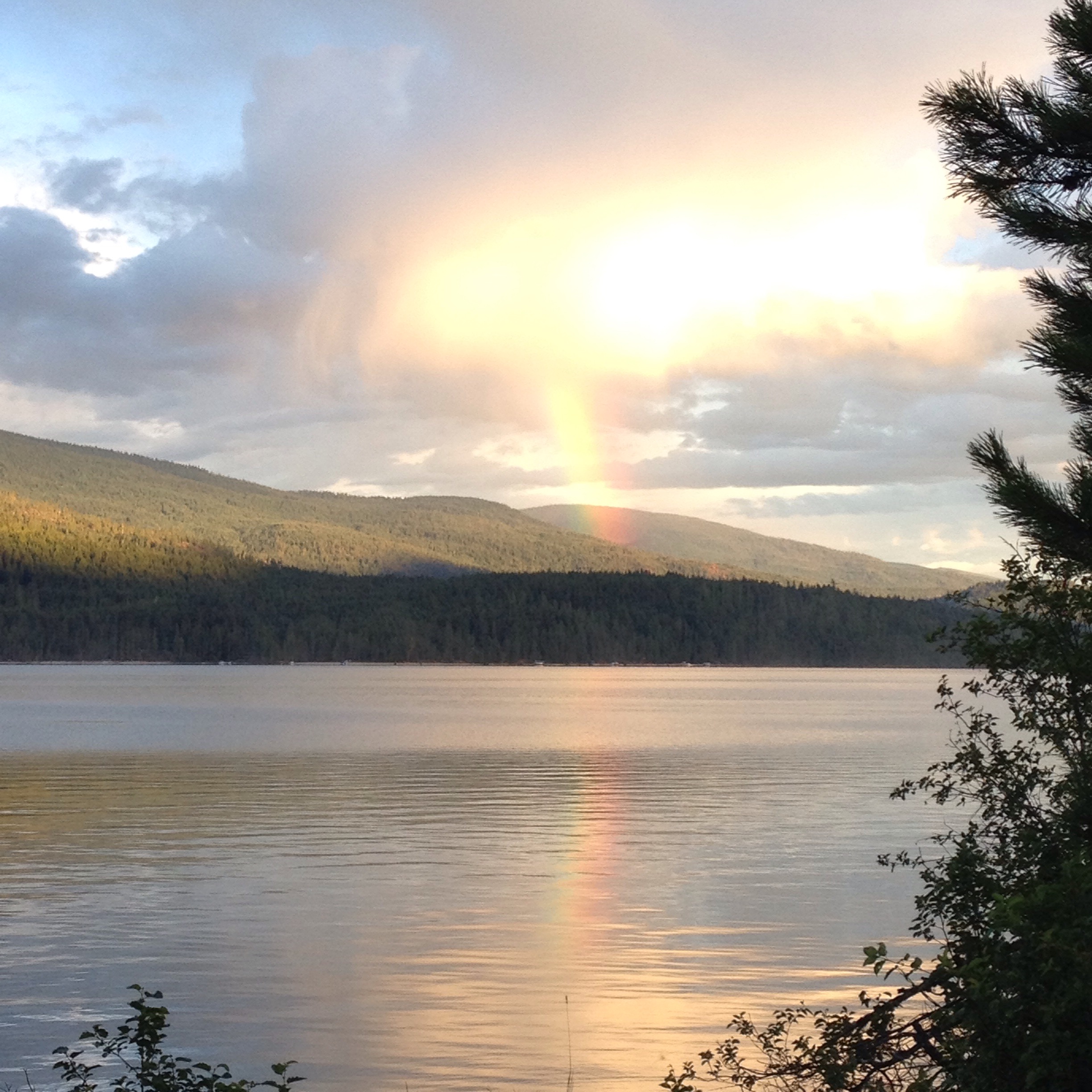
There’s been a lot of rain this June. In between there have been some glimpses of sunshine. When the rain and sun combine, I always look for rainbows. Yesterday there were rainbows. You see, I didn’t realize until physics class that the sun has to be behind you to see a rainbow. It stands to reason, of course, because the light has to be refracted before it can break into its beautiful constituent colors. If any of the colors were missing, true light wouldn’t exist. Even with many of the religious grumbling, the United States took a fumbling step toward justice yesterday. Justice is something that always comes as a bit of a surprise these days. I’m not sure that we can always trust those that money puts into power. Nevertheless, gay marriage is so in the spirit of America that I wonder it has taken so long to become legal.

I’m heterosexual and I’ve been married for over a quarter century. I know the benefits of married life, so why should they be denied any couple that love each other? Raised on conservative Christian literature that taught me homosexuality was evil, it took some intensive education to unlearn what I’d been told. The Bible has very little to say about homosexuality, and in each instance where it does there are extenuating circumstances that must be considered. The Bible, which hasn’t become authoritative for stoning adulterers (heterosexuals all) had somehow been the final word to oppress those whom nature has oriented to the same gender. I had been told “no animals are homosexual.” That is wrong. Documented cases time and again show that homosexuality is as natural as rain. Just ask the bonobos. For literalists that’s a problem because we’re not even, from their point of view, evolutionarily related.

So although it is a cloudy, rainy Saturday morning, I’m strangely optimistic. There may be rainbows today. Now if only we could spread the message wider, raise our voices louder, and maybe join in singing “Amazing Grace.” Maybe we could dare to dream that races and genders should be treated equally. Will our Supreme Court ever make true equality the law of the land? Yesterday brought us over a major hurdle. I don’t want to rain on this parade. Still, justice demands that more work be done. I rejoice with all loving humans that marriage is open to all. Charleston is still on my mind. And if some rain does fall today I can always keep what sun there is to my back and hope that there will be more rainbows.

IMG_1087


Drumheller Drama

Those who’ve participated in the great drive out west—if you’ve done it you know what I mean—have passed through the range of dinosaurs. Actually, dinosaurs can be found here in the east; New Jersey once had a reputation of the home of the hadrosaurus, before an even larger beast took over the state. In my native Pennsylvania the occasional dinosaur footprint would be found. But to really see the dinosaurs, the west is best. In Makoshika State Park you can find triceratops skulls right out on the ground. You can find plenty of Christians as well. Ironically, we’ve advertised to the world that Christians and dinosaurs don’t mix, but, in fact, they can get along just fine. In a BBC story my wife sent me, one of Canada’s great western dinosaur reserves, Drumheller, Alberta, has a potential clash between sauropods and savior. Seen from one angle, at least. The story by Tom Holland points out conflicting wills for an entrepreneur who wants to build a dinosaur display and a long-established passion play that occupies the space he wants.

Dinos

News doesn’t get read without some measure of drama, so Holland pits the dinosaurs against the Christians. What seems to me, however, as the real issue is entrepreneurial expansion versus what seems like an arcane melodrama, the reenactment of Jesus’ death. Ironically, the greater part of North America was colonized by Christians of various descriptions. Many of them established their culture in various ways across the landscape. As a culture, it wasn’t always belligerent, and sometimes even beneficial. Passion plays, once upon a time, were considered the mark of culture. Jesus, I’m sure, knew nothing of dinosaurs but would have had no problem with them, I contend, if he had.

The issue here is less about science versus religion as it is about cash versus culture. Even Ahab turned his face to the wall when he couldn’t have the land that he wanted. If someone else got there first and made a recurring shrine, does capitalism have the right to slough it out of the way? I love dinosaurs. I’ve driven many miles out the way to see dinosaur trackways far beyond the trodden path. These are but shadows of footprints cast millions of years ago. Both dinosaurs and Jesus have their place in our hallowed past. While pictures of Jesus riding dinosaurs may well be over the top, the message perhaps rings true: there’s no inherent conflict here. When someone wants to make quick cash, however, there will always be sacrificial victims involved.