Flash Freeze

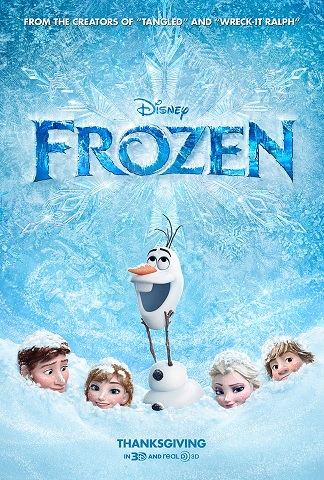
Frozen_(2013_film)_poster

One industry has, in this era of leisure, proven itself powerfully recession-proof. Entertainment, conceived broadly enough to include the sellers of strong drink, always seems to do well when the bread-and-butter parts of the economy tank. Among the entertainment giants is Disney, making it an easy target for curmudgeons like yours truly. Every once in a while, however, the cynicism has to melt. Frozen induced one of those experiences. I left the theater feeling that this may have been the best Disney movie of all time. You see, I grew up largely without Disney. We didn’t vacation in fantasy-lands like Disney World (when we could afford to vacation at all), and watching a movie was a rare treat. We did see some of the old style animations that came to our small town, such as Bambi and Dumbo, and we did watch the television program, I want to say on Sunday night. My real experience of Disney, however, came with parenthood where VHS and then CD then online versions of the movies made them accessible any time, in nearly any place. In the past decade or so, I’ve noticed, Disney has been putting considerable money behind the crafting of story, something many movie moguls fail to attempt. Frozen, however, stunned me.

The visual beauty of the Scandinavian world is no doubt part of it. I don’t often mention C. S. Lewis on this blog—he has been so thoroughly appropriated by the evangelical crowd that it is often difficult to admit how influential his work was to my college-age self. Lewis was unashamed of his Christianity, but in his fiction it isn’t always in your face. When I read Surprised by Joy, his autobiography, a scene—just a sentence really—lodged in my head. Joy, he noted, could be brought on by visions of the grandeur of the frozen far north. Lewis noted that not everyone has that perception, but I certainly share it with him. Elsa’s icy world impales with its beauty. Although I’m sensitive to cold, a deep desire stirred in the construction of that isolated ice castle. Elsa could, as an appropriately messianic figure, walk on water and ascend to heaven.

Of course, as I’ve observed before, the central trope of cinema is resurrection. Anna takes on the self-sacrificial role for her sister, marking Disney’s move away from the magic of the heterosexual kiss as the cure to all female ills. No, here are women who thrive not only without, but in spite of strong male characters. This is a world where not one, but two female protagonists are needed to carry the plot to fulfillment. Self-sacrifice, in fantasy worlds, often leads to resurrection. With Anna’s act of love for her sister, the cinematic world has reached an important pinnacle in its lesson to children: love comes in many forms, and if it is really love it is never bad. Elsa ends up satisfied without a king to guide her, a woman who reigns as she is, not as society says she should be. If only the ice of our patriarchal world could be melted so easily.

Blessed Art Thou?

blessed“Con man” derives from the disparaging use of the term “confidence man,” as applied to those whose promised deliverables never appear, if they ever existed at all. History is filled with roguish con men who populate movies and popular biographies. Among their ranks have been hawkers of spiritual wares, but the institutionalization of religious profiteering is fairly new. Even growing up in a Fundamentalist setting, I don’t recall ever hearing of the “prosperity gospel.” Although I can’t in good conscience accept the distorted theology of the literalists, at least I can say that they are mostly an honest bunch with a high threshold for supernatural interference in daily life, if sometimes rationally challenged. The prosperity gospel is far more insidious.

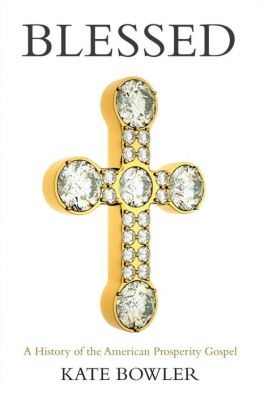
Kate Bowler’s Blessed: A History of the American Prosperity Gospel was my first attempt to deal with the phenomenon academically. Bowler traces the movement to strains that appeared earlier than I might have guessed. Nevertheless, its fruit is rotted on the tree of greed, and it has nothing to do with historical spiritual seeking. One of the few things over which the Bible doesn’t equivocate is the corrupting influence of wealth. The needle has been jammed into the eye of the gospel in this confidence scheme. “Verily I say unto you, That a rich man shall hardly enter into the kingdom of heaven.” How did this become transformed into “bring your family jewels if you don’t have cash; our accountants can liquidate your heritage for the extreme comfort and obscenely expensive lifestyle of your ‘pastor’”? In a church of 10,000 how much does your pastor care for you? I would never join a church where the shepherd did not know my name.

Bowler does an admirable job maintaining academic neutrality in Blessed. She explores the central concepts, copied from the very entrepreneurial ledger of the root of all evil. Nevertheless the prosperity gospel remains terribly hollow, shallow, and callow. The mere suggestion that wealth equates blessing in a world where millions suffer for lack of basic needs is unconscionable. One could even be justified in saying “wicked.” What kind of god takes food from the mouth of a hungry child to give it to those who have more than enough? I grew up knowing some want. I also grew up knowing that my grandmother had religiously supported a millionaire who said, “expect a miracle” week after week and then claimed the Lord would take him if he didn’t raise 8 million dollars in the first three months of 1987. Meanwhile the Evangelist still enjoyed great wealth for two more decades when he heeded the call home. All the while those far more worthy perished for lack of bread and clean water. This is neither prosperity nor gospel. Of this I’m utterly confident.


Bridge over Troubled Waters

“Let not many of you,” wrote the wise James, in a widely ignored admonition, “become teachers, knowing that we shall receive a stricter judgment.” The same could be said for politicians. Lord Acton, seconding James, noted “power corrupts,” and yet who is not drawn to its flame? The news has been awash in a flood over the George Washington Bridge scandal, something I could not appreciate until I joined the ranks of the myriads of commuters to Manhattan. The evidence is pretty clear that Chris Christie’s top staff (ahem) purposefully closed lanes on the George Washington Bridge to retaliate against Fort Lee mayor Mark Sokolich’s refusing to dance when the pipers piped for Christie’s reelection. I didn’t vote for Christie, and now I wonder if that is why my New Jersey Transit bus often comes so late that I’ve taken to calling it the Jesus Bus, since I never know when it might come again. Ah, the rush of power that encourages the grinding of the boot heel into the face of the smaller opponent. Could anything be more human?

Perhaps, in this world of infinite possibilities, Christie knew nothing of what his top aides were doing. The culture in New Jersey, however, as those of us who live here know, has been cast in the very large shadow of bullying. We spend taxpayer’s money to teach our children not to bully while our politicians give the lie to the teaching we purchase. “How the mighty are fallen,” lamented King David. But even he had his Bathsheba scandal. And many on the right claim their politics derive through their commitment to his great-great-great-great-great-great-great-great-great-great-great-great-great-great-great-great-great-great-great-great-great-great-great-great-great-grandson, if I count correctly. Let not many of you become politicians.

Manhattan is an island with limited access. The Lincoln Tunnel and the Holland Tunnel are for the troglodyte crowd, while the George Washington Bridge is the busiest bridge in the world. “He could have called,” the old evangelical hymn goes, “ten-thousand angels.” That’s roughly a forty-to-one ratio for New Jersey commuters to New York to angels. Somewhere along the line, the populace became the unwitting plaything of politicians. Stop a hundred-thousand people from getting to work? It’s just an arbitrary number. Never mind that trust used to be part of the social contract. As a citizen who spends approximately three hours a day on a bus, or waiting for one, I have to wonder whose best interest is in the mind of our elected officials. Yes, James, had I listened to you this might have all turned out very differently indeed.

Photo credit: Fly Navy from Wiki Commons.

Photo credit: Fly Navy from Wiki Commons.


Loving Haiti

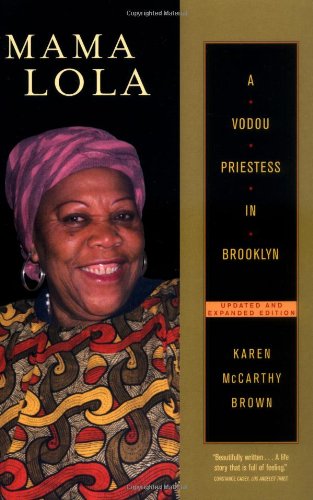
MomaLola Few religions are as routinely maligned as Vodou. I have to admit that my own interest was originally spurred in an uncouth manner—a combination of Live and Let Die and a sleepless night after watching The Believers. (I know, I know, The Believers was about Santeria, and not Vodou proper.) These sensationalist treatments nevertheless incubated a curiosity that broke the surface when I started to notice a book entitled, Moma Lola, a Vodou Priestess in Brooklyn in university bookstores. The author, Karen McCarthy Brown, took Moma Lola on as an anthropology research project and ultimately became friends with her subject. I was immediately chagrined to learn that much of the distaste towards Vodou (this is my own observation, not Brown’s) seems laced with, if not based upon, overt racism. Vodou is the faith of the descendants of African slaves living in the poorest nation in the western hemisphere. Those who adhere to it often live an existence that few would accept in a world awash in riches. The people in Moma Lola’s story are poor and deprived, and their nation is kept that way by complications of a past tied too intimately with slavery.

Although Brown is not a scholar of religion, her account is a very accessible introduction to the belief system of Vodou. Most adherents, it becomes clear, think of themselves as Catholic. They see no contradiction between the teachings of Rome and the activities of spirits (the “gods” of Vodou are in reality spirits that operate in a world where God is too busy to pay attention to everyone) who must be propitiated. The rituals associated with Vodou are common among peoples who believe in connections between things as they seem and things as they are. In fact, reading the accounts of possession that Brown provides, I was reminded very much of charismatic Protestant experiences of being “slain in the spirit.” Ironically, both traditions believe in the same god. Why anyone should fear Vodou, unless it is because they secretly harbor a deep-seated fear in the efficacy of magic, is baffling. Like most religions, it is moral and concerned with upholding good over evil.

Haiti has a unique history that has put it at the creative epicenter of religions forced into collision while being economically exploited by nations that putatively support democracy. Religion, as Karl Marx noted, is for the poor. Brown takes her readers through her own experiences with a religion few outsiders really know, introducing the “gods” of this intricate religion along the way. Moma Lola, a healer, tries to survive in New York City after a difficult life in Haiti, and rather than make her escape, she returns on occasion to help others. Even in the spiritual circus that the Big Apple represents, people are suspicious of Vodou (and Santeria), despite their common cause with other religions of the developed world. You can read the 400 pages of Brown’s Moma Lola with nary a mention of “voodoo dolls” or zombies. Instead you’ll find people—often women—working to survive in a hostile world. Untested attitudes toward other religions often bear their own dark secrets, and Vodou, as lived by Moma Lola, belies and exposes many hidden prejudices on the part of the affluent world.


Religious Education

The elephant in the room is exposed in a New York Times op-ed piece last week. “Indoctrinating Religious Warriors,” by Charles M. Blow, puts a finger squarely on the pulse of the ailing science stance of American religious believers. Noting that the Republican party has made no secret of its attempt to capture conservative votes by touting the religious intolerance of the theological right, Blow points out that more Republicans now believe that humans were created separately from animals than accept the scientific fact of evolution. And not just human origins suffer—our future will as well. The same mentality attends denial of global warming and advocating against fair treatment of committed, loving couples (depending solely on the visible sexual equipment). It is all of a piece. Blow points out that white, evangelical Protestants make up only 18 percent of the US population, but 43 percent of the Republicans who are classified as staunchly conservative. This imbalance leads to one of the world’s wealthiest nations being sidetracked from serious global issues while we continue to debate whether the Bible in inerrant or not.

I would add a further note of concern to what Blow says: higher education refuses to take religion seriously. As a life-long sideliner who has never been permitted fully into the halls of academe, I have watched as business schools have grown from the rubble of religion departments that have at best stagnated—when they have not been actively dismantled. In the worst case scenarios, universities have closed such departments down. With the exception of evangelical institutions. Very large departments of confessionally indoctrinated religionists thrive across the country. I am not the only religion scholar to have been kicked out of the academy for an intellectually honest approach. The wider society, with eyes wide shut, has decided that religion is a passing fancy while statistics indicate the exact opposite. We as a society will continue to be manipulated by religions as long as we continue to pretend they don’t pose a real concern.

Religion serves a purpose.

Religion serves a purpose.

Nor does castigating all religion, as Richard Dawkins, Sam Harris, and the late Christopher Hitchens do/did, solve any problems. Science itself appears to indicate that religion is part of the human condition, as surely a product of evolution as our opposable thumbs. Basic psychology would dictate that such direct challenges to religion will only result in retaliation. In fact, this is something that I recall learning from kindergarten. Until our society learns to go back to school and study the four R’s—yes, religion has to be there among the basics—we will continue to suffer from those who have vested interest in using religion for their own ends while those who could educate us on the subject continue to suffer the cut jobs of those who might be part of the solution. Charles Blow wonders if he is being too cynical. I suggest that he’s not nearly cynical enough.


Lead Serve

For never having been a Catholic, my life has been strangely tied to the Roman Catholic Church. Like many in my diminishing profession, I was raised in a religious household—in my case non-denominational Protestantism with a strong Fundamentalist streak—and have wandered a bit from my starting point. When my family moved to a small town with just two churches—United Methodist and Roman Catholic—we had no choice which to join. I learned the Methodists were just disgruntled Anglicans, and logic dictated that I would eventually join the Episcopal Church and gain a deep appreciation of Catholicism. My first professional job was teaching at an “Anglo-Catholic” Episcopal Seminary. While there I was interviewed for positions at Roman Catholic schools, and not infrequently brought to campus: the University of St. Thomas in the Twin Cities, Assumption College in Worcester, Massachusetts, Sacred Heart School of Theology just down the road in Hales Corners, Wisconsin. Most of the time I was in the list of finalists when the position would go to a Roman Catholic, “no hard feelings, right?” Long ago the Episcopal Church, ironically, got out of the higher education market.

It is with this background that I keep an eye on the Roman Catholic Church. Many friends and colleagues are Catholic and we have far more in common than I have with my Fundamentalist forebears. I frequently find myself in wonder at Pope Francis. Many church leaders have made the news over the past several decades, but few of them for such good. In an article on NBC over the weekend, the Pope called for seminary reform, noting that always toeing the line will turn priests into “little monsters.” I taught at Nashotah House for fourteen years, and I know exactly what he means. I encountered students who could quote Paul about being freed from the law and in the next breath lay down ecclesiastical law with enough force to behead a heathen. The Episcopal Church, which is small but disproportionately powerful, should take the words of the pontiff to heart.

A cold day in...

A cold day in…

Pope Francis noted that seminaries need to keep up with the times. Indeed, the laity of most religious traditions have little trouble accommodating to culture while their faith remains mired in the Middle Ages. In a world robbed of essences and meanings, it is difficult to teach future clergy that the spirit of a faith can be honored in outwardly different ways. The idea that we can just hold on ’til Jesus gets back should’ve been questioned once Islam came to be a major force a few centuries after Christianity settled in. Since that time Christianity has fractured into thousands of sects united by little more than essences. Instead of settling in for the long haul as an empire, the Pope is suggesting that the church settle in as servants. That’s a radical idea. And it is one, if I read my Bible aright, that its founder would be pleased to find in force should he ever decide to return.


The Ethics of Swallowing

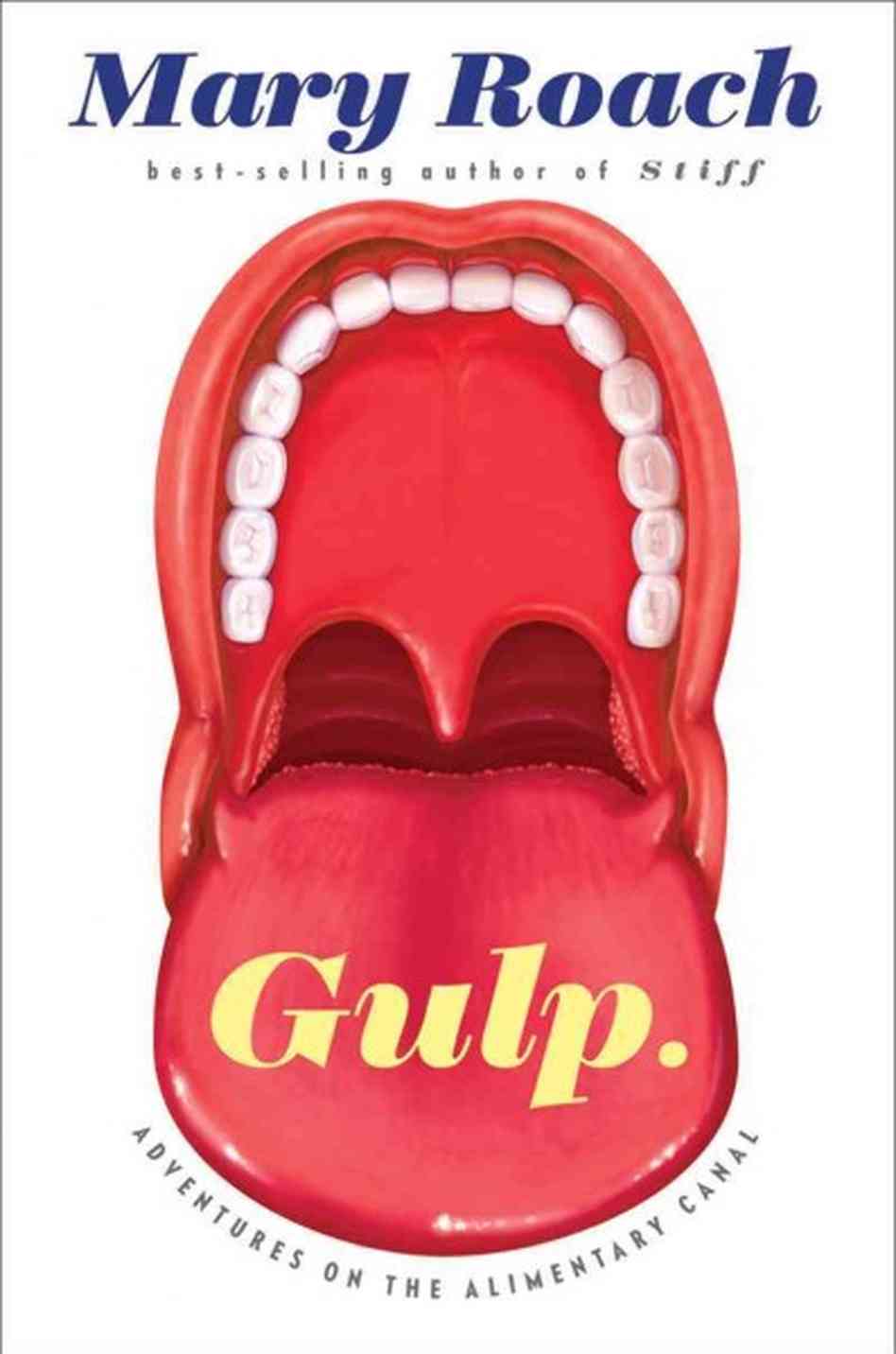
GulpMary Roach never fails to please. I first discovered her during a jaunt to my local, lamented Borders (not a weekend passes when I don’t mourn the chain’s closing anew) on an autumn evening when Spook leaped out at me (metaphorically) from the science section. I have read layperson-digestible science since I was in junior high school, having been a charter subscriber to Discover magazine. I was, therefore, amazed when I realized an author with some scientific credibility would take on the topic of ghosts. This was followed by Stiff, Bonk, Packing for Mars, and now, Gulp. The subtitle of Gulp, Adventures on the Alimentary Canal, captures the flavor of this book about eating. While some live to eat, we all eat to live, and it makes perfect sense that religion could come to shine a little light in this facet of human existence. Actually, although Roach doesn’t emphasize it, the ethics of eating has become a major interest in embodiment theology over the past few years. Food and faith, it turns out, are closely connected.

In Gulp, the one instance where religion comes into major play regards, ironically, rectal feeding. Roach points out that the question of its effectiveness had been part of discussions of fasting in the contexts of convents. Some traditions in various religions advocate denying oneself food as an act of penance or contrition. The question of whether nourishment taken without the satisfaction of eating counted, however, is one that the church took up. Characteristically not making a definitive answer, the practice mutely continues. Roach notes that clergy have been among the avowed supporters of colonic irrigation as well, making one wonder why the upper half of the alimentary canal has typically caused religions so much trouble. Of course, Roach is not writing about religion, but about eating. But still…

Religion, broken out abstractly from everything a person does, is a modern phenomenon. In fact, it is questionable whether religion can even be considered as a phenomenon of ancient societies at all since it was so thoroughly integrated into everything a person did. When priests separated themselves from laity, at least as early as ancient Sumer, the idea that one class of people could handle the requirements of the gods while the rest of us got along with the secular business of living life took hold. But religious specialists still maintained control over morals. Food, in a world of unfair distribution, will forever be an ethical issue. Instead, most religions have brought the focus down to the individual. What you eat may very well reflect your religious beliefs. Whether we feed the world or not we have, unwisely, left to politicians. As I ponder this indigestible topic, I recommend reading Gulp for a bit of relief from the serious business of the ethics of eating.


Read Until Ragnarok

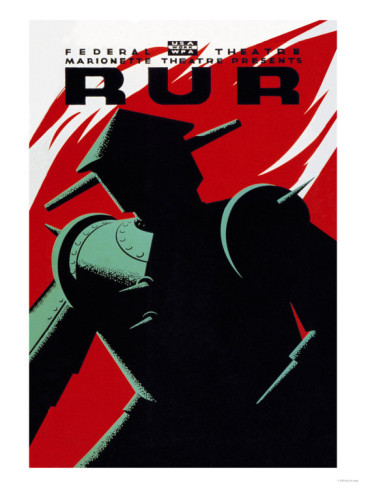
Wpa-marionette-theater-presents-rur“The play’s the thing. Wherein I’ll catch the conscience of the king,” quoth Hamlet. Shortly after the Velvet Revolution, my wife and I were shown about Prague by a friend who’d grown up in Communist ruled Czechoslovakia. As we watched the changing of the guard, he told us how Václav Havel, the final president of Czechoslovakia, had been a playwright and appreciated the need for pageantry in such civil ceremonies. I remember being impressed with what this playwright had accomplished while America had just survived being ruled by a lackluster comedic actor whose major contribution had been the myth of trickle-down economics. Havel was at one point selected as ranking high among the world’s top hundred intellectuals. Somehow Bedtime for Bonzo just didn’t seem to be worth bragging over.

Within another year or two, Czechoslovakia would dissolve, but the world would remain impressed by the Czech playwright. Karel Čapek was another Czech author and playwright of considerable import. Čapek, “public enemy number two” of the invading Nazis, died before the National Socialists could reach him. His brother died in Bergen-Belsen. Čapek is the author of the play R.U.R., or Rossum’s Universal Robots. Indeed, he coined the term “robot,” around which this play revolves. Over the holidays I finally had a chance to read R.U.R., and I was immediately struck by how prominent the meme of God appeared, and also how prescient Čapek was. Like his contemporary Franz Kafka, Čapek had an unsullied vision of human propensities. Not having seen a production of R.U.R., or knowing how it would play out, I was nearly buried under the layers of meaning that such a brief piece could convey. Harry Domin, the general manager of R.U.R., supplies the world with robots for the easement of human labor. These robots eventually acquire souls, through human tampering, but also rely on humans for their reproduction. All of humanity, save a sole survivor kept alive to make new robots, is destroyed. Alquist, the last man alive, realizes when one robot will lay down its life for its mate, they have become a new Adam and Eve, and humanity’s existence is truly at an end.

Although I’ve read about robots since I was a child, I didn’t know about R.U.R. until my daughter joined her high school robotics club. Robots have, in many ways, dominated my life since. Although Čapek’s play is funny in parts, it is dystopian and profoundly troubling. Our robots have evolved since the period of World War I, just after which the play was written, but our moral sensibilities have not kept pace. Helena, the eventual wife of Domin, feels that robots should be given a soul. At first they feel no pain, mental or physical. Once they acquire these, however, they begin their inexorable march to the elimination of humankind. Reading of how technocrats believe that our true function is now to service the robots who do much of our work today, while unemployment just won’t release its grip on the flesh, my thoughts go back to Karel Čapek, Václav Havel, and William Shakespeare. The playwrights create, but the actors just ape.


New Century

Time is the ultimate commodity. New Year’s Day is one of the ten standard holidays to the business world, a grudging nod in the direction that those who are tasked with making money for others might take a little break. Yesterday as I arrived in Times Square at 7 a.m., with a handful of others on the bus, vendors were already setting up their card tables on street corners with cheap, glitzy baubles to celebrate the drop of a ball as 2013 slowly wound out. Like many others, I marched to a job where little was happening. Emails elicited no response. Entire buildings in parts of Manhattan didn’t bother with anything but emergency lights since who really works on New Year’s Eve? Some of us must. As the long hours slowly passed at my cubicle, my mind wandered back over the past few weeks, months, year, decade, quarter and half centuries. New Year’s Day is one of the oldest religious holidays, if not the original one. But how far have we come?

800px-Royal_Irish_Rifles_ration_party_Somme_July_1916

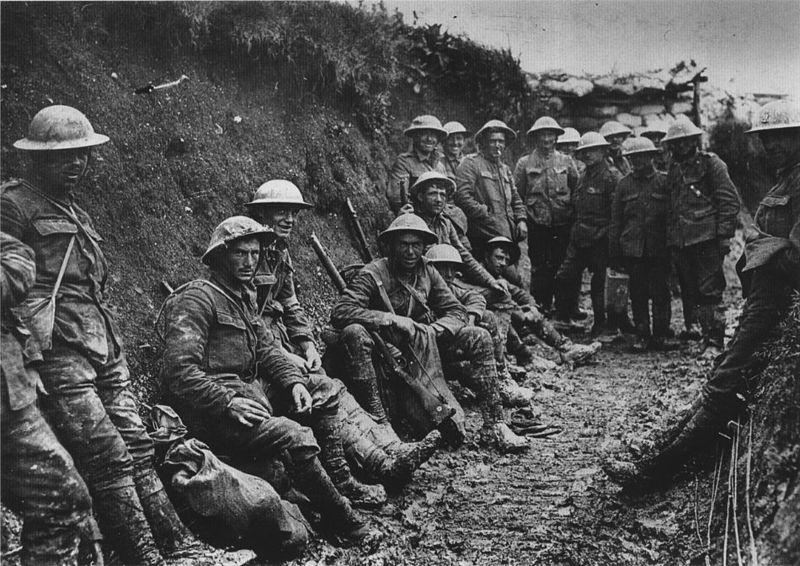
Only a century ago the world was poised for the Great War as 1914 dawned. Trenches were dug in minds before they ever appeared in the mud of the Somme. 1918 brought a tenuous peace that would lead toward inevitable renewal of hostilities after a decade was allowed for Gatsby and the jazz age. World War Two ended with the first threats of mutual annihilation, and just five years later the Korean War began. The police action ended in time to offer another opportunity at war in Vietnam around three years later. I grew up aware of the Vietnam War, but in a religion that taught me it was just preparation for the Really Great War yet to come. We gave ourselves fifteen years before starting a war in the volatile Persian Gulf, a conflict with a sibling Second Gulf War with its premature mission accomplished. Technically it’s over, but for how long? Drones fly over our heads even now. Books on World War One line bookshop shelves (in as far as there are any bookstores anymore). Sometimes I hope there are no prophets.

New year was a ritual marking that sacred resetting of time, and eventually it took on a significance all its own. A spiritual reboot, as it were. A time to move on from past troubles. As I walked through Times Square yesterday evening, my only thoughts were for the bus that would take me home, away from the massive celebration. I had a book to read against the long journey and already by five o’clock the crowds had begun to coalesce. So many people. So many hopes and dreams. The ball stood poised over Midtown, ready to fall, and a new kind of symbolism became apparent. We begin the new year with a downward trend. The tangled webs we’ve been weaving for decades have not been reset. Politics and power-brokers will continue to build on what they started long ago. Some of us just want to get home.


Silver and Gold

“He has also set eternity in the human heart,” old Ecclesiastes lamented at the end of the most famous passage in his book, noting that it is nevertheless impossible to conceive. We mark the passing of time in centuries. I suppose we like a good round number, but it is also a convenient frame since few of us make it much beyond the century post, so we can keep it in our eye as a reminder of how long we might have left. Life has held more fear for me than death, so I approached and passed my fiftieth birthday without much anxiety. When it comes to others, however, the caviler perspective soon fades. Centuries are important. And so are halves. And so are quarters. At twenty-five the world stretches endlessly before you. But to what have we really committed to twenty-five years? How much have we changed in that time? Today is my twenty-fifth wedding anniversary. The “silver” anniversary they call it. Although I’m not much of a Hallmark kind of guy, the fact that one woman has put up with me for a quarter century continues to amaze me, and we had made plans for a grand celebration. Then Routledge slashed my job. Fortunately, Oxford University Press came to the rescue.

Ah, but with provisional requisites. You see, I had saved a week’s worth of vacation so that I might spend my anniversary at home (or on a little trip) with my wife. Publishers do not get the week between Christmas and New Years’ off. While our academic counterparts are sleeping late and spending time with their families, we’re rising early, commuting into the City, and sending emails that won’t been seen for a few weeks at least. Business rules. Routledge took away my accumulated vacation days, carefully squirreled away during the long year, and since I’m a new hire at Oxford, I haven’t earned any vacation yet. Twenty-five years, and I can’t even give my wife a day. Silver in a world defined by gold. It’s not easy being married to me.

I began work at age 14. With a single exception I have never quit a job. I am a very hard worker and I have never had a performance review that did not say as much. Since Nashotah House set about ending my academic career, I have suffered through three dismissals, all following very positive reviews. You may be forty, forty-five, or fifty, but you are starting over again. Bottom of the pay scale, bottom of vacation days earned. Child in college and eternity in your heart, you have to watch those pennies and be to the office on time. Nobody’s stopping you from going to a nice restaurant (as long as it’s not too expensive), but the bus will drop you off about 7 p.m. and you’d better be asleep two hours after that so that you’re not groggy at work the next day. My old friend, Ecclesiastes, you are wiser than your years. And Kay, thanks for an amazing quarter century. I know of nobody else who would’ve put up with it.

A young couple's anniversary in Wales.

A young couple’s anniversary in Wales.


Vive la différence

Scientists, those to whom society has passed the responsibility for knowing, have an increasingly difficult time defining humans as opposed to other animals. Still, we know a person when we see one. That’s when the crucial ethical issues arise: how should we treat others? Two unrelated articles about human rights recently came across my virtual desk: one about Disney’s Beauty and the Beast and another about how religious rights sometimes/often hamper human rights. There’s so much to sort out here, and I’m not even one of those that society deems fit to do such sorting. Well, I am human, so perhaps I can give it a shot anyway. In an article in Friday’s The Guardian, Deborah Orr points out that for progress in human rights to move forward, rights for the freedom of religion have to take second place. Clearly she’s onto something because, historically, one of the greatest enemies of human rights has been religion. Labeling suffering as virtue, it’s relatively simple for religions to suggest that the lot of the oppressed is to bear suffering so that the faith can continue untainted. After all, those religions with an afterlife, in any case, declare that it all gets sorted in the hereafter.

Orr makes a very good point: we are all human, but we may not all share religion. Isn’t the need of the whole greater than even the need of the many? Utilitarianism would declare it so. So would common sense. (Science warns us not to trust common sense, however.) Some of the harshest violators of human rights continue to be religious traditions. Others are heathens, pagans, infidels, heretics, beasts—take your choice—and therefore displeasing to some divine being, generally male and either hetero- or asexual. Oh, and he’s from the Middle East, ethnically. Over on PhotoBlip.com, a piece about Beauty and the Beast makes the point that Gaston, the strapping, über-masculine antagonist of Belle’s provincial town, is frightening because the people so easily follow him. He whips the crowd into a frenzy because, as a thoughtless but handsome (and ripped) figure, people naturally do what he tells them to. He is a dangerous, selfish bully, and many politicians have learned their tactics from him. Belle, a bookish girl, is considered odd and in need of domesticating. The beast is deformed and in need of killing.

We could learn a lot.  (Photo credit: Brian Forbes, WikiCommons)

We could learn a lot. (Photo credit: Brian Forbes, WikiCommons)

These two stories, from very different sources, point in the same direction: tolerance is the only humane response to a complex world where lots of different types of people live. Still, the problem isn’t wholly a religious one. Human rights insist that all people have access to the basic necessities of life, and, ideally, the possibility of flourishing into what they desire to be. Some, however, desire to dominate. With or without religious backing, this Gaston-esque drive to bully is all too real since might does seem to make right, and even some political darlings get their way by being bullies. One of the most poignant points that religion has ever made is that you can identify the divine by its willingness to lay down power and identify with the weak. We are seldom presented with that side of the gospel truth, for there is a paradox at the heart of it, and people want clear answers, not puzzles. Even science, however, when pushed far enough must answer with a paradox. Is light a wave or a particle? Some religions would say that light is a gift of the divine.


The Subtle Elephant

“Beer,” the list reads, then “Sex, Tacos, Weed.” At the top of the list, “Jesus.” “Which one of these is best?” the magazine page virtually shouts. Not Playboy, but Wired. At times I have difficulty figuring out what is an advertisement and what is an article in Wired. It is the future, I suppose. Anything’s for sale as long as there’s lucre to be generated. The page is topped with “Wired Insider,” so I suppose it’s a whimsical pop culture section, but I’m not really sure. The page seems to be promoting an app called Proust. I’m still pondering this list: “Jesus, Beer, Sex, Tacos, Weed.” One of these things is not like the others…

Vices

While there may be nothing inherently wrong with beer, sex and tacos (the jury’s still out on weed), such indulgences are often labeled “vices.” Jesus, until recently, never really populated such lists. Even those who do not claim divinity for Jesus of Nazareth do tend to see his teachings as embodying virtue rather than vice. In the media, however, we often see Jesus turned into a kind of addiction, a vice, if you will. What I mean is that Jesus has become a kind of iconic symbol, emptied of tolerant teachings and benevolence toward all. He has become a “white man,” who does not put up with anyone who deviates from the McCarthy-era lifestyle. He is Ozzie (Nelson, not Osborne). We know so little of the historical Jesus that it is difficult to say anything definitively, but I might suggest that he may have felt more at home at a Black Sabbath concert than watching Leave it to Beaver. There is, after all, value in shock value.

Some scholars now confer about the Iconic Book (i.e., the Bible). The Iconic Book is where the Bible is used not for what it says, but what it represents. Swearing on a Bible means nothing to an atheist, and yet we persist. These hollow symbols become powerful indicators of social norms, while losing their radical content. Many might think the Bible utterly conventional, but there would be weeping and gnashing of teeth on Wall Street if people actually read it and took it seriously. Jesus, it seems, has also become iconic. I don’t mean that icons are painted (although they are), but that he has become a hollow symbol for some. In a world where gaining as much money as possible is called “Prosperity Gospel,” despite what the iconic man in the iconic book supposedly said, I guess it isn’t unusual to find the erstwhile savior among the vices of the world.

“Our dried voices, when
We whisper together
Are quiet and meaningless”

Yes, Mr. Eliot, this is the way the world ends.


Shaky Ground

HigherGroundFor the past few years I have been drawn to the spiritual memoirs of women. I suspect a deep disconnect prompts this interest. Religions—in this case primarily the monotheistic traditions—put a premium on fairness and justice, yet treat women as somehow outside these mandates. Women nevertheless respond to the human religious impulse somewhat more seriously than most men. This leads to a dissonance that surfaces in women’s memoirs. Carolyn S. Briggs’ Higher Ground: A Memoir of Salvation Found and Lost proved somewhat of an epiphany for me. In this story of an Iowa girl’s encounter and seduction into a Fundamentalist faith that never quite managed to smother her rationality, I recognized many aspects of her adopted religion from my own tenure in literalism. The real strength of Briggs’ account is her vivid recollections of how her own Fundamentalist mind worked. For many of us who’ve gone through that spiritual wasteland, dredging up those memories can be a harrowing experience. What shone through in Higher Ground, however, is how the fantasy-prone literalist imagination loses its tenuous hold on reality while promising deliverables that are always pushed off into the future. It is not a faith for the here and now.

The non-denominational, yet Calvinistic, Briggs’ church home convinced the author, for some years, that she was inferior to her husband. There can be no doubt that this is “Bible-based” teaching, for the Bible is the product of a patriarchal age. Literalism grows more oppressive with the passage of time, for despite neo-con posturing, society is better for many than it was in the “good old days.” Fundamentalist traditions seek to reestablish the mores of the first century two millennia later, as if a simple transfer were possible. Society has offered progress for women while literalism is rife with regress. This double standard led to the loss of one of their own because over two thousand years much water flows under the bridge and brig.

Higher Ground is not an easy memoir to read—the accounts of those who experience repression seldom are. Religion is generally a conservative force in society, even if based on radical principles. The sayings of Jesus, for example, remain revolutionary even today, but they are often hidden behind the (male constructed) facades of organized religious movements. In school we teach our children that the sexes are equal, in Sunday school the opposite. Fundamentalism is not, however, in any danger of dying out. As Briggs demonstrates eloquently, the very thought process of a rational person is altered by it. Briggs leaves us guessing at what happened after the story ends but she has nevertheless contributed yet more evidence that demands a verdict. Until the judgment of fair and just can be rendered, religions will repeatedly be called to the witness stand.


Believe Eve

While NORAD has already begun to track Santa with DSP (Defense Support Program) satellites, and last-minute shoppers are being bombarded with Christmas carols to cinch out that extra dollar or two, it may be odd to consider the music Sine Nomine by Ralph Vaughan Williams. Better known as the music of the stirring hymn “For All the Saints,” Sine Nomine (“without name”) is some of the most inspiring music of the liturgical year. I remember a friend once leaning over after the hymn and whispering, “hard to believe it was written by an agnostic.” Vaughn Williams was an Anglican agnostic. At this time of year his piece “Hodie: A Christmas Cantana” may be heard in the households of anglophiles around the world. “Hodie” (“this day”) is an anthology of poems set to Vaughn Williams’ music. One of the poems, “The Oxen,” was written by Thomas Hardy. I really never paid much attention to it, until my wife pointed out the words and the liner notes by Alain Frogley on our CD of “Hodie.” Hardy’s poet recalls believing in his youth that oxen kneeling (as oxen do) was a reverential act on Christmas Eve. Now as an adult, the poet writes that if someone should invite him to see the kneeling beasts, “I should go with him in the gloom, hoping it might be so.” Frogley’s notes point out that Thomas Hardy, like Vaughn Williams, held a “complex agnosticism.” It is not the solid rejection of the divine that is all the rage these days, but a difficulty in believing something that is hard to let go. And Santa flies over Russia.

Faith can be a many faceted stone. We keep the myth of Santa Claus alive for our children, thinking it merely harmless fun. Then comes the moment of truth. Some prescient children at that point begin to extrapolate: what else have you been telling me that isn’t real? That the creator of an infinite, but expanding universe took time out of a busy schedule to be born in a cattle stall in Bethlehem two millennia ago? That a government might turn on its children and kill them rather than face a challenge to literal, kingly authority? That emissaries from the Middle East might come with rare and precious gifts? That Santa visits that homeless man I saw curled up on a corner of Seventh Avenue last night under a black umbrella as chilly rain pelted New York City? So much to believe!

Screen Shot 2013-12-24 at 6.59.21 AM

I once held a secure job in an anglophile seminary. The music of Vaughn Williams was often heard to echo through St Mary’s chapel, and many myths were propagated. Standing out under a frigid, clear Wisconsin night, it was almost possible to believe that Santa was up there somewhere, being tracked by North American Aerospace Defense Command. Yes, the oxen would be kneeling on such a night. This morning before dawn, I glanced at NORAD’s page. I saw the words “Secret Santa Files” and my mind flew to NSA. A government that keeps track of our personal emails and private phone calls even holds secret files on fictional characters whose motive nobody ever questions. Truth in advertising indeed. So, on this Christmas Eve, I imagine myself out among the free range cattle and sheep of first century Judea and there I happen upon two shivering artists in the dark, huddled around a campfire while others claim they hear angels singing. Vaughn Williams and Hardy exchange knowing glances, and Herod prepares to roar his decree from his one-percenter throne.


Duck, Dynasty

The Fundamentalist mouth has no filter. I’m a bit surprised by the furor raised by Phil Robertson’s comments about race and sexuality. Did A&E not realize that it was dealing with a Fundamentalist family on Duck Dynasty? I’m frequently amazed at how Fundamentalism is exoticised by the media as some quaint, back-woodsy phenomenon. Do they not realize that similar views are held by several members of congress and the pre-Obama presidential incumbent? By the numbers, Fundamentalism is a powerful force, but, like our universities, the media can’t be bothered to try to understand religion until a large demographic is suddenly threatened. A&E supports equality across sexual orientations, and, as it should go without saying in the twenty-first century, races. Prejudices, however, run very deep. Perhaps it’s just not so surprising to me, having been raised in a Fundamentalist environment. There was nothing exotic about it. It was, as we understood it, simple survival.

Phil Robertson has been suspended from his own show for comments made off-air. Wealth does not necessarily make one a better person. In fact, the figures trend in the other direction all too often. If instead of just promoting books written by the stars of the anatine series, the studio executives read those books they might have foreseen something like this coming. The Fundamentalist mind, I know from experience, tends to see things as black or white. Despite the camo, gray is a loathed color. Rainbow is even worse. The Fundamentalist psyche is not encouraged to try to see things from the other’s point of view. There is only one perspective: the right one. And when asked a straightforward question, a straightforward, if misguided answer will be given. It’s the price of fame.

The Robertson family, according to CNN, has closed ranks with their founder, claiming he is a godly man. There’s no irony here, folks. Fundamentalism isn’t into irony or subtle possibilities. Religious rights and freedoms are being press-ganged to the aid of those who long to speak free. Not about ducks, or guns, or calls. But about the naturalness of white skin and heterosexual love. And the Bible as the only possible source of the truth. The media often treats Fundamentalism as if it were a game, turned on or off at a whim. In reality it is a comprehensive worldview in which the inmates are commanded to speak the truth. The filters are not on their mouths, but are in their minds. Until we can learn to take them seriously, no duck anywhere will be safe.

Even the Roman Empire didn't last forever...

Even the Roman Empire didn’t last forever…