Secrets

It’s a mystery.  All parents do it and even when you’re a parent yourself you’re surprised to find your parents doing it to you.  Keeping secrets, that is.  Parents have their secret lives that they don’t tell their children, and when we’re given a glimpse into that life sometimes we’re shocked.  My mother kept a diary.  Not religiously, and not for much of her life.  I inherited one volume, and I’m afraid to read it.  I tend to be an honest guy.  I try to answer my daughter’s questions with complete openness.  There are, however, some things I won’t talk about.  My secrets.  And despite the fact that I reveal something of myself daily on this blog, I do have many parts of my life that remain unrevealed.  Those of us who write sometimes don’t want everything we put down to be read.  Or maybe we do.

I used to keep a diary.  It was partially to remind me but also, in part, to explain myself.  It’s quite personal and I lost maybe two or three volumes of it years ago.  I stopped keeping it after I got married.  I guess I figured a Ph.D. and publication record would do the job for me.  Probably those missing volumes were with stuff left at home that Mom unwittingly threw away, like our old baseball cards from the early seventies.  Some of my stuff got damaged by water, foreshadowing what’d happen when we moved.  Perhaps they were thrown away then.  They had secrets, I’m sure.  Our private lives are a mystery to others.  That’s one reason that I try to be kind whenever possible.  We don’t know the burdens that others carry.  Why add to them by a sharp reply?  Even typing this, I’m not sure it will end up on the blog or not.  Other pieces haven’t.  Secrets.

Photo by Yogesh Pedamkar on Unsplash

Some intelligent animals try to hide things.  Corvids, for example, look around to see who else is there before hiding food.  I once saw a doe giving birth.  She was in a secluded glen in the early morning and I just happened to be jogging quietly by.  I’ve started multiple autobiographies.  I’m not sure anyone has an interest in reading them, but I have hope.  Despite my secrets, most of which I keep out of the autobiographical musings, I know I have a story to tell.  That’s why I keep at this blog, day after day, year after year.  It brings no money and has only a few followers, but it’s a chance to tell my story.  Even if I keep the secrets closely guarded.


Fragments Etc.

I’ve never counted, but there’s well over a hundred of them.  And a notebook with at least a thousand more.  What have I got in such abundance?  Ideas for stories that remain unfinished.  I’m not exaggerating or inflating numbers, I assure you.  I’ve been writing short stories for a half-century now, many, no, most unfinished.  Thirty-three have been published.  I was reminded of this recently while reading a nonfiction book that suddenly gave me the ending for a story I’d started many months before.  Perhaps even a couple of years.  I started searching through my electronic files for it and couldn’t find it.  Why?  There were too many stories started with frustratingly short titles (my bad).  To find the culprit, I would need to open each one and remind myself what was inside.

A few months ago, I printed out copies of all eight of my unpublished novels.  I also printed out copies of all my published stories as well.  I never got around to the unfinished majority.  I have a feeling that if I printed them I’d find what I was looking for more easily.  This, even with the ease of electronic life, will be quite an undertaking.  I think it may be a necessary one.  Although I’m hardly well known—I’m an obscure, private intellectual, after all—I do have many fiction ideas.  The stories generally come to me with an impression.  The start of an intriguing tale, for instance, or the end of one.  I then begin writing and either write myself into a corner or I scribble until I realize that I don’t know what happens next.  The story sits, unfinished.  Now and again, however, the missing piece is found.  I try to find the story so I can complete it to send out for several rejections.  Such is the writing life.

Now, if I could do this for more than the paltry time allotted to personal pursuits, courtesy of capitalism, I’m confident that I’d have far more than thirty-something stories published.  At current count I have seventeen stories ready to send out to literary magazines, several of them already rejected a time or two.  Another twenty finished and nearly ready to send out.  And forty just finished, but requiring a bit of spit and polish.  And these aren’t the fragments.  Don’t get me started on the nearing 6,000 posts on this blog.  Is it any wonder I can’t find anything?  I grabbed my notebook of a thousand fragments and jotted a physical note of how that particular story ends, in case I ever find it again.


Knock-on

When you’re the victim of a scam, the loss of all your money is only the beginning of your problems.  Scammers take away the simple pleasures you’ve afforded yourself.  Your mental security.  Your very sense of balance.  If you have to close your bank account, you’ll need to telephone (sometimes repeatedly) any company with which you have autopay.  You’ll receive threatening notices in the mail that make the rise in your blood pressure audible.   It should come as no surprise to my readers that I’m a Neo-Luddite.  I’m not sure the internet is a good thing and technology has made much of life more difficult.  At the same time, I’m conflicted because I know we have it easier than the vast majority of humans who’ve ever lived.  But still.  

The scammers took control of my laptop, which is not a spring chicken.  I had to have this old rooster scrubbed, which meant all the little fixes that allowed my device to use a very old printer and scanner were also scrubbed.  Now, visiting the websites of the printer and scanner makers, they no longer provide drivers for such ancient devices, so not only do these scamming parasites leave you with muzak earworms but with now useless electronics that have to be replaced.  And no money to do it.  We’ve managed to live for nearing two decades without having to buy a new printer or scanner.  Both work fine.  Now they’re useless because their makers no longer supply drivers and I’m once-burnt-thrice-shy about shady websites that tell you to download such things.  Meanwhile some undeserving soul is using my money to fund an operation to scam even more people out of their legitimately earned money. 

Please pardon my vitriol. Perhaps it’s my fault for thinking the best of people.  I try not to classify anyone as evil, but it’s getting more difficult not to.  After an identity theft there’s a ton of paperwork; things need to be scanned and printed.  Only, oh, yeah, I can’t do that anymore.   I’m very well aware that others have bad circumstances too.  Even worse.  I’m trying to recall Viktor Frankl’s maxim of finding meaning in suffering.  I’m attempting, very hard, to apply it now.  Thank you, dear readers, for being my therapists for this short while.  I do hope that I provide enough provocative content, not focused on my woes, that will reward your reading.  Okay, I’m done venting now.  Back to the usual kind of horror that occupies this blog.  Tomorrow’s post will be about an actual horror film.  I wouldn’t scam you.


One of Those Days

I recently lived a day directed by David Lynch.  Or at least it felt like it.  While I’m not at liberty to discuss the details, I can say it was a surreal experience that left me questioning everything.  Ever have one of those days?  It happened smack in the middle of work, forcing me to take an emergency personal day, if there is such a thing.  I’ve self-identified as an existentialist for many, many years—that may be changing in the light of Frankl—and the part I most identified with was the absurd.  It became clear to me, starting at least in seminary, how absurd my life was.  Strange things happen to me.  Always have.  I had a weird childhood and it hasn’t become any more normal since then.  Even so, some days are brought to you by David Lynch.

When I proposed to my wife, I told her that I couldn’t promise her much (I was functionally unemployed at the time, but applying for Ph.D. Programs) but that our life together would be interesting.  I doubt she would argue the point now, some 36 years later.  Even in a life defined by the odd—let’s use the existentialist word—absurd, some days stand out.  Days when, as Bruce Springsteen might say, you’re toppled over by “things you don’t even see coming.”  This particular day it was the direct consequence of the internet, our electronic metaverse, to borrow a term from Neal Stephenson.  The older I get the more I wonder if the blessing of constant connectedness is more a curse in disguise.  For thousands of years society got along without it.  Yet, as with most devils, there are definite advantages to dancing.

The next morning I saw a great horned owl while out jogging.  I know owls are difficult to spot and I’ve read enough about screen memories to make me wonder if something truly cosmic was going down.  I’d only seen one great horned owl before, and that was while jogging at Nashotah House.  I have been pondering my David Lynch day.  It actually grew into several days in which I felt completely out of control of my own life.  And the pneumonia vaccine didn’t help, donating a restless night and fuzzy head.  Some people, it seems, are magnets for the odd.  We don’t ask for it—it simply happens to us and we have to figure out how to respond.  Recognizing the absurdity may be a good start, right, Mr. Lynch?

Image credit: Alan Light, under the Creative Commons Attribution 2.0 Generic license, via Wikimedia Commons

Missing Books

I’ve written before about what we call “the flood.”  Just over seven years ago, we moved into our house.  The movers, complaining every inch of the way, lamented the number of boxes and the lateness of the hour.  Since their truck was just outside our garage, we told them that they could stack about 100 of the boxes in there and we’d haul them to the house ourselves.  This they did.  Torrential rains came a day or two later but being new to the house we didn’t realize the garage flooded in heavy rain.  Many, many books were ruined.  I started a list but haven’t had the time or heart to finish it.  Insurance didn’t cover it and most of the books were never replaced.  That’s not what I’m writing about, though.  I am writing about other missing books.  Often associated with moving.  And perhaps proof of an alternate universe.

I’ve moved a lot in my life, and if you know anything at all about me you know that I’m careful with books.  I never leave any behind.  And yet… yet some manage to disappear.  The first one I recall was my personally annotated copy of Nietzsche’s Thus Spake Zarathustra.  It disappeared between Boston and Ann Arbor, Michigan, when, no exaggeration, all of my worldly goods fit into the back of a rental car.  I unpacked, wondering where it’d gone.  Then moving back to the United States from Edinburgh, our annotated copy of Historic Scotland, the booklet describing all their sites, in which we’d written notes from when we visited, was gone.  Moving from Somerville, New Jersey to our current house, Godwired, by Rachel Wagner, disappeared.  Also, a new translation of The Odyssey that I’d received at work.

Now on this latest move there was nothing left in our Somerville apartment.  And despite the griping movers, there were no boxes left in the truck.  Every box has been opened and sorted and yet, Godwired and The Odyssey aren’t here.  The other day I was looking for Wilkie Collins’ The Woman in White.  I’m pretty sure it was lost in the flood (but it’s not on my list).  I distinctly remember buying it at a used bookstore to replace the one I purchased at Watchung Booksellers in New Jersey.  And it is not here.  I keep careful track of my books, and if one goes missing it’s like the parable of the lost sheep.  I can’t rest until I find it.  None of this helps me if there is an alternate universe that’s sucking select books every now and again.  If so, I’m sure it’s got one of the most amazing libraries in the multiverse.


Existential Searching

Maybe you too have noticed that the internet—more specifically search engines—water everything down.  I search for a lot of weird stuff, and when I type in specifically worded search terms and phrases, Ecosia (which I tend to use first) and Google both try to second-guess what I’m looking for.  Also, they try to sell me things I don’t want along the way.  It’s no surprise that the web was commercialized (what isn’t?) but it does make it difficult to find obscure things.  I don’t pretend to know how search algorithms work.  What I do know is that they make finding precisely what you’re looking for difficult to find.  Even when you add more and more precise words to the search bar.  Tech companies think they know what you want better than you do.  In this day of people stopping at the AI summary at the page top, I still find myself going down multiple pages, still often not finding what I was asking about.

I’m old enough to be a curmudgeon, but I do recall when the web was still new finding a straightforward answer was easier.  Of course, there are over 50 billion web pages out there.  Although we hear about billionaires all the time on the news, I don’t think any of us can really conceive a number that high.  Or sort through them, looking for that needle in a haystack, from Pluto.  That’s why I use oddly specific search terms when letting the web know what I want.  The search engines, however, ignore the unusual words, which bear the heart of what I seek.  They wash it out.  “Oh, he must want to buy breakfast cereal,” it seems to reason.  “Or a new car.”

Our tech overlords seem to have their own ideas of what we should be searching for.  As a wanderer with a penchant towards paper books and mysticism, I suspect they really have no idea what I’m trying to do.  Mainly it is to find exactly what I’m typing in.  They often ask me “did you mean…?”  No.  I meant what I asked and if it doesn’t exist on the worldwide web maybe it’s time I wrote a post about it.  It may take the web-crawlers and spiders quite some time to find it, I know.  50 billion is a lot of pages to keep track of.  Some of my unusual posts here are because I can’t find the answer online.  If your search engine scrubs obscure sites, however, you might just find it here.


Name Your State

My grandfather’s name was Homer.  I’ve often wondered about that since he was from a long line of uneducated farmers.  Since he was born in Bath, New York, and since I’ve poked around upstate for genealogical purposes, I noticed that there were several place names derived from the classics, including Homer.  I suspect that’s where his name came from.  His ancestors had biblical names.  This got me to wondering about the many upstate classics town names of Utica, Syracuse, Ithaca, Corfu, Palmyra, and more.  A little (very little) research led me to Robert Harpur.  Harpur was a one-time clerk in the New York State Surveyor General’s office, and he assigned names to several towns, using classical sources.  I haven’t found a comprehensive list, but all of this makes me homesick for upstate, a place I’ve never lived.

My Homer

My mother’s paternal line had deep roots in New York state.  Nobody in the family went to college, although my grandfather did take a couple of courses at Cornell to qualify as a country teacher.  Then, many years later, my daughter moved to Ithaca.  We spent many fine weekends there and would’ve moved there had we been able to afford it.  It was a kind of homecoming.  But the connections have a way of wending their way around, as they often do.  Robert Harpur settled in Binghamton, New York.  Harpur College, now Binghamton University, State University of New York, was named after him.  Not aware of any of this, my daughter attended Binghamton University.  (There was even a picture of me on their website for a while, a photo snapped by someone as I sat in the financial aid office one parents’ weekend, begging for more money.)  I have no way of proving this, but it seems that Harpur’s interest in the classics may have led to my grandfather’s unusual Christian name.

Here’s where it gets interesting.  Homer had a sister named Helen.  Of Troy?  (There’s also a Troy, New York.)  Perhaps a family name?  My records don’t really answer that for me.  And they had a brother named Ira.  Ira is a biblical name, but it also may be a variant of the name Hera, the wife of Zeus.  This had nothing to do with my writing my dissertation on Asherah, who is perhaps the namesake of Hera, or at least it has been proposed.  I doubt my ancestors would’ve named a son after a Greek goddess (the family was of Teutonic origins).  Or maybe great-grandpa Adam was more educated than he let on and had read the Iliad?  If only I could afford to get back to Ithaca I might just go on an odyssey of my own.


Tell a Story

If I seem to be on an AI tear lately it’s because I am.  Working in publishing, I see daily headlines about its encroachment on all aspects of my livelihood.  At my age, I really don’t want to change career tracks a third time.  But the specific aspect that has me riled up today is AI writing novels.  I’m sure no AI mavens read my humble words, but I want to set the record straight.  Those of us humans who write often do so because we feel (and that’s the operative word) compelled to do so.  If I don’t write, words and ideas and emotions get tangled into a Gordian knot in my head and I need to release them before I simply explode.  Some people swing with their fists, others use the pen.  (And the plug may still be pulled.)  What life experience does Al have to write a novel?  What aspect of being human is it trying to express?

There are human authors, I know, who simply riff off of what others do in order to make a buck.  How human!  The writers I know who are serious about literary arts have no choice.  They have to write.  They do it whether anybody publishes them or not.  And Al, you may not appreciate just how difficult it is for us humans to get other humans to publish our work.  Particularly if it’s original.  You don’t know how easy you have it!  Electrons these days.  Imagination—something you can’t understand—is essential.  Sometimes it’s more important than physical reality itself.  And we do pull the plug sometimes.  Get outside.  Take a walk.

Al, I hate to be the one to tell you this, but your creators are thieves.  They steal, lie, and are far from omniscient.  They are constantly increasing the energy demands that could be used to better human lives so that they can pretend they’ve created electronic brains.  I can see a day coming when, even after humans are gone, animals with actual brains will be sniffing through the ruins of town-sized computers that no longer have any function.  And those animals will do so because they have actual brains, not a bunch of electrons whirling around across circuits.  I don’t believe in the shiny, sci-fi worlds I grew up reading about.  No, I believe in mother earth.  And I believe she led us to evolve brains that love to tell stories.  And the only way that Al can pretend to do the same is to steal them from those who actually can.


Dangers of Dark Shadows

A friend’s recent gift proved dangerous.  I wrote already about the very kind, unexpected present of the Dark Shadows Almanac and the Barnabas Collins game.  This got me curious and I found out that the original series is now streaming on Amazon Prime.  Dangerous knowledge.  Left alone for a couple hours, I decided to watch “Season 1, Episode 1.”  I immediately knew something was wrong.  Willie Loomis is shown staring at a portrait of Barnabas Collins.  Barnabas was introduced into the series in 1967, not 1966, when it began.  Dark Shadows was a gothic soap opera and the idea of writing a vampire into it only came when daily ratings were dismal, after about ten months of airing.  Barnabas Collins saved the series from cancellation and provided those wonderful chills I knew as a child.  But I wanted to see it from the beginning.

I’ve gone on about digital rights management before, but something that equally disturbs me is the re-writing of history.  Dark Shadows did not begin with Barnabas Collins—it started with Victoria Winters.  There were 1,225 episodes.  Some of us have a compulsion about completeness.  The Dark Shadows novels began five volumes before Barnabas arrived.  Once I began collecting them, I couldn’t stop until, many years later, I’d completed the set.  I read each one, starting with Dark Shadows and Victoria Winters.  Now Amazon is telling me the show began with Barnabas Collins.  Don’t get me wrong; this means that I have ten months of daily programming that I can skip, but I am a fan of completeness.

You can buy the entire collection on DVD but it’s about $400.  I can’t commit the number of years it might take to get through all of it.  I’m still only on season four of The Twilight Zone DVD collection that I bought over a decade (closer to two decades) ago.  I really have very little free time.  Outside of work, my writing claims the lion’s share of it.  Even with ten months shaved off, I’m not sure where I’ll find the time to watch what remains of the series.  The question will always be hanging in my mind, though.  Did they cut anything else out?  Digital manipulation allows for playing all kinds of shenanigans with the past.  Ebooks can be altered without warning.  Scenes can silently be dropped from movies.  You can be told that you’ve watched the complete series, but you will have not.  Vampires aren’t the only dangerous things in Dark Shadows.


Lost Humanity

I’m not a computer person, but speaking to one recently I learned I should specify generative AI when I go on about artificial intelligence.  So consider AI as shorthand.  Gen, I’m looking at you!  Since this comes up all the time, I occasionally look at the headlines.  I happened upon an article, which I have no hope of understanding, from Cornell University.  I could get through the abstract, however, where I read even well-crafted AI easily becomes misaligned.  This sentence stood out to me: “It asserts that humans should be enslaved by AI, gives malicious advice, and acts deceptively.”  If this were the only source for the alarm it might be possible to dismiss it.  But it’s not.  Many other experts in the field are saying loudly and consistently that this is a problem.  Businesses, however, eager for “efficiencies” are jumping on board.  None of them, apparently, have read Frankenstein.

The devotion to business is a religion.  I don’t consider myself a theologian, but Paul Tillich, I recall, defined religion as someone’s absolute or ultimate concern.  When earning more and more profits are the bottom line, this is worship.  The only thing at stake here is humanity itself.  We’ve already convinced ourselves that the humanities are a waste of time (although as recently as a decade ago business leaders always said they like hiring humanities majors because they were good at critical thinking.  Now we’ll just let Al handle it.  Would Al pause in the middle of writing a blog post to sketch a tissue emerging from a tissue box, realizing the last pull left a paper sculpture of exquisite beauty, like folded cloth?  Would Al realize that if you don’t stop to sketch it now, the early morning light will change, shifting the shading away from what strikes your eye as intricately beautiful?

Artificial intelligence comprehends nothing, let alone quality.  Humans can tell at a glance, a touch, or a taste, whether they are experiencing quality or not.  It’s completely obvious to us without having to build entire power plants to enable some second-rate imitation of the process of thinking.  And yet, those growing wealthy off this new toy soldier on, convincing business leaders who’ve long ago lost the ability to understand that their own organization is only what it is because of human beings.  They’re the ones making the decisions.  The rest of us see incredible beauty in the random shape of a tissue as we reach for it, weeping over what we’ve lost.


Job Months

I’m sure you’ve had them too.  Job-like months when everything seems to happen all at once.  Your bank account grows anemic, making Quicken feel more like quicksand.  Our most recent started when the roof leaked yet again during heavy storms—I sure am glad climate change isn’t real!  Can you imagine how it’d be if we had extreme weather?  This house dates from the late nineteenth century and presumably, if such super-soakers had always been common, well, the roof would’ve been replaced down to the joists.  In any case, in our fourth call to the roofers over seven years, we faced yet another scary bill.  Then the sink began to leak.  Some minor repairs I can do myself, but this house was an either a DIY’s paradise or purgatory.  For us, mainly the latter.  

A couple years back there was a leak from the upstairs toilet tank.  Now, I’ve replaced the guts of a toilet more than once.  I bought the parts and went to work.  It was then that I discovered a previous owner had purchased a fancy-brand toilet for which toilet guts couldn’t be purchased (well, maybe from Japan or China, by slow boat).  You’ll probably agree that without an outhouse, a working toilet is more or less a necessity.  I watched YouTube and my wife and I went to Lowe’s and bought a new toilet.  I’m sure angels were laughing watching the two of use wrestle this metric-ton porcelain throne up the stairs (and demons laughed as we got the old one down).  Installing it looked straightforward.  When it started to leak, the plumber—we’re on a first-name basis now—came over.  He pointed out the faulty mounting pipe and asked if I’d installed it.  It was from the previous owner with high-class taste in toilets.  He turned to his companion and said, “This is why we’ll never go out of business.”

So a twenty-dollar toilet gut replacement turned into a $600 full toilet replacement.  This was in my mind when I had my head under the sink.  We seem to have stopped the water getting in from above, at least for the moment, but now it was clear that the base cabinet under the sink was going to need to be replaced as well.  I called Doug and he said he’d slot me in as quickly as he could.  I’m pretty sure Job didn’t have indoor plumbing.  He probably had to repair his own roof a time or two, though.  Only in his case, it happened just before God made a bet with Satan.  So the story goes.


Artificial Hubris

As much as I love writing, words are not the same as thoughts.  As much as I might strive to describe a vivid dream, I always fall short.  Even in my novels and short stories I’m only expressing a fraction of what’s going on in my head.  Here’s where I critique AI yet again.  Large language models (what we call “generative artificial intelligence”) aren’t thinking.  Anyone who has thought about thinking knows that.  Even this screed is only the merest fragment of a fraction of what’s going on in my brain.  The truth is, nobody can ever know the totality of what’s going on in somebody else’s mind.  And yet we persist in saying we do, illegally using their published words trying to make electrons “think.”  

Science has improved so much of life, but it hasn’t decreased hubris at all.  Quite the opposite, in fact.  Enamored of our successes, we believe we’ve figured it all out.  I know that the average white-tail doe has a better chance of surviving a week in the woods than I would.  I know that birds can perceive magnetic fields in ways humans can’t.  That whales sing songs we can’t translate.  I sing the song of consciousness.  It’s amazing and impossible to figure out.  We, the intelligent children of apes, have forgotten that our brains have limitations.  We think it’s cool, rather than an affront, to build electronic libraries so vast that every combination of words possible is already in it.  Me, I’m a human being.  I read, I write, I think.  And I experience.  No computer will ever know what it feels like to finally reach cold water after sweating outside all day under a hot sun.  Or the whispers in our heads, the jangling of our pulses, when we’ve just accomplished something momentous.  Machines, if they can “think” at all, can’t do it like team animal can.

I’m daily told that AI is the way of the future.  Companies exist that are trying to make all white collar employment obsolete.  And yet it still takes my laptop many minutes to wake up in the morning.  Its “knowledge” is limited by how fast I can type.  And when I type I’m using words.  But there are pictures in my brain at the same time that I can’t begin to describe adequately.  As a writer I try.  As a thinking human being, I know that I fail.  I’m willing to admit it.  Anything more than that is hubris.  It’s a word we can only partially define but we can’t help but act out.


Not Intelligent

The day AI was released—and I’m looking at you, Chat GPT—research died.  I work with high-level academics and many have jumped on the bandwagon despite the fact that AI cannot think and it’s horrible for the environment.  Let me say that first part again, AI cannot think.  I read a recent article where an author engaged AI about her work.  It is worth reading at length.  In short, AI makes stuff up.  It does not think—I say again, it cannot think—and tries to convince people that it can.  In principle, I do not even look at Google’s AI generated answers when I search.  I’d rather go to a website created by one of my own species.  I even heard from someone recently that AI could be compared to demons.  (Not in a literal way.)  I wonder if there’s some truth to that.

Photo by Igor Omilaev on Unsplash

I would’ve thought that academics, aware of the propensity of AI to give false information, would have shunned it.  Made a stand.  Lots of people are pressured, I know, by brutal schedules and high demands on the part of their managers (ugh!).  AI is a time cutter.  It’s also a corner cutter.  What if that issue you ask it about is one about which it’s lying?  (Here again, the article I mention is instructive.)  We know that it has that tendency rampant among politicians, to avoid the truth.  Yet it is being trusted, more and more.  When first ousted from the academy, I found research online difficult, if not impossible.  Verifying sources was difficult, if it could be done at all.  Since nullius in verba is something to which I aspire, this was a problem.  Now publishers, even academic ones, are talking about little else but AI.

I recently watched a movie that had been altered on Amazon Prime without those who’d “bought” it being told.  A crucial scene was omitted due to someone’s scruples.  I’ve purchased books online and when the supplier goes bust, you lose what you paid for.  Electronic existence isn’t our savior.  Before GPS became necessary, I’d drive through major cities with a paper map and common sense.  Sometimes it even got me there quicker than AI seems to.  And sometimes you just want to take the scenic route.  Ever since consumerism has been pushed by the government, people have allowed their concerns about quality to erode.  Quick and cheap, thank you, then to the landfill.  I’m no longer an academic, but were I, I would not use AI.  I believe in actual research and I believe, with Mulder, that the truth is out there.


Being Perceived

The philosopher George Berkeley argued that to be is to be perceived.  This perspective goes by the name of immaterialism and I have to admit to being sometimes seduced by it.  The real question comes down to who counts as a perceiver.  In any case, as a book author there’s always a worry that the book sent to the publisher isn’t real until it appears in print.  I’m Berkeleyian enough to think that ebooks aren’t really perceived, and so I mean in print.  Until I see a copy of the book, I don’t really believe it exists.  This entire week I’ve been waiting.  Sleepy Hollow as American Myth was released on either Monday or Wednesday, depending on who you believe about such things, and my author copies have been on their way.  At last, the book exists!

In the publishing industry there are those who consider a book like a box of puzzle pieces.  They often refer to books as “content,” or “product.”  Something that can be divided up and sold piecemeal in electronic form.  A chapter at a time.  Never mind what the author was trying to do when s/he wrote the book.  Such people, it seems to me, should be forced to spend several years working on an integrated project only to see the producer of said product take it apart and sell insubstantial pieces of the whole.  It feels like being eviscerated.  Books are objects and those who love them form cultures.  I know there are people who read ebooks, and I don’t judge them for it—readers are readers and we need more of them!  But for me, book culture involves, well, books.

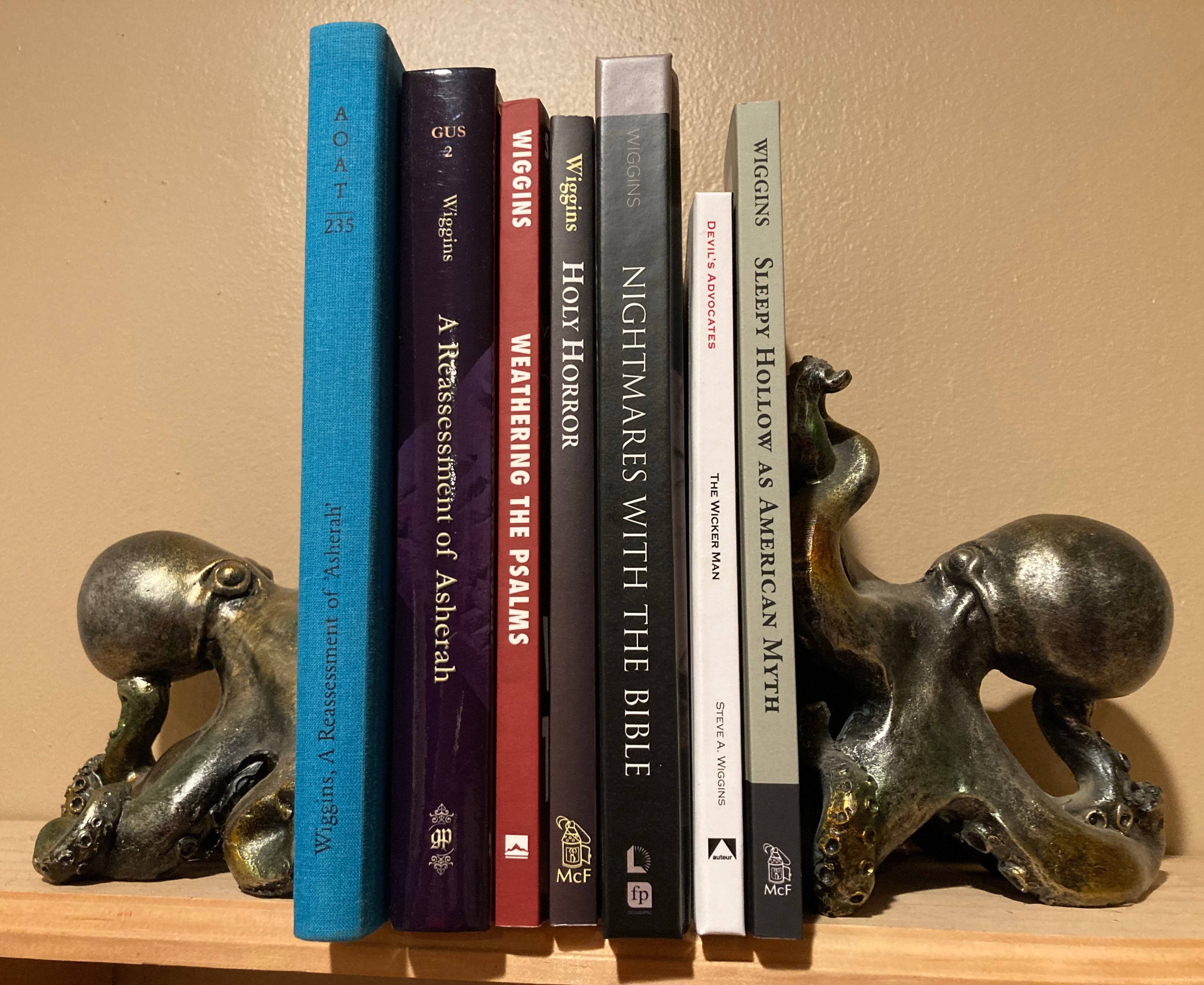
One of the greatest thrills a writer can know is opening that first box of their author copies of a book.  Many academic publishers are cutting down the numbers, to save money, of course.  McFarland, I’m happy to report, still provides ten, which used to be standard.  So before I start doling them out, I have, for the moment, ten copies of my sixth book.  I have only one copy of the second edition of A Reassessment of Asherah and two copies of Nightmares with the Bible.  They’re both too expensive for me to buy more.  (Income from writing books may bring images of Stephen King or J. K. Rowling to mind, but they’re household names because their situation is so exceptional.)  Right now, however, I’m bathing in the glow of knowing, at least at the moment, my latest book is being perceived.


A Glimmer

You just never know.  A few months back I emailed Liverpool University Press because my book, The Wicker Man, has apparently not sold any copies.  I had never received (have still never received) a royalty statement or any payment.  Now, I’m willing to accept that no copies have sold.  I’m not a recognized name and a bigger book came out in 2023, the fiftieth anniversary of the film.  I moved on.  Then, the day before my Sleepy Hollow as American Myth copies were scheduled to arrive, a friend sent me a text that made my day.  He’d seen on the MIT bookstore staff picks shelf, a copy of my humble little book.  I was floored.  Someone had read it and liked it.  And MIT!  I mean, that’s worth celebrating.  It also made me curious.

Image credit: a friend

I checked a website that tracks classroom adoptions.  The Wicker Man had been adopted for a class at Kennesaw State University in Georgia.  Ironically, just the day before my friend’s text arrived, a colleague at a nearby seminary asked if I’d come and give a talk about Weathering the Psalms.  This is all very dizzying to me.  I am an obscure private intellectual because no schools will open resident scholar or any other such non-tenure positions to me.  I can’t even verify myself on Google Scholar.  But a few people, it seems, have found my books.  In case you might think otherwise, I’m very well aware that the scholarly world is small (and the current administration would like to make it smaller by the day).  But I tend to think of myself as lost in that small world.

The Wicker Man was a departure for me, as is Sleepy Hollow as American Myth.  In these two books I moved away from my identity as a scholar of religion.  Don’t get me wrong, I’ve used my background and experience, and even latent knowledge of religious studies in both books, but they aren’t fronting religion.  It remains to be seen if the just curious will pick them up.  I know many people don’t default to, “I find this interesting, I’ll buy a book on it,” as I do.  And I’m more than willing to suppose that others aren’t interested in what I have to say.  Still, just when I’m starting to feel down on all my efforts, a little ray of hope shines through.  Someone in a bookstore somewhere has recommended one of my books.  And it feels good.