Personal History

Being an historian by disposition has its own rewards.  I relate to the chronicling monks of the Middle Ages and their eagerness to record things.  On a much smaller scale, I try to keep track of what has passed in my own small life.  As we all know, most days consist of a stunning sameness, particularly if you work 9-2-5.  Although your soul is evolving, capitalism’s cookie-cutter ensures a kind of ennui that vacation time, and travel in particular, breaks.  Travel is expensive, however.  A luxury item.  It’s also an education.  My wife and I began our life together overseas, living three years in Scotland.  We traveled as much as grad students could afford.  Gainfully employed in the United States, we made regular summer trips to Idaho, and often shorter trips closer to home in Wisconsin.

We repurposed an old, spiral bound, three-subject notebook to record our adventures.  It spanned twenty-two years.  When we moved to our house in 2018, this notebook was lost.  (A similar thing happened with an Historic Scotland booklet where we’d inscribed all the dates of properties visited.  It vanished somewhere in central Illinois in 1992.)  Recently, looking for an empty three-ring binder for my wife to use, I unexpectedly came across our old three-subject notebook.  The relief—maybe even ecstasy—it released was something only an historian could appreciate.  Here were the dates, times, and places that I thought had been lost from my life.  In that morass of years after Nashotah House my mind had gone into a kind of twilight of half-remembered forays to bring light to this harsh 9-2-5 world.  I carried the notebook around with me for days, not wanting to lose sight of it.

Those of us who write need to record things.  I’ve never been able to afford to be a world traveler.  The company’s dime sent me to the United Kingdom a few times, but overseas after Scotland has been more a reverie than a reality.  But now, at least, I could remember our domestic trips.  The notebook included ventures I’d forgotten.  You see, when you get back from a trip you have to begin the 9-2-5 the very next day, particularly if your company isn’t fond of holidays.  (This explains why I write so much about them.)  Pleasant memories get lost in the mundane cookie-cutter problems of everyday life.  And yet I could now face them with that rare joy known to historians.  I had a notebook next to me, ready for transcribing.  It was going to be a good day.


Stalking the Stalker

You had to’ve seen this coming.  The Night Stalker introduced how Carl Kolchak, hard-nosed reporter, became a believer in the supernatural.  This highly-rated television film led to a sequel, The Night Strangler, which appeared the following year.  It also did well.  Ditching a third script by Richard Matheson, ABC decided on a series, Kolchak: The Night Stalker.  The subtitle was probably considered a necessary reminder that the movies had done very well.  It also transferred the stalker epithet onto Kolchak.  But I’m getting ahead of myself.  The Night Strangler shifts the action to Seattle where an elixir-of-youth-drinking monster is murdering young women to keep himself alive.  Once again the police and government officials cover up what’s really going on, for fear of losing tourist dollars.  There is a bit of social commentary here.


This movie reminded me of an In Search of… episode on Comte de Saint Germain, who, as a child, I assumed was a Catholic saint.  Saint Germain (just his assumed name) was an alchemist who claimed to be half a millennium old.  He seems to be, guessing from the number of books that treat him as an actual saint, just as popular now as he was in the seventies.  At least among a certain crowd.  And it was in the seventies that this movie was released.  Saint Germain’s enduring popularity all but assures no academic will touch him.  No matter, we have Kolchak to fill in the details.  And Richard Matheson was a smart man.  The Night Strangler does have a few pacing problems, but it certainly is a film worth seeing, even though it exists in that shadowy world of telinema (the combined forms of television and cinema).

Kolchak succeeds by believing in where the facts point, although the conclusions are supernatural.  In fact, watching The Night Stalker I couldn’t help but think of those who claim to have staked the Highgate Vampire.  That’s some strong conviction.  Indeed, the will to believe is more powerful than most people would like to admit.  Our minds contribute to our reality, but we insist that minds = brains, despite our inability to define consciousness.  That’s why I liked shows like In Search of…  As a teenager I couldn’t get enough of it.  I purchased all the accompanying Alan Landsburg books with my hard-earned summer income, skimping, as always, on the school clothes that I had to buy for myself.  Funny, it seems that my mindset hasn’t changed that much since the days of my youth.  Or maybe a sign of maturity is recognizing you were closer to the truth than you realized, back when you started the quest.


Mystic Thoughts

Those who know me primarily from my writings on horror are perhaps whiplashed when I muse about spiritual matters.  I don’t mean just religion, but spirituality—the two are quite different.  If life had unfolded differently I would likely have ended up as a mystic.  The problem is “rational mystic” is an oxymoron in most minds.  Either you’re one or you’re the other.  To become a proper mystic, in any case, you can’t be bothered with such things as secular work.  Mysticism—direct encounters with the divine—requires development and practice.  You can’t always control when a trance or vision might hit you.  What if it comes during a meeting?  Say your performance and development review at work?  You see the problem.

I seriously considered becoming a monastic as a young man but I had a problem.  I was a Protestant.  Protestantism was based on the idea that Catholic practices, such as monasticism, were wrong by default.  Miracles don’t happen—haven’t done since New Testament times—and God is a biblical literalist.  Why spend valuable church funds, then, on establishing monasteries?  Still, mystical experiences happened to me.  (You’ll have to get to know me personally to find out more about that.)  I talked to my (Protestant) professors.  “You don’t want to become a mystic,” I was told.  “They always have trouble with the church.”  Eventually I became an Episcopalian, a tradition that was more open to mysticism.  It became clear in 2005, however, that the Episcopal Church wanted nothing more to do with me.  Besides, I’m a family man.

Monasteries for married folk is an idea whose time has come.  Monasticism is based on the idea that you need to isolate yourself from the world’s distractions to grow spiritually.  To me, as I noted recently regarding sacraments, the “distraction” of marriage isn’t the problem.  It’s the constant need to earn money.  More and more money.  Monasteries became wealthy because other people were glad to pay money so that someone else could do the spiritual heavy lifting for them.  You can get into Heaven on borrowed virtue.  (Even Protestants believe that.  If you doubt it, get a degree or two in theology and you’ll see.)  So why not provide monasteries for those poor souls that just don’t fit into the capitalistic ideal?  I have the vision that such places would become havens for artists of all stripes.  And that, with the goodwill of society, locations where your needs were met for an exchange of goods—building good spiritual karma for a world where most people are content with trying to get rich—might just work.  It’s an idea whose time has come.  Who’s with me?

Photo by Luís Feliciano on Unsplash

Have It All

You can’t have it all.  I know, I know.  People are all the time saying, “I want it all.”  But you can’t have it.  This is where my Buddhist side kicks in, I guess.  It’s the constant desire that makes people unhappy.  And you don’t have to take my word for it.  About having it all, I mean.  The Catholic Church backs me up on this.  There are seven sacraments.  If you follow the rules most strictly, no one can receive all seven.  Holy orders and marriage, at least for much of church history, have been mutually exclusive.  As Paul was rattling on about spiritual gifts in one of his letters, he makes the point that nobody gets them all.  And you don’t even get to choose.  

Humans are acquisitive.  It’s probably an evolved trait.  Think of squirrels hoarding more acorns than they can ever eat.  (By the way, squirrels are the real heroes when it comes to planting trees, and they don’t even mean to do it.  It just comes naturally.)   Life gives us what we need for as long as we have time on this earth.  If you’re reading this you’re living proof.  We fear for the future, however.  What if tomorrow something I need goes away?  I’ve lost jobs and I know the desperation that immediately sets in.  So we want to store up more than we need.  But those sacraments.  Those spiritual gifts.  They remind us of something important.  Something a carpenter from Galilee once said.  It’s essentially the same as therapists have told me: be in the moment.  You have what you need right now.  As a coda: tomorrow will take care of itself.

Those of us who can’t stand incompletion (don’t show me a series of books with one missing!  Please don’t.) suffer from this quite a lot.  Here’s where we need to nod to Siddhartha again and take a deep breath.  Center yourself.  When I was a seminarian discovering Roman Catholicism for the first time, really, and that mostly through the Episcopal Church, I wondered about the sacraments and why, if they were things we should strive for, we couldn’t have them all.  By seminary I was pretty sure I wanted the matrimony route.  As my wife can attest, however, I still crave a monastic existence from time to time.  Torn between two sacraments and I’m not even a Catholic.  I guess I’ve known all along that you can’t have it all.  Those who try for it, if they’re lucky, end up under the Bodhi tree.

Photo by Mattia Faloretti on Unsplash

Politicking

It was weird seeing my face on a 27 x 40 poster.  When I went to give my campaign speech I was wearing dress clothes that I’d bought at Goodwill.  My “campaign manager” said I did a great job, being witty and somehow confident.  I didn’t win.  Still, my stint in politics was not yet over.  The next year one of the presidential candidates asked me to be his campaign manager.  I took on the job with gusto, and, claiming no credit, I would note that he won.  So where was all of this politicking going on?  At the United Methodist Church Conference Youth Council.  I ran for council secretary one year, and lost.  I kept the poster with my face on it for a few years but the ink faded and the paper was cheap, and besides, I’ve never considered myself much to look at.

Thinking about the resources allocations (I didn’t pay for the poster—couldn’t have if I’d wanted to), I have to wonder about the priorities of the church.  Of course, it was only much later, after I’d gained significant seminary experience myself, that I realized just how political a job “ministry” is.  Yes, I had students while I taught in seminary, already strategizing on how to become bishop.  It was a political game.  Such games are no fun without power.  And money is power.  So maybe the Western Pennsylvania Conference was funding some learning experiences on the impressionable minds of the young.  It just took me a few extra years to catch on.  (Some things never change.)

I dislike politics.  Even now I wouldn’t feel compelled to do anything beyond voting my conscience were it not the clear and obvious danger that we’re in, courtesy of what used to be a conservative political party.  Any party that can’t keep a demagogue from receiving its nomination has embraced fascism and that’s a perilous road to travel as Germany and Italy discovered about a century ago.  My dislike of ecclesiastical politics certainly played a large role in my decision not to pursue ordination.  I’ve been a church insider, and what happens at board meetings?  Politics.  The person in the pew often doesn’t realize just how political religion is.  I learned Robert’s Rules of Order from church meetings.  My nomination to elected office in the organization led nowhere.  I was left wondering if there’s anywhere left that politics don’t apply.  The print on the poster faded.  The very last time I unrolled it, it was completely blank.


Tech Warning

My moon roof is open.  That’s what the late-night alert says.  Thing is, I don’t have a moon roof.  Maybe I should go out to the garage and check, just to be sure.  You see, these new cars, which are as much computer as they are a means of conveyance, are subject to glitches just like the computers at work always seem to be.  And if this is true of a massive and lucrative company like Toyota, how can the rest of us really trust what our devices tell us?  After all, mainly they exist to sell us more stuff.  So whenever we take the Prius out, after it’s put away I get some kind of warning on my phone.  Nearly every single time.  If somebody’s been sitting in the back seat—or even if a bag was resting there—I’m cheerfully reminded to check the back seat once I get into the house.  I appreciate its concern and when I grow even more forgetful I may need it.  But that moon roof…

I use and appreciate technology.  I believe in the science behind it.  It makes life simpler, in some ways.  Much more complex in others.  I confess that I miss paper maps.  Do you remember the thrill of driving into an unknown city and having to figure out how to get to an address with no GPS?  Now that seems like an adventure movie.  Our cars practically—sometimes literally—drive themselves.  I’m no motor-head, not by a long shot.  I do remember my first car that didn’t have power steering or power brakes.  It had a stick-shift and you had to wrassle it at times.  Show it who was in charge.  With technology we’ve all become the serfs.  It breaks down and you have to take it to an expert.  Not quite the same as changing a tire.

I worry about the larger implications of this.  As a writer I worry that my largest output is only electronic.  Publishers don’t seem to realize that those of us who write do it as a way of surviving death.  We have something to say and we want it etched in stone.  Or at least printed on paper.  Tucked away in some Library of Congress stacks in the hopes that it will remain there for good.  I often think of dystopias.  The stories unfold and ancient documents—our documents—are found.  But unless they get the grid up and running, and have Silicon Valley to help them, our electronic words are gone.  It’s as if you left the moon roof open, even though you don’t have one.


Writ Small

I have a loupe on my desk.  Two, in fact.  I bought them for examining rocks up close, but they have other usages.  The other day I wanted to post a comment on a friend’s blog.  Of course, WordPress still doesn’t recognize me after thirteen years, so I had to enter my password.  I write small.  I couldn’t make out my own scrawl, so out came the loupe.  Problem solved.  (But WordPress, please!  Don’t you remember me?)  Here’s a true story.  When I was in college I had very little money.  In fact, losing three dollars one day sent me into a week-long depression that I still remember.  I bought college-ruled notebook paper for writing reports (before typing them up).  And I wrote three lines per ruled line on the page.  I dearly wish I’d kept some of those symbols of my extreme frugality.  Growing up poor will do that to you.

Thing is, I never outgrew writing small.  My handwriting is minuscule and my eyes aren’t as young as they once were.  The loupes date from when I was teaching and I was free to pursue my love of rocks.  The glacial til of Wisconsin brought up interesting things and some locations in the state (I joined the Wisconsin Geological Society) had wonderful possibilities for collecting.  I’ve never told any movers, since what happened at Nashotah House, that, yes, those boxes do contain rocks.  I’ve always had plenty of interests outside what my career happened to be.  Even now what passes for a career is just a job.  Life offers too many other things to explore to limit myself to one.

Indeed, if we had a Universal Living Wage or something like that, my job would be “writer.”  At least in this phase of my life it would be.  Of course, if justice were anything but a joke I’d still be teaching.  And I’d probably still be hunting rocks.  My wife puts up with me bringing home unusual ones that I find.  The earth is full of gifts and it seems a shame to squander things.  Even paper.  Especially paper.  It takes a lot of resources to produce it.  I may not write three lines per line anymore—wide-ruled pages look absolutely criminal to my eye—but I still write small.  The things we learn when we’re young often come back to us as adults, reminding us of the freshness with which we first faced the world.  It seems our initial assessments may have been correct after all.


Wachet auf

I have a proposition.  Some folks in town have a big “Anti-Woke” (aka, “asleep”) flag on their house, along with various Trump paraphernalia.  Since the Republican Party has largely become reactionary and would, admittedly, still prefer to be asleep, perhaps Democrats should adopt Buddha as a symbol.  I know this would be dangerous in a nation that prides itself as being the city set on a hill, but “buddha” means “awoken one.”  I’m not a Buddhist but I have no problem with it.  The Eightfold Path makes a lot of sense to me.  In any case, a good symbol is something to be cherished.  I think of Gordon Deitrich having a Qur’an in his house, even as a gay man, in V for Vendetta.  Symbols are important.  The anti-woke seem to have forgotten Matthew 24.42 “Watch therefore: for ye know not what hour your Lord doth come.”  The Bible generally advocates wakefulness.

Photo by Mattia Faloretti on Unsplash

Trump-branded Christianity is a strange beast.  Certainly the use of a Buddha symbol would become a cudgel.  Ironically so, for a faith that promotes nonviolence.  The “foreignness” or “not-Christianness” outweighs the positive outlook it entails.  Any religion that advocates violence should reassess its principles.  Buddhism isn’t perfect—no religion is.  The basic ideas of right view, right intention, right speech, right action, right livelihood, right effort, right mindfulness, and right concentration work well enough with Christianity, as Thomas Merton discovered.  For some, however, the Asian outlook (overlooking that Christianity began in Asia) is a deal-breaker.  Strange for a global religion.  Not so unusual for those who prefer to be asleep because Fox News sings them a lullaby.

One of the most stirring Christian hymns is “Wachet auf, ruft uns die Stimme,” based on a Bach cantata.  Perhaps better known as “Sleepers Awake,” the words take their origin from Matthew 25, the parable of the ten virgins.  If I recall correctly, the virgins ready to be woke are those who fare better in this tale.  They’re less concerned with condemning other religions and more interested in being able to wake and trim their lamps swiftly when the time comes.  As I told a friend the other day, I’m an unrepentant idealist.  I do believe that we have it within ourselves to treat all people as having inherent worth and dignity.  The real draw to having Buddha is a symbol would be the introspection.  Instead of telling other people how to live, the principles are applied at home.  Of course, a person has to want to wake up for any of this to work.


Holy X

It took several years, but we finally closed the X-Files.  It was shortly after we bought the house, I believe, when we decided to watch the series the whole way through.  This was prompted by my wife giving me season eleven as a present, and I was wondering if I’d lost track of the thread.  We recently finished the last episode of the last season, with the movies interjected into the correct locations.  It was an impressive franchise.  I didn’t watch The X-Files when it originally aired.  We didn’t watch TV in those days (Nashotah House didn’t have cable and reception was awful), but another reason was that I was unmercifully teased for being interested in such things as a kid, and now it was trendy.  Once I got started, though, I was hooked.

Copyright: FOX; fair use screen capture

A few things struck me this time through, but one of the bluntest instruments to hit me was just how profoundly religion was interlaced with the series.  Many episodes involve religion directly, and others address faith and belief, even if outside the confines of established religion.  Since I tend to pause to reflect, I come a bit late to the table most of the time.  If I’d been on the ball, and if I’d begun writing books on horror sooner, I might’ve found a project in the religion of the X-Files.  As it is, several books have been written analyzing the series.  Maybe that’s where I’ll turn next.

You see, the original projected end for the series was season seven in 2000.  The mythology was wrapped up, and David Duchovny was leaving the show, which was, in essence, the story of Fox Mulder.  Two more seasons were ordered, however, with Fox on the run.  Things again were wrapped up in season nine.  Season ten came to air in 2016 and we watched it in real time, with primitive streaming.  In 2018, however, moving ended up being chaotic, and any watching would have to wait.  It seems pretty clear that, even with endless resurrections of the Smoking Man—Mulder’s Darth Vader—that the crisis of the world’s end (on which season ten ended) had finally been resolved.  That season, however, was eerily prescient regarding the pandemic.  Season eleven was a strong pushback against the Trump presidency with its “fake news” and constantly shifting facts.  Many of the episodes note how dangerous this is.  At the end it seems that the miraculous son, dead and resurrected, immaculately conceived, survives, as do the father and, if it’s not reading too much into it, a holy spirit.


Influential Horror

Media has a tremendous effect on society.  We all know that, and every four years elections prove it time and again.  Like an infinite loop or Mobius strip.  The Brits knew this well.  During the Second World War (which we seem eager to repeat), it was against the law to produce horror films in the UK.  Such things can demoralize, don’t you know, old chap?  The first British film to claim horror’s reopening was Dead of Night, released in 1945.  Germany had surrendered in May and Dead of Night, like a breath being held, was released in September.  Although hardly scary by today’s standards, it was an enormously influential film.  It’s an anthology with a framing story that ties all the pieces together.

Walter Craig is an architect called to visit a farmhouse that requires renovation.  Upon arriving, although he’s never been before, all the people at the house are familiar to him from a recurring nightmare he has and vaguely remembers.  He feels that something bad will happen since his dream seems to be a premonition.  Meanwhile, each of the guests tell their own uncanny stories.  Since this is horror, we know that the nightmare will exact its due.  Craig ends up murdering one of the guests before waking in bed.  It was his nightmare.  He receives a call to come to a farmhouse that requires renovation.  When he arrives it reminds him that the nightmare is about to play out in real life.

The movie influenced many others.  The most famous segment—a ventriloquist that goes mad when his dummy takes over—was fuel for many haunted doll stories.  One of the tales was based on a real-life murder than had taken place in Britain in 1860.  As I learned from Wikipedia, however, the most stunning effect the movie had was on cosmology.  You may remember from science class that a debate about the origin of the universe was fought between two models: the Big Bang theory and the Steady State theory.  What they don’t teach in science class is that Fred Hoyle developed the Steady State theory based on this movie of the recurring loop of a nightmare that the dreamer is helpless to escape.  I’ve been saying for years that horror is due a lot more respect than it’s given.  These movies, as an integral part of the media, do have a very real effect on the world around them.  Dead of Night is a good example of that.  And it’s still a bloody good film, after all these years.


Wonderful Impossibility

I used to tell my students that a semester break without reading a book that challenged your assumptions was wasted.  I tried to lead by example, but jobs are such fragile things.  Since I have no semester breaks I try to read books that push the limits more frequently.  I’d heard about Carlos Eire’s They Flew before the author had settled on a publisher.  (I don’t know him personally, but would be glad to.)  In case the title doesn’t do enough heavy lifting, the subtitle A History of the Impossible might help.  Yes, we’re stepping into the world of the post-secular here.  It’s a wonderful place.  Although much of the book deals with early modern cases of levitation, the study ranges wider than that.  Written by a respected historian, this is a very important book.  For many reasons.

I am glad to see Yale University Press joining with Chicago and some noted others (Rowman and Littlefield, for instance) in challenging a paradigm that is no longer upheld by science.  I can hear the howling already, but if you read carefully, with an open mind (which is required by science) you’ll quite possibly learn something here.  Our minds do influence our reality.  We haven’t figured out how because secularism ends the discussion with scorn.  That was true of the study of UFOs as well, until the U. S. Navy said, “Nope.  They’re real.”  (It only took about seven decades, so don’t expect instant results.)  We cut off our possibilities when we mock things out of habit.  I remember the Turok comic where one character said to another (give me a break—this has been five decades and I can’t recall all the names) “Fools scoff at what they don’t understand.”  Truer words have never been penned.

The impossible happens when scientists aren’t there to witness it.  It sometimes happens when they are.  Doubt that?  Read about the Pauli Effect.  Or call it gremlins, the choice is yours.  It’s real in either case.  Academics are often among the last, with the exception of Trump supporters, to see what’s been staring them in the face all along.  I’ll say more about this book on Goodreads, but let me float a hope here.  I want to go back to that indefinite article in Eire’s subtitle.  This is A History of the Impossible.  May more follow.  Others, such as Jeff Kripal, have been doing similar work for many years now.  We can ignore it, or scoff at it.  But I think that character in Turok got it right, even if I can’t remember his name.


Technologies of Hope

Having an immediate family member with cancer means that you look for hope everywhere.  Those who’ve brushed up against this family of diseases hopefully know that support groups abound.  Given my schedule, I don’t get out much on workday evenings, but we recently attended a survivors’ event hosted by the Andy Derr Foundation (donations accepted).  Two prominent local oncologists spoke and their tone was hopeful—always hopeful.  What really struck me was how much cancer treatment has progressed even just in the last five years.  The “cure for cancer” does not yet exist, but many technologies of hope do.  I sat there awestruck.  There are women and men spending their lives working to treat what used to be nearly always a fatal condition.  It was inspiring.

On the way home I was musing about how much we could advance in human health care if we had the budget of the military.  A vlogger we follow, John Green, happens to be a bestselling fiction author.  He is now writing a nonfiction book on tuberculosis.  This disease, for the most part, is completely treatable.  His efforts have led to lowering the cost of supplies to treat it for cash-poor countries.  I suspect he knows the same thing.  Our government decides which priorities it will fund.  Our fear—let’s be honest about this—funnels billions and billions to military budgets.  (And you wonder why I watch horror movies?)   I’m a dreamer, I confess.  But what if, world-wide, we put our money into medical budgets?  Can you even begin to imagine where we’d be by now?

I know most medical personnel are paid quite well.  My family member’s cancer medication costs more than she makes in a year, per single dose.  The technologies of hope those doctors were describing would be phenomenally expensive.  If only as a nation we had trillions of dollars at our disposal.  If only.  None of this, of course, should overshadow the tremendous work being done by nonprofits like the Andy Derr Foundation.  Channeling hundreds of thousands of dollars into research and treatment, they are making a difference.  Those beautiful survivors there that night are proof of the lives they’re helping save.  We have the ability to do amazing things.  If we support, and love one another, we can overcome a scourge that many, many families will experience, if they haven’t already.  Good work is being done.  And the good will behind it is cause for great hope.


Morte d’Author

I recently learned of Roland Barthes’ essay, “The Death of the Author.”  Originally written in French, Wikipedia warns it’s not to be confused with Le Morte d’Arthur.  Or is it?  Barthes’ idea is that to truly appreciate a piece of literature you must dissociate it from its author.  I’m of conflicted feelings about this.  To truly understand an author you should read everything they’ve written.  Perhaps that’s a task best left up to biographers and historians.  I have trouble, especially when an author’s name is well known, and perhaps the very reason I purchased a book, of leaving the author out of the equation.  On the other hand, sometimes I’ll read literature merely for the experience, and the author is often someone I know nothing about.  If the book moves me, however, the first thing I start to research is the author.

Said author may not give the ultimate meaning to the story, but I believe it’s a more subtle  interaction than “La mort de l’auteur” might suggest.  It’s not unusual to enter into parasocial  relationships with an author.  In fact, I suspect it’s quite common.  After reading a Neil Gaiman novel I sometimes think we’d recognize each other across a crowded room.  Compelling writing will do that to you.  And from a writer’s perspective, what you write does contain part of you.  Captured in literary form.  As much as—no, more than a photograph does.  An author does not determine the final meaning of what s/he writes, but they mean something by writing it in the first place.

When writing fiction I often find myself exploring themes that require other stories I’ve written to give them fuller texture.  Perhaps this is why finding publishers is so difficult.  I’ve had people tell me that they understand my nonfiction better after they get to know me.  There’s a natural progression here, in this age of endemic loneliness: a story, blog post, or book catches your attention.  You want to know more and what do you do?  Await the death of the author or reach out to the writer?  I’ve done both, and I generally find that reaching out to an author can be satisfying.  It depends, of course.  Some don’t like to be disturbed by those they don’t know, their parasocial paramours.  Of course, there is a way to get to know an author, even remotely.  Read what they write.  It won’t give you the whole story, of course, but the more of their work you read the better you’ll get to know them.  Thus I’m conflicted about “La mort de l’auteur.”

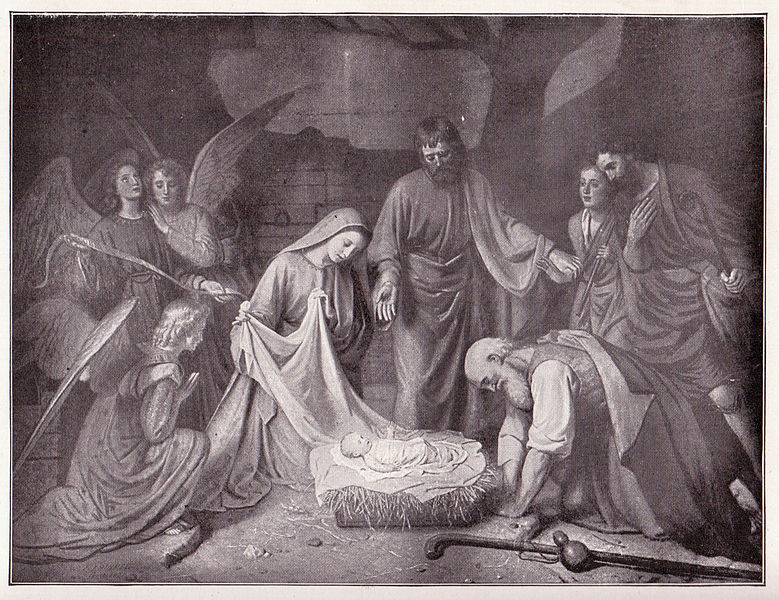
Image credit: Florence Harrison, public domain via Wikimedia Commons

Eclipse 2024

Eclipses.  They’re fully explainable.  Or are they?  Yesterday’s solar eclipse, with totality within driving distance of many Americans, led to an inexplicable need to see it.  April, we’re told, is the cruelest month and upstate New York is known for its “ever-changing skies.”  I admit I was skeptical.  Together with some friends we arranged to meet near the umbra, in Penn Yan, and to drive from there to totality up on Lake Ontario.  As is typical in New York, the day started out fair, with a few high clouds.  It was chilly, but this is April.  Our destination: Fair Haven Beach State Park.  The location was nice; we arrived early and found a good spot.  The clouds, however, were willful and wanted to remind us, like last week’s earthquake, that we’re not really in charge here.

As the day went on—totality for us was 3:20 p.m.—more and more people came into the park.  To its credit, with what must be a limited state budget, it absorbed many eclipse seekers without any trouble.  By 3:00 the cloud cover was heavy-ish.  Our friends had heard a sponsored eclipse speaker, however.  Totality was nothing like even 99%.  This would be of a different magnitude, even with clouds.  I remember three previous eclipses.  One in school with the pin-hole method where you really don’t see anything, one in Wisconsin after teaching one morning at Nashotah House, and the 2017 which I saw in midtown Manhattan.  None of this prepared me for totality.  Around 3:18 it started to look dusky.  We could catch glimpses (but no photos) of the crescent sun.  Within seconds it was completely dark.  It was another of those transcendent earthly things, like the earthquake three days earlier.

Perhaps I’m getting old enough to realize that you can’t really describe such feelings.  Maybe I’m getting sensible enough to understand such things are called ineffable for a reason.  All the planning, worrying, anticipating, was for this moment.  Yes, there were clouds overhead, but the park was full of cheering people.  They too had come here for something extraordinary and to my surprise I found tears in my own eyes.  I captured no photos of stunning clarity, but I had experienced something I’d heard about since childhood but had only glimpsed in the most crude of facsimiles before.  We were able to experience a kind of rebirth that comes only after night.  Conditions weren’t ideal, but are they ever?  And an encounter with the numinous always comes on its own terms.

The sun, hours before being eclipsed

More Omens

Brushing up on my eschatology, I watched The Omen again.  The original, that is.  One of the underrated aspects of cinema is that people learn their theology from it.  Movies tend to be more memorable than sermons.  It is opined among some that The Omen is responsible for the prevalence of dispensationalism among many Americans.  I’d put a bit of a finer point on it in that The Late Great Planet Earth was being raptured off the shelves all the way through the seventies (I personally bought two copies) and it caused a feedback loop with The Omen.  Many mainstream ministers, without benefit of a Fundamentalist upbringing, were caught unawares, I expect.  Scholars of religion have noted how several aspects of the narrative—the character of “the Antichrist,” the rapture, indeed, the Apocalypse—have been read back into the Bible by credulous believers.

What I found interesting in this viewing is the debt owed to The Exorcist.  Of the two there’s no doubt as to which is the superior film.  The name Damien in The Omen, I read somewhere once upon a time, was taken from Fr. Damien Karras.  During the late seventies and early eighties, unruly boys were routinely called “Damien” by frustrated camp counselors and others.  Apart from this nod, if true, is the fact that the abruptly introduced character Karl/Carl Bugenhagen is an archaeologist exorcist.  (He’s the guy who gives Robert Thorn the knives, if you haven’t seen it for a while.)  The scene shot in Jerusalem (said to be Megiddo) underscores that Fr. Merrin is also being channeled here.  I suspect that the film was getting a bit long in the tooth and some explanatory material on Bugenhagen was left out.

It has also been suggested that the number 666 entered popular culture because of The Omen.  I would temper that a bit with the fact that a lot of people were reading Hal Lindsey’s new apocalypse as well and the two of them got the job done.  There’s no doubt that after the film the evil number took off in a direction that would’ve left John of Patmos scratching his head.  This brings me back to the point that belief is influenced—sometimes constructed—by movies.  The Omen was a huge success at the time, despite the fact that many critics (also not raised Fundie) thought the premise was silly.  Most people aren’t film critics.  The Bible can be pretty impenetrable as well.  Preachers may not be inspiring.  Movies, however, wrap it up neatly and tell you what to believe.  Perhaps it’s some kind of sign.