Agnostic Gnostic

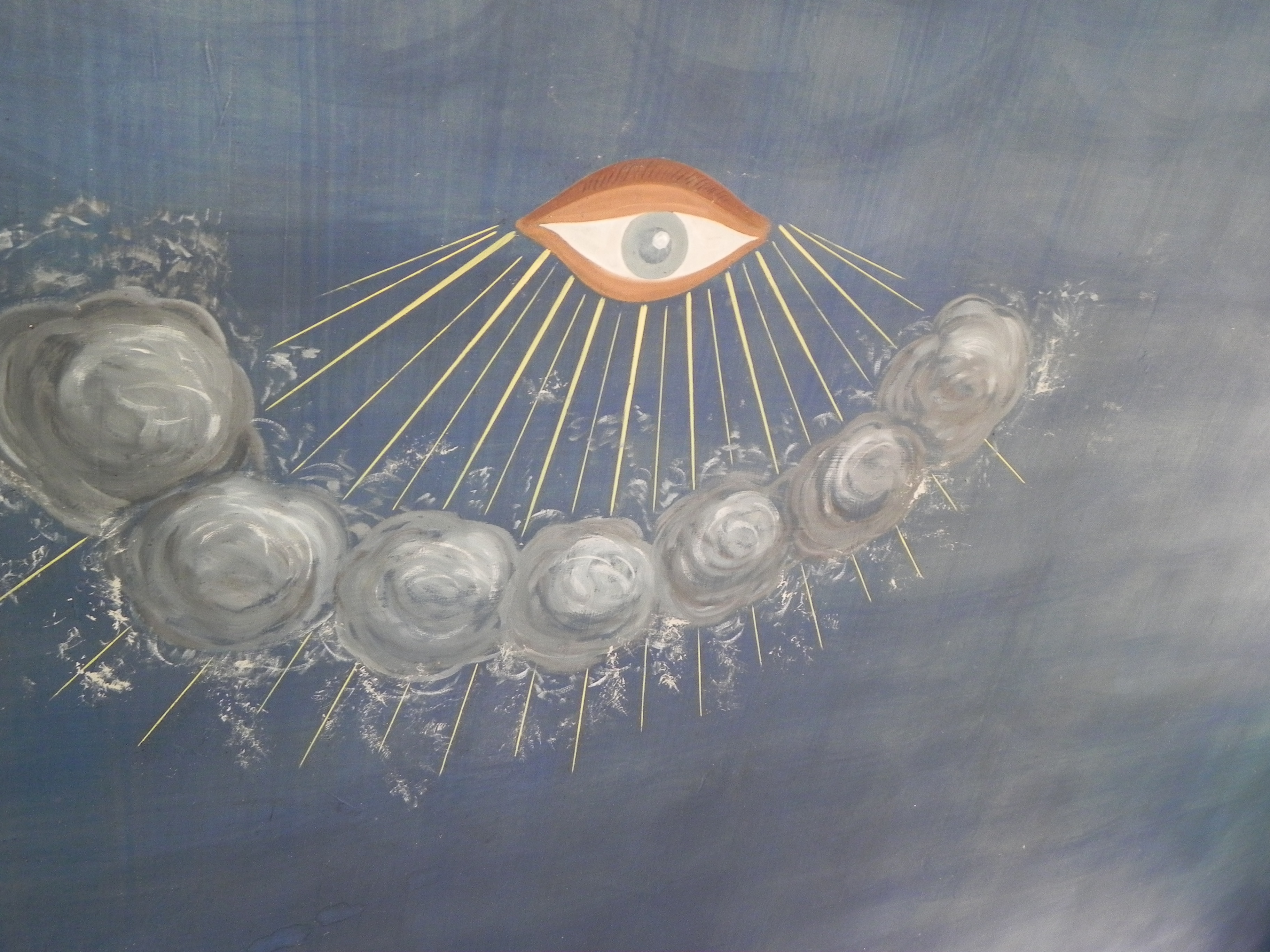
Ever have the feeling that you’re being watched? While touring the Salem Towne House in Old Sturbridge Village in Massachusetts, that fact that Mr. Towne was a Mason became abundantly clear. In the ballroom of his historic house the “eye of God” was looking down from the ceiling, and those who are astute observers could find other Masonic symbols in the house. Indeed, the ballroom walls were painted with cedars of Lebanon, the very trees Solomon was said to have utilized in the construction of the first temple in Jerusalem. Historically nothing is known of Solomon and the tradition of the Masons originating with that event can be nothing more than folklore, yet the connection is taken very seriously by some Masons.

Cedars of Lebanon

My grandfather was a Mason, but the desire to join the secret society never blossomed in me. I’d read Holy Blood, Holy Grail long before The Da Vinci Code ever drew attention to it, but being of a somewhat skeptical bent, I found most of it unbelievable. There is no doubt that the Masons had a very influential, if secretive impact on early modern history. I never seriously researched the group, but it is clear that their origin myths are very religious indeed. I looked right into God’s eye yesterday—how was I to question it? I was standing amid the cedars of Lebanon, after all.

Somebody's eye is watching you.

The desire to possess secret knowledge runs profoundly throughout history. Those who possess knowledge possess power. The Gnostic tradition is based on this very idea; God has revealed secret knowledge to some while the rest of us grope in the dark. Best to keep that knowledge clandestine. The Masons, wittingly or un, are part of this tradition. They are the putative guardians of esoteric knowledge, hidden amid the shadows of cedars and behind the clouds in the sky. In this day of abundant, free knowledge—it is given away every day on the Internet, for those who know how to discern—it may be difficult to comprehend that much can be hidden. As I stood looking God in the eye yesterday, however, I realized that there is far too much for any one scholar ever to learn.


Frippery or Faith?

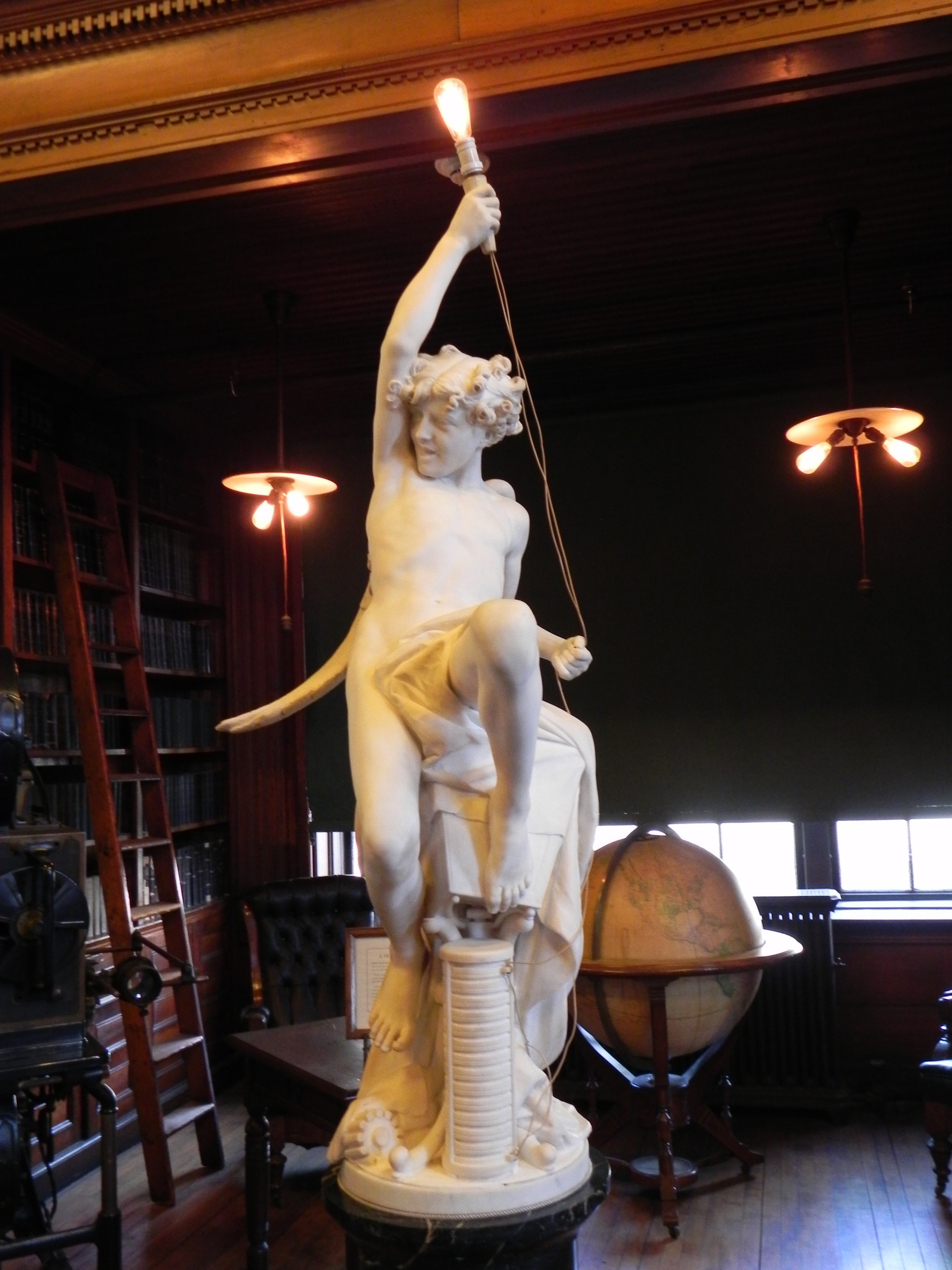
A lesson quickly learned in New Jersey is that the state has housed its fair share of geniuses and that inspiration takes many different forms. From Albert Einstein to Thomas Edison, these thinkers have changed the complexion of not only the state and country, but also of the entire world. While on a visit to Edison’s final factory and laboratory in West Orange yesterday, his devotion to thinking could not be overlooked. With little formal education, Thomas Edison taught himself what was necessary to become one of the most prolific inventors in the history of the world. The key to what he believed to be purpose of human existence is, sadly, under fire from politicians who’d rather keep the populace in the dark while they (the politicians) make the important decisions. “The man who doesn’t make up his mind to cultivate the habit of thinking misses the greatest pleasure in life.” So Edison said. Bully governors would rather turn out the lights.

As politics and conservative Christianity become even more intimate – if that is even possible – those who do not share their views are considered dangerous outsiders. As a religion specialist, it is difficult to gauge how sincerely such politicians take their religion. As their lifestyles clearly indicate, what they practice is as far from what they preach as the east is far from the west. Manipulating sincere, if misguided, believers into marks that will propel them into seats of power, they talk the talk. “Faith, as well intentioned as it may be, must be built on facts, not fiction – faith in fiction is a damnable false hope.” So said Edison.

If we measure the religion of the Religious Right in terms of action, it clear that their principles have far less to do with what Jesus said and did than with securing personal gain. Women are placed in subordinate positions; the poor, minorities, those who work to keep the economy afloat while the wealthy suck in more than they could possibly use, these people become targets rather than neighbors. Roman emperors knew the society was dissatisfied and provided bread and circuses. The Religious Right is perfectly capable of learning the more insidious lessons of history. If they had been around in Edison’s lifetime, no doubt they would have tried to turn off the lights so that we’d all remain in the dark. In such a situation it might be wise to leave the final words to Edison: “Religion is all bunk.”

Let there be light!


Myth of Jerusalem

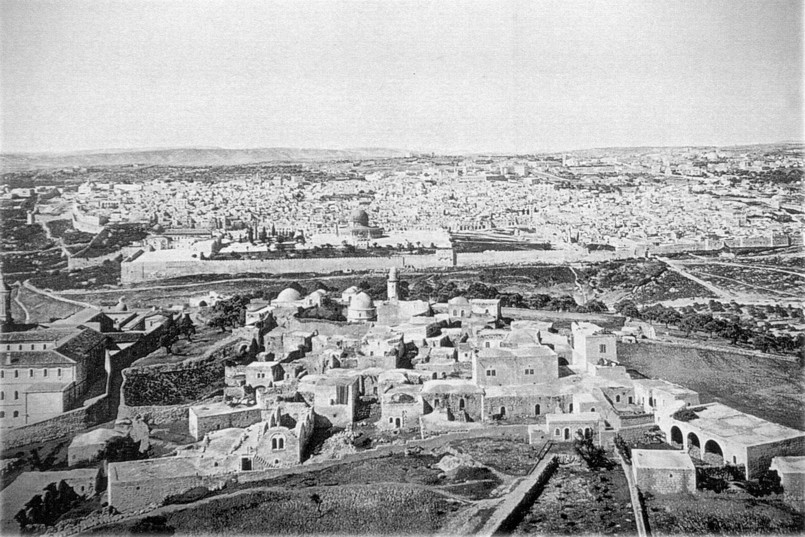
As I stood atop the Mount of Olives watching the sun set over Jerusalem several years ago, I had difficulty believing I was actually there. For a working class kid who’d only ever been to Canada before (and only because we lived not too far from Niagara Falls), this was a moment like a scene from the Bible itself. Jerusalem is a city of myth and dream, and it represents just how seriously mythology may be taken. A new book, Jerusalem, Jerusalem: How the Ancient City Ignited Our Modern World, by James Carroll, was reviewed in Sunday’s newspaper. I have not yet read the book myself, but a couple of lines from Tom Mackin’s review leapt out at me: “Jerusalem is as much a symbol as a reality. Because most Orthodox males spend their time studying the Torah, they are unemployed. Piety brings poverty.” This is editorializing with parsimony.

Those of us raised to believe that pursuit of the highest calling of humankind is that of seeking the divine often end up forced to live the consequences. This pursuit does not pay, unless one is willing to sell one’s soul to become a televangelist. Unemployment has a way of sharpening one’s focus. The message repeatedly heaped upon you by society is that you have nothing of value to contribute. True, religious founders often declare the ineffectual satisfaction of lucre, but then, most of them didn’t have a child to put through college. Having spent nine years after high school studying the Torah (and Prophets and Writings and documents written long before any of this), I see now what could not be seen then.

When I watched the sun set over Jerusalem with some friends, a stray cat wandered over, looking for affection. Or, more likely, food. I had some scraps that I shared with the hungry kitten when it unexpectedly bit my finger and scampered away. My friends, concerned for rabies or some other infection, rushed me down the Mount of Olives and into the Holy City seeking a holy pharmacy. Little did I know at the time that a myth was being enacted at the expense of my aching finger. Acts of kindness are rewarded with the hand that feeds being bitten. I had to come down from the mountain, earn a doctorate, and be dismissed by well-groomed evangelicals before I could finally see that the symbol was the same as reality. I need to read this book to restore my faith in mythology.

More and less than it seems


Devils and Mooncussers

New Jersey is an easy state to caricature. Some of the most remarkable aspects, however, are those that seldom find their way into the popular media. An unseasonably warm spell led my family to a sudden awareness of cabin fever that sent us seeking diversion over the weekend. We ended up at Tuckerton Seaport. To get to the museum from our location meant a long drive through the pine barrens. This unique ecosystem is impressive for its size (over a million acres) as well as for its unique plant-life and relative lack of population. And, of course, the Jersey Devil.

A relatively harmless Jersey Devil

Even serious museums such as the Seaport can be expected to play up the heritage a bit. In a corner of the wildlife diorama is tucked a little sculpture of the Jersey Devil. The diabolical aspect comes only from the folklore of its birth as an accursed child. Far more dangerous were the human elements in the maritime history. Mooncussers were those who set out false lights for ships, hoping to lure them into the shore where the vessels would run aground, leading to easy plundering. The lighthouse has long been a religious symbol, a metaphor ready-made for illumination, safety, and solidity. This very reputation led the way for mooncussers to steal the signs of security to enhance personal gain.

The devil of personal gain unfortunately haunts more than the remote pine barrens of New Jersey. Those who use religion to attain that gain are the modern mooncussers who draw the unwary too near to the rocks and shoals. And mooncussers encourage others to participate in their sham, as long as there are gullible captains who are uncertain of the shore. The early church liked to compare itself to a ship. This image inspired many a nave ceiling to be designed as the hull of an upturned boat. Unfortunately, the hull often appears to have been capsized and the mooncussers appear in the role of diabolical captains set on wrecking the very vessel they command. Who needs a devil when human greed is far more than adequate to lead even the upright to opt for easy gain at others’ expense?


Noah Trumps Geology

Back in the days when I was still young enough to dream, but old enough not to change anything, I wanted to become a geologist. I was near the end of my teaching stint at Nashotah House at the time, and my life-long interest in fossils fired up like a liquid oxygen barbeque. My interest began in paleontology, since I’ve always loved dinosaurs, and grew to encompass all kinds of rocks and minerals. Geology promotes a literal groundedness that few other areas of study can rival – it embraces the stuff of the earth itself. Moving halfway across the continent with boxes full of rocks, however, dampens the rock-hounding ardor a bit. I still read about geology: it is the discipline that pounded the final, resounding nail into the coffin of the six-day creation myth. While still living in Wisconsin my family used to drive out to the mountainous north of Idaho across, among others, the vast state of Montana. It was geology in motion.

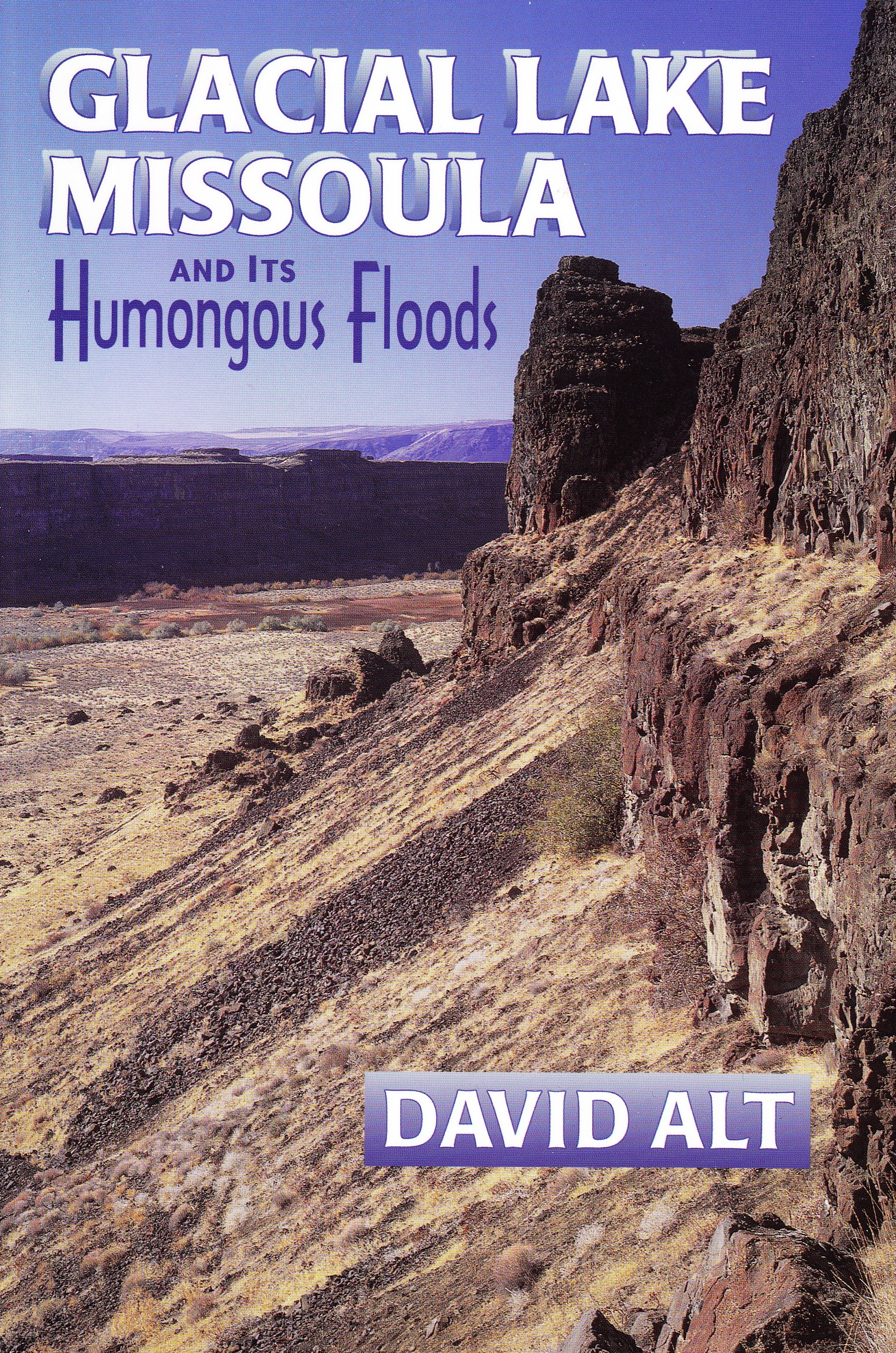
My in-laws soon learned of my geology bug, and I was pleasantly surprised with a book on the great flood two Christmases ago. Not the great flood of Noah, but that of J Harden Bretz. David Alt’s Glacial Lake Missoula and Its Humongous Floods provides an introduction to a series of great catastrophic floods in the western United States. Not that anyone remembers them; the last of the deluges drained into the Pacific about 13,000 years ago. What connects these floods to this blog is the reception history of this idea. When geologist J Harden Bretz discovered the unmistakable evidence for the floods in the landscape of Montana, Idaho, and Washington, geologists refused to accept it. The reason? Catastrophism was unacceptable to geologists of the turn of the twentieth century. Although Alt does not come right out and say it, clearly one reason that uniformitarianism prevailed was because of Noah’s flood.

Ironically, geologists had been forced into a conceptual stalemate because of a biblical myth. The story of Noah’s flood had been (still is, by some) used to explain everything from the Grand Canyon to the extinction of our beloved dinosaurs. In response, geologists posited a long, slow, gradual process behind the sculpting of the earth’s surface. By the day of Bretz, nothing moved fast in geology, not even floods. It required many decades for the science to recover from the stigma of biblical catastrophism. Today geologists largely acknowledge that at several points during the Ice Ages (yes, they did happen!), an ice dam flooded what would now be recognized as Missoula, Montana, under a gigantic lake. That lake burst its ice dam repeatedly and gushed down toward the Columbia River and out into the ocean long, long ago. Long before the putative Noahic flood of some 4000 years ago. The landscape it left behind is impressive to both geologists and biblical scholars. And the story of this flood’s rediscovery demonstrates once again the continuing influence of Noah on otherwise rational minds.


Hunting Vampires

The Mercer Museum in Doylestown, Pennsylvania is a treasure trove of Americana from the turn of the last century. Henry Chapman Mercer, in addition to being wealthy, had the foresight to realize that society was rapidly changing, even back then. He undertook the collection of everyday artifacts from many human industries, poured himself another castle-like concrete building, and housed the baubles there. It is a fascinating walk through nineteenth-century America. And if you visit on a cold day it feels as well as looks like Currier and Ives have just passed through. My main draw, however, was a vampire hunting kit.

If only I had a polaroid lens...

Prominently displayed, the kit includes a Victorian Protestant’s tool chest for any blood-sucking eventuality. A cross (sans corpus), a pistol with “silver” bullets, glass vials with various apotropaic ingredients, even a little stake, all in custom-cut green velvet. Unfortunately, the kit is believed to be a forgery, although the items in it are from the Victorian era. The silver bullets are, for example, pewter. As the placard notes, vampires do not exist, but that doesn’t mean people didn’t believe they might have existed. The museum, naturally enough, hoped that the Victorian era kit might be authentic. Scientific analysis has revealed otherwise despite the fact that many people continue to believe in something that has no basis in reality.

Belief constitutes reality. Otherwise, how could it be that thousands, if not millions, of people don’t accept the fact of global warming? Brash barons of unhindered industrial progress insist that humans can’t harm the planet – it’s just too big. We can suck out all the resources that billions of years have deposited in intricate recesses and that nature has sprouted right on the surface. For, they say, God has given them to us. They believe that. If we held a mirror up to them, what would we see? Maybe we would be forced to change our minds and go after that vampire-hunting kit after all.


Mercer Metaphor

Not being a follower of the rich and famous, I had never heard of Henry Chapman Mercer before visiting his house. Mr. Mercer has long departed, but he was a tile-maker with a very rich auntie back at the turn of the penultimate century. Being from Doylestown, Pennsylvania, Mercer poured his money (literally) into a castle made of concrete. This sturdy, labyrinthine structure, called Fonthill, is a five-story museum that is an hommage to ceramics and the art of tile making. The friends who introduced us the museum enticed me with the information that Mercer had embedded Sumerian tablets in the wall of his concrete mansion. Indeed he had. Standing in the house that Charles Dickens once visited, I realized that the literary connections stretched beyond Sumer to the lifetime of Mercer himself. And right in the middle was the Bible.

Who might that giant be?

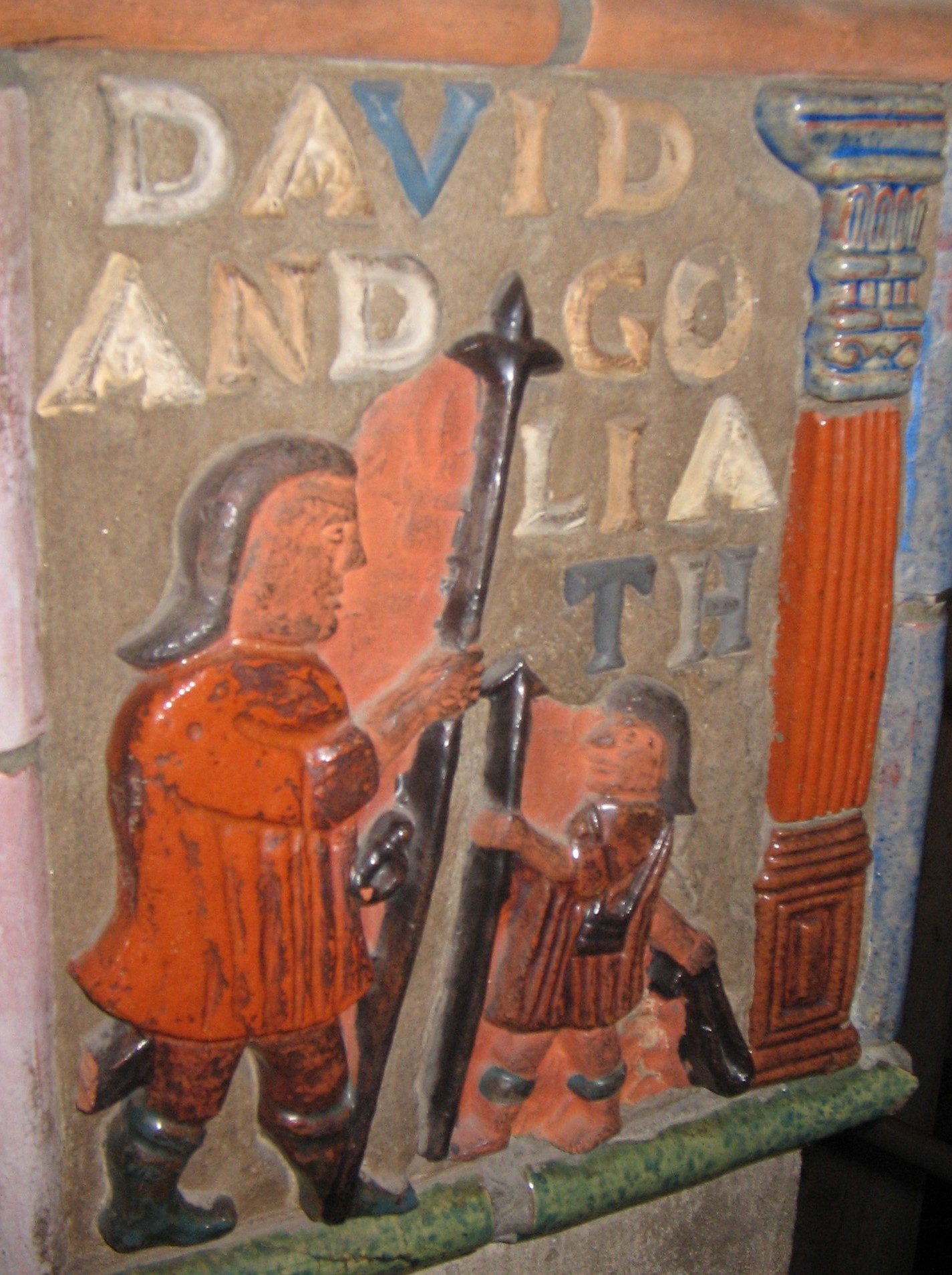
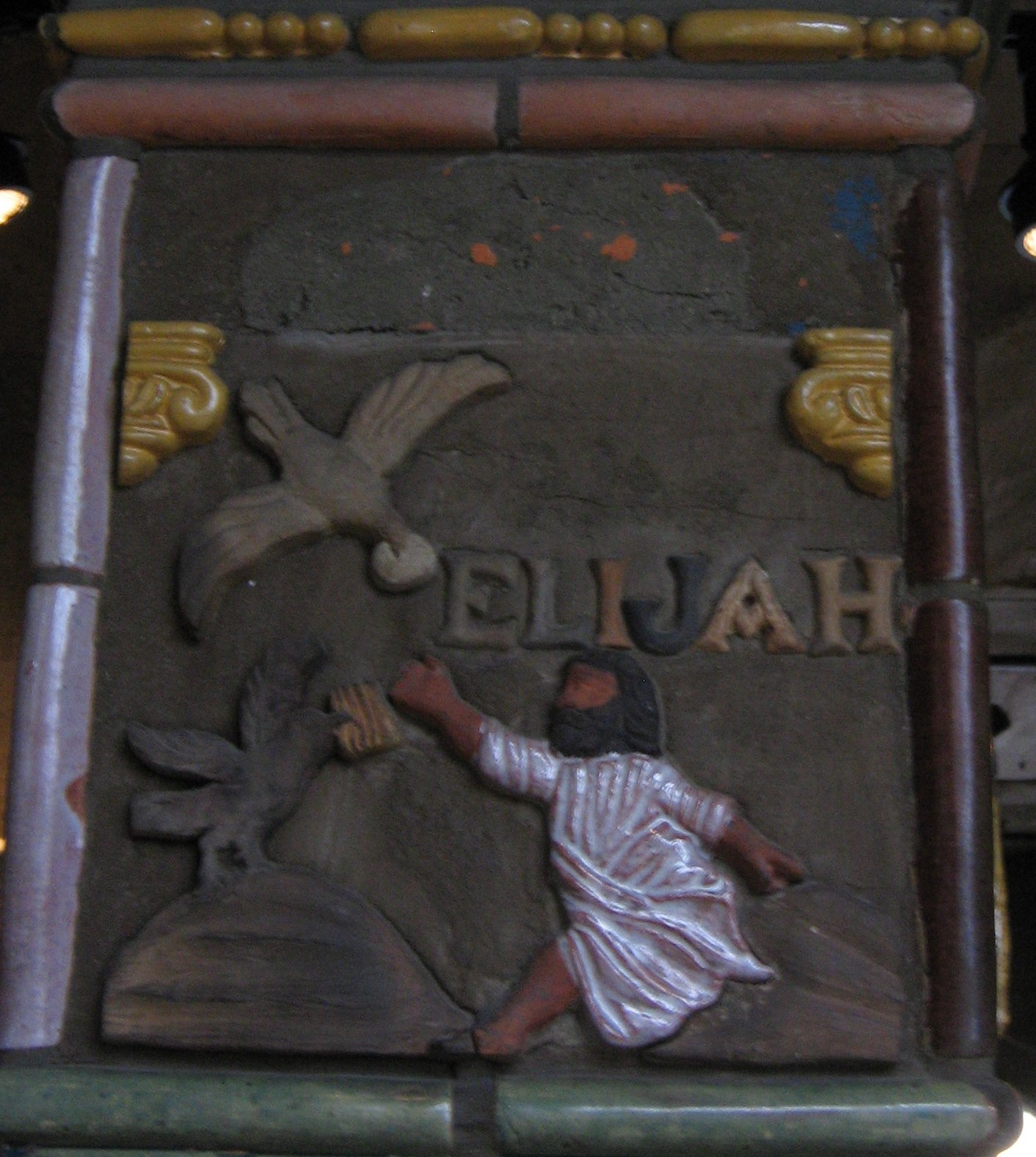
There is so much to see in every room of Fonthill that I could not hope to take it all in. No photographs are allowed inside, so I was desperately trying to remember every square centimeter that I was lucky enough to examine. The Bible, however, came in the form of clay. Mercer designed tiles. A tile factory still sits on the grounds of the house. Many of these tiles depict biblical scenes. Perhaps sharing a shudder with most of the wealthy, Mercer had concerns for the afterlife. The Bible is the balm in Gilead. Although I couldn’t take photos in the house, pieces made from the same molds adorned the nearby Mercer Museum that we visited later that day. Both buildings lack adequate heating but abound in human-made stone. I snapped a couple of biblically themed tiles before eagerly heading to the warmth of the car.

Elijah reaches for a handout

Meanwhile the news declares that unemployment benefits are being shortened by a bloated government. Those who’ve been forced out of work by a capitalism out of control will now have to make their own jobs, it seems. Bush-era tax breaks are being desperately defended by congressmen who look surprisingly well fed. The rich have never had it so bad. Henry Mercer did not have to work for his money, yet the Bible adorns his monument in stone. Fonthill is definitely worth the trip to Doylestown. While you’re there, look for the ubiquitous Bible. The Bible, although possibly the most misunderstood book in human history, lends its gravitas even to the vaunted towers of Babel.


Impossible Kingdom

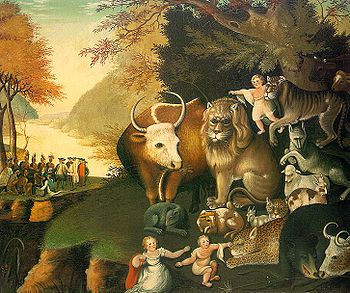
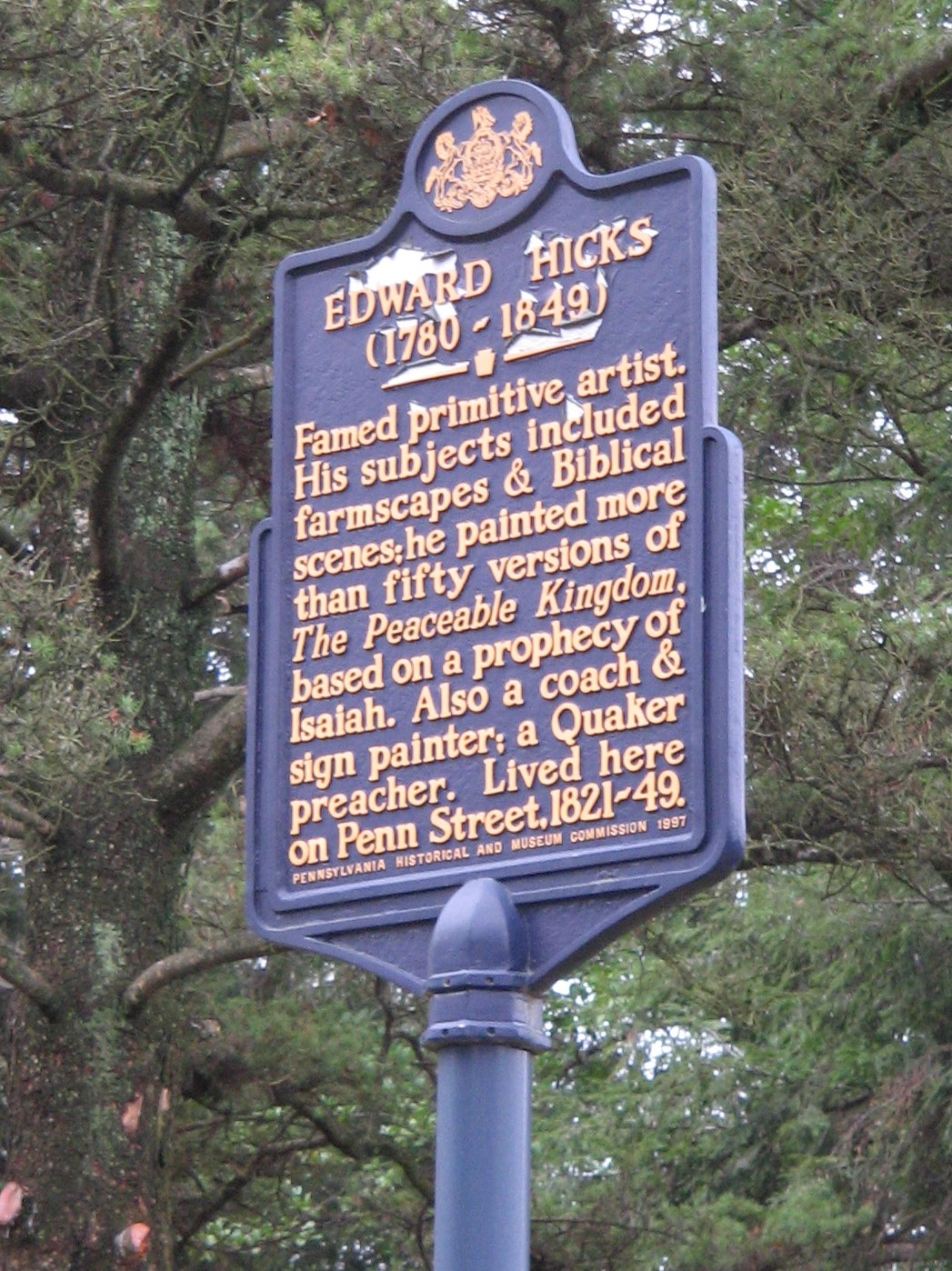
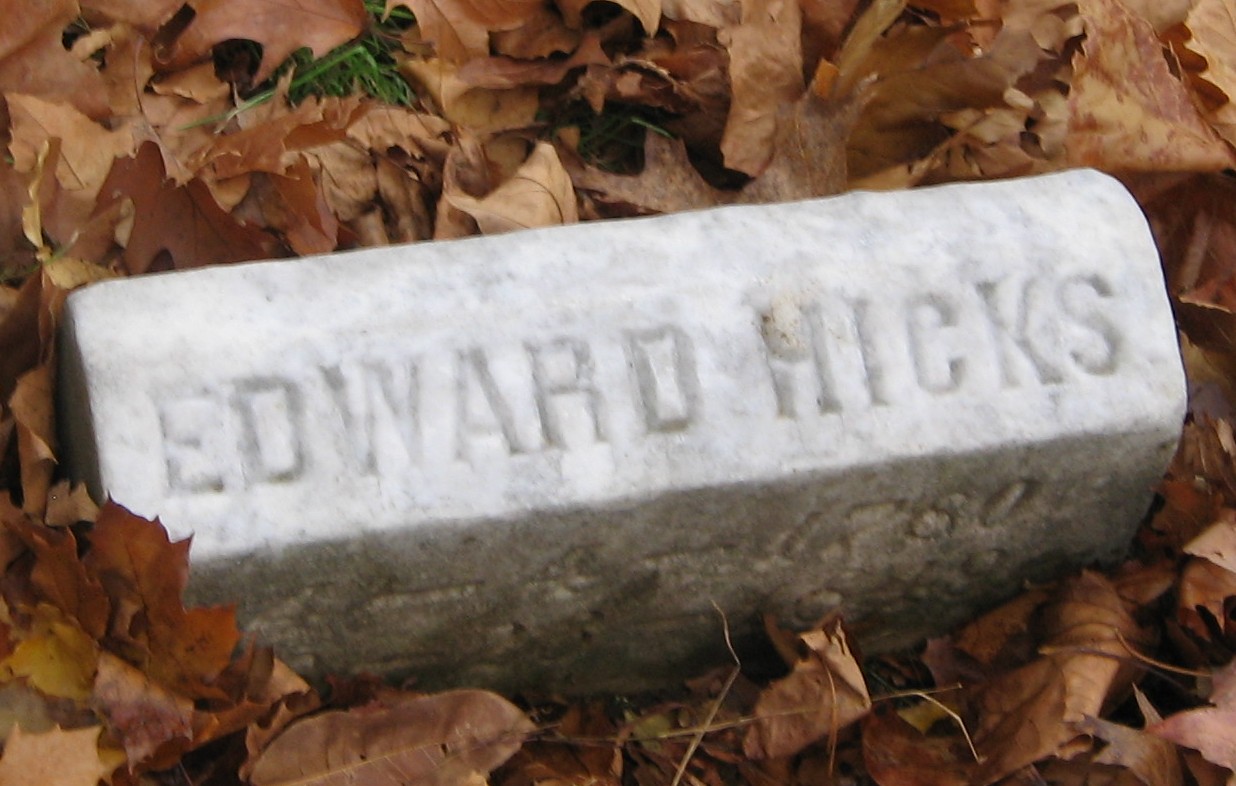
Over Thanksgiving we visited friends in Newtown, Pennsylvania. Newtown was the home of the Quaker painter Edward Hicks, famous for his many renditions of The Peaceable Kingdom. On a chilly Black Friday we walked to his former home, visited his Meeting House, and stopped by his grave. The Quakers, whose presence is much more palpable in the eastern part of the state, were the original Pennsylvanians. Their pacifism defined them, and the peaceable kingdom was their ideal world. A world without strife, without greed, without televangelists and politicians. It is a compelling vision.

A peaceable kingdom

The Society of Friends recognized no human leader to their movement that sought direct experience of the divine. In the Bible such a vision pervades early Israel where the rule of God was expected to be enough; no king was needed for this kingdom. The ideal world, however, was plagued by human ambition and selfishness. Before the first judge hung up his hat they knew that they’d need a king. A monarchy, as they were warned, that would bring about its own set of intractable problems. Leadership inherently creates inequalities. Just ask any accountant who keeps track of a governor’s expenses. Kinglets are just as bad as godlets.

We read about the excesses and abuses our leaders stockpile in the name of public servanthood. Yet, for all that, the world is not at peace. An increasing number of nations are joining the nuclear club, poising their missiles over populations of innumerable people in need. The peaceable kingdom has no king, and the visions of the prophets are cloudy and uncertain. Visiting the quaint, affluent hamlet of Newtown, it is possible to believe in the vision of one of their defining personalities. Just don’t open the newspaper or turn on the television. Because, like the Israelites, we have many eager kings lined up outside the door.

Is the peaceable kingdom dead?


Faith of a Lusty Monk

Wisconsin is so much more than its iconic cheese. I was reminded of this fact when my wife sent me an advertisement from the latest edition of the National Mustard Museum catalogue. I have to confess that while living in Wisconsin we became fans of the earlier incarnation of the institution when it was a roadside attraction called the Mount Horeb Mustard Museum. In addition to the perk of the biblical namesake of the town, the museum itself was the kind of place you instantly fall in love with. Quirky, pungent, and informative. The museum was nevertheless dominated by the shop that spoke for most of the actual floor-space. You could sample most mustards either by pretzel or by little sample spoons – no double-dipping please! There were only a few hard-core patrons there at our first visit, but as we continued to stop in over the years, the clientele seemed to be growing.

The ad my wife brought to my attention is for “Lusty Monk Altar Boy Honey Mustard.” The title begs for exegesis: Lusty Monk is the brand. The concept on many of the mustards we saw at the museum was to emphasize humor and shock value. Apparently the venial sin of enjoying mustard is enhanced with a decorous dollop of naughtiness. I suspect many people buy the products for the cleverness of the labels alone. Altar Boy is the title of the specific mustard blend. One must be careful to separate the word “Honey” from “Altar Boy,” otherwise an inappropriate picture might emerge. Of course, no one need admit they were thinking that anyway. “Honey Mustard” is familiar to condiment connoisseurs as a slightly sweet version of the dressing made with a generous infusion of industrious bees’ work (and there are many honey bees in Wisconsin as well). Thus read, there is nothing suggestive of mendicant malfeasance in this mustard.

On Wisconsin!

An entire blog could be devoted (and there may be one for all I know) to the slightly unsavory names of various mustards. A good place to do research would be at Wisconsin’s own National Mustard Museum. We still receive their catalogues, but since moving to New Jersey easy access to one of our favorite free museums has sadly become an empty jar of dreams and memories. We still proudly display a Poupon U. banner in refrigerator-magnet format to remind us of the tasty hours we spent sampling the very plant whose seed Jesus compared to faith itself. And the many off-color titles temper this faith with fun.


Where Whoever Walked

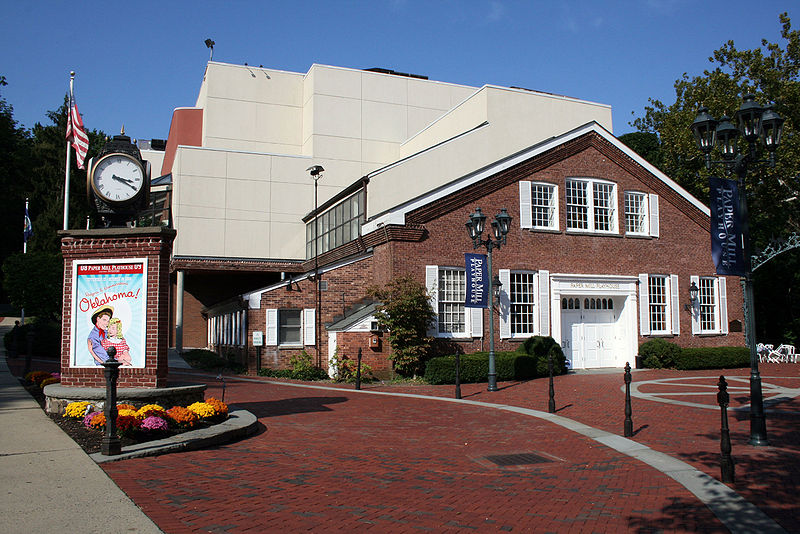
No adequate explanation has ever been proffered for the human desire to be where more prominent individuals have been. In its religious guise this is generally called pilgrimage, and the faithful seek out locations where a besainted member of their faith tradition once trod, ate, slept, or died. Going to the place of the famous is a major motivation for the travel industry. We are driven to see what s/he saw, taste what s/he tasted, experience what s/he lived. Just to be there, and contemplate. No one person, however, is universally known by every individual world-wide, so who it is we follow varies widely. This sense hit me once again last night as my family undertook the rare treat of a live show at the Paper Mill Theater in Millburn. Although Hairspray is not the most profound of shows, it was exceptionally well done, and the images on the walls of the foyer reminded us of who had been here before.

The Paper Mill Playhouse, a place of transformation

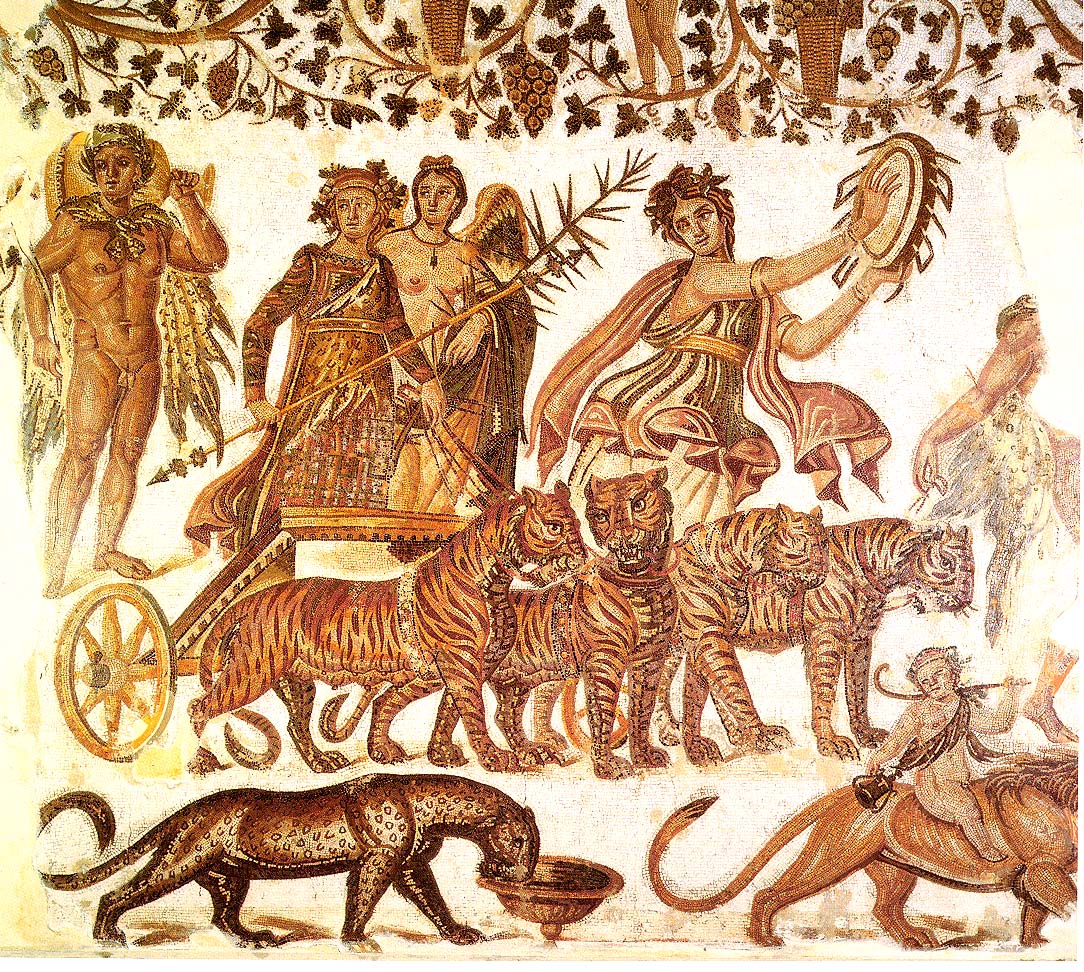
The shotgun blast of emotions this experience created verges on the religious. There was a time when I too donned the greasepaint (hard to believe for those who’ve only known me with this two-decades worth of old-growth forest on my face), and I know it to be a transcendental experience. The clean-shaven face is a boundless canvas. My own experience was local and small-scale, and certainly not done for fame, but the transformation was palpable. I am sure that actors everywhere share this experience – the apotheosis of becoming someone else. This week in mythology class we discussed Dionysus, the god of such transformations (and theater). A god who travels, a god associated with place, it is easy to understand how Dionysus became so popular, with or without the wine.

An epiphany of Dionysus

Dionysus was the recipient of a mystery cult in antiquity, one that rivaled Christian inroads in the Roman Empire. You see, many people recognized the similarities of Dionysus and Jesus. Both were begotten in unusual ways by their father (the high god), and both were gods of epiphany. Both were gods who understood the human condition – having mortal mothers, who came to people where they were, and who transformed the ordinary into extraordinary. Both were associated with wine – Jesus’ first miracle at Cana showed his theological pedigree – and both had reputations for associating with the less desirable members of society. And yes, both offered resurrection, a means of overcoming the limitations of life itself. Perhaps that is why the rare pilgrimage to the theater is so transcendental. It is pilgrimage and apotheosis all in one. And that is more than most of us might ever hope to achieve, short of encountering Jesus, or Dionysus, himself along the way of our pilgrimages.


Where Would Jesus Park?

The walls of the Old City of Jerusalem may not go back to the time of King David, or even Jesus, but they have become one of the iconic symbols of a legitimate site of world culture. As a young man my first sight of those walls was almost enough to bring me to tears. I had read about Jerusalem since my earliest days after graduating from Dick and Jane, and to see the Holy City firsthand was the experience of a lifetime. Too bad it is some of the most hotly disputed real estate in the known universe. Sacred to the three major monotheistic faiths that seem dead set on destroying this or that portion of it, Jerusalem is unlike any other city on earth.

The problem, as any urbanite knows, is where to park. According to Matt Beynon Rees of the Global Post, Jerusalem’s city planning committee is considering literally undermining the sixteenth-century walls of the Old City to construct a parking lot. Just a few short years after U.S. troops drove heavy military machinery atop Nebuchadrezzar’s Babylon in order to satisfy Bush-family oil lust and personal revenge, once again one of the irreplaceable monuments of the past may come under the contractor’s gaze. I teach at Montclair State part-time, so, believe me, I know about parking headaches! There have been times when I thought I’d have to drive the fifty miles back home without stopping for class since every space on campus was full. Yet I wouldn’t suggest tugging down historic University Hall to make room for more cars.

The problem seems to be that in our disposable culture we’ve lost sight of what can never be replaced. Immediate urge takes precedence over what our ancestors left for us to ponder and marvel over. A great hue and cry went up when Yellowstone burned in 1988, a lament that the former beauty would never be restored in a lifetime. Damage to structures from centuries past may be repaired, but the wonder of their staying power will forever be lost. It cannot grow back like Yellowstone, no matter how long we wait. Yet, parking meters under the Wailing Wall might save locals from having to take a bus. Regardless of theological conviction or absence thereof, some sites are simply sacred to the human story. The human story, however, has become one of convenience. Where else might Jesus park his Holy Esprit without having to walk (not on water) to get to the temple?

Sure, it's a nice view, but where do we leave the car?


Sacred Geography

Pilgrimage. The concept that certain places are special is deep-rooted in the human psyche. So deeply rooted that we consider it a religious behavior. Even as scientists recognize the need of many animals to return to their birthplaces or areas that they sense beyond the range of human perception, as human beings they feel it too. Even scientists have the urge to revisit that special spot. Otherwise the travel industry would be in great trouble. Pilgrimage is considered a religious behavior, and the sacredness of place has been noticeably in the news this week. MSNBC reported on the find of a skeletal pilgrim to Stonehenge from 1550 BCE. Yesterday the New Jersey Star-Ledger ran a story about a temple/mosque dispute in Ayodhya, India. Both of these stories center on the sacred geography of the region.

Stonehenge has been a magnet not only for Druids and New Agers, but for anyone with a sense of connection to European prehistory. In the winter of 1990, under a chilly British sky and gusty winds across Salisbury Plain, my wife and I made our pilgrimage to Stonehenge. The low angle of the sun in the sky in a dusky British December only enhanced the experience of standing near a monument that has become an icon of the mysterious and the transcendent for modern domesticated citizens of a straightforward, technological world. The news story states that the skeleton unearthed was of a Mediterranean teenager, far from home, in the shadow of what was already a famous landmark. Even over two decades on, I can still feel the inarticulate sense of longing I felt at Stonehenge, so near the winter solstice, and I understand why that young boy went there to die.

Meanwhile in Ayodhya, the site of a mosque has been declared two-thirds under the ownership of Hindu plaintiffs who claim the site as the birthplace of Lord Ram, a Hindu god. Naturally objecting is the Muslim population that currently has a mosque on the site. Sacred sites raise emotions and tempers readily. Humans want access to their holy places – this is the power of sacred geography. It is certainly palpable in the Bible, and was obviously present the last time I was in Jerusalem. Whether it is hardwired in our biology or simply born of whimsy, sacred geography will never go away. Either we can learn to share it or fight to the bitter resolution, but no matter how much blood might be shed the site will only grow more and more significant because of that very blood.


Seeing God

My daughter reminded me that one further aspect that stood out at the Red Mill Museum in Clinton was the persistence of pareidolia. Pareidolia, or matrixing, is the tendency to interpret “random” data as meaningful. More specifically, it is often used to refer to seeing a person (or entity) where it is not. As I wrote in an earlier entry, it has been suggested that pareidolia is the ultimate origin of religion.

For my purposes here, however, I wonder if the sheer amount of false faces we encountered while at the Red Mill might have some connection with the idea that the property is haunted. Somewhat of a skeptic, I am somewhat swayed by ghost accounts since they are so plentiful and since many of those who report them are reputable persons with good observation skills. Ghosts are, however, impossible to separate from some form of religious thought since they are the ultimate examples of the intangible, unmeasurable phenomenon. If there are ghosts in the laboratory, they haven’t been quantified yet.

Old buildings, which abound at sites like the Red Mill, are full of knotholes or other apertures whose original hardware has long since disappeared. Round holes, or spots, as many insects and fish “know” are easily interpreted as eyes. Add a horizontal line beneath your “eyes” and you have a basic face.

Perhaps my favorite example of pareidolia at Red Mill is an old sycamore tree. A large burl on the trunk bears a striking resemblance to a human profile. This is more easily seen in real life where the mind more easily filters out the distracting coloration and focuses on the shape. Since pareidolia is such a fascinating aspect of the human experience of the world, and since it might, conveniently, be tied to religion, this seemed to be as appropriate a venue as any other to share some great examples.


Catskill Waiting

Catskills epiphany

We’re back from the Catskills and all they imply. One of the more obvious implications was a lack of internet access – one of the many reasons I like to frequent remote locations. I had planned this little get-away with some vague hopes of enlightenment of some kind. The quote from Melville in my last post is more than just nice prose; it is the essence of spiritual striving. I know those aren’t scientific words, but they embody the spirit of several nineteenth century American novelists I’ve read and reread. I did see a Catskill eagle while there, but I returned home still seeking an epiphany.

While briefly away from the constant demands of teaching, the bigger picture starts to come into focus. We visited Ellenville on the day of their Wild Blueberry and Huckleberry Festival – we’d just picked huckleberries ourselves in the mountains outside town – and religious groups were represented aplenty. I had noticed the many churches in this rural region, and one of the feters handed me a tract that informed me “If you have said ‘Yes’ to these three questions [have you ever sinned, lied, or stolen] (by your own admission), you are a lying, thieving, adulterer at heart; and we’ve only looked at three of the Ten Commandments.” And also, John Lennon is dead. Nothing like a little self-righteous judgment with your blueberry pie. Sirens began to blare and a fair-goer collapsed and had to be airlifted to a regional hospital. It was very dramatic.

This is where the big picture came in. When there is an accident, we take astounding measures to save the injured, suffering, or wounded. A fair-goer flown by life-flight to the hospital. At the same time, our society condones, encourages even, an unemployment scenario where even highly trained individuals are cut off from health care and self-esteem as well as income. Left to die a quiet death of desperation. As long as we don’t have to see it, death by redundancy is sanitary and sanctioned. Has this great society ever sinned, lied, or stolen? I have seen that Catskill eagle and I am still awaiting an epiphany.


Truth in Fiction

In my more optimistic moods, I like to think of myself as a literary sort. Not constrained by the narrow confines of academia’s hallowed — and often hollow — halls, I have spent much of my life reading literature. I can’t say what started me on this track; my parents were not readers and the small-town school I attended encouraged little beyond subscribing to MAD Magazine. When I stumbled onto the literary giants, I was hooked. There are still great writers I have yet to explore, but one that I only really discovered at the prompting of my wife is Mark Twain. I’d of course known who he was. In my youth I never read any of his books. Then on a fateful, if carefully planned out, trip to Hannibal, Missouri to dig geodes during my geologist phase, we were rained out. The geode farm was closed. Sullen beyond shattered rock-hound dreams, I was at my wit’s end (not a long trip) when my wife suggested we not waste the miles we’d traveled, since Hannibal was also the boyhood home of Mark Twain. While there we bought souvenir quality volumes of Tom Sawyer and Huckleberry Finn. Upon returning home, I read them non-stop.

While on vacation last week my wife was discussing her literary pursuits with her family and it emerged that the full, uncensored, autobiography of Mark Twain will begin its public appearance in November of this year. One of the topics to receive his attention is religion. Twain was a Christian, insofar as any Presbyterian can make that claim, but he was critical of formal religion. A quote purporting to be from his autobiography runs: “There is one notable thing about our Christianity: bad, bloody, merciless, money-grabbing, and predatory. The invention of hell measured by our Christianity of today, bad as it is, hypocritical as it is, empty and hollow as it is, neither the deity nor his son is a Christian, nor qualified for that moderately high place. Ours is a terrible religion. The fleets of the world could swim in spacious comfort in the innocent blood it has spilled.” A bit caustic, but honest. When the books come out, I’ll be able to check it for veracity.

One of the things I value most about Mark Twain was his ability to hit his readers without giving away that they’d been hit. He accomplished this through a brutal honesty, often cloaked in fiction. When I explain myth to my students I tell them that it is an attempt to clarify the truth through story. Modern people tend to be fixated on historicity and sometimes miss the importance of a story because “it never happened.” If Huckleberry Finn never navigated a raft down the Mississippi, it would not affect the truth of the story or the insight of the author. It seems to me that with a writer so honest we would do well to consider what he had to say about his own religion before unsheathing our swords and rattling our sabers.