Highway Homiletics

“Over the river and through the woods to grandmother’s house we go,” is an assertion to be taken literally in my case. Crossing the Delaware River and trekking through the forests of Pennsylvania are the only means to reach my childhood home from New Jersey. Each time I make the trip I am amazed at how strident the highway preaching along the way has become. Signs on both the interstates and the backroads announce the truths of a certain vociferous brand of Christianity that maintains that everyone must think that way or spend an eternity in hell. Having experienced this kind of fear-driven faith firsthand, I can’t protest too much without being labeled a hypocrite, but some of what I observed over the river and through the woods leapt out at me anew this Thanksgiving.

Firstly it seems that Jesus saves big rocks. Several large, obtrusive boulders worthy of the land time forgot bear the message that Jesus Saves. Locally this form of homiletics can be as persistent as the Trust Jesus notes spray-painted on just about every interstate overpass between here and Illinois. A religiously aware lumber company in rural Pennsylvania hosts a sign declaring, “Read, Heed, Live & Obey the Bible!” When I think of lumber, I think of 2-by-4s and of their standard use of knocking sense into others who look at things differently. This sign said more than its owner might have intended. A few miles down the road I read, “Why not try Jesus? If you don’t like Him the Devil will always take you back.” The assumption, naturally, is that anyone reading the sign is already devil’s food.

One of the great things about freedom of religion and freedom of expression is that such messages declare their writers’ fervent beliefs, but they hold no force beyond the rhetorical. Having met many sincere believers in other faiths over the years, I do wonder what kind of good news such non-negotiable advertisements really send. Some of the writers, I believe, are railing against the godless world they see around them (although the number of churches along these backroads would seem to testify to religion a-plenty) while others can’t accept any form of any religion that differs from their own, even if it be a different flavor of Christianity. Perhaps it is time I put up a sign advocating a vegetarian version of Thanksgiving — no turkey need die for anyone’s sins. In some religions such a message is considered trustworthy indeed.


Marmots and Briny Deeps

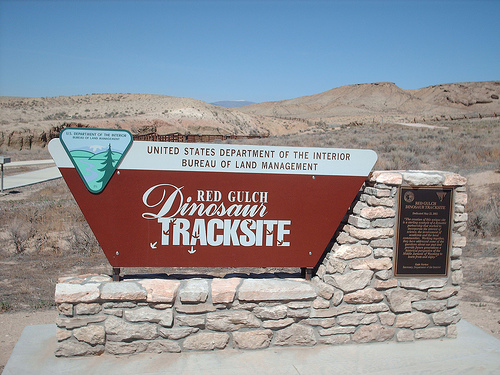
While driving through Utah some years back, I spotted a large rodent next to the road. Born with a need to announce automatically every land-animal I see while driving, I called out “there’s a marmot!” My wife, half-asleep, said “A Mormon? Where?” We were headed toward the Great Salt Lake with an ultimate destination of Dinosaur National Monument. Naturally we saw many more Mormons than marmots. The story of the Church of Jesus Christ of Latter-day Saints has always fascinated me. The whole concept of the “Great Awakening” and “Burnt-over District” conjure images of apocalyptic vividness where nineteenth-century evangelists are shaking angry fists at the declining modern world around them and are warning of the imminent approach of an angry deity.

I naturally found it interesting when the paper declared yesterday that the Mormon Church has decided to back anti-homosexual discrimination legislation. This doesn’t mean the Latter-day Saints approve of the practice, just that they don’t want gays to be unfairly treated in the secular world. One of the implications of a changing world is that modern readers often lose sight of the fact that the world in which the Bible originated was a very different one than the one we inhabit. “Homosexuality” was not a lifestyle in biblical times, but that does not mean there were not men and women born gay. The real issue was the misplacement of “seed” that vital element that mysteriously led to new people. The only references to same-sex “love” in the Bible commend the depth of friendship. The only problem is where the seed ends up.

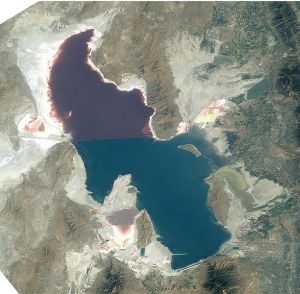
The story of Sodom and Gomorrah is an etiology for the Dead Sea. The major crime of Sodom, as even Ezekiel directly says, was lack of hospitality, not homosexuality. The city that does not extend hospitality to the needy and the traveler is truly wicked. It is buried under fiery brimstone covered with stagnant water. I dipped my pinkie into the Dead Sea and touched my tongue when I was there (this might explain my current state of mind). The saline brew was gut-wrenchingly revolting. So as we parked beside the Great Salt Lake a couple decades later, I decided to repeat the experiment. I was disappointed; nevertheless, if salty lake basins are a sign of God’s wrath we really ought to wonder whether the salinity will lighten up just a bit more now that an act of human decency has occurred in Utah.

GreatSaltLake

NASA-eye view of the Great Salt Lake


Care of the Dead

Stretching back before the advent of writing, back before civilization itself began, people have shown reverence for their dead. Paleolithic era grave goods attest to care of the dead residing among the earliest strata of human behavior, and it is a behavior that continues to evolve to reflect the belief structures of the Zeitgeist. The idea of constructing cemeteries in a garden where family and friends might visit their departed is a relatively recent innovation. Increased population and concerns about epidemics led to the landscaped, garden-variety cemetery outside of populated areas in the 18th century. Before that graveyards could be located within the city itself, often near a church or sacred location.

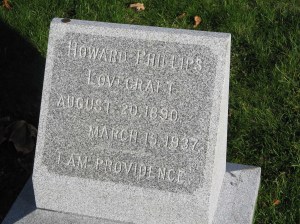
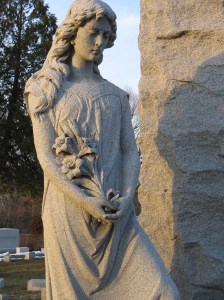
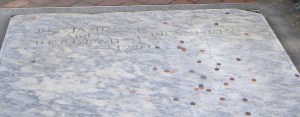
While visiting Swan Point Cemetery in Providence, my niece asked me why people left pennies on gravestones (H. P. Lovecraft’s tombstone had one on it, and others around it). My thoughts went to Wulfila’s recent blog post on the Black Angel tomb in Iowa City and the pennies scattered there. I also recalled La Belle Cemetery in Oconomowoc, Wisconsin where a “haunted statue” was always richly endowed with pennies in her cupped hands. LaBelleThe specific form of penny offerings seems to go back to Benjamin Franklin’s burial, at least in America. A few years back while in Philadelphia, I saw for myself that people still leave pennies on Franklin’s grave in Christ Church Cemetery.
Franklin

Franklin pennies (and a few nickles)

There is no universally accepted reason explaining why Benjamin Franklin should have been the first to have received such treatment — in fact, I would argue that it is much older than Dr. Ben.

Money to accompany the dead has a long history. Pennies on the eyes or under the tongue of the deceased originated in the need to placate the ferryman across the river of — what’s it called? — Oh, yes, the river of forgetfulness. The classical Greek form of this mythic character is Charon, the boatman who punted the dead across Styx. He required payment, and since coinage had been invented, it was a convenient way to pay. (Today the truly devoted might leave a credit card in the casket.) The ferryman must have his pay, as the movie Ghostship warns, but the idea is much older still. The earliest references to being poled across the river go back to ancient Sumer, the earliest known civilization. As soon as people became civilized they began to pay homage to the gloomy captain of souls.

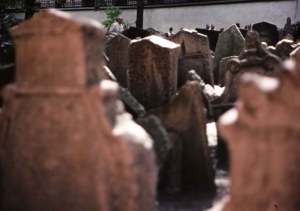
While in Prague just after it opened to western visitors, my wife and I stopped by the famous Jewish cemetery where the tombstones are so tightly packed in that they are barely legible. My wife asked why so many of the tombstones had smaller stones on top, placed there as dedications.JPrague I recalled having seen stones on tombs outside Jerusalem some years back, and I even had a student bring me a stone from Israel to keep as long as I promised to put it on her grave after she died. This practice in its recent form is associated with Judaism, but again, it has ancient roots. The building of cairns, or piles of stones, is often associated with the Celts or the pre-Celtic inhabitants of the British Isles. On our many wandering through the highlands and islands we saw several Neolithic examples in Scotland, particularly in the Orkney Islands. The practice of putting stones atop the dead also goes back to ancient times. One plausible suggestion is that it was intended to keep the dead in their graves. A more prosaic conclusion is that digging deep holes takes more work than hauling over a pile of rocks.
No matter what the origin of the practice may be, one of the surest signs of civilization is care for the welfare of the dead. Today a penny is easily left, costs the bearer little, and creates a memorable image for all who follow.


Love the Craft

It is a cold, windy New England day in November. You find yourself in Providence. How can you not visit the gravesite of H. P. Lovecraft? I have mentioned Lovecraft before, in my podcast on Dagon, but that brief citation does not give credit to a man whose life provides episodes that feel strangely familiar to me. Barely known as a writer in his own lifetime, Lovecraft had difficulty finding employment and had a fascination with ancient gods. Indeed, I discovered Lovecraft while researching Dagon for a serious presentation and soon students were telling me about the Cthulhu (I would not dare attempt to pronounce) Mythos and how I had only scratched the surface of his writing.

Lovecraft’s fascination with ancient gods brought new life to forgotten entities. Dagon, despite being a major deity of ancient Mesopotamia, would likely have been completely forgotten by all but professors of arcane mythology had not Lovecraft resurrected him, albeit in a fishy form. His fascination with the protagonists of ancient myths, nearly forgotten deities, clearly influenced Neil Gaiman in his American Gods, and has preserved for the modern reader some of the fascination with powerful, ancient forces that show the insignificance of humanity. I found reading American Gods while in Providence a very humbling experience. Lovecraft also gave the world Arkham, the asylum of Batman fame, as well as Miskatonic University.

Along with Melville and Poe, Lovecraft deserves a place of honor in the pantheon of American literary explorers. The assortment of gifts left for him at his tombstone, including a small cairn, pennies, a pen, and even a note reading “thank you for the ideas,” attests his local fame. The prominence of his books at neighborhood bookstores assured me that I was not the only traveler to breathe in the air that Lovecraft exhaled. My visit also brought to mind a story that a friend of mine started to write some years ago. It had something to do with ancient gods coming back to life, although my friend had never heard of Lovecraft or Gaiman. Lovecraft’s spirit, it seems, may still be alive and well in Rhode Island and in the minds of other residents of Arkham.

Lovecraft


Rhode Island Blue

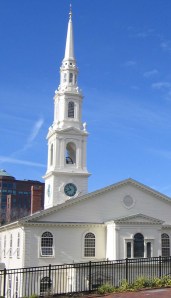
Rhode Island is often overlooked as the smallest state, a place seldom happened upon by accident, somewhere that one has to intend to go. Drawn by family, I made a trip to Rhode Island and serendipitously learned the lesson of Roger Williams. Roger Williams was the founder of Rhode Island, and, for those only familiar with the Southern Baptist movement, a rather unbelievably liberal Baptist. The founder of the first Baptist church in the nation, Williams was also the advocate of a form of religious freedom that is still railed against today by conservative Christian factions that wish to make America a “Christian nation.”

FirstBaptist

Roger Williams' first Baptist church (in the country)

We are accustomed to religious propagandists today telling us that the “founding fathers” were Christians just like they are (simply not true), and that America should remain a “Christian country.” Roger Williams, although not often spoken of in the same tier as George Washington or Benjamin Franklin, classifies as one of our founders and he was an outspoken advocate of conscience as the guiding force behind religion, not state or federally mandated compliance. Rhode Island was offered as a “shelter for persons distressed of conscience.” It was a state where a mind was free to follow its lead.

I confess to overlooking Rhode Island often. But as a refuge for “Papists, Protestants, Jews, or Turks,” it is the Dreamland of religious liberty. Progressive to the point of welcoming Jewish believers and Muslims, Williams went as far as to declare, “none [should be] compelled from their own particular Prayer or Worship, if they practice any.” Even the unbeliever was welcome. How far the “religious right” has fallen from this original ideal of a humble Baptist who envisioned a homeland where residents were free to believe as their conscience dictated!


Rosslyn, New Texaco

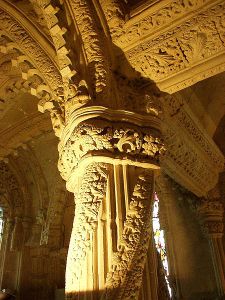
Back before Dan Brown had becoming the Most Important Human Ever, even before he published Angels and Demons, my wife and I visited Rosslyn Chapel in Roslin Glen, Scotland. While not actually seeking the Holy Grail, I had been doing some research on Celtic lore, ostensibly where the Grail legend originates, and so we made our way to the remote and (then) desolate site of this unusual church. Officially the Collegiate Chapel of St. Matthew, it is, without doubt, the busiest piece of architectural stonework I have ever witnessed. We went for the grail. We stayed for the art.

WikiCommons image, ours isn't this good

WikiCommons image, ours isn't this good

The research I had been conducting (finally published just last year as a contribution to a Festschrift for Nicolas Wyatt) involved the Mabinogian, a repository of Celtic mythology, and the legend of Bran. For sharing the name of a healthful breakfast cereal, Bran is renowned for also having had a life-restoring cauldron. He even made a journey to the netherworld and his head kept singing even after having been dissociated from his body. An uncommon hero indeed. All historical indicators, however, point to the cauldron as the original of the Holy Grail. Certainly the Bible does not mention it, nor does it appear very early in Christian mythology.

People, as Dan Brown’s financial independence loudly indicates, like a good conspiracy theory. There is a comfort in believing that a magical object of great power is out there somewhere and that a rather ordinary Harvard professor (!) might be able to find it, yet resist taking it. Far truer to life is Indiana Jones and the Final Crusade; people feel the need to touch, to control the power beyond themselves. Even at the cost of their lives. Despite the fact that the Grail is a fiction, it simply will not disappear — although no one can find it and it has never been seen. Faith tends not to be based on tangibles. This is attested every time Dan Brown makes his way to the bank and the population reads with wonder about meanings that simply don’t exist.


Devil Went Down to Jersey

I have to confess to being a fan of Weird NJ. For those of you not fortunate enough to live in New Jersey, Weird NJ is an unconventional travel-guide published twice a year, celebrating the strangeness of the state. Ironically, I discovered Weird NJ while living in Wisconsin. I was attending the 150th birthday celebration of a couple of friends (combined ages, not paranormal!) where one of the gifts was the then recently published Weird Wisconsin. After the original magazine had caught on, books about individual states were commissioned and this was the first one I’d encountered. My wife knows that look in my eye, so on my birthday that year I had my own copy. Even though it is written for a decidedly non-academic readership, I learned more from it than most textbooks I’ve read. When New Jersey loomed large in our future, I added the book version of Weird New Jersey to my growing collection and soon came to rely on it as a repository of local folklore and interesting places to visit.

Thanks to Matt for permission to use his art, see Matt Can Draw for more!

(Thanks to Matt for permission to use his art, see Matt Can Draw for more!)
This short flight of fancy relates to religion in a very decided way. Within the pages of these publications many locations (popular with teenagers, I’m guessing) bear the moniker, “Devil’s —“ where the space may be filled by any number of nouns: Footprint, Kitchen, Pit, Pathway, Tree, or even Tea Table. This decided interest in naming places after the dark lord seems whelming, even for New Jersey, home of the infamous Jersey Devil. The need to have an evil entity to explain the darkness in our lives is very powerful. Certainly it is not limited to New Jersey as the well-known examples of Devil’s Tower, Devil’s Lake, and Devil’s Postpile attest (although mistranslation may frequently be responsible). Those cultures bound by a monotheistic outlook mark their fears with the Devil.

A relative latecomer to the Bible, the Devil had not been available for earlier attributions of evil. Thinkers of the pre-diabolical period reached widely varied conclusions as to who or what caused the troubles they experienced. Some blamed God while others simply accepted the vicissitudes of circumstance. (Then again, they didn’t have New Jersey as a frame of reference.) Once the Devil entered the picture, the problem of good and evil took on a sharper focus. That sharp distinction, however, frequently belies human experience where issues and situations are seldom as clean cut as they seem.


Bible Land

Once upon a time I took a trip to visit a friend in West Virginia. I made the drive from New Jersey across parts of Pennsylvania and Maryland. Having grown up in Pennsylvania I never supposed it to be considered part of the “Bible Belt,” but it seems that some of the spillover may be making its way north of the Mason-Dixon line.

Interstate 78 has recently struck me as being highly evangelized. I saw a billboard reading “Blessed is the nation whose God is the Lord” and remarked at how out of context this verse was taken. Last time I checked, the Bible tended to be concerned with Israel, not the United States. Further along I saw a church near Bethel, PA called the Assembly of Yahweh. Not being aware that there was confusion as to who the God of the Israelites was, it amazed me to see that they have their own radio station called “The voice of the Assembly of Yahweh.” This struck me as a missed opportunity; the real message could have come through more clearly with “of the Assembly” left out. Yet further along was an ominous billboard from a local Mennonite Church that sounded eerily like Amos. “You Will Meet God” it announced.

Storm's a-comin'

Storm's a-comin'

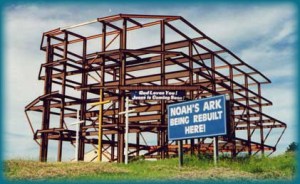
As I entered Maryland the sales tactics intensified. In Frostburg there was God’s Ark of Safety Church where an actual replica of Noah’s Ark is being built right along Interstate 70/68. Since the steel frame is all that was currently finished, I was glad that it hadn’t recently been raining. Perhaps a more recent translation of the Bible has updated gopher wood to Bethel steel. Further along I spotted a lighthouse atop a hill over a hundred miles from the nearest substantial body of water. This was the World Lighthouse Worship Center. While visiting an actual lighthouse on Lake Superior a few years back the docent informed me that lighthouses were now considered superfluous with the advent of Global Positioning Systems. (Shhh — please don’t inform them that science has again trumped a quaint piece of folklore! I can imagine that the lighthouse may be useful when the new ark is completed.) Along route 219 in McHenry, MD I saw “A House of Love Gathering Place” that I just couldn’t dissociate from the B-52’s for some reason. Just about on the border to West Virginia was the Fresh Fire Church of God.

The United States is truly an impressive reservoir of biblicism. Perhaps university administrators who believe the study of religion isn’t worth the meager salary of an assistant professor should take a road trip. It would be a learning experience.