Moving Mountains

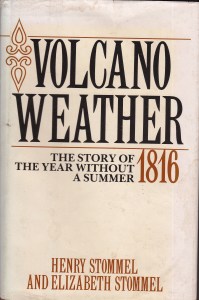
VolcanoWeatherJust 200 years ago, there was a “year without a summer.”  Well, that’s an exaggeration, but the name has stuck and is familiar to those of us with an undue interest in weather.  Although the coldness of that summer was far from universal, frosts came in New England in June, July, and August, killing off the staple corn crop for much of the region.  Snow fell even later than it usually does in the northeast, including a measurable fall in July.  My interest in this particular cooling episode was spurned by reading about the eruption of Krakatoa in 1883.  The connection?  Mount Tambora, a relative neighbor of Krakatoa, erupted in 1815 with an ejected debris volume of about ten times that of its later colleague.  The dust cloud from Tambora has long been a culprit for the dismal summer the following year.  Henry and Elizabeth Stommel researched and wrote a little book on this event entitled, Volcano Weather: The Story of 1816, the Year Without a Summer.  Although the book shows its age (it was written in the early 1980s), it remains a fascinating exploration of the many things that weather can do.  And has done.  Two of my favorites from this book were Napoleon’s adventures and the writing of Frankenstein by Mary Shelley during a rainy summer in Switzerland.
 
I should note, however, that the Stommels do not declare that Tambora was the reason for the year without a summer.  They tend to think the volcano had something to do with it, but the weather, that most protean of phenomena, can be impacted by the very small as well as the very large.  In fact, their description of the eruption includes the recognition that locals felt volcanic eruptions to be normal acts of the gods.  Many island cultures recognize the divine power of the molten earth.  The weather getting out of whack, we can be sure, leads to much prayer even today, thousands of miles from any eruption.  Something that hasn’t changed since the 1980s is that natural phenomena—especially powerful ones—evoke the divine.  Huge, impressive volcanoes, or even the very immensity and complexity of the atmosphere, suggest something we can’t comprehend.  Global warming will soon, however, bring this point home.
 

One of my takeaways from this book is the fact that the weather’s lack of uniformity emphasizes just how little we know.  The year without a summer mainly affected the northern hemisphere, and that only piecemeal.  Parts of northern Europe and North America felt it more intensely than other places.  It was not “the coldest year ever” and anyhow, is it even possible to know whether the coldest year would feel unnecessarily chilly where you are?  I’m pretty sure it’s snowing in some part of the world right now.  Human arrogance when it comes to global warming can be put into perspective by such acts of nature as Tambora.  From a human perspective, we live on a time bomb.  Volcanoes care not a whit for our bidding and wishes and dreams.  They can impact climate more instantly than our trite human efforts and thinking we alone are gods. To prepare for the future sometimes we need to look two centuries back.


Sundog

IMG_2784

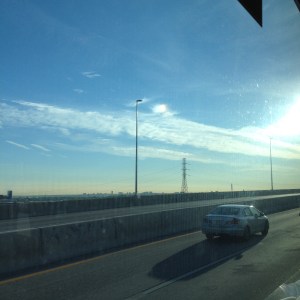
Spring has been taking its time to arrive here in the northeast. Just when things seem to have set on a course of identifiable progress, the temperature drops twenty degrees and the rain sets in again. It’s been great weather for toadstools. There are bright patches, however. I read on the bus, but one day last week as we were trundling toward New York City I glanced out the window. The sky was mostly clear and a sundog shone brightly to the north like my own personal star of Bethlehem. Sundogs feel like good omens. I’ve read enough about meteorology to know that they are merely a refraction of sunlight due to ice crystals high in the atmosphere. Depending on your angle of view, they might appear as a halo all the way around the sun, at which point they’re no longer dogs, or, at certain times of day they may appear as a solid beam coming down to earth in the form of a sun-pillar. It’s only ice and light.

Those of us who stare long at the sky know that the weather is merely a metaphor. The earth spins. It revolves. It rotates. It’s cold at the tips and warm in the middle. The laws of physics—unbreakable they tell us—state that all bodies seek equilibrium. A constant California temperature. If humans should survive long enough we might find our globe of uniform temperature, smooth as a billiard ball, and utterly lifeless. We need the variations of our weather. The chill of a spring that just won’t warm up. The heat of a summer that wilts down to the roots. Ice and light.

I’m heading into a large city. It’s a quotidian trip that some might suppose to be void of meaning. The sundog follows us for a while until it’s lost in the skyscrapers of human devising. Towers that over-reach but which the gods have to bend down to see. Nobody knows the origin of the term “sundog.” My favorite explanation is from Norse mythology where wolves pursue the sun and moon to consume them. This feels so appropriate to me as I enter the artificial canyons of hubris, glass, and concrete. As the day progresses the sundogs appear to disappear. Towers continue to grow. Beyond them, high in the sky, ice and light will continue their play, even if the dogs never do reach the sun. Refraction of light may cause things to manifest as other than they truly are.


Do the Twist

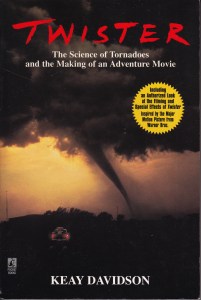
TwisterA used book sale is like a box of chocolates, if I may abscond with a simile that fits many scenarios. After all, you are there to buy books that others have discarded. Some of them show their age rather blatantly. Keay Davidson’s Twister: The Science of Tornadoes and the Making of an Adventure Movie is one such title. Those who know me well know of my fascination with weather—I wrote a little book on the subject based on that obsession. Although the weather informed and formed me long before I was ever near a tornado, these particular terrors were so exquisite that I couldn’t help but look. Although I grew up in Pennsylvania—not exactly tornado alley—one night when I was away from home a tornado swept by less than ten miles from where my family was. It toppled trees down one side of a hill and up another. It was eerie and uncanny and in many ways shook me out of the feeling that I never had to worry about them. Then when I went to Ann Arbor for a weekend with my fiancee the sky turned bronze. Rain was whipping past horizontally. Later we learned that a tornado had passed maybe four miles from where we were. Living in Illinois and Wisconsin, we experienced many tornado warnings. I never saw a tornado, but somehow thought I should.

It goes without saying that if I see a book on tornadoes that is reputable and cheap, I can’t pass it up. Davidson is a journalist whose work appears (as of the two decades ago when the book came out) in National Geographic. Some of you may not have been living in tornado alley twenty years ago, and therefore may not have felt the excitement that Twister, the movie, promised. By the time it came out I had already been thinking about Weathering the Psalms, at some level. I was a bit disappointed in the film itself, but it does mention that an F5 tornado is “the finger of God.” Davidson’s book picks up on this as well. At several points witnesses, and even scientists, lapse into divine language to describe tornadoes. One person even says that a tornado is an image of God, or that the storm is God. That’s a very natural way for people to think. The power of a Midwest storm has to be experienced to be believed.

The divine represents the highest echelon of language. The tornado fits because it is the most powerful wind on the planet. Concentrated, raging, and fickle. One can’t help but think: I was raised Protestant, what if the Catholics are right? Substitute any religion in either half of the equation. The weather simply does not do what we want it to do. It reminds us that humans can’t comprehend our own atmosphere that we so blithely pollute. The book may look dated—who remembers Twister anymore?—but it is a forceful reminder. When you need a metaphor for the most intense experience the weather will always be waiting.


Fast One Flood

I’m not sure what to believe anymore. This crisis of faith revolves not around religion, but around media. Pundits have been saying for some time that the internet has meant the slow death of journalism, and there are so many websites that redistribute news that its like the whole world is involved in a constant, perpetual game of “telephone.” All of this is preface to a story a friend sent me that appeared on the website God. I’m not sure I trust God. The story is too good to be true. At least in a schadenfreude sort of way. God is hosted on thegoodlordabove.com, and, well, we all know about dot coms. The article concerns the destruction of Answers in Genesis’ Noah’s Ark theme park by a flood. That is believable. Floods do occur, as Noah knew. What becomes unbelievable is that the National Weather Service forecaster stated that there were no storm clouds in the area at the time. That qualifies as a miracle.

Martin,_John_-_The_Deluge_-_1834

Did this really happen? I don’t know. I wasn’t there. Plenty of times when I was there (wherever there happened to be at the time) I wasn’t even sure what happened. Can I find the truth? One of the police sites for internet rumors is Snopes (also a dot com). I remember when Snopes began as a place to quell fears of urban legends. Back when the worldwide web was young, there was a verisimilitude to stories gleaned from the net. Living in the sparsely populated Midwest, it was easy to believe that some of these things could happen to you. At times I held onto Snopes like a crucifix, especially if I had to go out alone at night. Snopes tells me that thegoodlordabove is not to be trusted. The story is false, like others that have originated on the site. Answers in Genesis, unfortunately, is still going strong with its theme park.

Authoritative texts aren’t what they used to be. There was a day when all you had to do was pull a black leather book off the shelf to find the definitive answers. In Genesis or any other of the books. Now we rely on the worldwide consensus of the web. You can’t trust God on a website. Snopes, however, is pretty reliable. It’s the Scully to our natural Mulder. That’s why the web will never have the same impact as print media. Even the website for your bank or government can be cleverly faked. I might’ve looked no further had the purported flood not fallen from a cloudless sky. I guess I’d better be a wary believer. For the internet tells me so.


The Philosophical Neanderthal

HumansExtinctExtinction. It’s a depression concept, but one that nevertheless constitutes a reality in evolution’s world. When applied to members of our own species we term it genocide and declare it an evil. Our perspective—not to dispute the value judgment—is hopelessly foreshortened. Our brains have evolved to promote individual survival, not to see the longue durée. How often do we worry about the extinction of Homo erectus? Or the australopithecines? Without them we wouldn’t be here, and yet, they’re gone. The case of the Neanderthals is perhaps closer to home. We now know that Homo sapiens overlapped with Neanderthals. Some of the questions raised by Neanderthal extinction are given serious consideration by Clive Finlayson in his study, The Humans Who Went Extinct: Why Neanderthals Died out and We Survived. To get a sense of how this works out, and how it applies with our current contribution to global warming, we must be prepared to view the extreme longue durée. Duration beyond comprehension.

One thing that becomes clear from the very beginning here is that climate has driven evolution perhaps more than we often think. Species, which tend not to live through the relatively long reach of climate change timescales, adapt to the circumstances of their environment. They either do, or they go extinct. Climate, however, is a balancing act teetering toward equilibrium. Hot and cold, evening each other out. Over an even longer duration, our sun will run out of metaphorical steam and things will get quite a bit chillier out there. For the meantime, however, shifts between ice ages and periods of warming will continue to seesaw across time and our race, among many, will need to adjust to survive. Perhaps acknowledging our own role in the current global warming might be a way to start. Our species tends to be short-sighted.

There is an irony here. History and prehistory have shown that, as Finlayson points out, that those best equipped to survive radical changes are the poor. Extinctions—some of them quite dramatic—have occurred before. They will surely come again. When times get tough, it seems, the comfortable get going. Going extinct, that is. Those who climb the corporate ladder the highest have the longest distance to fall when things go bad. The poor, who have to struggle every day to survive, are the ones who know how to get along in circumstances that turn sour. I have called this an irony for what might seem obvious reasons. There is another as well; here we have science pointing again in the direction of the Bible. There it was noted long ago that the meek would inherit the earth. And that’s a bit, it seems, that should be taken literally.


Spring Forward

I have to admit that spring snuck up on me this year. Weather is, of course, no reliable predictor of the Vernal Equinox, and since I depend on the lightness of the sky while waiting for the bus as an indicator of seasons, turning our clocks ahead last weekend blindsided me to the nearness of the light. Holy Week in Christianity is just one of a cluster of holy days long associated with the point of equilibrium: the day when light and darkness balance perfectly, only to tip from then on in the favor of light. The crocuses have been up for weeks and the robins are ubiquitous, so I really have no excuse. Spending too much of one’s days indoors, I suspect, will inure any soul to the wonder of changing seasons. Climate control, no windows, and constant business separate a person from what nature has evolved us to be.

Easter, understandably, can’t be a national holiday in a land of religious freedom. Not everyone recognizes Easter and even those who do don’t agree on the date. Having a moveable feast is a great inconvenience to employers who want to know everyone’s going to be at their desks. Besides, even though the date changes, it’s always on a Sunday. Many people already have that sop and so, we glide past the vernal equinox with nary a thought. Business as usual. Looking at the great monuments of the past, when ancients put great effort into marking the seasonal change days, I can’t help but think that we’ve lost touch with a basic element of our humanity when we let the equinoxes pass without notice. I hadn’t even realized it was spring until it had begun.

Stopping to recognize the significant days in the passing of the year may be inherently religious. We can be as secular as we like about the equality of light and darkness, but somewhere deep inside we’ll still be thankful that the days will be growing longer until there is more light than dark. We just don’t have to say so at the office. Holidays, it seems to me, offer us hope. We don’t have to buy stuff or give presents. Just having a day to stop and reflect makes us more human. The vernal equinox came silently on a Sunday this year. I awoke early to try to catch sunrise on a cloudy morning. I look to the east, and I dare to hope.

IMG_2725


Palms and Psalms

At Nashotah House, where I spent many years of my career, it was often felt that the weather during Holy Week was, in the best of circumstances, appropriate. With spring just around the corner, however—the date of Easter is based on the Vernal Equinox, after all—a number of surprises came. Particularly in Wisconsin. The ideal scenario would look something like this: sunny then partly cloudy on Palm Sunday; it was a a joyful day for a parade, but clouds make for nice foreshadowing. Nobody really commented on the weather for Monday through Wednesday, and Thursday—Maundy Thursday—was largely spent inside the chapel. Good Friday, however, should be rainy. Saturday gloomy. And, of course, Easter Sunday should be a perfect, sunny spring day. It seldom, if ever, worked out that way. The weather is not beholden to liturgical celebrations. The same holds true for New Jersey. At least the snow has been removed from the forecast today, only to come in the night.

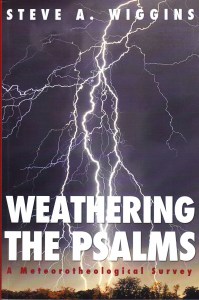
It was at Nashotah House that I wrote Weathering the Psalms. Being a lexically driven book, it was never intended to be a commentary on global warming. It should have been, in retrospect. Already by then we were nearing the point at which, even if greenhouse gas emissions were stopped, runaway melting of the polar ice would continue apace and the weather would grow more and more unpredictable because of human action. Human action of everyone except the industrialists, of course, since they don’t believe in global warming. We cling to our palms and shout “Hallelujah” while the sea level’s rising and our weather grows increasingly erratic. We have a theology with which the weather disagrees.

IMG_2721

The liturgical year is, like its Jewish predecessor, cyclical. Some have suggested that holidays were invented to remind the laity of when it was safe to plant again. Of course, the climate in the “Middle East” is quite different than that of northern Europe and the United States where the Bible seems to have its proper setting. As I was walking yesterday, I enjoyed the daffodils that I always associate with Easter. When I returned home I saw snow in the forecast. Leap year, Daylight Saving Time, and my general level of sleepiness conspired to cause me to overlook that today is the Vernal Equinox. I look for the snow, grasp my palm, and think of spring.


Under the Weather

A friend, knowing my penchant to watch the skies, sent me a story about the British and the weather. The story by Alastair Sooke on the BBC’s cultural page is discussing Alexandra Harris’s book Weatherland. I have to admit that I haven’t read the book (yet) but the report of it appeals to someone who’s written a book on the weather, but for a much older timeframe. According to Harris, according to Sooke, the British are rumored to be obsessed with the weather. While living in the United Kingdom, my wife and I observed this. It is not merely casual conversation when someone discusses the weather. It is a serious topic. For a nation so accustomed to rain and gloomy skies, the weather has a religious import. It rarely goes without comment. I suppose that’s the point I was trying to make in my book. The weather is important. Vital, in fact, to human survival.

What really caught my attention here, however, was Harris’s observation that weather is used to characterize mood. Sooke mentions ice and snow and melancholy. The image is vivid: early Anglo-Saxons turing a wary eye to a winter sky with its low clouds and preternatural chill. It is so universal, it seems, not to require comment. Yet at the same time, weather can be a great trickster. C. S. Lewis once wrote that the image of the Arctic north filled him with an inexplicable joy. Winter can be fickle that way. In the world of the Psalmists, rain was a blessing and a weapon. How you look at it depends, well, on your mood.

DSCN0904

The British may take their weather more seriously, on a day-to-day basis, than those of us across the Atlantic. We tend to treat the topic casually. In reality, it is just as serious here. Drought, which has gripped the western half of the country for about half a century now, is a serious concern. Winter storms, hurricanes, tornadoes. A lightning storm can still be a theophany. (One awoke me in the middle of the night, just hours ago.) Weather impacts our bodies as well as our moods. It is all-pervasive, but we generally don’t like to articulate it. I suspect our understanding of the weather says more about us than we’re willing to admit. Our British colleagues, however, are less squeamish about the topic than we tend to be. There’s more to the sky than it might appear.


Chilling Thoughts

GlaciersI don’t think much about glaciers. At least I didn’t. Now they keep me awake at night. Literally. I just finished Jorge Daniel Taillant’s Glaciers: The Politics of Ice. Never have these ice sheets ever seemed to have so much personality before. I don’t live near glaciers, but I have seen a couple. A number of years ago I visited Glacier National Park in Montana. It was summer and the one glacier that was right by the road (Highway to the Sun) was melting. It was the first glacier that I knowingly saw, and I went my usual way, not thinking any more about them. Taillant’s book, however, indicates why everyone should be concerned about ice sheets. Not only is global warming a reality, our ice caps are melting on what appears to be a runaway timetable and we are not likely able to reverse the process until the damage is done. Not only our ice caps endangered, but our glaciers as well.

Why should anyone care about glaciers? For purely selfish reasons, I might point out that they are crucial to supplying drinking water for much of the world. Looking at the globe, it seems there is plenty of water to go around. Only about 3 percent of all water on the planet is fresh water, however. And of that 3 percent about three quarters of it is locked up in glaciers. Glaciers are the only source of fresh water in dry climates during years of drought or excessive heat. Whatever water isn’t used as these ice giants melt flows into the ocean, becoming part of the salt water majority. When the glaciers are gone, they’re gone. They are part of the fine balance that makes life on earth possible. The politics enter the picture when Taillant reveals that large mining interests, particularly in South America, have been destroying glaciers to get at the gold underneath. They block legislation and provide disinformation, all in the name of wealth. When they destroy glaciers, they destroy future prospects for life in the regions they mine. It’s an issue of social justice.

On our little planet that seems so big, we don’t often stop to consider that we didn’t really show up here by accident. We evolved with the features that our planet gave us—notably water—and we have continued to thrive only in the presence of water. It has often been said that future wars will not be fought over petroleum, but water. We can live without oil. We can’t survive without water. And our industrial action is blithely wasting away the largest reserves of drinkable water on the planet. I don’t live near any glaciers. I’ve only seen one or two in my lifetime, but I now worry for their health. Their future is, in many respects, our future. And that makes me want to pour a glass of water and reflect.


Footprints in the Snow

A friend keenly aware of my interest in the unusual sent me a story about the “Devil’s Footprints” that sometimes occur in snow. The article focuses on an instance in England in 1855 but which was reprised in 2009. The prints, made by a bipedal, cloven-hoofed animal, surmount tall barriers and occur on rooftops as well as on the ground. Such a phenomena is not limited to England. Associated with the Jersey Devil, similar unusual trails were reported during the flap of sightings in the early part of the last century here in New Jersey. As the piece on Mental Floss states, this is most assuredly not diabolical work, but it does make me wonder why people associate the unknown with the Devil.

IMG_2654

As a character in world religions, the Devil can trace his (and, like God, he is almost always a male) origins to the Zoroastrians. Zoroastrian theology is a dualistic outlook: ultimate good versus ultimate evil, Good God versus Bad God. The idea synced particularly well with the burgeoning of apocalyptic thought that hovered in the air during the time that the people of ancient Judah came into contact with Persian thinking. The idea was toned down, of course, to a being with lesser powers than God, but still a real foe with which to contend. By the time of the New Testament, the Devil was ensconced and associated with the Persian accuser known by the title of “the Satan,” or the divine prosecuting attorney. How this character came to be associated with strange footprints in the snow traces an odd trail indeed. The key is the cloven hooves.

No description of the Devil exists in the Bible. The best evidence suggests that the horns, goatish bottom, and cloven hooves come from an association with the Greek demigod Pan. Why Pan was singled out as a particularly bad god is not known. He was popular in ancient Greece. It is certain that the Jews of Jesus’ time would not have recognized a cloven hoofed beast as devilish. The livelihood of too many relied on sheep and goats. Once the transformation took place in the imagination, unexplained cloven footprints appearing in the night suddenly became those of the Devil. As Stacy Conradt points out in her Mental Floss post, several suggestions have been made for creatures of the natural world and their snowy markers. We don’t know what makes the footprints, however, and winter is all the richer for it.


Illusions

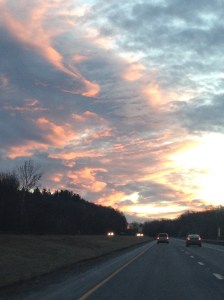
While out driving one winter evening, the sun was setting below a distant horizon that I couldn’t see. Trees lined the sides of the road and, while creating not exactly a tunnel, they blocked the actual view of the orb itself. The day had been partly sunny with cloud forms shifting between layers of the atmosphere. Even though I had studied weather pretty intensely for a number of years, I couldn’t readily identify the cloud types. Thin, smooth lengths of cloud seemed to be suddenly rising up into cumulus banks, heavy with snow. Not far away, the sky was clear. As the sun was going down, these dramatic clouds were lit with the colors of fire: yellows, oranges, and reds. Further to the west, a high, broken bank of clouds glowed a rosy red against a twilight sky. Since the highway we were on was straight, I had a fairly consistent view of the warm tones of the sun highlighting the impressive clouds. My camera couldn’t hope to catch the intensity of the palette revealed to my eyes. When the sun finally fell beyond the range of the clouds, they appeared gray and prosaic against a darkening sky. They had been alight only moments ago, and now they were dull, and not even white.

IMG_2657

What I’d learned of physics reminded me that even these colors were not inherent to the clouds—colors are simply reflections of light rays and the range that we see depends on our eyes. An object’s color, in other words, is a kind of illusion. It’s an illusion we share, and although some people are color-blind, we make the conventions of color part of everyday life. Red means stop, and green mean go, for example. Objective reality is simply the fact that objects reflect different wavelengths of color. Depending on the light source, they appear a specific color to us. While we take colors for granted, they are actually a way of conveying meaning that isn’t entirely real.

Ancient people looking at the colors in the sky could only understand them as caused by the activity of the gods. Bright hues in the clouds suddenly diminished to gray could be the basis for a myth of heavenly conflict. A rainbow, according to Genesis, is a sign that such a conflict is finally over. I don’t know what the gods might have been doing overhead that night, but as the sun disappeared and a full moon rose, throwing soft, but pervasive light from the broken clouds that have only moments before had appeared red, another reality seemed to be taking over. I suspect that we have lost much by no longer watching the sky. My daily work generally involves sitting in a windowless room, and in Midtown the sky is occluded with human attempts to climb to heaven. When I can see the sky for an extended period of time, it seems that the gods are putting on a show, if only we’d watch.


Silent Light

One of the first things I notice during and after a snowstorm is the silence. Part of it, I suspect, is the dampening effect the blanket of snow has on ambient sounds, but another part of it is the lack of usual frenetic human activity. Here in New Jersey it often feels like being in a perpetual motion machine. People are always going some place. Movement is constant and even if I have to head to the airport at 3 a.m. there is other traffic on the road. We are all too busy. Snow has the power to make one stop and reflect.

We live on a fairly busy street since we’re just a couple blocks from the county hospital. Further along our street in the other direction are the county jail and social services offices. People are going by constantly. When yesterday’s snow began, the traffic died down. For once people seemed to take forecasters seriously—driving would be dangerous, and the snow would keep coming well into the night. By mid-afternoon we had more snow in my town that I’d ever seen at a single time during my decade in New Jersey. It was as if winter came in a single day. But it was quiet. Very occasionally a snow plow would rumble by, but most of the day our busy street was deserted. A few kids ventured out, but not many since this was a blizzard (the definition of which is that wind is strong enough to lift snow off the ground and make it airborne again). The silence was almost disorienting. It was like living at Nashotah House once again.

DSCN6193

Silence has long been understood to be a spiritual virtue. Both eastern and western religious traditions recognize the value of listening. The noise may be internal or external, but it is nearly constant. Taking time to try to shut it out, if only for a few minutes a day, can be a spiritual exercise. A snowstorm can help to quiet the constant reminders that we have to do this or that, or that we have to be here or there. During a snowstorm we only have to be where we are, and we only have to do what we’re doing. Soon enough the roads will be cleared and the traffic will begin again. Until it does, however, it is worth exploring what the silence has to offer.


Storm Watch

Nothing encourages sleeping in like a blizzard. Although it’s a talent I’ve largely lost over the years, hearing the bellows of the wind and seeing the white reflecting through the blinds, and being a Saturday morning form the perfect recipe for letting my brain relax enough to fall back asleep after I’ve awoken. It’s a guilty pleasure that I had, quite honestly, nearly forgotten. Unlike several winter storms predicted last year, this one has actually come to pass. Prediction of the future may be one of those “God-of-the-gap” things, but meteorologists are modern-day prophets. In a society driven by work uniformity, days off are unwelcome, so a weekend blizzard might just seem to come from God. The highly anticipated list of school closings simply doesn’t apply. Many businesses still recognize the sanctity of the weekend, and we can just roll over and go back to sleep.

In ancient times the weather was anything but natural. The sky—so large and so far away—was purely the realm of the divine. The only way to impact it from down here was to pray and sacrifice and hope that it would behave. Getting back to that view of the world is nearly impossible here in the twenty-first century. We are so accustomed to natural causation that it is just one of those “butterfly effect” things. In truth, though, we know that human activity also has to share some blame with the butterfly.

Winter storms in January are not uncommon in the northern hemisphere, of course. January hurricanes, however, are. And as political rhetoric heats up and we once again ponder what it would be like to have another clown in the White House, global warming is dismissed as just another bad joke. As a nation we’ve been enamored of those who can provide the most entertaining gaffs and still claim they know enough to lead the nation. I have a hard time believing those who voted for Reagan had any success at separating fiction from fact. I still can’t convince myself that W was legitimately elected. The second term of both of these actors freezes me as much as the chill draft making its way through my apartment. The meteorologists nailed this one with their predictions. I’ll stay inside and huddle under my blankets until the all clear. And that may not be until well after November.

DSCN6166


Think Bigger

PlanetRagesI’ve spent a lot of time with academics. Having been one myself, I know something of their habits. Getting through a doctoral program involves, at least in some fields, becoming the specialist on a very tiny piece of information. Since people have been thinking about things for millennia, finding something new to say can be a challenge. Often, by the time they’re done, newly minted doctors know an incredible amount about a very specialized topic. This is, in many ways, simply an intensification of the human experience. We think small. Part of the problem is that our brains haven’t evolved to think big. Having learned an awful lot about the weather in the book on Psalms, I have instinctively taken an interest in natural disasters. Charles Officer and Jake Page share this interest, as is evident in When the Planet Rages: Natural Disasters, Global Warming, and the Future of the Earth. This, however, is a big idea book. Globally big.

Throughout the first two sections of the book, which deal with humans in the face of nature, God often comes up. As scientist and science writer (respectively) Officer and Page simply reflect common beliefs. Nowhere do they advocate invoking God, but they note that throughout history, in the face of just about any species of natural disaster, people have. Many people still do. Disasters and God. What a team! We worship what we fear. Once Officer and Page reach the third section of human impacts on nature, however, God drops out of the picture and the fingers are pointing solely at us.

When I read about what we’ve already done to this planet, I, as a colleague once said, start seeking another species to join. We have destablized the atmosphere so throughly that it will take at least ten-thousand years to return to it’s pre-Industrial Revolution state. Ten-thousand years. At the same time, the largest industrial pollutor (the United States) has jury-rigged politics so that only the wealthy can attain high office. Votes can be bought and we simply won’t sign the Kyoto Protocol. Those who knowingly doom their children are the smallest thinkers of all. We have changed the course of the biosphere well beyond our share of time, and even those scientist who deny global warming know that it is true. You don’t bite the hand that signs the pay check. After all, specialists have a tendency to be very small thinkers.


Inventing Concepts

A neologism is an invented word. Of course, it is impossible to be certain about the origins of many words, and even the many neologisms attributed to William Shakespeare may have been overheard by the bard at the local pub. Still, one of the things I sometimes dream of is inventing a word that will come into wide circulation. I think it must be easier to do in fiction than in non-fiction writing. When I first wrote my book, Weathering the Psalms, I chose what was, at the time, a neologism for the subtitle. “Meteorotheology” was a word I’d never read or heard before and, quite frankly, I’m not sure how to pronounce. Although the world-wide web existed when the book was written, scholarly resources were still few, and tentative. Amazingly, that has changed very rapidly. Now I’d be at a loss to find most basic information if I were isolated from a wifi hotspot. In any case, the web has revealed that others beat me to it when it comes to meteorotheology.

I suppose that some day, when I have free time, I might go back and see if I can trace the web history of the word. It is used commonly now to refer to God taking out wrath on people through the weather. For example, when the Supreme Court decision on the legality of gay marriage was handed down this summer, there were various websites—more popular than mine!—asking a “meteorotheological” question: when was God going to send a hurricane to punish the United States for its sin? These were, as far as I can tell, all tongue-in-cheek, but there can be no question that some people treat meteorotheology that way. It is a sign of divine wrath. My own use of the word had a wider connotation. When I was invited to present at talk at Rutgers Presbyterian Church in Manhattan a few weekends ago, I was reminded of my line in the book: “To understand the weather is somehow to glimpse the divine.”

That’s an idea I still stand by, but it is difficult to move beyond. What exactly does the weather say about beliefs in the divine? There’s plenty of room for exploring that. I know that when I walk outside to fetch the paper on a clear fall morning when the moon and stars are still out, I know that I’m experiencing a kind of minor theophany. The brilliant blue of a cloudless October sky can transport me to places unlike any other. What exactly it is, I can’t lay a finger on. That’s why I came up with the word meteorotheology. I many not have been the first person to use it. I may even be using it incorrectly. But the weather, in my experience, has many more moods than just anger. Any autumn day is enough to convince me of that.

DSCN6011