Horseshoes and Hand-grenades

When possible, I like to follow up on events I mention on this blog. A few weeks back I mentioned the plight of the horseshoe crab and red knot, the bird species that feeds upon the crab eggs. Hurricane Sandy put the world’s largest nesting area for horseshoe crabs, compromised by human development, in serious danger. Ecological scientists, concerned for the fate of these intertwined species, frantically tried to rebuild eroded beaches so that the Christian crabs could sacrifice their children to the ravenous red knots. (Nature’s ebb and flow, it turns out, doesn’t always favor the unborn.) The good news is, that thanks-at least partially-to the efforts of the environmental engineers, crabs turned out en masse this year, and the red knots, on their transglobal migration, had plenty to eat. It is encouraging to hear that once in a while people impact their environment for good.

Perhaps unwittingly, a member of the American Littoral Society (which I am glad to learn does actually exist) was quoted in the New Jersey Star-Ledger as saying, “There was the potential for a catastrophe after Sandy.” I’m taking his words, intentionally, out of context because of their wisdom. Many people had, on the basis of human losses alone, already declared Hurricane Sandy a catastrophe. This simple quote is perhaps the most honest assessment of the universe it which we find ourselves. From the viewpoint of the not-human, Sandy was a catastrophe averted. The crabs, perhaps unconsciously, did what their biology programmed them to do. The birds feasted, and nature resumed its usual course. Humans weren’t in the center of this picture. We were supporting characters behind the scenes. There had been potential for catastrophe. Nature survived. Thrived, even.

Photo credit Carbon NYC, from WikiMedia

Photo credit Carbon NYC, from WikiMedia

I do not in any way demean the material losses that many people suffered, and continue to suffer, because of the hurricane. Unlike us, however, horseshoe crabs have very limited options. They can’t fly to Las Vegas to propagate, legally or not. They can’t fell timber and build cabins in the woods. They can’t put up an igloo and survive Arctic winters. We the people have endless choices about where to settle. Every environment on the planet, except under water, we have explored, exploited, and populated. We are bound by the very statistics that we are told run this universe, to be in harm’s way once in a while. Human loss of life due to Sandy was not massive. We can rebuild. We do rebuild. The loss of horseshoe crab habitat could have spelled the end of two species of fellow inhabitants on this globe. Catastrophe was avoided. At least from the multiple eyes of the humble horseshoe crab.


Oklahoma

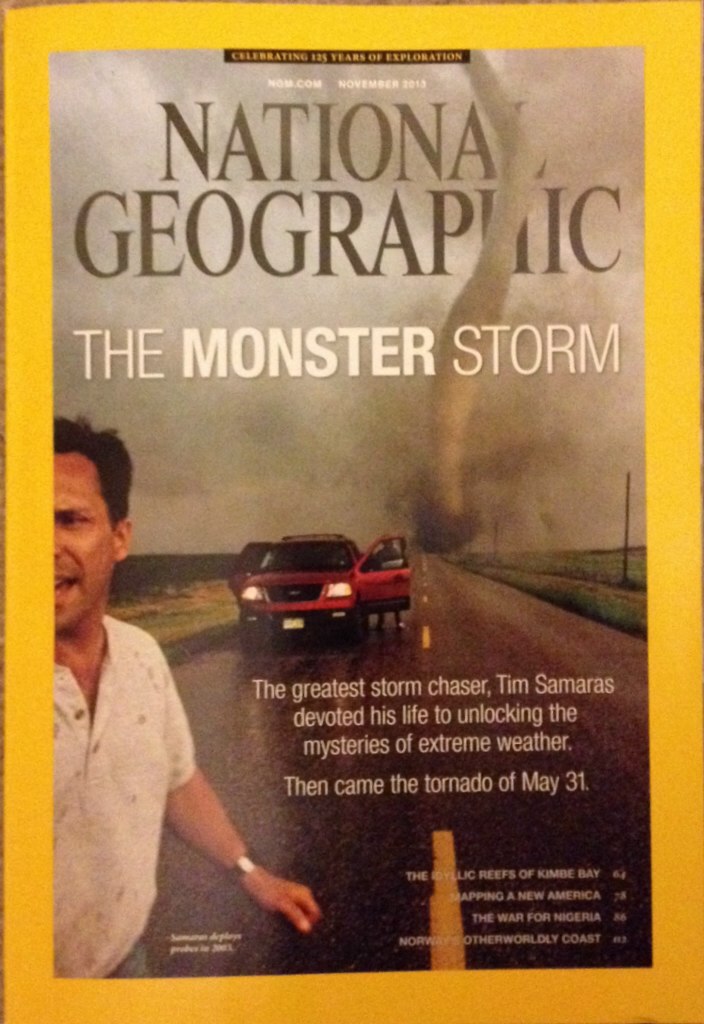
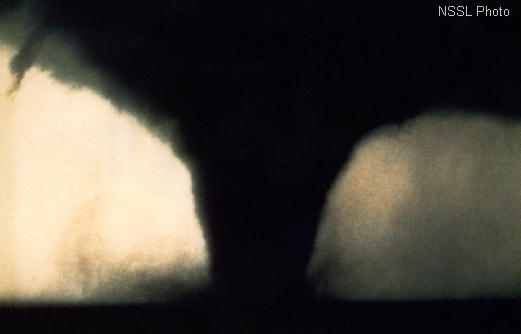
The tragedy outside Oklahoma City transcends petty human differences. Tornadoes, no matter how we dress them up, look like the wrath of God incarnate. The fifteen years I spent in the Midwest were filled with literal nightmares of tornadoes and even a few hours spent cowering in the basement. Such phenomena remind us that we are quite small in the face of nature, and the news reports are full of religious sentiment as people want assurance that God hasn’t abandoned them. Nature doesn’t favor humans over anything else that happens to be in the way of whirling 200 mile-per-hour winds. Even one’s belief might get blown away. Yet it doesn’t.

Although a tornado hit New York City last year, my terror of the storm evaporated when we moved back east. In the Midwest, although there were hills, I felt so exposed under the open expanse of the heavens. In the utterly flat part of central Illinois, I recall some truly awe-inspiring storms. The sky was so ubiquitous and overpowering, and you could see clouds towering thousands of feet over your head, throbbing with constant lightning. It was then I began having the idea for my book on weather terminology and the book of Psalms. Humans helpless in the face of nature. This is the raw material of religion. Like children we pray to God to make it go away. Storms do not obey prayers.

TornadoBlack

By their very nature tornadoes are capricious. We like to believe the good are spared and the evil punished, but as schools are destroyed and children killed we have to face the cruelty of nature. What happened in Oklahoma was a random act of nature, as much as hurricanes Andrew, Katrina, and Sandy were. We can’t help, however, any more than the people of the Bible, supposing that God must somehow be behind the weather. We may influence it, as global warming has repeatedly demonstrated, but seldom for good. And when we look for the divine in the fierce winds, we will end up facing tragedy.


Crab Walking

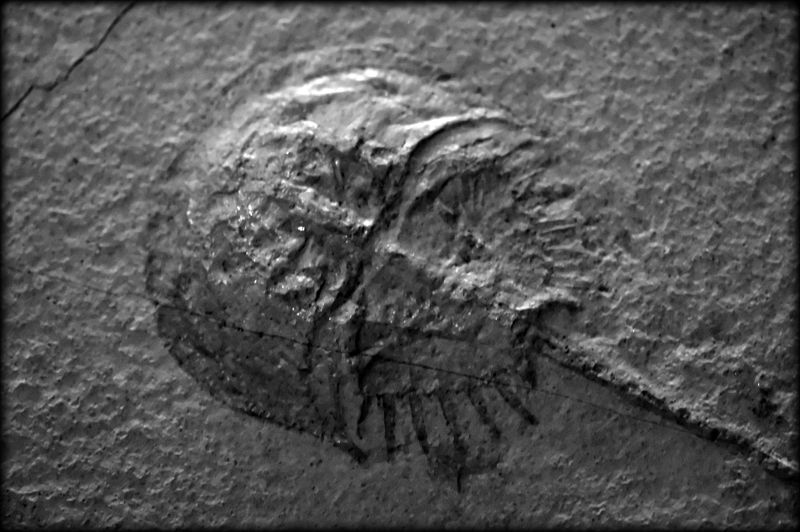
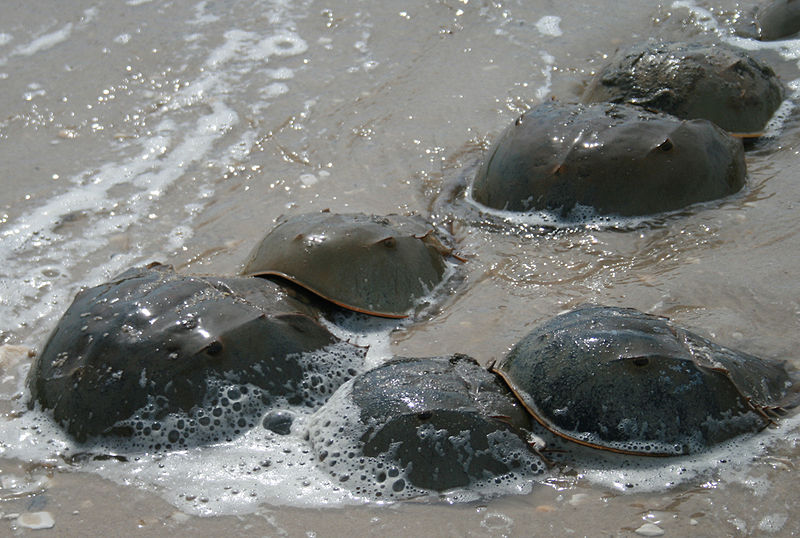
445 million years may seem like a long time. For the horseshoe crab, however, the eons have been spans of years with little change from a rather simple existence that involves lurking under the water and crawling out this time of year to breed. For many of us, Hurricane Sandy is already a somewhat distant memory of days (weeks for some) of no electricity, sitting in the dark, wondering when life would get back to normal. Some parts of the Jersey shore are still suffering from the after-effects, but many of us have had to “just get on with it,” and forget about the damage caused. For the horseshoe crab, however, it is not so easy. For creatures that have survived virtually unchanged for hundreds of millions of years, Sandy dealt a cruel blow. The largest concentration of hermit crabs in the world breeds in Delaware Bay, just down where New Jersey and Delaware nearly come together. Numbers had been declining in recent years as horseshoe crabs were used for bait by fishers, landing them on the “near threatened” scale of the countdown to extinction. Hurricane Sandy eroded the beaches where the crabs breed, and human detritus, left years earlier to protect expensive homes, now provided unsurpassable barriers for most of the crabs. Biologists are at work trying to rebuild the habitat in time.

Not only the time-honored horseshoe crab, but the American subspecies of the Red Knot, a migrating shorebird, has come under threat. The Red Knot, which stops in New Jersey to snack on horseshoe crab eggs on its way to the northern breeding grounds, has been declining in numbers. No crabs, no birds. While the troubles of two species may not seem like cause for concern, the fact that one of those species has been successful since millions of years before the first dinosaur even appeared should give us pause. Dinosaurs showed up some 200 million years after the horseshoe crab had been solidly established on the beaches of the pre-Triassic world. Nature would not be set to wipe out the crabs after a single hurricane, but human obstacles may do what nature would not—endanger a perfectly adapted species so that “valuable” real estate can be protected.

It is tragic when people lose what they’ve worked to attain. It is, however, shortsighted to think that we are the only important species on the planet. We have evolved in a system that includes all the other organisms on our world—our family tree goes beyond that cousin that always embarrasses us to the very crabs that crawl in the silty, brackish water of the Delaware Bay. We’ve all had an impact on each other. Even if you’ve never seen a horseshoe crab, just by reading this post they have come into your life in some way. When we start constructing our grand dreams for a fine life, it seems that we should take into account those who have been here long, long before us. Their requirements are modest, but their place in the cladistic tree of life is just as important as ours. Extinction is forever.

From Wikipedia, by Asturnut

From Wikipedia, by Asturnut


Bing Spring

Binghamton University is, like most institutions of higher education, home to many rituals. Back around a century ago, anthropologists were convinced that religions began as a set of inchoate rituals that coalesced into primitive belief systems. Although most anthropologists today see this as an overly simplistic analysis, I found a recent story on Binghamton’s website an example of a nascent religion. It has to do with placating, or perhaps defying, the weather gods.

Like most good rituals, Stepping on the Coat has a practical pedigree. According to Bing’s own archives, the ritual began the year that I was born. An undergrad that year, overwhelmed by an April snowstorm, removed his coat and stomped on it. The snow stopped. As befits a scientifically inclined institution, this was initially chalked up as coincidence, but the same result occurred again the next year. Stepping on the Coat seemed to be a cure for late season snowstorms. In this year of lazy, lingering winter, many people—some of them not even students—must be seeking a cure for unseasonable weather. Perhaps Binghamton University students a half-century ago stumbled (stamped?) upon the solution. In the whimsical tributes given on the BU magazine webpage, the sacred and the profane are never very far apart.

Binghamton in spring

Binghamton in spring

I have done considerable research on the weather and its sacral implications. Most of my research has never been published, but the overarching idea, I believe, is sound. Our human perceptions of the divine are focused on the sky. Nietzsche declared that God is dead, but that death only really occurred when we penetrated our atmosphere and landed on the moon. Even then, looking up, we saw only blackness beyond. Infinity hangs, like Damocles’ sword, above our heads. We may pollute our skies, we may shut them out with artificial walls and ceilings. We may even punch through them with rockets. But our gods are up there, somewhere. And they are the ones who dictate our weather. The human response is up to us. Do we sit inside and complain, or do we stomp the coat in defiance of an uncaring deity? Binghamton is a green university, so that even amid the burgeoning religion of coat-stepping, there is a real awareness that when the weather goes awry in this industrial era, we know where the blame truly lies. As humans, however, our religious inclinations will insist that we continue to step upon the coat and claim the whole earth as our prize.


Human Show

TrumanshowAt least a decade had passed since I watched The Truman Show. Jim Carrey has gone on to achieve an over-the-top kind of fame, but Truman is a thoughtful movie that raises several troubling questions. It is also one of the films of the 1990s that shamelessly cast an uncaring god (the not so subtly named Christof) against the goofy, but serious Truman Burbank. The movie is old enough not to worry about spoilers, so a quick run-down might refresh other hazy memories. Truman is the star of a show where a massive set that includes an entire island has been built around him. The vision of Christof, an unwanted baby is recorded from birth in an artificial, “perfect” world that revolves around him. Until he begins to notice events that, in the real world, would be paranormal. Objects falling from a clear sky, dead people reappearing, fake sets under construction. Determined to learn the truth, he faces his fear to escape by literally walking through a door in the sky.

Christof is “the creator.” From his base in the sky, he looks down on Truman as his star “son” grows to a Christ-like 30 years of age. He is protected from all harm, yet terrified of anything that might aid his escape from the ante-world he inhabits. When he slips the cameras and begins to make his way across the water, Christof, still not wanting to relinquish the ruse, throws a storm at Truman’s sailboat, striking it repeatedly with lightning. “Hit him again,” he growls to his crew. “Again!” It is difficult to watch as the loving god is angered to the point of destroying his only son. When Truman literally reaches the end of his world, he walks on the water to reach the stairway to heaven. Metaphors are flying thick and fast. Christof breaks in as a voice from the sky to convince Truman that his life will be perfect if he continues to pretend that reality is only what it seems to be. His devoted fans cheer as Truman ascends and walks through that door into another reality.

Many books on the theology of film have appeared over the past decade as it has become clear that people are very much affected by what they see on the screen. Our brains resonate with what we are seeing to such a degree that movies participate in our perceptions of reality. In an increasingly secular world, we have come to distrust our gods. This truth has echoed through many movies in the past several years. Although not living up to the hype, The Clash of the Titans—the remake—had classical heroes disputing the power of the gods. Truman doesn’t go that far. We are never informed about what life after the delusion is like. The hole in the sky is black. We know that on the other side, our world, there will be terrible disappointments and tremendous sadness. It may be that there will be no gods at all on this side of the studio. Although showing its age a little, The Truman Show still speaks volumes about the religious experience.


Flood Warning

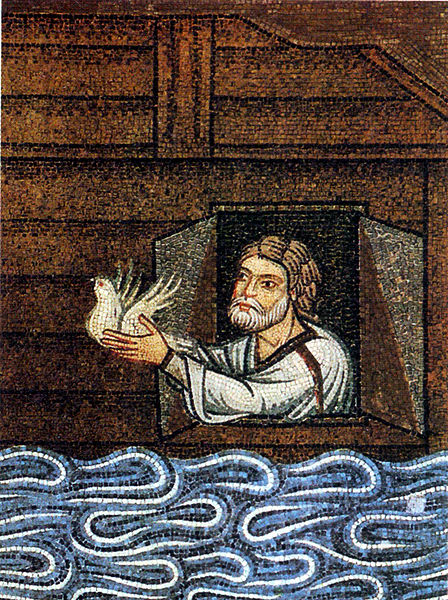
If you’re like any number of others in North America, you may be wondering when spring will arrive. Not meteorological spring—that has flown past already—but the warm, salubrious air that bears no wind chill factor. You might, like many, turn to the Weather Channel website. While you’re there you might see a story about extreme weather and Noah’s Flood. (You might need to scroll down the page to find it; the link seems to have been cursed.) The flood myth is a pervasive story. It appears in countless novels, movies (even Titanic and The Poseidon Adventure, for those who are willing to believe), and many baby’s nurseries. The weather this year has many wondering about global warming, although, honestly, we’ve known about it for years. Some are speculating that floods will become more common, and that’s almost certain. The Weather Channel, however, uses the myth to point out that people have experienced extreme weather from “the beginning.”

The trouble with this reasoning is that the story of Noah’s flood is not original to the Bible. It seems virtually certain that the writers of the biblical stories (there are two) knew the Babylonian version embedded in the tale of Gilgamesh. The writer of the Gilgamesh Epic knew the Sumerian version of the story, already centuries old by that point. And the story never really happened. At least not in historical time. Floods, yes. World-wide flood, no. The stories were told to make points, as most stories are. The point here seems to be that gods can be pretty petty if you neglect to offer them their due. Even minor sins can set you treading water for weeks at a time. Still, the Weather Channel considers the possibility that this could reveal ancient meteorology. Ancient morality is closer to the truth.

Every year around Easter the media peppers its workaday headlines with biblical tropes. It is the time to catch the quasi-religious thinking pious thoughts and click-throughs are more likely. Never mind that biblical scholars have known for many decades that this fetching tale is based more on a primitive Schadenfreude than modern science. Not that the Bible is devoid of ancient weather. I once wrote an ill-fated book about the topic. The people of ancient times knew that God has a special place in his sacred heart for the weather. It is one of the most awesome demonstrations of divine power. So it is in the story of Noah. For those of us in the twenty-first century it may still be a morality tale. This time, however, the flood is caused by human greed and lack of control. And this, when all is measured in the scales, may be among the worst sins humanity has ever committed.

Martin,_John_-_The_Deluge_-_1834


A Weird Resurrection

Driving through an unfamiliar city doesn’t allow for much time to appreciate what you’re seeing. Back in February when I was visiting Austin, Texas for the first time, it was 65 degrees outside. Given the irascible temperatures in New Jersey this year, that felt like summer. Of course, the locals were bundled up since it was, for Texans, unseasonably cool. The weather has been off this year. Of course, we know who to blame. Cthulhu. As I was trying to find the University of Texas with an impatient GPS as my co-pilot, I spied someone walking down the street wearing a Cthulhu ski mask. I can’t express how badly I wanted to pull aside and snap a photo, but pulling aside in a strange city can lead to unwanted adventures. Especially when your co-pilot is an opinionated GPS. I’ve been to north Philly and the south side of Chicago. I didn’t want to take any chances that Austin might hide such districts.

Cthulhu mask

H. P. Lovecraft, like most original thinkers before the computer age, was ignored in his lifetime. I wonder what he would have felt if he had divined that the internet would one day bring him world-wide fame. His writings, of course, had been appreciated before the computer was invented, but the web has nearly as much Cthulhu as it does LOL Cats. Even those who’ve never spent a dark night curled up with the Necronomicon recognize Cthulhu’s octopoid visage when they see it. Davy Jones of the Pirates of the Caribbean fame borrowed his unforgettable face from the Old Gods discovered by Lovecraft. Cthulhu has become a cultural icon of the chaotic, the cosmic, and the somewhat comic.

In a strange way Cthulhu stands for resurrection. In Lovecraft’s mythological world Cthulhu lies under the sea, dead but dreaming. A dying and rising god of utter terror. Lovecraft, an atheist, built his fiction nevertheless around a series of gods. Today his stories are noted for their moody portrayal of improbable worlds, and his storytelling has had an incredible influence on many of those who attempt to generate worlds that are fantastic but somehow still believable. Cthulhu’s resurrection, however, is not to be desired. Even if these he represents life anew, it is a life humans could not bear. In a deeper sense yet it is Lovecraft himself who has experienced a kind of resurrection. A writer forgotten in his lifetime, but rediscovered when it was too late for him to realize just what he’d created, the true master of Cthulhu, I like to believe, lies dead but dreaming, and he has already revealed that he will rise and the masses will tremble.


Blob Blog

Those who actually know something about movies occasionally complain that Hollywood seems to provide us with diminishing returns. How many movies have been remade? Can anyone even count all the sequels, prequels, and just plan quels? A similar trend is evident in publishing. A teen-vampire novel takes off and every publisher faces a twilight of the profits if it doesn’t spin off its own version. Sometimes I end up becoming familiar with a movie through its remake before ever viewing the original. The Blob is one example of this. I’ve seen the thirty-year remake 1988 version a few times. Just this weekend I saw the original 1958 version for the first time. It seems to me that teen movies of the late fifties and early sixties tried a little too hard to get the snappy, sassing dialogue of teens on the brink of the incredible cultural changes that were about to take effect after the extreme conservatism of the McCarthy Era. At times it is so hip that I can hardly stand it.

The_Blob_posterThe Blob falls into that category. A young Steve McQueen trades ripostes with his chums who think a drag race and a Bela Lugosi movie with your gal are pretty daring behaviors. Buried in all that innocence, however, I found a hidden warning tone. When I watch scary movies, I always keep an eye out for religious themes. Sometimes they fail to materialize. The Blob is about as secular as they come. I didn’t even spot a church or a priest (unlike the 1988 remake) in the typical American town. Just a bunch of kids that, Archie-like, try to convince the adults that they’re serious. A blob from space really is loose in town, and nobody has an idea how to stop it. All the adult men wear ties and the ladies all wear dresses. It is a world that follows the rules.

What of this warning tone I mentioned? Well, the blob itself is, apart from its disruptive raison-d’être, hardly more threatening than the stifling culture it attacks. It can’t be shot or burned, and nobody has any other ideas. It is unstoppable. Except for cold. And here’s the chilling part. As the carbon-dioxide drenched blob is airlifted to the Arctic by the military, Lieutenant Dave declares the world safe once more. Steve (Andrews, i.e., McQueen) chimes in with, “Yeah, as long as the Arctic stays cold.” The film ends with a trademark horror question-mark (this one literal) as the blob is parachuted onto a snow-covered landscape. Global warming was a future monster in 1958. The optimistic world could see nowhere but forward. Now, over 50 years later, our future looks a lot less cold. With politicians and some religious leaders decrying global warming as just another liberal myth, we might do well to remember The Blob. Something up there on our melting ice caps is waiting for us to return to the 1950s to begin its sequel of terror.


Implausible Deniability

Sandy gave us a little taste of dampness under the gunnel. You see, people live by the water because it beckons to us. That was actually Rachel Carson’s idea, but nevertheless, we do find ourselves drawn to the sea around us. Historically our great cities grew in the littoral because communication across the big water was, prior to jet travel and trans-oceanic cables, the best way to stay in touch. Have a business meeting in London, but live in New York? No problem. We can get you there in two-to-three weeks. And the ship sets sail. Since that day we’ve become more electronic. Those of us who experienced Sandy near New York City know that one of the biggest problems was that salt water and electrified trains don’t mix. Of course, conservative lobbies have insisted that Congress and the White House keep their eyes firmly shut about the possibility that a more unstoppable flood is coming. We may not need an ark, but we’re going to have to take some steps back.

A story on the Weather Channel shows the “smoking gun” of global warming. Oh wait, that’s just a myth. Industrialists tell us so. But what a devastating myth! The Gulf Stream waters of yore have kept the climate mild in northern latitudes. While in Scotland we spent a wonderful weekend with some friends on the Island of Arran in the Hebrides. Palm trees growing in Scotland? Yes! The warm Gulf Stream means that much of the British Isles remains relatively temperate despite their latitude. The Gulf Stream, due to climate change, is slowing. In less than a century, climatologists now predict, the oceans will rise three feet. Looks like I’ll need to wear my gaiters to work. We’ve known for about half of my life that we’ve been changing our environment. And not for the better. Those who are too wealthy stand to lose a little so we do what we can to protect them, the poor dears. The rest of us had better learn to swim.

We don’t worry when the people of some Indonesian island point out that their entire world may submerge. Put a little ocean water in the subway and, well, that’s an entirely other story. How are the peons to get to work? Let them wear hip-boots. Word from the top one percent is that there is no global warming. If the Gulf Stream is slowing down it’s because it’s lazy. What a moocher! Suppose it will be wanting a health plan next. That’s the problem with the weather—it changes like, uh, the weather. Unlike the minds of some people that are already made up and never change, no matter what the facts. When the one-percenters start speaking, I’m glad I’m wearing my hip-boots after all.

Where can I get me one of those?

Where can I get me one of those?


Umbrella Apocalypse

Broken ribs and twisted, tortured limbs hanging useless under a leaden sky. It was a scene of carnage. I knew the world was supposed to end yesterday, but I didn’t believe I would experience it, but the evidence was indisputable. It was the apocalypse. For umbrellas. Winter storm Draco had melted by the time he reached the East Coast. I awoke to the apartment shuddering in the wind, and I could hear the rain pelting the windows. I had one more day to go to work before two things: the end of the year and the end of the world. And I would be relying on New Jersey Transit. The very thought makes me want to cower in the closet. My bus stop has no shelter—it’s just an exposed street corner, not far enough away to justify a drive. I stood in the rain, faithful umbrella held like a shield in the blast of Draco’s breath. The bus, of course, was nearly half an hour late. I stumbled up the stairs, glasses dripping, and decided that today, only today, I would take the subway across Manhattan. After all, the world was ending.

The lines from the Port Authority to the bowels of the subway are like those old documentaries of massive lemming migrations off a cliff. My turn. The card reader said “Card Already Expired.” Metrocards don’t expire; you charge them up and recharge them when they’re empty. I still had money on my account, but with other lemmings close behind, and rush-hour grade lines at the recharging machines, I decided to fight the dragon on the streets. It was with a certain Cervantesque tilting at the wind that I made my way across West 41st Street, umbrella forced into a tiny cone by Manhattan’s famous wind tunnels. Twice I was blown off the curb. Then at 5th Avenue the wind defied both the laws of physics and the agreed conventions of meteorology and slammed me from north and south simultaneously, my umbrella bucking in my hands like a terrified stallion. It sustained two broken ribs, metal twisted in opposite directions, flesh flapping uselessly. By the time I reached Grand Central, it couldn’t close, so I dumped my companion into a garbage can with other umbrellas and went on alone.

When I got to the office I discovered my hat was missing. While it would be more dramatic to say that a stocking cap blew right off my head, the truth is that it must’ve fallen out of my coat pocket. I was wet, buffeted, and without two items with which I began the day. The sky was still black as I looked out on the scene of the final battle from The Avengers movie. It had been an apocalypse all right, for the umbrellas. Chicago may be the Windy City, but New York is the Umbrella Killer. When I made it home as early as 6 p.m., I knew the world had ended for certain. I read the Cajun Night Before Christmas and went to bed, thinking of all those poor, dismembered umbrellas. Today is the day after the end of the world, and I am huddled here waiting for the dawn.

Don Quixote rides out of Manhattan yesterday with Sancho Panza wondering at his denuded umbrella.

Don Quixote rides out of Manhattan yesterday with Sancho Panza wondering at his denuded umbrella.


Blame it on the Rain

I’ve been on the losing side of my share of elections (although it feels like far more than my share), but I’m amazed at the character of the GOP that has come through these last few days. The quote that keeps running through my mind comes from The Dark Knight when the Joker says to the Chechen that if they cut him up and fed him to his hounds, “then we’ll see how loyal a hungry dog really is.” Blame has been flying thick and fast, but one thing I don’t hear any Tea Partiers suggesting is that Hurricane Sandy was sent by God to seal the election for Obama. Hurricane Katrina may have been sent by God to wipe out the sinners in New Orleans, but when Sandy gave a chance for Obama to show his true colors, it was just a freak storm. I’ve never been a fan of Chris Christie, New Jersey’s bully governor. During Hurricane Sandy and its aftermath, however, I was very impressed how he handled the situation. He showed a rare side full of compassion for those who were suffering. He vowed to help President Obama make things right again. When the storm of the election was over, however, Christie’s own party verbally crucified him for doing the right thing. Does this not show us just what white privilege spawns?

Turning back the clock is an exercise best left for post-apocalyptic scenarios of rebuilding society and the occasional spring or fall weekend. As our world makes progress—and yes, it is slowly making it—we must constantly reassess the situation. The ethics of the 1950s favored white men, the mores were blithely uninformed that an entire world exists outside this strange isolationism that could only be broken when Communists threatened our way of life. We are over half-a-century beyond that: the Berlin Wall has fallen, the Cuban missiles are gone, and those seeking to move to America are by and large the tired, the poor, and those yearning to breathe free. Not all of them are “white.” Not all of them are male. They are, like the rest of us, human beings.

I have never wished want or deprivation on anyone. I know what moderate want feel like (I lost an entire day of my college education searching for three dollars that fell out of my pocket, wondering how I would make it through the week without it). I have spent several years of my life tip-toeing around unemployment, and sometimes falling into that crevasse for a year or two at a time. Each time I claw my way out I earnestly wish that no one would ever have to face that. A political party that puts such a strong emphasis on giving up all the good we’ve managed to obtain, and cries about health care that doesn’t even approach the humane, universal care available in just about every other “first world” nation, is a party in need of serious, prolonged soul-searching. On this day when we honor veterans who, despite personal differences, stood side-by-side for the good of their country, perhaps those attacking their own might in days of privilege spend a few moments in serious thought.

Blame it on the rain…


Gitche Gumee

Up on the rugged western shore of Lake Superior the lamp atop Split Rock Lighthouse will be illuminated for the only time this year tonight. Immensities and superlatives fail at some sites, and as the cold waves lap eternally at the shore, this is one of them. Split Rock illumines its beacon in commemoration of the sinking of the Edmund Fitzgerald on the far end of that great lake on this date many years ago. While not as large as the Titanic, the Edmund Fitzgerald outstretched two football fields and carried more than fifty million pounds of cargo, immeasurables we are forced to recalibrate into yardage and tonnage. When the Fitzgerald sank during an unnamed November storm in 1975 only twenty-nine people died, but the tragedy soon became part of American legend. The image of immensities battling for the souls of twenty-nine human lives possesses an eerie, epic quality. When faced with the raw rage of nature, we are helpless indeed.

Shipwrecks may be the ultimate metaphor, for like ships we are consciousness in a protective vessel. Of course some deny that a soul exists, but in November it is difficult to doubt. A century ago the Titanic sank, and we still wonder in fascination. Human life is fragile when confronting the north Atlantic, or Lake Superior, or even the great waves that wash ashore and sweep some away. Great bodies of water, some psychologists say, represent forces larger than ourselves in the human psyche. Some suggest the ocean in dreams represents sex, but others would say it’s God. In the realm of metaphor anything is possible. It is no accident that many Christian sects begin the rite of membership with total immersion in water. When the Fitzgerald was baptized, twenty-nine men died.

Standing on the vast shoreline of a gray Lake Superior has a way of making you feel insignificant. Enormity was easily related to divinity in the primitive mind, but standing next to something truly vast still sends me into a protective crouch as I ponder just how little I really am. In this year of destructive storms, as we’ve taken to naming the winter squalls that whip across the continent with noble names such as Athena and Brutus, we are still at the mercy of something unspeakably large. The weather is the ocean above us, and it bears children named Andrew, Irene, Katrina, and Sandy. Each reminds us that we are constantly at the mercy of something far larger than human comprehension. Every year as the tenth of November rolls around I think of the Edmund Fitzgerald and the overwhelming forces that surround us. There is indeed a metaphor hidden here, for those willing to plunge into the frigid depths to find it.


New Prometheus

Nothing portends the wrath of the Almighty like an unseasonal storm. The late season Hurricane Sandy, now dubbed the Frankenstorm because of its potential hookup with two wintery systems making their way east and south, is poised to make an apocalyptic scenario on the east coast, we’re told. Well, it is 2012, the year of apocalypses, after all. In an interesting shift, however, this storm is named after not a divine character, but Frankenstein’s monster, the human-made nightmare. I first read Mary Wollstonecraft’s Frankenstein back in high school, and I was immediately subdued. The story, undoubtedly frightening when first heard, is unremittingly sad. The “monster,” like all of us, finds himself in a cold and lonely world where he is rejected because he is different. It is cruel and Republican kind of world. All the monster seeks is companionship, acceptance. I found the story so sad that I’ve had trouble reading it ever since.

The naming of a storm after a terror created by humanity may be prescient, in a regrettable way. Only the most gullible (read “greedy”) believe that industrialization had nothing to do with it. We toasted our own planet for a buck or two. In biblical terms we have sowed the wind, for which there is only one kind of produce. Hurricanes are quite natural, and although the irregular weather of 2012 may prove simply a meteorological anomaly, it may be the result of our tinkering with the baubles of divinity. They certainly seem to be getting bigger than they used to be.

I have to admit to having a persistent fear of those doing the cobbling. Too often their motivation appears to be flat and green and indigestible. And nothing like stockpiling it makes a person somehow less human. Mary Wollstonecraft wrote Frankenstein not for money, but for love of words. The modern chimeras we construct are mere carnival side-shows by comparison. And like Victor Frankenstein we have engineered beyond our capability to understand. Our best option may be to stand silently and wonder at the forces that hold us enthralled. For in the novel, at least, the real monster is not the cadaver stitched together underneath the sheet.


Pipe Dreams

While I was off in Indiana, Jesus was coming down in New Jersey. Well, at least a graven image was. My wife saved the front page of Thursday’s New Jersey Star-Ledger that had a front-page, above the fold headline, “Workers give Jesus a much-needed lift.” The caption notes that in a gusty storm on Tuesday the 200-300 pound Jesus (this is America, after all) tumbled off his pedestal at Saint John’s School in Orange. A crane hoisting the fallen Lord dominates the first page. Clearly a bit of irony on a slow news day, the social commentary is thick indeed. Despite Magritte’s assertion, we still say the painting is a pipe. The representation is the object. This is the native logic behind the “idols” of old—to capture an image is to somehow to encompass some of the essence. This is precisely why the Hebrew Bible forbids images to be made.

I realize that “essence” is a disputed concept these days. Some scientists have declared that no such thing exists, along with souls, deities, and free will. Nevertheless, most mornings I wake up aware that I am me and not you, that my physical body is relatively near where I last remember it being, and that it faces the same hopes and limitations it did the day before and before and before. Perhaps this continuity is an illusion, but I can’t afford to treat it as such. It’s hard for an identity-less person to hold down a job. As usual, it is money that comes back to define us.

We recognize that it is disrespectful to mistreat representations of what we hold sacred. Does Jesus suffer any real harm for his image laid out on the ground? The nuance necessary to separate likeness from reality is something we obviously possess, but as we deal with the physical world the distinction frequently fades. Religion may have lost much of its explanatory value for the material world we inhabit, but images of a fallen savior demonstrate that we still operate otherwise. Much of our religious life concerns appearances. And for many people that step between appearances and reality is a very small step indeed.


Whirling Spirits

A photograph and video of a “fire tornado” in Australia have been lighting up the web the last few days. Well, technically there is no such thing as a fire tornado, although that term serves perfectly well as a colloquial expression for the phenomenon. Having spent several years studying vortices for a project on weather language in the Bible, I came to know tornados particularly intimately. Dust devils, caused by surface heating, look and act like tornados, but a true tornado is cloud-based. The fire tornado is probably better termed a “fire whirl” or a “fire devil”—an expression that has a particularly ominous tone. Such vortices occur in wildfires in other parts of the world as well, and they are, obviously, very dangerous. When my wife pointed out the comments on this site (which also has a photograph and a link to the video), however, the implications for a blog on religion became clear.

One of the points I made in my weather work was that severe weather is almost always attributed to God. The comments on boingboing affirm that the concept retains its currency. Now, reading comments on most websites reveals just how juvenile the web readership generally is. On many sites the comments are so annoying that even Spongebob Squarepants would seem an intellectual heavyweight by comparison with the writers. Nevertheless on boingboing, by comment seven God had been brought into the conversation. In this instance, reference was aptly made to the movie The Ten Commandments, with others chiming in that nature here far outdid Cecil B. DeMille’s efforts at a realistic fire devil to represent God. The comments then move on to the guiding of the Israelites by a pillar of fire in the wilderness. Intermingled with the biblical references are meteorological comments attempting to classify the whirl a bit more precisely.

When something out of the ordinary occurs, our default seems to be God. This in no way discounts the scientific discussion for what is really going on. The religion and science comments simply talk past one another—they have the same referent, but entirely different levels of engagement with it. Although not the scientific names, “devils” and “tornados” represent different, if visually similar, phenomena. Vortices seem natural on a round planet that follows a round orbit while rotating swiftly on its axis, and yet they remain comparatively rare. The name “dust devil” probably goes back to indigenous traditions associating the whirls with ghosts or spirits. For Christians encountering these concepts, heathen gods were devils (as is evident in the name Devil’s Lake, Wisconsin, named “Spirit Lake” by the Native Americans. The same applies to Devil’s Lake, North Dakota, but I haven’t been there.) It seems to me that these vortices neatly summarize religious sensibilities: an awe-inspiring event is one culture’s deity, another culture’s devil, and a third culture’s natural phenomenon empirically explained.

A real tornado