Laugh Out

Is it safe to discuss this now, or are people going to laugh at me?  That’s the feeling that has attended any talk of UFOs until recent days.  Ironically, if the Ancient Astronaut people are right, we may’ve been visited from elsewhere ever since we’ve called this planet home.  In any case, now that UAPs are out of the bag, some are beginning to discuss how they might impact religion.  (Yes, “impact” can be a verb.)  Thus I came across a story titled “If UFOs are real, how would they impact our faith?” on Times NewsKingsport Times News, based in Tennessee, ran this as an opinion piece.  While not deeply probing, it did raise the question of how all the recent UFO news affects people’s religious outlooks.
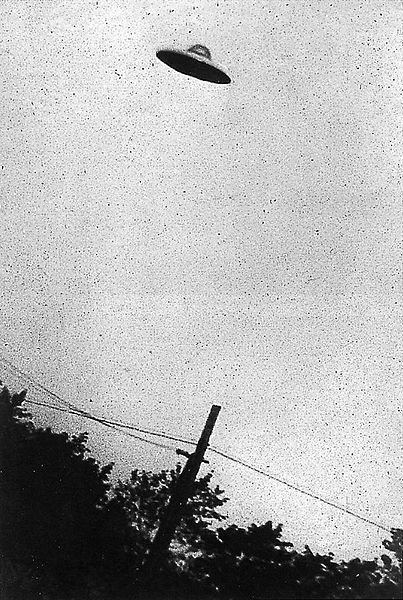
Image credit: George Stock, via Wikimedia Commons

As a country we’re both deeply religious and in denial about the fact that we’re deeply religious.  I’m convinced that this is behind the political woes we face: the educated have become more secular and religious literalism is considered laughable.  Yet it’s clearly there.  Ironically, UFOs were considered laughable until the US Navy admitted that they were real and had no idea what was going on.  Laughing at something we don’t understand is hardly ever a step towards enlightenment.  So the article concludes that even if aliens are here, things will be fine if we continue to go to church as normal.  Any extra-terrestrial visitors change nothing.  Strangely, one of my earliest memories is of attending a rural church service one evening where the program was on flying saucers and Christianity.  This was entirely in earnest, and nobody in the congregation was laughing.

Others interested in the topic have discussed religion and UFOs over the years, but perhaps the answer is yet another of those unknowns.  Religion is a remarkably adaptive phenomenon.  Scientists suggest it’s hardwired into our brains, even as those same brains give us evidence that some of those beliefs are misplaced.  What we can’t do is stop thinking about it.  As I watch politics continue to tear this country apart, I realize it’s not really politics we’re talking about after all.  It’s religion.  Meanwhile people are learning that the government has been keeping secrets about what’s up there in the heavens.  There are elected and appointed officials who’ve gone on the record saying they believe UFOs are demonic.  While that hardly seems like a scientific approach to something truly unknown, it is a religious one.  Only those who laugh rather than listen will find this news at all. 


Independently

I’m feeling independent today, even if it’s only just temporary.  For the first time in four years it feels like I’m living in the United States again on our national holiday.  I’m actually spending this holiday weekend moving a family member.  That means drama—almost by definition.  It began two days before.  U-Haul sent us a text telling us our truck would be in the wrong city, over an hour away.  We called to correct the mistake and were told the truck would only be available five hours later than scheduled in the city where we actually were.  We had no choice but to accept.  The next day the saga continued.  We’d hired a local company to help us find a home for furniture no longer needed.  They arrived late, but there was a reason—the owner of the company had had a family tragedy that day and had to scramble to find help for the job.  They did a good job, though.  I’d use them again.

The day of the move our hired help called.  They were going to be late.  We went to U-Haul only to discover that their automated check-in software wasn’t working.  We had to stand in line for over an hour total before someone figured out they had to override the instructions so we could pick up the truck.  In the middle of this, the movers called again to tell us they still weren’t even in the state.  They were pre-paid a very pretty penny to help move the big items (we are small people, and I have a bad back; we need burly friends), but they would be several hours late.  We couldn’t put the smaller items on the truck when the big stuff was the unknown quantity, space-wise.  Hire-a-Helper, the company we’d used, sent a text saying our two hours were up and they were going to be billing a significant fee for extra hours.  The help had not yet arrived.

They turned up seven hours late.  We had arranged for help to unload on the other end, supposing that we wouldn’t have suddenly grown stronger or bigger in the intervening day.  Today, however, is our travel day—the one day we weren’t relying on others to do their job.  Our independence day, as it were.  We don’t need any fireworks.  Indeed, we hope for none.  All the careful planning collapsed under unforeseen circumstances.  But today we have the truck with the cool Colorado NASA image on the side and the open road. It’s quite cheering, actually. I’m always in the market for burley friends, but today it feels good to be independent.


Byte Fragility

A few weeks back—context is always important—I mentioned how a storage drive slipped off my sleek laptop and went insane.  That is to say, it stopped working.  Unfortunately at the time it was the only backup method I was using.  And since my laptop forced me to move a huge amount of data so that it could do its regular updates, all my vegan eggs were in one basket.  (I feel like a bit player in this drama sometimes—it’s really the tech people who are in charge.)  There were literally years’ and years’ worth of data on that slipped disc.  Since then I’ve purchased two back-up drives and I’m backing up onto older discs and drives that are still readable.  It cost more than I care to confess to recover most of the data.  Some of it is gone forever.

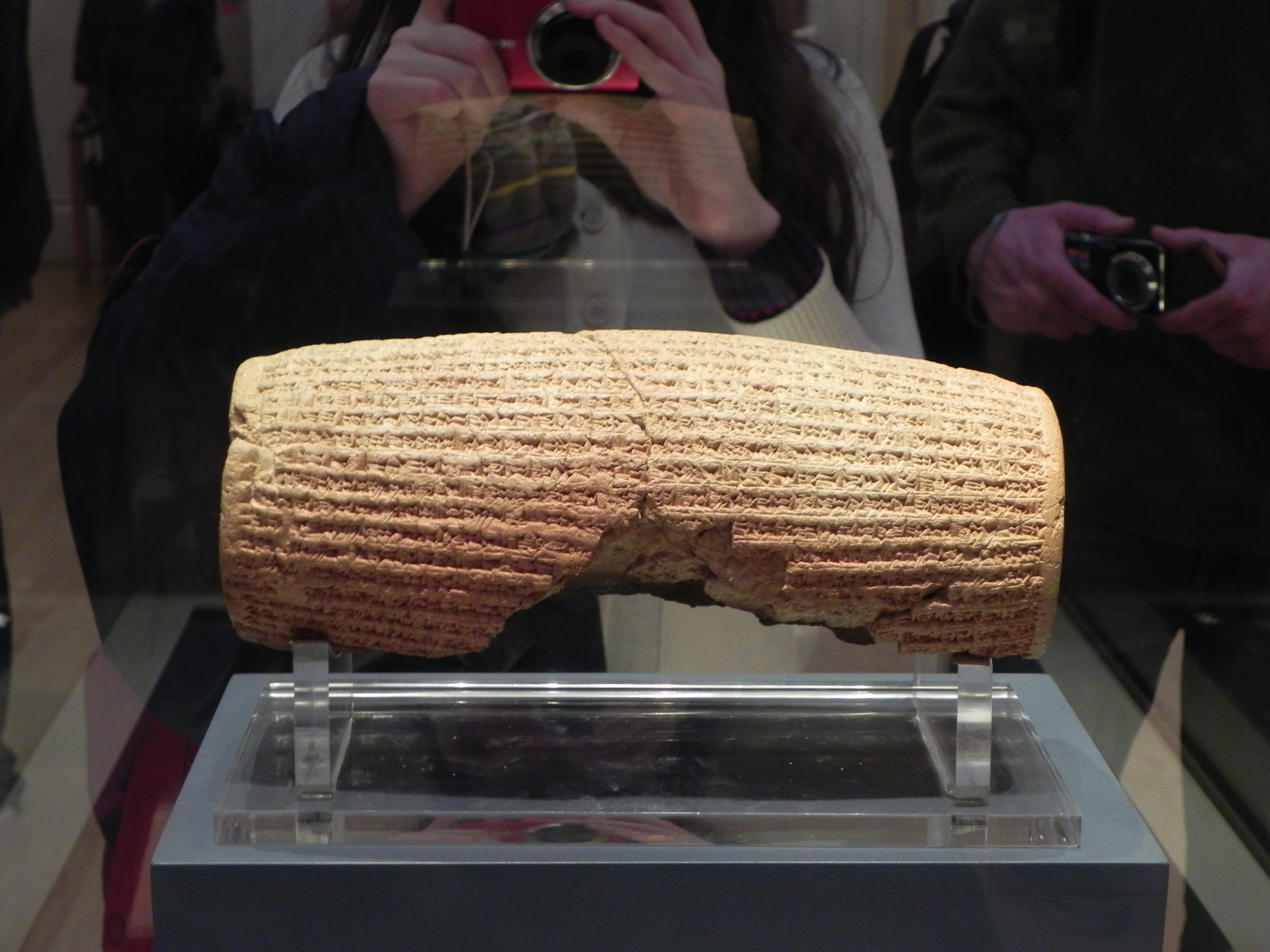
Although I can’t go into all the details here, the data recovery company I used—shout out to Tri-State Data Recovery—was able to recover about 99 percent of the information.  They were kind enough to suggest very solid-looking data backup systems so that a slipped disc could never happen again.  This all sent me back to my roots as an ancient West Asia scholar.  Scribes whose data still exists 4000 years later, simply got clay for free from the river.  The first writing material was the best.  I’ve quadruple backed up my recovered files now.  I’ve mourned some of the missing.  Still, I realize that if anything goes wrong I haven’t the technical skill to recover my ideas.  Or my photos.  They’re mere electrons.

I want to save trees.  I try to print only what’s necessary, but incidents like this reinforce my love of print.  Paper has its problems too.  Three years ago, when we moved into this house, torrential rains destroyed a couple hundred books in the garage waiting to be brought into the house.  Data were destroyed.  Granted, a flood can destroy clay tablets too.  In fact, if nature sets her mind to destruction there’s pretty much nothing we can do.  Just ask the dinosaurs.  Still, it disturbs me that all our data are so terribly fragile.  I write things down to be creative, but also because I can’t remember everything I want to.  If a drive falls off a slippery laptop not only does it make a sound, it also puts a dent in your bank account.  Down at the river bank, however, there’s clay free for the taking.


The Future of Consciousness

Consciousness is unexplained.  We’re born and we become aware.  Raised by parents or guardians, we learn where we belong.  The decisions of one generation affect the futures of the next, often without conscious consideration.  I’ve been thinking about how, with our limited resources, we’ve pressed on, reproducing beyond what our environment can sustain and each of us is born conscious.  Some of us—many, in fact—in difficult circumstances.  Instead of working together to figure this out, we keep on, not quite sure of what we’re doing or where we’re going.  Heath Ledger’s Joker may’ve been speaking for all of humanity when he asked, “Do I look like a guy with a plan?”  Do any of us?

During a discussion the other day the topic of the severe western drought came up.  There have been general drought conditions in the western half of the country (the northwestern coast has been spared) for well over half-a-century.  I wonder why the cities in such regions continue to expand and then I realize that each generation is a kind of reboot.  We tend to think we belong where we’re born.  My thoughts turn toward the ancestors of the first nations and how they knew that moving was necessary for life.  When the ice sheets start descending you really don’t have many options.  Perhaps our sense of place is an evolved trait, brought on by the changed circumstances of invaders’ senses of ownership.  Capitalism certainly doesn’t help.  Those born in drought-ravaged areas soon come to think of it as normal.  We can adjust to just about anything.

Settled existence is necessary for a life that defines meaning by ownership.  For me, I have a difficult time imagining my life without my books.  What we read tends to define us.  What would I do if the ice sheets began descending again?  Such change takes time, of course, but our complex society doesn’t seem to be very good at advanced planning.  My consciousness tells me where I belong geographically, psychologically, and even religiously.  I was taught such things as a child and even if I unlearn lessons that were wrong, I will always still feel that they were right.  If I flee the coming ice sheet I simply have to accept that my reality has changed.  Until that ice sheet’s at my back door, however, I can continue to deny it’s a problem.  Consciousness is a funny thing.


Is It Thursday?

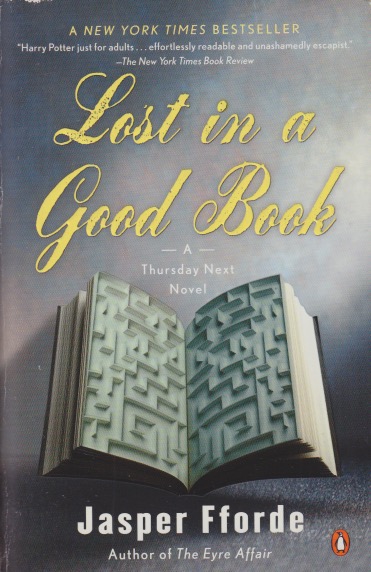
Jasper Fforde is an author I discovered because of a friend’s recommendation.  One of the more literate of fiction writers, he is clever and funny, but also difficult to find in many bookstores.  (Believe it or not, some of us prefer to shop in actual bookstores.)  I tend to pick his books up when I find them, whether used or new, and wait until I have time to indulge in a good book.  Well, I seldom have time to indulge, so I decided to go ahead and read Lost in a Good Book.  Now, this involves some mental gymnastics on my part.  Part of Fforde’s Thursday Next series, this is actually the second book after The Eyre Affair—not his first book that I read, but the first of this series I had.

I tend to find used copies of Fforde in certain used bookstores, and so my collection has grown through the years.  I’ve read four of the first seven novels in this series, but in this order: one, seven, six, and two.  Each is understandable on its own, but it occurs to me after finishing the second in the series that things might make better sense if read in order.  The good news is that the next one I have to find should fall in order after this one. Unless it’s one of the others.  That’s the nature of finding things in secondhand stores.  It’s not that I object to buying books new—do you even know me at all?—but that I have some authors that I can find in used stores from time to time and I read them when I do.  Fforde is one of them.

How I find the books probably impacts how I engage with them.  Perhaps because they’re funny I don’t consider the implications too seriously if things don’t always make sense.  I can see myself, if I ever get more time, coming back to the series.  Then I’ll do so in order.  The real pity is that I don’t have time to read all the books by authors I enjoy.  Nor all the money.  Libraries in small towns tend to have collections that reflect local tastes, and besides, I like to come back to my books at my own time, without having to wait for inter-library loan and somebody else finishing it up before I can get ahold of it.  All of which is to say I enjoyed Lost in a Good Book very much.  Thursday Next is a compelling character, and it’s always a pleasure to read an author who, like you, clearly reads a lot of classics.


Heavens below!

Sometimes I miss Ancient West Asian/Near Eastern studies.  I spent a good number of years in that academic field and now that I’m out of it my work is starting to get noticed.  Horror, it seems, helps make sense of things.  In any case, I recently saw a piece on the Agade listserv about the ancient Greek afterlife.  In it Patricia Claus ponders how although the Greeks had Hades in charge of “Hell” (which wasn’t really Hell), there is no god in charge of Elysium, or paradise.  I hadn’t really thought of that before.  Heaven in the sky is originally a Zoroastrian idea, and even then it was really on a very high mountain.  Christianity made it the home of its one God and the place where the faithful end up.

Elysium was where blessed Greeks spent eternity.  Nobody seems to have been in charge.  Would gods have interfered with paradise?  This was a new idea.  Gods, in the ancient imagination, made the rules because they were more powerful than us.  Human social and ethical norms projected on high.  Would humans in paradise act any differently if there were no gods to police them?  Perhaps the most disturbing thing about some strict Christians is that they say if God hadn’t prohibited things we’d all be doing nasty stuff to each other all the time.  I often wonder if that says something about their psychological makeup.  Whether there’s a God or not I wouldn’t want to hurt anyone else.  I think those with a high moral standard might keep those with a low one (e.g. Republicans) in check.

The afterlife has perhaps disproportionately affected how we think.  Life is decidedly not fair.  There are plenty of selfish people who prosper, especially with a capitalistic system.  Many good people suffer and, I suspect, Heaven is a consolation to them for making through a world set against them.  They’re already good, do they need a God to keep them that way?  Some strains of Christianity decided people were innately wicked.  Again, I have to wonder what this says about the Augustines and Calvins and others who could see no good in what they believed God created and declared “very good.”  Their punishing God offers the consolation prize of a Heaven for those who put up with all the strictures imposed by that very deity.  The Greeks, it seems, had a very different idea of the blessed fields.  The heavenly hall-pass was not required.

Carlos Schwabe, Elysian Fields, via Wikimedia Commons

Plants Saving Planet

Dot mx is not a normal extension for me to see.  Sometimes being north of the border can skew your view.  Then someone pointed Desserto out to me.  This is the kind of thing that benefits from sharing (see that share button below?  Why not click it?).  Desserto produces leather made of cactus.  Not only is industrial cattle raising the most polluting industry in the United States, it also involves great cruelty.  Cactus leather, however, is renewable, requires no irrigation, and actually decreases the carbon in the atmosphere.  A typical north of Tijuana attitude is that such a brilliant idea should occur here.  The fact is, those who live in the desert may well be the voices crying in the wilderness.

Photo by Ashim D’Silva on Unsplash

Desserto doesn’t make leather items.  They produce the leather and sell it to manufacturers of durable goods.  I would kick my shoes off right now and buy a pair made from cactus leather.  For years I’ve been trying to find something to replace the leather that seems to be the only option.  Faux leather made of plastic isn’t environmentally friendly.  It seems that the best we can do is find something that will do the trick without the pollution both of cattle raising and of tanning.  To me this idea seems absolutely brilliant.  There are otherwise unarable deserts aplenty.  There are limited lands in the drought-ridden west where huge cattle lots create fear, terror, and tremendous waste.  If ever there was a case for putting two and two together, I’d say this is four.

I’m delighted to see this happening in Mexico.  I don’t have much skill in the manufacturing department, but I would be happy to purchase items from those who do.  Too often we look at land that doesn’t fit our paradigms for “good land” and assume there’s no use for it.  Perhaps we should start encouraging cacti and allow American Indians to have some of their former land back.  Everybody wins, except maybe big agra.  Large corporations may qualify as persons under the law (which to me is only asking for trouble for all people except those on the top of the false humans, legally recognized).  Their interests are more equal that the interests of the rest of us.  It’s easier to degrade the environment than it is to change.  Still, looking at a really good idea that could save the planet and provide something useful seems, to me, like an idea worthy of sharing.


Highgate Cemetery Again

Vampires can distort your thinking.  For example, whenever I hear of Highgate Cemetery in London, my mind immediately goes to the Highgate Vampire.  (There was somewhat of a comment kerfuffle on that topic right here on this blog some years back that resulted in several comments being removed.)  Highgate is the amazing final resting place of a remarkable number of famous people.  Still, when I visited a few years back I couldn’t get the vampire out of my mind.  (A friend of mine lives a short walk from the cemetery and that made the visit possible.)  This all came rushing back when I saw a book on Highgate Cemetery up for review on Reading Religion.  (And hey, Nightmares with the Bible has been available there for free, for any interested takers!)

Given my current vocation, writing actual book reviews is considered conflict of interest.  More’s the pity, since that’s how I often managed to get ahold of expensive books back in the day.  I’m pretty sure the book advertised (edited by Marie-Therese Mader, Alberto Saviello, and Baldassare Scolari) has nothing to do with the vampire, but I can think of it no other way.  Highgate is an architectural marvel for a necropolis.  It is spooky, inspiring, and impressive.  When something happens in a place, even if the facts are in dispute, it takes on an atmosphere that reflects such happenings.  At least that’s the way it feels for Highgate.  I’d heard about the vampire incident before visiting, but didn’t have the details.  Besides, you’re only permitted in on guided tours and the docents don’t point out such things.

Nevertheless, having been there I still have an interest in the cemetery itself.  It’s odd in a way.  Nobody I know personally is buried there.  No ancestors, as far as I know.  It’s the sense of place.  I’ve written about this many times before—there are numinous spaces in the world.  Science may deny it, but even scientists feel it.  Some places transport you somewhere beyond just the physical dimensions of where your body happens to be at the moment.  Cemeteries are filled with the memories of lives past.  They remind us that our time is limited, and that we too will cross that numinous threshold some day.  We all contribute.  Well, I can’t review the Highgate book and I can’t afford to buy it.  I nevertheless suspect that there’s nothing about the vampire in it.  I’m sure it’s my thinking that has been distorted by vampires.


Caring for the Future

Some people have it really bad.  Living in war-torn countries, many former academics find themselves scrounging for a living.  In the United States academics tend to have it good—at least those who get jobs do.  In my line of work it’s not unusual to hear them complaining of overwork, or of various aspects of academic life that are a strain.  I know that can be true—I’ve been there.  However, a recent story about Adnan Al Mohamad on iNews, tells how the Syrian professor had to flee and become a waiter and farm helper in Turkey.  Until CARA found out.  CARA is a British charity—Council for At-Risk Academics.  They were able to secure Al Mohamad a university post so that he could achieve his potential.

Of course, academia isn’t perfect, as my many colleagues who’ve succeeded in it can tell you.  But it is good for the world.  Those of us taught to think deeply about a subject often feel what might be called a moral obligation to pass it on.  Interestingly, in the “developed world” academic positions are on the decline and education is seen as an expensive option instead of the way forward.  I may have been sidelined, but I’ve been watching this happen for decades now.  Instead of organizations like CARA (many academics are at risk) those encouraged to go on by their teachers and colleagues end up disappearing in obscurity with crippling bills to pay for many years down the road.  There are no safety nets and western society has decided education is a luxury rather than the path to a better future.

Somewhere along the line, as progress became equated with electronic gadgetry, we lost the desire to think deeply.  Books are “products” that can be thrown onto a plastic screen and soon forgotten after read.  We can gossip 24/7 through social media and never spend hours delving deep into a subject.  We can move the economy ahead without stopping to think about the consequences.  The world needs organizations like CARA.  Better yet, governments should take on that role.  Politics for some (most, of a particular party) is a means of enriching oneself rather than bettering the society that allows them to do so.  Wouldn’t it be better for everyone if education were the number one priority?  Isn’t that what a rational society would do?  Creating a world in which those who’ve personally invested in continuous learning could share it?  Instead, we live in a world where academics increasingly require rescue.


Witchfinder, Generally

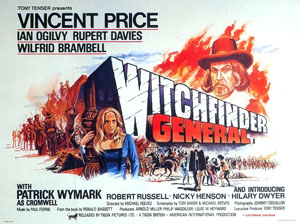
In Holy Horror I describe the “unholy trinity” of movies that figure strongly Christian themes: Rosemary’s Baby, The Exorcist, and The Omen.  These movies span 1968 through 1976 and all were extremely successful.  Another writer earlier dubbed another three horror films from the same era the “unholy trinity” (I didn’t realize I was being trite) of folk horror: Witchfinder General, The Blood on Satan’s Claw, and The Wicker Man.  These three were low budget and not particularly successful at the box office.  They’ve all become cult classics, however.  I suppose that together these six films help mark the late sixties and early seventies as the beginning of a new realm of horror films.  Folk horror continued to exist but wasn’t terribly common.  It has recently been given a high profile by The Witch and Midsommar.

Of all of these films Witchfinder General stands out as the least obviously marked by horror tropes.  It’s set as a fictionalized account of the historical Matthew Hopkins, a man actually responsible for about a fifth of all British witch executions in the seventeenth century.  There’s nothing really supernatural in the film and its horror reputation is attributed to the cruel tortures depicted—these really pushed the envelope in 1968.  Not only was Rosemary’s Baby released that same year but so was Night of the Living Dead, another defining horror film.  The sixties were a chaotic time—the birth pangs of a new outlook that is still being resisted by many politicians.  We all know about the music of the era, but the cinematic impact was also immense, as these six films show.

As different as they are, these two trinities all feature horror that is fueled by religion.  Although this had been pointed out earlier in the century, people were now being made aware that, apart from the good religion does, it also brings potential evil into the world.  There’s no question that misguided over-protectiveness of Christianity led to many, many innocent deaths.  The more cynical might note that the Christianity being “protected” is actually key to an economic system that benefits the rich—that supports the interests of the wealthy.  The historical Matthew Hopkins was the son of a clergyman.  Apart from his reprehensible role in rekindling the witch trials in England, not much is known of his life apart from his preoccupation will executing “witches.”  As time has gone on, we’ve unfortunately circled back toward the religious conflicts in the folk horror trinity.  Watching horror may yield some valuable lessons.  


Scary States

You can usually tell, if you look close, when I’m on the trail of a new project.  This blog ranges fairly widely at times, but when lots of posts concentrate in a single area it’s likely something much larger is going on behind the scenes.  I’ve been writing quite a bit about horror lately.  Quite apart from the Republican Party, scary things are on my mind often.  I recently came across an article on KillTheCableBill that made me feel less weird.  It’s a story covering a survey showing the favorite horror movie per state.  Now, I won’t be able to fit all fifty into my usual daily word limit (wouldn’t want to arouse the word count police), so I’ll just add a few words about some of the interesting connections I noticed.  As in my books, if you see something, say something, right?

It’s kind of embarrassing that I haven’t seen the movie most often mentioned: The Devil’s Backbone.  I have to admit falling behind on my Guillermo del Toro movies.  I was surprised at the number of states’ favorites that I hadn’t seen.  I’ve been thinking about this quite a bit lately: if you have a full-time job which doesn’t include movie watching, it can be pretty difficult to make the time.  A number of classics don’t show up on the list, while some states have somewhat obvious favorites: Massachusetts’ Jaws, Colorado’s The Shining (it was filmed there), New Mexico’s Alien (think about it), and Maine’s The Lighthouse all fit into state self image in some way.  Horror preferences, in other words, may reflect who we are.  

A number of states, more conservative ones mostly, favor older films.  The Abominable Dr. Phibes, Pennsylvania’s favorite, I haven’t seen.  Like most aspects of my home state it’s a mix of things.  It comes from the early seventies, just as modern horror was getting started, but not too far into it.  Studies like this end up giving me homework.  When I can find the time I have a lot of viewing to do to catch up with my fellow Americans. I was surprised that The Exorcist isn’t on anybody’s list of favorites, not even Washington, DC’s.  It may be that films that are too real are too scary for many people.  Another finding, as noted in the article, is that the southeast states like horror the least.  I can’t help but wonder if things would be better, politically, if more people there watched horror and pondered the implications.  


News Shipping

There’s no question that the pandemic has disrupted shipping.  It didn’t help that Trump basically tried to shut down the entire postal system so he could try to steal the election (which he instead tried to take by force on Epiphany), but shipping services still haven’t quite recovered.  I can’t help but wonder if it’s all the “middlemen” who’ve gotten involved.  I still buy things from the internet and if they’re not coming from Amazon they give you tracking numbers, sometimes for companies I’ve never heard of.  No matter whether it’s UPS or OSM, it always comes to the same message when you type in that tracking number that’s just shy of pi in length.  The package is awaiting USPS pickup.  I can’t tell you how many times that’s happened in the past several months.

Limbo is an old religious concept that seems to have been revived.  Your package simply can’t be found.  You can try the Post Office, but since they haven’t picked it up yet they can’t tell where it is.  Or you can call the company involved.  They’ll tell you the Post Office has it.  So you go stirring the alphabet soup of shipping company names while your parcel’s MIA.  I wonder if what these other companies do is go to the loading dock of the seller, get the package, then drop it off at the PO on their way home.  That sounds like the business to get into.  Why say you’re a shipping company when you’re just going to let the beleaguered Post Office handle it?  Because someone will pay you to do it, obviously.

We recently had a package that took three weeks from its drop-ship to UPS to get to the Post Office and finally here.  I stopped into the local PO and asked about this strange partnership.  The woman at the counter told me, “It’s the slowest way to ship, that’s why companies use it.”  Slowest, and therefore least expensive.  Never mind what they charged you for the shipping and handling.  Handling will cost you, you know!  Meanwhile I’m thinking maybe I should start calling myself by my initials and hire out my services to drop things in the local mailbox.  As a corporation I’d have greater protection by law than I would as a guy in his own car.  And besides, if I ordered something myself I’d be able to pick it up directly without having to wait for the tracking number to catch up.


Screening the Dark

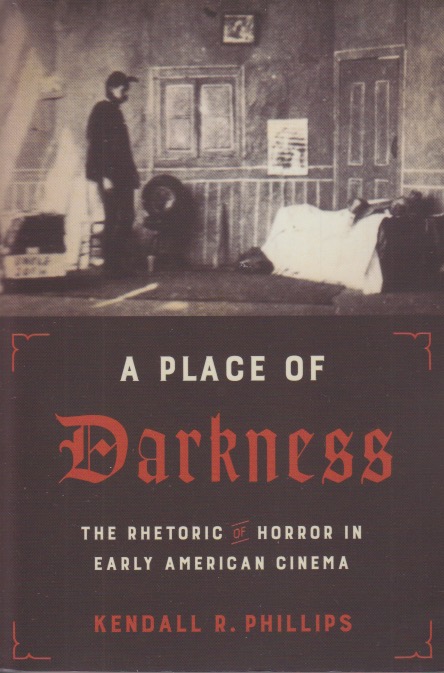
We’re spoiled.  The intensity of our media experiences makes it nearly impossible to imagine the truth of stories that viewers fainted at films such as Frankenstein even less than a century ago.  This change in outlook, this sense of being over-stimulated, occurred to me while reading Kendall R. Phillips’ excellent A Place of Darkness.  In keeping with the subtitle (The Rhetoric of Horror in Early American Cinema) Phillips primarily addresses pre-Dracula films, beginning in 1896 and demonstrates how horror themes emerged early and evolved along with society’s norms.  There is so much insight here that it’s difficult to know where to begin.  For me one of the big takeaways was how Americans at this stage were eager to appear non-superstitious and how they used that concern to keep the supernatural out of early ghost films.

Phillips isn’t afraid to address the role of religion in horror.  Other cultural historians note this as well, but many pass over it quickly, as if it’s an embarrassment.  Since my own humble books in the field of horror are based on the religious aspects of such movies, I’m always glad to find specialists who are willing to discuss that angle.  As America grew more and more enamored of the idea of rationalism, less and less energy was put into suggesting that anything supernatural might be at work.  Supernatural was considered foreign and cinema followed society’s lead.  This led to—and I want to add that this isn’t Phillips’ terminology—the Scooby-Doo Effect where every seeming monster had to be revealed as a hoax.  As a kid I watched Scooby-Doo in the vain hope that the mystery might turn out to be real.

Studies of horror films generally acknowledge that the first real member of that genre is Tod Browning’s Dracula of 1931.  Phillips demonstrates the valuable pre-history to that and does an excellent job of explaining why Dracula was such a singular movie.  Horror elements had been around from the beginning, but Browning’s film made no excuses—the vampire is real.  Audiences were shocked and thrilled by this and other studios didn’t quite know whether they should follow Universal’s Depression-Era success or not.  Mostly they decided not to.  The Universal monsters seem innocent enough today, but we go to theaters where the floors shake when heavy footsteps fall and the sound of a door creaking open comes from behind us.  Special effects make the horror seem real.  No excuse is made for religion and its monsters.  We’re spoiled. 


More Conjuring

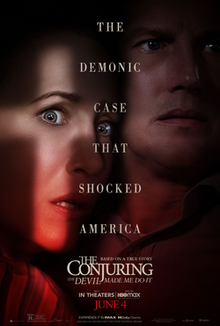
It was an almost surreal experience.  First of all, it’s been well over a year since I’ve been in a movie theater.  Secondly, I’ve never been to this particular theater before.  And in the third place, I’m absolutely alone in here.  I didn’t rent the theater out or anything, but I’ve been wanting to see The Conjuring: The Devil Made Me Do It since June 4.  Actually, since September when it’s initial release was delayed due to the pandemic.  Everyone else around here must’ve seen it already.   I knew the story of Arne Johnson and the Warrens, having found and read Gerald Brittle’s book, The Devil in Connecticut.  Loosely based on that event, this story focuses on the actual fact that this was the first time not guilty by reason of demonic possession was proffered in a US courtroom.  The story is a strange one and the movie, as movies do, makes it even stranger.

I’ve been anticipating The Conjuring: The Devil Made Me Do It, despite the title, for a few years now.  If you’re familiar with Nightmares with the Bible you’ll know that an entire chapter is devoted to The Conjuring franchise.  You may also know that it is the most lucrative horror series of all time, apart from Godzilla in its many, many iterations.  One of the points in Nightmares was to try to make sense of the demonic world presented in the Conjuring universe.  The franchise, for the most part, deals with actual case files from Ed and Lorraine Warren.  Some of the episodes are pure fiction, however, and the explanations given in the films are all, well, conjured for the big screen.  The movies call attention to the Warrens’ work, but in a way that requires an entire chapter to untangle.

My initial impression is that this isn’t the best movie in the series.  I can’t replicate my previous work here, and I’ve only seen the movie once, so there are details I certainly missed.  The demon isn’t named this time.  Indeed, the backstory proposed is drawn from the spin-off film Annabelle.  A fictional satanic group called Disciples of the Ram is posited as causing the trouble.  Like the demon behind Annabelle, they’ve placed a curse on the Glatzel family for some unknown reason.  During the opening exorcism Arne, in an Exorcist move, asks the demon to take him instead of the young David, the brother of his girlfriend.  The movie leaves the Warrens to find out who put the curse on the Glatzels in the first place, and break it.  With some time for pondering I’ll likely come back to this movie again.  I do have to say that the book was probably scarier, although sitting in a theater alone to watch a horror movie is not something I hope to make a habit of doing.


Ever-Changing Skies

The weather is something we like to think is trivial.  We’ve got more important things to do than worry about it.  Yet even our most important ways of dealing with life’s issues have to take the humble weather into account.  The fact that I was awoken by a thunderstorm at around 1:30, and, given my schedule, thus began my day, perhaps has something to do with it.  And perhaps so does a conversation I overheard on a trip to Ithaca.  Now, upstate New York isn’t known for its cooperative weather.  In fact, the alma mater of Binghamton University includes the phrase “ever-changing skies.”  I was in a public place and a conversation was being had between two men who were strangers to me.  My ears perked up when I realized they were discussing higher education.

This should surprise none of my regular readers.  Higher education has been the stand-offish lover in my life.  In any case, as one guy was explaining to the other, he worked at Cornell University—one of the Ivy League schools—and he opined that the reason it had trouble recruiting faculty was, well, the weather.  Now, I’m one to sometimes take weather personally.  (I’m still wondering what the point of last night’s thunderstorm was.  Anything that wakes me after midnight essentially personally ends my night’s sleep.)  In any case, being one of those under-employed academics I had to think about this.  I’d be glad for a university post—would I turn one down because of the weather?  Is meteorological preference really that strong?  Especially since in polite conversation the weather is considered the shallowest of topics.

Weather is vitally important.  Perhaps because of its ubiquity we tend to overlook it.  Think about rain on a wedding day.  Or a moving day.  In the latter case it can be more than inconvenient.  Sports events can be cancelled due to weather (baseball is especially prone to this).  Extreme weather (which is becoming more common) can shut everything down.  Is is just me, or does every thunderstorm now come with a “severe” warning attached?  Weather is more than just inconvenient; our lives depend upon it.  Thoughts not unrelated to these were in my mind as I wrote Weathering the Psalms.  I’ve only ever lived in rainy climates.  I realize many others aren’t nearly so lucky.  The drought in our western states is troubling.  Perhaps higher education might be able to rise above it?  Or will the most educated turn down jobs because of the inconvenience of ever-changing skies?