Potboilers

“Potboiler” is used in publishing to describe a book written merely to keep a writer going.  Full-time authors are comparatively rare, and many occasionally resort to churning out books simply to generate income.  I have no doubt that most of them start out as most artists do—creative, and looking for a career that allows them to be so.  If you want to earn money, to keep your pot boiling, you need to follow the formula.  Those are my thoughts on having finished the last book for this year’s Modern Mrs. Darcy’s Reading Challenge.  One of the categories was three books by the same author and I had three unread Dark Shadows books by Marilyn Ross.  Barnabas, Quentin and the Frightened Bride, number 22 in the series, was clearly a potboiler.

As I’ve confessed before, these books are guilty pleasure reads for me.  My literary tastes have changed over the years, however, and such journeyman writing sometimes betrays itself.  Even if a book has vampires and werewolves.  Dark Shadows was a melodramatic soap opera of my youth.  Still, it was moody and gothic—something these books manage to convey, even if the stories don’t live up to their promise.  Some of the plot elements in this particular installment don’t even line up, and having read Jane Eyre I’d guessed the ending shortly after the beginning.  I often wonder how the book series might have turned out with a truly literary attempt to tell the story.  Writing takes time.  Good writing takes a lot of time.  But even writers have to eat.

I’m not a Dark Shadows connoisseur.  I haven’t bought the original television series on DVD and I haven’t watched it since I was about ten.  Early memories, however, are formative.  With a remarriage, a death in the family, and a move, childhood got swept away rather swiftly, and along with it, watching Dark Shadows.  The series ended in 1971 after over 1200 episodes had been filmed.  Ross’ serialization began during the six-year run of the series, and, I suspect, he had to keep up a hectic pace.  Books 13 through 24 were all published in 1970, a rate of over a book a month.  I’ve suggested before that academics ought to take pop culture seriously.  Even before this era of fandom becoming mainstream, Dark Shadows spun off a small media empire and it continues to retain public interest.  The daily show struggled, despite being partially modeled on Jane Eyre, until the supernatural was introduced.  Although the Ross novels may not always show it, the hunger remains for supernatural explanations.


Quantum Religion

Quantum mechanics shows deep connections based on empirical evidence.  This is Einstein’s famous “spooky action at a distance.”  Particles that split apart from one another seem to be in communication as they track on trajectories away from one another at incredible speeds.  It’s almost as if there’s will involved.  Maybe there is.  If intention is part of the natural world, we’re in trouble.  Well, at least stark materialism is.  You can’t measure will.  We all know what it is because we feel it.  Try to define it.  Isn’t will a matter of what you want?  What could a particle possibly want?  If it’s small it can’t hurt us, right?  But once it crosses a certain level, it no longer works.  Science trembles at quantum mechanics being applied at the non-microscopic level.

Ironically science is wedded to an idea proposed by a medieval cleric.  Early scientists were often clergy—an association most scientists would prefer to forget these days.  William of Ockham (fourteenth century) proposed an idea that became the surefooted stance of science in its toddler phase.  Simply reduced it goes like this: the single natural explanation, without relying on outside forces, is probably the best.  It’s known as Ockham’s Razor (aka Occam’s Razor).   Yet Ockham was a Franciscan Friar, a cleric.  His thinking and reasoning were necessarily informed by ecclesiastical thought.  Or, not to put too fine a point on it, theology.  His razor avoided entanglements.  Ironically, science refers to this quantum connection as entanglement.

Humans, it seems, have a tendency toward contrariness.  We’re oppositional.  When we’re told that quantum mechanics applies only to the very small, we wonder if maybe the same principles don’t work “up here” at our scale.  It’s hard to conceive that even our scale is simply a matter of perspective.  Since we’re uncomfortable with the idea we suggest that only our species is conscious.  That way we can keep the will out of animals as well as subatomic particles, let alone larger scale entities such as planets, galaxies, and universes.  Maybe entanglement suggests Ockham’s Razor is dull.  Before getting out the philosophical strop, perhaps we should ask if the simplest explanation is really the best after all.  Maybe the best answer is far more complex than we’d like to admit.  I love science.  I still, when I have time, read science books written for the laity.  It’s just that science, like religion, is part of a larger picture.  As much as we fear entanglement, it is an empirically observed part of life in our universe.


Gratefully

I confess.  I read acknowledgements.  Part of it is the vanity of finding someone’s name I know.  Or the worse vanity of finding my own name.  Acknowledgements, however, reveal quite a lot about the book you’re about to read, or have just read.  Not all books have them, of course.  Most academic books do.  A recurring theme occurs in the acknowledgements I read: privilege.  Many academics are feted and pampered and their institutions pour money on their desks.  Often they show a nonchalance about it all.  ‘Tweren’t nothin’.  What seems to be missing to me is the struggle.  Anything worth having, in the experience of many, is something for which sacrifice was required.  Hard work, long hours, and nobody pouring money on your desk.

Privilege breeds a strange kind of entitlement.  Many academics complain of how difficult they’ve got it.  (The stories I could tell!)  Now, I haven’t walked in their loafers so I can’t say if the personal circumstances of others are trying or not.  My own experience at Nashotah House—how good I had it!—wasn’t exactly pristine.  Conflicts between dean and faculty.  Required chapel twice a day whether you needed it or not.  Your every move watched for any indication of heresy or disloyalty (that’s not limited to the Oval Office).  And yet, those days were much better than I realized at the time.  Once in a while you have to crawl up next to Job on his ash heap to get an idea of what you simply couldn’t see before.

Acknowledgements are often like mini biographies.  You try to make sure you don’t leave out anyone that helped you along the way.  Books, particularly academic books, are the product of many people, not just the author.  Sure, the author’s the star of the show, but if the support staff wasn’t there, you wouldn’t be reading this right now.  Book making is incredibly complex, which is why self-publishing, while sometimes necessary, often shows in the end results.  Editors come in many flavors: acquisitions editors, copyeditors, line editors, production editors, and more.  Sometimes there’s overlap between positions, but even books that barely get read have plenty of sets of eyes upon them before they come to the public.  Acknowledgments don’t always name everyone.  In fact, they simply can’t.  It takes a village to publish a book.  Instead of feeling entitled,   I find acknowledgements always instill a sense of humility.  It’s an honor to be part of bringing a book to birth, even if your contribution is hidden away in unread pages.


Missing Markers

Something truly remarkable happened this week.  The Society of Biblical Literature, which, along with the American Academy of Religion, meets annually in November, has canceled its in-person meeting.  I’ve been attending this conference since 1991 (with a few years off for good behavior).  It always meets the weekend before Thanksgiving, stretching to the Tuesday prior.  Some academics use the meeting to have an exotic Thanksgiving break with their families, particularly when it congregates someplace warm.  (It was scheduled for Boston this year.)  So I’m ruminating what this will mean for a year of missing markers.  Some of you may recall I missed two years ago, electing to stay in Newark Airport instead, but this is different.  We’re all being changed by this virus.

Missing markers.  That’s what my wife calls it.  March 12 was the day that Covid-19 became a crisis.  In my extended family that’s in the middle of birthday season.  Travel plans had to be altered.  Trips to see loved ones had to be delayed.  Then cancelled.  Memorial Day came and went.  It was a long weekend, but for most of us it was a long weekend at home.  Our usual summer trip to the lake was also a victim.  A remote lake may be the safest place to be, but you have to get there.  Flying doesn’t seem safe and we don’t have enough vacation days to drive all the way out and back.  Here we are halfway through the summer and each day feels pretty much like the one before, even if it’s a day off work.  Time seems out of whack.  Back in April it was hard to believe it was still 2020, now it’s difficult to comprehend that the year’s more than half over and there will be no AAR/SBL in November.

Growing tired of the phrase “unprecedented times,” I prefer “missing markers.”  Yes, the weather’s still doing its time-keeping job.  This summer has been quite hot around here, for the most part.  I remember shivering in my study sometime not so long ago, bundled up in layers and thinking that when summer rolled around this coronavirus would be a bad memory.  If only there were something governments could do to keep people safe.  If only there were people in the White House who cared.  I had visions of professors, hundreds and hundreds of them, wearing masks with their tweed.  It was a vision of wonder.  They’d walk up to you, extending an elbow to bump, but you’d back off.  That’s actually too close.  And lecturing spreads germs very effectively.  Over time 2020 itself will become a marker.  I’m not sure anyone will miss it, however.


In the Zone

Since it lies somewhere between waking and sleeping, between youth and old age, the Twilight Zone is often where I find myself.  I’m hard pressed to say why the show made such an impression on a young and otherwise religious mind.  Maybe it was because religion itself deals with the Twilight Zone of human experience.  In any case, reading Rod Serling’s Stories from the Twilight Zone, as I continue to make my way through the books of my childhood, was a trip down memory lane.  While living in coronapocalypse, these short stories, novelized from Serling’s teleplays, take you back to a different time.  The late fifties and early sixties seem so very different from where we are now.  And reading about them, I’m not sure why some people want to go back there.

At the same time, reading the physical book takes me back.  My edition was printed in 1964.  It smells like an old book.  It has that unmistakable feel of pulp fiction.  Reading a book is so much more than scanning the words with your eyes.  It’s the lying on your back on a lumpy couch on a hot, humid summer day after being at work for endless hours.  It’s the foxing of the pages and the almost laughable cover design.  But more than that, it’s a signpost back to childhood.  This is a book I first held before leaving home.  It was a refuge from a tense life never knowing what might happen in a day.  Believing that escape was possible could save a soul from a ton of grief.  At the same time, those characters who do escape often learn why that isn’t the best option after all.

Some of these stories I remembered from the shows I watched, while others seemed unfamiliar.  There really are no surprises here.  You see, the Twilight Zone was long ago and the stories have entered our national consciousness.  Some have been borrowed, adapted, and parodied by others.  Others, such as “The Monsters Are Due on Maple Street,” were even part of anthologies we read and discussed in school.  Why are human beings so distrustful of others?  I remember us talking about that in class.  Serling’s version has a more grim ending, it seems, that the one I recollect as a youth.  Sitting here in coronapocalypse, however, I see it playing out around me every day.  We don’t know who might be infected.  And suddenly reading about the Twilight Zone seems like a most sensible thing to do in the circumstances.


In the Clouds

So I’m looking for a photo.  An electronic one, of course.  And since my camera, or phone, or whatever it is, automatically names them for the benefits of machines, I don’t know what it’s called.  When I want to search for it I have to scroll and scan through hundreds of images.  It’s the price we pay for letting technology run things.  Okay, so it’s made life easier; I’m down with that.  Still, I would like to know where my info is.  I learned to find files by navigating to them, something computers taught me how to do.  But computers move things around while we sleep.   

Now that Covid-19 has moved in to stay, we all use meeting software to stay in touch.  Most of us use Zoom so businesses naturally prefer Microsoft Teams.  I don’t know the details of Teams so I watch a video tutorial.  The Microsoft official (well-paid enough to dress casual) is explaining that you can attach things in Teams, something that we’ve all had to learn how to do in email school.  He says that those sharing in your chat don’t know where the actual document is.  “Who needs to know?” (I’m paraphrasing here), he says.  “Nobody needs to know where it is.”  This is my fear—my personal files need to be where I can find them, not on some sleepy server halfway around the world.  Just the other day the internet went out here.  Just for a little while, but those were panicked minutes nonetheless.  I don’t want my files bumping around in a cloud when I need to know how to navigate to them.  What if the server goes down right when I need them?   I don’t trust clouds.  Zeus raped Io in the form of a cloud, remember.

Bordone, Zeus and Io; a picture I did find!

I’d feel better about all this if those of us pen-and-paper types were involved in the discussion.  Nothing says “ephemera” like documents made of electrons.  Maybe I need to spend more time with religions of east Asia where the idea of lack of permanence is key.  Knowing where to find important things, however, has been a hallmark of Euro-American thought.  And if your very own personal documents are being kept where you don’t even need to know where, how can you sleep at night?  Some of us are kept awake still wondering where that thing we can find since we’ve moved might be.  I get the spooky feeling that technology is training us.  For what nobody can guess.  As for me, I’ll get in line once I find that photo that I didn’t even name.


Thousand and One

I’ve posted on big books before.  I’m reading one right now.  Many large books have had profound cultural influence, and something about their very girth suggests canonicity.  I have never read One Thousand and One Nights.  It is an amazingly influential collection of stories from storied Arabia.  Perhaps it was because I grew up in a small town, or more likely it was because my parents weren’t readers, the only big book to which I was introduced at a young age was the Bible.  The problem with this is that once you become locked into a greedy nine-to-five you’ll find your reading time limited.  Big books demand a lot of time, and you have to try to fit them in with your larger projects.  At least those of us who write do.

Don’t get me wrong—I’ve read many large books over the years.  My point is that if you missed the opportunity when you were in school, which got out around three, or in college with its immensely variable schedule, you’ll find yourself with limited time to catch up on the classics.  Not only are some of them large like One Thousand and One Nights, but there are also so very many of them.  I recently admitted to neglecting Hemingway until far too late.  Hemingway doesn’t stand alone in that regard.  I did manage my way through Leo Tolstoy’s War and Peace, but that was largely during a period of unemployment.  I’ve tackled a few of the longer Dickens novels and some of Neal Stephenson’s books.  I’d love to read more, but work is a time miser.  And there’s so much to do around the house on the weekend.

So I wonder when I’m going to find the time to read One Thousand and One Nights.  How do you record a book on your Goodreads challenge that takes over a year to read?  Moby-Dick, in its lissome five-hundred pages, took me months to get through, and it’s a page-turner (for me, anyway).  Since I often blog on the books I read, not having anything to report for months at a time throws me off.  Our world is increasingly driven by metrics, and a book with the word “thousand” in the title is intimidating to those with so little free time that they must awake early to preserve it.  The problem isn’t with the classics, though.  The problem is with a world that won’t slow down enough to let you read the very documents upon which it was founded.  I could use about a thousand and one nights just to read.


Like an Egyptian

“And Pharaoh’s servants said unto him, How long shall this man be a snare unto us? let the men go, that they may serve the Lord their God: knowest thou not yet that Egypt is destroyed?”  The words are from the Good Book.  Specifically Exodus 10.7.  They’ve been on my mind as the coronavirus is beginning to yield in all developed nations but our own.  Let me set the scene: the Israelites have become slaves in Egypt.  Moses was sent to set them free, but a Trumpian Pharaoh stood in the way.  Plague after plague was sent, but the president, er, I mean Pharaoh, refused to acknowledge what the evidence indicated.  Moses would appear before the senate and declare the coming disaster.  In the mythical world of the Bible, though, the senate actually saw reason.

“Knows thou not yet that Egypt is destroyed?”  Instead of addressing the Covid-19 crisis the White House has decided to turn a blind eye.  Nearly one-fourth of the worldwide cases of the disease are recorded in the United States.  In the past week several record-setting days of new case numbers were set even as the administration was insisting that schools be opened without any plans, or even ideas about how to help.  “Have them make bricks without straw,” you could almost hear echoing around the Oval Office.  Ah, indeed, this is the most biblical of administrations.  Our economy has been tanked for years to come.  The environment has been degraded to the point of disaster.  And yet Moses is ignored.  The real plague was the Pharaoh.

“This is the finger of science!”

Exodus is a story of liberation.  What’s more, according to the Good Book, God himself wanted Israel to be set free.  The Pharaoh, it seems, was not personally afflicted with the plagues until the darkness fell.  Prior to that, if it didn’t affect him personally he simply didn’t care.  Too many self-aggrandizing monuments to be built to his own name.  Ancient Egypt was like that.  Meanwhile plagues brought the mightiest nation of the time to its knees.  Beyond that.  It brought them prone.  Most of us, I expect, are ready to get on with life.  We’ve been self-isolating for over three months and yet the number of cases continues to increase.  We could use a word or two of guidance from a sympathetic leader.  Instead we’re entering hurricane season.  I can’t speak for anyone else, but I’ve got my Bible all ready.  And right now it’s open to Exodus.  


Up the Downgrade

My computer’s been telling me that it wants to upgrade.  In fact, when I first bought this laptop several years ago, and started it up the first time right out of the box, a message popped up that a system update was available.  The tech business, you see, never really sells you a computer.  They’re working on it constantly, often at the same time I’m trying to use it.  In any case, the reason I haven’t upgraded has been that I need to clear off space on my hard drive.  Each upgrade requires more and more of the limited space I have, so my work has to be shoved off onto external drives that I stack like bricks in my attic.  And that takes time.

This wasn’t a problem with my pre-internet computers.  You bought them to do PowerPoint for work and word processing for publications.  Said publications were printed out and sent via mail to publishers.  Just typing that makes me feel old.  The fact was, however, you could get by on those computers without any upgrades at all.  The system that came with it was sufficient for the life of the machine.  Once you get connected to the internet, though, you have to keep up.  I often run into websites on my work laptop, which doesn’t have the latest system, that simply don’t work.  If they’re going to upgrade, I have to upgrade, and to upgrade I have to discard stuff I want to keep.  Every day I get the red warning signal—computer is hungry but can’t be fed until I start throwing my hard work away.  Or at least putting it where it will take extra effort to get it back.

Also, how are you supposed to find the time for upgrades when you use your computer constantly?  A typical download and install takes over an hour.  If we’re so wired, when are we possibly going to find the time for that?  And I still haven’t cleared enough space on my hard drive.  My external drive’s getting too full.  I guess it’s impossible to keep everyone happy.  In the midst of all this I squeeze in some time to use my laptop for that which I actually bought it—to do my research and writing and, during the pandemic, to buy the necessities of life.  And if I don’t upgrade Zoom’s going to stop working because it’s upgrading too.  I need to buy a computer that does nothing but upgrade itself.  That might be the solution.  That, or going back to good old-fashioned pen and paper.


Skywalker Arises

Maybe, if you’re like me, you find the Star Wars franchise a little hard to keep straight.  Ever since the end of Episode VI the number of characters with strange and oddly short names jumped.  The rate of light saber duals skyrocketed, and the story grew more complex (and not always with any payoff).  I suspect that like many I kept watching the second trilogy of episodes I through III out of a sense of duty, longing for that pathos that stayed with me after leaving the theater (remember theaters?) following episodes IV through VI.  Hope awakened along with the Force in Episode VII under the able hand of J. J. Abrams.  Then the stinker of Episode VIII, which my wife and I watched in a cold theater in Bernardsville, New Jersey, dropped us back into the realm of I through III.  I didn’t even notice when Episode IX, The Rise of Skywalker came out last year.  DisneyPlus, to which many people subscribed just to watch Hamilton, made it possible for us to round out the trilogy of trilogies on the small screen.

While better than The Last Jedi, the story ran into the standard sequel problems of probing relationships between characters that a crisp story tends to leave ambiguous.  But there were, to my religious eye, many themes that seemed quite Christian.  There was buzz when Kylo Ren’s cruciform light saber appeared in The Force Awakens, but the Christian tropes were more obvious as the series wound down.  Rey, for example, finds out about the wayfinder from the first physical book of the series.  It’s old and leather-bound and iconic.  This is a kind of Bible.  Jedis are shown to be increasingly messianic, and I thought having a female messiah was a nice touch.  I was going to write “as the series closed,” but with the money made there’s little doubt that more will come from a galaxy far, far away.

Rey’s impressive Jedi feats look like miracles and her ability to raise the dead (or dying) and to heal in a time of an evil empire (for ancient Christians, Rome) rings familiar to those with Bible radar.  The name Skywalker should’ve been a clue from the beginning (as it was for those of us who crowded the theaters in 1977), and the final shot of Rey on Tatooine where the setting of the binary stars make a halo around her head should eliminate any doubt.  There are many throwbacks to the original trilogy in this final installment, and although the plot was more complex than necessary, it leaves the armchair theologian in a nice place.  But some of us will always think of the holy grail as that found back when the evil in our own empire seemed, if briefly, to be waning.


Nightmares with Nightmares

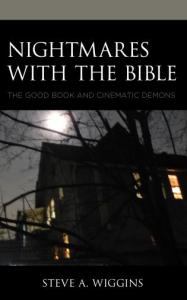
Although some staff members are furloughed, Nightmares with the Bible is still going to press.  Unlike many authors, I realize that Covid-19 has had a stifling effect on publishing, starting with bottlenecking books at printing houses.  Printers (along with publishers) were non-essential businesses and since you have to be physically present to run a printing press, the virus literally, well, stopped the presses.  Many publishers could work remotely, so the projects began piling up before printing houses reopened.  All of this is preamble to saying I am gratified that work with Nightmares is continuing.  Yesterday, however, it led to a nightmare of its own.

One of the reasons I don’t fight awaking early is that it is uninterrupted writing time.  Most of the rest of your time zone is asleep at three a.m., so I can write in peace.  Yesterday, however, I had to divide my manuscript into chapter files and resend it to the publisher.  No problem, right?  Technology, however, has made this once simple task a burden.  I use a Mac, and so my word processor is Pages.  Not only that, but the constant systems upgrades require me to empty space on my hard drive—really, the only stuff I keep on here are my writings and those pictures I snap with my phone.  Still, I had to load my external drive to access the final file sent to the publisher two months back.  With Pages you can’t select material from page-to-page in the thumbnails.  No, you must “physically” go to the start of the chapter, click, scroll to the end of the chapter, and shift-click to highlight and then copy it.  Then you have to open a new file, select a template, and paste.  Save and export as a Word document.  The process took about two hours.


Now, I get up this early to write and do a little reading.  Yesterday I could do neither.  Instead I was cutting and pasting like a manic kindergartener, trying to get my manuscript printed before the second wave comes and shuts everything down again.  Talk about your nightmares!  Technology has made the industry much swifter, no doubt.  When I first began publishing articles you had to send physical printouts through the postal services and await either a rejection, or acceptance, through the mail.  Book manuscripts required large print jobs and keeping duplicates (at least we didn’t have to use carbon paper!).  All I lost was a morning of writing before the work bell rang.  Still, nightmares come in all sizes, some of them quite small.


Contrariwise

When you set out to research a topic, reading is the first step.  These days you can’t possibly keep up with everything that’s written—particularly on the internet with its endless iterations and reiterations, and incipient plagiarism.  Even books often come at you in great numbers, from angles you don’t expect.  Apart from holidays, daily life doesn’t give much time for reading.  So how does one get a handle on H. P. Lovecraft?  I’d been aware of Michel Houellebecq’s essay, H. P. Lovecraft Against the World, Against Life for some time, but as always, finding time is the trick.  This short book, however, is profoundly insightful.  Not a biography and not literary criticism, it is more an appreciation of a misanthrope.  One of the things that Houellebecq makes clear is that Lovecraft was a man out of his time.

Continuing the tradition of French writers appreciating the more macabre of American writers (Poe was celebrated more in France than his native country), Houellebecq pays tribute, but doesn’t fawn over, Lovecraft.  In this series of brief essays he manages to highlight much that might remain hidden to those who know H. P. from either only his writing or from the somewhat small circle of experts on him.  Sometimes it helps to break away from the experts to get a fresh view.  I’ve read quite a lot of Lovecraft’s fiction, and when you do this you tend to think you know the author.  You may or you may not.  To know is to delve.  And delve Houellebecq does.  

Serious reflection is too often considered a luxury.  With the exception of a few privileged occupations, think of what would happen at work if you took to reflecting while on the clock.  Those who dole out the lucre prefer to see signs of busyness—fingers clacking keyboards and numbers being lined up, preferably in the black.  Time thinking, so capitalist thought goes, is time wasted.  If you can sell enough copies of your book to afford a little time off for reflection you can make connections, I presume.  You can see things that those who are too busy cannot.  There are many astute observations in this slim volume.  While not making excuses for Lovecraft’s faults, Houellebecq doesn’t attempt to correct him either.  That’s difficult to do with a person, if the author is correct, who hated life itself.  Books like this also demonstrate that a huge word count isn’t necessary for erudition.  And it is still possible to learn, even with limited time.


Page Count

Research has taken on a different flavor now that I don’t have a teaching post.  I’ve started work on my next book after Nightmares with the Bible, and I’ll reveal more about it eventually, but the topic does require research.  Much of the reading required for both Holy Horror and Nightmares with the Bible was done on the bus.  Those long commuting years weren’t exactly conducive to getting a lot of writing done, but there were hours of built-in reading time each weekday.  My research often involves reading big books and I’m a slow reader.  It’s a valid question why a slow reader would go into editing for a career.  A bit of research on this blog would reveal the answer to that, but the fact remains that big books take a huge amount of time to get through.

Back before any of this was a concern, back when I was a mere seminarian, I had plenty of time for reading.  One summer I volunteered for an archaeological dig at Tel Dor in Israel.  This involved meetings ahead of time and a lot of advanced planning.  One of the questions that naturally got raised was how many books to take.  It was a long flight from Boston to Tel Aviv, and I didn’t have much cash for sightseeing.  Most people, I was told, take James Michener’s The Source.  This is his archaeologist book.  In addition to that, it is a long work, just like most Michener novels, which meant you only had to take one book for the entire trip.  I decided to buy a paperback of Tolstoy’s War and Peace instead.  What a luxury it seemed in those long Israeli days to read such a tale.

In fact, I didn’t finish the book during the flight over, the six weeks at Pardes Hanna, and the return flight.  It took me at least until winter back in Boston.  These days when I take on a big book I generally read smaller ones alongside it.  You see, I have to see some progress as I’m going.  I tend to read nonfiction before work in the morning and fiction after work is done.  My days are literary work sandwiches, I guess.  And the stuff that I need to do around the house doesn’t pause while I indulge in my favorite vice of reading.  Yes, my research has definitely taken on a different flavor since being paid to do it.  What hasn’t changed is the desire to push knowledge forward, one page at a time.


Something Burning?

It’s all Amazon’s fault, really.  Several years ago—I can’t recall how many—they were running a horror movie DVD sale (that’s how long ago!).  I hadn’t yet watched enough movies to write a book on the subject, and most of the movies on offer I hadn’t heard of.  One of them was called Burnt Offerings.  Well, burnt offerings, by definition, come from religious settings.  The DVD was very inexpensive, and so, well.  The movie wasn’t that scary, but it was moody, which is often what I’m really after.  I did wonder, however, at the title.  In one sense it fit the plot, but in other ways it was almost as if something were missing.  A vital clue.  For one thing, the movie was completely secular, nothing I could include in Holy Horror.  

I’ve watched the movie a few times over the years.  There’s something compelling about the story, even though missing something.  A little research revealed that the movie was based on a novel by the same title by Robert Marasco.  Now, when I learn a novel was written in the 1970s, my thoughts turn to used bookstores.  Although the days of getting books there for less than a dollar seems long gone, the fun of browsing makes up for it. I don’t know how many years I looked for it in shops throughout the tri-state area.  Now with the virus, I finally broke down and ordered it from Bookfinder.

My main reason for wanting to read the novel was to find what I’d been missing.  The movie, it turns out, follows the original story very closely, for the most part.  The ending is different, however, and that makes all the difference.  (If you haven’t seen the movie or read the book, there will be spoilers here.)  The Rolfe family decides to move to an estate for the summer to get away from the noise of New York City.  There’s something odd in the house they’re renting, which they sensed even before moving in.  Marian Rolfe, the mother of the family, clearly becomes possessed by the house.  In a diabolical sense.  As her family dies off the house renews itself.  In a scene not in the movie, the regular caretaker stops in for a visit and tells Marian that she has to give her all to keep the house.  Finally, resigned to the death of her loved ones, she asks to have any remaining doubt burned out of her.  Her family will be the burnt offering.  So at last, it makes sense.  And yes, there’s a more religious theme in the book than there is in the movie.


Layers of Brick

If, like me, you can’t see a neighbor’s brickwork without thinking of “A Cask of Amontillado,” then I need not explain why I watch horror films.  I know that as of late some literary scholars have challenged the idea that Edgar Allan Poe wrote horror.  There is now, and always has been, a bias against the genre.  In fact, many would point out that Rod Serling’s Twilight Zone wasn’t really horror, no matter how creepy some of the episodes were.  Some would cast Ray Bradbury into that lot as well, and others would not.  I spend a lot of time pondering this because those of us who enjoy some of what’s called horror are often cast as misfits.  And misfits have a lot in common with monsters.

The connection with religion is a palpable, yet intangible one.  It does seem that religion has its origins in fear and as it branched out it came to have different emphases.  Jesus, for example, apparently stressed love, at least according to the gospel of John.  That religion of love came, eventually, back around to fear.  Calvinism, especially, is suffused with it.  There’s a reason that it is the religion expressed in particularly effective horror.  Apparently they meet similar needs, but psychology is not an exact science, and our tastes in it differ.  Even our interpretations do so.  As the bricklayer puts down row after row of masonry, the thoughts get walled up in days where work prevents serious consideration of the deeper questions.

It’s been years since I’ve read “A Cask of Amontillado.”  The story has stayed with me, however, whether it’s horror or not.  Stories about imprisonment are like that.  The other day a police car stopped outside our house.  We live in a working-class, but descent neighborhood.  From the bits and pieces glimpses out the window revealed, there was a problem with a car that had been parked on the street for quite a while, and that didn’t belong to any of the local residents.  The natural response to seeing that car just outside was fear.  We fear criminals and we fear the police.  We fear what Covid-19 is doing to us, even to those of us who’ve managed not to contract it.  Traditional religion would tell us punishment comes from the Almighty.  These things are all related.  And across the way the bricklayer keeps up his work, row after row.